Feeds:
Posts
Comments

Archive for the ‘Zombies’ Category

  SOUNDTRACK: DAUGHTER-Tiny Desk Concert #313 (October 21, 2013).

Daughter is a quiet folk band (at least in this Tiny Desk Concert) in which two acoustic guitars (Elena Tonra and Igor Haefeli) and one drum (Remi Aguilella) play behind Tonra’s gorgeous, angsty vocals.

For all three of these songs, she sings delicate whispered vocals that are quite lovely, but also quite dark.

Like this line from “Youth” “Most of us are bitter over someone / setting fire to our insides for fun.”  I love the way Haefeli’s guitar harmonics sound like keyboards and how powerful the martial drumming sounds when it comes in.

“Landfill” opens with thudding drums (Mallets instead of sticks) which are louder and bigger and yet still feel gentle.  And yet, as the blurb says: The song is “achingly pretty and melancholy, the track builds to an absolute gut-punch of a line — “I want you so much, but I hate your guts” — that conjures a pitch-perfect mix of gloom, desire and hostility.”

They put out an EP and in 2013 released an album:

the lovely If You Leave, but Daughter was kind enough to resuscitate “Landfill” for this stripped-down performance at the Tiny Desk. As you’ll see and hear, that aforementioned gut-punch is a recurring specialty for the band: In all three of these sad, searing songs, singer Elena Tonra showcases a remarkable gift for coolly but approachably dishing out weary words that resonate and devastate.

Between these two songs, Bob asks if this is an awkward place to play, and she responds, “No, we’re just awkward people.”

For “Tomorrow” there is a beautiful ascending guitar melody and loud drums.  I really like the way the guitars play off of each other–even though they are both acoustic, they sound very different and complement each other nicely.  Like in the wonderful melody at the end.  Despite how pretty the song was, apparently she was unhappy with it saying “a bit ropey, that one.”  I hadn’t heard that before, but evidently it means “unwell…usually alcohol related” so that’s pretty funny.

[READ: August 30, 2016] Science: Ruining Everything Since 1543

Zach Weinersmith writes the daily webcomic Saturday Morning Breakfast Cereal.  I supported the Kickstarter project for his book Religion: Ruining Everything Since 4004 BC and this book was part of my funding level.

I was more interested in the religious comics, but I am tickled by how funny the Science comics are.  Weinersmith knows a lot of science (or at least scientists) and make some really funny jokes about the subject.

The one thing I have to say off the bat is that I don’t love his drawing style.  There’s something about it that I simply can’t get into.  Even after two full books of these drawings, it just never gels for me.  But that’s fine. because I’m here for the jokes.  And they are awesome. (more…)

Read Full Post »

Frank Conniff–Twenty Five Mystery Science Theater 3000 Films That Changed My Life in No Way Whatsoever (2016)

tvfrankSOUNDTRACK: TA-KU & WAFIA-Tiny Desk Concert #577 (November 6, 2016).

Ta-ku & Wafia are Australian, and I knew nothing else about them.  So:

The chemistry between Australian singer-producer Ta-ku and his fellow Aussie singer-songwriter Wafia becomes apparent the instant you hear their voices intertwined in song. On their first collaborative EP, (m)edian, they draw on their individual experiences to touch on subjects like compromise in relationships as they trade verses and harmonize over hollow melodies.  With production characterized by weary low-end rumbles and resonant keys, the two float above the music, playing off each other’s harmonies.

Although the blurb mentions a few bands that the duo sounds like I couldn’t help thinking they sound The xx (although a bit poppier).

“Treading Water” especially sounds like The xx.  Both of their voices sound really close to that band (although Wafia’s high notes and r&b inclinations do impact that somewhat).  It’s funny that they are just sitting there with their eyes closed, hands folded singing gently.

“Me in the Middle” is another pretty, simple keyboard song with depth in the lyrics and vocals.

Introducing, “Love Somebody,” she says its their favorite on their EP and he interjects Go but it now, which makes her giggle.  Her voice is really quite lovely.  I could see them hitting big both in pop circles and in some alternative circles if they market themselves well.

[READ: November 10, 2016] 25 MST3K Films that Changed My Life in No Way Whatsoever

As you might guess from the title, Frank Conniff was involved with MST3K.  He was TV’s Frank and, as we learn from this book, he was the guy who was forced to watch every movie first and decide whether it could be used for the show.  This “job” was created because they had watched a bit of Sidehackers and decided it would be fun to use.  So Comedy Central bought the rights (“They paid in the high two figures”) and then discovered that there was a brutal rape scene (“don’t know why I need to cal it a ‘brutal’ rape scene any kind of rape ,loud or quiet, violent or Cosby-style, is brutal”) that would sure be hard to joke about (they edited it out for the show which “had a minimal effect on the overall mediocrity of the project.”

The book opens with an FBI warning like the videotapes except for this book it stands for Federal Bureau of Incoherence because the document contains “many pop culture references that are obscure, out of date, annoying and of no practical use to anyone.”   So each chapter goes through and explains these obscure references for us all. (more…)

Read Full Post »

 socks kronosSOUNDTRACK: KRONOS QUARTET-Tiny Desk Concert #322 (November 25, 2013).

2013 was the 40th anniversary of Kronos Quartet.  I first heard of them about eight years after they started with their cool arrangement of “Purple Haze.”  And then I learned that they were like a sponge, soaking up and playing music from all over the world: In just one year they released albums with tango, songs by South African composers, Polish composers, jazz musicians and so much more.

I have many of their releases, although I realized I more or less stopped listening to new stuff from them around the turn of the century (since when they have released some 16 albums!).

Well, amazingly, the Quartet is still the same original players (except for the cellist–the cello is like Kronos’ drummer as they seem to replace her every couple of years).

They play three pieces here and the three range the gamut from dark and broody to rather sweet to quirky.  In other words, typical Kronos.

For more info:

The musicians —  David Harrington (violin) and longtime members John Sherba (violin) and Hank Dutt (viola) and new (as of 2013) cellist Sunny Yang — could reminisce over more than 800 new works and arrangements they’ve commissioned in 40 years. But instead, the new-music train pushes ever onward to new territories. They remain a living, breathing world-heritage site for music.

Now in the midst of its 40th-anniversary tour, Kronos brings to this Tiny Desk Concert a new arrangement, a work from a new album and, for Kronos, something of a chestnut, a piece the group recorded a whopping five years ago.

“”Aheym” (Yiddish for “homeward”) was written for Kronos by Bryce Dessner; a member of the Brooklyn rock band The National, he studied composition at Yale. The music thrives on nervous energy, pulsating with strumming and spiccato (bouncing the bow on strings) while building to a tremendous fever.”

I love this piece. It is intense and dramatic with its 4-3-3 bowing from all four members.  There’s an interesting cello melody with pizzicato strings from the rest.  The overall melody seems somewhat circular with different instruments taking on different leads.  But this song also plays with some interesting bowing techniques.  In addition to the spiccato (about 4 minutes in), the players drag the bow for momentary scraping and scratching sounds.

Another wonderfully dramatic moment comes at 7 minutes where each musician takes a turn bowing his or her note while the violin plays a super fast series of notes.  The song builds and build in dramatic until it gets to about nine and  half minutes and it reaches its powerful ending.

“Lullaby,” opens with plucked cello notes and strummed viola.  “It is a traditional song with Afro-Persian roots (from the group’s Eastern-flavored 2009 album Floodplain), [and] is woven from different cloth altogether. Colorful tones that lay between our Western pitches are threaded through the music, anchored by a gorgeous solo from violist Dutt; his contribution takes on the warm and weathered sound of a grandmother singing to a child.”  It is slow and moody and beautiful.

Harrington introduces the final piece by saying it’s by a performer that no one had heard of–including, until recently, even himself.

“Kronos caps off the concert with another hairpin turn, this time to a fresh arrangement of “Last Kind Words,” a little-known blues song from around 1930, recorded by singer and guitarist Geeshie Wiley. In Jacob Garchik’s exuberant arrangement (which Kronos premiered this fall), interlocking strums and plucks provide a kind of rhythm section, while Harrington’s violin stands in for the now-forgotten blues singer.”

There’s lots of plucked notes from everyone–including plucked bent note on the viola which gives it a real “early” guitar sound.  While I don’t know what Geeshie sounded like, so I can’t compare the violin to her vocal, the whole thing sounds great together.  In fact the whole thing is unlike any string quartet I’ve heard–so different and wonderful.

I’m going to have to bust out so Kronos CDs.

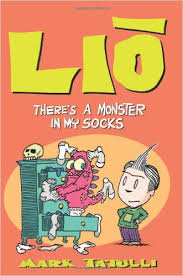
[READ: September 10, 2016] There’s a Monster in My Socks

I’ve been quite puzzled about the publication history of the Liō books.  And this just adds another layer of confusion.  This book covers the exact same time period as Happiness is a Squishy Cephalopod which was published in 2007.  The difference is that Cephalopod placed all of the strips in order, while this one seems to move things around quite a bit (the thinner format also means that it can’t quite handle the single panel strips very well.   But more egregious is that this volume (remember, the one printed after the previous one) prints the Sunday color strips in black and white.

The book also leaves some of the strips out.  It covers the date range from May 15, 2006 – Feb 16, 2007 (Cephaolopod went to May 23), but while it has the Feb 14 strip, it does not have the Feb 15 strip.  Weird.

So, basically this is an inferior version of the same book, but the publishers presumably wanted the books in this more friendly size (or some other nefarious reason).

I’ll include the review of Cephalopod below.

And, here’s the current list of existing Liō books. It’s a shame that there are years and years of strips thus far uncollected. (more…)

Read Full Post »

melvin3-cover_SOUNDTRACKCREOLE CHOIR OF CUBA-Tiny Desk Concert #192 (February 6, 2012).

creoleThis concert was something of a surprise for me.  The blurb seems to think that it should be a surprise, especially if you are familiar with Cuban music.  I’m not, so I’m even more surprised.

Just when you think you know Cuban music, along comes the Creole Choir of Cuba. This group sprang from the ashes of Grupo Vocal Desandann, a small vocal outfit created in the late 1990s to celebrate traces of Haitian culture in eastern Cuba.  That history dates back to the late 18th century, when slaves from Haiti were delivered to Cuba to harvest sugarcane after successful slave revolts in Haiti. A long-lost culture was revitalized by the group through music performed largely a cappella and entirely in Haitian Creole.

As with other forms of music associated with the African diaspora, The Creole Choir of Cuba’s work resonates with songs of resistance and celebration of community life, which offered hope and relief from the bitter realities of slavery.

The choir sings three pieces.  And it’s cool the way it is a choir for certain, but that they throw elements into it that are not normally associated with choirs.  For “Marasa Elu” their voices are beautiful, with a great bass voice underpinning the soaring lead voice.  It’s fairly astonishing that she starts to cry at the end of the song (whether fake or not it’s hard to tell).

“Ayiti Krye” has a different lead singer with a very different voice.–although the rest of the choir still sounds great with her.  It comes as quite a surprise about half way through the song when the drums and percussion come in–it really changes the feel of the song and of this choir.  Suddenly the piece is a more dancey song, especially as the percussion picks up speed.  A guy with a wonderfully raspy voice takes over lead.  And the rest of the group really starts to get into it–dancing and singing a beautiful backing vocal that sounds much less like a choir and more like a Cuban dance song.

For “Lumane Casimir” the first singer is back.  There are quiet congas keeping the beat.  While the backing vocals sound a lot like a choir, the lead singer sounds more like a conventional singer.  By the end, they are having a ton of fun and she invites two of the audience members to dance with her (including Felix, the host).  And as any music like this should, the end of the song introduces a whistle keeping a beat.

This is a very different kind of choir–at once sacred and fun.

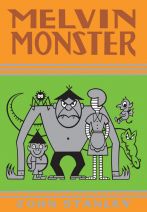
[READ: January 22, 2016] Melvin Monster Volume 3

Last year I really enjoyed the Moomin books which Drawn & Quarterly reprinted.  Another artist that D+Q has reprinted is John Stanley.  And they have made the appropriately titled The John Stanley Collection.  This collection is somewhat confusingly labelled because there are collections of different characters (Nancy, Tubby, Melvin) each with multiple volumes, and it seems like maybe they are supposed to go in a certain order.  And really it’s not that hard to figure out once you know the way it works, but it’s a but of puzzle if you see only a few books on the shelf at the library.

These books were originally printed as comic books.  This book contains the final Melvin Monster comics.  The title page says “Collected from the issues seven to nine of the Dell comic book series”  And D+Q has retained that look perfectly.  Even the paper that they have used for this beautiful book looks like comic book paper (although it is very heavy stock).

In the first issue of the book, Baddy tries to get Melvin a job as a babysitter.  The baby is actually a huge giant which leads to all kinds of amusing scenes of Melvin fleeing from the giant.  Although Stanley was never concerned about being PC, the fact that he set his strip in Monsterville certainly allowed him to get a way with a lot of rather un-PC dialogue.

I’m not sure why Stanley only made nine issues (if it was Dell’s decision or his), but there’s a lot of repetition in the premises.  Melvin trying to go to the school and Ms McGargoyle not allowing him in is a very common joke.  Although in fairness, she does think up many new ways to keep Melvin away.

Little Horror is always a fun character.  In this one she does a spell which turns Melvin into a half frog.

There’s a joke about Cleopatra, the family’s alligator, trying to eat him. And the one with Damon constantly giving him bad advice would be funny whether they were monsters or not.

“Blackout” is an interesting strip as it shows Baddy getting ready to watch wrestling –“the first four rows of human bean lady fans armed with cement filled handbags an shish kabob skewers.”

Book 8 opens with “Supermonster” in which a huge monster living nearby is getting ready to destroy Monsterville.  And it’s up to Melvin to help out.

I enjoyed seeing him integrating snow into a few of these strips (although not sequentially in any way).  There’s a good one that involves digging to the school.  There’s a short one that involves Little Horror breaking ice with her high-pitched shriek and another short one with a giant snowball (that I don’t quite get).

Speaking of un-PC, there’s an entire story that involves a Native American totem pole monster–I guess since it’s a monster its okay, although the way it talks is pretty awful.

Book 9 starts with a monster that frightens Baddy.  I enjoy that Baddy is actually quite a coward despite his size and demeanor).

Little Horror returns with a broken magic wand which is pretty fun.  The punchline where a tiny Baddy is afraid of Mummy is outstanding .

I also really enjoyed the way that McGargoyle got rid of Melvin in the final schoolhouse joke–by having him learn C-A-T and B-A-T and then telling him he graduated.  Of course Melvin redefines high school for us all.

The final strip in the book is the one I knew from the D&Q 25th anniversary book.  In it, Melvin drinks a potion that turns him into a normal-looking boy. Which would of course freak out the whole family.

I also like that the final pages of this book include all of the original covers from the Dell comics (12 cents each!)

I’m fascinated at the publishing schedule of these issues

  • Apr-Jun
  • Jul-Sept
  • October
  • December
  • July
  • October
  • January
  • Apr
  • May
  • August

Perhaps the most interesting thing of all though is his biography which states that John Stanley “bitterly left comics sometime in the late 1960s never to return.”  Woah, I want to hear more about that!

Maybe when I read the Nancy books.

Read Full Post »

melvin2-cover_SOUNDTRACK: GLENN JONES-Tiny Desk Concert #188 (January 23, 2012).

glennI’d never heard of Glenn Jones.  The blurb says that he only recently took up the banjo (which I assume means he has played the guitar for a long time?).  Also, how funny is it  that there are two banjo players in a row.

Jones plays 3 instrumental pieces  “Tinka Marie” is a very pretty banjo instrumental (although I can’t help but feel that his high string is slightly out of tune—I find it a little jarring throughout the song).  The banjo also sounds very compressed or tight or something.  It’s unusual especially when compared to the expansive sound of the guitar in the other two songs.

Before “The Great Pacific Northwest,” he says that if he plays it right, “Mt. Rainier should burst right through the floor of this room.” He has a very interesting playing style.  He has capoed the three bass strings, but not the higher strings.  He then plays chords up and down the fretboard (leaving the capo where it is).  The beginning of this song is a series of slowly played chords, which allow each individual string to sound.  Then it picks up as he begins playing fast finger-picked (with a  thumb pick for the bass strings) melodies.

“Of Its Own Kind” continue with that half capo style and finger picking.  It has a really lovely melody, as do all three.

[READ: January 17, 2016] Melvin Monster Volume 2

Last year I really enjoyed the Moomin books which Drawn & Quarterly reprinted.  Another artist that D+Q has reprinted is John Stanley.  And they have made the appropriately titled The John Stanley Collection.  This collection is somewhat confusingly labelled because there are collections of different characters (Nancy, Tubby, Melvin) each with multiple volumes, and it seems like maybe they are supposed to go in a certain order.  And really it’s not that hard to figure out once you know the way it works, but it’s a but of puzzle if you see only a few books on the shelf at the library.

These books were originally printed as comic books.  The title page says “Collected from the issues four to six of the Dell comic book series”  And D+Q has retained that look perfectly.  Even the paper that they have used for this beautiful book looks like comic book paper (although it is very heavy stock).   (more…)

Read Full Post »

melvin1-cover_SOUNDTRACK: DEBASHISH BHATTACHARYA-Tiny Desk Concert #319 (November 12, 2013).

I like how the blurb for this Concert begins:

You’ve probably never seen or heard an instrument like this. The Hindustani slide guitar is the creation of Debashish Bhattacharya, whose creation pairs his first love — a Hawaiian lap steel guitar, a gift from his father when he was only 3 — and the sounds of India. You can see the similarities to a lap steel guitar, as Bhattacharya lays the guitar across his legs, sliding a metal bar to create the fluid, almost vocal melodies. The additional strings (and lack of frets) allow him to slide easily between notes, in the process creating a sound that resonates and drones while remaining attuned to his Calcutta home.

It’s a pretty cool instrument and does evoke Indian sounds without necessarily sounding entirely Indian.

His music incorporates a good deal of North Indian (Hindustani) classical music, but you can also hear the blues pouring out from this stunning creation. I first met Bhattacharya 17 years ago when he was touring with other great slide guitarists, Bob Brozman and Martin Simpson. In those 17 years, his music has become even more astonishing, and his instrument refined even further. This trio includes his daughter (Anandi Bhattacharya) on vocals and his brother (Subhasis Bhattacharjee) on tabla.

He plays two lengthy pieces.  It’s clear that the three of them are totally in synch with each other.  He often plays off of his daughter as she sings and he follows her (or vice versa).  He is constantly kepimg an eye om her to see what will happen next.  It’s cool watching him play the drones throughout as well.

“Raaga Khamaj” She sings beautifully.  I love the way the little finger taps can create such a great expressive sound on the tabla, but then he really wails later.  Two thirds of the way through the song almost stops entirely and then he switches to a really funky riff–its a great transition.  At times he’s almost scratching the strings making even more interesting sounds.

There is some tuning between songs and then “O My Beloved!/Pillusion” begins.  It’s more mellow overall, goalmouth the middle has an absolutely wild guitar solo which has him sliding his slide all over the place.  It’s pretty wild

The current album and some of what’s played here today can be found on two different records, the first with guitarist John McLaughlin and Dobro master Jerry Douglas (titled Beyond the Ragasphere) and the second with his brother and daughter (titled Madeira: If Music Could Intoxicate). These are brilliant recordings — and a good place to start exploring more from this unique artist after his intoxicating Tiny Desk Concert is done causing your jaw to drop.

I really enjoyed this set a lot and would love to check out his studio records to see what those sound like.

[READ: January 19, 2016] Melvin Monster Volume 1

February starts children’s month here.  Partially it’s because we can all use the good messages and kindness that children’s books offer.  But also because some of the books that I’m going to post about have been sitting in queue for over a year.  So let them see the light of day.

Last year I really enjoyed the Moomin books which Drawn & Quarterly reprinted.  Another artist that D+Q has reprinted is John Stanley.  And they have made the appropriately titled The John Stanley Collection.  This collection is somewhat confusingly labelled because there are collections of different characters (Nancy, Tubby, Melvin) each with multiple volumes, and it seems like maybe they are supposed to go in a certain order.  And really it’s not that hard to figure out once you know the way it works, but it’s a but of puzzle if you see only a few books on the shelf at the library.

These books were originally printed as comic books.  The title page says “Collected from the first three issues of the Dell comic book series”  And D+Q has retained that look perfectly.  Even the paper that they have used for this beautiful book looks like comic book paper (although it is very heavy stock).

So the premise of this strip is that Melvin Monster is a nice, good boy.  But he is raised by literal monsters.  Melvin wants to do what normal human kids do, but his parents Baddy and Mummy want him to be more disrespectful and monstrous.

The characters are Melvin Monster, Baddy (his father), Mummy (his mom) and Cleopatra their pet crocodile who wants to eat Melvin.  There are a few other recurring characters as well, like the witch and

Even though these books were first, I read them second.  And I have to say I enjoyed the long form of these stories a bit more than the short stories of the later issues.  Although interestingly the very first strips are short and don’t establish the character at all. They are just thrown right on to the page.  Well, it does actually establish that Melvin is a disappointment to his Baddy because he wants to go to school (his father played hooky for 8 years straight).

The next strip sees him going to school and other monsters trying to beat him up for wanting to go.  That’s when his demon guardian Damon shows up, although he calls him Medwick rather than Melvin–this mixed up identity results in some good jokes later on.  Ultimately Melvin winds up accidentally blowing up the school which makes his parents very proud.

The next strip continues right where the previous one left off, with Melvin sailing through the air after the explosion.  He winds up in Human Being Land where everybody treats him very badly–and he thinks it’s so nice that they want him to feel at home.

The next book focuses on the door in the cellar. His parents get mad at him and send him to the cellar.  They never go there, but milkmen and mailmen love it so much they have never come out.   When Melvin is down there he opens a secret door.  The path leads him to the subway which is pretty funny.  Incidentally in this book it is called Humanbeansville.  Through his good intentions, he breaks up a crime ring and flies home

I enjoyed that the following story introduces us to Little Horror but also continues with Baddy’s adventures in the basement hole.

Some funny scenes include him being captured by a zoo, where a specialist on monsters comes to investigate him.

In the third book Melvin gets in more trouble and Damon is there to rescue him (with a little pain as of course) from a quicksand trap.

He also manages to not die from the witch’s apples–one good one spoils the bad ones.  And then there is short strip about him breaking a window, which is deemed a good bad deed.

The final long story is a weird one about the giant rat who lives in their walls and has opened up a 4 star French restaurant (I kid you not).

There’s a few more short ones and then the final strip is about a rock that has been teetering in place for centuries.  Of course, Melvin bumps into it and then has to think fast.

I’m not sure how people reacted to these strips when they first came out–if they were considered “bad” or whatever, but it’s funny how sweet and innocent the bad behavior ultimately is.

For ease of searching, I include: Bela Bartok

Read Full Post »

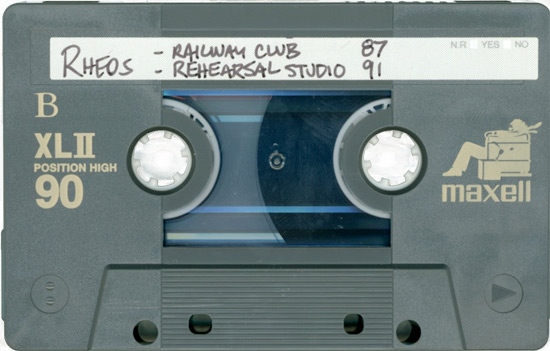
liofriends SOUNDTRACK: RHEOSTATICS-Railway Club, Vancouver, BC (November 1987).

RailwayClub87-PROD91It’s pretty impressive that this show (ostensibly from the same month as the previous show) has such a different setlist.  Between the two shows they play 22 songs and only four are repeated.  And this time five of the songs come from their debut album, Greatest Hits.

This tape begins with a recording of “Indian Arrow” by the 13 Engines.  It sounds very different from the other songs on the tape–the audience is very loud and you can hear a woman say “I wanna sing this one” (!).  I know this song from a Martin Tielli solo tour (and indeed, he sounds pretty much solo here–although there is a piano, too).

The rest of the tape all has the same audio quality but sounds different from the first song.  “Crescent Moon” begins mid-song (as if it was recorded over by “Indian Arrow”).   “Sad Sad World” is more upbeat than the title suggests with a “vocal solo” introduced with Dave and Tim chanting M-R-T-I-N in time with the music.  An upbeat “Ditch Pigs” leads to some silly banter during the guitar solo.  “Churches and Schools” sounds a lot like Talking Heads.  “Bridge Came Tumbling Down” is a Stompin’ Tom Connors song–they really had been playing him since forever.  Then they play a good version of “Higher and Higher” (from Greatest Hits).

It’s their last night in Vancouver, apparently which leads to a lengthy talk about he next song–a funky version of “Good on the Uptake” with lots of screaming at the end (from Tim).

The band plays the full version of “The Ballad of Wendell Clark” (with a some jokes about “Joel” whoever that is).  It’s rollicking and stomping and Martin starts playing “O Canada” as part of the solo.  Bidini stops the song and asks him to play it again, so Martin plays it on a good echoed effect (and Dave Clark shouts “alright Joel!”)  There’s some inappropriate jokes before Martin launches into a delicate version of The Beatles’ “Across the Universe-“-not the best version I’ve heard but still nice.

The final song is a romping stompin “PROD”–the only song The Rheostatics play in G#.  It has a fun shambolic end and it ends the set with them saying they’ll be back to play some Menudo tunes after a short break (which we never do hear).

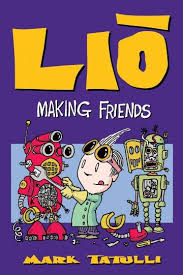
[READ: January 15, 2016] Making Friends

It’s unsettling to me that the Liō books come in different shapes.  This one is even hardcover!  The contents of these stories are not unsettling to me though, even if they are to some readers (looking online, you can find gripes).

Liō continues to be a strange kid who loves zombies and squids and spiders and playing pranks.  This is his latest book (and I just confirmed to see that he is still publishing daily, so a new book must be coming soon, right?).

Tatulli still has some great gags.  And this format book has some of the strips in color. (more…)

Read Full Post »

lioSOUNDTRACK: RHEOSTATICS-El Mocambo, Toronto ON (November 1987).

ElMo-Nov1987After re-listening to some of the Rheostatics most recent shows, I checked the Rheostatics Live site and found out that he has added some really old shows.  This show is the oldest show on the site, dating back to 1987.  A brief Rheos history shows that in the earlier incarnation, it was Dave Bidini, Tim Vesely and Dave Clark.  They were joined by the Trans Canada Soul Patrol and played mostly R&B and funk.  Around 1985 the Soul Patrol left and Martin Tielli joined.  Around the time of this show, they had released Greatest Hits.  And then they broke up (circa 1988).  Then they reformed in 1991 with an entirely different sound.

So this is from what I guess you’d call he Mach II era: no Soul Patrol but before the breakup.  Interestingly, only two songs from this how appeared on their debut album, although many appeared on earlier demos.

They play 11 songs, including what I assume is an improvised rap from Dave Clark (the really silly one of the band).  And the songs are dominated by a smooth guitar sound and often times a funky bass.  Perhaps the most amazing thing about this set is the prominence of Tim.  He sings many of the songs and Dave includes him in many jokes.  Martin is almost non-existent.

“National Pride” dates back to 1983 and starts as a kind of goofy rap song but then turns into the funky version from the demo.  Martin Tielli also released a solo song called “National Pride” which is nothing like this.  They follow this with the “Greensprouts Theme Song” (which they played at the AGO almost 30 years after this show).  Dave Clark calls it the “silliest song ever written,” although in the years hence they have made a few challenges to that claim.

“Good on the Uptake” is a song I’ve heard in a few places before.  Tim sings lead and there’s a kind of funky bass line with lots of guitar harmonics.  I think Martin is singing backup (and probably playing the harmonics).

Tim breaks a string and Dave Clark shouts, “This song is called Rheostatics learn how to string their guitar.”  With a broken string they play an impromptu version of “Red Dog Ray” taught to them by Reverend Ken and the Lost Followers “about the beer strike in 1983.  We were all pissed off because we had to drink Old Milwaukee and Rolling Rock and all that shit.”  This song has come up in their sets in the early 2000s.

It segues right into “Ditch Pigs” from Greatest Hits and sung by Martin.  The middle section devolves into a chant of “I want an egg salad sandwich and a glass of Coke.”

For “Four Upright Walls” Bidini introduces David Clark as the Poet Laureate of Etobicoke.  This is a rap of sorts in which the band does response to Dave’s rap (with all kinds of crazy sound effects and even some beatboxing (!)).

“Crystal Soup” is very much a Tim song–it sounds a lot like a song he would write now–there’s a surprise guitar riff in the middle of the verses that sounds a bit like Rush.  At the end of the song Dave introduces “Mr. Nigel Tufnel,” although I’m not sure to whom he is referring.  “Sue’s Mining Song” (also sung by Tim) has a kind Rush feel although the lyrics are very un-Rush (“woman,” “girl” and a line about “buzzards on your Steely Dan”).  It also features Tim screaming a high note!  It’s a pretty heavy song (especially at the end).

It’s funny that they follow-up with “a nice song,” Martin’s sung “Crescent Moon” a very, very new wavey song that Bidini wrote, and which leads of Greatest Hits.  They follow with a fun and fast rocking “People’s Republic of Dave” in which Dave encourages Tim to make silly faces.  And Tim growls that he wishes his name was Dave.  This seems like a great show ender, but they’ve got one more song.

“Chemical World,” has a kind of discoey guitar opening and lots of slap bass.

[READ: January 5, 2016] Zombies Need Love Too

I prefer to read series like this in order, but sometimes you can only get the books that you can get (and you don’t get upset).  For reasons I don’t understand, my library only had the first two books (which were also collected in Liō’s Astonishing Tales which they also have) and the two most recent books.  There’s maybe two books in between, as far as I can tell.

The good thing is that there’s not a lot of forward narrative in these stories–except perhaps for the new pets that Liō acquires.

So after four years what is Tatulli writing about?  Well, largely the same stuff, which is fine with me. (more…)

Read Full Post »

silentSOUNDTRACK: HOSPITAL SHIPS-Tiny Desk Concert #177 (November 23, 2011).

hospital shipsHospital Ships is a band created by Jordan Geiger, who was in the band Shearwater, among others. In 2011 he released his second album as Hospital Ships.  The blurb describes the album as “packed with poppy folk songs and brash rockers enhanced with instrumental flourishes and bursts of guitar feedback,” but for this recording, they strip everything down to the basics: a guitar, banjo, ukulele and a drum with a towel over it to muffle the sound.

Geiger has a rather high-pitched, delicate, almost talking-singing voice and his songs are rather pretty.  The band plays 3 songs in just over ten minutes.  The first one, “Phantom Limb,” (once my lover, now my friend, you are my phantom limb) has a recurring motif of them saying/singing “ha ha” which is rather catchy.

“Carry On,” features a four-letter word (technically a seven letter word), which might be one of the first times on a Tiny Desk Concert that such a word is uttered.  It’s especially funny given how sweet the band sounds.  The sentiment of the song is nice though: “To all the women I’ve loved, When I was with you I would say I was better off….  And when I’m gone, carry on, carry on.”  There were harmonies in the first song, but they are more prominent in this one (three part) and are quite nice.  The banjo player also does a whistling solo.

“Let Me In” made me laugh because he uses the word baby a lot (which Ben Folds said in his Tiny Desk that he has never said in real life, so why would he put in it a song?).  But this song is very gentle and sweet–just Geiger on his guitar singing “baby, let me in.”

Geiger’s voice reminds me of a few different people–Ben Gibbard from Death Cab for Cutie especially on the final track; perhaps the Mountain Goats or the Weakerthans.  And his songwriting is very good.

[READ: December 26, 2015] Silent But Deadly

I really enjoyed the first Liō collection, and was pretty excited that I could find the second collection so quickly (my library doesn’t have any more collections for some reason, so I’ll have to track the rest down elsewhere).  This book collects the strips from February 25, 2007 – December 2, 2007.

Not much has changed from that book to this one, but I think Tatulli’s comic chops have gotten even better.

The strip won me over immediately with the first one in the book. Lio draws a monster and it comes to life.  He looks at the marker and it says “magic marker” and he gets a big grin and goes back to work.  So simple yet so funny.

It is that big grin–wide open-mouthed just unfettered mischievous delight that occurs in nearly every strip. (more…)

Read Full Post »

lio1 SOUNDTRACK: JOE HENRY-Tiny Desk Concert #176 (November 21, 2011).

joe henryI had never heard of Joe Henry, so imagine my surprise to find out that he was releasing his 12th album in 2011.  For this Tiny Desk, it’s just him at a stool playing his guitar.  He has a very easy vibe, telling stories between songs and playing them with very little fuss.

He opens the show by saying this is, “not exactly like Woody Guthrie playing for the union members but you are working people.”

He plays four songs, “Sticks and Stones,” After the War,” “Odetta” and “Piano Furnace.”

Between the first two songs, he says he first became aware of Tiny Desk Concerts when his friend Vic Chesnutt was on the show (amusingly, he was the second person on the show).  He says he has a song on his new record about Chesnutt (Chesnutt had recently died).  He doesn’t play it though.  At first it seems like he might not be allowed to play it, but then it seems like maybe he just doesn’t get to it.

Rather he plays “After the War” where his guitar sounds like it has an incredible echo on it.  That echo is also present on the third song.  After which Bob asks him about his guitar.

Joe says he’s had the guitar for 6 years.  But the guitar dates back to 1932.  He says that he heard things differently with this guitar.  It’s got a smaller body and was actually sold as a budget guitar by Gibson (for $19 in 1932).  He also jokes that it’s black and looks a bit like a World Wrestling Federation belt.

Then someone asks him about Sam Phillips.  Joe says he sold her husband a guitar about 20 years ago.  She and her husband have split and Sam got the guitar and has been playing only that guitar for the last 20 years.  He says that he loves that she doesn’t plug in her guitar.  She plays into a microphone where you can hear the whole guitar and which makes the other players lean in to hear her.

I love the chords he plays in the final song, “Piano Furnace,” even if I don’t know what the song is about.  Henry’s voice is familiar.  I think he sounds a bit like a number of different singers.  And overall, nothing really stands out in his performance, except that everything sounds great and hiss songwriting is really solid.  That’s not a bad thing.

[READ: December 20, 2015] Happiness is a Squishy Cephalopod

Mark Tatulli is the author of the Desmond books.  I liked the stories, but I didn’t love the drawing style so much.  Imagine my surprise to find out that Tatulli has been drawing comics featuring this little boy Liō since 2006 (going forward, I’m leaving off that line over the o, because it’s a real pain).

And even more surprising is that I like the drawing style in the comic quite a bit–it is slightly refined over the Desmond books and is all the better for it.

I am also really surprised to find out that this strip appeared in newspapers across the country.  I’ve certainly never heard of it (but then I don’t read newspapers anymore, either).

So Lio is strip about a boy named Lio.  Lio is a dark, dark kid.  He has a pet squid, he loves monsters and he’s delighted by chaos. (more…)

Read Full Post »

« Newer Posts - Older Posts »