Feeds:
Posts
Comments

Archive for the ‘War’ Category

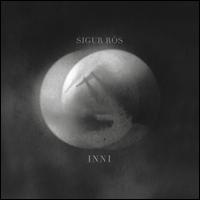
SOUNDTRACK: SIGUR RÓS-Inni (2011).

I’ve said before that Sigur Rós was one of my favorite live shows ever.  They created an amazing atmosphere that went beyond the music and the visuals.  It set the bar very very high.

So here is their first official live album and it does not disappoint.  It clearly cannot live up to the live experience (there is so much to see after all), but it really conveys just how amazing these guys can sound live.

Sigur Rós feels like they should only be a studio band–they are so atmospheric, so ethereal, that it doesn’t seem like it should translate live.  But they do, in fact , it brings a new energy to the music.  And the fact that Jonsi can easily hit those unearthly notes just blows my mind.

I’m not sure whether to say that Sigur Rós have hits or not, but this is like a best of playlist from all of their albums.  From their “debut” Ágætis Byrjun, we get the ten minute opener “Svefn-G-Englar.”  Although the songs all feel long, they run the gamut from two to three minutes through eight and nine up to fifteen.  They also play the awesome “Ný batterí” a few songs later.

There’s a number of songs from Takk… “Glósóli,” “Hoppípolla,” “Með Blóðnasir,” and “Sæglópur.”  There’s a couple of songs from () as well (of course, since they were untitled it takes a bit of work to know that . “E-bow” ends disc one and the concert ends with the glorious 15 minute “Popplagið”

From Með suð í eyrum við spilum endalaust, we don’t get “Gobbeldygook,” their sort of hit, but we do get “Inní Mér Syngur Vitleysingur,” “Fljótavík,” “Festival,” “Við spilum endalaust” and “All Alright”

The set also includes “Hafsól,” a B-side of “Hoppípolla” (which was a remake of a song of their real debut Von).  The best example of how Sigur Rós is not just wispy music comes in “Hafsól.”  After a few minutes of their atmospheric stuff, the drums kick in and the song becomes incredibly loud and chaotic with crashing cymbals and grinding guitars and feedback.  It’s amazing.  That it ends with a tin whistle solo just highlights the what the band is willing to put into just one song.

“Popplagið” closes out the concert with more of that dynamic.  At 15 minutes, it takes a while to get there, but somehow the drums feel more grounded.  And at the 6 and a half-minute mark when the drums really kick in and guitars get noisy and raw, it’s an unbelievable moment.  The song turns tense and intense and doesn’t let up for the rest of the track.

The encore is an unreleased track called “Lúppulagid.”  It is a slow, relaxing kind of track (it plays over the credits of the DVD).  Yes, there’s a DVD that comes with the two disc set.  I have not yet watched the DVD, but I’m pretty psyched to check it out.

This disc can’t convey the magic that is Sigur Rós live, but it really shows what they are capable of.

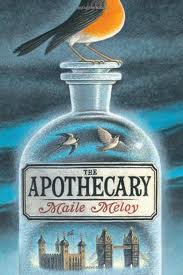
[READ: February 2, 2102] The Apothecary

Maile Meloy has written some of my favorite books (novels and short stories).  She is an excellent writer with a wonderful sense of reality–I’ve described her as unsentimental: her characters are typically downtrodden and not likely to follow flights of fancy.

And that’s just one reason why this book is so surprising–it is about magic!  It’s also surprising because its written as a YA book (the protagonists are fourteen).  And finally, it’s surprising because it is set in England, and previously, Meloy had been a small town America kind of writer (as far as I remember, anyhow).

Although I found the opening a little slow going (more on that in a minute), by about the third or fourth chapter I was totally hooked on this fantastic story.

The book is set just after WWII.  The main character (and narrator) Janie and her family live in Hollywood.  Her mom and dad are both television writers who are being hunted as Communists.  They tell her that they must flee for London.  (This was told briskly, and I wonder if teens know about the Communist trials in the 50s).

They move to London (where they have jobs set up as BBC writers) and learn to cope with the move from warm, sunny, prosperous Hollywood to cold, gray and still-under-rationing London.

One problem I had with the beginning (in addition to the Communist part) was that Janie talks a lot about Katherine Hepburn–walking like her, being strong like her.  Both of these things seemed like they maybe weren’t explained enough for the intended audience.  Perhaps I’m not giving young readers enough credit, but I was very distracted thinking, would a teenager want to read this?  I mean I barely know Katherine Hepburn as a young beauty.  The other problem I had was that the kids felt too modern to me.  Or maybe not modern so much as out of time.  It doesn’t really feel like the 50s.  It’s not really a problem, but every once in a while I had to remind myself that it was set in the 50 at the height of the nuclear scare.

Of course, once Janie gets to school, those concerns evaporate.  Janie goes to a fancy London school–they wear uniforms and learn Latin)–I guess it is timeless.  She is immediately introduced to Sarah Pennington, a very very rich girl (she has a butler).  What I liked is that even though Janie is different and from California and Meloy shows that they are different, she doesn’t exploit these differences.  She doesn’t make it a clique story between Janie and Sarah.

Things are dire in post-war London.  It is cold all the time and you need to put pennies in the wall to get the heat to come on–this is why people from England like hot water bottles so much!  So Janie and her dad go down to the apothecary to get hot water bottles and pennies.  When the apothecary hears that they are American, he offers Janie some homesickness medicine.  Janie and her dad don’t believe it will work but she takes some anyhow.  And she seems to feel a bit better.

Soon after this, Janie learns that the apothecary’s son is a boy in her class named Benjamin.  In school, Benjamin stood up to the lunch lady when she insisted that everyone “duck and cover” when the air raid siren went off.  He’s nobody’s fool, he knows how dangerous the Bomb can be.

Janie is surprised that Benjamin and the apothecary are related.  The apothecary is nice and mild-mannered whereas Benjamin is strong-willed.  And, it turns out that Benjamin wants nothing to do with his father’s business–even though the Society of Apothecaries has paid for his education.  He wants to be a spy. (more…)

Read Full Post »

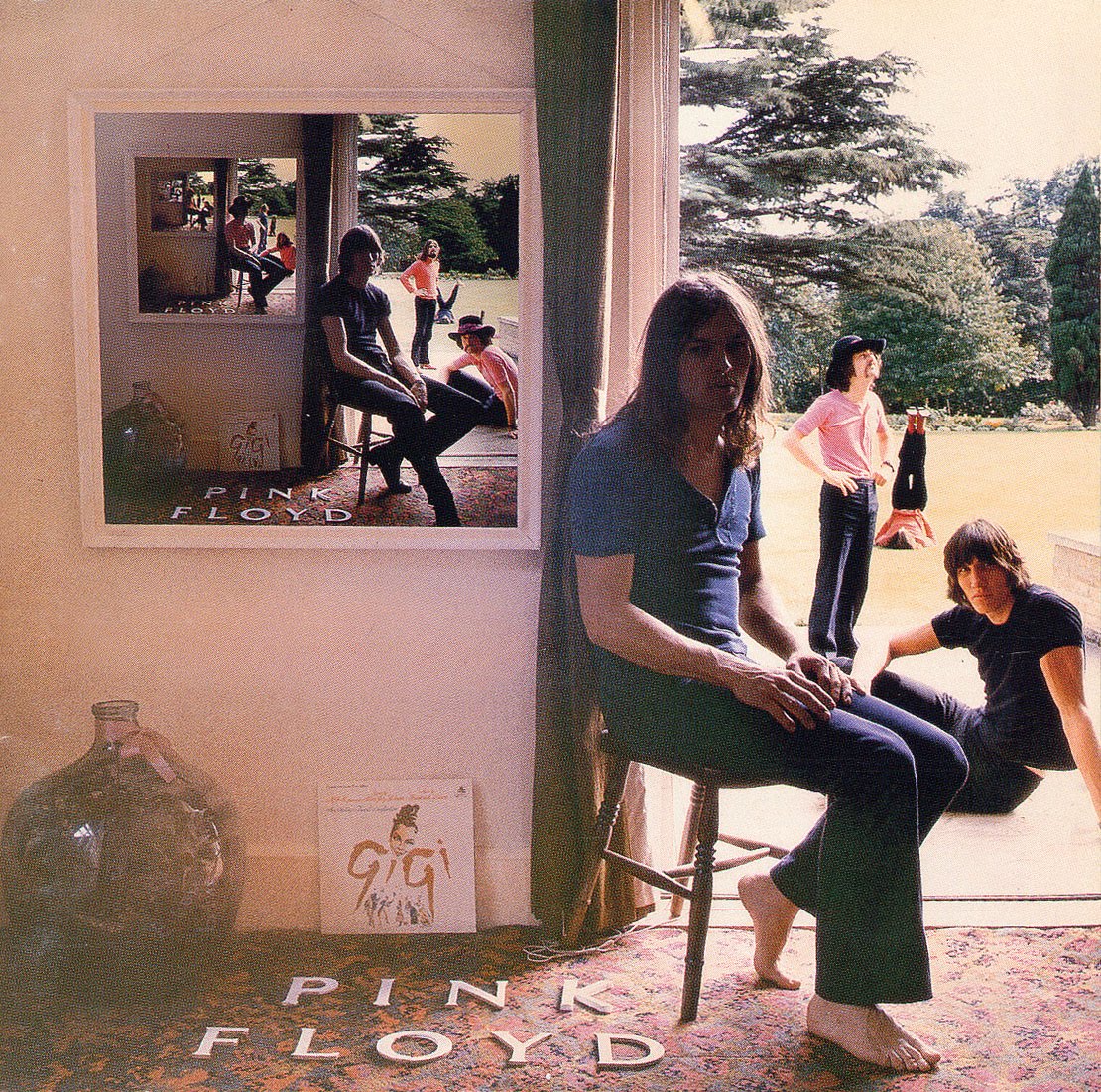
SOUNDTRACK: PINK FLOYD-“Several Species of Small Furry Animals Gathered Together in a Cave and Grooving with a Pict” (1969).

I‘ve mentioned this song a few times here so I figured I’d talk about it itself.  This bizarre song comes from PinkFloyd’s bizarre album Ummagumma.  Back in high school we ranked albums by a very specific content rating and this one received the highest: SDI-seriously drug induced.

Disc One is a live album but disc two contains compositions by each of the band members.  They each received about thirteen minutes of time to do what they wanted.  And they really seemed to go to town.

Roger Waters created this track, and it is very, very weird.  I’ve always loved it, probably because it is so audacious.  Wikipedia gives us this:

The track consists of several minutes of noises resembling rodents and birds simulated by Waters’ voice and other techniques, such as tapping the microphone played at different speeds, followed by Waters providing a few stanzas of spoken word in an exaggerated Scottish burr.

The Picts were the indigenous people of what is now Scotland who merged with the Scots.

You can hear it in all its glory (and then marvel that the guy who made it later when on to make some of the most famous music ever released) in this video.

I also love that someone liked this bizarre thing enough to put it on a Pink Floyd compilation (Works) as well.

And the wind cried Mary.

[READ: January 25, 2012] “Terminator: Attack of the Drone”

I found a link to this story somewhere, I can’t recall where, now.  It was mentioned with excited breath that Moshin Hamid, who I don’t know, had written this exclusive short story for The Guardian.  Hamid has been shortlisted for the Man Booker prize and has written two novels: The Reluctant Fundamentalist (2007) and Moth Smoke (2000).

This story was not quite what I expected from the brief biography I’d read.  Because of the ominous title, I assumed it might have something to do with Iraq (I realize that this came out before the recent downing of the U.S. drone in Iraq, but it still seemed plausible).  Rather, what we get is a bit of sci-fi about smart machine that are on a murderous rampage.

The story is not really as sci-fi as all that, except that what I wrote is true. But it’s more about two boys as they try to deal with this new world of death, machines and heroism.

It begins with the note that “the machines are huntin’ tonight.”  (There’s an interesting dialect in the story, especially from someone who lives in Lahore, New York and London.  We get lines like “Sky’s light enough so’s we’d maybe see the machine but all’s quiet and it ain’t about,” which I register as Southern American.  And yet the characters are named Omar and Yousuf.  I can’t decide if that’s an attempt to show a future world of total integration or just a total disconnect.)

There aren’t many humans left–his Pa is dead, his ma got her leg blown off by a landmine.   But at least his sisters are still alive–that’s more than most people have.

The machines come thundering through, crushing everything in their sight.  They also fly–you can’t see them, but you can hear them.  No one has ever killed a machine. (more…)

Read Full Post »

SOUNDTRACK: MITCHMATIC-“Why Don’t You Know” (2012).

This song reminds me in spirit of the old Fresh Prince songs–buoyant and fun, funny and a little silly.  And although it doesn’t sample I Dream of Jeannie, the mood is the same.

The track opens with a great sound of an old rotary phone.  When the music comes it, it’s completely loungey: strings and easy music propel this song to the heights of Cool.

The delivery style is gentle but fast and the lyrics are funny “I’m gonna tell you some reasons that you wanna date me.”

Mitchmatic is a Canadian rapper and his record is coming out soon on Old Ugly records.  Listen to the track at NPR and explore his stuff at his bandcamp site.

Darling I would like you so much more if you loved me back…

[READ: December 31, 2011 and January 24, 2012] “Wolves at the Door” and “Comment”

This is a blog post from Barry that deals with politics.  Although it was written in 2004 it is completely relevant to the current state of affairs in American politics.  I suppose it was ever thus, but it sure seems worse now.

He opens, “Stop me if I ‘m getting too cynical, but I think elections are won by the guy with the stupidest policies.”  He explains that it’s not because people are dumb; rather, it’s because when you are marketing to an entire country, “your best strategy is to scramble straight to the bottom of the barrel and start groping around in the muck there for the lowest common denominator.”  This is very true.

But I think the perfect summary for politics is (as Barry writes): “smart is complicated, but dumb is catchy.” (more…)

Read Full Post »

SOUNDTRACK: tUnE-yArDs-Tiny Desk Concert #179 (December 1, 2011).

tUnE-yArDs perform three songs in this Tiny Desk concert.  Merrill Garbus doesn’t chat a lot between songs, but she’s clearly having a good time (witness them all jumping at the end of “You, Yes You” and how much she smiles at the end of the set.  This is a wonderful opportunity to see and hear her live sampling technique in a small setting (with close up cameras!).

Her voice sounds great–she pulls off all of those voices that she conjures on the record.  And her ability to sample herself and make it work is wonderful to witness (I never imagined that some of those “sirens” and “keyboards” are actually her voice).

The live band is also really hot.  The bassist really hold everything together and the horns sound great–duplicating the sound of the record with just enough flare to keep it original.

And to think she’s making all of  that guitar noise with a ukulele!  It’s pretty groovy.

Watch it here.

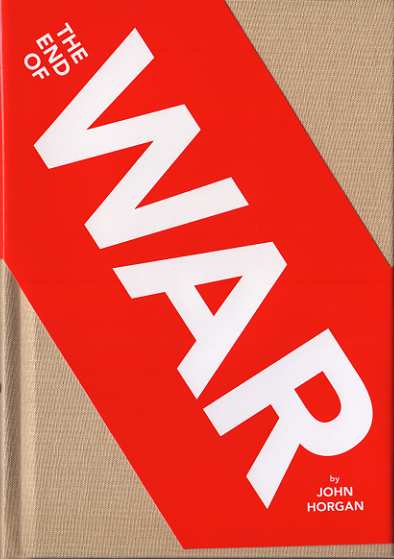
[READ: January 21, 2012] The End of War

This is a non-fiction book in which Horgan believes that in the not too distant future (his lifetime I believe), we will see the end of war.  Not the end of violence, nor anger nor aggression–he’s not crazy–but military campaigns against another country could be ended if we reversed our fatalism about war’s inevitability.

Horgan is a writer for Scientific American and in this book he uses the scientific method to show that ending war is utterly possible.  Now, although Horgan is himself kind of a pacifist (he’s not entirely one, this interview explains), his family is not–his father and grandfather are both veterans and his son is looking to enlist in the army.  Nevertheless, Horgan feels that war is not a viable way to solve problems and that the cost of human life is never worth it.

His research shows him that war should be thought of as a solvable, scientific problem—like curing cancer.  The difference is that cancer is outside of our control, while war is not.  But like cancer, war can infect any society–there is no “reason” for it, but it is like a virus–it infects all cultures, even peaceful ones.  If one culture is aggressive the peaceful neighbors need to prepare for war or move away.

Horgan anticipates skepticism, indeed, many of the sources he quotes are skeptics, and he deals with all of their arguments accordingly.  He looks at those who say that war is genetically part of humanity (as many people believe) or that the best way to prepare for peace is to prepare for war (as just about everyone seems to believe).  He looks at those who say that scarcity causes war (not necessarily true), to those who say that as long as there are guns there will be war (he disagrees).  He has a reasonable, believable argument for all of these doubts.  He even shows that the whole “alpha male, XXY chromosome” argument has been disproven and while men are more prone to violence, they are not more prone to wage war.

He also shows scientific evidence that war has not been around as long as people (or even apes) have existed.  Indeed, the first evidence for “war” (as opposed to violence) is 10,000 years ago (not much in humanity’s timeline).

He culls data from previous wars to show that the causes of wars can never be narrowed down to one thing.  And yet, rather than seeing this as a negative–that so many things cause war, he sees it as a positive–that causes of war are not monolithic and impervious to breakdown.

I was skeptical of this book when I started reading it.  I was willing to accept the various scientific answers that he showed (that war is not innate, for example) but my skepticism came because of what I guess you call the military industrial complex–that our military budget is huge and is not going to go down any time soon.  Just see how much protest is garnered by the miniscule amount that President Obama wants to reduce it.  [Everybody knows this truth but it’s worth seeing in print–our military budget is more than almost every other country combined.  China, who spends the next largest amount on their military has a budget that is 1/6 the size of ours.  That is shocking and depressing and a horrific waste of money].

But his point is that like with so many other things that we have outlawed or abolished over the years: slavery, apartheid, monarchy (as opposed to democracy), acceptance of torture; if we have enough consensus we can also abolish war.  He gives examples that it’s actually not as hard as we might think.  Germany and Japan become pacifist virtually overnight (it was forced on them, but they have taken to it with no problem) and even better, Sweden and Switzerland are pacifist voluntarily.

He also points out that war is already on the wane–although the United States was in two wars very recently, the warlike nature of the world is much less than it was even as recently as the first half of the 20th century.  The number of casualties from war has dropped dramatically compared to World War I.  We simply need to find ways to solve crises that do not involve killing people.

All of the chapters were interesting in this book (the book is more or less set up to deal with an issue per chapter).  Some of the chapters were a little long but at 186 pages (plus a bunch of citation pages) this book is short overall.  I appreciate all of his scientific rigor and his ability to show the arguments and then knock them down.

For me, the most interesting and satisfying chapter was the one that found that preparing for war, despite claims that it is necessary, actually does not keep a people safe. That the allocation of resources towards war removes resources from things that actually make people’s lives  better: art, culture, medicine, health.  Preparing for war doesn’t keep us safe, it actually harms us.

Similarly, he shows that competition for resources is not necessarily a cause for war.  To the contrary they have found that in some cultures scarcity brings out altruism.

In short, he says that the only thing that prevents us from abolishing wars is our fatalism that war is inevitable.  The more fatalistic we are about war the more we accept hawkish ideas which perpetuates more war. Once we stop believing that and we try to work towards the end, he believes that we war can end very quickly.

Horgan doesn’t really calm my fears about the military industrial complex–but who knows with enough popular opinion, maybe voters can change things.  It’s a wonderful thought.  And here’s hoping that this post can spread the good word.

And here’s an interview with Horgan that addresses a lot of these questions.

Read Full Post »

SOUNDTRACK: WILD FLAG-Live at the Black Cat, October 20, 2011 (2011).

It’s interesting to compare this show by Wild Flag with their SXSW show.  This set is longer, but they retain the same raw energy and intensity.  It also sounds as though the tour has been rough on Carrie’s voice, which sounds a bit strained and hoarse (even when she talks!).

They play most of their debut album, but they also throw in a couple of new songs and even a few covers.  Perhaps the most fascinating part is the 15 minute (!) version of “Racehorse.”  There’s a lengthy noodling section as well as a cool part where Carrie goes a little crazy asking about money.

Janet Weiss is absolutely amazing here too.  And the keyboards, definitely complement everything well, but they are always the most notable flubs, and there’s the same one as in the SXSW show (not as bad, but noticeable).

Without a doubt the most interesting thing is the hearing that Mary Timony gives guitar lessons in Washington DC.  She lives there and evidently earns extra cash by doing guitar lessons.  Wow.  How cool would that be?

Check out the show here.

[READ: January 15, 2012] The Influencing Machine

Brooke Gladstone is one of two reporters who works on NPR’s On the MediaOn the Media is an awesome show which dissects things that happen in the world and examines the way the media portrays the events.  They work pretty hard to see who is reporting bias, who is exposing bias and how things are getting out to the average media consumer.  It’s worth anyone’s time to read (it doesn’t take very long).  And it’s also fun and enjoyable.  As anyone who has heard the ending of On the Media: “and edited [dramatic pause] by Brooke” knows, there’s always a smirking grin attached to the program.

When I heard that this book came out I was pretty excited to read it.  And then I promptly forgot all about it.  Lucky for me, my wife can take a hint, and she got it for me for Christmas.

The first surprise of the book is that it is written as a graphic novel–illustrations by Josh Neufeld (who has drawn for Harvey Pekar’s American Splendor).  The funny thing about the illustrations is that I have no idea what Brooke Gladstone looks like (which I rather prefer about my NPR announcers), but I really like the cartoony style of her avatar (which reminds me of Elaine from Seinfeld and which inspired me to draw a kind of similar version on my drawing site.

On to the book.

This book works as a primer for understanding media ownership, media consolidation and media power.  The opening few chapters are going to be nothing new for anyone who has read Chomsky or Vidal on the media.  But since most people haven’t, it’s a wonderful way into some of these thorny issues of who tells us what and why. (more…)

Read Full Post »

I used to not like Christmas songs very much.  Mostly because they;re unavoidable at the holidays but also because if you subject yourself to radio and mall versions, you get a really really bad selection of tunes.  The lowest common denominator of low denominators.

Sarah is a huge fan of Christmas music (even intentionally putting on Magic ninety-eight point threeeeeeeeee) during the holiday season (which may indeed be 50/50 when it comes to music and commercials and which tends to play quite a bit off my least-favorite song list, but they at least mix it up).  And, buying some of our own Christmas music (including alternate versions and new songs) has really helped get the monotony out of our mix.

This is a list that I created in 2008 and I see that it hasn’t really changed much at all.  There are some albums that we have recently acquired which I haven’t digested enough to see if they rank here or not.  But perhaps by the end of the holiday I’ll have a new post about new favorites.

Sarah’s comments are in red.  And, interestingly, she has created her own favorites list on her site.  Let’s see if anything has changed for her.

So, here’s my favorite Christmas songs circa 2008. (more…)

Read Full Post »

SOUNDTRACKPEARL JAM-Austin City Limits (2009).

Pearl Jam records (and sells) most of their shows and they occasionally videotape them as well.  But they don’t do TV all that much (excepting the recent Late Late Show episodes).  There seemed to be something special, or at least different, about Pearl Jam on Austin City Limits.  Think of it almost like Unplugged Updated.

It opens slow with Eddie on an acoustic guitar and strings behind him.  In fact, the whole set seems less heavy than many of their sets.  But that’s not to say that the band doesn’t rock out, because they do.

The first six songs of the set come from Backspacer.   And then they bust out “Army Reserve” (which makes sense given who is in the audience, see below).  Then there’s a wonderfully raucous version of “Do the Evolution” (one of my favorite PJ songs).

After that riotous track, they bring the strings out for one more song.  It’s a rather funny little joke because it’s just the strings and Eddie on acoustic guitar playing “Lukin,” the 80-second song that is so fast you can barely hear the words.

For an extra treat, touring mate Ben Harper comes out to play slide guitar on “Red Mosquito” (which is always a treat).  And the set ends with an amazing version of “Porch” with a super long guitar solo in which Mike McCready really shows off his chops.  There’s even a moment where Mike and Stone are riffing off each other, classic rock style.
The set ends the Eddie talking about playing for the wounded veterans in the audience and how it was quite moving for him given all they have done for us.  Over the closing credits you see the band mingling with the veterans (including a guy who has lost a leg).  It’s all surprisingly touching for a rock show.

[READ: November 20, 2011] “Perchance to Dream”

A while back I read all of the Jonathan Franzen articles that were published in The New Yorker.  I thought I had read everything he’d published until I realized I had forgotten to read this piece (possibly his most famous) that was published in Harper’s.  It fits in well with this weekend’s theme because it was mentioned in Evan Hughes’ article that I talked about yesterday and because David Foster Wallace is mentioned in it.

As with most of Franzen’s non-fiction, it’s not easy to write about critically unless I want to argue with him, which I don’t necessarily want to do.  So instead, I’ll try to summarize.  Of course, this is a long and somewhat difficult article, so let’s see what we can do with it.

The first surreal thing is when you see the byline: “Jonathan Franzen is the author of two novels, The Twenty-Seventh City and Strong Motion, and is writing a third.”  It’s hard to imagine he got a huge article in Harper’s before he wrote The Corrections.

The second surreal thing comes in the text: It opens with “The country was preparing for war ecstatically, whipped on by William Safire (for whom Saddam Hussein was ‘this generation’s Hitler’) and George Bush, whose approval stood at 89 percent.”  And it is only a few paragraphs later when he mentions Patriot missiles that it clicked that this was written in 1996 and not 2001 and that he was talking about the 1991 Iraq invasion.  He mentions this as a prelude, saying that he was trying to sequester himself in order to start writing again.

Then he talks about Paula Fox’s novel Desperate Characters as a benchmark in terms of insight and personal conflict, even if it is so crazily outdated (that someone would throw an inkwell!).   He talks about this book quite a bit. I’m, not sure I found it compelling enough to want to read, but it’s always interesting to hear a fan write about a book I’ve never heard of.  He will return to this book throughout the essay. (more…)

Read Full Post »

I have been getting The Washington Spectator for years and years.  I was delighted with it in the beginning when the editor had the wonderful name of Ben Franklin.  I am delighted now that publisher’s name is Hamilton Fish.  But aside from these two fascinating details, I have always enjoyed the content.  It was thoroughly researched and detailed.  And the little 4 page leaflet always looked like a newspaper in design and style, and it gave it a kind of gravitas–no flashy colors or pictures.

Well, here it is, Vol 37, Issue No 21 and they have finally changed the format.  And not only that, they have created a website and have a Facebook presence!  Welcome to the 20th century!

I say that jokingly because despite these changes (which look great by the way), The Spectator has not abandoned its old school journalism practice.  21st century news is pretty much all flash and brash–style over substance–quick reporting with no concern for accuracy and very little attention brought to retractions (can anyone say “climategate” (I wish they wouldn’t call it that)).  But The Spectator is exactly the opposite, and I am delighted to say that although they are now a lot more accessible, they have not lost any of their tenacity or thoroughness.

The redesign is quite nice.  There’s an image on the front page and now there are pull quotes in red, which stand out nicely on the pale paper.  Although I always liked the pull quote box in the middle off the front page, this new format allows for a couple of different pull quotes as well as an opportunity to mix things up a bit.  (more…)

Read Full Post »

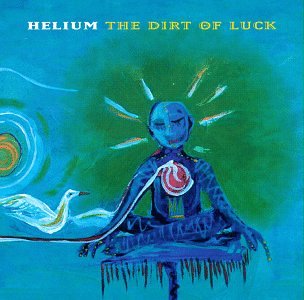
SOUNDTRACK: HELIUM-The Dirt of Luck (1995).

Mary Timony fronted Helium for a few years.  In that time she was recognized as something of a guitar wizard–not in her speed and flash, but in the weird sounds she conjured from the instrument.

She also had very peculiar musical sensibilities (these songs are quite odd) and a cool feminist attitude.  This album features the amazing song “Superball” (one of the best songs of the mid 90s–check out the video and watch the guitarist playing the strings with a screwdriver!  Man I miss the 90s) as well as a number of unpolished gems like “Medusa” and “Pat’s Trick” (the dual vocals are very cool and the dispassionate “oh oh oh” is very interesting, plus I love the lyric about “long-ass curly hair”).

Her singing style is often quite slacker-y, like in the opening of “Medusa”–she’s not always audible, and she often seems like a kind of buzzy sound more than a voice.   She sounds like she’s singing from very far away–seemingly powerful and yet quiet at the same time.

But combine that with the cool scratchy/noisy guitar sounds she gets and she’s pulling off a very cool combination (think Dino Jr without the hooks and killer solos).

Like “Baby’s Going Underground” features some crazy shoegazer guitar washes for most of its 6 minutes which really changes the pacing of the record.  There’s also the great “Skeleton,” a riff so cool that Sonic Youth used it for “Sunday.”

She also has a way with haunting melodies as on the piano  instrumental “Comet #9” and on “All the X’s Have Wings” which sounds very medieval. I think of Timony as a guitarist and yet there is there are lots of keyboards on the album too–mystical keyboards that are fascinating and seem out of character with the guitars, but actually work quite well.   But the prettiest song is “Honeycomb.’  It’s a sweet song with a wonderful melody.  It is followed by the ender “Flower of the Apocalypse” a guitar-based instrumental that is mostly feedback but is also surprisingly melodic.

Helium had mild accolades back in the 90s.  They released a couple of albums and then Mary Timony went solo.  It’s nice to have her playing now with Wild Flag.

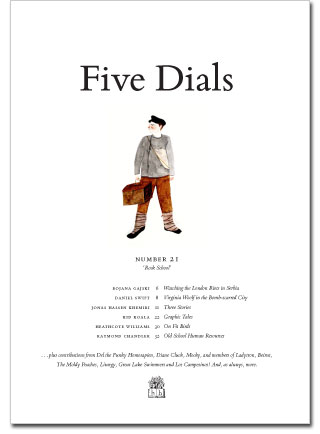
[READ: November 11, 2011] Five Dials Number 21

This is the first issue of Five Dials that I was ready to read when it was sent to me (I’ve been all caught up for a while now).  So that’s pretty exciting!

I was tempted to say that i enjoyed this issue more than other issues, but I have enjoyed most Five Dials issues equally.  But this one is definitely a favorite.

CRAIG TAYLOR–A Letter from the Editor: On Turning 21 and Thinking About Rock Stars and Greece.
The magazine introduction jokes about them now being legal to drink in the U.S. and also about now being old enough to run for M.P. in England.  He also tells us about their “new” section Our Town, which has vastly expanded in this issue.  He also explains that there are many rock stars on hand to give the magazine tutelage (authors that the rock stars enjoy) and three short stories.  He ends with a notice that they have gone to Greece where they are gathering material for Issue 22. (more…)

Read Full Post »

SOUNDTRACK: SUFJAN STEVENS-The Age of Adz (2010).

Sufjan Stevens has released a bunch of albums of beautiful orchestral rock.  It is multi-layered and complex with classical elements and all kinds of cool instruments.

And this album starts out with a beautiful acoustic guitar melody and Sufjan’s delicate vocals.  Although it is a far more stripped down song than usual, “Futile Devices” seems like it is heading in the standard direction.  But anyone who heard Sufjan’s Christmas album number VIII knows that he has been having some fun with electronics.  And they show up with a vengeance on track two, “Too Much.”

All of the multilayered noise that was once orchestral and (some might say) precious has been replaced by a cacophony of gorgeous electronic noises.  The beginning of the song reminds me of the sounds in Skinny Puppy’s “Stairs and Flowers” (how many Sufjan Stevens reviews mention Skinny Puppy?).  The song is nothing like Skinny Puppy once the vocals kick in–it’s catchy and delicate–but those electronics underpin the whole thing, bringing his pastoralia into the twenty-first century.  When I first reviewed this song I didn’t like it but once you get absorbed by Sufjan’s world, it’s an enticing place to be,

“Age of Adz” takes this electronic nonsense even further with an 8 minute brew of strange sounds and choral voices.  But he always manages to throw in some catchy parts, no matter how strange the song gets.

For me one of the highlights of the disc is “I Walked” it features one of my favorite Sufjan things–falsetto vocals in a beautiful but unexpected melody.  And this song has them in spades.  “Now That I’m Older” has a very disconcerting sound–his voice is slowly warbled and mournful.  It’s a beautiful melody that is alienating at the same time.

“Get Real Get Right” returns to his earlier style somewhat (there’s more layers of music, although the electronica is still in place).   “Vesuvius” is a beautiful song and “All for Myself” is another of those great falsetto tracks that I like so much.

“I Want to Be Well” eventually turns into a manic electronic workout in which he repeats the chorus “I’m not fucking around.”

But nothing compares  to “Impossible Soul” a twenty-five minute (!) multi-part suite of electronic chaos.  It’s a fantastic song complete with autotune (used to very cool effect), repeated swelling choruses (it’s like a Polyphonic Spree tribute), electronic freakouts, and acoustic comedowns.  All in a positive, happy message.  I can’t stop listening to it.  “It’s not so impossible!”

Sufjan continues to impress me.

[READ: November 10, 2011] McSweeney’s #9

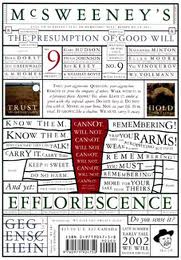
After the excesses of McSweeney’s #8, I was excited to get to the brevity (and urgency) of McSweeney’s #9.  This one is a paperback and looks like the first couple of issues.  The cover is mostly text with a hodgepodge of phrases and pleas.  You get things like: Thankful, Emboldened, The (Hot-Blooded/Life-Saving) Presumption of (Perpetual/Irrational (or More Likely, Irreducibly Rational) Good Will, Efflorescence, Our motto this time: We Give You Sweaty Hugs,” Alternative motto: ” We Are Out Looking,” GEGENSCHEIN (no more), and the promise: “We will Do Four This Year.”

This is the kind of issue that makes me love McSweeney’s.  There are some wonderful short stories, there are some nice essays and there are some dark moments all centered vaguely and tangentially around a theme.  There are some great authors here, too.

The back cover image is called Garden Variety by Scott Greene and it’s a fantastic painting.  You can see it here (navigate through the 2000-2004 paintings, but I have to say I really like the style of all of his work.

There are no letters and no nonsense in this issue.  So let’s get to it. (more…)

Read Full Post »

« Newer Posts - Older Posts »