Feeds:
Posts
Comments

Archive for the ‘Universities’ Category

SOUNDTRACK: KISS-Dressed to Kill (1975).

I feel like I used to  give this disc short shrift because (horrors) its cover is in black and white.  But, unlike the first two discs which were heavy (poppy, but heavy), Dressed to Kill is very anthemic and, well, a little wimpy.  Despite these caveats, I still know every word to the disc, and I do rather enjoy it.

In fact, the first four songs on the disc are not featured on Alive!.  It starts out really poppy with “Room Service” which has a pretty wild guitar solo.  The next track, “Two Timer” is a Gene-sung slow track which even has Gene getting into a spoken word bit: “That’s the truth baby, you’re a two timer.”  “Ladies in Waiting” is one of those fun Kiss songs that starts out a little off-sounding but ends up being a really poppy singalong.  “Getaway” continues a trend of songs that Ace wrote but which Peter sings.  (Evidently Ace didn’t feel confident in his vocals yet).  The side ends with the cool “Rock Bottom,” a slow, pretty guitar intro opens into a rocking song.

This is the rare Kiss disc where Side Two has more hits than Side One.  “C’mon and Love Me” (an unusual request, frankly) is a fun rocker with a lot of baby baby’s.  “Anything for My Baby” is a really upbeat song which amuses me for all of the things that he swears he would do for her: steal, wheel and deal, crawl or kneel, etc.  Next is “She,” one of the all-time great Kiss songs.  It’s heavy, it’s menacing, it has an awesome guitar riff and a great guitar solo.  The fact that they tucked it away in the middle of side two is really weird.  “Love Her All I Can” is a fast rocker that’s followed by Kiss’ most popular song of all time, “Rock And Roll All Nite.”  At this point in my Kiss listening career I’m a little tired of this song.  It’s a very catchy anthem, no doubt, but it’s really not a very good song as far as Kiss songs go.

The recordings for the Kiss Alive! disc were taken on the Dressed to Kill tour and yet the live album has the fewest songs taken from this album.  It’s kind of funny that their most popular song comes at the end of this disc.

[READ: December 22, 2009] Wet Moon

This is a fantastic goth-inspired graphic novel with the absolutely worst title ever.  Wet Moon is the name of the town the book is set in, but it is never mentioned beyond the welcome sign, and I just can’t imagine what inspired the name.

Okay, actually, I just looked up wet moon on Wikipedia, and found out that it is an astronomical term for when the “horns” of a crescent moon point up, away from the earth (like devil horns).  And so I completely take back my complaint, as I now think the term is pretty cool and very appropriate.

And that is the only thing that I find disagreeable about this book.  (Well, actually I don’t like the lettering either, but more on that on a moment).

The town of Wet Moon is a college town where goths live and thrive (and no doubt many fans of the book wish the could live there).  Our heroine is Cleo, a young, slightly overweight goth with a pierced nose and bottom lip.  She has just moved out of her parents house and is living on campus.  (There is an implication that her house is a dorm, but if so, it is the single most beautiful dorm ever, anywhere, so I’ll pretend it’s an apartment–I mean, there’s a walk-out balcony for cripes sake). (more…)


Read Full Post »

SOUNDTRACK: The Believer June 2004 Music Issue CD (2004).

Every year since 2004, The Believer magazine has published a Music Issue which comes with a CD.

I recently received the 2009 CD, but I thought it might be fun to go back through the previous ones and see what kind of music they put on them since the beginning.  I was delighted to see how many bands I like now that I was either introduced to or SHOULD have been introduced to by these discs.

The inaugural issue was a fantastic collection of then-underground alt-rock (the issue also featured interviews with a few of the artists–you can see the Colin Meloy interview here).

The collection contains all previously released songs (I think).  But for me it was a great introduction to a number of bands that I didn’t know: The Walkmen, The Mountain Goats, Ted Leo + Pharmacists.  It also contained a new release by a band I did know, The Constantines.   And, this was my introduction to a band that turned out to be one of my new favorites: Death Cab for Cutie.

There’s a lot of great songs on here, and it would make a great hanging-out-at-a-party-with-friends soundtrack.  There’s not a lot of diversity on the disc which is a bit of  a bummer (although it’s good for a mellow party).  However, the 19 second blast of “You Got the Right” by the Tiny Hawks does break things up a bit.

But with a great collection of songs it would be wrong to complain.  For a complete listing (and another review) check out this page.

[READ: December 9, 2009] “The Use of Poetry”

Ian McEwan writes fantastically engaging stories about relatively simple things, oftentimes relationships.  And he has these relationships so well sussed out that a simple six-page story like this can pack in a ton of humanity.

In a post some time ago I wrote about how World War II affected Britain much more than it affected the U.S.  And, how artists of a certain age have found great drama from the war.  This story is no exception.  Except that the war veteran is not the main character.  But I loved this summary of the main character’s dad, the typical “stoic British man.”

Like many men of his generation, he did not speak of his experiences and he relished the ordinariness of postwar life, its tranquil routines, its tidiness and rising material well-being, and above all, its lack of danger–everything that would later appear stifling to those born in the first years of the peace.

That’s an amazing encapsulation of a generation of men.  And it rings very true to me.  But what’s more amazing is that that description is not even about the main character Michael, it’s about his dad, Henry. (more…)

Read Full Post »

SOUNDTRACK: BLACK SABBATH-Vol. 4 (1972).

When I was younger I liked this Sabbath album a lot more than I do now.  There are some absolutely stellar tracks on here, but most of the songs are a rather peculiar for Black Sabbath.  It showcases ballad-y nature that Ozzy would have for some of his biggest hits twenty years later.

“Wheels of Confusion” opens the disc with a fascinating bluesy sounding guitar solo that turns into a straightforward rocker.  But, as it’s 8 minutes long, there’s a lot of twists and turns.  And it ends with a two and a half minutes of upbeat guitar soloing (with a tambourine keeping the beat!).

“Tomorrow’s Dream” opens with a rocking bendy guitar riff  but in the middle the chorus turns the song into a delicate ballad.  This is followed by “Changes” a full-on piano ballad (!).  It’s catchy, no doubt, and I loved it when I was younger, but I’m not entirely sure it passes the test of time.  This is followed by “FX” which is literally almost two minutes of echoing blips and bleeps, some of which go back and forth on the headphones.  It’s a very strange addition to any disc and is really the perfect example of “filler” unless by some chance this was majorly cutting edge at the time.

This is redeemed by “Supernaut” one of the all-time great Sabbath tunes.  It’s heavy, fast and features a great guitar riff.

“Snowblind” is a another fantastic song.  A great riff, and of course, it’s totally pro-cocaine!  How can you tell?  Well, because at the end of the first verse, you can hear a very unsubtle whisper of “cocaine.”  My, how the band has changed in just a couple of years.  This song also features a ballady mid-section.  It also features an awesome middle bit that rocks very hard (and can be summed as: don’t tell me what to do).  The drugs hadn’t deteriorated Sabbath’s songwriting yet, but give it a couple more records!

“Cornucopia” is one of the weird songs that you find on the second side of a Sabbath album.  It’s a got an awesome slow, doomy opening riff which then turns into a speedy rocker.

When I was kid I really liked “Laguna Sunrise” and I still do.  It’s a pretty acoustic guitar number (with keyboards or strings or something).  After “Changes” you’re not surprised by anything that Sabbath will throw at you, but this song is really shockingly delicate.

“St. Vitus Dance” is probably the most schizophrenic Sabbath song.  The opening guitar riff is so incredibly upbeat, happy and boppy; who knows what will come from it.  And then the verses turn dark and edgy with lyrics about a breakup.  And then the happy guitar bits come back!

The disc ends with “Under the Sun/Everyday Comes and Goes.”  It is once again another wonderfully sludgy guitar riff that turns into a fast rocker (“I don’t want no Jesus freak to tell me what it’s all about!”).  After the verses, you get this wonderfully weird guitar solo that’s like an ascending scale on acid.  Fun!  About three minutes in, it turns into “Everyday…” an uptempo rocker that’s not out of place with the other half of the song, but which does seem like an odd placement.

This disc was strangely experimental for Sabbath.  And, while it’s nice to see them not getting stuck, some of their choices were certainly weird.  And yet all Sabbath fans seem to regard this disc pretty highly (I think it’s the iconic cover that we all remember so fondly).

[READ: December 10, 2009] Unseen Academicals

Terry Pratchett knows football (soccer)??!!  In all the years of Discworld books, I don’ think there has been any mention of football (or even any sport).  Who knew he had a 400 page book about football in him?

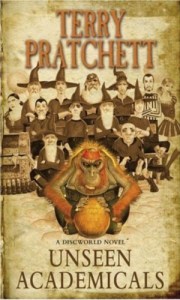
Oh, and what is wrong with US book publishers?  Look at the utterly lame US cover at the top here.  First of all, the book is about soccer…why are they reaching for the ball with their hands??  Second, look here at this awesome UK cover by Paul Kidby (the official illustrator of Discworld).  Does he not have publishing rights in the US?

American readers, check out this cover.  It is awesome!  It gives you the whole cast, it gives a wonderful graphic of just what you’d be up against when you play this team.  Look, there’s the Librarian!  And, of course, the drawing is great.  Well, at least we have the internet.

But back to the football.  As with any Pratchett book it’s not just about football.  There is a whole bunch of stereotype-busting, inner-strength growing, pop-culture raspberrying, and general hilarity as well.  Oh, and Rincewind is back!  Hooray! (more…)

Read Full Post »

SOUNDTRACK: BLACK SABBATH-Black Sabbath (1970).

I’ve talked about Black Sabbath quite a bit, so why not take a look at their records directly?
One of the fun surprises about their first disc is the stereo mix (although it was 1970, so maybe one shouldn’t be surprised).  Guitar in one ear, bass in the other and sometimes only a guitar solo in one ear with nothing else going on!  The other surprise is that even though Tony Iommi’s guitar is on fire and he has huge lengthy guitar solos (the one in “Warning” is like 8 minutes long), the other members, especially the drums, really come to the fore.

What can one says about the title track?  The opening thunderstorm (with creepy bell tolling) sets the mood perfectly and then the killer riff kicks in and Ozzy Osbourne’s weird, loud, somewhat whiny and frighteningly frightened voice asks “What is this that stands before me?”  It’s a slow song, especially for one that spawned a genre of fast heavy metal, but it sense of ominousness is tangible.

“The Wizard” undermines everything you think you know about heavy metal since it begins with a harmonica.  However, it is a pretty creepy harmonica, and the melody is certainly spooky.  What’s so fascinating about the song is the drums.  While the whole band plays the somewhat odd riff, the drums have a huge place of prominence in the song, with little snare drum solos after each line (and a prominent cowbell at one point).  There are some wild guitar solos, but you wouldn’t be crazy thinking that this was the  drummer’s band.

The next song is listed as four songs: “Wasp/Behind the Wall of Sleep/Bassically/N.I.B.”  “Wasp” is a short, fairly upbeat instrumental, but “Behind the Wall of Sleep” is where the words kick in.  It’s a pretty explicitly anti-drug song (“turns your body to a corpse”).  And I’m fairly certain there are two vocal tracks, one in each ear.  “Bassically” is the wild bass solo (again, taking away the dominance from the lead guitar). Which leads to “N.I.B”., one of the great, classic Sabbath songs.  An awesome bass riff that propels the song to its climax of “My name is Lucifer please take my hand.”  Although it also features a strangely plaintive refrain of “Your love for me has just got to be real.”

“Wicked World” comes in a little preachy and kind of out of place.  But mostly because it’s got a strangely jazzy feel. It’s not out of the ordinary in concept, it’s just a little less subtle than some of the other tracks.

“A Bit of Finger/Sleeping Village/Warning” is the ending trio of tracks (14 minutes in all) that are really hard to distinguish.  “A Bit of Finger” is a very short acoustic guitar solo (I assume, I mean, the “Sleeping Village” lyrics kick in pretty quickly). But I love that there’s a Jew’s harp in the background.  Then there’s a crazily long guitar solo.  Or, should I say there are two guitar solos: a different one in each ear.  I think that the solo is part of “Warning” (it’s the same melody after all) but who can tell.  “Warning” is another fantastic Sabbath song.  The bass line is great and Ozzy sings one of his oddly plaintive songs of loss: (“the feelings were a little bit too strong”).  But the middle section is an astonishingly long guitar solo, or should I say solos. This solo even stops at one point and he comes out with a whole new melody/solo after that.  And then another solo.  Most of the soloing is in the right ear, which leaves the left ear struggling in vain to hear what’s going on (it’s fun to listen with just the left ear phone in).  With about a minute to go, the song proper returns.  It’s pretty bizarre.  And maybe that’s when Tony Iommi’s ego was placated.

Despite this being one of the first really heavy albums, it still retains a bluesy/jam feel to it.  The songs are long, there’s wild freewheeling guitar solos, and the sound itself isn’t a constant bludgeoning (like later heavy metal), it comes in bursts, which somehow makes it more ominous!

It’s really tremendous.

[READ: November 27, 2009] “Midnight in Dostoevsky”

Although I don’t know where this story is set exactly, I can totally picture the scene.  And I am superimposing it directly onto a location from where I went to college.  I realize that’s totally wrong, but I couldn’t resist.  This story had very weird overtones to me and actually inspired me to want to write a story that has apparently been percolating in my head for years.  We’ll see about that.

Anyhow, as for the story itself, I confirmed my suspicion that DeLillo doesn’t write short stories too often.  According to his Wikipedia site, he wrote one short story in 2002, another in 2007 and then this one.

DeLillo is a postmodern master, which leads one to think that his stories will be convoluted and difficult.  But this story is pretty straightforward.  Two college kids, walking around on a cold winter day spot an old man walking toward them.  They create a backstory for the man and, in the end, attempt to confirm or deny what they have concocted.  Fairly straightforward.

But as with any great story, the real action happens in the characters’ heads, or in this case, in the narrator’s mind and his spoken dialogue with his compatriot. (more…)

Read Full Post »

geminSOUNDTRACK: KATE BUSH-Hounds of Love (1985).

I have a very specific memory of the first time I heard the song  “Hounds of Love.”  I was in high school and the Wilderness Adventure Club was heading towards whatever destination we were going to (funny I can’t remember the destination, but I recall the car trip there).  The head of the club (who was a teacher, but not one I had) was driving a bunch of us in his station wagon and this song came on.  My friend Brad and I howled with laughter at the “barking” that Kate does. “Roo Roo Roo Roo.”

It only occurred to me recently that the driver probably enjoyed the music or else he wouldn’t have had it on, so that wasn’t very nice of us.  It also occurs to me that he must have had the disc (actually the tape, as there were no discs then) because I don’t imagine the song was ever on the radio.  (Although I also think there may have been a DJ talking about the songs, so my memory is shaky).  I just remember laughing and laughing and quite likely Roo Rooing for much of the trip.

So, it’s funny now how much I love this disc (my high school self was a metal head, my college self expanded his musical mind rather a lot).

Kate’s previous two records were a wonderful precursor to this monumental disc.  The big hits come at the top: “Hounds of Love” is indeed an amazing song, as is “Running Up That Hill.”  But they’re familiar enough that I don’t have to say anything.  “The Big Sky” is a rollicking romp of fun.  And “Cloudbusting” is just simply amazing.  (Look for the video with Donald Sutherland!).  It’s five minutes of intense storytelling.

But for me, the second side of the album (starting with track 6 on the disc) is the real selling point.  It’s something of a story called The Ninth Wave.  And what I love about it (in addition to the awesome music) are the amazing effects and sounds and voices that are all over the tracks.

It begins simply with a delicate piece, “And Dream of Sheep,” a beautiful piano ballad.  It’s followed by the mesmerizing “Under Ice.”  The opening string sounds evoke someone skating on an ice (which is what the song is about).  As the tension grows (is someone under the ice?) voices far back in the distance compete with Kate singing “Its me!”

The next track, “Waking the Witch” begins with some awesome headphone voice work.  Voices from various family members implore her to wake up.  Left, right, middle, back.  Then, a voices asks “Can you not see that light over there?”  With a far off voice whispering “over here.”  When the song finally bursts forth, her voice is manipulated in a creepy disjointed way.  Followed by different musical sections with cathedral bells.  All through the track a male authority figure condemns the girl for being a witch.  And as the song ends (with a sample of the helicopter from Pink Floyd’s The Wall she is found guilty.  It’s quite intense.

The intensity slackens somewhat with the mellow “Watching Me Without You.”  But it builds again with the manic intensity of “The Jig of Life” a traditional jig with uilleann pipes in the background and Kate’s vocals over the top.  The song breaks into a very traditional sounding step dance seisiun until Kate starts whispering “I put this moment here” (more of that cool headphone stuff) and the song takes of again.

“Hello Earth” starts as a simple ballad reminiscent of “And Dream of Sheep” but it grows in intensity only to break for a choir passage.  It then returns to the intensity of Kate’s voice which fades and ends with Kate’s whispered:  “Tiefer, tiefer.  Irgendwo in der Tiefe.  Gibt es ein licht.” (Roughly: Deeper Deeper, Somewhere in the depths there is a light.)

The disc ends with “The Morning Fog” a respite from the intensity of the music and the contents.  It’s a light ballad (with amazing fretless bass work) that seems like it could have been used in a John Hughes film.  Especially for the “I tell my mother/father/loved ones/brother how much I love them” lyrics.

The Ninth Wave is one of my favorite suites to listen to.  It not only demands attention, it usually gets it.

Hounds of Love is, simply put, fantastic.

[READ: November 15, 2009] Gemini & The Transfiguration of Benno Blimpie

When I was a kid, watching cartoons on Channel 11, WPIX, there was a frequent, (in my memory it was incessant) commercial for a Broadway play.  And the only things I remember about the commercial were two snippets:  In the first, a young boy is gorging himself on food and his mother yells “TAKE HUMAN BITES!”  The second shows a woman who says “I’m  not hungry, I’ll just pick” who then grabs a handful of spaghetti from someone else’s plate.

This commercial was such a part of our culture, that my friends used to shout “TAKE HUMAN BITES” at each other all the time.  And yet, after all these years, I couldn’t remember what the play was.  So, out of curiosity, I did some searching to see if I could find this mysterious play (and, more importantly find the commercial).

So, thank you, internet, for helping me discover the play is Albert Innaurato’s Gemini.  No commercials have been forthcoming, sadly.

Well, I thought it would be fun to read this play and see if it was as funny as the commercial seemed.  Who could have guessed that the play would have turned out like this? (more…)

Read Full Post »

tr3A patron asked for Technology Review to be added to our collection.  When he said it was a technology magazine published by M.I.T. I thought it was going to be way too academic for our patrons.  But when I read the sample issue, I was really delighted with it.  So much so that I ordered a subscription for myself (the library has yet to decide).

The technology that the magazine covers is actually tech that is accessible to everyone: alternative fuels, cheap laptops, even technology in medicine (and how it will impact us as patients).  But there’s also some super high tech stuff: robotic arms, nuclear power, genetic engineering.

It opens with an Editor’s Letter followed by Reader’s Letters.  Next comes the Notebooks section.  This features several very short pieces about different ideas: green energy, memory boosting drugs. (It also has oddly computer generated drawings of the writers). (more…)

Read Full Post »

ijestSOUNDTRACK: SONIC YOUTH-Sonic Nurse (2004).

nurse

After the glorious Murray Street, SY return with an even better disc: Sonic Nurse.  This is probably their most overtly catchy (and therefore in my opinion wonderful) record since the Goo/Dirty period of 1991.  (Can it really be 13 years between these discs?).

This disc features Jim O’Rourke as well.  I’m led to believe that he has been playing bass with the band in order to free Kim up to do other things.  Although what she is doing I can’t really imagine.

“Pattern Recognition” opens with the most catchy guitar line in Sonic Youth memory.  Such a great and easy guitar riff.  Kim’s voice is sultry and wondrous.  And Steve Shelly really gets a chance to shine with some fun drum parts.  And, as is typical lately, the catchy songs get some lengthy end treatments, so this song ends with a 2-minute noise fest.  But it’s a good one.  “Unmade Bed” is one of Thurston’s special mellow-singing songs but the guitar solo is weird and wonderful.

“Kim Gordon and the Arthur Doyle Hand Cream” was originally called “Mariah Carey and the…” (and I have no idea if the original was different).  Is one of those noisy Kim-sung jams that SY are known for. But it also features a “Hey hey baby” sing along chorus too.

“Stones” continues this midtempo catchiness with another amazing guitar riff that runs throughout the song.  While “Dude Ranch Nurse” is another mellow Kim piece that has a great riff and wonderfully noisy bridges.  And of course, Lee is awesome on “Paper Cup Exit,” yet another fatastic song.  The cool breakdown in the song is a nice unexpected twist.

“I Love You Golden Blue” may be the most beautiful song the band has ever done.  Kim’s voice is delicate and delightful as she whisper/sings over a gorgeous guitar line.  The final song is another of Thurston’s beauties: “Peace Attack” a slow builder, complete with verse ending guitar solos.

Sonic Nurse is a beuaty.

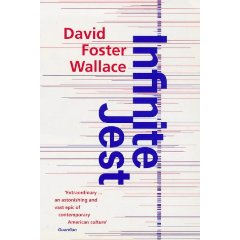
[READ: Week of September 14, 2009] Infinite Jest (to page 949)

Flying in the face of potential spoilers, I was looking for any evidence of there ever being a “unedited Director’s Cut” version of Infinite Jest.  There is, supposedly, one copy of the full text floating around, and I’m actually quite surprised no one has tried to capitalize on DFW’s death by releasing it (I’d rather see that than another “This is Water” type publication).

But while looking around, I got this pleasant surprise from the Howling Fantods–these are comments on a first draft of IJ (without too much unpublished work shown).  But there’s also this disturbing (to me) item:

(N.B.: Wallace made numerous corrections for the paperback edition of 1997, so that edition is the one scholars should use. Put a Mylar cover on the pretty hardback and leave it on the shelf.)

Great. So I read the wrong copy?  Twice??

ijdot1
I haven’t said very much in any of these posts regarding DFW himself.  I don’t feel it is my place to comment on the man or his situation.   However, through a nice shout out to me, I found this really cool site: The Joy of Sox.  It’s primarily about the Red Sox but it has a delightful side venue in DFW information.  There’s not a ton, and he quotes extensively from others who have done more research than he–he’s a fan of DFW, but this is a sports blog after all.  But it is a delightful collection of miscellanea.  And he pointed me to this article, “Democracy and Commerce at the U.S. Open“, which I had never read (so thank you!).   So, do check out the site, he’s not doing Infinite Summer, but he’s likely going to read IJ again in the fall.

ijdot1
As this almost-final week opens, the book is flying downhill like an AFR wheelchair, paralleling Gately’s literal inability to talk with Hal’s metaphorical? literal? we’ll see? one.  But it really is the Gately show.  We learn more and more about him, and his back story makes him more and more likable.  Who ever would have guessed? (more…)

Read Full Post »

blackSOUNDTRACK: SONIC YOUTH-SYR 4: Goodbye 20th Century (1999).

syr4This SYR recording consists of Sonic Youth’s interpretations of 20th century composers’ works.  Some of the composers are obscure, but a few are more or less household names: John Cage, Yoko Ono, maybe Steve Reich.  I knew a few of these composers from Kronos Quartet, but for the most part the pieces are all new to me.  Since I don’t know the original pieces I have no idea how faithful they are.

The most fascinating thing about the disc is the CD-ROM video of “Piano Piece #13 (Carpenter’s Piece)” which shows the band performing.  The “song” is literally the band nailing the keys of a piano down.

There are a number of guests on the CD, including the first (I think) performance by Coco Haley Gordon Moore (on the 17 second “Voice Piece for Soprano”).  And, the liner notes are all in English.

This is the longest SYR disc (at over an hour and a half) and it is a fascinating mix of noises and sounds and screams and spoken bits (okay okay okay okay okay okay okay).

This is not for everyone, not even the average Sonic Youth fan.  There’s absolutely nothing in the way of “songs” here.  The abstractness of the disc is palpable.  And, clearly, just knowing that one of the pieces is a bunch of people nailing keys of a piano, you get a fair idea of the breadth of “music” that the disc covers.

[RE-READ August 19th] J.O.I. Filmography

Before reading this week’s section, I had noticed that many people on Infinite Summer (and elsewhere) have discussed James’ films and how they relate to incidents in the overall story.  So, I decided to go back and re-read his filmography Endnote, just to see what else I could learn.

In general, with more background, the Endnote is much more interesting. The first batch of films are more amusing to read about just to see the emphasis on pain and disfigurement.  We also see that he had been using students and teachers from E.T.A. in his films for a while.

We have had an in-depth look at some of these earlier films: The Medusa v. The Odalisque; Homo Duplex, The Joke, The ONANtiad (which the endnote describes as unfunny).  But the ones we haven’t seen show distinct commentary about the state of the country since the Reconfiguration (it’s clear that J.O.I. was against it).  The American Century As Seen Through a Brick deals with anti-O.N.A.N. riots; The Universe Lashes Out is about the evacuation of New Hampshire during the Reconfiguration; Poultry in Motion concerns the toxification of Thanksgiving Turkeys; and No Troy is about miscalibrated Waste Displacement Units that crashed into Troy, NY (which was mentioned in the scene about people looking for entertainment outside of their living rooms).

[Unrelated to the story, on page 990 of my paperback IJ (with forward by Dave Eggers) every italicized word contains a superscript 1 after it (indicating, what? more footnotes?) It is an astonishingly weird glitch/typo and I can’t believe that it wasn’t spotted before going to print as it makes the titles actually harder to read.] (more…)

Read Full Post »

ny1It took me going to Seattle to learn about The New Yorker magazine.  I was visiting my friend Rob and he was really surprised that I didn’t read the magazine all the time (my reading always seems to surprise people, see The Believer.)

Upon my first read of the magazine, I was surprised to see that the first twenty pages or so are taken up with upcoming shows: films, concerts, sports, everything.  I actually wondered how much content would be left after all that small print.

Since then I have learned that Sasha Frere-Jones writes columns in here quite ofuiten.  For reasons known only to my head, I was convinced that Sasha was a black woman.  Little did I realize that he is not.  And that he was in a band that I have a CD of called Ui.  He is an excellent resource for all things music, whether I like the artist he’s talking about or not.  Some entries are here.  This audio entry about Auto-Tune is simply fantastic.

But of course, there’s a lot of content.  And the first thing you get are letters.  I don’t think I have EVER looked at the letters section. (more…)

Read Full Post »

ij9SOUNDTRACK: SONIC YOUTH: A Thousand Leaves (1998).

1000This CD actually ties to the book because the crossed out title on the CD is “mille feuille” and the first song is called “Contre le Sexism.”

This opening song is weird and lets you know that this disc is not going to be a friendly listen.  Over some feedback and scratchy noise, Kim whispers and hollers, most notably that “it’s just a kitten.”  But just when you think that the disc is going to be a crazy noise experiment, the next track “Sunday” proves to be another one of Thurston’s supremely catchy singles.

The back and forth continues with Kim’s abrasive “Female Mechanic Now on Duty” and Thurston’s delicate “Wildflower Soul.”  But the pattern is broken with Lee’s spoken-word over simple guitar lines piece, “Hoarfrost.”  It lacks Lee’s usual catchiness, although his later song “Karen Koltrane” more than makes up for it.  Then Kim surprises us by giving us the catchy “French Tickler.”

To me, “Hits of Sunshine” is the centerpiece (literally and metaphorically) of the disc.  It’s 11 minutes long and ranges through the main stylistic feelings of the disc.

The whole disc is over 70 minutes long and it feels meandering.  This is not to say that it has no focus, it’s just not full of pop gems.  And yet for all of its wandering, it hasn’t lost the tunes.  Mixed reviews abound for this disc with everything from 1 to 4 stars coming from the pros.  And, I think depending on my mood, my overall rating could be just as diverse.

I admit that at the time I was starting to lose my adoration for the band.  These longer, more abstract pieces were less enticing than the noise of yore.  But now that I’m a bit older, I can appreciate what they were doing.

[READ: Week of August 17] Infinite Jest (to page 651)

I was planning on starting this week’s write up with a bit about J.O.I’s filmography, which I delved back into and found some fascinating information.  But this week’s write up is pretty long already, so I’m going to do a mid-week (but still spoiler line approved) retrurn to the filmography shortly.

So until then, let’s get back to the book:

This week’s reading gets off to some detailed viewing of the Incandenza men’s psyches before launching into an adrenaline fueled rush.

Mario is still freaked out about Madame Psychosis not being on the air.  He’s not sleeping well at all, and when the insomnia hits him, he goes for walks (even though he knows, and is worried about, how much it freaks out the Moms).

Mario is slowly turning into the absolute heart of the book.  He absolutely and without question loves Hal, and he is concerned for him because he’s been acting differently lately (Mario himself never changes).  He also prays nightly, and in a serious way, talks to God (although he doesn’t expect any one to answer…he’s not crazy).  And, in a very touching scene, which seems to resonate so well with late 1990s America, he is troubled that no one can talk about things sincerely without it being ironic.  (Pemulis wants to set up a prayer hotline for atheists that would just ring and ring). (more…)

Read Full Post »

« Newer Posts - Older Posts »