Feeds:
Posts
Comments

Archive for the ‘Translators’ Category

  karlove5SOUNDTRACK: RAGA ROCKERS-“Slakt” [“Slaughter”] (1988), “Hun er Fri” [“She is Free”] (1988) and “Noen å hate” [“Someone to hate”] (1990).

ragaKarl Ove mentions many bands in his books.  Raga Rockers appeared twice in this one.  I can’t find a ton about them online, because they never really made it beyond Norway, but the Google translated version of their website says:

Raga Rockers is an ingenious rock ‘n roll band that has existed since 1982.

Today the band consists of: Michael Krohn (vocals, lyrics), Hugo Alvar Stein (keyboards / guitar), Eivind Staxrud (guitar), Arne Sæther (keys), Livio Aiello (bass) and Jan Kristiansen (drums).

The band came out of the punk community in the early eighties, but became such a “poppy” large parts of the Norwegian people have founded acquaintance with them.  Songs like “She is free” and “Someone to hate” is almost singalong classics! Their greatest triumph came perhaps in 1999 when they played for thousands of ecstatic Norwegians at the yellow stage at Roskilde Festival. (Reviews of the show by Dagbladet (which Karl Ove wrote for) and Dagsavisen–both are in English.

Despite their punk roots and the rather violent song titles, the songs are almost poppy–heavy guitars but simple chords and a singer who doesn’t sound angry at all.  In fact, if I didn’t read about their punk roots, I’d swear these songs are kinda goofy.

“Slakt” is a simple song, opening with a 4/4 drum and splashes of guitar.  The middle is a bluesy riff with a chorus of “ah ha ha”  The lead singer’s voice is mostly kind of deep–not quite what I expected from the heavy guitars.

“Hun Er Fri” is quite different from the others songs.  It’s only 90 seconds long and features a piano.  The chords are still simple the piano may be playing single notes in fact).  The lyrics are pretty much nonstop and kind of fast.  It seems like a silly pop trifle and I can see why it’s popular among their fans.  The first time I listened to it, I was surprised it ended when it did.  This bootleg live version is certainly fun.

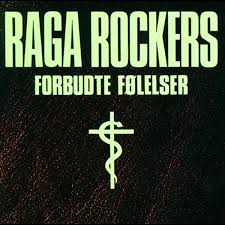
rocknrollThese two songs came from their 1988 album Forbudte følelser [Prohibited feelings]

“Noen å hate” has a bit more of a metal sound, but is essentially the same kind of heavy rock with simple chord progressions.  There’s a good solo at the end.  A black metal band called Vreid has done a cover of this song (which really only sounds different because the Vreid singer is more growly).

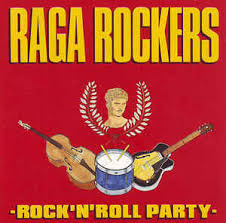
This song comes from their 1990 album Rock n’ Roll Party.

And yes, they are still around.  They took a hiatus in the 2000s but came back with three albums 2007’s Übermensch, 2010’s Shit Happens and 2013’s Faktor X.

[READ: May 1, 2016] My Struggle Book Five

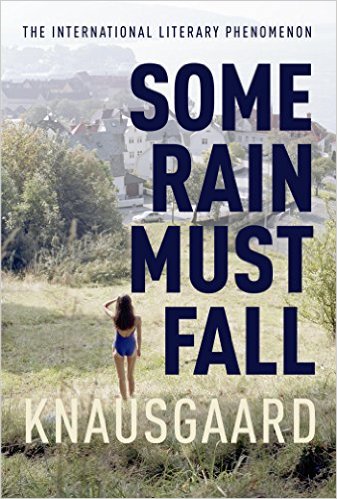
karlove 5ukI realized as I read this fifth book that I should have been keeping a vague sense of the timeline of these books.  Specifically, because he opens this book with this: “The fourteen years I lived in Bergen from 1988 to 2002 are long gone.”  So if he was born in 1968, this book covers roughly ages 19-33.

So my general outline for the other volumes:
Book Five: 1988-2002 (19-33)
Book Four: 1987 (18)
Book Three: 1968-1981  (1-13)
Book Two: 2008 (40) (with flashbacks to meeting his second wife in 2003 or so)
Book One: 2008 (40) (with flashbacks to his father’s death in 1998 or so)

What era could Book Six possibly be about?

We’ll find out next year in what is said to be the 1,200 page final volume.

So as I mentioned above, Karl Ove talks about the fourteen years he lived in Bergen.  And it made me laugh that he says:

The fourteen years I lived in Bergen, from 1988 to 2002, are long gone, no traces of them are left, other than as incidents a few people might remember, a flash of recollection here, a flash of recollection there, and of course whatever exists in my own memory of that time.  But there is surprisingly little.

And then he proceeds to write 600+ pages about that time. (more…)

Read Full Post »

april16  SOUNDTRACK: JEREMY MESSERSMITH-Tiny Desk Concert #158 (September 19, 2011).

jeremyI had never heard of Jeremy Messersmith before this show (the blurb even comments how it’s a shame more people haven’t heard of him since he is so sweetly poppy).

He looks a bit like Buddy Holly although my first though when he started playing was that he sounded not unlike Belle & Sebastian.  But there is more to his music than a simple reduction like that.

Messermith plays five songs (FIVE!).  For the first three he has a four piece behind him–big jangly electric guitar, a cello and a drummer accompanying his really nice picking style.

In “Toussaint Grey, First in Life and Death,” the electric guitar is mostly picking as well.  It’s a gentle song and you can really hear his voice well.

In “Knots” the tempo picks up with bigger drums and louder electric guitar.  I also love the picked cello as a bass guitar (this is the song that reminded me so much of B&S).  But by the end it is wholly his own (the falsetto note at the end is great).  This song is super catchy.  I love the break in the song when the drums kick in again.

For “Violet” the cellist switches to keyboards and the guitar plays some big jangly chords.  The chorus is great once again–super catchy and poppy.  Even better, there’s some great background Bah bahs and then other oohs of harmony.  But it’s the switch to an even higher note at the end of the bah bahs that totally had me hooked.

For the final two songs it’s just him and the cello.  His picking style on “A Girl, A Boy, and a Graveyard” is wonderful.  His voice sounds like someone although I can’t quite place it, but I love it.   The song is sweet and delicate.

Before the final song “Tatooine,” (which is about Star Wars obviously) he says that Steve Earle was in not too long saying that now songwriters write songs for nerds, and so this one is for the nerds.  The first line is “twin suns of Tatooine taught me everything I know.”  Pretty nerdy alright.  It’s just him and the keyboard on this, and the song is perfect this way.

I’m really looking forward to hearing some studio version of these songs.  This Tiny Desk was quite a find.

[READ: March 12, 2016] “Hygge”

I have read several stories by Dorthe Nors and I’ve found most of them a bit odd.  And so was this one, which was translated from the Danish by Misha Hoekstra.  I’m not even sure what the title means.

I’m unclear about a lot of things in this story.  How old is the narrator?  He is at an old folks’ home with a woman named Lilly. She has made the place nice for him (cleaned the dead leaves off the windowsill and put the budgie under its cover so it can go to sleep).

They’d had a fight earlier–she’d said that thing about his face–but she was trying  be nice now.  And she wanted everything to be cuddly.  Her hand was “inside the waist of my trousers.” (more…)

Read Full Post »

july2015 SOUNDTRACK: DAVID WAX MUSEUM-Tiny Desk Concert #103 (January 9, 2011).

waxI know of David Wax Museum from NPR’s coverage of The Newport Folk Festival back in 2010 (audio from their show is no longer online, sadly).  They played a wonderful set of interesting, somewhat Mexican sounding music.

David Wax plays a tiny Mexican jarocha guitar and Sue Slezak plays percussion on a donkey jawbone–which sounds great and is quite unusual to see.  The band is rounded out with Sam D’Agostino on saxophone and percussion and Mike Roberts on guitar and upright bass.

“Yes, Maria, Yes” opens the set with a lot of fun (how does that little guitar sound so buoyant?)  Wax and Slezak sing wonderfully together, and that jawbone introduces such an unusual sound.  About 1:20 into the song, the bass comes in and adds a whole new low end.  But then there’s a crash as the bridge from the bass collapsed!  Thus ends the bass in the song, although it’s not really missed.

For “Let Me Rest,” a far more mellow song, Wax switches to a full-sized guitar, Roberts switches to electric guitar (and they bemoan the loss of his bass) and Slezak plays fiddle.

Wax says that they have been in Washington DC playing house concerts every night, perhaps they have graduated to office concerts.

“Unfruitful” is one of my favorite of theirs.  The opening is interesting with the band kind of warming up (and Wax bouncing all out of frame).  It’s a raucous fun song with the fun chorus of “Tunnels in the sand.”  With Slezak wailing on the fiddle and Wax singing his heart out, it’s a great conclusion

I really enjoy David Wax Museum and I’ll get to see them at a Festival this summer.

[READ: January 6, 2015] “One Day Less”

I have been aware of Clarice Lispector for years, although I have never read her work (I recently got a free copy of her gigantic collected stories, so I hope to read that some day).

This story was the last one she wrote (it was found on her desk after her death–creepy)

It is an unusual story in which a woman, Margarida Flores, wonders how to fill the time in her day.

As the story opens, she wonders if death will come, if her endless days will ever end.  Perhaps death is a bluff?

She had a long day ahead with no plans.  She doesn’t even have the will to read or watch TV.  Then the story is filled with a section where the text reads: (more…)

Read Full Post »

2292015SOUNDTRACK: AMANDA SHIRES-Tiny Desk Concert #146 (August 3, 2011).

shiresAlthough the blurb suggests that I might know Amanda Shires, in fact I do not.

Shires has a powerful non-vibratoed voice and she plays several different instruments–what looks like a giant ukulele as  well as the fiddle.  She’s accompanied by Rod Picott on the guitar.  He really seems to flesh out her instruments very well.

As to her sound, she explains before the final song, “I do have one happy song, we’re just not going to do it.”

The most remarkable thing about the first song, “Swimmer…” is her excellent whistling of the main melody.  It is piercing and very catchy.  Actually the whole song is quite pretty

Before starting the second song she asks if they are in a fast mood or slow mood.  When the answer is fast, she immediately says they’ll play “Shake the Walls.”  I really liked how the opening notes were plucked and strummed on the violin.  The song is pretty simple and quiet until she plays a noisy violin solo in the middle which really livens things up.

Before the final song she asks if they’d like a song about suicide.  Someone whoops in assent and they laugh.  So she says they’ll play a song about trains. (“when you need a train, it never comes”).  I really like the chord progression in the chorus.

Despite the downer music, the duo clearly had a fin time.  Picott ends by saying “Its hard playing for smart people instead of our usual crowd.”

[READ: March 6, 2015] “Total Solar”

The protagonist of this is a journalist in Afghanistan.  He has been speaking with a researcher from the United Nations Ornithological Department, who keeps introducing conversations with “If you really want something to write about…”

But rather than taking notes, he is drawing pictures of himself committing suicide in various gruesome ways.  This relates to his writing a story about a contractor who’d been executed in a new way–using wire rather than a knife.

Yes the story is pretty brutal. (more…)

Read Full Post »

1252016SOUNDTRACK: BRUSHY ONE STRING-Tiny Desk Concert #510 (February 27, 2016).

brushyAlthough I don’t know where the “Brushy” part comes from, the “One String” part of Brushy One String’s name comes from the fact that he plays a guitar with one string.  A low E string.

Obviously, then, the songs are pretty simple.  Most of them are just one or two notes.  They are more or less bluesy and the main selling point of his music is his voice.

“Destiny” is the first song. I really like the middle of it where he scats in a cool accented…something.  The song begins as a fairly simple blues riff with Brushy’s vocals.  But when he gets to the chorus, he does some great things with his voice to make it really powerful.

“Chicken in the Corn” is a YouTube sensation with nearly 9 million views.  It’s fast and wild.  This song has a bit more of percussive quality as he keeps a beat on the guitar while playing his one string.  This song also has a cool scat section and multiple single styles.  It’s pretty fun.

“No Man Stop Me” is a slow song.  It’s a spiritual song and it’s way too long.  There’s a lengthy recitation and a lot of repetition, and or a song this much, it’s just too much.

[READ: January 19, 2016] “Aspice”

This is a very short story (one page translated by Anya Migdal) that is all about making Aspic.

The narrator is a woman who dreads making the annual aspic for the holiday dinner. “It’s a special kind of religion, making the aspic.  It’s a yearly sacrifice though we don’t know to whom or for what.  For some reason it must be done.”

And then in first person present she talks about the steps involved. (more…)

Read Full Post »

photoSOUNDTRACK: WILCO-Tiny Desk Concert #509 (February 23, 2016).

wilcoAs far as I can tell, Wilco is the first band to be invited back for a Tiny Desk Concert (there was a stated rule that no one would come back twice, with some people skirting that by coming with another band).  Laura Gibson was invited back since she was the very first attendee, but since Wilco’s newest album has been so successful, it seems somehow fitting that they get invited back.

And perhaps in honor of that, while their last performance was noisy and raucous, this one is decidedly more mellow—with all acoustic instruments.  But that doesn’t mean it’s quiet and calm either.

For the first song “The Joke Explained” from Star Wars, they used banjo, acoustic bass, hollow bodies electric guitar (w/ slide), the ever-present melodica and muted drums (w/shakers).  And it sounded great.

For the second song, the older “Misunderstood” everybody seemed to switch instruments.  Tweedy switched guitars, the acoustic bass became an acoustic guitar, the hollow body became a slide guitar.  Nels Cline’s slide guitar brings so much to the song by doing seemingly so little.  I love how this simple, sweet song has a wild middle section–a crazy breakdown with noisy cymbals and drums–drummer Glenn Kotche is fantastic–and everyone else playing some crazy high-pitched notes until it all settles back down again.

Tweedy has another guitar for the third song “I’m Always In Love” and the melodica is back.  There’s xylophone keeping the melody.  And as with all of these songs, Tweedy sounds great and the backing vocals add wonderful harmonies.  Cline plays a wonderful slide solo, too.

Before the final song and there’s another guitar change for Tweedy, and he says that after this song, “you guys need to get back to work solving this Trump problem. Figure it out! Its weird!”  They play “Shot in the Arm,” another great old song.

The band sounds excellent—a wonderfully full sound even without amplification. I am really excited to see them his summer.

There’s also a nifty video showing “Misunderstood” with two 360 degree cameras so you can see what goes on in the audience during a Tiny Desk Concert.  Check it out.

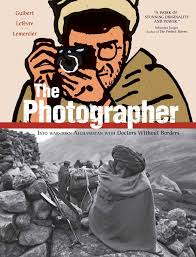
[READ: February 7, 2016] The Photographer

I loved Guibert’s book Alan’s War, in which he took the words of Alan Cope and put them to an amazing graphic novel.  Well, he is back again doing the same thing with the words of famed photograph Didier Lefèvre.

Didier Lefèvre died in 2008, but before he died he left a legacy of amazing photojournalism.  That includes this trip to Afghanistan which he took with the team from Doctors without Borders.

Alexis Siegel translated this book again, and he offers an excellent introduction which not only explains Lefèvre’s life, it also gives context for everything tat these men and women were up against in that war-torn region.

As mentioned Guibert draws out the story that Lefèvre told him.  But this book is different from Alan’s War in that it also uses the photos that Lefèvre took.  Guibert fills in the gaps where Lefèvre, didn’t or couldn’t, shoot.  And there was a lot he couldn’t shoot. (more…)

Read Full Post »

SOUNDTRACK: mohawk CHELSEA WOLFE-Tiny Desk Concert #507(February 12, 2016).

chelseaI know Chelsea Wolfe from my fiends Liz and Eleanor who are fans of her. I have her album Pain is Beauty, which is atmospheric and gothic and reminds me of Siouxsie and the Banshees.

For this Tiny Desk, she strips away all of the band and noise and plays just her electric guitar (with some major fuzz) and sings (with some looping as necessary). I’m especially intrigued that one of her strings seems to be ever so slightly out of tune, which brings a really interesting tone to her echoed guitar playing.

Her voice is really pretty.  On the record I’d been trying to think who she reminded me of.  I hears Some Siouxsie Sioux, but in this set it’s someone else and I just can’t quite place it.

“Maw” really showcases her voice as she sings a lot of lines that soar, ever so briefly, and her voice sounds really powerful.  There’s a whole goth kind of tone going on with her low guitar and her echoed voice.  I especially like the end of the song where she wordlessly sings as her guitar echoes to a close.

She doesn’t talk between songs.  And immediately she begins “Crazy Love.”  This song has a beautiful melody and great singing but with a  very dark overarching feel.  I saw that her music was described as “doom folk” which certainly makes sense.

I like “Iron Moon” best.  The slow riff in the beginning and the way her voice seems to want to crack but never does, it’s really powerful.  And the way she always sounds great while she hits those big notes.  It’s a great set and a rather unique sound for her.

It’s also nice to hear her talk at the end, just to know that she actually spoke to the people there.

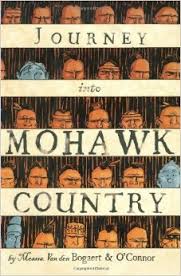
[READ: February 27, 2016] Journey into Mohawk Country

Harmen Meyndertsz van den Bogaert was only twenty-three in 1634 when he ventured into Mohawk territory in search of the answers to a pressing question: where were all the beaver skins that the Indians should have been shipping down the river?  And he wrote a journal of his experience of traveling into the future-New York State in the dead of winter accompanied by the delegates from the Mohawk tribe.

George O’Connor has taken van den Bogaert‘s diary and used it word for word (after being translated by Charles T. Gehring and William A. Starna in 1988) to create a visual representation of this journey.  I know O’Connor mostly because he is the editor of First Second’s Fables and Fairy Tales collections.  I gather he is also an illustrator, although this is my first exposure to him. (more…)

Read Full Post »

vamplove SOUNDTRACK: DO MAKE SAY THINK-You, You’re a History in Rust [CST045] (2007).

rustYou, You’re a History in Rust feels very different from DMST’s previous album.  That record felt kind of insular and tight.  This one feels expansive and experimental.  Like the first song which has multiple sections that feel completely unrelated and which are only connected by silence.  Or the fact that there are lyrics in a song, or even a fairly conventional song.

“Bound to Be That Way” This song opens in a peculiar way.  There’s a drum rhythm, that slowly builds and some piano chords are laid over the top. This goes on for about 45 seconds and then fades out.  And then a new melody–completely different–with horns and guitar peeks its way out. And then it too fades.  Then around 2 minutes a pretty guitar melody comes through followed by big crashing distorted drums. Eventually a new riff enters the song and it really starts grooving.  It’s fantastic, but it too is just a portion of a song which ends at around 4:30.  And then another new section comes in. Then acoustic guitar riff is counterpointed by some horns.  The final melody is the catchiest one of the bunch and it ends this strange song on a high.

But if that was strange, “A with Living” offers the biggest shock to fans of the band.  There are words in this song!  And they are sung! Words were co-written and sung by Alex Lukashevsky and the Great Lake Swimmers’ Tony Dekker.  Akron/Family also joins in doing “oohs” and “ahs.”  It opens with rumbling drums and then the singing begins.  The song has a conventional verse chorus verse structure with big horns.  It’s catchy (the vocals are great).   But it’s also a 9 minute song and at 4 and a half minutes the song moves way from the melody and enters a lengthy instrumental section with deep rumbling guitars.  The chorus of voices returns briefly before the mellow guitars lead us to the end.

“The Universe!” is one of my favorite DMST songs.  It rocks and rollicks.  It has two notes and then five bashing chords.  Repeated several times.  It’s one of the most straightforward songs they’ve done.  It has screaming guitar solos and a cool sliding bass. It’s also very raw sounding, with all kinds of noise floating around it.  And just like that, it’s gone.  Seguing into the quiet, “A Tender history in rust” which opens with processed guitars or keyboards, layered upon each other.   There are voices fighting through (saying all kinds of sounds—including laughing), before it switches to a pretty acoustic guitar riff.  It’s a delightfully conventional folk melody–another unusual addition for the band.

“Herstory of Glory” has another pretty acoustic guitar melody with some rattling drums (in the right ear).   Then there’s a rumbling bass and distant voices before more and more instruments add to the beautiful song–pianos, trumpets, claps.

“You, You’re Awesome,” is the shortest song on the disc at under 4 minutes.  It opens with slow electric guitars and a e-bowed solo.  After a minute or so, the rest of the band comes in with a slide guitar and banjo making a kind of sloppy folky romp.

“Executioner Blues” is another favorite.  Its 8 minutes long with some lovey guitar riffs and sounds.  It opens with some big guitars and a repeating riff.  A martial drums enters the song and keeps it moving until the next big section.  Horns repeat a similar melody and then a romping bass guitar takes over.  More instruments kick in making the song noisy and slightly distorted.  There’s piano trills, glockenspiel, electric guitar, noises and more.   and the instruments all go up the scale slowly for a few bars and then play a punch of staccato notes.  It’s rather dramatic.  After several permutations of this, they just keep going up and up the scale until the reach the top and then they gradually descend again.  The last minute is a series of quiet bass notes, as if everyone has totally come down from that intensity.

“In Mind” is a quiet disc closer.  A simple guitar melody, it is joined by banjo and trumpet.  Then some bass lines come in followed by a very distorted chorus singing “When you die, you’ll have to leave them behind/You should keep that in mind/When you keep that in mind, you’ll find a love as big as the sky.”  The disc ends with some quite banjo plucking.

This disc goes all over the place and really explores different avenues.

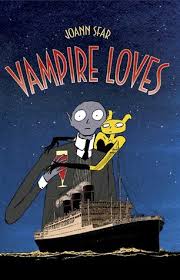
[READ: February 10, 2016] Vampire Loves

Joann Sfar created Little Vampire (and apparently about 100 other comics, some of which have been translated into English by Alexis Siegel and published by First Second).  Of the things I’ve read by him, (and there have been a few) I enjoyed this the most.  It seems like a lot of his books (like Little Vampire) are for kids, bu this one is absolutely for adults (there;’s curses in it and talk of sex and everything).

There are four stories in this book (I just learned that Sfar has written six in total, so maybe there will be more translated). After the third book in this collection, there’s a question as to whether or not Ferdinand, the vampire in this story is Little Vampire.  There’s a little drawing of Little Vampire which says that Ferdinand is him.  “But vampires don’t grow up!  No, but they can grow little.  Ferdinand was me before!  You mean that before being little you were grownup? Yes.”  So there’s that sorted.

“Could Cupid Care Less?” starts us off with Ferdinand the vampire’s woes.  His girlfriend, Lana, (a kind of plant creature) has just come back.  She cheated on him, but turns the conversation around to say that it is his fault–if he weren’t so jealous he never would have found out.  He freaks about this and she storms off again.  Furious, he sets off for his nightly feeding.  Ferdinand is a nice vampire–he takes little sips and only with one fang so it looks like mosquito.  While he is feeding on a woman, a red-haired vampire storms in and shows him how to do it right.  She is a vixen with an ankh necklace and after feeding, she comes on to Ferdinand hard.  She says she likes old, proper-looking vampires–not goth wannabes.  She brings him back to her house but before they can do anything, her sister walks in.  She’s also red-haired and has a shapely figure and actually has more in common with Ferdinand.  And that’s when we learn that the first woman’s name was Aspirine and her sister’s name is Ritaline (ha!).

All of the stories cut back and forth to different sections.  So we cut over the Lani who is staying with the Tree Man.  He is trying to hit on her, but she’s having nothing to do with it.

We return to Ferdinand where he just can’t get rid of Aspirine, even when he wants some alone time.  He can’t get a woman he wants and can’t get rid of the ones he doesn’t.

“Mortal Maidens on My Mind” opens with a Japanese woman meeting Ferdinand in Paris and falling for him.  They do all kinds of things together and she even writes home about him.  But Ferdinand had to return home and that was the end of that.

We cut back to the Tree Man who is still pining for Lani but is having no luck with her.

Back home, Ferdinand runs into the man who slept with Lani, Michael.  He also argues that it was Ferdinand’s fault that things wound up as they did.  He says that he was just looking for fun.  He didn’t want to hurt anyone, so why did Ferdinand have to get involved?  After a fight Ferdinand leaves to go to a bar where he tries to hook up with a woman but it all falls apart.

Then we cut to a man who has created a golem.  He wanted the golem to do bad things, but the golem is so kind that he couldn’t possible have made the him do the evil things he planned.

The postscript of the story contains a few notes on the protagonists of this story which sort of retroactively tries to make sense of the seemingly disparate story lines and lets us know how these characters belong here.

“Lonely Hearts Crossing” shows Ferdinand on a cruise.  But first we meet a woman named Alas, and her spiritual ghost-creature-friend named Sigh.  Alas is looking to score with the captain of the ship (who is the invisible man).

Meanwhile Lani is going shopping with Tree Man.  He has become her buddy and he can’t get out of it.

On the ship, Ferdinand runs into a werewolf who turns into a wolf when he sees a girl.  He only transforms back if he can kiss a girl.  But he is a such charming creature that he has no problems scoring–much to Ferdinand disgust and amazement.

The story turns very exciting as there are armed criminals on board and a shootout.  And by the end of the story Ferdinand is making out with the spirit ghost creature (who teaches him how to go through walls which turns them both kind of ghostly for a time).

“Moonstruck Post Mortem” ends the book with Ferdinand trying to pick someone else up.  His conscience is bothering him lately though so he manages to get rid of it.  The woman is interested in him but already had two boyfriends so she kind of blows him off.

The scenes shifts to Ferdinand at the police station.  He’s not n any trouble.  in fact, the police would like him to help with their investigation of suspicious murders.  Since he’s nocturnal they figure he can look at night.  That’s how police work, right?

Ferdinand decides to go out drinking again. He meets a woman he likes, but she seems disinterested. So he quickly moves on and finds a  creature who is into him.  But he is quickly utterly disgusted by her.  And the first woman just came back. Oh no!

Frustrated, he leaves and goes to see the dentist–because the dentist has some secret information about the investigation. But before he will give the information to Ferdinand, he needs to give him a compete check up.  By the end, he tells Ferdinand not to get involved. And as the story progresses and the criminal is found…  Ferdinand is shot and thrown into a hole!  Can Ferdinand’s conscience come to the rescue?

The whole story concludes with Ferdinand going back to find Ritaline (but of course finding Aspirine instead).  She offers to let him bite her–but when one vampire bites another it’s “catastrophe.”

It’s a totally nuts book but very funny.  Another fun book in my #10yearsof01 February.

I think the reason I don’t enjoy the Sfar books as much as I might is because they are printed so small.  I don’t know what the original size was, but the format makes everything feel really squished.  This makes the dialogue hard to read and means you can’t see all of the details that well.  I think if these books were bigger it would really help their appeal.

Read Full Post »
little vamopSOUNDTRACK: DO MAKE SAY THINK-Winter Hymn Country Hymn Secret Hymn [CST025] (2003).

hymnThis album, at least according to the liner notes, seems to be broken into three sections, as the title suggests.  Although there is no explicit attachment of a particular hymn to the songs, there is a gap between the listings, giving each section three songs.

“Federica” is 9 minutes long and opens with a very lovely slow guitar melody.  Then the drums crash in and the song doesn’t change so much as intensify.  At around 3 minutes the song pauses before a loping bass adds to the mixture and the songs gets bigger and bigger, and even a little funkier. When the distorted guitar comes in at 5 minutes, it’s hard to believe it’s basically the same song all along.  It builds to a cacophonous explosion and then settles down again. A new style emerges—slow and plaintive with mildly distorted guitars. But they can’t stay muted for long. The distorted guitar comes back and forces the song forward with some distorted bass and other noises until it resumes a reprise of the original guitar melody.

“War on Want” is only 2 minutes long.  It is mostly strings that seemed to be looped in some way.  There haven’t been a lot of strings in DMST records so far, so this is new.  They drift slightly out of tune as they introduce the 3rd song “Auberge le Mouton Noir.”  The song opens with some crackling noises and some pretty, slow chords. which resolve into a simple riff.  The song builds, growing faster with a great propulsive beat. I like that it switches back and forth between the chords and the guitar riff.  Is that a slightly out of tune bass guitar before the ringing guitar solo takes over?

The second section begins with “Outer Inner & Secret.”  It’s ten minutes long and opens with an interesting bass line and guitar motif. It’s quiet and insistent, kind of dreamy. After exploring some quieter avenues some feedback squalls float in and out.  About 4 minutes in the song builds, but it quickly recedes only to build again and recede once more.  For the third build the drums kick in and the song launches in a louder direction for a few measures.  But just as you think it’s going to take off for a while, it settles down and then comes back to a quitter style with martial beat and keyboards.   The remainder of the song switches between loud building guitarists and quitter moments with just bass and drums.  For the last-minute or so horns burst forth and then the music drops away except for the horns, which end the song with a plaintive melody.

The 4 minute “107 Reasons Why” is a slow horn & guitar melody song.  There’s some interesting sounds that play over the top of the delicate melody, including a nice horn line.

“Ontario Plates” is 7 minutes long and opens with very jazzy drums and bass–it’s rather noir with a quiet saxophone.   Once the sax plays over the top it just increases the jazziness. DMST has always had a jazz feel but this one really pushes it about as far as the band has gone. The drums start to come to the fore and I love the way about 3 minutes in the drums morph into something else and the song almost imperceptibly switches into a new song entirely. The bass takes over and a new riff enters the piece. About 5 minutes in, the song switches to a very bright and uplifting motif–big horns, bright guitars and a catchy riff.  It’s quite lovely.

The third section opens with “Horns of a Rabbit.”  This song introduces big drums and kind of electronic bass sound.  About two minutes in the noise beaks through—bashing guitars and intense drums.  It even includes a pretty wild guitar solo. I like how the song (which is only 4 minutes (kind of disintegrates on itself before merging into the two-minute “It’s Gonna Rain,” which may indeed be simply the sound of rain on a tin roof.

The final track, the 7 minute “Hooray! Hooray! Hooray!” opens with some synths sounds—unlike anything else on the record.  And then a pretty guitar intro mixes with some lovely horns.  It’s probably the most delicate thing they have created.  After 3 minutes the occasional guitar swirls grow louder and it grinds it way to a happy and uplifting keyboard riff.   Then a bunch of surprises for DMST: A slide guitar plays a little solo and then, most surprisingly, a chorus of voices sings the melody.  The ending slide guitar sounds like it could come from Mercury Rev or The Flaming Lips.  If you listen closely, you can hear people shouting Hooray! in the background.

This album feels a bit more claustrophobic than their others, and while I like pretty much all of the songs, I really like their other albums more.

[READ: December 20, 2015] Little Vampire

Joann Sfar is responsible for the Sardine comics which I kind of liked but mostly didn’t (I think that may have been because of the uglyish drawing style).  But here Sfar has another series called Little Vampire.  (I also just learned that Joann Sfar is a man, so apologies earlier, but I think that’s an understandable mistake).

This book collects three stories into one volume, all translated by Alexis Siegel.  Each story is about 30 pages.  And they follow the “life” of little vampire.  He is a sweet boy with a bald head, big eyes and pointy ears.  He lives in a castle with call all kinds of undead people including his dog Phantomato (he is bright red and rather devious) and several other monsters.

“Little Vampire Goes to School” introduces us to the home where the monsters live.  As the undead are partying, Little Vampire comes down and says he wants to go to school.  The others are horrified, but he won’t give up the idea. He says he’s bored and wants to meet other children (most of the undead are adults).

Little Vampire’s mother (who is strangely pretty in her weird design) and the other elders allow him to go to school, but he can only go at night when it is closed.  So the undead come and all attend school with him.  The class is taught by The Captain of the Dead who is an old dead pirate. (more…)

Read Full Post »

deogrataisSOUNDTRACK: JOSH RITTER-Tiny Desk Concert #119 (April 11, 2011).

ritterNot too many performers mention the actual day that they are performing their Tiny Desk Concert.  But Ritter mentions Valentine’s Day twice during his set so I thought I’d post it on Valentine’s Day even if the actual date of the posting is much later.

I don’t really know Ritter, I’ve heard of him, but I’m not too familiar with him.  Nevertheless, I was quickly won over by him.  He is charming and polite and is certainly having a good time (he even laughs at some lines in his songs).

His first song “The Temptation Of Adam”sounds vaguely familiar.  The melody is very catchy and his voice is strong and excellent.  Lyrically the song is quite interesting.  I especially loved this section: “We passed the time with crosswords that she thought to bring inside/ ‘What five letters spell apocalypse?’ she asked me/ I won her over saying, W.W.I.I.I.’/ She smiled and we both knew that she misjudged me.”

“Lark” is a faster song, but still very folksy and clever.  I love that although the melody is fairly simple, the way he plays it (with very fast fingerpicking) makes the song sound more complicated.  “Rattling Locks” is a dark minor chord song, louder and heavier than the other two.

The site says there is an audio only track called “Pale Blue Eyes,” but I can’t find it.  For the last track, his 2003 song “Kathleen,” he introduces the song by saying, “I think Valentine’s Day is the most awkward self-imposed holiday — even worse than New Year’s — so this is an awkward song.”  It’s a louder song, with Ritter’s voice reaching great intensity.  It’s a great way to end the set.

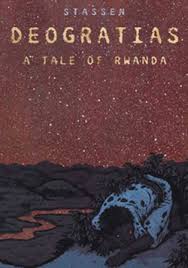
[READ: February 14, 2016] Deogratias

Here’s another story that I would never have read if it were not for First Second’s #10yearsof01 challenge.  The thought of reading a story about the genocide in Rwanda just seems to depressing to undertake.  And yet in the spirit of reading things outside of your comfort area, I decided to read this this weekend.

And I am incredibly glad that I did.

I feared that this story would be one of rampant genocide–struggle and death and mutilation and everything else that I could imagine.  But rather, what Stassen has done is created a story about how the toll of genocide can impact one person.  Yes, it affects him directly and the story is incredibly sad, but it was a very different story than I expected, and it was so personal that it made it more tragic without having the oppressive unreality of millions of dead people in the plot.

The introduction alone is worth reading, as translator Alexis Siegel gives a brief summary of the Rwandan tragedy.  I’ve always found the conflict to be really hard to grasp.  Hutus and Tutsi, a privileged minority, a brutal majority.  The back and forth was so hard to grasp, and the names of the tribes were similar as well.  It is hard for a lazy person to keep straight.

But I found Siegel’s explanation to be succinct and very effective. (more…)

Read Full Post »

« Newer Posts - Older Posts »