Feeds:
Posts
Comments

Archive for the ‘Translators’ Category

SOUNDTRACK: VÄSEN-Tiny Desk Concert #720 (March 23, 2018).

Back in 2012 I had my first exposure to the nyckelharpa at Scanfest.  And now, nearly six years later Väsen (who did not play at Scanfest that year) have brought the nyckelharpa to Tiny Desk (and the blurb’s description is hilarious).

Väsen came to the Tiny Desk with just three instruments, but all together it was a 30-string sonic blast of 12-string guitar, viola and nyckelharpa (a fiddle with keys — think 15th century keytar).  Guitarist Roger Tallroth, violist Mikael Marin and nyckelharpist Olov Johansson have been a touring troupe for more than 25 years with 18 albums filled with adventure, amusement and virtuosity. They span the wide emotional range of Swedish folk music, equally haunting and celebratory. There are some similarities to Irish jigs, reels and waltzes that I’m more familiar with, but this music is more ear-bending, with more surprises than I’m used to in traditional string band folk music.

The band plays three instrumentals (all of their songs are instrumental) from their new album Brewed.

It’s fascinating how much these songs sound like Irish jigs and reels (fiddle and guitar after all).  There’s a looseness to them that makes them fun and enjoyable–perfect for drinking and dancing.  Especially a song called “IPA-Gubben” which means, “The old IPA man.”  On introducsing the song Olov points to Mikael and says “this is the old IPA man, he brought this tune as a birthday present when he turned 50.”

It’s possible that the nyckelharpa is quieter than the viol as it’s not always unique sounding amid the music.  But there are a few times when the nyckelharpa is playing a melody that stands out and you can really watch and hear Johansson shine–I had no idea the instrument could be played that quickly either.

Not to take anything away form the other two.  The viol plays some incredibly fast runs and melodies and the guitar while primarily used for chords, also adds in some fast runs.

“Väsenvalsen” was composed by Mikael.  It is the first ever Väsen waltz.  The song starts slowly and then dramatically takes off with some wonderfully fast (and very Irish-sounding lead lines on both viol and nyckelharpa.  I love in the middle when the nyckelharpa plays a harmony melody over the top of the viol so you can hear both instruments clearly.  It has a lovely ending with the nyckelharpa playing high notes to end the song.

“Sommarpolska” means “summer polka.”  It was written by Roger and has a  lovely melody that grows and subsides as the instruments ebb and flow.  It’s a joyful dance song and a wonderful concluding piece.

[READ: January 31, 2018] “Two Women”

In typical Amos Oz fashion, this was a rather short story.  It was translated by Sondra Silverston.

Osnat wakes before her alarm and passes the apartment occupied by Boaz and Ariella.  She thinks about what happened two months ago as if it had happened to strangers many years ago.

But it was only two months ago Boaz told Osnat he’d been having an affair with Ariella.  So he’s leaving her and moving in with Ariella (who lives in the same building).  Their affair began one day when Boaz came to fix a broken tap.  Boaz prepared for a huge confrontation, but as he started to ramp up his argument, she cut him off: “Go.  Just go.” (more…)

Read Full Post »

 SOUNDTRACK: RHEOSTATICS-The Horseshoe Tavern, Toronto, ON (March 29, 2007).
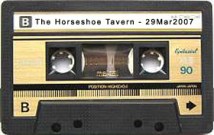
Visit this link for all kinds of information about this show (labelled Good)–interviews, blog posts, photos (and even links to myspace!)

So this is the final show before the band;s final show (before they reunited).  Martin’s voice is still out, but he tries valiantly.

The Horseshoe Tavern show opened with a lengthy intro of Dave mucking about on acoustic guitar.  He announces Tim Vesely on the bass and joining us tonight Mr Ford Pier on the keyboards.  That intro segues into “Easy to Be with You,” and this proves to be one of my favorite version of the song.  They are having such a lot of fun with it the “do dah do dah” is terrific and big and I love that the “…to Harmelodia” line is done entirely on the synth.  And while we’re at it that Martin Tielli on the guitar and hat.

Martin: “welcome to our penultimate show.”
Dave: “now I know what ‘penultimate’ means.
Mike: “Hot?”
Dave: “I always that it meant better than the best.”

Martin takes lead on “Aliens (1988).”  He doesn’t sound great but he valiantly tries his best–whispering when he needs to.  As has become customary, Tim plays the “Artenings Made of Gold” riff during the middle section of the song and then they sing it at the end.  When he whispers it sounds good–although not as good as his real voice.  Ford asks what an artening is “I’ve been wondering this for am awfully long time and I think I have a right to know.”  Martin whispers: “a simple precious object.”  Tim: “we’ve narrowed down that they’re made of gold.”  Ford: “as opposed to artenings made of dung I suppose.”  Dave: “No there are those.”

“This next song is from our Bahamian period… hanging with the Baja Boys … and Ozzy.”  Tim says, “This is the song about our cats at home.  They’re still around Alfalfa and Wolfman.”  A great version of “Introducing Happiness.”

Martin says “Christopher” is about growing up in Ontario. I wrote it when I was quite young.  There’s a cool jamming solo in the middle that Tim gets in on as well.

At the end of “King of the Past” Tim says, “nice song, Dave…  Martin: One of the many songs that Dave writes and others sing.  Tim: And finish for him–i wrote the third verse (try to make sense of it).  Dave: “That’s what a band is all about… a musical soccer team.”

“I’ve been cursed with a problem that a lot of people have been…”  Dave: “Being Italian?”  Tim: “Listening to too much Marianne Faithfull.”  Martin: “I never know what’s going to come out of my mouth.”  Tim continues: “This song pretty much sings itself.”  Dave: “We’ve got the Hitmaker 2000.”

Martin plays “P.I.N.” and says, “I’ll do the rock and roll thing and ask for help for you to sing along.”

“Mumbletypeg” opens with Dave saying, “have you heard the news, there’s going to be good rocking tonight.   We’re going to bring back all of the 80s catch phrases because we lived through it.  We suffered through … a few good moments in a sea of piano key ties.   Tim starts “calling out the chords” –give me a C minor.  Tim “That’s it.  That’s enough.  Two C minors are pretty good.”  Dave: “Whatever you want, Tim. G?  A7?  D?  I know all the chords.”  Tim: “How about some handclaps….  No I don’t like the handclaps.  I liked the C minor better… wait C minor with handclaps.  Mike: “I feel like Tyler Stewart back here–keep going Ty! Dave: “You don’t have enough splash cymbals to pull of the Tyler Stewart.”  The song sounds great.

“Pornography” is sent out to all our american friends.  And then as Martin plays “In This Town” he says, help me out i haven’t played this in a year.  What’s the verse everyone?”  Everyone happily sings along.

Dave: “So we’re breaking up and it feels alright.  We’re all going to be a mess tomorrow.  When are we going to have a big stage cry?”  Mike: “Are you going to play the note that makes everybody weep?”

He’s not, instead they play a lovely “Loving Arms.”

And then Paul Linklater “The Scribbled Out Man” will play with them.  Mike says, “You guys got a nice drummer (It’s Don Kerr).  Tim: “And so do we.”  Mike: “I’m not threatened.”

Ford asks how many people have been in the Rheostatics.  Dave: “define ‘in.'”  Does Seth the Magician count?  He wasn’t into us.”  Then some solid advice: approach with caution when playing with magicians.  Dave: “I gotta be careful that Mysterium doesn’t put a curse on me.  Then more words of wisdom from Geddy Lee: “always take your wallet on stage.”  Tim: “And I’ve not lost a dollar since I’ve been in this band.”

Martin tells a story about that one time the woman with the short skirt and the diaper was dancing at the Town Pump.  People were pointing at her and after the show she and a guy with a harmonica and a neck beard were going through our coats on my amp.  She was wise to the Geddy Lee advice.  Dave: “It actually was Geddy Lee.”  Martin: she was doing splits on stage really hard in her adult diapers–the diapers must have been for cushioning not pee pee. Luckily we never have any money so martin didn’t lose anything.”

Martin: I went to see Colin Hay… some people after they finish… they go on tour and sing their songs and they spend about half an hour talking about how I wrote a fucking song.  (Dave: I think you’re selling Colin Hay a little short”).  And the guy from The Kinks and they’re brilliant and I love them but get off the stage already.  Dave: “Colin Hay talked about being drunk at the US Festival  — he was wearing a brown suit and decided to shit his pants rather than using the porta porty.”

Dave: “That’s where I’m headed story and song isn’t it inevitable.”  Mike: “Live and incontinent.”

I wrote [“The Ballad Of Wendel Clark”] about being a skinny effeminate Etobiocokian kid, angry in my basement and I didn’t like the guys who liked hockey at the time (Tim: at the time?).  “Hey, I got into the playoffs last year.”  The song features the bridge from Stompin’ Tom Connors’ “Bridge Came Tumbling Down”).  There’s a wild picking solo from Paul Linklater (sounds nothing like Martin’s playing).  Paul’s first band was called Gig Vest from Justice, Manitoba, they totally blew us away and we’ve been fans of Paul’s ever since.  Tim: “but we mostly prefer the early funnier stuff.”

“Song of Flight” sounds gorgeous and segues nicely into a wonky and fun version of “Song of the Garden.”   They play a noisy weird jam. Dave: “take it up to A.  they start playing “Radios In Motion” by XTC (they keep chanting “new science” which leads to Ford singing “She Blinded With Science” and playing weird chords.
Dave starts off “Queer” by singing the chorus of “Big Leagues” by Tom Cochrane.

They send “Queer” out to Hawksley Workman.  After a few verses it segues to a slow “Saskatchewan” which eventually leads back to the conclusion of “Queer.”

Somebody yells and insanely long “yeah” it lasts about 8 seconds as Dave starts singing “The List.”  I assume it’s an early version.  It’s followed by another acoustic song “My First Rock Show”  When he gets to the Massey Hall line, he starts a “Massey Hall” chant.

Hey Ford, what was your first rock concert  Ford: D.O.A. (that’s too good) my first larger show at an arena the first one my parents knew I was gong to was Big Country in Munich in 1984.  Big Country were kind of the ELO of new wave.  For D.O.A., I had to sneak out because I was young.  Dave:  Do you have a D.O.A. song you can do for us?  It’s only fitting.  Tim Vesely was born to play D.O.A. drums.  Ford starts “The Enemy.”  Then says, they used to give me money to do that.  It’s a fun interlude: “Wonder if Martin has done his cigarette yet.”

For the first encore they play “We Went West” with some input from the other guys-backing vocals and Dave saying “I remember that.”  The songs seems to rock harder by the end.  “Joey 2” is solid and uneventful but his voice is pretty much gone for “Self Serve Gas Station.”  He whispers some of the moments but his voice is lost on “the morning time has come!”

“Michael Jackson” is pretty quiet (with Tim singing “abc,123”).  Finally Dave asks Tim: “Do you like the rock?”  Tim: “I don’t know I like the classical, I like the jazz.”  Dave: “Martin’s got the rock, Timmy’s got the roll.  Mikey’s got the funk.  Fordy’s got the roll”  Tim:  “I don’t feel it…. I’m starting to feel it…. I still don’t feel it.”  An extended ending started by Tim on bass with Martin adding solos.

Then a quick run through the “Green Sprouts Theme” with Tim calmly saying “from the ground” but then screaming, take it to the bridge!”

They came back out again for “Legal Age Life” w/ Peter Elkas and Ben Gunning from Local Rabbits (and no Martin who was having a beer and a chat at the back of the bar for this encore).  Four fans sings verses.   They all try to jump to the chorus too soon, but they sound good.  Then it’s time for a guitar solo or a bass solo we’ll have one of our guests–the shaggy guy or the clean cut guy (clean cut!)  The guy plays the solo.  Then the shaggy guy plays a solo.  And then the segue into “Record Body Count” which Ben or Peter sings.

Then they talk about the weirdest fans:

  • the girl Julia who brought a stuffed chicken to all our gigs
  • Kai the Ass Dancer guy with irreverence sweatband who did creative dance to our early days
  • the guy with a Riverdance headband who did creative dance to our early songs.
  • the gypsy from Dawson City

“Oh, there’s Martin.”  They call him up from the crowd, it’s pretty neat watching from the crowd.  Tim: “make sure you know the words.”  There’s talk of Padre Pio and bilocation.  They send “Stolen Car” out to John Tielli. Martin: “he’s my brother….I mean literally.”

They apparently ended the show with an acoustic “Northern Wish,” although there’s no recording of it.

[READ: January 6, 2018] “Take Me”

I have only read one other piece from Lispector and it was peculiar, but I liked it.

This one was peculiar but I did not like it at all.  I’m willing to accept that since it was an excerpt from the novel The Chandelier, it was less clear than it could have been.  But no, this was just an unpleasant read.

It begins with Virginia looking in the mirror . The entire story is in her head.  She knows she looks lovely and she wonders “who will buy me?  I want someone to buy me so much.  I want someone to buy me so much that…that…that…I’ll kill myself.”

Then she goes out on the town, kills a dog (seriously) and asks a disgusting man to take her. He gets all excited and then she stepped on his face and spat on him. (more…)

Read Full Post »

SOUNDTRACK: CORNELIUS-Tiny Desk Concert #718 (March 19, 2018).

I was familiar with an artist known as Cornelius, but I guess I didn’t really know anything about him, because this blurb came as a total surprise:

As Cornelius, Keigo Oyamada has stretched his vision across frenzied indie rock, lush ’60s-style pop, psychedelic funk and glitched electronics, all deconstructed and reassembled like a neon cubist-pop sculpture. After a little more than two decades, no one can really imitate his complex cool.

Sporting a pair of sunglasses (always), Oyamada recently brought his band from Japan to the Tiny Desk on a rare U.S. tour, including his longtime collaborator and Pizzicato Five session musician Hiroshisa Horie, drummer Yuko Araki (Mi-Gu, Cibo Mato’s live band) and synthesist Yumiko Matsumura (Buffalo Daughter). They’re all musicians who tease and poke at music’s fringe territory, but still know how to make a song buzz and pop with gleeful curiosity.

So I guess I know Cornelius from Pizzicato Five.  But I was not prepared for the trippy synthy music that this band created.

Cornelius performs three very different songs from last year’s Mellow Waves. There’s the robotic groove of “Helix/Spiral,” which repeats and mutates the same phrase and melodic fragments in a delicate and strange dance.

“Helix/Spiral” is all synth with his vocals auto-tuned into robotic sounds.  The lyrics are mostly him speaking those two words over and over (which I thought was saying Alex Spy-lo, but that is clearly me not understanding his accent.  The synths are great.  One is doing cool trippy backing sounds while the main riff is a disjointed melody that begins confusing and ends as an earworm.

“In a Dream” is a star-swept landscape that invites the subconscious to search for meaning, its keyboard flourishes and light acoustic strums so breezy you could almost call it a kind of retro-futuristic yacht rock.

I love the full synth sound (and swirling bass of “In a Dream”).  I believe he is singing in Japanese.  The chorus of the song is so incredibly catchy in an almost light folk sort of way.

But set closer “If You’re Here” is the real marvel to behold live, as the band performs at different tempos, gradually solving a polyrhythmic puzzle of a slow jam. The song also features one of my favorite guitar solos in recent memory — it’s unflashy, but twists, spits and resolves in the most unexpected ways.

“If You’re Here” is a longer song–nearly 7 minutes–with a kind of slow building feel.  Those electric guitar solos from Cornelius himself are very cool indeed.  There’s a lengthy instrumental coda at the end which is very trippy and cool.

I really enjoyed this set and every new listen brought in something new.

[READ: January 9, 2018] “The Send-Off”

This is an excerpt from a novel called Inhumaines which has just come out in English (translated by Camille Bromley).

The previous piece that I read from Claudel was pretty surreal.  This one is as well.

It begins

Last night, Roger Turpon, from dispatching, invited us to his suicide.  There were twenty of us.  Family and friends only.

Turpon has been talking about killing himself for a while now, but boy “A suicidal person is tiresome.”

Finally Dupond helped him out by calling him a coward, saying he won’t do it.  They stood in the parking lot in mid-autumn with leaves blowing all around them.  “It was lovely.”

Three days later they received the invitation: Mr and Mrs Turpon are delighted to invite you to Roger’s suicide this Saturday. (more…)

Read Full Post »

SOUNDTRACK: MAL BLUM-“See Me” NPR’S SOUTH X LULLABY (March 13, 2018).

I feel like I was pretty lucky to see Mal Blum just days before they went to SXSW and made a Lullaby.

Without the band, Mal sings more quietly which certainly lets you hear the words more clearly–and Mal is a gifted lyricist.  But Mal also writes catchy tunes.

I love that the verses are quiet and muted, but there’s loud strumming in between.

And as the song nears the end, the intensity ratchets up for a line of “why can;t they see me?”  …before the quiet conclusion: “I was right there.”

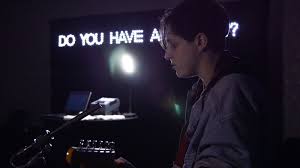
Mal performs in front of the Future of Secrets art installation.

The Future of Secrets was conceived by Sarah W. Newman in collaboration with Jessica Yurkofsky, Rachel Kalmar and metaLAB at Harvard. The installation, which is part of the SXSW Art Program, asks those attending to anonymously type a secret into a laptop and in exchange someone else’s secret is given to you. Those secrets are then projected on a wall, which is the backdrop for this video.

“‘See Me’ is an unreleased song that will be on our next record (sometime next year),” Blum tells NPR. “It’s about the disparity between how one sees oneself, or the struggle of being seen as we are, versus how others view us, which can result in an unintentional hidden self or a perpetual feeling of invisibility. Being transgender informed the song, but it’s not exclusively about that.”

[READ: September 10, 2017] “An Education”

This is a short piece about two girls in school  I assume it is set in Hungary as it is translated from the Hungarian by Len Rix.

The narrator said she was always a hard-working child filled with self-discipline.  But her parents never understood that she did it all for herself–not for them or to make anyone else happy.  Her father was the school principal and was absolutely proud of her–she was hardworking and punctilious like he was.

Her mother, on the other hand, was clearly more loving to her sister Blanka–when she lost her temper with Blanka “there was something frenzied and indiscriminate about the way she pummeled her.”  Her father tried to push her very hard to make her learn more.  Her father was far more proud of the narrator than Blanka, but “no one was ever as proud of me as Blanka [was].” (more…)

Read Full Post »

 SOUNDTRACK: RED BARAAT-Chaal Baby (2010).

Red Baraat is one of the few bands to play two Tiny Desk Concerts. I’ve also had the fun experience of seeing them live.

The band was founded by dhol player Sunny Jain as a way to bring Bangrha music to Brooklyn.  The band speaks to many disciplines and plays a wonderful mash up of styles.  So while the foundation is bangrha music, there’s elements of funk, go-go, Afro-Cuban, Brazilian, and jazz–all designed as one big party.

This debut album features the dhol, soprano and tenor sax, trumpets, trombones, sousaphone and drums and percussion.

To my ear the sousaphone is the grounding instrument–often standing out as the bass while the rest of the brass is playing melody or soloing.  And yes, sometimes the sousaphone gets a solo or two as well.

I love the vocal interjections–whether nonsense or actual words I can’t tell, but they are often fast and fun–good punctuation to the melody.  And the band knows melody.  The main riff of “Tunak Tunak Tun” is a blast.  And the vocal phrases are there to humanize the party.  I didn’t realize that this was a cover of Bhangra pop singer Daler Mehndi’s song of the same name, but that explains the catchiness.

In fact there are several covers on the album.  “Hey Jamalo” (a reworking of Malkit Singh’s popular “Hey Jamalo Tootak Tootak Tootiyan”) opens with a rousing introduction with a solo from dhol.  I rather wish there was more obvious dhol playing (which is so much fun to watch live) but it blends in pretty perfectly with the rest of the music and fits perfectly with the percussion solo in the middle of this song.

They play three Bollywood soundtrack hits “Dum Maro Dum,” “Samaro Mantra,” and “Mehndi Laga Ke Rakhna.” “Dum Maro Dum” has some cool percussion sounds an a real jazz feel–I love the way they stretch out the notes in the middle.

The word Baraat (Hindi: बरात) (Urdu: برات‬‎) means a groom’s wedding procession in North India, West India and Pakistan.  Unsurprisingly, they play two covers of traditional Indian wedding songs “Punjabi Wedding Song (Balle Balle),” which has some fun stop and start melodies and a real marching band kind of vibe and “Aaj Mere Yaar Ki Shaadi Hai” which opens with some dramatic percussion before settling into some very pretty processional music.

But it’s not all raucous party music.  “Arcana” slows things down with a cool riff or two and nice accompaniment.

However, other songs like “Drum and Brass,” escape easy categorization with a clarinet reminiscent of Eastern Europe combined with percussion and melodies from Western Asia.

The title song “Chaal Baby” has some great chanting and dramatic horns moments which I saw described as “the Dirty Dozen Brass Band gone Bollywood” or belonging at a Punjabi football halftime show.

Speaking of marching band, there are a few moments on this album that felt kind of like a marching band to me.  “Mehndi Laga Ke Rakhna” was an example of a marching band vibe.  That kind of sound is hard to avoid (if indeed they are trying to) with that kind of instrumentation, although perhaps that is the inevitable comparison to processional music. My experience is that it works better live than on record.

But songs like the original “Baraat to Nowhere,” showcase a great original melody and some fun soloing.  Nearly every song features a solo by one or more members of the band allowing everyone to show his chops.  And back to that sousaphone–I’ve never heard anyone make sounds like that from an instrument before.  Great stuff.

“Samaro Mantra” the Bollywood song, ends the album on almost a down note.  The melody is somber, the drums are martial.  It’s kind of an odd choice for an otherwise upbeat and celebratory album.  But maybe it works as a calm down after an exiting wedding–time to go home everybody, party’s over.

Sunny Jain – dhol / drumset / percussion ; Rohin Khemani – tavil / doumbek ; Tomas Fujiwara – drumset ; Arun Luthra – soprano sax ; Mike Bomwell – tenor sax ; Sonny Singh – trumpet ; MiWi La Lupa – bass trumpet ; Smoota – trombone ; John Altieri – sousaphone

[READ: January 14, 2018] “Pieces”

I rather enjoyed Hye-Young Pyun’s previous story and was intrigued to read another one.  This one was translated by Sora Kim-Russell.

The previous one was thoughtful and disturbing and so is this one.

In this story, which is surprisingly unspecific about the characters, a man’s wife went missing a month earlier.  She slipped off off of a gorge and was presumed drowned.

He has just gotten a call from the police that a body part has been found and they would like him to identify it.  The part that was found was a right leg. (more…)

Read Full Post »

SOUNDTRACK: ANNA MEREDITH-Tiny Desk Concert #713 (March 2, 2018).

I have never heard anything like this.  From sound to melody, to intensity, to instrumentation, this whole thing just rocked my world.

The melody for “Nautilus” is just so unexpected.  It opens with an echoed horn sound repeating.  And then the melody progresses up a scale, but not a scale, a kind of modified scale that seems off kilter just as it seems familiar.  The cello plays it, the guitar plays it, the sousaphone (!) plays it.  And it continues on in like fashion until only the high notes remain and then a menacing low riff on sousaphone cello and guitar breaks through–a great villain soundtrack if ever there was.  While everyone plays this riff, Anna returns to the keys to play the modified scale.

Meanwhile, the drummer has looked like he’s asleep behind his small kit.  And then 3 anda half minutes in he wakes up and starts playing a loud but slow rhythm.  The guitar begins soloing and as it fades out that main riff begins, now with a simple drum beat–not matching what anyone else is playing, mind you.  The sousaphone (which must have an echo on it or something and the cello pick up the low menace and it seems like everybody is doing his and her own thing.  But it all works amazingly.

So just who is Anna Meredith?

Anna Meredith was a former BBC Scottish Symphony Orchestra Composer in Residence. Two of the three songs performed here come from her 2016 release called Varmints.

Bob Boilen was also impressed when he first saw Anna Meredith live:

I first saw this British composer a year ago, in a stunning performance at the SXSW musical festival. It was one of the best concerts of my life. The music I heard sent me into a state of reverie. If music could levitate my body, this is how it would sound. It carried me away and thrilled my soul. I was giddy for days.

Now, I know this isn’t music for everyone. … But if you know and love the music of Philip Glass, King Crimson or Steve Reich — music that’s electrifying, challenging and sonically soars and ripples through your body — then crank this up.

Lest you worry that she couldn’t translate it to the Tiny Desk (she says they normally have 23 suitcases full of crap so this has been an exciting challenge to squeeze in here)

Out of nearly 700 performances at the Tiny Desk, this is simply the most exhilarating one I’ve experienced. The instrumentation is unusual, with pulsing bass sounds produced by a wonderful combination of cello, tuba and electronics. It’s all rhythmically propelled by an astonishing drummer and Meredith pounding a pair of floor toms. And much of the repetitive melody is keyboard-and-guitar-driven that morphs and erupt with earth-shaking fervor.

The second song, “Ribbons” is quieter.  It’s and new song and it has vocals.  Her vocals aren’t great (“hard when you’ve got the voice of a five-year old boy”) but the melody she builds around it shows that her  voice is just one more instrument (albeit saying interesting words).  Actually, that’s not fair, they are just so different from the noise of the other two songs that it feels very faint in comparison.

It opens with a quiet guitar and electronic drum.  And slowly everyone else joins in.  A nice string accompaniment from the cello (Maddie Cutter), bass notes on the sousaphone (Tom Kelly) and even backing vocals from everyone.  By the third go around the drummer (Sam Wilson) is playing the glockenspiel.  By that time the song has built into a beautiful round and the quietness of her voice makes complete sense.  As the song nears its end, Sam has switches to a very fast but quiet rhythm on the floor tom.

She introduces the band and wishes a happy birthday to guitarist Jack Ross.  She says this is a great present as “so far all we’ve gotten him is an apple corer, the gifts have been a bit low grade.”

They make some gear switches, “we have a bit of a logistics problem with all our gear we can’t quite afford to bring enough glockenspiels, we pass the pure crap glockenspiel  around ans everyone gets to go ‘my turn!'”

“The Vapours” opens with a wonderfully wild guitar riff–fast and high-pitched and repeated over and over.  Anna Meredith adds waves of synths and then in comes the sousaphone and plucked cello.  Then fast thumping on the floor tom propels the song along.  The song slows a bit a Anna plays the clarinet (!).  The song dramatically shifts to some complicated time signature while Anna plays glockenspiel.  After a few rounds, while this complex guitar riff continues the drum and sousaphone start playing a pretty standard beat the contradicts everything else that’s going on and then Anna just starts pounding the crap out of some more toms.

All through this there are electronic sounds adding to the chaos and I have no idea who is triggering them, but it’s really cool.

The end is almost circusy with the big sousaphone notes and yet it’s like no circus anyone has every heard.  When the camera pulls back and you can see everyone working so hard and yet smiling ear to ear (especially Maddie), you know this is some great stuff.

The end of the song winds up with a hugely complicated tapping melody on the guitar and everyone else working up a huge sweat.

I couldn’t get over how much I loved this.  I immediately ordered Varmints and checked her touring schedule.

How disappointed was I to see that Anna Meredith had played Philly just last month and has now gone back to Europe!  I do hope she comes back soon.

[READ: August 30, 2017] McSweeney’s 48

For some reason, I find the prospect of reading McSweeney’s daunting.  I think it’s because I like to post about every story in them, so I know I’m in for a lot of work when I undertake it.

And yet I pretty much always enjoy every piece in each issue.  Well, that explains why it took me some three years to read this issue (although I did read Boots Riley’s screenplay in under a year).

This issue promised: “dazzling new work; a screenplay from Boots Riley with a septet of stories from Croatia.”

LETTERS

GARY RUDOREN writes about using the Giellete Fusion Platinum Razor every day for 18 days and how things were good but have gotten a little ugly.  On day 24 he had a four-inch gash under his nose.  Later on Day 38 it was even worse–a face full of bloody tissue squares.  By day 67 he is writing to thank McSweeney’s for whatever they did perhaps it was the medical marijuana but now his face is baby butt smooth even without shaving.  He wants to change the slogan to Gilette Fusion the shave that lasts forever. (more…)

Read Full Post »

SOUNDTRACK: ROY AYERS-Tiny Desk Concert #712 (March 1, 2018).

I hadn’t heard of Roy Ayers, although I imagine I’ve heard his work somewhere before.  I love the vibes so I was looking forward to his set.

I was a little bummed to hear him singing–I assumed it would be all instrumental. Especially since his songs aren’t exactly lyrically masterful.  But the jazzy funky solos were pretty great.

Roy Ayers [is a] 77-year-old jazz-funk icon.  He sauntered through the office with a Cheshire grin on his face, sharing jokes with anyone within earshot. Accompanying him was a trio of brilliantly seasoned musicians — keyboardist Mark Adams, bassist Trevor Allen and drummer Christopher De Carmine. Later during the performance, pride washed across Ayers’ face as his bandmates took the spotlight. (Be sure to watch as Adams woos not just the room but brightens Ayers’ face during his solo.)

The set began with one of Ayers’ more recognizable hits: an extended version of “Searching,” a song that embodies the eternal quest for peace and love.  The vibes solo at 2 and a half minutes is worth the wait, though.

The lyrics are essentially.  I’m searching, searching, searching searching. It takes over a minute for him to even get to the vibes!  It’s followed by a groovy keyboard solo that starts mellow be really takes off by the end.

During “Black Family” (from his 1983 album Lots Of Love), you’ll hear him call out “Fela” throughout. That’s because Afrobeat legend Fela Kuti was a huge influence on Ayers in the late 1970s; the two eventually collaborated on an album, 1980’s Music Of Many Colors. “Black Family” is, in part, a tribute to Fela, even if the original version didn’t include his name.

Again the lyrics: “lo-lo-lo-lo-long time ago” and not much else repeated over and over and over. But it’s all lead up to a great vibes solo (as the band gets more and more intense).  I love that the keyboardist has a keytar as well and is playing both keys at the same time–soloing on the keytar with an awesome funky sound.  There’s even a cool bass solo.

Concluding this mini-concert, Ayers closed the set out with his signature tune, “Everybody Loves the Sunshine”, a feel-good ode if there ever was one. The essence of this song flowed right through him and out to the NPR audience.

Another terrific vibes solo is followed by a keytar solo which is full of samples of people singing notes (they sound like Steely Dan samples)–it’s weird and kind of cool.

[READ: August 2017] McSweeney’s No 46

As the subtitle reflects this issue is all about Latin American crime.  It features thirteen stories selected by Daniel Galera.  And in his introduction he explains what he was looking for:

DANIEL GALERA-Introduction
He says it used to be easy to talk about Latin American fiction–magical realism, slums and urban violence.  But now things have expanded.  So he asked 13 writers to put their own Latin American spin on the crime story.

And of course, each McSweeney’s starts with

Letters

DANIEL ALARCÓN writes passionately about Diego Maradona’s famous “Goal of the Century” and how as a child he watched it dozens of times and then saw it thousands of times in his head.  When he learned of Maradona’s questionable “Hand of God” goal, his father said that his previous goal was so good it counted twice.  But Daniel grows sad realizing that the goal of the century also marked the beginning of Maradona’s decline.

LAIA JUFRESA this was a fascinating tale about a game called Let’s Kill Carlo that her family played.   It involves a convoluted history including her mother “inventing” a child in order for her husband to come to Mexico from Italy and avoid conscription there.  But when this child “Carlo” “came of age” they had to think of reason why he wasn’t there anymore–so they invented the Let’s Kill Carlo game.

YURI HERRERA waiting for a bus in New Orleans as a man lay in the gutter also waiting.

VALERIA LUISELLI her friend recently moved to Minneapolis with her nervous wreck Chihuahua named President.   He was diagnoses with terminal cancer and the vet encouraged all manner of alternative therapies.  This friend was a very sweet person and had many virtues. And yet perhaps through her virtue the alternative therapy seems to have worked.

FRANCISCO GOLDMAN wants to know why immigration officers at Newark Airport are such dicks (and this was before Trump–#ITMFA).  He speaks of personal examples of Mexican citizens being treated badly.  He had asked a friend to brings books for him and she was harassed terribly asked why did she need so many bags for such a short stay.  Another time he was flying back to NYC with a Mexican girlfriend.   She went through customs and he didn’t hear anything for hours.  He didn’t know if she would even make it though customs at all–even though she’d done nothing wrong.   He imagines wondering how these officers live and what their lives must be like that they seem to take pleasure in messing with other people’s lives. (more…)

Read Full Post »

SOUNDTRACK: SHAKEY GRAVES-Tiny Desk Concert #495 (December 14, 2015).

I thought I had posted about every Tiny Desk Concert, but on double checking I found that I had missed this one.  I had heard of Shakey Graves and I assumed he was a country/folkie singer.  Which he is, although really his style is to mix country, blues and rock ‘n’ roll.  I also had no idea his real name is Alejandro Rose-Garcia.

This set sees Graves on acoustic guitar (with a strap with his name on it) accompanied by another acoustic guitar (which seems rather small) and a mandolin.

“To Cure What Ails” is a pretty, slow folk song. It’s simple enough with nice high mandolin notes and a good guitar line between verses.  Shakey has a nice voice and the song feels compelling like a story, although I don’t think it is.  He’s also charming and funny in little ways–he makes a lot of funny faces and chuckles.  But his music is really solid and the harmony at he end of the song is really great.

For “The Perfect Parts” the mandolin switches to bass and they have a little discussion n how to play it.  Shakey tells the drummer how to play the beat and then says they’re going to make it us as they go along.  This song is darker and has a cool sinister vibe.  He sings in kind of deep mumble for this song which works well for this song.  The song gets a little intense for a few lines.  And by the end it builds pretty loud with some good whoa ho ho backing vocals.  So much so that for the last chord, “he attempted a stage dive at the Tiny Desk.”

For the last song, “Only Son,” he:

breaks out his guitar and suitcase kick drum/hi-hat, [and] a palpable rush of swooning adrenaline hits the room. I felt that at the Americana Festival in Nashville, at the Newport Folk Festival and here at the Tiny Desk.

He says it is soon to be the last of the suitcase kick drums (this is his third).  He dreamed about having an object that he could cart around with him and still make a lot of noise.  The drum is actually behind him and he stomps the pedals with his heels (I can;t believe the camera never zoomed in on it).

He says the song is about “the moment in your life when you realize you’re not alone… there’s an aha! moment where you’re like ‘not just me?’  The drummer plays bass, the mandolin player has the mandolin back and Shakey has the kick drum suitcase.  There’s some terrific harmonies (and chuckling ) throughout the song, and I love the way it stops and starts.

[READ: Late 2016 and early 2017] McSweeney’s #45

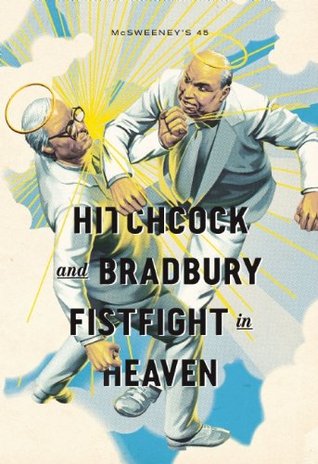
The premise of this collection was just too juicy to pass up.  Although it did take me a while to read it.  Eggers’ introduction talks about the contents of this issue.

DAVE EGGERS-Introduction
Eggers says he came across a collection of stories edited by Hitchcock. He really liked it and then learned that Hitchcock had edited 60 volumes over the course of 35 years.  He was excited to read literary genre fiction.  But he was more impressed that theses stories did what literary fiction often forgets: having something happen.  He then bought a cheap book edited by Bradbury (Timeless Stories for Today and Tomorrow) and he liked it too.  He was surprised that there were so many canonical writers (Steinbeck, Kafka, Cheever) in a Bradbury collection.

So, why not make a new collection in which we can compare the two genres.

Despite this looking like a pulpy paperback, there were still Letters.

LETTERS

CORY DOCTOROW
Doctorow says that Science fiction is not, indeed, predictive.  That any genre which deals with so many potential future events is bound to get some things right.

JAMIE QUATRO
Quatro says she was asked to write a letter for this genre issue, but Quatro doesn’t do genre, so she was about to pass.  Then her son, from the backseat, asks what bulwark means.  Then inimical.  Then miasma.  He is reading a book called Deathwatch about soldiers whose brains are removed so they no longer fear. Suddenly, when she compares this idea to her essay on Barthelme, she sees that maybe McSweeney’s was on to something after all.

BENAJMIN PERCY
In fifth grade Percy (who has a story below) gave his teacher a jar full of ectoplasm.  He has always been different.  He proposes the Exploding Helicopter clause: if a story does not contain an exploding helicopter (or giant sharks, or robots with lasers for eyes or demons, sexy vampires. et al), they won’t publish it.

ANTHONY MARRA
Marra discusses Michael Crichton and how something doesn’t have to be Good to be good.  He says Crichton was a starting point for him as an adult reader.  And what can be wrong with that? (more…)

Read Full Post »

815

SOUNDTRACK: BORIS-Crossing Waltz (2016).

Boris have put out (by my understanding) eight live albums.  As with most of their releases, they’re not all easy to find.  I happened to get this one because they were selling it at the show I was at (many of their releases seem to be only for sale at the merch table).  This one is from their own Fangs Anal Satan label.  It was released in 2016 but was recorded sometime around 2011.

It happens that this era is one that I know best (they put out three albums on the same day and they are all still available) so this is a fun live album for me since it’s fun to hear the distinctions and their ability to translate them in a live setting.

The disc opens with a two-minute intro–sirens from the opening of “Heavy Rocks 2011” which leads into “Riot Sugar.”  The song is heavy–it rocks out and is full of Atsuo’s whoops and yells–the sign of a real rocking song.  “8” is a song I didn’t know.  It starts with a lot of gong and has some great falsetto vocals.

“Statement” is great to hear live because it’s cool that they can play the songs just like on record.  Not that it sounds like the record exactly, but that they can recreate the music live–and keep it all catchy too.

Then things slow down for a few songs from Wata.  “Attention Please” is quiet and silky with cool guitar and effects.  I love the way Wata delivers the quiet, whispered lyrics.  It’s followed by “Party Boy.”  “Party Boy” appears on two records.  It’s hard to know which “version” this is but this one is slinky, dancey and heavy at the same time (we’ll say Attention Please, since there’s not much synth)..

“Flare” is from a 7″ and it is very heavy.  Then it’s back to Wata singing the really catchy “Spoon” with heavy drums.  The first disc ends with the 16 minute “Missing Pieces” (longer than the album by a few minutes).  Like a good epic, it starts slowly.  After three minutes Atsuo introduces a lot of drums and then the bass and guitar roar for about a minute.  It fades to near quiet once again.  There’s a minute or so of just vocals before the guitars come back, this time with soloing while Takeshi is singing.  Around six minutes in it turns to noise, noise, noise–both guitars on feedback and scraping and the drummer going bananas.  The band stops on a dime for complete silence and then takes off again–noise and more noise.  There’s feedback and gongs and more feedback.  And then at 11 and a half minutes the drums return–continuing through to the end.

Disc two opens with “Window Shopping” which is all about fuzz and buzz, full of Atsuo’s yeahs and a crazy wild solo at the end from Wata. 

Then they move back to some older albums for 2 songs.  “1970” comes from 2002’s Heavy Rocks album (the orange one).  It is full of bass rumble.  It leads to the classic “Pink” with gongs as the transition.  Even all of these years later, these songs are full of power.

“Alierion” is the longer version.  It starts slow and quiet and builds and builds, getting heavier for 12 or so minutes. The last minute is a solo piano melody, a dramatic departure for them.  Then the sirens come in again for “Looprider.”  “Looprider” is eight catchy minutes of shoegazey fun.

The by now standard closing of “Farewell” ends the show.  Hearing those opening notes live was great and it is great here.  The song sounds terrific.

One of the things about Boris live is that their vocals are never clear.  Perhaps if you understand Japanese the vocals are more obvious, but it feels like they may be something of an afterthought, especially live. The band is all about the sonic experience and the vocals, the voice, is just another piece of that.

1.1 Intro  2:35
1.2 Riot Sugar — Heavy Rocks (2011)  4:53
1.3 8 — Japanese Heavy Rock Hits Vol 1 (2009) 4:03
1.4 Statement — Smile (2008)  3:49
1.5 Attention Please — Attention Please (2011)  6:34
1.6 Party Boy — New Album (2011)  3:55
1.7 Flare — Asobi Seksu x Boris 7″ (2012)  4:24
1.8 Spoon — Attention Please (2011)  4:57
1.9 Missing Pieces — Heavy Rocks (2011)  16:01
2.1 Window Shopping — Heavy Rocks (2011)  5:58
2.2 1970 — Heavy Rocks (2002)  5:03
2.3 Pink — Pink (2006)  4:52
2.4 Ailerion — Heavy Rocks (2011)  13:52
2.5 Looprider — New Album (2011)  8:18
2.6 Farewell — Pink (2006)  7:37

[READ: February 8, 2016] “Quaestio de Centauris”

I was sure that I had read or posted about stories from Primo Levi before 2016, but I see no evidence of it.

Perhaps I have never read him, just heard of him.  I don’t know if this story is anything like what he typically writes, but it was a pretty unexpected story topic (continuing with the theme of this issue, apparently).

The story was translated from the Italian by Jenny McPhee.  And, as one might decipher from the title, the story is about centaurs.

The narrator says that his father kept a centaur in the barn.  Although he admonished the boy not to bother it, the bot and the centaur, Trachi, became friends.  Trachi even allowed him to ride on his back from time to time. (more…)

Read Full Post »

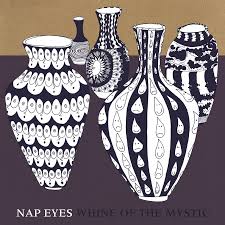
SOUNDTRACKNAP EYES-Whine of the Mystic (2015).

Nap Eyes opened for Alvvays and although we only caught half of their set, I really enjoyed it.  Lead singer Nigel Chapman, had a kind of deadpan Lou Reed spoken delivery (with an extra affectation–perhaps something to do with being from Halifax?).  The drums were thumping and spare and the guitar played a mixture of pretty melodies and squalling feedback.

The songs are pretty minimal musically.   Bassist Josh Salter and drummer Seamus Dalton keep the rhythm steady with occasional grace notes from Salter.  It’s really the work of guitarist Brad Loughead that stands out–in addition to Chapman’s lyrics of course.

A comment on the lyrics from the bandcamp site:

Throughout the record, workaday details punctuate (and puncture) cosmic concerns, as Nigel wrestles with air and angels, struggling (and often failing) to reconcile the Romantic rifts, both real and imagined, that define our lives: between chaos and order (or wilderness and paradise, as in “Tribal Thoughts”); solipsism and fellowship (“Dreaming Solo” vs. “Oh My Friends”); the anxiety of social (dis)orders both big and small (“The Night of the First Show”; “No Man Needs to Care”); and the various intersections and oppositions of religion, art, and science (“Dark Creedence” and “Make Something.”) 

This first album (after several EPs with great song titles) pretty much plays that template right out of the gate–the guitars do squall with feedback,but it is kind of low on the mix–disturbing the silence but not overwhelming it.

“Dark Credence” is pretty much the same thing repeated for four minutes but the way it builds with more intense drumming and ever noisier guitar feedback is great.  “Make Something” is a slower song that adds some interesting lead guitar notes as the song nears its end.

“Tribal Thoughts” is the first song that really stands out.  It’s faster paced, with a spirited, plucked melody.  Chapman is a bit more emotive and by the end the lead guitar has really taken off.  There’s some interesting lyrics in this song too, imagine singing slowly in deadpan: “I hear the beat against the slow lines / The lines i wrote / I never write them down anymore / fuck iiiiiiiiiiiiiiitttttttttt

“Delirium and Persecution Paranoia” is a 7 minute drone of a song that really doesn’t change much.  It makes you focus on the impenetrable words:

Round the inner core rocks / the outer core flows / but while the outer core cools / the inner core grows / the loaded sun sends out heat and light and deadly magnetic radiation  /  What you gonna do / the human race / when the solar wind through the magnetosphere is breaking  / Most of us down here lying down for years / sleeping the night away / some of us try but never survive /  stay up whole night and day  //  My friend once told me about a rare insomniac’s condition / sleeps not one minute a day but feels 20 minutes of pain and blurry vision.

And I just love the amusingly desperate end:

Oh baby, all I need is another second chance
Oh baby, all I need is another twenty-five second chance
Oh baby, all I need is another two-hundred and fifty-second chance
Oh baby, all I need is another two-hundred and fifty thousand second chance

“No Man Needs to Care” is a faster song with a nice circular guitar riff.  What does no man need to care about? “No man needs to care about another man’s hair.”

“Dreaming Solo” slows things down again, and then there’s two shorter somewhat poppier (but still angsty) songs.  “The Night of the First Show” is a delightful dark (lyrically) but perky (musically) take about what I gather was the first Nap Eyes show.  “Oh My Friends” is another slow, short song.  The short ones are so different from the droning quality of the longer ones.  Like the album closer “No Fear of Hellfire,” another 7-minute song.  It opens with ringing guitars and propulsive bass.  “Sunday morning only comes around once, these days.”  And the chorus: No feel of hellfire makes me feel good.”

[READ: November 15, 2017] “Chasing Waterfalls”

This is the second story I’ve read by Krasznahorkai (this Hungarian story was translated by John Batki).

Of his previous story I wrote:

This is the kind of story that makes me wonder why someone would write about the things they do.  Not because it’s bad or not worth writing about, I just can’t imagine where the idea came from.

This was a challenging story for me to read because there are no paragraph breaks (and I love my paragraph breaks).  It is just an endless stream of prose.

This one isn’t quite as out-of-thin-air, but it’s a pretty peculiar story nonetheless. (more…)

Read Full Post »

« Newer Posts - Older Posts »