Feeds:
Posts
Comments

Archive for the ‘Technology’ Category

eggersSOUNDTRACK: NICK BUZZ-Circo (1996).

nickbuzzMartin Tielli has been prolific both as a solo artist and with his “side project” Nick Buzz (named after his love of smokes).

Nick Buzz’ first album came out in 1996 (during a time when the Rheos had just wrapped up their album The Blue Hysteria) and was ignored.  It was reissued in 2002 to a bit more fanfare.  I reviewed it once before and while I thought I was more dismissive of it then, it turns out that I wasn’t.  That I enjoyed it and felt mostly the same as I do now.

“Spilling The Wonderful” starting out with a mellow piano intro, the song jars into a noisy/drunken waltz melody and a violin solo before returning to the cabaret/waltz style that opened the song. It is deliriously catchy. The song ends with some tape manipulation before seguing into “That’s What You Get For Having Fun.” This song opens with some slapped and scratchy guitar sounds with a refrain of “there’s a monkey in my underwear.”  There’s a super catchy guitar riff that is sung along to—this song really shines live.

“Just Because” mellows things down a lot, with a jazzy sounding guitar and Martin’s delicate vocals.  The music for his one was written by pianist Jon Goldsmith which might explain the mellowness. It’s a sweet ballad.  Although the segue after this song is some clips from the radio (possibly sung by Tielli?) which are distant and crackling.   There’s a saxophone playing as well.   This merges into an announcer introducing the band for their (live) cover of Joni Mitchell’s “River.” It’s a beautiful, delicate version with Hugh Marsh’s electric violin solo swirling around.

Some dissonant sax segues into Sane So Sane which is actually a pretty gentle piano song. They play with the recording sound as the drums get muffled and dense and there’s more backing vocals thrown over the top.  But it remains largely conventional.  “Hymn to the Situation” is a creaky somewhat creepy song that Martin described as being about a self-centered jerk. who says things like “I’d suicide for you.” There’s a canned crowd cheering at a particularly funny line and even a cow mooing as the song ends

“Fornica Tango” is a wild weird song.  It is tango (Tielli speaks Italian), but the rhythm is kept by a squeaky sound (which is likely Marsh’s violin).  The song is interrupted throughout by a crying baby or, even stranger, a screeching chimpanzee (fornica translates as ant). The song ends with some crazy sounds from Marsh’s electronic violin.  The highlight of the record is “Love Streams’ a beautiful ballad based largely around a piano melody and Marsh’ keening violin. It’s followed by “Aliens break a heat” which is more tape manipulation and all kinds of weird effects (backward vocals I believe) for 2 minutes. Until it’s replaced by sounds of traffic (European) and horns honking.

The final song is the amusing “The Italian Singer/Just Because I’m Nick The Buzz” It starts slowly with some plucked strings and Tielli’s voice. There’s some spoken sections and lots of staccato music until the gentle ending which resumes the melody from “Just Because.”

It’s a peculiar album but one that gets better with each listen (and hearing him play some of these songs live has really introduced new aspects of them to me.

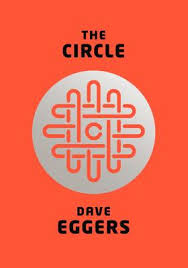
[READ: October 10, 2015] The Circle

I put this book off for a while but with no real reason for doing so.  And I’m sorry I waited so long because the book is really good–it’s thought-provoking and questions a lot of established ideas but is also really kind of fun and utopian.

What’s most impressive to me about the way the book is written is that the story itself is really quite simple.  It is a gradual building up of intensity.  At the end of which the main character has to make a decision which proves to be very important both for her and everyone else.

The story is about Mae.  Mae had been working at a dull and dispiriting job in civil service at her home town.  The job was dull, the people were dull, there was zero energy in the place and even her boss was depressing.  It sucked.  She had been there for 18 months and when her boss joked about her getting a promotion, she’d about had it.

She contacted her friend Annie.  Annie was her college roommate and boon companion for a few years.  And Annie worked at The Circle, the coolest most awesome place in the country to work at–think google, but better).  Was there any way that Annie could help out Mae?  Indeed there was.  Annie got Mae a job at The Circle, just like that.  Annie was one of the Top 40, the influential crowd at The Circle and Mae was in (her first day is hilarious, because Annie plays a wonderful prank on her). (more…)

Read Full Post »

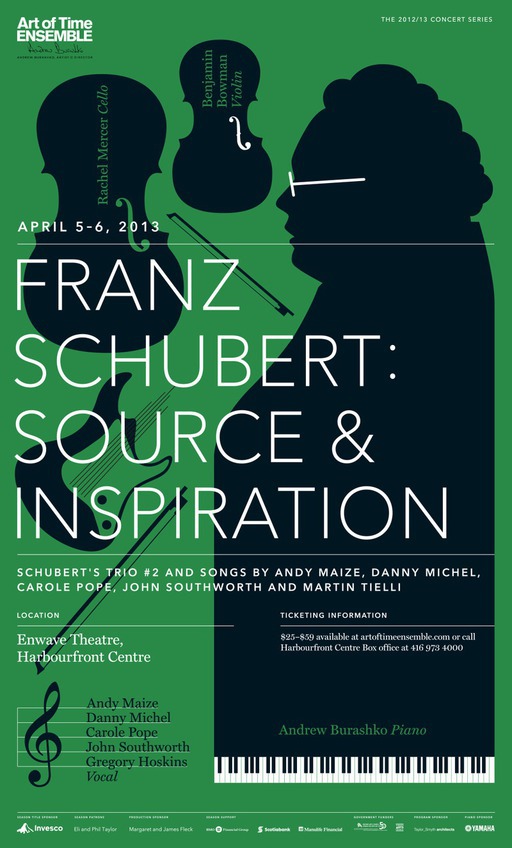
feschukSOUNDTRACK: THE ART OF TIME ENSEMBLE with MARTIN TIELLI–Korngold: Source & Inspiration (Enwave Theatre, Harbourfront Centre, Toronto, ON, January 30, 2009).

aotimeAfter seeing The Art of Time Ensemble yesterday, it was quite serendipitous that I would have a show from them (featuring Martin Tielli) to post about on the following day.

This concert is the third in the Art of Time’s “Source & Inspiration” series. Two years earlier the first concert focused on composer Franz Schubert.  The previous year’s concert focused on Robert Schumann. This time the spotlight was on the 20th century Jewish composer Erich Korngold–a composer of European pedigree who became well known for his wonderful Hollywood film scores.

This concert featured Korngold’s Suite for Two Violins, Cello and Piano as the ‘source’ as well as new songs inspired by this work from Martin Tielli, Danny Michel and John Southworth.

This recording is only 8 minutes long because there’s only two Martin Tielli songs. “Lied Two” (the German word for song is lied (pronounced leed) so Martin called his “Lied Two.” And “Moglich” which translates into “possible.”  Both pieces are played with by the orchestra.  Martins sings.

The more dramatic of the two would be “Moglich” with his loud whispered “Relaxxxxx at the end.”  For more information about the show, you can click on this link.

Full Program & Repertoire:
Suite Op. 23 for 2 Violins, Cello and Piano Left-hand
Erich Korngold
i.Praeludium und Fuge
ii.Walzer
iii.Groteske
iv.Lied
v.Rondo-Finale

INTERMISSION
Athabasca
Adventures of Erich Korngold
—John Southworth
The Sailor Song
Island

—Danny Michel
Lied 2
Moglich
—Martin Tielli

Performers
Andrew Burashko, piano
Danny Michel, singer
Erika Raum, violin
Stephen Sitarski, violin
John Southworth, singer
Martin Tielli, singer
Winona Zelenka, cello

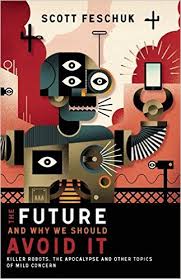
[READ: November 22, 2015] The Future and Why We Should Avoid It

The title of this book made me laugh so I set it aside to read it.  Little did I know that it would be so very funny that I put aside other things so I could finish it.

I hadn’t heard of Feschuk before.  He has written two previous books (How Not to Completely Suck as a New Parent sounds pretty good) and writes mostly for MacLean’s magazine.

As you might guess from the title, this book looks at the future, and Feschuk’s predictions are uncanny.  For instance, I brought the book home and decided to look at it in the bathroom.  And the introduction states quite clearly:

By now, life should be awesome and leisurely and you should be wearing a spacesuit and high-fiving your wisecracking robot sidekick.  Except instead your dishwasher is broken, your god-damn iTunes won’t sync up and right now you’re reading this book on a toilet in your bathroom instead of where you should be reading it–on a toilet in your hover car.

Too right, too right. (more…)

Read Full Post »

 schoololsSOUNDTRACK: KHAIRA ARBY-Tiny Desk Concert #94 (November 29, 2010).

khairaA year ago I would have said I know nothing about music from Mali, but the shows at NPR have given me a greater appreciation of it.  And, while I wouldn’t say I’d have been able to pick this out as music from Mali, I definitely recognized the style of the what I’m going to call fiddly guitar that seems to be prominent in Mali music.

You can really hear how good guitarist Drahmane Toure is with the way he keeps up the constant soloing and fiddly bits.  It brings a cool distinctive sound to the otherwise steady rhythm from the bass and percussion (which looks like a beautifully carved salad bowl covered in duct tape).

The rest of the band includes an acoustic guitar, a bass backing singers and some other instrument that i can’t figure out.

Of course, this show is meant to celebrate singer Khaira Arby, the queen of desert rock.  And she is fine.  I don’t really have much to say about her.  She sings perfectly for this music, and sounds almost more like a prayerful singer than a professional one.

[READ: December 27, 2013] Diary of a Wimpy Kid: Old School

Clark said that this book was the best Wimpy Kid yet (a claim he has made before, so this must be really great).  My story about this book is that I knew the cover was black and I know basically what the back cover looks like, so when we saw Age of Ultron this summer, imagine my surprise to see that the boy was reading this book (which didn’t come out until last week).  Movies are magic.

Anyhow, this book begins in September with some hilarious snark about “the good old days.”  I love Greg’s reaction, “I think they’re just jealous because MY generation has all this fancy technology and stuff they didn’t have growing up.”  And now Greg’s mom’s big kick is to get everyone to unplug.  To unplug and reconnect with the community. (more…)

Read Full Post »

dragonsSOUNDTRACK: THE NELS CLINE SINGERS-Tiny Desk Concert #78 (September 7, 2010).

nelsNels Cline has played guitar with Wilco for over a decade, but he has also played with punk rockers and jazz musicians.

The Nels Cline singers are an instrumental collective  that consists of Cline on guitar, upright bassist Devin Hoff and distinctly jazzy drummer Scott Amendola (he plays a lot of percussion including hitting a cymbal with what looks like a chopstick).  They also have special guest Yuka Honda from Cibo Matto on keyboards.

Cline gets some great sounds out of his old beat up guitar (I have genuinely never seen anyone play harmonics on the guitar in the manner that he does).

The music is airy and spacey (especially “B86 (Inkblot Nebula)” which features bowed bass and interesting sounds from Honda and a fascinating array of bell and cymbals on the drum set.

For “Thoughts on Caetano” he switches guitars.  Unfortunately the video seems to keep cutting out around this point so the rest of the show has to be on audio only.  But the sounds that they create are very cool and interesting.

The biggest surprise to me in these pieces is that they are mostly fairly short.  They seem like they could be side-long explorations, but “You Noticed” comes in around 4 minutes or so, and “B86” is only around 3 minutes as is “Thoughts on Caetano.”

The final song has a more jazzy feel.  Complete with a  bass solo and some very interesting drum sounds (I wish I could see how he’s doing them).  This last song is the longest it’s about 7 minutes.

I was really surprised by this Tiny Desk–I had no sense of what Nels Cline would play, and it was a real treat to hear.

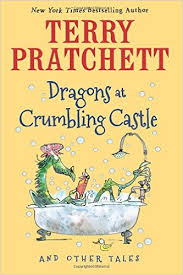
[READ: August 19, 2015] Dragons at Crumbling Castle and Other Tales

Obviously death has never stopped anyone from releasing books.  So here is one of the first collections of posthumous stories from Sir Terry Pratchett.

Interestingly, these are stories from when Terry was a young lad.  This is a selection of children’s stories that were first run in the Bucks Free Press (he was a junior reporter).  They are simple but clever, with lots of ideas that Pratchett would explore in greater details as he got older.

There are 13 stories in the book, and they explore variations on Pratchett’s themes like that the unfamiliar is not the enemy (necessarily) and that people can and often will be surprised by how others react.  He also has some a story idea that would blossom into the carpet people stories later on.

“Dragons at Crumbling Castle” (1966) is a story of everyone overreacting when they find a dragon in the castle  (it proves to be a little baby dragon).

“Hercules the Tortoise” (1968) is the story of a brave tortoise who crosses his pond.

“The Great Speck” (1969) is an interesting story of huge worlds on tiny specks and how even they can be territorial

“Hunt the Snorry” (1966) is  a very funny story about brave hunters going in search of an elusive thing which proves to be something else entirely (and which they inadvertently catch).

“Tales of the Carpet People” (1965) is similar to the Speck story in that it talks about very small people living in a carpet and their adventures as they try to see the world beyond (the dreaded linoleum).  I actually found this first story to be kind of dull and confusing, but I can see how it became the basis for greater things.

“Dok the Caveman” (1966) invents all kinds of things but they usually go wrong–nevertheless the inventions themselves are pretty spectacular.

“The Big Race” (1968) differs from all the other stories in that it is about technology (although it is very Pratchettian in the end).  It proves to be a race between a gas-powered car and a steam-powered car (and anyone else who wishes to join the race and cheat if necessary).

“Another Tale of the Carpet People” (1967) was more successful perhaps because they actually got off of the carpet and met new people.

“The Great Egg Dancing Championship” (1972) was a funny story about how cheaters never win (and about dancing on eggs).

“Edwo the Boring Knight” (1973)  Sometimes boring people to sleep can be your greatest weapon.

“The 59A Bus Goes Back in Time”  (1966-67) This story was fun in its time travel (going to the major historical epochs) but more so because of the way the locals reacted to the bus.  And that the bus should always try to stay on schedule.

“The Abominable Snowman” (1969) had a lot of fun with the conventions of exploration and how easy it is to derail a planner.  It also works with the idea of a very tiny creature that everyone is searching for.

“The Blackbury Monster” (1968) is all about how fame may not be the best thing for a small town after all.

“Father Christmas Goes to Work” (1973)  How is Father Christmas supposed to make any money on the other 364 days of the year?  Get to work!  But what can he possibly do?  Not much it seems.  (There’s a happy ending of course).

The text is manipulated to make it very kid friendly (large print when people yell, different fonts, dark pages when it is a dark scene, that sort of thing.  It also has illustration by Mark Beech, but I found them to be really basic sketches.  I would have loved to see more by Pratchett artist Paul Kidby.

I tried to imagine my kids enjoying these stories, but I didn’t really think they would.  Perhaps because they aren’t British and it isn’t forty years ago.  But I enjoyed them.  And each one brought a smile to my face.

Read Full Post »

modernSOUNDTRACK: RHEOSTATICS-The Media Club, Vancouver, BC (October 22, 2004).

media clubEvery year, the Rheostatics would perform what they called Green Sprouts Week in Toronto.  In 2004 they did a West Coast version. Five nights in a row at The Media Club.  This recording is from the fourth night.

Once again, the recording quality isn’t great (although it’s better than the previous night’s).  And once again the show is edited down (it’s barely 90 minutes–just long enough for a cassette).

It feels like perhaps Martin’s voice was hurting by this night.  As an introduction he says, “I’m going to try to sing a song called ‘P.I.N.'”  Even though most of the banter has been removed, there is a funny part with Dave talking via the cymbals (being very silly indeed).

They play the first version I’ve heard of “Here Comes the Image” with a very long synth solo.

They cover XTC’s “Radios in Motion” with vocals by local musician Paul Myers.  They also play The Clash’s “London Calling” and while Myers vocals are great, Tim can’t seem to get the notes on the bass right.

Strangely, for an edited show, it accidentally repeats “Aliens” twice and leaves off “Fan Letter.”

The intro to “Stolen Car” gives Dave a chance to throw in an “obligatory Beatles reference” when he starts singing the words to “Norwegian Wood.”  And the end is scorchingly good.

The final song is a fun version of “Legal Age Life.”  It starts with him asking someone to blow into his beer bottle for notes.  The song ends with a twist contest.  And the prize is the new Sting CD, which they love mocking.  They even joke that Sting has a song called “Stolen Car” but it has a parenthetical “(Take Me Dancing)” which makes it an entirely different song.

It’s another great fun night of Rheos music

[READ: July 14, 2015] Modern Romance

I was really excited to see this book in the bookstore.  Although I like to keep up with new books, I had no idea Aziz had a book out.  And since he is hilarious and other recent Parks and Rec folks have had hilarious books out I was prepared for a lot of laughing.

Well, it turns out that this book isn’t exactly funny. I mean it’s funny because Aziz wrote it, but it’s actually a sociological book about modern romance.  Really.  He has enlisted the help of NYU sociologist Eric Klinenberg and they have compiled and studied all sorts of data.  They have sponsored panels and had discussions and really tried to discover how romance has changed in the last 50 or so years.

It sounds like it might be dry, but again, Aziz throws his snark and wit all over it so just as you get a little tired of statistics, there’s a funny joke about a rapper or some such. I mean any book that opens with “OH Shit!  Thanks for buying my book!” has got to be funny right? (especially if you imagine Aziz saying it). (more…)

Read Full Post »

princessSOUNDTRACK: DAWN OF MIDI-Dysnomia (2013).

domI heard about this disc while listening to The Organist podcast. (Episode 6)  I didn’t know anything about Dawn of Midi, but I understand they were/are a kind of improvisational jazz band (piano, contrabass and drums).  But don’t stop reading yet.  Dysnomia (between this and Method of the W.O.R.M.’s Cicatrix, I am certainly learning a lot of new words) is certainly jazzy.  But it doesn’t feel like jazz exactly.  In fact, I would never have guessed that they were playing real instruments.

The album is 47 minutes with 9 songs.  They are all instrumental and more or less flow into each other.  And as I say, I never would have imagined that it was just three instruments playing the music.  Not because it sounds weird–there’s nothing particularly unusual sounding about the record.  But because it is so precise.

And indeed, the piano doesn’t really sound like a piano (it’s a little muted), but the other two instruments are quite clearly drum and bass.  And yet it’s the rhythms and textures of the songs that are so unusual.  The songs are minimal, true, but they are complex in that minimalism.  So while there’s repeated piano notes, there’s complex drum patterns.  And the songs morph and change over the course of the record.  And not just from track to track but within a song as well.

Without going into great musical detail, there’s not a lot to say about the individual tracks.  As I say, it’s a lot of repetition, but there’s enough morphing that it never gets boring.  Maybe the piano is the emphasis for these few minutes, then a snare drum takes over.  Or the beat shifts or speeds up.  It’s really cool.  And it’s really hard to believe that these three guys are playing this live and not with machines.

I really can’t say enough about this record.  I didn’t expect to like it as much as I do, but I find that I can’t stop listening to it.

Check it out at their bandcamp site.

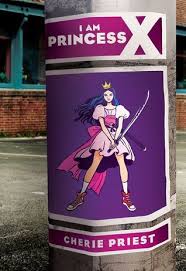
[READ: July 17, 2015] I am Princess X

Sarah brought this home from the library and said that I would like it and, as usual, she was right.

The story is about May and Libby, two young girls (fifth grade?) who are thrown together (they don’t know each other but are both skipping gym class) and form a cool bond.  Libby is a great artist, and while they are sitting in the Kindergarten playground, the little kids come over and ask her to draw things.  Soon enough, Libby draws a princess (I like that it was suggested by a boy).  She’s wearing red high tops, a crown and cape and has a cool katana sword (I must say this has to be the smoothest playground ever if she could get that much detail out of playground chalk).

The girls name her Princess X and since May can’t draw, she comes up with stories about her.  And soon enough, Libby and May have binders full of the Princess’ adventures.

As with a lot of YA books, there’s a horrific tragedy that follows.  Libby and her mom are in a car and her mom drives them off a bridge where she and Libby die.  (I know!).  May always thought there was something suspicious about the whole thing–Libby had a closed casket–but since May was a little girl no one paid her any mind.  Libby’s dad fled Seattle and that was the end of contact for May.

Meanwhile, May’s parents divorced and may moved back to the South (people in Seattle tease her about her accent).  But she does get to come up to Seattle to visit her dad from time to time.

And this time, when she’s walking around old haunts, she sees a sticker on a window.  It is Princess X and it even says “I am Princess X”  What the heck?  Well, when Libby’s dad sold the house, all of their Princess X stuff was given to goodwill.  So it must be someone who found it and stole their ideas.  But what if it’s something else? (more…)

Read Full Post »

raslSOUNDTRACK: METHOD OF THE W.O.R.M.-Cicatrix (2015).

motwormMETHOD OF THE W.O.R.M. is the project of one guy–known as Grimm.  Cicatrix is a collection of songs that spans decades (“begun long before the present digital day”) and recently remastered and released.

The blurb on CdBaby (where you can download the disc–it’s also on iTunes) notes that Method of the W.O.R.M. is “an industrial hard rock with a trip hop edge, intelligent grown up lyrics delving into the microcosm and macrocosm of our world. Influences run the gamut of NIN, Massive Attack, Cop Shoot Cop, Swans, Coil, Tricky, Skinny Puppy, Tom Waits and many others.”

There’s quite a diversity in that list even if the bands are similar, and you can hear the melding of influences.  And you can hear most of them in the songs. But what sets MotWORM apart from these bands is a keen sense of melody in the vocals.  Most industrial music tends to bury the vocals with distortion or just under the music.  But Grimm’s got a good (even pleasant) singing voice which elevates the songs above the din of lesser industrial bands.

While it’s not like pre-digital technology was all tape manipulation, it also wasn’t as easy as it is now.  And the complexity in these songs shows a lot of skill and attention to detail.

“No Flesh” opens the collection.  After some interesting noisy samples (steel drums?), a slow bassline enters (which also sounds sampled—it’s got a very 70’s sound).  The song slowly builds with more and more layers of sound until the vocals come in–a gentle singing that also builds.  There’s a Skinny Puppy feel in the music, but the vocals are very different from Puppy’s style.  “Purge” is the first of many songs with sampled dialogue, but it’s the sounds around the dialogue that are so interesting–squeaks and buzzes, radio tuners? who knows where they come from.  Once the verses start, the main music in this track is more synthy–a compelling riff that wends through the mix.  When the distorted guitars kick in, it takes the song to an entirely new level.

“Burned” showcases the vocals up front in the mix over a simple layered melody.  But there are actually a lot of vocals in this song, including a fascinating sample that opens and closes the track.  Grimm adds layers of vocals–harmonies (or not exactly)–distorted vocals and clean vocals.  I particularly like when the higher voice sings a new (very cool) melody in the middle of the song (the sampled voice melds nicely if creepily with this too).  This song is a real highlight.

“Tragic Rabbit” has some more interesting samples and a pulsing synth line with cool swirling sounds over the top of the vocals.  “As If a Dream” is a slow trippy number with an excellent processed sample.

“A Viral Method” introduces live drums (which sound great and were provided by Swans’ Phil Puleo).  It also has a great live guitar sound playing a fast riff and harmonics.  There’s more great harmony vocals. And a wild riff for the bridge (do I dare say a bit prog rock?).  Although I love the cool samples and layers in the earlier songs, this live instrumentation adds an excellent urgency to the music.  The only problem with this song is that it’s so short.

“Absolution” starts off quietly but after the distorted guitars, the chorus is super catchy–the way it seems like it’s going to end but rebuilds itself.  It’s really well crafted.  “A Moment of Silence” opens with a retro-sounding synth bass.  It’s a fairly minimal song with the vocals really taking over as that synth line drifts to the background and new sounds bubble up.  “Wasted” opens with distorted guitars kind of like a Ministry song, but the vocals are much cleaner, which brings an unexpected quality to what could have been a typical heavy song.  Especially the chorus which is musically bright (even if it’s lyrically dark).

“Freak-O” (what a great title) opens with some loud jackhammer type drums.  The song creeps along menacingly (with a great sample of someone shouting “You are one ugly son of a bitch!”).  I like the simple melody that simmers up from the noise by the end of the song.  “Miscreant” opens with quieter acoustic guitars before the drums kicks in and a menacing synth line takes over.  The vocals are quietly sung with an interesting effect placed on them.  The middle of the song has some wild sounds–I’m not entirely sure what’s happening with them, but it makes for an unsettling ambiance.

“I Love You Goodbye” is my favorite song on the disc.  It starts out simply with big guitars but quickly retreats into a much quieter verse.   There’s a great riff that throws in a slightly dissonant harmonic note that is just great.  But as the song builds into a unexpected bridge with horns, the song adds an dark carnivalesque atmosphere (and that harmonic note returns in a more prominent role).  It’s such an unusual riff and really bodes well for the interesting direction MotWORM might be heading (if they ever release anything else).

This is a real fun disc full of interesting sounds and samples.  If you like industrial music this is a disc totally worth checking out.

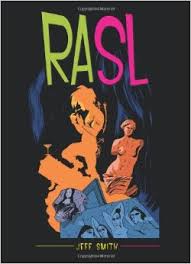
[READ: July 31, 2015] RASL

Jeff Smith is creator of Bone, one of my favorite comics ever.  As far as I can tell he hasn’t done a lot since Bone, but he sure did his research for this book.

The title is unfortunate (and is explained satisfactorily in the last few pages, but it’s still awkward and hard to manage).  But the work inside is extraordinary.  The story concerns dimension jumping, art theft and a whole lot of information about Nikolai Tesla.  It’s also more mature than Bone, in that there are a couple of (non-explicit) sex scenes.

In a nutshell, RASL (real name Dr. Robert Johnson) and his partner Miles are scientists.  They grew up together and studied the works of Tesla.  Miles married Maya, a beautiful scientist who has assisted them with their work over the years.  They delved deeply into the research that Tesla undertook (Resonant frequency, remote control, the earthquake machine, wireless communication) and used his ideas to create a machine that is something like a transporter/dimension hopper. They are working for the military but hope to be able to use the device to end wars (idealist scientists as they are).  Their small tests has been successful, but RASL believes that they need more testing to see if there are any effects when you use it on bigger subjects.

So he takes the machine and hops.  It turns out that each hop between dimensions takes its toll on his body and also tends to confuse matters.  (In one dimension, he checks his iPod and sees that Blonde on Blonde was recorded by Robert Zimmerman (I love that detail)).

We learn that RASL (who as the story opens has shaggy hair and cuts and bruises, unlike the composed scientist we see in flashbacks) has been jumping from dimension to dimension to steal precious works of art as a way to make some money.  There is also a really creepy-looking man whose face looks almost amphibian (Smith has some really disturbing characters in this book) chasing after him.  This man kills everyone that RASL knows in different dimensions because he is after something 9and he believes that the people in other dimensions are not real).  It is slowly revealed why RASL has been reduced to this state. (more…)

Read Full Post »

ageSOUNDTRACK: COURTNEY BARNETT-Live at SXSW, (March 21, 2015).

cbsxswI enjoyed Barnett’s single “Avant Gardener” a lot.  Then I got a little sick of it (I love WXPN, but man they can overplay a song).  And yet I still like Barnett’s wordplay and her sense of melody.

I was really psyched to hear how noisy her latest single “Pedestrian at Best” was.  When she played the NPR SXSW showcase, a night in which she played exclusively songs from her then unreleased new album, I did not expect her to be so rocking.

But she really embraces the noise.  The sharpest, clearest sound in this show is Dave Mudie’s ever present snare drum–a cracking sound that keeps the beat and the song steady while Courtney thrashes away on her guitar and Bones Sloane’s low bass thuds along.

The set is short, and Barnett seems genuinely delighted at the size of the crowd.  They run through 8 of the songs of the new album, and they sound great.

  • “Elevator Operator” a great opener, familiar sounding but new.
  • “Pedestrian at Best” noisy and rocking–she has a ton of fun with this.
  • “An Illustration of Loneliness (Sleepless in New York)” is a bit mellower
  • “Depreston” a slow song with great lyrics.
  • “Nobody Really Cares If You Don’t Go to the Party” a bratty fast rocker with Barnett slurring her lyrics in a fun way.
  • “Aqua Profunda!” a song about swimming in Melbourne.  2 minutes long which she describes as “stupid.”
  • “Dead Fox” super catchy and poppy.
  • “Kim’s Caravan” closes this short show with a long song.  It starts slow and moody, But Barnett starts wailing on her guitar by the end.

It’s kind of a shame that the show is only 36 minutes, but it’s a great way to get in, play some great songs and get out leaving us wanting more.  I hope the full length rocks as much as this show does.

You can watch her whole set at NPR.

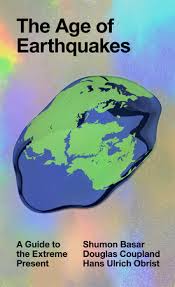
[READ: March 20, 2015] The Age of Earthquakes

I saw this book at work and could tell just from the typeface that it was a Douglas Coupland book (he is that much of a brand).  I was a little thrown off by the other names on the book as I’ve never heard of them, but it is clearly a Coupland production, even if he is alphabetically second.

I’m not even sure what the other two authors contribute (or who they are), as the book is so clearly Couplandy.  Of course, having said that, the majority of the book is pithy aphorisms about the age of technology and the future.  So truly any one could have said them.

There is something kind of staid and conventional about Coupland writing about the craziness of the future and all that.  He’s been doing it for decades now.  But I found this book enjoyable.  Not mind blowing (although some ideas are pretty fascinating), not life changing, but enjoyable. (more…)

Read Full Post »

dec2014SOUNDTRACK: LULUC-“Star” NPR Lullaby SXSW (March 18, 2015).

lulucRecorded outside of Stubbs while the groundscrew was cleaning up the huge mess, Luluc play a beautiful quiet ballad.

Steve Hassett plays lead acoustic guitar and sings harmonies while Zoë Randell plays rhythm guitar and sings lead. Interestingly, his voice often goes in higher registers than hers.

I really like the solo that he plays that adds a bit of uptempo feel to this otherwise quiet song.

Check it out here.

[READ: March 23, 2015] “At First Blush”

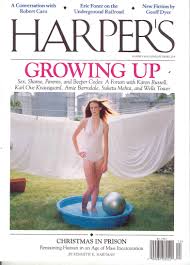
This issue of Harper’s featured five essays (well, four essays and one short story) about “Growing Up: five coming of age stories.”  Since I knew a few of these authors already, it seemed like a good time to devote an entire week to growing up.  There are two introductions, one by Christine Smallwood (who talks about Bob Seger) and one by Joshua Cohen who talks about the coming of age narrative.

Here’s yet another piece by Karl Ove (like the recent essay in the New York Times Magazine) translated by Ingvild Burkey

It’s hard for me to imagine that Karl Ove (who has written literally thousands of pages about his life) could have anything more to say–any incident that he hasn’t gone over with a microscope.  And yet, here he is with a new incident.

As with most things from Karl Ove, it explains a minute detail which proves to be a big event.  He was 12 and in school and told to spit out his gum.  As he walked up to the wastebasket the attention made him blush.  The first time he can recall the burning shame making him more self-conscious which then kept repeating itself.   And then some one said “Karl Ove’s face is all red!” (more…)

Read Full Post »

dec2014SOUNDTRACK: TOM BROSSEAU-“Will Henry” NPR Lullaby SXSW (March 17, 2015).

tbFrom March 17-March 21, the SXSW festival raged on. And my friends at NPR Music were there so I didn’t have to be. In past years they have had a nightly recap of their favorite shows of the day. This year they upped the ante by inviting a musician to sing a lullaby.  Most of these lullabies occurred in some unexpected outdoor location at 2 or so A.M. after a long day of music.

Tom Brosseau was the first up. He has a long history with All Songs Considered, and he was game to play a song he has never recorded–a murder ballad about Will Henry.

Brosseau has a delicate voice. And with just him and his acoustic guitar (and the sounds of bird and traffic, this is a delightful lullaby.  Even if the words are a murder ballad.

The song is pretty consistent in its simple musical pattern, so that at around 3 minutes when he runs a riff, it’s quite stimulating.

Check it out here.

[READ: March 23, 2015] “Beeper World”

This issue of Harper’s featured five essays (well four essays and one short story) about “Growing Up: five coming of age stories.”  Since I knew a few of these authors already, it seemed like a good time to devote an entire week to growing up.  There are two introductions, one by Christine Smallwood (who talks about Bob Seger) and one by Joshua Cohen who talks about the coming of age narrative.

Russell’s essay is all about growing up in the age of beepers in Florida. For her 14th birthday she received a Motorola beeper.  She says the beeper was an evolutionary adaption for teenagers.  [I for one am not that much older than Russell, but I missed the whole beeper phenomenon and found them incredibly silly].  Before she turned 14 she was a solitary person but the beeper was a way to get hee out and mingling with people (more…)

Read Full Post »

« Newer Posts - Older Posts »