 SOUNDTRACK: COURTNEY BARNETT-Live at SXSW, (March 21, 2015).
 I enjoyed Barnett’s single “Avant Gardener” a lot. Then I got a little sick of it (I love WXPN, but man they can overplay a song). And yet I still like Barnett’s wordplay and her sense of melody.
I was really psyched to hear how noisy her latest single “Pedestrian at Best” was. When she played the NPR SXSW showcase, a night in which she played exclusively songs from her then unreleased new album, I did not expect her to be so rocking.
But she really embraces the noise. The sharpest, clearest sound in this show is Dave Mudie’s ever present snare drum–a cracking sound that keeps the beat and the song steady while Courtney thrashes away on her guitar and Bones Sloane’s low bass thuds along.
The set is short, and Barnett seems genuinely delighted at the size of the crowd. They run through 8 of the songs of the new album, and they sound great.
- “Elevator Operator” a great opener, familiar sounding but new.
- “Pedestrian at Best” noisy and rocking–she has a ton of fun with this.
- “An Illustration of Loneliness (Sleepless in New York)” is a bit mellower
- “Depreston” a slow song with great lyrics.
- “Nobody Really Cares If You Don’t Go to the Party” a bratty fast rocker with Barnett slurring her lyrics in a fun way.
- “Aqua Profunda!” a song about swimming in Melbourne. 2 minutes long which she describes as “stupid.”
- “Dead Fox” super catchy and poppy.
- “Kim’s Caravan” closes this short show with a long song. It starts slow and moody, But Barnett starts wailing on her guitar by the end.
It’s kind of a shame that the show is only 36 minutes, but it’s a great way to get in, play some great songs and get out leaving us wanting more. I hope the full length rocks as much as this show does.
You can watch her whole set at NPR.
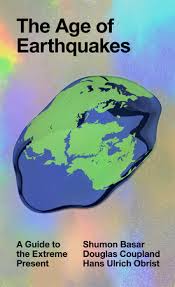
[READ: March 20, 2015] The Age of Earthquakes
I saw this book at work and could tell just from the typeface that it was a Douglas Coupland book (he is that much of a brand). I was a little thrown off by the other names on the book as I’ve never heard of them, but it is clearly a Coupland production, even if he is alphabetically second.
I’m not even sure what the other two authors contribute (or who they are), as the book is so clearly Couplandy. Of course, having said that, the majority of the book is pithy aphorisms about the age of technology and the future. So truly any one could have said them.
There is something kind of staid and conventional about Coupland writing about the craziness of the future and all that. He’s been doing it for decades now. But I found this book enjoyable. Not mind blowing (although some ideas are pretty fascinating), not life changing, but enjoyable.
I like the way the book is designed like a web site (with a scroll bar for % completed). I like that there are “links” to click and I like that there’s even a moment where it says wait 2 seconds before turning the page (like the ads on YouTube).
The 250 some pages are pretty much chock full of pictures with one or two lines superimposed on them. Lines like: “Twenty years ago the internet used zero per cent of human energy consumption. Today the digital economy uses 10 per cent of the world’s total electricity. It’s the same amount that was used to light the entire planet in 1985.”
Coupland has always emphasized people’s lives as stories, so the update is: “Our lives are no longer feeling like stories…our lives are becoming a lineup of tasks.” Which is too true.
I also enjoyed a kind of joke like “How old are you? I’m seven iPhones old.”
As with other Coupland books there are lots of newly defined words: Time snack; gap-induced time stretching; smupid and stuart, and the excellent Detroitus, to name just a few of the couple dozen in there. Some of which you can see excerpted at The Guardian.
There’s also some lines that show how much he knows us: “Have you ever bragged that you’re going on holiday and won’t be checking your emails only to crumble within two days. Of course you have. Thais was a rhetorical question.”
But despite the overwhelming feel of the future, Coupland wants us to embrace it. “Every new technology allows us to learn something new about ourselves.” And
Some people think you should get off the internet… Why would you want to disconnect from the Internet? It’s fun. It keeps you from feeling alone. It gives you information and doesn’t judge you. Most of all…everybody on earth is feeling the same way as you. The last time humanity had so much in common was when a few remaining cave people sat out the last Ice Age.
A final thought about that: “People are more connected than they have ever been before–except they’ve been tricked into thinking they’re isolated.”
In addition to the one liners, there are three longer pieces. One is about going on a date with a computer selected ideal mate and what it would be like to spend time with “yourself.” I know I’ve read the passage elsewhere. It is available on the Financial Times website, although that’s not where I read it. It’s interesting and a genuinely cool concept to think about.
There’s a longish essay which is in several small sections about playing Monopoly (and how no one ever finishes it), and the stock market crash.
A few other pithy lines:
- Maybe it’s okay to no longer want to feel like an individual.
- Do you like a lot of things online? Liking isn’t voting.
- There’s no shopping in Star Wars.
- Poor famous people are depressing
- I miss doing nothing.
The end of the book looks at the Turing test, the singularity, with quotes like “machines are increasingly talking about you behind your back.”
There’s a second essay that’s also available on the Financial Times, about downloading an app called Todd who eventually takes over your life and then leaves you to yourself. It’s funny and potentially plausible.
The book is also chock full of pictures. Some of the pictures are of art by Coupland himself, some are by Michael Stipe and the rest are:
“With visual contributions from Farah Al Qasimi, Ed Atkins, Gabriele Basilico, Alessandro Bava, Josh Bitelli, James Bridle, Cao Fei, Alex Mackin Dolan, Thomas Dozol, Constant Dullaart, Cécile B. Evans, Rami Farook, Hans-Peter Feldmann, GCC, Liam Gillick, Dominique Gonzalez-Foerster, Eloise Hawser, Camile Henrot, Hu Fang, K-Kole, Koo Jeong-A, Katja Novitskova, Lara Ogel, Trevor Paglen, Yuri Pattison, Jon Rafman, Bunny Rogers, Bogosi Sekhukhuni, Taryn Simon, Hito Steyerl, Michael Stipe, Rosemarie Trockel, Amalia Ulman, David Weir, Trevor Yeung.”
The book is described as :
A highly provocative, mindbending, beautifully designed, and visionary look at the landscape of our rapidly evolving digital era. 50 years after Marshall McLuhan’s ground breaking book on the influence of technology on culture in The Medium is the Massage, Basar, Coupland and Obrist extend the analysis to today, touring the world that’s redefined by the Internet, decoding and explaining what they call the ‘extreme present’.
I’m not really sure it’s all that. And I was originally going to say that it’s the kind of thing you read quickly and forget about. But I’ve been mulling some of these ideas over since I read it and I think I’ve decided that I might want to get a copy of it someday. I think it would very interesting to read in ten or fifteen years time to see if their ideas are quaint or archaic. And, well, I do love Coupland’s brand.

 I Just Read About That...
Leave a comment