Holy cow, Buffalo Tom! I more or less forgot about these guys (who I really liked back in the 90s). Some of their songs from that period are fantastic. They never had any major success, but they had a series of great releases. Evidently they reformed a few years ago and released a reunion album. And now, in 2011, they have a brand new record. Wow.
I haven’t listened to them in a few years, (although their albums covers are still very fresh in my head). But I listened to a few older songs for comparison’s sake. To me the biggest difference between Tom in 1999 and Tom in 2011 is that the singer now sounds even more like Elvis Costello. Bill Janovitz has always had a strong baritone voice, but with a few extra years thrown on, it has maturity that it lacked back then (not that it needed it, but the songs are more mature lyrically now, and the voice fits it well).
This song is a kind of punky (poppy punk, but still punky) rocking anthem. It’s under three minutes and it aims for mega catchiness.
[READ: July 18, 2011] “The Orderly”
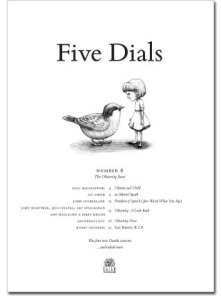
Having read the brief story by Arthur Bradford in Five Dials, I realized that I knew the name and decided to see what else I had read by him. It wasnt much, but I enjoyed what I’d read. I decided to look him up and discovered that he really only wrote one book, a short story collection called Dogwalker, before switching media to TV (and a show called How’s Your News?).
On his website, he has links to a number of published stories (fiction and non-); since the Esquire pieces have been collected in his book, there’s really only three unique fiction stories available here. So i decided to read them all.
Now Nerve.com was a site for “literate smut.” I remember when it came out and it was somewhat revolutionary in the sex world because it tried to raise the bar of quality and to include some decent writers. I didn’t actually know that nerve.com was still active (it is, and there’s some really good stuff there). As such, I feel like perhaps the stories at nerve aren’t entirely top-notch. Not Penthouse forum, mind you, but not Hemingway either. (more…)
I’ve enjoyed My Morning Jacket since I bought their live album Okonokos. I’ve enjoyed all of their releases since, but I never listened to Z, the album that forms the basis of much of Okonokos. Finally, I saw it cheap and picked it up.
And I was really surprised. The reason I hadn’t gotten it was because I figured I had all of the songs already in live format, so who needed the studio? Well, it turns out that the studio versions are quite different from the live ones. In fact, on my first listen, I didn’t really like the studio versions all that much. After a few listens of course, I like them just fine, but they are indeed quite different.
There are three songs here that didn’t make the live record: “Into the Woods,” “Anytime” and “Knot Comes Loose.” But the other seven songs appear (often in slightly longer form) on the live disc. And the live disc is fuller, louder and more energetic than the studio. That’s what a live album is supposed to sound like.
Z, on the other hand, sounds a bit more polished, more almost dancey–reflecting the kinds of sounds they would incorporate down the road (like on Circuital). But Z isn’t quite as full-sounding. Despite that, the songs are top-notch. And Jim James’ voice is truly a thing to behold (check out that crazy high note at the end of “What a Wonderful Man”).
I hate to sound like I’m down on this disc, because indeed, I am not. It’s a really fascinating mix of psychedelia and Prince-inspired keyboard rock (I’m not going as far as funk, but it’s certainly Prince-y. There’s some folk tracks, there’s the amazing “Wordless Chorus” which has a kind of 70;s soft rock feel, which is followed by the Prince-titled “It Beats 4 U” which sounds nothing like Prince, but has a great subtle guitar intro. “Gideon” doesn’t match any of the over the top epics of earlier records, but it sure feels close. And “Off the Record” is a practically ska. The album even has a near 8 minute closing track, the awesome “Dondante.”
All in all, Z is pretty great. But I still like the live versions better. That’s what happens when you listen to things out of order, I guess. But when do live albums count for anything?
[READ: July 11, 2011] 3 book reviews
According to Five Dials, Zadie Smith is an official member of Harper’s staff now (funny I found out about it from Five Dials, but they really do have tentacles in all aspects of my life). Congratultions, Zadie.
I can’t imagine having to review two or three books a month (I know I review a lot here, but most of them are short stories). Zadie plows through a lot of books for this column, but what is wonderful is that the diversity of what she reads is really pronounced. Just witness this months’ books.
MELA HARTWIG-Am I a Redundant Human Being? Zadie takes a great angle on this novel. She (with the help of an online reviewer) compares the protagonist of this novel (written in the 1930s) with Carrie Bradshaw from Sex in the City. Why? Because both protagonists seem to live their lives in the male gaze. And yet they both also continue on their merry way regardless of what the men say or do. True, Hartwig’s novella has much more angst, but really, there is a similar attitude present.
I especially like Zadie’s argument that women writers have never really had they way to express the bragging rights that men have employed time immemorial “We can’t, as the saying goes, pull it out and slap it on the table.” And as such, women have had to achieve their victories through more roundabout means. I rather liked this analysis. And, I think it makes for more interesting reading most of the time. (more…)
This Guster album is confusing. It’s rather short (compared to their other discs). Combined with the (kind of flimsy) cardboard packaging, it feels almost like an EP. It also seems to be kind of religious (although I don’t think it is)–like a themed EP. And yet it isn’t off-putting or anything (a few mentions of Jesus is all, although that’s a lot more than usual).
But, like most of Guster’s releases, it’s super catchy kind of alternative jangly pop. After one or two listens the songs are instantly recognizable. There isn’t a bad song in the bunch. However, they’re also mildly underwhelming compared to their previous releases. The songs feel a bit more subtle, but really it seems like they might be just a little too smooth. The dynamics aren’t quite as exciting as they have been.
Having said all that, the disc is still pretty great and I find myself humming a lot of these songs all day long.
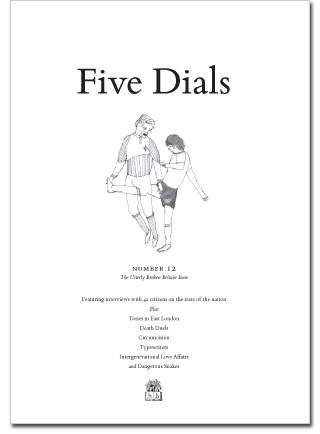
[READ: June 18, 2011] Five Dials Number 12
Five Dials Number 12 has a theme explicitly stated on the cover. The premise of the theme is that the Conservative Party of Britain had been claiming (in their TV ads and billboards) that Britain was broken. This idea was relentlessly pushed across Britain. And Five Dials wondered if people thought that that was true in general. So they asked 42 citizens (no idea what kind of random sample it may have been, realistically) and they recorded the results.
The rest of the issue has some of the standard Five Dials material we’ve come to expect: essays and fiction, advice and lists. The theme gives an interesting tone to the proceedings.
CRAIG TAYLOR-A Letter from the Editor: On Broken Britain and Nick Dewar
Taylor addresses much of what is said above. David Cameron (I still can’t get used to him being Prime Minister, it’s still Gordon Brown in my head–I guess Cameron hasn’t done much yet) is the man who keeps trying to “mend our broken society.” Even though (and statistics are similar in the U.S.):
They found that violent crime had almost halved since 1995, while crime generally fell by an extraordinary 45%. The figures for teenage pregnancies – a favourite of those talking about social decay – remain constant since Labour came to power in 1997; so too do those for teenage abortions.
The rest of the letter is devoted to the passing of Nick Dewar. Dewar drew the illustrations for Five Dials Number One. I really liked Dewar’s style, and his absurdist sensibilities. Taylor says that Dewar’s color work was even better. And I think he’s right. (more…)
This is a charming and very French sounding soundtrack. A delightful melody runs throughout the disc (which totals just over 25 minutes).
When Sarah first heard it, she said, “What’s this French music you’re listening to?” And indeed, it is very French-sounding. There are very simple instruments: melodica, acoustic guitars, piano. And that melodica is a prominent sound–giving it a sense of intrigue as well as a sense of solitude (the melodica can sound so yearning). But it’s not all melodica and intrigue; for instance, there’s some delicate xylophone on “Night Time Apartments.”
There are also several snippets from the movie online. Here’s one clip (with Tindersticks score underneath):
Of the new soundtracks releases this one is my favorite. And it’s one that I could see listening to for fun.
[READ: June 16, 2011] “The Rules of Engagement”
This is the final story in The Walrus‘ Summer Reading issue. As I mentioned, the intro states: “We asked five celebrated writers to devise five guidelines for composing a short story or poem. They all traded lists–and played by the rules.” Alexi Zenther was given rules by Sarah Selecky (which I posted below).
I really enjoyed this story, despite the immoral behavior. Susan and her friends from high school (it’s ten years after high school now) are enjoying a foreign vacation for a week. The first thing we see is a man seducing Susan. They call him “Fork” because after a few hours of flirting, he asked, “And now we fork?” Amusingly, for someone who made a living seducing women, he was bad in bed.
The other women also meet and bed these professional gigilos. After sex, one of them simply walked over to the woman’s wallet and took money when he was ready to leave. She notes that he took “probably less than I would have given him if he had asked.”
The women are in various stages of relationships, one woman is divorced, another is serially monogamous and a third is married (that’s the immoral part).
There’s a wonderful diversion in the story that flashes back to Susan’s grandfather Bert. Bert had a U-pick apple stand and the girls worked there for many summers. There’s an especially tender moment in which Susan and Bert are wandering the island and they see a wild horse. And the scene fills Susan (and the reader) with a sense of wonder at her grandfather. (more…)
SOUNDTRACK: THE KOPECKY FAMILY BAND-Tiny Desk Concert #131 (June 6, 2011).
I’d never heard of The Kopecky Family Band, but the write-up about them was pretty interesting, so I decided to give the Tiny Desk concert a listen. The band (all 7 of them) play a great collective of music: two guitars (acoustic & electic) bass, cello, violin, drums and keyboard. They play a sort of traditional folk with a very full sound.
Indeed, they remind me an awful lot of The Head and the Heart (the singer’s voice in particular), although they are from different edges of the continent and have been playing music about as long as each other (indeed, The Kopecky Family Band released an EP in 2008 whereas Head and the Heart formed in 2009).
And the Kopecky website offers lots of free music (which is very cool).
“Howlin’ at the Moon” is a full acoustic sounding track. “Birds” has a simply gorgeous whistle/xylophone melody that is as beautiful as it is catchy. “Disaster” is a tender ballad with wonderful harmonies. And “Red Devil” is a somewhat more rocking song, which really helps to demonstrate the bands’ diversity.
And the band is charming. Keyboardist/singer Kelsey admits to having left a trinket of some kind of the office bookshelves (which are littered with things). It’s a wonderful set, and because of it, I downloaded the band’s first EP from their site.
[READ: June 5, 2011] Great Philosophers Who Failed at Love
Shaffer was signing books at BEA this year. My coworker told me that he was very funny and that he signed her book in an amusing way. He happened to be signing at the table next to the line I was on. Sadly, he finished before I was able to get to him. But I was pretty close to the beginning of the line, so I asked if I could grab a copy of his book, which I did (although no autograph for me).
This is a silly book of nonfiction. It looks at thirty-seven philosopher or thinkers and their utter failure at love. Each man (and occasional woman) has had some distinguishing characteristic that made them pretty lousy in the emotional range.
The title of the book is funny and is meant to be kind of surprising: these smart folks were terrible at love. Of course, spending a minute or two thinking about who these people were and what they did, it’s not surprising that they were lousy at love. These were intellectuals, people who spend most of their time in their own mind. Of course they couldn’t have a serious relationship.
Nevertheless, these stories are all more or less amusing (Louis Althusser accidentally strangled his wife to death(!) which isn’t amusing per se, but the story of it is, kind of). Shaffer does a great job at keeping each entry brief but really retaining the salient points of the thinker’s philosophy and a cogent example of his or her lousiness at love. He also throws in some amusingly snarky comments of his own as he goes along.
I was delighted that the book order was done alphabetically rather than chronologically. A chronological list would have been a little too samey in terms of each person’s context. The alphabetical list allows for jumping around from say Plato to Ayn Rand which keeps the stories interesting and fresh.
At the end of each person’s piece, there’s an “In His Own Words” which offers a quote that details his or her written philosophy regarding love.
Dare I say that this is an ideal bathroom book? It certainly is. And it makes you feel a little better about yourself (if you haven’t for instance, adopted your mistress as your daughter (Sartre)).
SOUNDTRACK: MOGWAI: GovernmentCommissions: BBC Sessions 1996-2003 (2005).
It’s unlikely that Mogwai will ever release a greatest hits (well, someone probably will, but the band themselves don’t seem likely to do so). As such, this compilation of BBC Recordings will certainly work well as one.
As I’ve mentioned many times, the BBC recordings are universally superb. The quality of the recordings is unmatched. And, typically the band takes the sessions very seriously. The major different between these sessions and the official studio release is that the band is playing these songs live. They are mixed well and sound great but they are live, so you can catch occasional subtle differences.
Mogwai, despite their seemingly improvised sound (all those noises and such) can recreate everything they do perfectly, and their live shows are tight and deliberate (except for the occasional moments where they really let loose).
The ten songs here span their career and are not played in chronological order. This allows all of these wonderful songs to play off the tensions of each other. And it shows that their later songs, which are less intense than their earlier ones, are still quite awesome and in a live setting don’t really lack for intensity after all.
The highlight of this disc is the scorching eighteen minute version of “Like Herod.” The original is intense and amazing, and this live version allows them to play with the original in small ways, including allowing the quietness to really stretch out before they blow the speakers off the wall with the noise section of the track.
Even though I’m a fan of Mogwai, I don’t hear a radical difference between these versions and the originals. Or should I say, it’s obvious which song they are playing. There are some obvious subtleties and differences as befitting a live album, but unlike some live discs you don’t immediately notice that this version is “live.”
And that works well for both fans of the band (because as you listen and you hear the subtleties) and for newcomers–(because you’re not listening to weird, poorly recorded versions or versions that are for fans only). And so, you get ten great Mogwai tracks. Just enough to make you want to get some more.
[READ: June 11, 2011] The Burned Children of America
I found this book when I was looking for other publications by Zadie Smith. This book kept cropping up in searches, but I could never really narrow down exactly what it was. As best as I can tell, it is a British version of a collection of American authors that was originally published in Italy (!). Editors Marco Cassini and Martina Testa work for minimum fax, an Italian independent publisher. In 2001, they somehow managed to collect stories from these young, fresh American authors into an Italian anthology (I can’t tell if the stories were translated into Italian or not).
Then, Hamish Hamilton (publisher of Five Dials) decided to release a British version of the book. They got Zadie Smith to write the introduction (and apparently appended a story by Jonathan Safran Foer (which was not in the original, but which is in the Italian re-publication). This led to the new rather unwieldy title. It was not published in America, (all of the stories have appeared in some form–magazine or anthology–in America), but it’s cool to have them all in one place.
The title must come from the David Foster Wallace story contained within: “Incarnations of Burned Children,” which is one of his most horrific stories, but it sets a kind of tone for the work that’s included within (something which Zadie addresses in her introduction): why are these young successful American writers so sad? So be prepared, this is not a feel good anthology (although the stories are very good).
Oh, and if you care about this kind of thing, the male to female ratio is actually quite good (for an anthology like this): 11 men and 8 women.
ZADIE SMITH-Introduction
Zadie Smith was a fan of David Foster Wallace (she wrote a lengthy review of the ten-year anniversary of Brief Interviews with Hideous Men which is republished in her book Changing My Mind), so she is an ideal choice to introduce this book. Especially when she provides a quote from DFW’s interview in 1995 about how living in America in the late 90s has a kind of “lostness” to it. With this in mind, she sets out the concerns of this collection of great stories: fear of death and advertising.
Zadie gives some wonderful insight into each of these stories. The introduction was designed to be read after the book, and I’m glad I waited because while she doesn’t exactly spoil anything, she provides a wonderful perspective on each piece and also offers some ideas about the stories that I hadn’t considered. And it’s funny, too. (more…)
There’s a fascinating release history behind this EP (which mostly means fans wind up with three copies of “Stanley Kubrick.” First it came out as EP with 4 tracks (which I ordered on import). Then it was released in the US as EP+2 with two songs from the Fuck the Curfew EP (which was not released in the US) and finally in 2000 it was reissued again as EP+6 with ten songs in total (compiling 1997’s 4 Satin, 1998’s No Education = No Future (Fuck the Curfew), and 1999’s EP–I didn’t buy this version because by then I had the original imports).
“Stanley Kubrick” is a slow burner with a great repeated mournful guitar. It’s one of their best songs. “Christmas Song” is a slow, upbeat track with a very pretty melody. “Burn Girl Prom Queen” opens with some really quiet guitar. After about 90 seconds, a brass band kicks in adding amazing horns over the simple guitar melody. It’s my favorite track on the disc. “Rage: Man” is the first song on the album where Mogawai’s noise tendencies really come to the fore. Once again, it’s a simple slow melody (with piano). About two minutes in, the song is bombarded with noise guitars that take over the song but don’t obscure the melody. There’s also a noisy guitar solo played over the noise. Soon enough all the noise ends, and the simple, harmonic’d guitar comes back and the song ends peacefully. It’s a great example of Mogwai dynamics.
The other two tracks, “Rollerball” and “Small Children in the Background” come from the other EP as I mentioned. It’s odd to squeeze in songs from a different release, but Mogwai don’t sound terribly different on these early EPs, so these songs work well together.
Despite their length, Mogwai EPs are pretty uniformly wonderful.
[READ: June 1, 2011] Five Dials Number 8 bis
After publishing Five Dials Number 8, they quickly rushed out this addendum to the issue, which they’ve called Five Dials 8 bis. According to the introduction: “The definition of ‘bis’ is a passage to be repeated, so here is a small bis for our eighth issue.”
It’s only 9 pages long and really only contains one long piece. Primarily, this is a memento of their Paris-issue release party, which they held in Paris (duh). The opening pages includes scans of postcards (“One of our volunteers waded into conversations and asked attendees to write down their own thoughts on Paris. We’ve reprinted five of our favourites.”) The editor’s letter, which explains all about the party and this issue, is not credited to anyone, so I can’t so who is responsible. [This lack of proper crediting is the one major flaw with this publication–just saying illustrations by, and then not saying which is whose, or not including the date of publication is maddening].
The big article is by Guy de Maupassant (translated by Siân Miles). (more…)
ATTENDED: WEIRD AL YANKOVIC-Live at the State Theater, New Brunswick, NJ May 19, 2011 (2011).
I’ve seen “Weird Al” live three times now and I have never been disappointed by the show. The first year my friend Matt and I waited out by the bus and got the bands’ (minus Al’s) autograph. The second time we waited even longer and Al had an autograph (and picture taking) session in the theater after the show (how cool is that?).
This year, Sarah and I didn’t wait around afterwards (kids at home) but the show was still great. Al made a joke after the first song thanking his opening act, Technical Difficulties. (There were indeed 45 minutes of technical difficulties before the show, but Al’s joke made us quickly forget it–and, kudos to the State Theater: I ordered my tickets online from their site and the day after the concert, the theater owner sent an email apologizing for the delay. Classy!).
Sarah had never seen him perform before, so she was pleasantly surprised by the set selection. I was also surprised by the set selection because he pulled out a few older, more obscure tracks (“Frank’s 2000″ TV” (!), “You Don’t Love Me Any More”–complete with Al smashing a guitar!). But he also dazzled with some new tracks from his forthcoming album.
The set opened with the polka medley (“Polka Face”). This is the first polka medley that I didn’t know any (well almost any) of the sped up songs, but it’s always a treat to watch them play it live. The one complaint with the show was that the sound in the theater wasn’t very good (which is surprising given that it’s an old theater) so it was hard to make out a lot of the words, especially to the new songs–and what’s Al without the lyrics?). But his new song “I Perform This Way” (parody of Lady Gaga’s “I Was Born This Way”) was fantastic (Al was dressed up like a cartoon peacock).
Yes, costume changes. One of the most entertaining things about Al’s shows is the costume changes. For all of his big video hits, he comes out dressed like the video (the band does as well, although it’s a bit more subtle). So, we get the Amish garb in “Amish Paradise,” the Michael Jackson red jacket for “Eat It”–(another surprise) and, my personal favorite, the fat suit from “Fat.” One of the funniest costume changes was for a song that will sadly not be released on the album (but you can hear and download it here), “You’re Pitiful,” in which he wore multiple T-shirts (about 5) which all expressed some kind of funny comment (anyone know who was the face on one of the shirts?) and finally ended in a Spongebob Squarepants shirts and tutu.
So how does he do all of these costume changes? In between songs, when the band runs offstage, they play wonderful video clips. Some of the clips are from his TV shows, some are faux documentaries, and the best are interviews that Al splices together (you can see a whole bunch here) which are hilarious and surprisingly mean-spirited. I wish he would release them (and any other AlTv segments) on DVD, but I imagine that no one would ever give permission for that–check out the Kevin Federline one, for instance. But they’re all pretty great.
The crowd was also totally into it (including the guy behind us with an Al wig (and a Harvey the Wonder Hamster). And the age range was fantastic–from kids to grandparents. My only hope is that my kids are old enough to come to a concert next time he comes around.
Oh and a brief word about his band. He’s had the same four guys with him for years and years and years. Rubén Valtierra is the newest member of the band and he’s been with them since 1991. Jim West (guitar), Steve Jay (Bass) and Jon “Bermuda” Schwartz (drums) have been with Al since 1980. They are tight as a drum, can play incredibly diverse styles at the drop of a hat (check out “CNR” which sounds exactly like The White Stripes) and they all seem to have a lot of fun on stage (see them jump in the air on “Fat” or the crazy vocal-only solo at the end of “Yoda”
–which I think is longer than ever and totally mind-blowing).
[READ: May 21, 2011] This is a Book
I recently read Martin’s “This is Me” in the New Yorker. “This is Me” is, along with about 100 other things in This is a Book. I also heard Demetri Martin on NPR a few Sundays ago and he read a few short things from This is a Book. And they were quite funny.
Indeed, the funny things in this book are really very very funny. It seems to work that the shorter the item, the bigger the laugh. Conversely there are a number of longer, extended jokes which just go on and on, like a Saturday Night Live sketch that just won’t end. Those quickly lose their humorous value. Fortunately there aren’t too many of those in here.
What makes me smile a lot about the book are the jokes he plays with book conventions. So the title page says “This is a book by Demetri Martin called This is a Book by Demetri Martin.” Or the previous page:
Also by Demetri Martin
*
*Nothing yet. This is his first book.
The book opens with “How to Read this Book.”
If you’re reading this sentence then you’ve pretty much got it. Good job. Just keep going the way you are.
I’m not going to spoil the rest of the book (or talk about each piece). But I will mention some real highlights: (more…)
My friend Lar told me about Battles way back in 2007. I listened to the concert he sent me, and it was great. But my memory of the band was that they were really heavy (the drummer was in Helmet and Tomahawk for cripessakes).
But they’re not so much heavy as noisy and crazy. And this track is a head-spinning amalgam of keybaords, unsettling rhythms, processed guitars and singing from Argentinean techno producer Matias Aguayo. The lyrics sound like they are not English, but they are (with heavy effects on them).
The song is weird, indeed. But after just one listen, I was totally hooked. It’s catchy and bouncy and very sunny and it’s a real joy to listen to. I absolutely must go back and check out their debut Mirrored.
Five Dials Number 5 was an excellent issue that I enjoyed immensely. They followed it up with Number 6, which deals with a subject that I was very passionate about in the early 90s: censorship/obscenity. When I was in high school and college, the PMRC was the big bogeyman for advocates of free speech (of which I am one). I still advocate passionately for freedom of speech (now that I’m in a library, the issue can be part of my daily life), but it seems like there are so many more important issues in the world, that stickers on a record seem kind of silly.
Nevetheless, as this issue reminds us, those who control what is said control what we hear. And that’s true for music and books, as well as our everyday news. So, free speech should never be taken lightly. Although this issue looks largely at obscenity in England, they also pull up some good information from Jello Biafra as well.
CRAIG TAYLOR-A Letter from the Editor: On John Mortimer and Obscenity
John Mortimer appears later in the issue. He was the lawyer who defended Lady Chatterly’s Lover against accusations of obscenity. And Taylor points out that Mortimer’s attitude was that he “understood the silliness of censorship.” And with that attitude, he was able to work to convince juries of that silliness. The rest of the issue looks at important cases of censorship over the years, from The Dead Kennedys to NWA (it’s nice to be reminded about how “dangerous” they were when they came out). He also laughs at the lame attempts at putting adult content on network TV (Fudge you!). (more…)
SOUNDTRACK: THE HEAD AND THE HEART-SXSW, March 18, 2011 (2011).
Just months after their in-studio session, The Head and the Heart played South by Southwest. This set seems somehow louder than the in-studio (which seems a very common phenomenon–the bands just seems to be quieter in-studio somehow, even if they are playing hard, it still seems subdued, which isn’t bad at all, just odd). So here, the band really lets loose (or maybe it’s because they’ve been playing no for six extra months?) and they sound like they’re really having fun.
Their sound is loud and (somewhat) chaotic, and it really suits them. The set list is similar to the in-studio (they also play “Cats and Dogs” which segues into “Coeur d’Alene”). “Ghosts” and “Lost in My Mind” are also here (“Lost” sounds great in this rambling, somewhat shambolic format). They also play “Down in the Valley.” Added to the set are “Winter Song” and “River and Roads.” These two songs feature vocals by violinist Charity Thielin, and I have to admit I don’t love her voice. Perhaps it’s in this context or that she is mixed a wee bit to loud (because I didn’t dislike her voice in the in-studio). As I said, I haven’t heard the studio version yet, so I’ll chalk it up to a very large crowd.
But otherwise the set is outstanding, and I’m becoming a huge fan of the band.
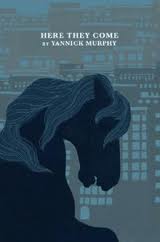
[READ: March 28, 2011] Here They Come
I had been thinking about reading this book for a while (the blurbs on the back are quiet compelling) but I kept putting other McSweeney’s books in front of them (I had hoped to finish an entire stack of McSweeney’s novels before The Pale King came. But it shipped two weeks early and threw off my plan).
I have read two pieces by Murphy in previous McSweeney’s issues, but looking back they didn’t prepare me for this strange story. And the strangest thing is the point of view of the narrator (but more on that later).
This is actually a simple enough story. Set in New York over an unspecified time period (there’s a couple of winters and a couple of summers, but I’m not sure if it’s new seasons or flashbacks), the (as far as can tell) unnamed narrator girl leads a pretty crap existence.
Firs there is John, the hot dog vendor. He’s a married man from a middle eastern country (his family is back there). And basically the narrator lets him feel her up (for what it’s worth on a flat chested 13-year-old) for free hot dogs and candy bars. She doesn’t seem to upset by the groping and keeps going back to pass the time with him.
Then there is her brother, an obnoxious boy who walks around in a silk dragon bathrobe all the time. When he is not smashing things with his guitar when he walks past the furniture, he is smashing things in his room or threatening to shoot himself with their old, unloaded gun.
Her mother works all the time but really can’t afford to take care of them or feed them. And she says “Merde” night and day (she is French). But worse is her mother’s mother, la mere, who stays with them from time to time. la Mere seems like she has money but she never gives them any. (more…)
 SOUNDTRACK: BUFFALO TOM: “Guilty Girls” (2011).
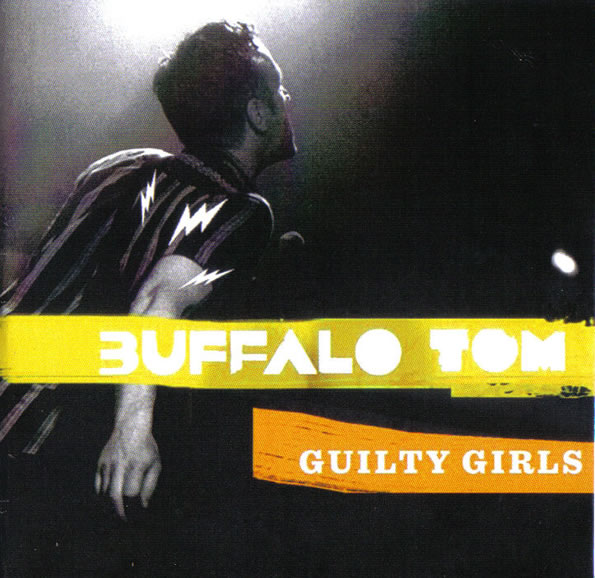 Holy cow, Buffalo Tom! I more or less forgot about these guys (who I really liked back in the 90s). Some of their songs from that period are fantastic. They never had any major success, but they had a series of great releases. Evidently they reformed a few years ago and released a reunion album. And now, in 2011, they have a brand new record. Wow.