Feeds:
Posts
Comments

Archive for the ‘Sex’ Category

CV1_TNY_03_04_13Chast.inddSOUNDTRACK: DEFTONES-B-Sides & Rarities (2005).

220px-Deftones_-_b-sides

Deftones released this B-sides collection after Deftones.  It contains mostly covers.  They also later released an album called Covers which has all of these covers and some new ones.  Covers was released on Record Store Day and is really hard to get now.  The covers that are extra to that CD are: “Drive” (originally by The Cars), “Caress” (originally by Drive Like Jehu), “Do You Believe” (originally by The Cardigans), “Ghosts” (originally by Japan) and “Sleep Walk” (originally by Santo & Johnny).   Despite those interesting songs, B-Sides and Rarities is no slouch.

“Savory” is a cover of a song by Jawbox.  Chino’s voice sounds so utterly different here, I completely don’t recognize him.  It’s not the most impressive start to the collection as even after a lot of listens the song still hasn’t really stuck for me, but it’s also one of the few songs I didn’t know beforehand.  (It turns out the cover was actually by the band Far (with the members of Deftones playing as well)).  But it was the Cocteau Twins cover that really blew me away.  The Cocteau Twins, an ethereal lighter than air band get a very respectful treatment here.  “Wax and Wane” has a pretty heavy bass line which Chi produces (with cool effects on it), and while Chino doesn’t try to ape Elizabeth’s Fraser’s voice, he does a great job in her register (how he figured out the words, I can’t imagine). Lynyrd Skynyrd’s  “Simple Kind of Man” gets the Deftones treatment with whispered/creepy vocals in the first verse and a big loud chorus.  The cover of Helmet’s “Sinatra” is very heavy (I don’t know the original but I know other Helmet songs) but it doesn’t sound quite like Helmet–a perfect Deftones take on the band, with very low tuned bass strings.  The second biggest surprise comes from their cover of Sade’s “No Ordinary Love.”  I don’t know the original, but I do know about Sade and this song keeps all of the funky bass and the slinky sexiness of a typical Sade song.  But it adds an interesting slightly sinister vibe that really makes the song stand out.

The band performs a great spooky gothy cover of The Cure’s “If Only Tonight We Could Sleep” (at what I gather is a live tribute show) complete with that weird Middle Eastern sounding guitar and the cool splash cymbal.  It’s followed by a great cover of The Smiths’ “Please Please Please Let Me Get What I Want” and he does a surprisingly good Morrissey.   Their cover of Duran Durans “The Chauffeur” was the first cover that I had heard by the band and it was the first time I thought about how cool a Duran Duran song could sound: win-win.

There are some reinterpretations of Deftones originals as well.  “Change (In the House of Flies)” works very well in the acoustic format–sounding somehow more dramatic.  “Teenager” has a trippy Twin Peaks vibe when it opens.  This is the “Idiot Version” with guys from Idiot Pilot joining the Deftones.  It doesn’t sound all that different from the version on White Pony and yet I really didn’t recognize it out of context.  “Crenshaw Punch/I’ll Throw Rocks at You” is the heaviest thing on the album, with loud abrasive guitars.  It was a B-Side from Around the Fur.  My least favorite track is “Black Moon” which is a sung by B-Real from Cypress Hill.  I liked Cypress Hill a lot back in the day, but there’s something unsatisfying about this pairing–or maybe it’s just that this songs really sticks out on the disc.  The acoustic “Digital Bath” is trippy and very cool–it’s amazing when they strip down their songs, which are usually so abrasive and heavy and they still manage to sound great.  “Be Quiet and Drive (Far Away)” is another acoustic piece with a remix by DJ Crook.

More than just a stop gap or a collection of misfit tracks, this is a really cohesive Deftones album and actually a great place to start for people trying to ease their way into the band.

[READ: March 3, 2013] “Summer of ’38”

This story is about Montse.  Montse is an old woman with three children.  Her husband died some time ago and she is by herself.  Her daughters come to visit her but she doesn’t like to be a bother to them.  On this occasion, her daughter Ana says that she met a man who is writing a book about the war and he would like to talk to Montse to see if she has any recollections of the time (she was a teenager in 1938).

Montse doesn’t want to talk to the man, she says she won’t remember anything and why doesn’t he write the book without her.  But the man arrives anyway.  When he asks her questions, she says she knows nothing about the war.  But he says that a retired general (for Franco) is coming to their town to show the writer war locations.  The general says he remembers Montse’s name and would like to meet with her.  His name is Rudolfo Ramirez.  She says she barely remembers him and that maybe she’s even thinking of someone else.

The writer says it’s not a big deal but is she would like to meet with him he will be at the cafe on Saturday for a casual lunch. She gives a reluctant maybe and the writer leaves. (more…)

Read Full Post »

thisoneSOUNDTRACK: JAPANDROIDS-Post Nothing (2009).

japan1Japndroids are two guys from Vancouver.  And man, they make a racket fit for a group double its size.  There’s a lo-fi quality to the recording but that’s mostly because the guitar is buzzy and noisy and distorted and the drums are miked very loud (and there’s cymbal splashes everywhere).  The vocals (which are mostly screamed/sung) are also pretty relentless (especially when the backing vocals come in).  And yet for their simple punk aesthetic  their songs aren’t short. “Young Hearts Spark Fire” which opens with some slower guitar (before crashing into a huge verse) runs over 5 minutes.  That’s five minutes of thumping drums and super fast guitars.  Well, they do take small breathers in the song, but they don’t last long.

But for the most part, the songs are simple, fast rockers and while there is a sameness to the album, there is diversity within their sound.  “Rockers East Vancouver” has a bit more treble in the guitar and a slow middle section.  It also has what sounds like a bass guitar break–but remember there’s no bass.  The thudding guitar and drums that open “Heart Sweats” also sound very different, as do the groovy Ooooohs that punctuates the verses–making it a very distinctive song.

“Crazy/Forever” opens with a nearly 2 minute instrumental before turning into a slow rocker that last for 6 minutes of catchiness.  The album closer, “I Quit Girls” has a cool feedbacky sound on the guitar that makes it sound rather different as well.  And the song itself is a slow almost ballad (bit not really a ballad, don’t worry) that really stands out on the disc.  So this debut is 8 songs in 36 minutes–a great length for a fun rocking album.

[READ:  February 19, 2013] This One is Mine

If you named a book Unlikable People Who Do Foolish Things it probably wouldn’t sell. Or maybe it would.  Regardless, it’s an apt subtitle for this novel.  Semple is extremely daring to write a story in which nobody is likable at all.  Luckily for her, though, is that she writes really well and the book itself is very likable, so much so that I stayed up way too late several nights in a row to finish it.

So this book is about a small group of people who run somewhat parallel lives.  David Parry is married to Violet.  His sister Sally is single.  Although David is the sort of fulcrum between the two women, the story is about the women far more than David.  But it’s important to start with David to set things up.  David Parry is a multimillionaire.   He works in the music industry–he’s the asshole that all the bands need on their side.  So, he has autographs with everyone (working on getting his daughter a photo op with Paul McCartney, had Def Leppard play his wedding, etc).  But he’s cold and distant to his wife.

Or at least he seems to be from Violet’s point of view.  Violet is a writer.  She wrote a very successful TV show but wanted out of that life.  When she met David, they had an amazing first date (and David still swoons when she looks at him that way, but it seems like she hasn’t been looking at him that way very much lately).  And when they settled in, she realized she didn’t have to work anymore.  But then she felt odd realizing that she wasn’t making any money herself.  So she threw her creativity into a new house.  Which took forever.  Then they finally managed to have a child (Dot), but Violet found being a mother overwhelming as well, so the nanny (called LadyGo) takes Dot much of the time (and yes, David is resentful of this too).

Violet is at loose ends with her life.  And then she meets Teddy.  Teddy is a loser–a former addict with Hepatitis C, he plays double bass in a Rolling Stones cover band.  When she first sees him, he is playing in the park for some kind of function (not as the Stones cover band, but in some other kind of band) and she is entranced by the music they make.  Teddy has a double bass and, when Violet runs into him after the show, because she parked near him, he is trying to fit it into his crappy car that breaks down all the time.  Indeed, it won’t start now.  He can;t afford to fix it which means he wont be able to get to gigs, which means he won’t have money for rent, etc.  He’s about as far from Violet’s one can get.  Yet, despite the fact that he is an asshole: verbally abusive, cocky and prone to make very bad choices, she falls for him.  She offers to pay to have his car fixed.  And then imagines when they can meet again. (more…)

Read Full Post »

McSweeney’s #13 (2006)

13SOUNDTRACKPARTS & LABOR-Stay Afraid (2006).

partslaborParts & Labor have changed t heir style over the years going from noisemakers who have a melody to being melodious noisemakers.  This album is one of their earlier releases when noise dominated.  Right from the opening you know the album is going to be a challenge.  The first song has pounding drums (electronics that sound like bagpipes) and heavy distorted shouty vocals.  By the end of the songs there is squealing feedback, punk speed drums and screaming distorted vocals (complete with space sound effects).  It’s an aggressive opening for sure.  Song two opens with a long low rumbling and then “Drastic Measures” proves to be another fast-paced song.

“A Pleasant Stay” is 5 minutes long (most of the rest of the album’s songs are about 3 minutes).  It continues in this fast framework, although it has a bit more open moments of just drums or just vocals.  The way the band plays with feedback in the last minute or so of the song  very cool.

“New Buildings” has a hardcore beat with a guitar part that sounds sped up.  “Death” is a thumping song (the drums are very loud on this disc), while “Timeline” is two minutes of squealing guitars.  “Stay Afraid” has a false start (although who knows why–how do these guys know if the feedback sounds are what  they wanted anyhow?).  The song ends with 30 seconds of sheer noise).  The album ends with the 5 minute “Changing of the Guard” a song not unlike the rest of the album–noisy with loud drumming and more noise.

The album is certainly challenging, it’s abrasive and off putting, but there;s surprising pleasures and melodies amidst the chaos.   Indeed, after a listen or two you start to really look forward to the hooks.  If you like this sort of thing, this album s a joy.  It’s also quite brief, so it never overstays its welcome.

[READ: April 15, 2011] McSweeney’s #13

I have been looking forward to reading this issue for quite some time.  Indeed, as soon as I received it I wanted to put aside time for it.  It only took eight years.  For this is the fabled comics issue.  Or as the cover puts it: Included with this paper: a free 264 page hardcover.  Because the cover is a fold-out poster–a gorgeous broadside done by Chris Ware called “God.”  And as with all Chris Ware stories, this is about life, the universe and everything.  On the flip side of the (seriously, really beautiful with gold foil and everything) Ware comic are the contributors’ list and a large drawing that is credited to LHOOQ which is the name of Marcel Duchamp’s art piece in which he put a mustache on the Mona Lisa.  It’s a kind of composite of the history of famous faces in art all done in a series of concentric squares.  It’s quite cool.

So, yes, this issue is all about comics.  There are a couple of essays, a couple of biographical sketches by Ware of artists that I assume many people don’t know and there’s a few unpublished pieces by famous mainstream artists.  But the bulk of the book is comprised of underground (and some who are not so underground anymore) artists showing of their goods.  It’s amazing how divergent the styles are for subject matter that is (for the most part) pretty similar: woe is me!  Angst fills these pages.  Whether it is the biographical angst of famous artists by Brunetti or the angst of not getting the girl (most of the others) or the angst of life (the remaining ones), there’s not a lot of joy here. Although there is a lot of humor.  A couple of these comics made it into the Best American Comics 2006.

There’s no letters this issue, which makes sense as the whole thing is Chris Ware’s baby.  But there are two special tiny books that fit nearly into the fold that the oversized cover makes.  There’s also two introductions.  One by Ira Glass (and yes I’d rather hear him say it but what can you do).  And the other by Ware.  Ware has advocated for underground comics forever and it’s cool that he has a forum for his ideas here.  I’m not sure I’ve ever read prose from him before. (more…)

Read Full Post »

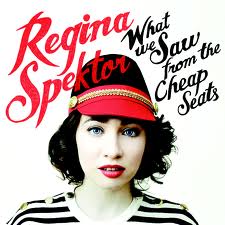
CV1_TNY_01_21_13Blitt.inddSOUNDTRACK: REGINA SPEKTOR-What We Saw from the Cheap Seats (2012).

spektorRegina Spektor’s latest album has gotten rave reviews this past year and deservedly so.  It’s catchy and more than a little weird.  The songs could be huge but they don’t have the gloss that makes for big sellers.  Which is fine, because Spektor’s niche is perfect with her in it.

Amidst the quirk, there are some wonderful piano pop songs with unexpected lyrics.  There’s a great phrase in the opener “Small Town Moon,” “Today we’re younger than we’re ever gonna be.”  But after the pretty piano intro, Regina’s full band kicks in for some rocking verses.  “Firewood” is a gorgeous piano ballad dealing with a common theme in her songs: death (but with jaunty piano lines and a beautiful instrumental section).  And “Open” falls into this category as well–achingly beautiful (and a touch Ben Foldsy in the piano).  Although there’s some really crazy sounds on “Open” too, like Spektor dramatically gasping for breath after lines of verse.

The album is full of electronic “drum” sounds that are what I assume is really Spektor going “doo doo” and then electronically manipulated.  You can hear them on one of the weirder songs, “Oh Marcello” which has Spektor singing in a crazy Italian accent and has a chorus of “I’m just a soul whose intentions are good”–but not in the manner in which it was originally sung).  This drum sound is really prevalent of “All the Rowboats” a fascinating song that seems to offer pity for paintings in museums.

“How” is also filled with theatricality–and Spektor’s gorgeous soaring voice.  “The Party” is another big blockbuster number–lots of instruments and a big soaring vocal.  Wonderful.

“Don’t Leave Me (Ne Me Quitte Pas)” has one of the catchiest choruses that I have no idea what is being said (because it’s in French).  It also has great orchestration giving it a very worldly feel.  “Patron Saint” is another pretty song, with lovely strings.  The disc ends with an acoustic guitar/piano tune.  A simple song to “Jessica.”  This album is gorgeous and deserves a wider audience.

[READ: January 16, 2013] “Experience”

Tessa Hadley had a story in the New Yorker back in June (she seems to be a favorite of theirs.  I liked that one, and I like this one as well.  Hadley creates interesting scenarios for her stories, scenarios that I can’t really imagine happening (unless things are different in England).  But I feel like that scenario’s set up is neither here nor there for the point of the story.  So in this one, a woman who has very recently divorced from her husband is looking for a place to stay.   A friend of a friend who is going to America for a few months agrees to let her live in her house rent-free.  Now I’m not saying that that kind of thing can’t happen, indeed there is a lot of fiction based on the idea of staying in someone’s house while they are away, but I’ve never heard of it happening in real life.  And despite my saying this, I don’t have a problem with it.  I’m willing to believe it happens all the time.

So the narrator, Laura,  makes herself at home in Hana’s house.   She doesn’t have a ton of money so she is more or less subsisting on what’s around the house until she has to get a job.  She checks out all the rooms and enjoys the comforts of Hana’s well-off lifestyle.  Then one day she finds a key to a locked attic room.  She decides to explore the room and see what kinds of secrets it hides.  It contains largely the ephemera of a successful woman: porn videos, a wetsuit, coffee table books and a number of paintings (Laura believes Hana made her money in the art world).  But then she finds a box that contains more personal effects.  Including a diary.

The diary reveals that Hana had been having an affair with a man named Julian.  Hana describes Julian, who is married, as rough and as someone who hurts her, but that the s*x is great.  I found it charming that Hana wouldn’t curse in her own diary  writing “f****d in the shower” and “Then X and you know what.”  The last words in the diary were “He makes me so happy.”

Reading this makes Laura feel despondent–she has never had any experience like that–she married young, was dutiful and is now divorced.  Her husband was smart and gentle and rather boring–even when they split up it was reasonable.  This causes Laura to mope around a bit.  Until one day Julian knocks on the door. (more…)

Read Full Post »

dtmaxSOUNDTRACK: TOM WAITS & KEITH RICHARDS-“Shenandoah” (2013).

roguesgallery-f8be47f3887d51de57ea842a129f0a722e53ef74-s1This tune comes from the album Son Of Rogues Gallery.  The album is, of all things, a sequel to the album Rogues Gallery.  The full title is Son Of Rogues Gallery: Pirate Ballads, Sea Songs & Chanteys.  The first album was a kind of novelty–I can’t even say novelty hit as I don;t know if it was.  But it must have had some success because here’s a second one (and there’s no Pirates of the Caribbean movie to tie it to).

The album has 36 songs (!) by a delightful collection of artists, including: Shane MacGowan, Nick Cave, Macy Gray, Broken Social Scene, Richard Thompson, Michael Gira and Mary Margaret O’Hara (among many others).  I enjoyed the first one, but I think the line up on this one is even better.

“Shenandoah” is not a song that I particulalry like.  Because it is traditional, I have a few people doing versions of it, but I don’t gravitate twoards it–it’s a little slow and meandering (like the river I guess) for me. And this version is not much different.  What it does have going for it is Waits’ crazed warbling along with even crazier backing viclas from Keith Richards (there;s no guitar on the track).

[READ: January 7, 2012] Every Love Story is a Ghost Story

I had mixed feelings about reading this biography.  I’m a huge fan of David Foster Wallace, but I often find it simply disappointing to read about people you like.  And yet, DFW was such an interesting mind, that it seemed worthwhile to find out more about him. Plus, I’ve read everything by the guy, and a lot of things about him…realistically it’s not like I wasn’t going to read this.  I think I was afraid of being seriously bummed out.  So Sarah got me this for Christmas and I really really enjoyed reading it.

Now I didn’t know a ton about DFW going into this book–I knew basics and I had read a ton of interviews, but he never talked a lot about himself, it was predominantly about his work.  So if I say that Max is correct and did his research, I say it from the point of someone full of ignorance and because it seems comprehensive.  I’m not claiming that he was right just that he was convincing.  And Max is very convincing.  And he really did his research.

It’s also convenient that DFW wrote a lot of letters–Max has a ton of letters to quote from.  And DFW wrote to all kinds of people–friends, fellow authors  girlfriends, colleagues….  Aside from old friends, his two main correspondents were Don DeLillo, whom he thought of as a kind of mentor, and Jonathan Franzen, whom he considered one of his best friends and rivals.  I guess we can also be thankful that these recipients held on to the letters. (more…)

Read Full Post »

SOUNDTRACK: RA RA RIOT-“Is It Too Much” (2013).

raraI loved the first Ra Ra Riot album The Rhumb Line.  This song expands on some of the ideas from that album, but I fear that it goes in the one direction I would have preferred they not go.  The album had strings, nice harmonies and a great singer all melded into an interesting rock structure.

This song retains all of the elements that were interesting, but it removes it from the rock structure, making it  sound much more lightweight.  It’s pushing too far into easy-listening.  And do I hear autotune on the vocals?  The instrumental middle section is the most interesting part of the song.  But Ra Ra Riot seems to have removed the riot part of their sound.  If this is the direction of the album, I’m afraid I won’t be following.

[READ: January 8, 2013] “Consider the Writer”

I just finished the D.T. Max biography of David Foster Wallace.  I was curious what kind of reception it received.  And lo, here’s a review by Rivka Galchen (something I would have read anyhow since I enjoy her so much).

Galchen opens with two main points–the biography is gripping (and it is, I’ll be saying more about that tomorrow, too).  She writes: “In writing a chronologically narrated, thoroughly researched, objective-as-­imaginable biography, Max has created a page turner.”

The second idea is that you keep thinking “that you just don’t find Wallace all that nice”  (which I also thought).  But then she wonders if it is fair to be worried about that.  We should not judge others after all.  Especially since, as she points out, “We don’t always find ourselves asking whether a writer is nice. I’ve never heard anyone wonder this at length about, say, Haruki Murakami or Jennifer Egan.”  So why is that a concern about Wallace?  Because niceness is what Wallace wrote about, tried to encourage.  And perhaps “One understandably slips from reading something concerned with how to be a good person to expecting the writer to have been more naturally kind himself.”  But that is not necessarily the case–people strive for things that they cannot achieve.   I like her example “the co-founder of A.A., Bill W., is a guru of sobriety precisely because sobriety was so difficult for him.”   And her conclusion: “Wallace’s fiction is, in its attentiveness and labor and genuine love and play, very nice. But what is achieved on the page, if it is achieved, may not hold stable in real life.”

And Galchen talks a bit abut DFW himself (the book is a biography after all).  How he wore the bandana because he sweated so much–how self conscious he was about that and by extension nearly everything he did.  This mitigates his not-niceness somewhat.  It also ties in to his alcoholism  drug use and depression.  And his competitiveness, which is obvious in the biography.  She enjoys the pleasure of Wallace’s correspondences, “especially with his close friend and combatant Jonathan Franzen, but also with just about every white male writer he might ever have viewed as a rival or mentor. Aggressive self-abasement, grandstanding, veiled abuse, genuine thoughtfulness, thin-skinned pandering — it’s all there.”  I rather wished that the authors’ own reactions were included (of course it’s not biographies of them, and they are still alive), just to see if they sparred back with Wallace or if they were put off by yet indulgent of his needs. (more…)

Read Full Post »

12SOUNDTRACK: FRANK OCEAN-“Bad Religion” (2012).

frankoI didn’t know anything about Frank Ocean until I started looking at all of the  Best Albums of 2012 lists.  He was on everyone’s list and was pretty near the top of all of them.  So it was time to check him out.

It  turns out that he’s affiliated with the Odd Future collective, whom I’ve talked about in the past.  But he’s also been on a lot of big name records.  Channel Orange is his debut album (that’s not a mixtape) and the big surprise seems to be that this song (which he sang live on Jimmy Fallon) is about a male lover.  And I guess that’s progress.

So Ocean sings a slow R&B style, and I have to say his voice reminds me of Prince a lot.  Which is a good thing.  I really like this song.    It has gospelly keyboards (but in that Purple Rain kinda way).  And a really aching vocal line.  It’s really effective and it’s really simple.  And I think that’s what I liked best about this song and others that I’ve heard–he’s really understated.  Crazy, I know.

Now I do not like R&B, it’s one of the few genres that I just don;t get.  And yet there’s something about this album (the tracks I’ve listened to) that is really compelling.  It’s not awash in over the top R&B trappings, and it doesn’t try too hard.  It’s just Frank  (not his real name) and his voice over some simple beats.  A friend of mine recently said that all of a sudden she “got” this album, and  I think I may have to get it as well.

[READ: December 30, 2012] McSweeney’s #12

At the beginning of 2012, I said I’d read all of my old McSweeney’s issues this year.  I didn’t.  Indeed, I put it off for quite a while for no especial reason.  Now as the year draws to an end, I’m annoyed that I didn’t read them all, but it’s not like I read nothing.  Nevertheless, I managed to read a few in the last month and am delighted that I finished this one just under the wire.  For those keeping track, the only issues left are 13, 14, 15, 16, 20, 10, 38, (which I misplaced but have found again) and 42, which just arrived today.  My new plan in to have those first four read by Easter.  We’ll see.

So Issue #12 returns to a number of different fun ideas.  The cover:  It’s a paperback, but you can manipulate the front and back covers to make a very cool 3-D effect (by looking through two eyeholes) with a hippo.  The colophon/editor’s note is also back.  Someone had complained that he missed the small print ramble in the beginning of the book and so it is back, with the writer (Eggers? Horowitz?) sitting in Wales, in a B&B, and hating it.  It’s very funny and a welcome return.

As the title suggests, all of the stories here are from unpublished authors.  They debate about what exactly unpublished means, and come down on the side of not well known.  And so that’s what we have here, first time (for the mos part) stories.  And Roddy Doyle.

There are some other interesting things in this issue.  The pages come in four colors–each for a different section.  The Letters/Intro page [white], the main stories [pink], the Roddy Doyle piece (he’s not unpublished after all so he gets his own section) [gray] and the twenty minute stories [yellow].  There’s also photographs (with captions) of Yuri Gagarin.  And a series of drawing that introduce each story called “Dancewriting”–a stick figure on a five-lined staff.  They’re interesting but hard to fathom fully.

LETTERS (more…)

Read Full Post »

[ATTENDED: December 9, 2012] A John Waters Christmas

watersSarah and I were pretty excited to go see John Waters: gay icon, movie provocateur and all around oddball.  We had no idea what to expect from this show (his Christmas shows have apparently been around a long time although I have no idea how much it changes per year), but we knew it would be peculiar (and damned funny).

What we got was John Waters in a beautiful sparkly suit talking about seemingly whatever came into his mind (although I know from others that  the routine has the same elements in every show, so I it is not extemporaneous).  He had a podium and a bottle of water, but he used neither.  Instead, he walked around the stage, telling stories, telling jokes and being as filthy as he could.

Since this is a Christmas show, he talks a lot about the holiday (he really likes it, mostly because people give him presents), he talks a lot about sex (the more deviant the better), and he talks about himself.

We were surprised by the age range in the audience   Aside from a few young people (in punk garb), we were the youngest by far.  And while that certainly makes it seem like the older folks of the Branchburg area are much hipper (and dirtier) than I realized, it also makes some sense.  Waters definitely reached his most prolific peak quite some time ago.  And those earlier film were much raunchier than his more recently releases.  By now, Waters has settled in as kind of an outre celebrity but one who is more than happy taking part in pop culture (The Simpsons for instance–quite a long way from Divine eating poop).  We wondered if half of them knew what they were in for–but I didn’t hear any gasps, so I guess they did.  The older attendees could no doubt also appreciate a number of cultural references that were just too old for me. (more…)

Read Full Post »

41

SOUNDTRACK: SWANS-Live at All Tomorrow’s Parties, October 2, 2011 (2011).

swansatpBefore Swans released this year’s amazing The Seer, they toured supporting their previous album (with a number of songs from The Seer included). This set has two songs from The Seer, “The Apostate” and “The Seer, Pt 1” together they comprise 50 minutes of the nearly two hour show.  The set also includes “No Words No Thoughts” (24 minutes) and “Jim” (a teeny 6 minutes) from 2010’s My Father Will Guide Me Up a Rope to the Sky.  The final track is an eleven minute version of “I Crawled” which goes all the way back to 1984’s Young God EP.

I would never have thought of Swans as a jam band, and yet here they are, with 5 songs in 2 hours.  Although unlike jam bands, they aren’t showing off their musical chops or noodling solos, they are created expressive and moody soundscapes–not as scary as in days of old, but very intense nonetheless.

The set sounds great, although I imagine this would be more enjoyable to watch than to listen to (there a great swaths of music where there’ s not a lot happening).  I wonder what Gira is doing during these stretches.  My friend Phil (or Phillipe Puleo as Gira calls him here) plays drums on the album and on this tour, and I have to say he must be exhausted–man he hits the drums hard.

I listened to this show before I heard The Seer, but it didn’t prepare me for what the album would contain.  Now having heard that album, I appreciate this live show even more–they really master these long songs.  I am going to have to try to see them the next time they swing by.  I admit I used to be afraid at the thought of seeing them because their early music was so intense, but this seems to be a different Swans now, one that an old man like myself could even handle.

The set is no longer available on NPR.

[READ: December 10, 2012] McSweeney’s #41

The cover of this issue has a series of overlapping photographs of lightning.  I didn’t really look at it that closely at first and thought it was an interesting collage.  Indeed, Sarah said it looked like a science textbook of some kind.  But when I read the colophon, I learned that Cassandra C. Jones finds photographs of lightning and (without manipulating them digitally) places them together so that the lightning bolts create shapes.  And indeed, that is what is going on.  And it’s amazing!

The cover’s pictures create a greyhound running (front and back covers show different stages of the run).  There’s also circles and a rabbit running.  It’s incredibly creative and very cool.  You can see some of her work at her site.

The feature of this issue is that there are four stories from Australian Aboriginal Writers, a group that I can honestly say I have never read anything from before.  There’s also beautiful art work accompanying most of the longer stories, three gritty non-fiction pieces and some letters, most of which aren’t very silly at all.

LETTERS (more…)

Read Full Post »

CV1_TNY_12_17_12Sorel.inddSOUNDTRACK: PG. 99 Document #8 (2005).

doc8In yesterday’s post I talked about a pg. 99 concert in which they played the entirety of this album.  Since the album is available for streaming (and download) at Robotic Empire, I figured I’d give it a real listen.

While there’s no mistaking that this is the same band, I was surprised by just how nuanced this recording proved to be.  That almost seems like a joke because it is a blistering punishing punk album, but there are a lot of moments where the band is quiet and there’s only one instrument playing, or when you can actually hear lyrics.

The disc opens with a sampled quote about “Playing whatever you want as sloppy as you want.  As long as it’s good and has passion.”  This album is not sloppy at all–it’ s very noisy and chaotic, but the chops are there–the band is very precise.  I also like the unusual guitar sounds in “Your Face is a Rape Scene.”  “The Hollowed Out Chest of a Dead Horse” sounds much better on album than live–you can really hear all of the diverse parts and the interesting tones that the lack of noise produces.  And the ending is really quite beautiful (maybe if it has been in the middle it could have broken up some of the pummeling).

There are two more songs on the album than were played live.  In the concert, the singer said  that they only learned  those seven songs, which may well be true.  I love the title of the one extra track, “The Lonesome Waltz of Leonard Cohen.”  The Final Track, “The List (FILTH)” has a completely different recording style and sound, so I assume it must be some kind of bonus track.  Indeed, some research tells me that these are both bonus tracks, which makes sense as the end of “Horse” does sound like an album ender.

[READ: December 13, 2012] “I Love Girl”

I’ve said before that I really like Simon Rich’s super short jokes.  And I’m a little less enamored of his longer jokes.  This one was three pages and there was a lot to like about it, but something that kind of bugged me as well.

This “story” is about Oog.  He’s a caveman (duh) and he speaks like a caveman (which mostly means leaving the word “a” out before nouns).  Oog is Rock Thrower.  Oog is not too smart–he can’t make words good and although he understands the numbers one and two, he has trouble with three and four.  And forget about five.  But Girl is smart.  And once in school Girl helped him with his math by saying that four was just two twos.  He still doesn’t understand what she meant.

Oog loves Girl.  But Girl belongs to Boog.  Boog is an artist.  He draws pictures of horses and demands respect from everyone.  He also has sex with Girl right in front of everyone. (more…)

Read Full Post »

« Newer Posts - Older Posts »