Feeds:
Posts
Comments

Archive for the ‘Set at School’ Category

20SOUNDTRACK: ARTURO O’FARRILL-Tiny Desk Concert #303 (September 14, 2013).

arturo Arturo O’Farrill is not, as I expected, an Irish traditional musician.  He is, in fact, a Latin jazz pianist.  And the blurb states:

Latin jazz works best when the musicians involved are as fluent in Afro-Cuban rhythms as they are in the deep grooves and advanced harmonics of bebop. Arturo O’Farrill has that pedigree in his DNA: His father, Chico O’Farrill, was part of a groundbreaking group of musicians who created the mash-up of Afro-Cuban music and jazz back in late-’40s New York.

The octet you see in this video is a stripped-down version of the Afro Latin Jazz Orchestra, which is at least twice as large — don’t think I didn’t try to get the whole band behind Bob Boilen’s desk — and dedicated to both preserving the legacy of the elder O’Farrill and documenting the younger musician’s efforts to move the music forward.

The octet includes trombone, trumpet, sax, bongo, conga, drums, bass and of course, piano.  And they play three pieces (for quite a long set).

“In Whom…” has a good swinging feel with O’Farrill’s piano running wild.  At one point they cut to the conga player and the lady behind him is checking her phone (rudeness even in 2013!).  But it’s not all about the piano, there s sax solo and then a fairly lengthy bass solo.  Indeed there are many bass solo moments in this concert–Arturo certainly shares the spotlight.

The second song is “Compay Doug.”  He explains that “compay” means some who is not family but who is as close as family or maybe even closer.  The main melody has a cool fast/slow riff and then there’s another long bass solo.  There’s some great conga work in the middle of the song ( you can hear the percussionist use a rain stick, too).  Late in the song there a trumpet solo.  So even though this is ostensibly a pianist’s performance, there is much more–but don’t be fooled, his piano playing is intense!

The final song is called “Mass Incarceration Blues.” He says many years ago it was called “Blue State Blues,” then it became “Stop and Frisk Blues” and now it’s called “Mass Incarceration Blues.”  NPR’s Felix Contreras joins them (he ha so many cameos!).  There’s a super fast series of opening piano runs.  Then there’s a surprisingly fun (given the name) staccato melody and lots percussion.  And, as if to get everybody a moment to shine, this song includes a trombone solo, a sax solo and Felix even gets a conga solo.

[READ: July 5, 2016] Goes for the Gold

This book came out in time for the 2016 Summer Olympics, and Babymouse joins the swim team!

The book begins with her doing a fantastic dive (called the Reverse Messy Whisker Dive) only to wake up in her backyard kiddie pool.

Despite her fantasy of doing dramatic dives, she actually spends all of her time after school reading and eating cupcakes.  Her parents insist that she do something–join a team or whatever.  She chooses to join the school swim team, “The shrimps.”  She figures how hard can it be, “I mean, swimming’s not even a real sport.”

Well not when you wear the suit that Babymouse has on.  She is encouraged to wear a proper swimming suit and goggles and a cap (to much amusement of everyone).

But swimming proves to be hard–between trying to go straight, the way the chlorine dries out your fur and the whale living in her locker (Moby-Dick, anyone?), it’s more than just splashing in a pool.

Especially when we see the other team–actual sharks!  And is that a giant squid at  the bottom of the pool?

But The Shrimps are very good and when Felicia Furrypaws dismisses swimming as not even a real sport, Babymouse has second thoughts–or at least would rather stay up late eating cupcakes.  Will she feel guilty about letting her team down?  Of course, she will.

But what will she do about it?

Read Full Post »

19SOUNDTRACK: MARTIN HAYES & DENNIS CAHILL-Tiny Desk Concert #269 (March 11, 2013).

hayescahillEven though I have enjoyed much Irish music over the years, I was unfamiliar with Martin Hayes and Dennis Cahill.

The blurb says:

You’re about to watch one of the best fiddlers on the planet and a subtle guitar master work their magic. For too many of us, Irish music is something that merely gets trotted out around … St. Patrick’s Day and the coming of spring — and made a cliche by commercialism.

But for a moment, stop, put aside your notion of jigs and reels, and just listen. Martin Hayes plays his fiddle with an exquisite touch and tone, as well as a magnificent sense of melody and rhythm that never ceases to astonish.

Hayes has worked with many accompanying musicians, and some are equal partners, but with Dennis Cahill you get delicate support. It’s a rhythm that keeps the tune in; that accents and colors it but never overtakes it. It’s brilliant restraint that serves the music and perfectly suits his partner. So with fresh ears, come join us in a rare treat with a familiar sound.

And indeed, this is just beautiful fiddle playing and understated guitar work.  It’s a fantastic pair.

They play three pieces (some of which are actually made up of smaller independent pieces).

“The Mountain Lark/Tom Doherty’s Reel” I’m not sure when the first part ends, but I love as they get near the end of the piece—the fast bowing is just great.   Hayes gets some really amazing sounds.

As with many great Irish players, modesty is the key.  He talks about how he learned while watching his father and how he enjoys other players.  He talks about how traditional Irish music is not slavishly about the past, but it incorporates new elements into an old tradition.  As you can tell by the name of the second half of this next pair: “P. Joe’s Reel/The Barack Obama Reel.”

He also says that it’s good to see you get music breaks.  Music breaks should be part of all work—lunch break and music break.  The final piece is in fact a traditional piece called “O’Carolan’s Farewell To Music.”  It was originally written for harp by Turlough O’Carolan and is rumored to be the final piece that O’Carolan played before he died.  The transposition to fiddle and guitar is perfect.

[READ: February 8, 2016] Bad Babysitter

Babymouse continues to delight with the funny stories and amusing spoofs.

This story opens with Babymouse dreaming about “The Old Woman Who Live in a Shoe” (which is instantly transformed into a bunny slipper).  She wakes from her daydream about comics to see an ad for a Super Scooter, only $79.  There’s no way Babymouse’s mom will pay for this, so Babymouse better save up!

The next day at school one of her friends say that there’s a babysitting job available if Babymouse would like it.  Babymouse imagines herself as Mary Poppins until the dream kitten (who looks suspiciously like Felicia Furrypaws) complains about her whiskers.

Babymouse is set to babysit for Mrs Ladybug whose child (she swears) is a sweteahrt and only cries when he is hungry.  And, he should sleep the night. Ha!  He is up all night and, just like with her goldfish, Babymouse overfeeds the baby until it throws up all over her.  This job ends with her watching a zombie movie (called Babysitting Movie) and causing serious damage to the hosts’ house. (more…)

Read Full Post »

two-worse  SOUNDTRACK: CHEICK HAMALA DIABATEN-Tiny Desk Concert #285 (July 6, 2013).

hamalaNPR Music has been the sole source of my exposure to music from Mali.  I have really grown to like its slightly unusual patterns which are all based on a fairly standard rock structure.  But unlike some of the other Mali musicians I’ve been exposed to, Diabaten does not play guitar.  He plays banjo and the ngoni (but there is plenty of guitar in the song too).

The blurb tells us

Malian tradition lies at the heart and foot-stomping soul of Cheick Hamala Diabate and his band, but their melodies and undeniable rhythms cut across age and ethnicity. Diabate primarily plays the ngoni and the banjo; think of the ngoni as a great-grandfather to the banjo and it all makes sense, because both instruments share the ability to convey melody and plucked percussive rhythm.

Diabate is from Kita in Mali and born into a family of griots, or storytellers; his first cousin is the legendary kora player Toumani Diabate. Cheick Hamala Diabate makes his home these days in a Maryland suburb a few miles over the D.C. line, and his musicians are American-born and inspired by this lively lyrical music, which often tells a tale about Mali and its people as part of the sway and shake.

“Mali De Nou” sounds fairly traditional–with all of the percussion.  And then about a minute and half in a noisy scratchy guitar solo plays over all of the music–a very Mali sound.  But it’s interesting that, for the beginning anyhow, Diabate isn’t doing all that much.  In fact, the song feels almost overwhelmed by percussion (but in a good way). There’s a shaker or two, big floor drums (congas?) and a drum held between the knees and there’s even that big round gourd drum.

There’s also a sax and a bass, the lead guitar and of course, Cheick’s banjo.  By the middle of the song,  Chieck does some lead banjo playing.  And then it sounds like he’s put some effects on the banjo making it sound almost like a kettle drum—he even plays the strings below the bridge.  He really gets a lot of cool sounds out of the instrument

After this song he chats briefly and wants to “Invite you guys to visit Mali, it’s a beautiful country, you’ll be more happy.”

For “Talcamba” he switches to the ngoni.  He explains that the original ngoni had 4 strings, but his has 7 so he can play…more.  This instrument can play reggae, salsa, everything.  This is when he says the American banjo is like the grandson of ngoni.

Tacamba is a dance from north Mali—you can move your body (he waves his arms).  There are vocals but they are mostly a chanted refrain   The solo on the ngoni isn’t a conventional solo, it’s him flicking the strings making a very interesting sound.  I could have used more close-ups of this instrument as you could barely see the strings, and I’d love to see how he fit 7 on that small neck.  Half way through the song it shifts gears and the tempo really picks up—there’s a fast guitar solo with all that percussion keeping up.  And then the percussionist puts down her shaker and starts dancing in the center of the room.  It feels inspired and impromptu and it’s a lot of fun to watch.  While she’s doing that, Cheick picks up a hand drum and starts creating a new rhythm.  It is joyful and celebratory.

For the final song, “Djire Madje,” he switches to acoustic guitar which he plays lefty upside down (so the high notes are at the top).  He plays the lead riff.  At one point the electric guitar is also playing a lead but in a very different styles and they work very well together.

[READ: October 10, 2016] The Terrible Two Get Worse

I really enjoyed The Terrible Two, and this sequel is just as enjoyable.  The pranks are bigger, but the victim has changed.  Why?

Because Niles Sparks’ and Miles Murphy’s pranks got their principal fired!

Principal Barkin was the perfect guy to play a prank on–he had no sense of humor, he was pretty jerky and his face got really purple when he was upset.  But Principal Barkin is nothing compared to his father.  We met his father in the previous book–he yelled a lot, especially at Principal Barkin.  You see, the principal’s father was the previous principal, and he was a tough guy–he took no guff from anyone.

So after a delicious opening prank, Niles and Miles set about to making a great prank on Photo Day.  One of the great things about these books is the illustrations (by Kevin Cornell).  Sometimes the text incorporates the illustrations into the story. Like with Picture Day–the hilariously bad “pictures” absolutely make the sequence.  But it’s what they do to Principal Barkin’s son (who has paid the extra $10 for a gray background) is frankly genius.

But even better is what they have done to the whole school photo– a prank many months in the making.

(more…)

Read Full Post »

two SOUNDTRACK: MOHAMMAD REZA SHAJARIAN-Tiny Desk Concert #276 (May 20, 2013).

rejaI had never heard of Mohammad Reza Shajarian, but I see that he was voted one of NPR’s 50 Great Voices.

With the visit of the incredible, honey-voiced Mohammad Reza Shajarian from Iran, we lucked out by having him sing on not just any day, but on the biggest holiday of the Persian calendar: Nowruz, the New Year.

Shajarian is accompanied by brothers Sohrab and Tahmoures Pournazeri (celebrated musicians in their own right) and French percussionist Robin Vassy.

They play one song, an improvised piece called “Az Eshgh (Love Song).”  There is an upright, bowed instrument, the Kamancheh which plays the lead melody for much of the song.  The rest of the music comes from the Tar, one of the most important musical instruments in Iran and the Caucasus.  It has a rather tinny sound.

Meanwhile, the drummer has several different gourd drums.  He hits one with his fist and scratches the notches on the side.  Around three and a half minutes in, he starts blowing into this whistle-like object that makes a wind sound.  He also has two gourds that are floating in water.  He takes one out and we can hear the dripping.  He gets almost two minutes of a solo to play all of these sounds.  Its very cool.

Interestingly, even though this Tiny Desk is all about Shajarian, he doesn’t sing all that much.  But when he does, it’s quite powerful.  As the blurb says:

In the course of this love song, titled “Az Eshgh,” Shajarian unleashed torrents of swooping, soaring, goosebump-inducing sound — still perfectly controlled at age 73.

[READ: September 20, 2016] The Terrible Two

I love Mac Barnett.  He’s one of my favorite children’s authors.  I only know Jory John a little but I’ve enjoyed what I’ve read by him.  There are also fantastic illustrations by Kevin Cornell to make this book a delightful story about pranksters.

The book opens in Yawnee Valley, a quiet place where cows are the main thing.  Literally.  They are everywhere–and you hear them mooing all day and night (and throughout the book).  Miles Murphy (the dark haired boy on the cover) is moving to Yawnee Valley.  And he is not happy.  He has already sighed 100 times that day.  He hates the thought of leaving his friends and starting a new school.

Page twelve lays out an excellent summary of what it’s like to be a new kid in a school.  What kid are you going to be?  chess kid? basketball kid?  front-row kid? kid who’s allowed to see R-rated movies?  Kid whose family doesn’t own a TV and just wants to watch your TV?  And so many more options.  But Miles knows who he is.  He’s the prankster.

But when he gets to school (this is the first day of school), someone has moved the principal’s car to the front of the stairs–blocking the front door. Looks like Yawnee Valley Science and Letters Academy already has a prankster.

The principle is Principal Barkin.  He loves being principal of the school, as his father and his father and his father and his father had been.  There was one embarrassment in the family chain of command–the principal who actually closed the school during a blizzard, but otherwise, their record was sound–no closures.  And Barkin’s own son was poised to become the principal as well. After all, he had been elected president the past two years–just as had all of his ancestors–president and then principal–that’s the plan.

But this first day of school was not a good day for Principal Barkin.  And Chapter 6 lists the 40 things that happened as soon as he found out that his car was blocking the main entrance (none of them were good for him).

Principal Barkin suspects and questions everyone for being responsible for doing this prank.  And when he sees Miles–the only child he doesn’t recognize–he automatically assumes he is guilty.  Miles assures him that he didn’t do it.  Principal Barkin says okay but he will have his eyes on him.

Barkin then gives him a book called 1,346 Interesting Things You May or May Not Know About Cows.  He also gives Miles a buddy.  The buddy is named Niles.  He is dressed in a blazer with a sash that reads “school helper.”  The introduction goes like this: “Niles is the student who first told me abut my car.  Miles is the student who I suspect moved it.”

Niles is the most cheerful, obnoxious child Miles has every seen.  And he will not let up.  Niles introduces Miles to people (like Holly the girl who sits next to him).  He states the obvious.  And he tells Miles about Josh Barkin, the Principal’ son.  And boy is Josh a jerk.  Josh intentionally hits Miles in the face with his backpack as he walks by.

Niles says “while i don’t want to call anyone the worst, Josh is pretty mean sometimes…also he really likes the word nimbus for some reason.” (Josh calls everyone a nimbus as an insult).

Another kid who makes a lot of noise and is used mostly for comic effect is Stuart, Stuart talks in all caps and really really states the obvious.  Everyone hates him.

Miles is still pretty bummed about someone else being the school prankster.  But when Josh comes over in the cafeteria to give him a hard time, Miles deliberately dumps his food all over himself and then manages to blame Josh.  Josh says he didn’t do it, but Niles supports Miles.  When Miles asks why he would lie for him, Niles says that Josh made him swallow a rock over the summer–twice.

Miles gets home an has a kind of rough night.  So doe Principal Barkin whose father calls to yell at him for the embarrassment of his school day.  But while Bakin is beaten down, Miles is inspired.  And he comes out with his greatest prank ever.

The awesome birthday party of a boy he just made up, Cody Burr-Tyler.  The plan?  Make the party secret, tell only a few people and then watch everyone show up with presents.

It’s a great plan and it works.  And just as he is about to reap his rewards, Cody Burr-Tyler shows up and steals the show.  What just happened?

I don’t want to spoil who the prankster is.  He is impressed by Miles but sees some serious flaws.

Like the birthday party–did Miles really think he could fool the entire class and walk away with a bunch of presents and have people still like him?  He had to learn to be subtle.

And so the prankster offers to let him join forces to become a great pranking team.  But there is no way Miles is going to join forces with HIM.  So instead, Miles challenges him to a prank battle.

And the rest of the book is a series of escalating pranks.  The whipped cream one is outdistancing as is the diorama double cross (everything about the plan is genius–on both sides).

Can these two join forces to torment the person who most needs some comeuppance?  (Yes).  But what can they do that will really be a spectacular prank that people will talk about for years?

I was surprised and delighted by the final prank and I love the way they pulled it off.

I’m really looking forward to book two.


Read Full Post »

curswedSOUNDTRACK: MAYA BEISER-Tiny Desk Concert #283 (June 29, 2013).

mayaMaya Beiser is an Israeli-born American cellist.  And the blurb tells us that:

Maya Beiser’s Twitter handle — @CelloGoddess — says it all. She’s a brilliant cellist with a stunning command of her instrument, and she’s tightly tied to technology. Beiser takes the sound of her cello and runs it through loop pedals, effects and other electronics to make her instrument shimmer, drone and groove.  Time Loops, her 2012 album, is one of that year’s hidden gems.

The music feels experimental in that she’s using an age old instrument (and age old tuning) mixed with technology.  But the two songs she plays here are simply beautiful and the technology only serves to make the songs all the more enticing.

I don’t know what these pieces are “meant” to sound like.  In fact, I don’t even know the composers.  But her version of these pieces (with the wonderful drones and echoes of what she is playing) are terrific.

Osvaldo Golijov: “Mariel” One of the fascinating things about this piece is that it is impossible to tell what she is looping (especially since we miss the very beginning to see if she clicks any pedals).  But is she looping what she has played or is there some other music being added in?  This is a mournful piece with some great sounds (looped) accompanying her.  It’s seven and half minutes of beautiful cello music.

She introduces the second piece “Just Ancient Loops” Mvt. 1 by saying that Michael Harrison wrote the piece for her.  She plays 6 minutes of the 25 minute epic piece, or what amounts to the first movement (called Genesis). She also tells us that it was written in “just intonation” which is an ancient way of tuning the cello, but it is natural for the instrument which is all about pure fifths.

It opens with some plucked bass notes which are immediately looped and run through much of the piece (how is she controlling the loops?  I can’t see her feet at all).  By the middle, the piece is in full swing with different cello sounds echoing and looping. It sounds full and fantastic and over all just really wonderful.

I typically enjoy cello music, but there is something especially cool about this performance.

[READ: September 2, 2016]. Harry Potter and the Cursed Child

I wasn’t all that excited about this book.  It was a play.  Did Rowling even write it?  (I actually still don’t understand the provenance of the story)?  And did I really want to read about a grown up Harry?

Well, first T. read it and then S. read it and they both said it was great.  So I read it.  And I flew through it (and stayed up too late reading it, too).  And, man was it enjoyable.  More than enjoyable.  I immediately got right back into the Potterverse and I loved seeing the famous characters grown up.

So, what’s this book about, exactly?

Well, without giving spoilers (to those few to whom it applies), the plot starts off 19 years after the action of the last book.  (more…)

Read Full Post »

bythewaySOUNDTRACK: KAYHAN KALHOR-Tiny Desk Concert #203 (March 24, 2012).

kayhanWhy not continue February’s Resistance with an Iranian performer?

Kayhan Kalhor plays the kamencheh, a four-stringed fiddle-like instrument.  The piece he plays is a 12 minute improvisation.  It is otherworldly and unlike anything I’ve heard–although the blurb makes it sound like a fairly common instrument in his native country.  I don’t have much to say about the piece, so I’ll let the blurb do most of the talking:

For Persians, the New Year comes not in the dead of winter, but right at the vernal equinox. As spring renews the earth, people celebrate this fresh beginning as Nowruz, a joyous 12-day festival to celebrate beauty and abundance. We were lucky enough to have a master musician and composer from Iran, Kayhan Kalhor, visit us in time to celebrate with his gorgeous and deeply moving music.

As one of our interns observed during Kalhor’s mic check, Kalhor’s instrument does the dancing as he kneels with his legs folded beneath him. (This performance actually marks a Tiny Desk Concert first: having a musician perform on top of Bob Boilen’s desk, covered for the occasion by a rug, as Persian tradition dictates.) As Kalhor plays, his bowed, four-stringed kamencheh, a spiked fiddle, spins this way and that, swaying gracefully from side to side.

Before Kalhor played for us, I asked him what he was going to perform. He told me that it was to be an improvisation: “I don’t know yet where I’ll start, or where I’ll end up,” Kalhor said simply. That humble comment aside, Kalhor is a great master who embodies the core principles of this style of music: the ability to perform, entirely by heart, a huge amount of music composed over centuries — but then to take that tradition to new places through the art of improvisation. For us, he then proceeded to spin out a soulful, contemplative and beautifully moving improvisation in the mode of Nava.

The piece has been given the title: “Improvisation In Dastgah Nava.”

As the screen goes black, Kalhor asks: “Was this enough for you? I wanted to go on but I wasn’t sure how much time you had.”

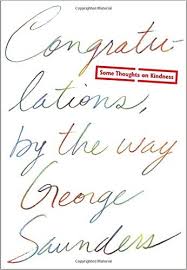
[READ: February 1, 2017] Congratulations, By the Way

Children’s books will commence shortly. But as hatred continues to spread in Washington, one more post on kindness.

Have you ever read George Saunders’ convocation speech at Syracuse University for the class of 2013?  It is stunning and moving and profound.  And yet at heart it is so simple–be kind.

This book, much like David Foster Wallace’s This is Water, is a padded-out book version of Saunders’ speech.  (With illustrations of stars by Chelsea Cardinal).  I am generally opposed to this sort of cash grab book ($14 list price for content that is freely available), but as with Wallace’s book, the speech is so great that any way it can get into people’s hands is a good thing.

There’s not much I can say about the speech, because it is all true and beautiful and doesn’t bear me summarizing.  But I wanted to compare the wisdom of this speech with our horrifying new President and his band of hate-spreaders.  As you read this and know it to be true, wonder what in the hell happened to the people currently running our country that they have fallen so far from the common decency of this speech.

I was thinking how we are taught as children not to lie (Trump lies daily, egregiously) to study hard (Trump is unqualified and none of his cabinet picks are qualified–half of them are downright simpletons), to be kind and obey the golden rule (Trump is literally harming / hurting / damaging / ostracizing / potentially killing people every day with his executive orders).  How did a wicked liar actually win?  Why aren’t the good guys coming to take him out?  I am prepared to RESIST, but it get harder every day with every evil thing he and his minions do.  And watching our spineless elected officials (on both sides, but especially Democrats who were pushed around for eight years) cave to this dictator’s dreams is the most disheartening thing I have ever experienced.

And so, it takes someone liked George Saunders to lift you up.  To believe that somehow this will all be made right.  And to espouse try to kindness where you can.  Because it sure isn’t coming from anyone elected.

The full content of the speech is below.  Read it all, it’s worth it.  Share it with everyone.

(more…)

Read Full Post »

tny 10.27.08 cvr fnl.inddSOUNDTRACK: RDGLDGRN-Tiny Desk Concert #571 (October 14, 2016).

rdgldI’d never heard of RDGLDGRN before this show.  The colors in the band’s name represent the band members: Red (Marcus Parham), Green (Pierre Desrosiers) and Gold (Andrei Busuioceanu), and they wear their respective colors all the time (although I didn’t realize that Andrei’s shirt was gold until after reading this).

The blurb tells us that “if you go to a RDGLDGRN show, you’ll see a traditional stage set-up with a full complement of instruments… you can hear and feel the excitement of a full-blown band and a full drum set.”  However, with “their recent experimentation with Brazilian-style percussion over acoustic versions of their songs, they decided that an all-acoustic set infused with Brazilian vibes would make for the perfect Tiny Desk concert.”

They start with their new single “Karnival” a fun song played on ukulele with lots of percussion.  Green does most of the rapping although everyone sings.   After this they played unplugged versions of some of their best-known songs (although not known by me, obviously).

Before starting “Chop U Down” they say don’t sing along with this one, you’ll mess us up!  Gold plays a scratchy guitar and red plays a simple melody on the high notes while Green raps away.  It has a very catchy chorus especially the way the other singers add parts to the song.

When it’s over Gold tells us that the best part of a RDGRNGLD show is when Green forgets a verse (I don’t think he did, but it seemed like he almost did).  Green says the last time he forgot words, he freestyled a verse and no one noticed the mistake.

“Doing The Most” is more sung than rapped—they have great voices.  I really like the melodies of this song.  This is the song where the audience is meant to sing along (to the insanely catchy buh bah bah bah part).  All the while, Gold was keeping the beat on the guitar body.

They had only prepared three songs, but they were having so much fun, they decided to do a fourth. For this last song they semi-freestyle something.  Green started rapping and they played along.  It’s not very long and for some reason is called “No Pixar” (Freestyle) (I didn’t hear them say the word Pixar at all), but it’s a fun song and his freestyling is quite impressive.

I still don’t know much about RDGLDGRN, but it was a fun show.

[READ: March 10, 2016] “The Boy Who Had Never Seen the Sea”

J.M.G. Le Clézio won the Nobel Prize in Literature in 2008.  Which pretty much means I’d better like this story, right?  Well, it turns out that this particular story was written in 1978 (and was translated by Deborah Treisman) so that gives me a pass, I think.

Actually I did enjoy this story, although I found it most unusual.

It didn’t read like a 1970s story, but it certainly had a much less plot-driven feel.  It seemed relaxed and like it wanted to just unfold around the reader.

It begins in the first person.  The unnamed narrator is talking about a boy called Daniel.  Daniel (who had a jaw like a knifeblade–I didn’t like that this specific detail was mentioned twice and then not put to any use) wanted to be called Sinbad.  He had read the Adventure of Sindbad many many times.  It may have been the only book he ever read and he carried it with him everywhere. (more…)

Read Full Post »

 doubledownSOUNDTRACK: JAKE SCHEPPS’ EXPEDITION QUARTET-Tiny Desk Concert #187 (January 19, 2012).

jakeJake Schepps’ Expedition Quartet is a somewhat unusual string quartet in that the instruments are violin and upright bass (normal) but also guitar and banjo.  And so the songs have a classical feel–melodies repeated in a fugue style, but with the prominence of the banjo, it feels more like a folk song.  The violin takes on a kind of fiddle sound.  And that’s interesting enough, but it’s the story of the music that they are playing which makes it even more fascinating:

About 100 years ago, Béla Bartók was traipsing through his native Hungary (Romania and Slovakia, too) with a bulky Edison phonograph, documenting folk songs and dances. There’s a priceless photo of the young composer, his contraption perched on an outside windowsill with a woman singing into the horn while anxious villagers stare at the camera. By 1918, Bartók had amassed almost 9,000 folk tunes. He made transcriptions of some; others he arranged for piano, while elements of still others found their way into his orchestra pieces and chamber music.

This was the country music of Eastern Europe, and its off-kilter rhythms and pungent melodies continue to captivate music lovers and musicians like Colorado-based banjo player Jake Schepps, who has recorded an entire album of Bartok’s folk-inspired music.

For this concert, with fellow members of Expedition Quartet — violinist Enion Pelta-Tiller, guitarist Grant Gordy and bass player Ian Hutchison, they played a Bartók hoe-down of sorts.

They play three pieces:

“Romanian Folk Dances: ‘Stick Game'”  Bartók (arr. Flinner).  This is a quieter piece with moments of bounce.  Indeed, Schepps doesn’t feel like the leader of this group because everyone shares the spotlight.  The guitar takes a lengthy solo–its got a very jazzy feel (which is a little weird on an acoustic guitar).  The violin takes a pizzicato solo, which is neat.  When Schepps finally does do a solo it’s not a showoffy banjo solo, it just fits in well with what everyone else is playing.

“For Children (Hungarian Folk Tunes): ‘Stars, Stars Brightly Shine'” Bartók (arr. Schepps).  This is a slower tune and it is much shorter as well—it doesn’t really lend itself to soloing.  Although the violin takes on the lead melody and it sounds mournful and beautiful.

“Mikrokosmos No. 78 / ‘Cousin Sally Brown'” Bartók / traditional (arr. Schepps).  Before this track, when someone tells Schepps that No 78 is his favorite of the Mikrokosmos, he says that he prefers 79.  The bassist says that 79 has gotten too commercial.  The end of the song has a tag of “Cousin Sally” a rollicking traditional dance number.  The four seems to play somewhat at odds with each other briefly and when they all rejoin for the end—it’s pretty great.

[READ: December 27, 2016] Diary of a Wimpy Kid: Double Down

I keep expecting the quality of the jokes in the Wimpy Kid books to decline.  But rather, this book was not only hilarious, but it worked really well as a book, too.

What I mean is that, I know that the Wimpy Kid series is online and that Kinney does a new story every day (or at least he did , I don’t know if he still does).  These books had always been taken from the online site (and I assume they still are).  But somehow, this book has jokes that circle back to jokes earlier in the book.  There’s at least a half a dozen callbacks which makes this book more than just a collection of diary entries…it’s a perfectly contained unit with a satisfying ending.

(more…)

Read Full Post »

2016-12-05-21-06-09SOUNDTRACK: THE CRANBERRIES-Tiny Desk Concert #197 (February 23, 2012).

I’d published these posts without Soundtracks while I was reading the calendars.  But I decided to add Tiny Desk Concerts to them when I realized that I’d love to post about all of the remaining 100 or shows and this was a good way to knock out 25 of them.

cranbI really liked The Cranberries’ first album, but was turned off by them when they got overplayed on their second album (If I never heard “Zombie” again…”).

I didn’t realize that they launched a comeback of sorts back in 2012.  And this Tiny Desk Concert was a stop on their tour.  They play five songs–far more than most bands.  They may have been one of the biggest st bands to play up until now.

For this set, they strip down to acoustic guitar, tambourine, electric bass and Dolores O’Riordan’s vocals.

One of the things I liked about their first album was her delicate voice.  She found her more aggressive voice on later songs (where her accent really leaks through).  And that brash style is present here.  Which makes “Linger” sound a little odd and a little less pretty.

They play two then new songs which I rather like: “Tomorrow” and “Raining in My Heart.”  Since I’ve no expectations about them, I find her voice works very well with them.  They also seem much simpler than some of their earlier songs and she not doing anything unusual with her voice..

“Ode to My Family” (the doo-doodoo-doo song) sounds pretty good in this setting.  Although I always laughed about the “does anyone care” refrain because well, sometimes I didn’t.

They take a request to play “Zombie” and I have to say I really like it in this acoustic format.  She straps on an acoustic guitar and plays most of the “leads.”  She definitely does some unusual things to her voice, but overall its sounds good.  Somehow the electric bass really adds to all of the songs–I never noticed how much it added before,

Overall, the “lads” sound good and her voice has maintained its power.  Although I can help but think she looks a lot like Billie Joe Armstrong with that haircut.

[READ: December 24, 2016] “Being Mary”

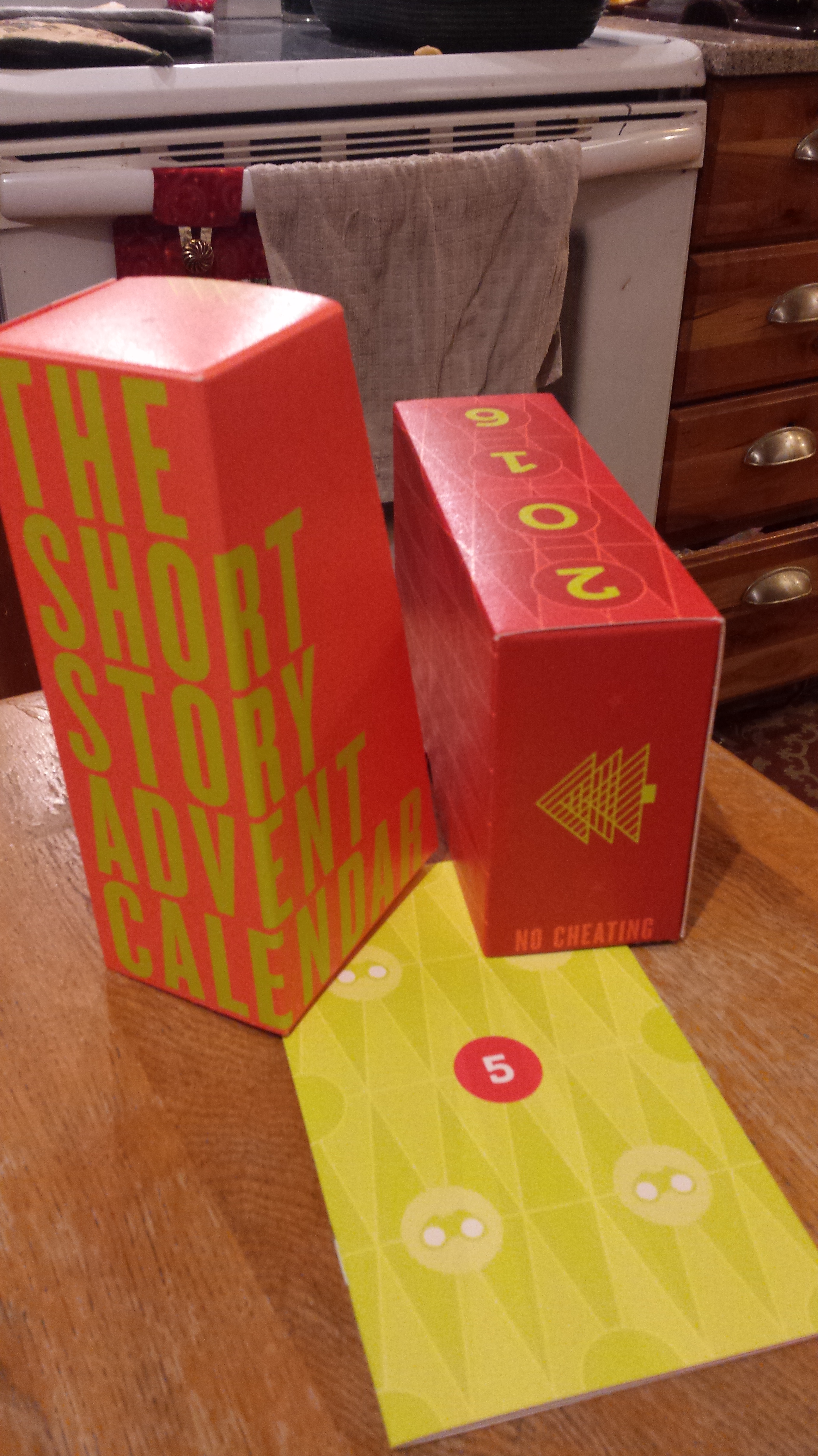
Near the end of November, I found out about The Short Story Advent Calendar.  Which is what exactly?  Well…

The Short Story Advent Calendar returns, not a moment too soon, to spice up your holidays with another collection of 24 stories that readers open one by one on the mornings leading up to Christmas.  This year’s stories once again come from some of your favourite writers across the continent—plus a couple of new crushes you haven’t met yet. Most of the stories have never appeared in a book before. Some have never been published, period.

I already had plans for what to post about in December, but since this arrived I’ve decided to post about every story on each day.

This is theoretically the final book in the Short Story Advent Calendar (wow that went fast).  But there is a bonus story for tomorrow (how cool!).  Let’s not get ahead of ourselves.

This short story is about a girl, Laura, who is supposed to be Mary in the school Christmas pageant.  She has always wanted to be Mary (she is six now) and feels she was destined to play her.  Last year she was an angel, which was disappointing.  But at least she wasn’t Jezebel or Judas or “poor old Leah, the unwanted older sister.”

But tragedy has struck.  Literally. (more…)

Read Full Post »

storiesSOUNDTRACKPOLYPHONIC SPREE-Tiny Desk Concert #259 (December 21, 2012).

The Polyphonic Spree performs a Tiny Desk Concert.I really enjoyed Polyphonic Spree’s first album (and their strange robes and cult-like following (apparently even within the band).

They put out a Christmas album some time ago, and since we have a big pile of Christmas albums, I grabbed that one.  I didn’t love it, but it was a fun addition to our collection.

This Tiny Desk Concert is notable for just how many members of the band are behind (and on the side of) the Tiny Desk (perhaps 18?).

And the band is suitably musical–trombone, trumpet, keys, drums, bass, cello, violin and a ten (or so) piece choir.

Interestingly, I find that the weak link in this whole thing is leader Chris DeLaughter.  It’s just that his voice is really not that interesting. It’s especially notable on “The Christmas Song” where he sings some high notes unaccompanied.  When the choir comes in (and they change the melody) it sounds really cool.  I especially love the way they make “reindeer really know how to fly” into a high note.

The first song is “Happy Xmas (War Is Over)” which I feel is the Christmas song they might be best known for.  It’s pretty traditional to the original, with the choir filling in for the kids.  The addition of horns really adds a lot to it.

“Silver Bells” gets a pretty rocking treatment–the buildup at the beginning is pretty cool.  They change the main melody to an almost circus-like waltz. I love the way it sounds when everyone joins in–and when the choir is singing along to the rocking end (with a very different melody) it sounds great.  But once again DeLaughter’s voice doesn’t seem up to the task of leading this larger group.

But it’s festive and fun, especially with everyone in red robes (and DeLaughters green one).

[READ: December 2016] Christmas Stories (1854-1864)

Last year, I started reading some Charles Dickens Christmas Stories in December.  I imagined that I’d finish the whole book this season (all 750 pages of it), but I didn’t come close.  I enjoy these stories but they are not quick reads by any standard.

The fascinating thing with a lot of these stories is that they appeared in All the Year Round, a Victorian periodical founded and owned by Dickens and published between 1859 and 1895 throughout the United Kingdom.  But just because these stories came out for the Christmas issue doesn’t mean they have anything to do with Christmas directly.

I thought I’d be reading a whole chunk of the book in a row, but I wound up skipping around a bit.  Maybe next year I’ll finish the remaining stories. (more…)

Read Full Post »

« Newer Posts - Older Posts »