Feeds:
Posts
Comments

Archive for the ‘Sci-fi’ Category

SOUNDTRACK: KING GIZZARD AND THE LIZARD WIZARD-Murder of the Universe (2017)

Every KGATLW album is different.  Including this one.  Murder of the Universe is their second album of 2017.  It is narrative concept album split into three separate stories, each containing elements of spoken word to carry a narrative. The first two chapters feature Leah Senior’s narration, while NaturalReader’s “UK, Charles” text-to-speech application narrates the final chapter.  And it totally rocks.  There’s great riff, distorted guitars and harmonicas and lots of whooping vocals.

There are, essentially three stories on this disc.  The first chapter, The Tale of the Altered Beast, is about a human who stumbles on a mystical human/beast hybrid.  The narration is quite long and deadpan and tells a fairly complex story, which starts:

As soon as the dust settles, you can see
A new world in place of where the old one had been
Your skin is crawling with dry, crusted mud
And your naked feet are wet in a pool of blood
And the whistle of the wind in your ears is so loud
That your memories have blown up in a mushroom cloud
And as your eyes accommodate
There appears by the meadow
A brute like a bear with a long, dark shadow
And you violently shake over what you have seen
As you remember the tale of the Altered Beast

Nearly each of the nine tracks has narration interspersed with singing.  There’s a lot of repeated sections, but more as a thematic choice rather than as repetition.  The titles of the songs are indicative of this: Altered Beast I, II, III and IV and Alter Me I, II and III.  But those parts are not simply repeats.  Rather, they allude to each other with repeated riffs and words.  But even though parts are repeated there are plenty of original riffs throughout.

The third part of “Alter Me” has a cool 80’s sci-fi keyboard sound, which works perfectly before the noisy harmonica returns.

The “Altered Beast” story is the longest part of the story at 19 minutes.  And the final “Altered Beast” part has a very nifty fast section that I believe is in 11/4.

The last track “Life/Death” is very different–keyboard-fueled and almost poppy sounding, this final minute of the story is not a happy one.

The second chapter, The Lord of Lightning vs. Balrog, focuses on a battle between the forces of light of darkness.   And the segue between the two, called “Some Context” references “People-Vultures” from Nonagon Infinity.

It opens with guitarist Joey Walker’s Mongolian throat singing behind the narration on some of the tracks.  This adds an extra sense of ominousness to the story.

So the main story is a battle between The Lord of Lightning and Balrog and  they each get a song:

When the songs proper start, “The Lord of Lightning’s” theme is somewhat proggy with all kinds of ostinato (to use a term form the narration).  In addition to keyboard parts and some heavy rocking parts, there’s a callback to the chorus of “Nonagon Infinity.”  The music for this chapter is very complicated with fits and starts and various drum lines.

While the interstitials in the first chapter were done with an interesting guitar riff, the interstitials in this part come with a fast rumbling bass line.  “Balrog” has a lot of chanting befits a KGATLW song.

The war comes to a head in the Floating Fire which has more throat singing and a martial beat and its aftermath “The Acrid Corpse” … but which one is the corpse?

The third and final chapter, Han-Tyumi & The Murder of the Universe, is about a cyborg in a digital world who gains consciousness and decides to strive only for what a cyborg cannot do: vomit and die.  How very King Gizzard.  There’s a lot about vomit in this song. Maybe it was just fun hearing the robotic voice say vomit?

He decides to create a creature dubbed the “Soy-Protein Munt Machine” whose only purpose is to vomit. When the creature rejects his love, Han-Tyumi decides to merge with the machine, which causes it to lose control. This machine explodes and infinitely expels vomit, which eventually engulfs the entire universe: and so the universe is murdered.

It opens with keyboard swirls, like the opening credits a sci-fi soap opera

This is a much heavier bunch of songs, like the thumping (with extra drums) on “Digital Black.”  Over a futuristic keyboard section Han-Tyumi recites his problem:

I am bereft of two human things
Two things that a cyborg can never do
Two things that I strive for
Two things between myself and mankind
Death
And
To vomit

This story is bonkers.  But it totally rocks and it leads to the really catchy song (which they played live when I saw them called, what else, “Vomit Coffin.”  The final song is a tour de force of instrumental power while HanTyumi talks of vomiting and getting bigger and bigger until he destroys the universe.  Gross and hilarious and totally rocking.  Destroying the Universe never sounded so good.

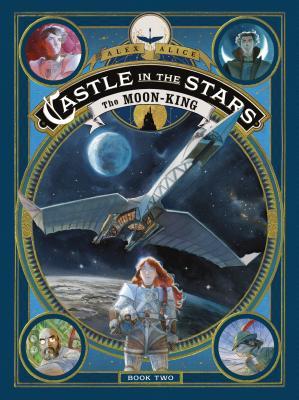
[READ: February 28, 2019] Castle in the Stars 2

This gorgeous graphic novel was originally published in French and was translated by Anne and Owen Smith.

Part two continues with the beautiful look of his book.  I am really fascinated at the way these characters can look at time cartoonish and at times almost photo-realistic (in soft focus).

At the end of the last book our team escaped from certain danger by jumping aboard an aethership.  The crew is Seraphin (whose mother has been lost in the aether when she took a ship there and never returned), Seraphim’s father as well as Seraphim’s friend Sophie (a girl!) and her half-brother Hans (the very cartoony looking character). They are joined by King Ludwig whom we are told at the begiinning of the story just wanted to leave everything behind. (more…)

Read Full Post »

SOUNDTRACK: GIL SHAHAM-“Partitat No. 2 “Gavotte en Rondeau” by J.S. Bach” (Field Recordings, January 12, 2012).

This was the very first Field Recording posted on the NPR site back in 2012 [Gil Shaham: A Violinist’s Day At The Museum].

Shaham plays Bach in the Hirshiorn Museum.

As Gil Shaham wandered through the back offices of the Hirshhorn Museum and Sculpture Garden in Washington, D.C., he said he felt “like Ben Stiller in Night at the Museum.” For this impromptu Bach mini-recital, the violin superstar momentarily became part of the art, bathed in the modish lighting and projections of a multimedia installation during the performance.

He is introduced with the rather amusing:  “A world famous, world renowned violinist who, by the way, starts every morning with a bowlful of Cap’n Crunch.  He told me that.”

I love that this first Field Recording was, like many of NPR’s best things, a spontaneous idea:

A crowd packed the exhibit room to watch as Shaham launched into Bach’s third partita. After the performance, the violinist greeted fans in the museum, many of whom were headed to his concert at the Kennedy Center that night. He seemed surprised and delighted that the guerrilla concert, announced only on local classical station WETA and Twitter that day, drew so many people willing to hear Bach in the afternoon.

[READ: January 22, 2017] “Are We Not Men”

Boyle’s stories aren’t usually as fanciful as this.  But I loved it just as much as many of his other more down to earth stories.  I particularly enjoyed that it was set in the future, although there was no real statement of that until late in the story.  There were hints, which seem obvious in retrospect, but which at first just seemed like hyperbolic or metaphorical.

Like “the dog was the color of a maraschino cherry” or that the lawn incorporated “a gene from a species of algae that allowed it to glow under the porch light at night.”

The story opens with the cherry-colored dog killing an animal in the narrator  Roy’s front yard (on that grass).  He wanted to chase the dog away because it might ruin his grass.  Then he noticed that what the dog had killed was his neighbor Alison’s pig.  She loved that pig and anthropomorphized it.  To try to salvage the pig, he ran up to the dog waving his arms.  It immediately latched onto his forearm instead.

As Roy fights with the dog, the dog’s owner, well, the daughter of the owner, came running across the street.  She looked like a teenager but was actually 11 or 12.  When the girl says, “You hit my dog,” he replies that she bit him.  The girl says Ruby would never do that–she’s just playing.

Amid this horrorshow of blood and violence and death, and a sprinkling of genetic splicing, Boyle throws in a very funny experiment gone wrong.  Crowparrots were a modified bird which blended crows with the invasive parrot population.  It believed that the experiment would turn the parrots into carrion eaters.  But instead it made their calls loud and more frequent.  And they mimicked, so they “were everywhere, cursing fluidly, (“Bad bird! Fuck, fuck, fuck!“).” (more…)

Read Full Post »

SOUNDTRACK: MUDHONEY-“Halloween” (1988).

Mudhoney recorded a cover of Sonic Youth’s “Halloween” just two years after the original was released.

Mudhoney, a deliberately noisy and abrasive band recorded a deliberately noisy and abrasive version of this song.  And yet at the same time, it doesn’t hold a candle to Sonic Youth;s version for deliberate noise and chaos.

On the other hand, in many respects the Mudhoney version is better.  It feels more like a “real song” with the guitar, bass and drums all playing along fairly conventionally.  It follows the same musical patterns as the original, with that same cool riff, but it just feels…more.

Mark Arm sing/speaks the lyrics more aggressively and less sensuously than Kim Gordon did.  In some way it helps to understand the original song a little more, as if they translated it from Sonic Youth-land into a somewhat more mainstream version.  Although it is hardly mainstream what with the noise and fuzz, the cursing and the fact that it lasts 6 minutes.

It feels like Mark emphasizes these lyrics more than the others although it may just be that the songs builds more naturally to them:

And you’re fucking me
Yeah, you’re fucking with me
You’re fucking with me
As you slither up, slither up to me
Your lips are slipping, twisting up my insides
Sing along and just a swinging man
Singing your song
Now I don’t know what you want
But you’re looking at me
And you’re falling on the ground
And you’re twisting around
Fucking with my, my mind
And I don’t know what’s going on

Happy Halloween

[READ: October 24, 2018] “From A to Z, in the Chocolate Alphabet”

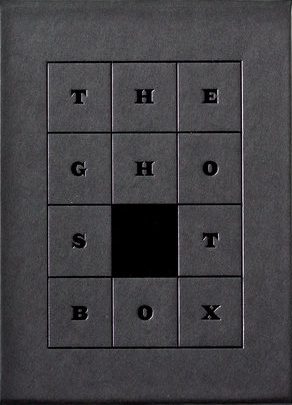
Just in time for Halloween, from the people who brought me The Short Story Advent Calendar and The Ghost Box. comes Ghost Box II.

This is once again a nifty little box (with a magnetic opening and a ribbon) which contains 11 stories for Halloween.  It is lovingly described thusly:

The Ghost Box returns, like a mummy or a batman, to once again make your pupils dilate and the hair on your arms stand straight up—it’s another collection of individually bound scary stories, edited and introduced by comedian and spooky specialist Patton Oswalt.

There is no explicit “order” to these books; however, Patton Oswalt will be reviewing a book a day on his Facebook page.

Much respect to Oswalt, but I will not be following his order.  So there. (more…)

Read Full Post »

SOUNDTRACK: BENJAMIN BOOKER-“Have You Seen My Son” (Field Recordings, September 3, 2014).

This Field Recording [Benjamin Booker: Newport Folk Gets The Summertime Blues] opens with Benjamin Booker taking his tuner off of his guitar and dropping it down a rain grate, never to be seen again.

Like many of the Field Recordings, this one also takes place at the Newport Folk Festival. NPR has a great relationship with the Newport Folk Festival, but they don’t have as much footage that’s available at any time as they used to.

There’s some kind of archway that they seem to use a lot for these Recordings.  Although in this instance, he is not in the archway, but just outside of it.

In 2014, Booker released his debut album.  As of now in 2018, he has quite a following. I know I hear his name on the radio a lot.  Booker has a distinctive voice, raspy and old, even though he himself is young (much younger than I realized).  And, as I thought last time, his speaking voice is so very different from his singing voice.

Even before releasing his debut album last month, Booker’s gravelly voice and bluesy swagger had guitar fans buzzing with anticipation. It didn’t hurt that he’d nabbed a gig touring as the opening act for Jack White, one of his idols.

With a borrowed acoustic guitar, Booker joined us outside one of the secluded secret tunnels in the heart of Fort Adams State Park after his set at this year’s Newport Folk Festival. While we were setting up for this Field Recording, Booker offhandedly mentioned that a few years prior, he’d applied to become an NPR Music intern. He didn’t get that gig, but he told us that missing out spurred his desire to explore another side of his passion for music.

“Have You Seen My Son?” is a quiet shuffle of a song.  Frankly it’s not that impressive as a song, at least you wouldn’t think much of him from just this song.  Except for that voice of course.

[READ: October 7, 2017] I Know What You Read Last Summer

This essay opens with an epigram by Ruth Franklin from Slate, May 8, 2017.

Michael Chabon has spent considerable energy trying to drag the decaying corpse of genre fiction out of the shallow grave where writers of serious literature abandoned it.

LeGuin has a lot of fun with this premise.  She begins with a scary opening about something crawly, squelching, stomping–an unknown force smelling of broken rotting flesh: Goddamn that Chabon, dragging it out of the grave where she and the other serious writers had buried it.

Could he not see that Cormac McCarthy–although everything in his book (except the wonderfully blatant use of an egregiously obscure vocabulary) was remarkably similar to a great many earlier works of science fiction about men crossing the country after the holocaust–could never under any circumstances be said to be a sci-fi writer, because Cormac McCarthy was a serious writer and so by definition incapable of lowering himself to commit genre. (more…)

Read Full Post »

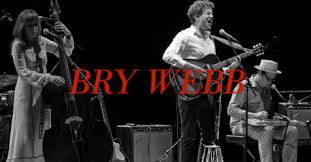
SOUNDTRACK: BRY WEBB-Live at Massey Hall (May 31, 2014).

I thought I hadn’t heard of Bry Webb, but it turns out that he is the singer for the iconic brash band Constantines.  I have enjoyed almost everything they’ve put out.  But I had no idea that Webb also wrote pretty, acoustic ballads.

For this show he is backed by The Providers, a five piece band with interesting instrumentation.  Aaron Goldstein plays pedal steel and Rich Burnett plays lap steel guitar, two similar but distinctive sounding instruments.  They’re with Anna Ruddick on upright bass, Nathan Lawr on drums and Tom Hammerton on keys.

He opens with two songs from his first album.  “Undertaker” opens the show and sets the tone of catchy folk songs.

“Asa” starts with a nifty drum intro before settling into a nice folk song with a prominent lap steel and pedal steel (I’m not sure which is playing what).

“Big Smoke” is a newer song with a bit more complex arrangements.  Webb has a great, gritty deep voice that works nicely for his songs.

Then he returns to his first album for “Lowlife.”  The two-guitar interplay at the end is really pretty.  He jokes, “We put that little jam rock session there for the folk festivals this summer.  Picture yourself a hippie mom… flowing…  doing the hippie mom dance.”

He tells a story about his friend Will who was an usher at Massey Hall and used to get him into shows.  Will said that an usher was not to look famous guests in the eye.  But Gordon Lightfoot came to do a small comeback run.  Will worked up the courage over the course of a week to look at Gordon in the hallway.  On the last night, Will walked past him and nodded to him.  He got a scolding but it was totally worth it.

“Fletcher” is a mellow folk song that starts with just him on the guitar.  After a couple of verses, the band adds in their quiet additions. The song builds to a long jam with two pedal steel guitar solos at he end  “There’s that hippie jam again.  We lifted that one right from the Dead.”

For the final song they play “Receive Me” a new song that has some really cool moody elements including a lot of organ and a wild noisy lap steel solo.  There’s another rocking jam at the end.

I’m used to Constantines breaking things and being wild, but this is a great other side to Webb.

[READ: April 4, 2016] “The Slows”

I loved this story.  The construction was fantastic.

There’s something compelling to me about that fact that it was written in Hebrew (translated by Yaacov Jeffrey Green).  I don’t think of Hebrew as being the language of choice for interesting, futuristic, sorta sci-fi stories.  Maybe it’s time I do, though.

The story opens with bad news.  The Preserves, home of The Slows, is going to be closed to further study.  The narrator is especially dismayed about this because not only is it his job that has been cut but he has grown strangely attached to the Slows.

He met the news of the closing with a lot of whiskey and a terrible hangover the next day.

The Slows, it turns out, are a kind of primitive human.  On this particular day, one of the Slows has managed to get past security and into his office.  She has brought her human larva with her and is complaining that her grandmother was one of the people to sign the treaty protecting the Slows. (more…)

Read Full Post »

[LISTENED TO: September 2017] The Hitchhiker’s Guide to the Galaxy complete radio series

The history of the Hitchhiker’s Guide to the Galaxy is almost as convoluted as the story itself.

Douglas Adams (with help from John Lloyd) wrote the radio story in 1977.  It aired in 1978.  A second season aired in 1980.

Adams wrote the novel based on the radio series in 1979.  And then the second book The Restaurant at the End of the Universe in 1980.

Then they made the TV show.

Apparently Adams considered writing a third radio series to be based on Life, the Universe and Everything in 1993, but the project did not begin until after his death in 2001.  The third, fourth and fifth radio series were based on Life, So Long, and Thanks for All the Fish and Mostly Harmless which were transmitted in 2004 and 2005.

It’s interesting and a little disconcerting how different the radio play is from the story of the book. There are a lot of similarities of course, but some very large differences.

The first series obviously leaves a lot out from the book, since the book wasn’t written yet. (more…)

Read Full Post »

[LISTENED TO: September 30, 2017] The Resisters

I saw this audio book at the library and thought it might be a fun book for a long car trip.  It turned out the family wasn’t going on one for a while, but Clark and I were heading to Hartford for the Pokémon Regional Championship, and this was just about the right length for the trip.

I was turned off by the cover–that very computerized version of the kids.  Although I see that Nylund writes books in the Halo series, (and has an interesting history writing for Microsoft, go figure).  So I guess it makes sense that there’s a computer edge to it.

The story wastes no time opening and doesn’t wait for you to catch up.

Ethan Blackwood is twelve and, as the book opens, he is in the last few seconds of a very important soccer match.  But, with no explanation given , we learn that this soccer match is not what we are used to.  All of the competitors are wearing large armored suits and the ball can hit speeds of 300 MPH.  Ethan is a year younger than his teammates, but he has proven himself on many occasions and they all look to him for a great play. (more…)

Read Full Post »

McSweeney’s 49: Cover Stories: Contemporary writers reimagining classic tales (2017)

SOUNDTRACKBIG K.R.I.T.-Tiny Desk Concert #714 (March 5, 2018).

A while back I downloaded one of Big K.R.I.T.’s mixtapes and rather liked it.  Since then he seems to have become pretty huge and I feel like he has really expanded on his style.

K.R.I.T. sings/raps three songs from his new album.

4eva Is a Mighty Long Time, a double album in which he covers everything from blessings to depression while plumbing the carnal and spiritual depths of his own duality. All three songs performed here come from side two, titled after his birth name Justin Scott.

The first song “Mixed Messages” is really thoughtful.  He sings and raps

I gotta whole lotta mixed messages / in my songs am I wrong / to feel this way
I got me a lover but I still wanna cheat / I wanna be saved but its fuck the police
i never really liked the fake shit / but I’m attracted to the fake ass and fake tits
i really wanna sing but id better rap

K.R.I.T.’s backing band, which includes Burniss Travis II on bass and Justin Tyson on drums, also features on keys Bryan Michael Cox — the hitmaking producer and songwriter behind a slew of Billboard chart-toppers. Together, the trio delivers stripped-down versions of the latest thought-provoking material in Big K.R.I.T.’s catalog.

Introducing the second song, “Keep The Devil Off” he says his grandmother introduced him to gospel.  She brought him to church and “she would wake me up when i fell asleep saying wake up you gotta hear this.”  He sings beautifully.  And then the rapped verses are really well structured.

And when he stops to pay homage to his church-going grandmother before performing “Keep The Devil Off,” it’s clear that everything she instilled in him is keeping him alive, too.

Definitely in these times we need to keep the negativity away–keep the devil off.

His grandmother was clearly very important to him.

Big K.R.I.T. has kept her spirit alive through his music since his breakout mixtape, K.R.I.T. Wuz Here, which he released in 2010, the same year she died.  So it only makes sense that he would bring her with him for his Tiny Desk concert.

Halfway through his three-song set at NPR Music headquarters, K.R.I.T. stops to pull out an old-school tape recorder — the same one his grandmother would use to record him singing and reciting poetry as a child. “I have to feel like my grandmother was my first mix engineer,” he says before pressing play to reveal him and his brother as kids singing a duet of R&B crooner Donell Jones’ 1999 slow burner, “Where I Wanna Be.”

He plays the tape and cracks up listening to it.  He gets the audience to sing the refrain with his younger sell.  And then his grandmother introduces he and his brother as an R&B singer, “but I’m sticking with the rap thing.”

It’s a sublime interlude — one that resonated so strongly with K.R.I.T. that he had to start his last song, “Bury Me In Gold,” over to catch the proper beat. “I’m super emotional from this, too,” he says, laughing in a moment so genuine it was only right to leave it unedited.

He says “Bury Me in Gold” is not about gold really, it’s about having something so that in the event he gets to heaven he’ll give everything away.

He tells us to remember that peace of mind and your soul are more important than gold.

I’ve always enjoyed thought provoking rap and K.R.I.T.’s lyrics combined with his voice really work wonders.

[READ: May 29, 2017] McSweeney’s 49

It has been a long time (three years or so) since the previous McSweeney’s volume.  During that silence, the publishing house went non-profit and that seems to have taken up a lot of their resources.  They even address this a bit in the interdiction to this book.

But regardless of the reasons why, it is great to have them back.

As the subtitle says, this is a book of “cover stories.” What that means is a little vague–the contemporary writers model their story after a classic story.  I try to compare it to music covers, although in music covers the music and words are typically the same with some kind of variations.  Typically, the words are the same but the music is different.  I liked to flip this idea on its head for describing these stories in that the words are different by the music is the same.

Since I don’t know most of the original stories here I don’t know how similar these are to the originals–same character names?  Same ideas?  Same plot?  I don’t know.  And perhaps it would affect the way I read these stories if I was familiar with theory original pieces.  But without knowing them, these just turned out to be good stories from good writers.

Interspersed between the stories were poems and, in a wonderful commentary on our current shitty president and the cowardly house of representatives who on the day I finished this voted to strip 24 million people of health care, are comparisons of classic historical figures’ speeches with the petty garbled tweets of out current crap in chief.  Can we impeach this motherfucker already?  And send the whole lot of them to jail, please.  #ITMFA

As many McSweeney’s do, this one opens with letters.  And of course they aren’t really letters at all, even if they are addressed to McSweeney’s.  Many deal with cover songs, but a few are much more serious, political and right on.

WAJAHAT ALI writes from Camp FDR in Washington DC where he and his fellow prisoners were finally able to cobble together WiFi.  Ali explains that the Executive Order was inevitable the ban, the vetting, the registry were all just prelude. The need to protect against terrorism outweighs the individual rights and the rights of American Muslims…read the Supreme Court decision.

NICK JAINA writes about the Sept 23, 1970 episode of The Johnny Cash Show in which Ray Charles appears and plays “Walk the Line” and then “Ring of Fire.”  The letter states that the creator of “Ring of Fire” is actually mis-attributed.  The story is that June Carter wrote it after seeing a page in her uncle’s book of Elizabethan poetry.  But Johnny first wife claims that Johnny wrote it while drunk about a certain female body part: “all those years of her claiming she wrote it and she probably never knew what the song was really about.”  Then it reverts back to Ray Charles’ performance with an unseen band playing behind him–especially a great baseline–and as the song ends he lets out one last shudder and cackle like he just invented the orgasm.  “Johnny returns to the stage looking like a man who just watched someone have sex with his wife but was so in awe of how good he was at it that he could only thank him.”

ROBIN TERRELL talks about trumpmania in the Czech Republic from the perspective of a black woman, lesbian, child of civil rights activists, mother of a black man living in Prague.  The look in the eyes of people after the election: The U.S. is going to fuck us over again.  It stunned Europeans that the U.S. could generate someone fouler than Europe’s own crop of white male extremists.  She is now a refugee from her own country.  #RESIST #ITMFA

KIMBERLY HARRINGTON says she always believed that even in the darkest times humor has its place.  But lately she’s been bursting into tears rather than cracking a smile.  She hopes she can find things to laugh at–even death in these horrible times.

MARY MILLER says that for the longest time she thought her uncles wrote “Stagger Lee.”  Her uncles were musicians who wrote songs but also threw some covers into their shows.  She believed that “Stagger Lee” was one of theirs. She realizes that they are not famous and that no one will remember them–but she promises them that she will remember them.

RICK MOODY writes at length about Elektra’s 1990 tribute album Rubaiyat: Elektra’s 40th Anniversary.  I remember it coming out and I remember not getting it because it was too expensive. But Moody talks about what a great conceit this collection was to have contemporary artists cover classic songs.  He also talks about how the tribute album was quite popular in the 1990s (was it ever).  Some thought: He loves Bjork, but he thinks of the Sugarcubes as a cheeseball imitation of the B-52s (and that their “Motorcycle Mama” is pretty bad.  He mentions a few great tracks, like Kronos Quartet covering “Marquee Moon,” Metallica doing “Stone Cold Crazy,” and even a Howard Jones cover of “Road to Cairo” by the cult hero David Ackles.   But he says fully half of the collection is bad, some of it even awful–not worth its list price at the time but it has a great number of masterpieces on it.

Will Buttler (from Arcade Fire) wishes to make some amusing corrections: some errors during concerts, and apologizing for singing “I’m So Bored” with the USA because he is not.

ARIEL S. WINTER-This is an interesting philosophical question wondering whether or not Marty McFly actually created “Johnny B. Goode.”  How could he cover it before Chuck Berry had released the original.  As a child this blew her mind.  This facile beginning then goes on to say that before recorded music the notion of a cover didn’t really exist.  And indeed in the 1950s people recorded songs without concern for copyright.  It’s also true that when Chuck Berry plays Johnny B. Goode live, it’s not considered a cover of his original.  She concludes by that the Back to the Future is probably the first time she ever heard Johnny B. Goode.  So Marty McFly’s is the original to her (as it is to all the kids at the dance).  So in addition to a song having an original for the performer there is also an original for the listener.  Anyone who has loved a song for years before finding out that it’s a cover has had that experience.

INTRODUCTION BY THE EDITORS

This introduction talks about how the first time they did a “cover story” was in 1999 in issue 4.  Rick Moody covered Sherwood Anderson’s “The Egg.”  They had been planning to do an entire issue of covers as far back as two years ago and then things happened in the McSweeney’s universe to delay it.  And now : this issue is being born in a moment of racial, social and economic reckoning and imminent fascism…into a country that looks much different from the one in which it began, fronted now by a mean and disingenuous imitation of a president.   As such: Tucked between these thirteen beautiful renditions of thirteen classic stories are instances when a cover is not an homage but rather a perversion of its predecessor”  And by that they offer examples of eloquent speeches by former leaders and then tweets from our pervert in chief.

GARY BURDEN-excerpt from Nobody Knows (an autobiography)

Gary Burden created the cover images for this issue.  I had no idea who he was, but this autobiography tells me just how interesting a fellow he was.  He has been responsible for some of the most iconic album covers of the last 60 years!

These excerpt shows his origin story–he was 8 on December 7, 1941 and he has had vivid memories of WWII.  When he was 16 he joined the Marines.  But he was restless, got involved in bad things, was dishonorably discharged and got mixed up with even worse people (he says he can’t believe the things he did back then).  In 1964 he met “Mama” Cass Elliot. They spent a lot of time together and this opened him up to meeting all kinds of people: David Crosby, Stephen Stills, Graham Nash.  Eventually he met and hung out with Jim Morrison and designed Morrison Hotel (a fascinating story that).  In one of the nicer things I’ve heard someone say he says that Jim was a real poet, someone who was unafraid of delving deeply into life irrespective of the personal cost.  Then he met Neil Young. He says that Buffalo Springfield has been his favorite band and then one day Neil came to Mama Cass’ house in his 1948 Buick Hearse.  He was also hanging around when CSN decided to become CSN&Y and then he and Neil became friends. and Neil sold him his house in Topanga.  Eventually he made the cover art for After the Gold Rush (and he gives a little story about the old lady there on the cover).  I’m kind of curious to read this whole book now, especially if it includes album covers.

EMILY RABOTEAU-“The Babysitter” after “Some Women” by Alice Munro
This is the story of a babysitter for Mrs Fagan.  She is a young girl and her employer is very rich and locally famous.  And quite eccentric (she went to East Africa and allegedly witness the Ark of the Covenant and then wrote a controversial book about it).  But in their town she was known as the white lady with black kids (Maya 3, Eddie 10 months old).  The story reflects back on the babysitter as child (she is now the same age as Mrs Fagan was when the babysitting began.  The babysitter’s mother is kind of jerk and is very sarcastic about this babysitting arrangement.  She is also a very strict Jehovah’s Witness, so when the narrator gets her first period rather than tell her mom, she just takes products from Mrs Fagan.  As the story opens Mrs Fagan’s son has just arrived and that changes the dynamic in the house.  How will Mrs Fagan take it when the narrator accidentally sets fire to the kitchen? I really enjoyed the way the end of the story plays on the notions of memories and the impact people have on others.

MEGAN MAYHEW BERGMAN-“The Lottery, Redux” after “The Lottery” by Shirley Jackson
“The Lottery” seems like a pretty easy story to cover–I think everyone knows everything about it and it has been covered in things like The Hunger Games in their own ways.  I don’t know if this story references the original (with the redux),  for this story the people of the island of Timothy were exiled from America fifty years earlier for crimes against the environment.  They were gathering on July 27th, the day of the lottery.  And indeed the lottery is a death sentence, although it’s not entirely clear why.  Interestingly, the story is more about the girl chosen and what her life up to that point has been like.

ANTHONY MARRA-“The Tell-Tale Heart” after “The Tell Tale Heart” by Edgar Allan Poe
This story doesn’t diverge all that much from the original except for the wonderful modern twist on the beating heart.  It’s hard to say more without giving things away but I loved the modernization.

JESS WALTER-“Falling Faintly” after “The Dead” by James Joyce
I didn’t know all that many stories before hand, but I knew this one very well and this is wonderful homage.  It is not in any way rewriting the story–it’s a very different story, but it alludes to the Joyce story and directly mentions it and it is quite clear where the connection between them is.
Michael is a writer.  He is married with kids but has moved temporarily out to New York to write for this new police procedural.  The show is doing well and the female star is quite beautiful.  They bond over cigarettes–she is foreign and smokes like a European, he recently started again.  As stories like this tend to go, Micheal gets the wrong idea about this young, hot actress.  And given that she is not American she misunderstands the subtleties of his behavior (which isn’t very subtle admittedly).  But he wants her to know that his story is a tribute to Joyce’s “The Dead.”  When he talks about the dead she thinks he means real dead people and is pretty freaked out.  This leads to a restraining order and a police intervention–not how he thought his life in New York would go.  What doe sit have to do with “The Dead”?  Well they are standing smoking in the snow as it gently floats to the ground falling through the universe, faintly falling.

LAUREN GROFF-“Once” after “Wants” by Grace Paley
I loved the way this story started.  I saw my enemy at the beach.  With that as a groundwork we slowly learn just how this woman has an enemy (it’s an old boyfriend’s mother) and how they have grudgingly begun to respect each other decades after the two broke up. I really enjoyed this short piece.

ROXANE GAY-“Men on Bikes” after “Rape Fantasies” by Margaret Atwood
I can’t imagine what the original of this story is.  The actual story of this is pretty peculiar itself.  Basically, the men in town have all started riding bicycles everywhere.  It started when one of them was arrested for drunk driving.  He didn’t lose his license but his wife took it away from him.  He dug out a bike and began riding it.  She thought he looked ridiculous, but when another man had his license taken away, they began riding together.  It was quite a sight, although I’m not sure what the point of it was.

NAMWALI SERPELL-“Company” after “Company” by Samuel Beckett
I like Beckett, and I know that he can be confusing.  I don’t know what “Company” is about so I have no idea how it relates to it, but man I did not get this at all.

It was confusing and really long.  It is broken into many small sections which might be connected.  The first is about the brightening which happened although many people missed it. Then we learn about the ship which is electro epidermal, which is cool but not really explained  and then the story turns into a quest for melanin and just when you think it’s a sci-fi story, it becomes a story about race.  There is a pale man tied to a tree hitting a sack (pound pound).  There’s a lot of vomit.  If the white man inseminates even one person, finding pure stem cells is impossible.  Dark skin marked you as  lucky when the darkening came.  But then she says the mission is over.  There’s more vomiting.  A fellow is supposed to be invisible in the village but Pound sees him.  There’s more vomit, a section titled rape, where Pound rapes Lila every once in a while and then who the hell knows what happens at he end.

KIESE LAYMON-“And So On” after “Hills Like White Elephants” by Ernest Hemingway
Weeks ago 64 black folks changed the world.  You are the 11th.  Aside from the direct address to the reader the story is pretty straightforward and interesting.  Chanda Stewart was 8th, the narrators research assistant was 9th and Doug E., Chandra’s boyfriend was 1st.  They are at a fancy restaurant, Chandra, the narrator and you.  She swears that Doug is a porn star, but the narrator argues that having 1089 twitter followers and awkward consensual sex with a few white women filmed on an iPhone 2 in his fake Timberlands, blue knee brace and yellow wrist bands makes you a porn participant, not a star.  The story comes down to which side the narrator is going to choose.   sides or run for our lives.  Because while they were talking, Doug E. and about sixty young black kids were marching down the street.  To the school.  They each had an ax and a shovel.

MEG WOLITZER-“If You’re Happy and You Know It” after “A Perfect Day for Bananafish” By J.D. Salinger
I haven’t read this Salinger story in a long time, so I don’t really know how it connects to this, but I really enjoyed it.  I enjoyed the way that it was written which was a little confusing but in an intriguing way.  Set in a hotel on Miami there is the young woman in 609 who arrived with her new husband.  She’d sent him off to the beach.  We see her telling her parents that he is taking it easy, but they want to know if he is taking the Klonopin.  Later that night in the lobby, a four year old girl, Chloe, is in the lobby of that hotel watching a man play piano.  The man is a guest also and he is playing and really getting into it.  Another boy asks if he can play This Old Man and the player jokes about the boy calling him old.  But Chloe asks if he can play “If You’re Happy and You Know It.”  He says he might be happy but he may not know it. She is puzzled by that.  He says she is breaking his heart.  We soon realize that the pianist is the Klonopin man, and while things don’t get dark exactly, they certainly get strange.  And Chole’s parents have foisted her off on a poor babysitter the whole time.  This was one of my favorites in the book.

T.C. BOYLE-“The Argentine Ant” after “The Argentine Ant” by Italo Calvino
I can’t imagine what the original story is like, but this one from Boyle was really icky and really fantastic.  Its’ a fairly simple premise–a family moves to a rental property in Argentina, only to find that it is swarming with ants.  The ants are everywhere–even crawling all over their baby.  They run to the next door neighbor’s house only to see that they know about the ants and might have a secret weapon.  But mostly they just seem to be putting their furniture in jugs of water–presumably as a deterrent.  There is also an Ant Man who might be fighting the ants or who might actually be bringing more.  What is great about the way Boyle writes this is that the guy renting the house is working on an academic theorem that his wife thinks is rather frivolous.  And that tension underpins everything.

ALICE SOLA KIM-“One Hour, Every Seven Years” after “All Summer in a Day” by Ray Bradbury
Again I don’t know the original, but this story was great, and also weird. The weird part is that the story seems to start over multiple times. And that’s because there is a kind of time travel component to it.  The title refers to how often the sun comes out on Venus.  There is a girl, the main character, named Nargit. She was born on Earth and so she saw the sun.  The other kids are pretty angry at her for it (as if it’s her fault).  They are abusive to her, and the time travelling is the girl’s attempt to protect her younger self.  Many things go wrong but they bring about different results.

CHRIS ABANI-“Sleepy” after “Sleepy” by Anton Chekhov
This story was pretty horrific.  Kemi, a sixteen year old black girl who is now an orphan is working for a white family.  The family has two little children, one of whom is a baby.   The family is horrible to Kemi.  Pretty unrelentingly horrible.  Kemi is tired and never gets a break and the baby cries all the time.  She can’t soothe the baby and the family blames her for her failures.  Her exhaustion builds and builds until you pretty much know the ending several pages before it happens.

TOM DRURY-“The Yellow Wallpaper” after “The Yellow Wallpaper” by Charlotte Perkins Gilman
I know the original story although not super well.  But this version feels almost exactly the same. I honestly can’t tell what the difference is (without having re-read the original again to compare).   Jane and John are renting a place on an island for the summer.  John thinks Jane is not strong and keeps her hidden away in a room with yellow wallpaper.  He more or less runs everything in her life until she starts seeing people through the wallpaper.  You know things can’t go well from there.

POETRY:

REBECCA LINDENBERG-“Having a Coke with You” after “Having a Coke with You” by Frank O’Hara

MATTHEW ZAPRUDER-“Poem for Keats” after “Ode to a Nightingale” by John Keats

STEPHEN BURT-“A Nickel on Top of a Penny” after “Piedra Negra Sobre Una Piedra Blanca” by César Vallejo

BRIAN TURNER-“The Metaphor Program” after “The Red Wheelbarrow” by William Carlos Williams

STEPHEN BURT-“Roofers” after “The Armadillo” by Elizabeth Bishop

MATTHEW ZAPRUDER-“Poem on the Occasion of a Weekly Staff Meeting” [the first two lines are taken from “A Poem on the Occasion of the Consecration of Sandford and Shippon Churches” by Rev. F. Wilson Kittermaster, 1855]

STEPHEN BURT-“Suspense” after “To Brooklyn Bridge” by Hart Crane

KEVIN MOFFETT-“Second Wonder”-a monologue that will air on The Organist.
I found this puzzling at best.

PATTY YUMI COTTRELL-excerpt from Sorry to Disrupt the Peace
I read this book not too long ago.
This except was about two young children who invented a game called “Confession” in which the boy confesses his real or imagined sins to his sister.

~~~~~

The comparison quotes are called Great Speeches from History vs. the Tweets of Donald J. Trump:  I can’t bring myself to write any of the jerks tweets.

Mahatma Gandhi from the “Quit India” speech, 1942 vs. a Feb 4 2017 tweet

Abraham Lincoln’s “The Gettysburg Address” 1863 vs. a Feb 18 217 tweet (about fake news)

Martin Luther King Jr from “Letter from Birmingham Jail” vs. Feb 21 2017 (crowds planted by liberal activists)

Frederick Douglass from “The Hypocrisy of American Slavery” 1852 vs. Feb 6 2017 (negative polls are fake news).

Franklin D. Roosevelt, inauguration speech 1933 vs. Jan 22, 2017 (including all my enemies)


The bad thing about this issue is that the last four or five stories were all real downers, making it a pretty tough slog.  But I loved the idea, and I liked that they found the time and space to point out how stupid trump sounds and looks and is.

For ease of searching, I include: Cesar Vallejo

Read Full Post »
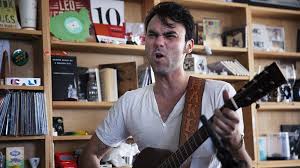
SOUNDTRACK: SHAKEY GRAVES-Tiny Desk Concert #495 (December 14, 2015).

I thought I had posted about every Tiny Desk Concert, but on double checking I found that I had missed this one.  I had heard of Shakey Graves and I assumed he was a country/folkie singer.  Which he is, although really his style is to mix country, blues and rock ‘n’ roll.  I also had no idea his real name is Alejandro Rose-Garcia.

This set sees Graves on acoustic guitar (with a strap with his name on it) accompanied by another acoustic guitar (which seems rather small) and a mandolin.

“To Cure What Ails” is a pretty, slow folk song. It’s simple enough with nice high mandolin notes and a good guitar line between verses.  Shakey has a nice voice and the song feels compelling like a story, although I don’t think it is.  He’s also charming and funny in little ways–he makes a lot of funny faces and chuckles.  But his music is really solid and the harmony at he end of the song is really great.

For “The Perfect Parts” the mandolin switches to bass and they have a little discussion n how to play it.  Shakey tells the drummer how to play the beat and then says they’re going to make it us as they go along.  This song is darker and has a cool sinister vibe.  He sings in kind of deep mumble for this song which works well for this song.  The song gets a little intense for a few lines.  And by the end it builds pretty loud with some good whoa ho ho backing vocals.  So much so that for the last chord, “he attempted a stage dive at the Tiny Desk.”

For the last song, “Only Son,” he:

breaks out his guitar and suitcase kick drum/hi-hat, [and] a palpable rush of swooning adrenaline hits the room. I felt that at the Americana Festival in Nashville, at the Newport Folk Festival and here at the Tiny Desk.

He says it is soon to be the last of the suitcase kick drums (this is his third).  He dreamed about having an object that he could cart around with him and still make a lot of noise.  The drum is actually behind him and he stomps the pedals with his heels (I can;t believe the camera never zoomed in on it).

He says the song is about “the moment in your life when you realize you’re not alone… there’s an aha! moment where you’re like ‘not just me?’  The drummer plays bass, the mandolin player has the mandolin back and Shakey has the kick drum suitcase.  There’s some terrific harmonies (and chuckling ) throughout the song, and I love the way it stops and starts.

[READ: Late 2016 and early 2017] McSweeney’s #45

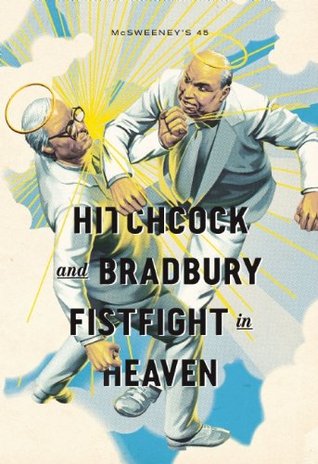
The premise of this collection was just too juicy to pass up.  Although it did take me a while to read it.  Eggers’ introduction talks about the contents of this issue.

DAVE EGGERS-Introduction
Eggers says he came across a collection of stories edited by Hitchcock. He really liked it and then learned that Hitchcock had edited 60 volumes over the course of 35 years.  He was excited to read literary genre fiction.  But he was more impressed that theses stories did what literary fiction often forgets: having something happen.  He then bought a cheap book edited by Bradbury (Timeless Stories for Today and Tomorrow) and he liked it too.  He was surprised that there were so many canonical writers (Steinbeck, Kafka, Cheever) in a Bradbury collection.

So, why not make a new collection in which we can compare the two genres.

Despite this looking like a pulpy paperback, there were still Letters.

LETTERS

CORY DOCTOROW
Doctorow says that Science fiction is not, indeed, predictive.  That any genre which deals with so many potential future events is bound to get some things right.

JAMIE QUATRO
Quatro says she was asked to write a letter for this genre issue, but Quatro doesn’t do genre, so she was about to pass.  Then her son, from the backseat, asks what bulwark means.  Then inimical.  Then miasma.  He is reading a book called Deathwatch about soldiers whose brains are removed so they no longer fear. Suddenly, when she compares this idea to her essay on Barthelme, she sees that maybe McSweeney’s was on to something after all.

BENAJMIN PERCY
In fifth grade Percy (who has a story below) gave his teacher a jar full of ectoplasm.  He has always been different.  He proposes the Exploding Helicopter clause: if a story does not contain an exploding helicopter (or giant sharks, or robots with lasers for eyes or demons, sexy vampires. et al), they won’t publish it.

ANTHONY MARRA
Marra discusses Michael Crichton and how something doesn’t have to be Good to be good.  He says Crichton was a starting point for him as an adult reader.  And what can be wrong with that? (more…)

Read Full Post »

SOUNDTRACK: BIG DADDY KANE-Tiny Desk Concert #708 (February 19, 2018).

I remember Big Daddy Kane, of course, although I don’t think I knew any of his songs.  As far as I can tell, Kane hasn’t released an album since 1998.  But his voice sounds great and he seems pretty content to rap his old hits.

The smooth operator, Big Daddy Kane, still emits that same palpable swag he did as a lyrical heartthrob during his heyday. He strides into the room and fully commands it with his presence.

One of the greatest to ever bless the mic, Big Daddy Kane treated Tiny Desk to an office block party in the true essence of hip-hop.  Kane, aka Dark Gable, was a breakout member of the seminal Juice Crew in hip-hop’s golden era during the latter part of the 1980s. He popularized quick-cadence flows and multisyllabic rhyme schemes.

He performed a short set of classics, including “Smooth Operator,” “Ain’t No Half Steppin’,” “Raw” and a bonus freestyle. Through his warm, engaging and devilishly self-effacing style, the pioneer used an interlude between songs to address the intergenerational divisiveness defining rap today and the importance of fans of all ages supporting whatever they like, while “focusing on what’s positive and keeping that in the spotlight.”

The Concert opens with a great drum beat and a funky bass line for “Smooth Operator.”  The rather wimpy keyboard riff with the sax is kind of a wasted opportunity to give fuller sound to this song.

It’s interesting that Kane–whose voice still sounds deep and full–keeps the old songs with incredibly dates references like “Freddy Krueger walking on Kane Street.”

Mid song Kane says, “stay right here Ben… gonna make this into a family affair.  Are there any smooth operators out there?”  They sing the riff.  Then, “Let me see whats happening behind me.  Jay Dub (John Williams) on sax, is he a smooth operator?”  He is.  Kane tells him to “Make yourself at home” with a good solo.

While that solo is going on, he says “certain members of the band just can’t wait till their turn (looks at keyboardist who had been playing with the solo).  He says, “He’s been with me a long time, he’s the baby of the crew we call him J Minor (Judson Nelson)–most places we play he’s not supposed to be there, he’s not old enough. If I ask you to play like a grown man, how’s that sounds, baby?  He plays a smooth solo.

Kane: “I forgot there was another verse.  I was having so much fun looking at them.”

We should keep this party going.  I saw a couple of these people looking at their watch.  Some of you all might be on lunch break I don’t want to mess it up

“Ain’t No Half Steppin” starts off with simple sax and some more dated lines:  “Friday the 13th, I’m gonna play Jason.”  (Rappers loved horror movies back in the day).  He gets the crowd into it: “Say it like it’s 6’o clock Ain’t no half steppin’.”

“Let me hear you once more…  I lied, just one more time y’all.”

After the song he says, “I’m enjoying myself.  This is all right for real I might fill out an application for a job here next week.  this ai’iiht.”

“I’m gonna do one more song and then were gonna shut it down and this ain’t got nothing with y’all getting back to work, I’m starting to get hot in here.”

A great drum beat starts off “Raw” which is followed by that crazy squeaky sax.  And there’s this one last pop culture line: “The rhymes I use definitely amuse better than Dynasty or Hill Street Blues.

Mid-song, a cool faster drum beat is added–I love the snare sound Matt Lambert gets and then the whole band kicks of for a great riff on bass and sax to end the song–it’s a shame it ended there as it was really taking off.

People don’t want him to leave, so they do a freestyle.  A cool slide bass line from Benjamin Geis and staccato piano.  It’s my favorite music of the show.  And the speed of his freestyle rap is really impressive.  And he (virtually) drops the mic and is off.

It’s a great old school set.

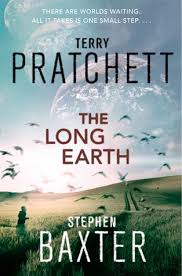
[READ: Summer 2017] The Long Earth

I have read nearly everything that Terry Pratchett has written (I kind of drifted a bit towards the end, but I’ll catch up eventually).  Anyway, I was in the bookstore in Bethlehem, PA and saw this book.  It’s a series I’ve known about but didn’t know very much about.  I decided to check it out to see what it was all about.  I don’t know very much at all about Stephen Baxter except that he’s a hard science fiction writer, meaning he focuses as much on the science as he does on the fiction.

So how does this pair–a hard science writer and a comic parodist of fantasy work together?  Well, honestly the story is much more Baxter than Pratchett. Although since I haven’t read any Baxter, I guess I can’t say that legitimately, but it’s definitely not very Pratchetty.

Well, maybe some of the character interactions are kind of Pratchetty, but certainly not like any of his Discworld characters.  As with any co-writing experience, I wondered how this story was constructed.  So I found an interview with Stephen Baxter from around the time they finished writing the fourth and final book

How did the idea for the Long Earth series come about?

The whole thing was basically Terry’s idea. He’d started work on this project and short stories set in this world back in the ’80s but he got stuck with it.  He wanted to have a very human, level way to access these words. You don’t need to get there on a rocket ship, you can just walk in.  At the same time, the vision for the end was going to be out on a galaxy somewhere.

We’d known each other for years and [about] five years or so ago at a dinner party, Terry [said he] was going through his archives looking for unpublished short stories and things like that and he came across an aborted project from about 30 years ago.  We were just talking about that and it just struck me as immediately a great idea because it’s so simple and yet it’s got endless possibilities.  By the end of that [party] we already had the storylines and Terry was going to send me the material.

Terry was having trouble seeing so Stephen did the typing and then “We fixed each line and each scene together.”

So that’s that sorted.

Baxter also says “it just struck me as immediately a great idea because it’s so simple and yet it’s got endless possibilities.”

And that is the truth.  The story can be summed up pretty easily. (more…)

Read Full Post »

« Newer Posts - Older Posts »