Feeds:
Posts
Comments

Archive for the ‘Religion’ Category

yorkernSOUNDTRACK: SOUL COUGHING-“Is Chicago, Is Not Chicago” (1994).

soul cI really enjoyed Soul Coughing’s output, and Ruby Vroom stands out as a great debut.  They had a terrific blend of great music played behind a more or less spoken word.  The idea wasn’t unique, but they made it work as more than a gimmick.

The musicians of Soul Coughing were tremendous and Mike Doughty’s voice has a wonderful resonance for telling is offbeat/absurd stories/poems.

This track seems especially appropriate when talking about Saul Bellow.

Starting with rhythmic guitar chunks, an upright bass plays a very cool rising and falling bass run.  It sounds like modern noir.

Then Doughty tells us “a man drives a plane into the Chrysler building.”  It’s difficult to hear it now, but in 1994 it was simply a fantastical image.   The drums come in as the guitar starts making shapes and slashes of sounds.

The chorus is a rather boppy moment amid the noise as things slow down for the recited “Is Chicago is not Chicago.”

Then the bridge(s):

Saskatoon is in the room
Poulsbo is in the room
Bennetsville is in the room
Palmyra is in the roomKhartoum is in the room
Phnom Penh is in the room
Pyongyang is in the room
Cairo is in the room

The song ends with a wonderful cacophony of guitar scratches and drum beats that definitively ends the song without it having to end itself.

[READ: September 1, 2019] “Re-Reading Saul Bellow”

I decided to read this article because I like Philip Roth and because I have never read any Saul Bellow.  In fact, although Saul Bellow is a name I was familiar with, I wasn’t entirely sure what he had written. So I was pretty surprised to read that he wrote The Adventures of Augie March, which I had without a doubt heard of, but which I knew very little about.  I was also really surprised to find out that he was still alive when Roth wrote this esay (Bellow died in 2005).

Roth knew Bellow, of course, and Bellow had once told him that his Jewish heritage led him to doubt himself as a writer.  This was mainly because “our own WASP establishment, represented mainly by Harvard-trained professors considered a son of immigrant Jews unfit to write books in English.”

By the time he wrote Augie March, he was prepared to open not with a line like “I am a Jew, the son of immigrants,” but “I am an American, Chicago born.”

Roth summarizes a few of Bellow’s works and talks about how he progressed as a writer.  Of course, he writes this re-reading as if we ourselves have read the books (so, spoiler alerts).

He more or less dismisses the first two novels Dangling Man (1944) and The Victim (1947) and moves straight on to The Adventures of Augie March (1953) saying how the transformation from the earlier writer to the writer of Augie is remarkable.  It won the National Book Award.

He especially likes “the narcissistic enthusiasm for life in all its hybrid forms” that is propelling Augie.  He cries out to the world “Look at me!”

What appeals to me about the way Roth describes this book is the “engorged sentences” as “syntactical manifestations of Augie’s large, robust ego.”  That sounds like a fun 500 page book to me.

Up next was Seize the Day (1956) which is a short novel and the fictional antithesis of Augie March–a sorrow-filled book about the culmination of a boy who is disowned and disavowed by his father.  Whereas Augie’s ego soars, Tommy Wilheim’s is quashed beneath its burden.  Tommy cried out to the world “Help me!”

Bellow seemed to alternate between comedy and tragedy and I would much rather read the comedies myself.

Next came Henderson the Rain King (1959) which contain an exotic locale, a volcanic hero and the comic calamity that is his life.  Henderson is a boozer, a giant, a Gentile, a middle-aged multimillionaire in a state of continual emotional upheaval.  He leaves his home for a continent peopled by tribal blacks who turn out to be his very cure. Africa as medicine.

According to Wikipedia, Bellow became very conservative and somewhat (or very) racist as he got older.  I hesitate to read this book although it was written when he was younger.  On the other hand, I do enjoy that Roth calls it “a screwball book but not without great screwball authority.”  So that’s a tentative maybe on reading this.

Herzog (1964) also won the National Book Award.  Moses Herzog is a labyrinth of contradiction and self-division. He is Bellow’s grandest creation.  Herzog is American literature’s Leopold Bloom.  Although in Ulysses, “the encyclopedic mind of the author is transmuted into the linguistic flesh of the novel and Joyce never cedes to Bloom his own great erudition… whereas in Herzog, Bellow endows his hero with a mind that is a mind.”

Much of the plot is given away in the review, presumably because a 50 year-old award-winning book is pretty well known.

Roth says that Herzog is Bellow’s first excursion into sex in a novel. Adding sex allows Herzog to suffer in ways that Augie March never did.  He also says that “in all of literature  I know of no more emotionally susceptible male, of no man who brings a greater focus or intensity to his engagement with women than this Herzog.”

In Herzog, there is barely any action that takes place outside of Herzog’s brain.  Roth suggests, the best parts of the book are the letters that Herzog writes.

This book sounds rather appealing.  Unlike Mr. Sammler’s Planet (1970) which also won the National Book Award (dang this guy must be good).  Roth gives it a rather short write up, but it appears to be about a man dealing with the culture around him.  It is a darker story, that sounds like a critique of the sixties.

That leads to Humboldt’s Gift (1975) which won the Pulitzer Prize for Literature [that is an impressive amount of awards Mr Bellow].  Roth describes it as the “screwiest of the euphoric going-every-which-way-out-and-out comic novels.”  It is “loopier and more carnivalesque” than the others.  It’s like the tonic that helps him recover from the suffering in Sammler.

Interestingly. Roth doesn’t really talk about the rest of Bellow’s works: The Dean’s December (1982); What Kind of Day Did You Have? (1984); More Die of Heartbreak (1987); A Theft (1989); The Bellarosa Connection (1989); The Actual (1997); Ravelstein (2000).  Rather he continues with Humboldt and talks about Bellow’s relationship with Chicago.

Roth says that in Bellow’s early books Chicago was barely mentioned–a few streets here and there, but by Humboldt Chicago infuses the book.

Perhaps Below didn’t seize on Chicago at the start of his career because he didn’t want to be “a Chicago writer” any more than he wanted to be “a Jewish writer.”

Roth does in fact mention The Dean’s December, but only to say that the exploration of Chicago in this book is not comical but rancorous.  Chicago has become demoniacal.

It feels like Bellow is no longer a part of Chicago.

Read Full Post »

SOUNDTRACK: FRENCH, FRITH, KAISER, THOMPSON-“Bird in God’s Garden/Lost and Found” (1987).

The words are a poem by Rumi.   It is a slow droney song that is primarily drums from John French.  Thompson sings in his quieter style.

There are several different versions of this song. There’s an earlier unreleased version with Richard & Linda Thompson that is much quieter.  I especially like this version because after every other verse they brighten things up with a dramatic five note string riff (or maybe it’s Kaiser on the sanshin) that seems to come out of nowhere.

They spice up the middle of the song with a rollicking traditional Irish sounding fiddle melody from Fred Frith’s “Lost and Found.”  (Frith plays violin).  It adds a bit of zing to an otherwise dirgey song.

After about three minutes of the slow thumping there’s a wonderfully rocking instrumental section complete with fiddles and bass playing some wild melodies.

It was recorded on the album Live, Love, Larf and Loaf and also appears on Thompson’s collection Watching the Dark (1993).

[READ: September 1, 2019] “Nell Zink’s Satire Raises the Stakes”

I have really enjoyed the Nell Zink books that I’ve read. I’ve even read an excerpt from Doxology, the book that’s reviewed in this essay.

What I like about this essay though is the summations of her writing and her earlier books.

Schwartz says that Zink looks at life from the fringes.  She then summarizes her three impossible to summarize books in simple and amusing fashion: (more…)

Read Full Post »

SOUNDTRACK: NICOLE BUS-Tiny Desk Concert #882 (August 21, 2019).

Nicole Bus is from Amsterdam.  Everything about her makes it seem like she has been around for a while.  Her style of music, her raspy voice (which makes her sound older than she is) and her choice of instrumentation (the horns and flute melodies sound old school).  But she is an emerging artist:

Nicole Bus’ sound is nostalgic. It’s reminiscent of vintage R&B, yet still feels current, and can transcend age and demographics.

Her style is R&B, but her singing style is far more reggae influenced.  It’s really fascinating.  The first song, “You,” opens with spooky piano from Eugene “Man Man” Roberts and slow horns from Chris Stevens (trumpet) and Aaron Goode (trombone). I love the addition of the flutes from Korey Riker.  More and more I can’t get over how good flutes sound in rock.  Her delivery is quite reggae until she lets out with her powerful raspy voice.  The song is really catchy.

Nicole followed by premiering a new song about women’s empowerment, “Love It.”  Drummer Mark Thomas starts with drums and then switches to hand drums.  Anthony DeCarlo adds acoustic guitar while Jasmine Patton sing high note backing vocals.  I love in the middle of the song when Eugene “Man Man” Roberts play a very 70s-sounding fill on the keyboards.  Riker adds more great flutes.

She ends the set

with “Mr. Big Shot,” an up-tempo banger mixing high-energy rhythms with ragga-influenced vocals.

Nicole plays acoustic guitar and there’s a cool, catchy four note bass riff from Ray Bernard that propels the song along.  Lamarcus Eldridge joins Patton for some great backing vocals.  This melody has been stuck in my head for days now.

I’d never heard of Nicole Bus, but I really enjoyed her set and her energy.

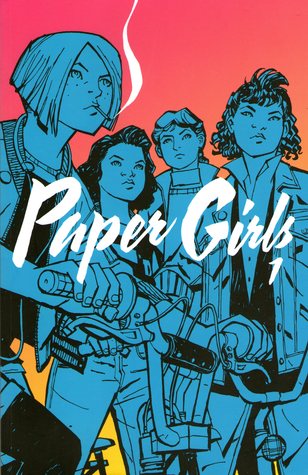
[READ: September 1, 2019] Paper Girls

This book turned out to be so much more interesting than I imagined.

The title was strangely puzzling and the cover had a kind of 1980s look to it.

It didn’t occur to me that “paper girls” meant newspaper delivery girls.

It’s coincidental that this book starts out with the main character, Erin, getting up at 4:40 to deliver papers since that’s almost exactly the same way as Middlewest in which Abel gets up at 4:30 to deliver papers.

Anyhow this story is quite different form that one because it has a cool feminist attitude, although it is also supernatural.

It begins with Erin asleep and dreaming of Christa McAuliffe in heaven.  Then she wakes up at 4:40 and gets ready to deliver the Cleveland Preserver.  It’s also November 1 (1988) as evidenced by The Far Side calendar (nice touch). The calendar has “hell morning” written on it.

Why?  Because at 4:40 on the morning after Halloween there are still hooligans roaming the streets.  One dressed as Freddy Krueger harasses Erin immediately.  But while he is giving Erin a hard time, three girls pull up on bikes and harass right back.  One girl uses some very inappropriate language which Erin (who goes to Catholic school) chastises her for.  The girl, Mac, waits for a thank you. (more…)

Read Full Post »

augSOUNDTRACK: YEASAYER-“Ecstatic Baby” (2019).
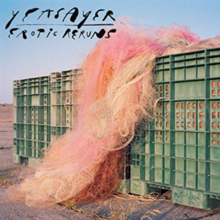
I220px-ER_artwork really enjoyed Yeasayer’s Odd Blood album, but I didn’t hear much about them after that. I had no idea they’d released four albums since then.

“Ecstatic Baby” is the fourth (!) single from the album.  Odd Blood had an early Depeche Mode-with-an-edge vibe.  This song is much poppier.  But I feel like the production feels kind of muted and claustrophobic.

The main melody is a fun sliding synth sound over a sliding bass.  There’s falsetto vocals that remind me a lot of pop songs from the 1980s.  But the song isn’t all that interesting.

I enjoy retro pop, but this song goes in places I don’t really like that much.

[READ: August 10, 2019] “Two Stories”

There are indeed two stories here.

“He Wants Forgiveness from Her” is written from the point of view of a boy.  The boy says he wants to be a writer.  His father is a rabbi and a man in his thirties has stopped in to ask him questions.

Essentially. the man explained, he had been engaged to a woman twelve years ago.  It is customary that when you break an engagement, you ask for the other party’s forgiveness.  But he never did.  He found someone new and moved on.  But he had been having terrible luck ever since.

His business failed, his children were stillborn.  He believed he needed forgiveness to move on.  So he asked the rabbi to call her to his office. (more…)

Read Full Post »

SOUNDTRACK: iLe-Tiny Desk Concert #874 (August 3, 2019).

It’s not very often that you hear a song that is all percussion.  But the first song of this set is only percussion and (Spanish) vocals.

iLe is a singer in the Puerto Rican band Calle 13.  Her most recent solo album Almadura:

is filled with metaphors and allegories about the political, social and economic conditions in Puerto Rico.

When vocalist Ileana Cabra Joglar and her band visited the Tiny Desk, they’d just arrived from the front lines of the historic demonstrations taking place in Puerto Rico. Two days earlier, they were part of a crowd of tens of thousands who were on the streets calling for the resignation of embattled Gov. Ricardo Rosselló. (Rosselló recently stepped down, effective August 2.)

Right from the start, it was clear what was on iLe’s mind in her song “Curandera” — “I am a healer / I don’t need candles to illuminate / I bring purifying water to cleanse / Removing pains so they never return” — as congas and percussion shook the room with an Afro-Caribbean beat.

This is the song in which all of the band members play percussion–primarily congas although Ismael Cancel is on the drum kit.  While everyone plays congas, it is Jeren Guzmán who is the most accomplished and who plays the fast conga “solo.”

In the chorus of the slow-burning “Contra Todo,” iLe sings about channeling inner strengths and frustrations to win battles and remake the world. Her lyrics are rich with history, capturing the spirit of the streets of San Juan even as she stood, eyes closed, behind the Tiny Desk. Her entire performance is a startling reflection of this moment in Puerto Rican history.

“Contra Todo” has a rich deep five string bass from Jonathan Gonzalez and two trombones (Joey Oyola and Nicolás Márquez). Two guitars (Bayoán Ríos and Adalberto Rosario) add a kind of percussive strumming and a quiet song-ending riff.  Jeren Guzmán plays the congas with mallets, something I’ve never seen before.

By the time iLe and her band launched into “Sin Masticar,” they’d already captured the full power of protest, as their musical arrangements raged with the intensity of a crowd joined by a shared cause and pulse.

“Sin Masticar” has a super catchy chorus, perhaps the best way to get people involved in a protest.

[READ: August 2019] Midnight Light

Two years ago Dave Bidini co-founded The West End Phoenix, a newspaper that is for people in Toronto’s West End.  It’s print, it’s old school, and it’s pretty awesome.  I don’t think I’ve ever been to the West End, but I find the writing and the content to be interesting and really enjoyable.

It’s no surprise that Bidini has worked in journalism and loved and hated it.

I’ve always loved newspaper: the smell of the ink and the rough of the newsprint weighted in my hands, their broadsheets flapping like Viking sails.  When I was a kid, our family read them all–the Globe and Mail, the Toronto Star, The Sun, and before that The Telegram–at the kitchen table with each person drawing out whatever they needed: comics, sports, business, entertainment (and yet never Wheels, the Star’s automotive supplement).

He started writing before he picked up a guitar.  When he was 11 he submitted a poem about a hockey player to The Sun‘s “Young Sun” section.  It was accepted and he won a T-shirt.

In 1991, he was asked to write a regular column for a Star satellite weekly called Metropolis.  The day his first piece was to be in print he waited at the nearest newsbox for the delivery man.

But he had no stamina and fewer ideas and he was eventually let go.  Which led to writing books.  But he still wanted to write for the paper and then he remembered: Hey, Yellowknife had a newspaper.

This book is about journalism.  But it’s also about the Canadian North.  And while the journalism stuff is interesting–and the way it ties to the North is interesting too, it’s the outsider’s perspective of this region of the world (that most people don’t even think about) which is just amazing to read about–the people, the landscape, the conditions.  It’s fascinating. (more…)

Read Full Post »

SOUNDTRACK: RADCO-“Didn’t You Know” (2017).

Since this essay is about Mennonites, I decided to see if I could find any Mennonite rock bands.  Well, Radco was a “punk” rock band from Vancouver, BC.

Drummer Amber Banman described their music as

A heart crushing, unstoppable, rock and roll machine. Ha-ha .We like to say we’re too polite for punk rock as we all generally mind our P’s and Q’s. But oh boy, can we rock!

They have a few songs on bandcamp.

This song does rock (although there is a xylophone melody at the end).  It’s catchy with solid guitars.

The lyrics are indeed a polite diss track:

Pay attention
Before you miss
All of these things
That you could have kissed
Didn’t you know I wanted to go
But you left me standing by my front door

As of 2018 Radco were no more, although three of them went on to form The Poubelles (Amber sings lead in this band).

[READ: July 1, 2019] “Mennonites Talking About Miriam Toews”

The July/August issue of The Walrus is the Summer Reading issue. This year’s issue had two short stories, a memoir, three poems and a fifteen year reflection about a novel as special features.

I really enjoyed Miriam Toews’ All My Puny Sorrows.  I haven’t read her book A Complicated Kindness, but I gather that it (like Sorrows) shines a light on Mennonite culture.

The introduction to this piece says that Kindness introduced the world to the Mennonites of Manitoba’s Bible belt.  Her 2018 novel Women Talking is a fictionalized account of women living in the aftermath of sexual assault in an ultraconservative Mennonite colony in Bolivia (that book sounds painful to read).

This piece is a collection of cartoon panels each one a person expressing a real sentiment about Toews (although the panels are fictionalized). (more…)

Read Full Post »

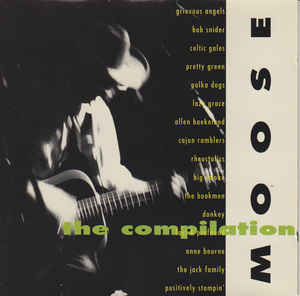
SOUNDTRACK: PRETTY GREEN-“I’ll Follow the Rain” (Moose: The Compilation, 1991).

Back in the 1990s, it was common to buy a compilation or soundtrack or even a band’s album based on one song.  Only to then find that you didn’t really like anything else on it.

Maybe that single sounded like nothing else on the album.  Maybe the movie was almost entirely one genre, but they had that one song that you liked over the credits.  Or maybe the compilation was for something but a song you really wanted was on it, too.

With streaming music that need not happen anymore.  Except in this case.

I bought this compilation, used, recently exclusively for one song, Rheostatics’ “Woodstuck.”  It’s a goofy song and this is the only place you can get the studio version.  The actual compilation was not well documented, so I didn’t know what the other bands on it might sound like.  It turns out to be a compilation for Ontario based Moose Records which specialized in Rock, Folk, World & Country.  They put out another compilation in 1992 and that’s all I can find out about them.

This song was written and performed almost entirely by Ed Blocki, who I guess is Pretty Green (he has other people play violin and cello).

Blocki is (and maybe was) a producer.  This song sounds so much like a ton like a 1970s folk recording, which must be intentional.

It’s really slow and mellow.  I have to assume it was written as a reaction song to The Beatles’ “I’ll Follow the Sun,” there’s just too much similarity.

[READ: July 1, 2019] “The Space Between Trees”

The July/August issue of The Walrus is the Summer Reading issue. This year’s issue had two short stories, a memoir, three poems and a fifteen year reflection about a novel as special features.

I really enjoyed this short story–the way it juxtaposed two very different jobs.  But the ending was really abrupt and unsatisfying.  There was so much going on that I hope it is an excerpt from a novel because as short story it falls flat.

Benjamin Hertwig is a poet.  This might explain why the language of the story is so good, and maybe also while it feel so elliptical.

This is also yet another story about people (specifically a young woman) planting trees in Canada for a summer job.  I have read at least four stories about this profession and it makes it seem like this is a very common thing that most young Canadian try (and quickly give up because it sucks) at least once in their life. (more…)

Read Full Post »

SOUNDTRACK: TASHA COBBS LEONARD-Tiny Desk Concert #860 (June 24, 2019).

Tasha Cobbs Leonard tells the crowd we’re gonna do some worship songs–gonna go to church some.  Everyone is wearing blue except Tasha who is in a very colorful outfit.  She is “regarded as one of the best gospel singers performing today — she’s won numerous awards, including a Grammy.”

“Break Every Chain” has the opening lyrics: There is power in the name of Jesus.”  It opens with David Williams II playing keys and after a verse or two Wellington “Boo” Britt adds some simple drums.

Her backing vocalists Kennya Miller, Breona Lawrence, and Emoni Robinson sound fantastic–adding a wonderful chorus.

After the first chorus Archie “Snoop” Pearson adds some bass and the whole song feels full.

Her Tiny Desk set started out with one of her favorite songs and her most popular tune, “Break Every Chain,” an anthem that reminds many of us that “there is power in the name of Jesus.”

Tasha gives a little preach about God’s plan for everyone before the next song

“You Know My Name,” is one Cobbs Leonard wrote a few years ago with South African musician and friend, Brenton Brown.

This songs starts out as a ballad with just guitar from Benjamin Forehand and voices.

I like the way Tasha was brought to the Tiny Desk:

I first saw Tasha Cobbs Leonard sing live in my church’s 4,000-seat sanctuary. Her voice easily powered-over the PA system and I was amazed by how well I could hear its beautiful resonance and clarity.

The final song is “The River of the Lord,”

a country-influenced tune, written by her husband, musical director and producer, Kenneth Leonard, along with some of their friends. Originally from Jesup, Georgia, Cobbs Leonard explained that “where I’m from, this is called a hand-clapping, foot-stomping, church song. We’re going to clap a little bit, put a smile on our faces and celebrate the river and the joy of the Lord.”

I grew up listening to religious music that was pretty bland and people who didn’t seem to like singing it.  But I can see why people get into gospel music.  Music that’s this fun–even religious music–is really enjoyable..

[READ: July 1, 2019] “First Powwow”

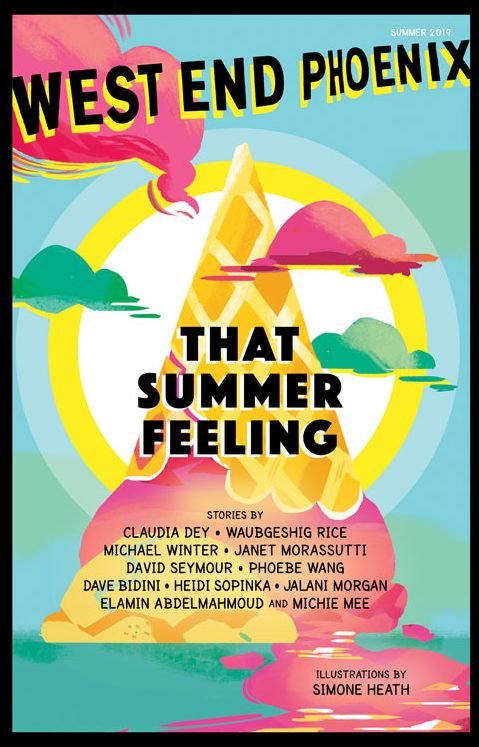
The Summer 2019 issue of The West End Phoenix was a special all comics issue with illustrations by Simone Heath.  Each story either has one central illustration or is broken up with many pictures (or even done like a comic strip).

Each story is headed by the year that the story takes place–a story from that particular summer.

1983: Waubgeshig and his family traveled more than 300 kilometers from Wasauksing to Mississaugas for his first powwow.

He doesn’t remember the journey or arriving.  He really only remembers the sound of the big drum.

The beat echoed in his chest and he was thrilled at the colors of the people dancing around the drum. (more…)

Read Full Post »

SOUNDTRACK: TOMBERLIN-Tiny Desk Concert #855 (June 6, 2019).

I rather like when we see a glimpse at the workings of things.  Like how a Tiny Desk Concert typically happens:

Before I bring an artist to the Tiny Desk, I try to see them perform live. It helps me get a handle on what they’ll be capable of doing at my desk, minus all the artful tinkering of a studio. But I never saw Tomberlin before she came to my desk. My desire to see Mitski and Overcoats when Tomberlin was last in town had me at another venue and another opportunity failed to happen. But I was simply in love with Tomberlin’s ethereal debut album At Weddings and took a chance.

I didn’t know how her fragile songs would translate; all I knew was that Tomberlin was coming to the Tiny Desk to play acoustic guitar and sing, along with her musical partner Andrew Boylan. The eerie production that felt like the backbone to the fragile songs on At Weddings would be gone.

I haven’t heard this album, so I don’t know about the eerie production.  I wonder if that would set her apart from other similar women-with-acoustic-guitars.   This is not dismissive of Tomberlin–it is genuinely hard to distinguish yourself when all you have is a guitar and your voice.

On the first song, “Any Other Way” she sounds like a couple of other recent quiet(er) female singers.  The addition of Boylan helps a bit because he able to add some delightful harmonies and some simple guitar riffs to accompany her strums.

I think her perspective also sets her apart a bit

Tomberlin is the daughter of a Baptist pastor, grew up singing in the church and, since her teens, has questioned her own beliefs in God and faith. And as you listen to her sing these delicate, vulnerable songs, you may find your way to a new songwriter, capable of distilling doubt and isolation while forming a community around her music and expressing assurance.

So lyrics like this are quite unusual

Feeling bad for saying
Oh my god
No I’m not kidding

They say that even the most seasoned performers get nervous at the Tiny Desk.  Those nerves are apparent a bit between songs as she asks, “How’s work going today?  Anything happening? I don’t keep up with the things when I’m doing this thing.”  She continues, “I tried to mute trump’s name on Twitter but it doesn’t work.”  After trying to banter some more she says, “I’m going to stop talking and we’ll play another song.”

The combined guitars and harmony vocals on “Self-Help” are really wonderful. And this verse is terrific

I used the self-help book
To kill a fly
I think it worked mom
I think I’m fine

The final song, “Untitled-1” plays nicely with the harmony guitars.

When Tomberlin began to sing at her Tiny Desk Concert, wearing a bit of Tiny Desk nervousness on her sleeve while singing “I know I’m not eternal, I’m just a young girl,” these songs questioning her religious beliefs, felt deep and personal.

This song was the most interesting of the three for the guitars and for the way she really puts some power in her voice as the song progresses.

[READ: June 4, 2019] “Poorly Mapped”

The June 10th issue of the New Yorker features five essays by authors whom I have enjoyed.  They were gathered under the headline “Another Country.”

Dinaw Mengestu was born in Ethiopia but had not been back for many years.  His family left when he was two years old, in 1978.  When he returned, twenty-five years later (the only one in his immediate family to do so during that time) his aunt Aster asked him not to leave the house while she was out.

She had told him that nothing had changed in those years” even your mother’s shoes are still there.”  Further, everything he would need was available in their house–satellite television, internet and American food.  So he should stay put.

He assumed her concern as because of the protests and mass arrests dating back to 2005, but she shrugged all of that off saying that Western news made it seem worse than it was, “We’re fine, we go to work we live our lives.” (more…)

Read Full Post »

SOUNDTRACK: JADE JACKSON-NonCOMM (May 17, 2019).

I thought this was Jade Bird when I saw her name listed.  I have come to like Jade Bird quite a bit.  I had also forgotten about Jade Jackson.

Jackson is getting ready to release her second record, Wilderness, next month, and she and her band came prepared with a seven-song set of catchy country rock tunes.

I guess it’s the “country” part that meant I’d like her less.  I don’t like country music (duh) but I do really like the feminist lyrics that so many country singers have been writing lately.  All of these new country singers who are getting crossover airplay write about strong women.  I just wish I liked their music and their voices (too twangy) better.  Having said that Jackson’s voice is far less twangy than most.

And her lyrics are pretty good. Like in “Bottle It Up”

I cross my heart
I don’t need a man’s hands to open the jar

Although it seems like a lot of modern country songs are about drinking (old ones too, of course).

But her songs are certainly more rocking than country, I’d say.  “City Lights” rocks a lot harder and was more enjoyable to me.

 Jackson pushes the boundaries of that genre label in any way she can, citing influences from Lucinda Williams to Mazzy Star and The Smiths, and enlisting seasoned punk rocker Mike Ness of Social Distortion to produce her records.

Jade Jackson flew in from California just in time to play the last set of NonCOMM this afternoon. But you’d never guess the singer-songwriter was a bit jet-lagged — and struggling with a guitar that had just endured a cross-country flight in the cargo hold — if she hadn’t told us.

“Finish Line” is slower but still pretty catchy.  “Tonight” is even slower.  She says it’s a personal song about something that happened to her.  The lyrics are not explicit although it is clear what happens and “Jackson emphasized that its very personal content made it the most difficult one on Wilderness to write.”  It’s surprising to make it have such a catchy chorus.

She thanks the audience for being so nice and promises that they will carry on their guitars next time.

Her older songs have a lasting familiarity, like the foot-stomping “Good Time Gone.”

This does sound familiar, but I’m not sure if I’ve ever heard it before.  It is catchy and foot stomping.

“Secret” opens with an guitar intro that sounds a bit like U2’s “Sunday Bloody Sunday” but which goes in a different direction.  There’s a pretty ripping guitar solo which I adds an edge to the song.  She says she wrote it in her car on the way to the gym.

She ends the set with “Troubled End.”  This one is the real foot-stomper, the one kind of country song I like.

So yes, I guess she’s a country crossover sing that I do like.

[READ: June 3, 2019] “Prosperity”

After reading the essay from Salman Rushdie about India, I was interested to read a story about India–using what I learned from that essay to help flesh out this story.

And this story had everything: torturing dogs, torturing cats, child prostitutes, religious violence, infidelity and incest!

This was, without question, the most horrible story I have ever read.

All of the above things were done by the narrator (well, he didn’t torture the animals, but he did calmly report about it and described it in detail).  All of it is told in first person, which makes it so much worse. (more…)

Read Full Post »

« Newer Posts - Older Posts »