Feeds:
Posts
Comments

Archive for the ‘Racism’ Category

SOUNDTRACK: hiatus

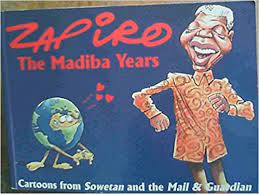
[READ: February 9, 2022] The Madiba Years

Having read some of the more recent Zapiro books, I was delighted to see that our library had most if not all of his previous books as well–one that cover pretty much from the start of the Mandela years.  Mandela even blurbed this book: “Very exciting ad quite accurate.”

So why is it called the Madiba years?  It doesn’t say in the book, so I had to look it up

The clan or family name represents a person’s ancestry. The meaning is deeper than a surname and is used as a sign of respect and affection. The origin of Madiba comes from a chief who ruled in the 18th century, according to the Nelson Mandela Foundation.  Madiba would be used in “an intimate context,” said Richard Pithouse, a politics professor at Rhodes University in South Africa. When Mandela entered school, a teacher gave him the name Nelson. It was customary for Africans to also give children English names back then.  But the wider public had also taken to referring to Mandela as Madiba.  “People would not tend to use that name if they didn’t have positive feelings for him,” Pithouse said.

So there you have it.

This collection opens in 1994 with leader Mangope of Bophuthatswana’s declaration that democracy would not be coming to his homeland (he was very wrong).  With the eyes of the world on South Africa, Election Day shows the shining face of Mandela, pictured as the rising sun over the garbage heap that was the un-democratic elections.

June sees the proposal of the Truth and Reconciliation Commission–to find out what really happened during Apartheid.  There’s also talk of Joe Tokyo, a figure who has been mentioned in other books.  I’m fascinated by his name. In this particular cartoons, his housing plan is described as a pie in the sky.

Things that could apply to any leader include a woman scrubbing the floor in the Prime Minister’s Office.  In 1956, the assistant says to the PM: “Delegation of women to see you.” Then in 1994, the same woman (now much older), the same comment.  This time the scrubber says, “And this time it better work.”

There’s a lot of pages about Winnie Mandela (full name: Winnie Madikizela-Mandela).  I’d heard of her but never really realized what all the fuss was about–she was Nelson’s wife, right?   Well, apparently after he was imprisoned (citing Wikipedia):

In the mid-1980s Madikizela-Mandela exerted a “reign of terror”, and was “at the centre of an orgy of violence” in Soweto, which led to condemnation by the anti-apartheid movement in South Africa, and a rebuke by the ANC in exile. The Truth and Reconciliation Commission (TRC) established by Nelson Mandela’s government to investigate human rights abuses found Madikizela-Mandela to have been “politically and morally accountable for the gross violations of human rights committed by the Mandela United Football Club”, her security detail.  Madikizela-Mandela endorsed the necklacing of alleged police informers and apartheid government collaborators, and her security detail carried out kidnapping, torture, and murder, most notoriously the killing of 14-year-old Stompie Sepei whose kidnapping she was convicted of.

Damn!  And apparently her totally horrific activities weighed on Mandela.

They divorced about two years after he was elected.  But even in 1996 there’s a cartoon of Mandela behind bars with 1962-1990 and then from 1990-1996, he is chained to Winnie.

The big question after the Apartheid government failed was what to do with the men leftover.  Could they just put them in a museum?  Boerassic park?  Apparently F.W. De Klerk had a lot of “amnesia”–couldn’t remember anything that happened before 1990.

And what about the 3,000 former government functionaries that acting president Pik Botha indemnified?  It sounds like the blanket indemnity was ripped off of them–hopefully that will happen to anyone in this country pardoned under our former leader.

I particularly like the one where all of the dominoes fall, knocking down all of the former bad leaders with de Klerk next–again, could be very relevant to our country if they can actually act on it. It’s depressing though that this de Klerk cartoon is in November 1995–so long after the election in April 1994.

But Mandela wasn’t perfect.  When it comes to South African arms sales, apparently he turned a blind eye to backdoor sales.  And his Assembly Chairperson Cyril Rhamaphosa was concerned that when he consulted the public, they seemed to be full of intolerance.  The leaders cut down a hangman’s noose, but there’s a large tree with “pro hanging public opinion.”

There’s also the great unsolved mysteries of the world like The Curse of Tutankhamen, Bigfoot, The Bermuda Triangle and South African foreign policy.

It’s not all politics–there’s some strips about rugby and Springbok, which I’m fascinated by.  And of course much celebration for South Africa in the football (soccer) world.

He also has a strip for National Crime Prevention week. It was suggested that prisons becomes places of education.  But Zapiro says they already are–the criminal leaves with his diploma in drugs, gangs, guns, and knives.  Maybe they just need to change the curriculum.

And the first of many anti pro-life cartoons.  This one has Dr. Claude Newbury saying there shall be no abortion under any circumstance.  Then there’s a lightning bolt with Newbury suddenly pregnant and unwanted babies all round him with god saying “Get real, Claude.”

Evidently the Boer separatists (Volkstaat) were trying to prevent a new South Africa from forming

The concept of a Volkstaat, also called a Boerestaat, is the set of proposals to establish self-determination for Afrikaners (Whites) in South Africa, either on federal principles or as a fully independent Boer/Afrikaner homeland.

Then he shows the trouble with the integration of primary schools as two black students.  The room full of students all look like H.F. Verwoerd (and old man with his nose in the air).  But the glimmer of hope comes when a little white girl takes off her Verwoerd mask and smiles the black students.

Bishop Desmond Tutu as part of the Truth and Reconciliation Committee is shown in a graveyard labelled Apartheid Crimes.  Tutu says, “God help is to remember that the people who did this are also your children.”  God says “lemme get back to you on that one.”

And then in May 1996 De Klerk says the new NP position is “We brought you democracy.”  This compares to the short attention span of the voter:  Western Cape voters oppressed by the Nats for 40 years and happily votes Nat today.

On to Olympics fever! We see that Cape Town is bidding for the Olympics in 2004.  There’s old man Uncle Sam with an Atlanta 1996 shirt tripping over hurdles of security and efficiency and asking Baby South Africa if he really wants to try this.

Then Mandela went to England and it was a big celebration with Nelson’s column having its own Nelson removed and the nearby lion statue saying “tough luck old chap there’s only one Nelson In London this week.

Speaking of London, there’s nothing like the Charles and Diana Royal Side Show to distract the world from real problems.

And remember mad cow disease?

Zapiro sets his sights on Mugabe.

Robert Gabriel Mugabe was a Zimbabwean revolutionary and politician who served as Prime Minister of Zimbabwe from 1980 to 1987 and then as President from 1987 to 2017.

Obviously Mugabe was a bad dude.  Zapiro shows Mugabe putting targets on the back of gays and lesbians in Zimbabwe, while wearing a button that says bigot and proud of it

There’s only one mention of Clinton in this book.  He looks like Tintin as he is in The Adventures of Clintin in Bosnia.  He waltzes in with a peace but there’s Snowy the dog “I’d feel a lot better if that piece of paper has a disarmament clause.”

Zapiro also introduces Netanyahu who will have Isareal aiming for peace (by firing missilesat the peace dove)–he sure nailed that one.

You can see more of his cartoons at https://www.dailymaverick.co.za/zapiro and at www.zapiro.com.

Read Full Post »

SOUNDTRACK: hiatus

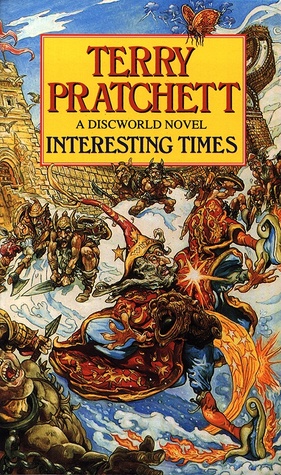
[READ: December 2021] Interesting Times

I tend to think that there aren’t that many Rincewind novels, but it’s clear that Terry liked to have him around as this is the fifth one!

I’ll also preface this by saying that some readers find this book to be problematic because it deals with people from the Aurient (Asia) and tends toward the stereotypical.  I will come right out and say that some of the things said in this book were cringeworthy, and one or two things made me uncomfortable.  However, keep in mind that Pratchett was clearly anti-racist in the Disc overall.  The Watch is one of the most un-racist institutions in fiction.

Remember also that Pratchett was a satirist and is writing for comedy.  Few people fare worse than white “European” men under Pratchett’s pen.  Finally, this book is mostly meant to be about ancient China and the draconian empires.  Yes, he throws in anachronisms (as he always does), and he blurs the boundaries into Japanese culture here and there–not cool.  But the real targets are bureaucracy and tyranny.

The book starts out with Rincewind finally happy.  That doesn’t bode well.

Then the Patrician of Ankh-Morpork receives a demand from the Agatean Empire that the “Great Wizzard” be sent to them immediately.  Vetinari doesn’t know what to make of this, but it obviously involves the WIzards.  All signs (well, the spelling of WIzzard) points to Rincewind.  Although the “great” part surely doesn’t.  But the wizards are suspicious of foreign parts and no one else wants to go, so why not send Rincewind?

In part because after Eric, Rincewind has been on a desert island.  The Wizards use their machine Hex (a proto-computer) to bring him back to Anhk-Morpork.  Rincewind is none too happy–he was really looking forward to the Amazon women that had just arrived on the island.  They might have potatoes after all.

But Hex worked and Rincewind is back.  Although soon enough they are about to send him to the Agatean Empire.  The Hex works by displacing something from where you land.  Which in this case was a lit cannon.  It arrives in the middle of the University (the Wizards wisely put out the fuse). (more…)

Read Full Post »

SOUNDTRACK: hiatus

[READ: January 9, 2022] It Only Comes in Orange, Mr Zuma

This is the second collection of editorial cartoons from South Africa’s Daily Maverick newspaper.  Zapiro (Jonathan Shapiro) has been making editorial cartoons and caricatures since the early 1990s and has 25 books of cartoons published.  Turns out I have access to most of them so I may need to d a deep dive–maybe I’ll understand some of the politics more.

I really don’t know very much about the South Africa, and I feel like news about the country is not covered very much here.  I don’t understand all of the jokes in here, but I do feel like I have a vague grasp on the country now. However, it’s when Zapiro turns his pen abroad–especially against trump, that I can see how good of a satirist he is.  I posted this picture when talking about the previous book, but this cartoon appears in this one:

When he publishes the cartoons in the newspaper, they speak for themselves.  But in these collections, he adds a caption since most of the details are no longer fresh.  For the above he wrote:

Hell-bent on overturning the election result, trump supporters storm the Capitol building in Washington. The riot leaves five people dead.

How is it that there is any question about this still in our country.  Why is our justice system so slow?

Well, given the justice system in South Africa, our looks like a quick resolution. (more…)

Read Full Post »

SOUNDTRACK: Right-wing lies about the Insurrection (2021).

[READ: November 2021] Small Blows Against Encroaching Totalitarianisms: Volume Two

Two years into the previous administration, McSweeney’s published two small books which railed against everything the Criminal in Chief stood for and had done.

Reading these books in 2021 after he had been soundly trounced in the election and with the possibility of jail time (for any of multitude of the illegal things that he did) is somewhat calming.   I think if I had read this in 2018 it would have been thoroughly dispiriting.  Because even though these essays provide hope, they are just full of recounting of the horrors that that [fill in the blank] and his crew of reprobates did.

It has been a year since the brainwashed masses tries to overthrow our government.  And still nothing has happened.  Our country is broken.  These essays don’t really fix it, but it’s nice to know you’re not alone in thinking this way. (more…)

Read Full Post »

SOUNDTRACK: The sounds of trump supporters violating our National Buildings in a failed Insurrection plot (2021).

[READ: December 2021] Small Blows Against Encroaching Totalitarianisms: Volume One

One year ago trump and his lackeys tried to overthrow the government.  Thankfully they failed.  But one year later not enough people have been punished.

Two years into the previous administration, McSweeney’s published two small books which railed against everything the Criminal in Chief stood for and had done.

Reading these books in 2021 after he had been soundly trounced in the election and with the possibility of jail time (for any of multitude of the illegal things that he did) is somewhat calming.   I think if I have read this in 2018 it would have been thoroughly dispiriting.  Because even though these essays provide hope, they are just full of recounting of the horrors that that [fill in the blank] and his crew of reprobates did.

Not even including the attempted insurrection and overthrow of our country.

It has been a year since the brainwashed masses tries to overthrow our government.  And still nothing has happened.  Our country is broken.  These essays don’t really fix it, but it’s nice to know you’re not alone in thinking this way. (more…)

Read Full Post »

SOUNDTRACK: hiatus

[READ: December 31, 2021] You Can’t Be Serious

S. and I were wrapping presents for Christmas this year and put on A Very Harold & Kumar Christmas (which I thought was new and didn’t realize was ten years old).  I had said something about thinking Kal Penn was really cool and respecting his decision to work for the White House.

And lo and behold but there was this book in my Christmas pile.

Kal Penn, Jersey represent!, has led a fascinating life.  And he seems like a very cool (but not scoring you weed on the weekend kinda cool) guy.

Kal starts his book by saying that in kindergarten, the fastest, dumbest boy in his class called him the n-word.  He didn’t know what it meant, but he knew it was bad from the way the kids reacted.

A traumatic way to start a book and a school.  But things got better from there.  He recalls not paying much attention in school and also class trips to Old Sturbridge Village–that’s over three hours away!  His class went there–multiple times?  He loved the acting that went on there.

He talks about getting picked on for being a nerd.  But also about being grateful for living in a diverse New Jersey town–he went to a lot of mitzvahs.  His story of being on a boat for someone’s mitzvah is pretty funny.  And yet, he also talks about a hate group called Dotbusters based in Jersey City (I am so shocked to hear about this) who harassed assaulted and even killed Indian people.  His aunt lived there and his grandmother visited her there. (more…)

Read Full Post »

SOUNDTRACK: THE WEATHER STATION-Tiny Desk (Home) Concert #237 (July 20, 2021).

For a band this soft, there are sure a lot of players.  I can’t even figure out what Philippe Melanson the second drummer (!) is doing for most of set.  It’s especially amusing since at least initially The Weather Station was just one person: (singer here) Tamara Lindeman.

However, it’s the setting of the Home Concert that is so magical.

There’s a desk and a band playing songs filled with nature’s imagery somewhere in the woods of Mulmur in Southern Ontario, Canada.  …. The songs for this Tiny Desk (home) concert are filled with imagery of nature and our relationship with our planet.

I like that they are really spread far apart–that the camera has to pan far left and right to catch everyone (although, really for most of the set it’s guitarist Christine Bougie and saxophone/ clarinet player Karen Ng who are off screen.

If Melanson is relatively quiet, full on drummer Kieran Adams is one of the loudest players here.  In songs like “Robber” there’s almost nothing but drums (the rest of the music lays a bed on which the drums seem to skitter around).  In fairness, Melanson does get to wail a lot of “Robber” as well, which is easily the most fun track here.

“Tried to Tell You” has a real 70s soft-rock vibe.  It’s amusing, for instance, to watch keyboardist Johnny Spence as his hands literally don’t move almost the whole time that the camera is on him.  I like the way the quiet guitar and clarinet bounce back and forth off of each other in this song.

The keyboard melody is much more prominent for “Parking Lot.”  As with most of the song, the pulsing bass from Ben Whiteley is what really grounds the song.

With images of a blood-red sunset in the song “Atlantic” and the lines “Thinking I should get all this dying off of my mind / I should really know better than to read the headlines / Does it matter if I see it? / No, really, can I not just cover my eyes?,” Tamara writes about her passion for the earth and its future, but the tunes are calming and thoughtful, not doctrines or lectures.

“Atlantic” has a nice pulsing feel with squiggly guitar lines.  The spareness of these songs is really in evidence when you see that Bougie is often barely playing before jumping into a big flourish of notes

“Robber” is a six minute jazzy piece that slowly builds to some wild fun.  The build up is spectacular and once again Bougie’s guitar work is terrific.

[READ: July 15, 2021] Oh, Boris!

My library gets all kinds of strange books–books that don’t really seem like they belong in a University library.  But I believe they like to make sure they cover all of the bases–just in case.

Which explains why we have a book like this.  A 6″x6″ square book that’s 64 pages and looks like it was conceived, written and published in a week.

I found this book while searching through old books to see if they could be cataloged (it actually fell out of the pile because it was so small).  Perhaps the only really interesting thing about this is that it was written in 2016, a full three years before Boris Johnson became Prime Minister.  He had just been named Secretary of State (really!) around the publication of this book.

For those of us in the States who wondered how the Brits created such a buffoon, it’s worth noting that he was born in the United States (guess they should also have a law that a PM must be born in the country). (more…)

Read Full Post »

SOUNDTRACK: SLEATER-KINNEY-Tiny Desk (Home) Concert #231 (July 1, 2021).

Sleater-Kinney were once an abrasive riot grrl band with vocals that were challenging and guitar riffs that were often abrasive.  The songs and the vocals intertwined in fascinating ways, making music like nobody else.

They took a lengthy hiatus and reemerged sounding a little different.  Then they released another album which sounded very different (so different that it caused Janet Weiss, holy drummer of the trio, to depart).

That album was not Sleater-Kinney.  It was good, very good in fact, it just wasn’t the same band.  Now, they’ve released another album and this one verges even further from their trio sound.

It’s still good, but it’s disconcerting that our two guitar-wielding singers aren’t playing much in the way of guitars.

“Path of Wellness” opens with a funky drum beat (from Vince Lirocchi) and bass.  Bass!  The gypsies had no home and Sleater-Kinney had no bass.  Well now they do in the form of Bill Athens.

On the previous album I bemoaned that Carrie Brownstein and Corin Tucker’s vocals didn’t intertwine like they used to.  It’s nice that the two sing the song together.  The vocals are much closer to traditional harmonies than untraditional S-K vocals.  But there is a bit of that wild S-K interchange in the voices.  And, once the song takes off in the middle though, Carrie plays some leads and Corin plays big loud chords.

Corin Tucker and Carrie Brownstein sing of human frailty and self-improvement, vibrating with low notes of disgust. Then Brownstein shoots Tucker a knowing smile as they sing, “You could never love me enough,” and the pair, who have been making music together for nearly 30 years, start to unwind things: Brownstein hisses “I am on a path of wellness” through gritted teeth before ripping into a four-note riff that feels like it’s pulling your guts out; Tucker sets her voice at maybe 75 percent howl capacity to sing “I feel like I’m unknown” and Brownstein still has to raise a hand to steady herself against the force. She can’t stop grinning.

“High In The Grass” feels looser and hazier than on the album;

“High In The Grass” has Corin playing the chords, Carrie playing the main riff and third guitarist Fabi Reyna playing the high lead read.  I don’t know if Corin would have normally played that or not, but having an extra guitar doesn’t hurt.

Corin sings this song rather delicately, in a kind of soft falsetto.  But when they get to the chorus is sounds like classic S-K vocals.

The guitars are pretty awesome in the middle part as all three women play different things  Corin is playing chords up and down the neck, Carrie has some riffage going on in the middle and Fabi is playing a scorching feedbacky solo.

Track three is a surprise.  Going back to 2002’s One Beat, they play the title song.  Corin and Carrie put down their guitars and keyboardist Galen Clark plays piano while Bill Athens plays bowed upright bass.

“One Beat” played with piano and bowed upright bass, making it that much easier to hear how, by the end, Tucker’s pleas and Brownstein’s yelp have been inextricably knitted together.

The album version is spare intertwined guitars and tribal drums–a very different sound.

“Worry With You” feels heavier [than the album].

The guitar riff sounds very S-K, and the guitars (and keys) do bring a heaviness to the proceedings.  The verses are jumpy and erratic but they resolve into one of their catchiest chrouses yet.

So yes, you can hear Sleater-Kinney in this album. But one aspect of the band is definitely gone.  Nevertheless, the core remains and it sounds terrific.

[READ: June 10, 2021]  “Standing By: Fear, loathing, flying.”

It was fascinating to read this article in 2021 because at the end he talks about fearing to ask the person near him on line who they voted for.  I wondered when he wrote this because it really applies to pretty much any election in the 21st century.

The essay opens with the joke that when your flight is delayed it’s a national tragedy–why isn’t this on the news!  But when you hear about it from someone else, it’s totally ho hum.

But mostly he gets to be snooty about his fellow passengers.  Like the guy next to him in a T-shirt and shorts:

It’s as if the person next to you had been washing shoe polish off a pig then suddenly threw down his sponge saying, “Fuck this.  I’m going to Los Angeles.”

He also talks about flight attendant friends who have given him some insight.  “I’ll be right back” is code for “Go fuck yourself.”  When he asked another attendant how he dealt with unruly travelers, the answer (at the end of the essay) is very satisfying.

He talks about another flight in which he saw an old woman with her young grandchildren who were dressed beautifully–like children from a catalogue.  The boy was even wearing a tie–clip on, but that’s ok. (more…)

Read Full Post »

SOUNDTRACK: MAHANI TEAVE-Tiny Desk (Home) Concert #228 (June 24, 2021).

Who knew there was a thriving musical scene on Easter Island?  But what I found more interesting in this Tiny Desk (Home) Concert was the ecological work that was done there.  When Teave gives a tour of the building, it is inspired–such great use of six years of recycled resources wit ha technique called “Earthship Biotecture”

Tiny Desk (home) concerts have visited many faraway places – from Lang Lang in China to Mdou Moctar in Niger – but none as far-flung as Easter Island. The 63-square-mile isle, called Rapa Nui by its residents, is located some 2,000 miles off the coast of Chile.

And yes, classical music thrives there – thanks largely to Mahani Teave, the pianist who offers this engaging performance from the music school she co-founded. As a child, Teave saw the first piano brought to the island in 1992 and dreamed of becoming a world-class concert pianist. It was a dream she fulfilled, but just as she was poised to launch her international career, an even stronger dream tugged at her heart.

In 2014, she broke ground on the Toki School of Music, aiming to teach traditional and classical music to Easter Island’s children. Constructed from over 2,500 used tires and 60,000 cans and bottles, the building, with its cisterns and solar power, is a testament to Teave’s vision for sustainability.

Teave plays three pieces.

She begins with a sparkling Allemande by Handel,

George Frideric Handel: “Suite No. 5 in E, II. Allemande” is a beautiful piece that really shows off her musical chops.

followed by a beguiling performance of a Chopin Nocturne.

This sounds lovely and serene.  It’s amazing to watch her long fingers play these keys so elegantly.  This song is much longer than the first piece and goes through several modes of intensity.

Teave closes with an ancestral song, featuring sisters Eva and Tama Tucki Dreyer. The story follows Rapa Nui’s first king, whose reign coincided with a natural disaster. It’s a metaphor, Teave says, for our planet, to “leave this place a little bit better than how we found it.” With her fine playing and her music school, Teave has done exactly that.

The girls sing the oprning of “I hē a Hotumatu’a e hura nei” while Teave plays.  After a verse, they move off camera and Teave plays a lengthy instrumental that begins mildly but really shows off some impressive fingerwork by the end.   The girls come back in to end the song.

[READ: July 10, 2021] “Featherweight”

This was the first story I’ve read by HolyWhiteMountain.  I really enjoyed the intimate look at Native families.  And HolyWhiteMountain’s writing style was really engaging.  But eventually, the story got bogged down in reveling in sex and it got a little boring.

He says that he had been off the res for about a year when he first met his love.  They were both going to school at U. Clarkson and he felt that he had already been acculturated.  He was happy with this acculturation because he wanted to know what the rest of America was all about.  He lists all of the white women he dated including Barbara who called him her “favorite Indian toy.”  He called her Barbie, they had “two- or three- or four-times-in-a-night nights”  But they broke up when she said “I always wanted to be Native American.”

But it was tough dating Native American girls because his Granma and aunts always said she could be so-and-so’s daughter.  But they also didn’t want any half-breed babies.

A lot of indians belong to the Church of Latter-Day Eugenicists… Brown-skin supremacists. That’s just how they are.

Then he found a woman–Allie–from a “tribe his tribe used to kill,” so it was okay to get her number.   Allie was a pretty interesting character.  She was smart and academic–writing papers about racism in America and giving presentations about her work. (more…)

Read Full Post »

SOUNDTRACK: hiatus

[READ: June 19, 2021] On Juneteenth

In recognition of Juneteenth this year, my University gave anyone who wanted one a copy of this book.

Gordon-Reed begins the preface by saying that Juneteenth was originally a Texas thing.  June 19, 1865 was the day that enslaved Texans were told that slavery had ended.  That was two year after the Emancipation Proclamation had been signed and two months after Robert E. Lee surrendered to Ulysses S. Grant.

What’s interesting though is after stating this she says that she was initially annoyed that people outside of Texas were celebrating this day because it was a supposed to be a Texas thing and she has great pride in her home state–despite the above.

This short book is written with anecdotes and history in an attempt to not only talk about the history of Black people in Texas but also to help understand how she can have pride in a place that seemed to not want her.

Indeed, the first chapter is about Texas and how it came to be–a brief history lesson for Texans and non-Texans alike.  Most importantly though is the image of Texas:  Texas is a white man.  Her essays look to find out what that means for all not-white, not-men in the State. (more…)

Read Full Post »

« Newer Posts - Older Posts »