Feeds:
Posts
Comments

Archive for the ‘Pranks’ Category

SOUNDTRACK: OKX: A Tribute to Ok Computer (2010).

OK Computer is one of the best records of the 90s.  Every time I listen to it I hear something new and interesting.  So, why on earth would anyone want to cover the whole thing?  And how could you possibly do justice to this multi-layered masterpiece?

I can’t answer the first question, but the second question is more or less answered by this tribute which was orchestrated by Stereogum.

The answer is by stripping down the music to its bare essentials.  When I first listened to the songs I was really puzzled by how you could take a such a complex album and make Doveman’s version of “Airbag,” which is sort of drums and pianos.  Or gosh, where would you even begin to tackle “Paranoid Android?”  Well Slaraffenland create a bizarre symphonic version that excises many things–in fact half of the lyrics are missing–and yet keeps elements that touch on the original.  But it’s an interesting version of the song and shows  a bizarre sense of creativity.  And that is more or less what this tribute does–it makes new versions of these songs.

Mobius Band make a kind of Police-sounding version of “Subterranean Homesick Alien.”  Again, it radically changes the song, making it a fast and driving song (although I don’t care for the repeated “Uptights” and “Outsides” during the verses).

Vampire Weekend, one of the few bands that I actually knew in this collection (and whom I really like) do a very interesting, stripped down version of “Exit Music, for a Film.  The “film” they make is a haunted one, with eerie keyboards.  Again, it is clearly that song, but it sounds very different (and quite different from what Vampire Weekend usually sound like).

“Let Down” (by David Bazan’s Black Cloud) and “Karma Police” (by John Vanderslice) work on a similar principle: more vocals and less music.  The music is very stripped down, but the vocals harmonize interestingly.  Perhaps the only track that is more interesting than the original is “Fitter Happier” by Samson Delonga.  The original is a processed computer voice, but this version is a real person, intoning the directives in a fun, impassioned way.  There’s also good sound effects.

Cold War Kids take the riotous “Electioneering” and simplify it, with drums and vocals only to start.  It’s hard to listen to this song without the utter noise of the original.  “Climbing Up the Walls” is one of the more manic songs on this collection, with some interesting vocals from The Twilight Sad.

There are two versions of “No Surprises” in this collection.  Interestingly, they are both by women-fronted bands, and both treat the song as a very delicate ballad.  Both versions are rather successful.  Marissa Nadler’s version (the one included in sequence) is a little slower and more yearning, while Northern State’s version (which is listed as a B-Side) is a little fuller and I think better for it.  My Brightest Diamond cover “Lucky.”  They do an interesting orchestral version–very spooky.

Flash Hawk Parlor Ensemble (a side project of Chris Funk from The Decemberists) do a very weird electronic version of the song (with almost no lyrics).  It’s very processed and rather creepy (and the accompanying notes make it even more intriguing when you know what’s he doing).

The final B-side is “Polyethylene (Part 1 & 2),”  It’s a track from the Airbag single and it’s done by Chris Walla.  I don’t know this song very well (since it’s not on OK Computer), but it’s a weird one, that’s for sure.  This version is probably the most traditional sounding song of this collection: full guitars, normal sounding drums and only a slightly clipped singing voice (I don’t know what Walla normally sounds like).

So, In many ways this is a successful tribute album.  Nobody tries to duplicate the original and really no one tries to out-do it either.  These are all new versions taking aspects of the songs and running with them.  Obviously, I like the original better, but these are interesting covers.

[READ: November 5, 2011]  McSweeney’s #8

I had been reading all of the McSweeney’s issue starting from the beginning, but I had to take a breather.  I just resumed (and I have about ten left to go before I’ve read all of them).  This issue feels, retroactively like the final issue before McSweeney’s changed–one is tempted to say it has something to do with September 11th, but again, this is all retroactive speculation.  Of course, the introduction states that most of the work on this Issue was done between April and June of 2001, so  even though the publication date is 2002, it does stand as a pre 9/11 document.

But this issue is a wild creation–full of hoaxes and fakery and discussions of hoaxes and fakery but also with some seriousness thrown in–which makes for a fairly confusing issue and one that is rife with a kind of insider humor.

But there’s also a lot of non-fiction and interviews.  (The Believer’s first issue came out in March 2003, so it seems like maybe this was the last time they wanted to really inundate their books with anything other than fiction (Issue #9 has some non-fiction, but it’s by fiction writers).

This issue was also guest edited by Paul Maliszewski.  He offers a brief(ish) note to open the book, talking about his editing process and selection and about his black polydactyl cat.  Then he mentions finding a coupon in the phonebook for a painting class  which advertised “Learn to Paint Like the Old Masters” and he wonders which Old Masters people ask to be able to paint like–and there’s a fun little internal monologue about that.

The introduction then goes on to list the 100 stores that are the best places to find McSweeney’s.  There are many stores that I have heard of (I wonder what percentage still exist).  Sadly none were in New Jersey.

This issue also features lots of little cartoons from Marcel Dzama, of Canada. (more…)

Read Full Post »

SOUNDTRACK: MOGWAI-Batcat (2008).

“Batcat” is one of my favorite Mogwai songs.  The melody is intense and the drumming is wonderful.  I picked up this single for the B sides (which will undoubtedly be collected somewhere one of these days anyhow, but that’s okay. 

It was very hard to pass up a song called “Stupid Prick Gets Chased by the Police and Loses His Slut Girlfriend”  Given that the song has “Chased” in the title, this is a surprisingly slow tune.  It builds slowly over a series of keyboard waves.  There’s also a slow guitar melody that keeps the piece grounded.  It’s one of their more subtle songs, which again, is rather surprising given the title.

“Devil Rides” is quite jarring in that it features vocals by Roky Erickson.  I don’t really know anything about Roky.  I picture him as a large, unkempt man with crazy hair and a beard.  His voice is otherworldly and seems to be maybe just a wee bit off from what the music is playing.  It’s a strange track and works very well with Mogwai’s history of slightly off-kilter vocalists. 

[READ: November 3, 2011] The Discomfort Zone

After reading The Corrections, I planned to read one of Franzen’s earlier novels.  But they were all quite long (even his debut!) and I wasn’t ready to get so immersed yet.  Then I found The Discomfort Zone in the biography section of the library.  It was less than 200 pages and seemed like just the thing.  It turns out, however, that I had read most of it already.  Three of the pieces were published in slightly different form in the New Yorker: “The Retreat,” (here as “Then Joy Breaks Through”) “The Comfort Zone,” (here as “Two Ponies”) “Caught” (Here as “Centrally Located”) and one “My Bird Problem” (here as “My Bird Problem”) which appears to be unchanged. 

That leaves two essays that were new to me: “House for Sale” and “The Foreign Language.”

The collection works as something of a biography, although really it’s not–it’s a collection of essays about his life, but I don’t think I would go so far as to say biography.   The book also doesn’t follow a chronological order. (more…)

Read Full Post »

SOUNDTRACK: QUEENSRŸCHE-The Warning (1984).

Queensrÿche fulfilled the promise of their debut EP with this album.  It takes the blueprint of the EP and expands it wonderfully.  They introduce some cool low vocal chants to compliment Tate’s soaring alto (like on “En Force”), they also introduce some wonderful effects and riffs and scales (also on “En Force”).

There’s also some really great, odd “keyboard” bits thrown in as kind of sound effects or jarring moments (“Deliverance”).  “Deliverance” also has great backing vocals, and I love the way the “Deliver Us” part of the song is quite different from the soaring of the rest of the vocals.  The back and forth of “No Sanctuary” also showcases the bands skills very well.

The band even shows signs that they’re not sticking to standard heavy metal.  On “N.M. 156” there’s some sci-fi chanting and the really cool section of the song in which Tate sings “Forgotten…Lost…Memories” and the “Lost” part is a completely unexpected note.   They were taking chances from the beginning.

“The Lady Wore Black” is updated with the stunning “Take Hold of the Flame,” a slightly more progressive version of that first song.  “Before the Storm” was the first song I heard from this album and it has always been my favorite on the record (this is one of those few albums where the better songs aren’t front loaded).  “We watch the sun rise and hope it won’t be our last” (they were always happy guys).

“Child of Fire” opens with a wonderful riff and the compelling, “the souls that are damned by the pain that you bring send you higher.”  The song settles down into a slow part and Tate growls “Damn you and the pain they must feel” and you can tell he means it (whatever else the song is about).

All this time I don’t think I ever realized that “Roads to Madness” was nine minutes long.  It is definitely foreshadowing the kind of epic work they would do later.  And it closes out the album in a cathartic blast.  It’s wonderfully pure metal from the mid-80s.

[READ: October 20, 2011] Celebrations of Curious Characters

I had never heard of Ricky Jay before getting this book, but apparently he is a reasonably well know radio personality (on KCRW), he is also an actor on Deadwood, and he’s a magician.  This book is a collection of his KCRW radio show broadcasts along with accompanying pictures from his vast collection of obscure ephemera.

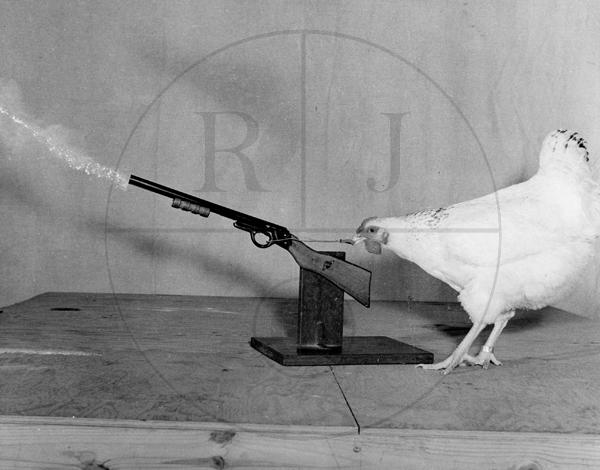
There are forty-five entries in the book–each one is a page long (it’s an oversized book and they are two columns each).  Each essay is Jay’s take on a particular subject or, as the title says, curious character.  Jay is a collector of esoteric information, especially that related to magic and, for lack of a better word, freakish behavior.   One of the most enjoyable parts of the book are the pictures that accompany each entry.  The pictures come from Jay’s collection and each picture’s provenance is given in the back of the book.  So we get pictures like “The little Count Boruwlaski, engraving by A. van Assed ([London]) Borowlaski [sic], 1788). or Lithograph of Chung Ling Soo (Birmingham: J. Upton, c. 1912) or Frontispiece portrait from George Devol, Forty Years a Gambler on the Mississippi (Cincinnati: Devol & Haines, 1887).  Some of these photos you can see on his website.  Or you can enjoy this picture of a chicken firing a gun that is not in the book (it comes from his site). (more…)

Read Full Post »

SOUNDTRACK: SISKIYOU-Siskiyou [CST067] (2010).

Siskiyou is a fascinating band whose debut album was released on Constellation last year.  The main guy in Siskiyou is Eric Huebert, who was drummer for the Great Lake Swimmers.  He quit the band and moved to an organic farm in British Columbia. And while farming he created this album (which is named for the California mountain range and is not, as a I imagined, a play of the phrase Sick of You (which I will still think regardless of the truth).

There’s a wonderful article at Paste about this album, where I learned a lot about the disc.  The disc was recorded in stairwells (which seems so cool) and at field recordings on the beach.  It was made on the cheap and very independently.  And I love it.

It feels very much like a small solo project (although he is quick to point out that he had help from another Great Lake Swimmer, Erik Arensen, as well as his wife and some friends.  But really, it feels like a vulnerable man singing in his wavering voice over some stark acoustic songs.

But unlike a poppy folk album, this one feels awkward.  The melodies are beautiful, but the lack of polish and production makes the recordings feel more fragile than they might otherwise be.

Indeed, Huebert’s voice, while always on pitch, threatens to just collapse under the strain of recording that first song, the gorgeous “Funeral Song.”  But it’s the second song that tells you this isn’t just a home recording.  “Everything I Have” feels like a great Lou Barlow/Sentridoh song–recorded on lo-fi equipment, until you hear the gorgeous horns come in a play the simple yet very winning melody over the loud folk guitars.  Again, if this had been over-produced it might have veered in cheesy, but the lo fi sound (and the cool lyrics) make this one of the best folk songs I’ve heard in ages (and it’s only 2 minutes long, too).

This is followed by two delicate songs: simple melodies, on either banjo or piano and shuffle drums.  My favorite song is “It’s All Going to End.”  Horns give it a kind of mariachi feel, but lyrically it’s wonderful: “I don’t like you one little bit, keep that shit up man, you’re gonna get hit.” All sung in his delicate wavery voice (and again, under 2 minutes long).

Another highlight is the “cover” of “This Land is Your Land.”  Called “This Land,” it opens with a slow piano melody that doesn’t sound anything like the original.  And then he begins whispering the lyrics–once again totally unlike the original.  But mid way through he changes the lyrics, to a new type of song about how he is never going home.  It turns the song mournful and rather powerful.

“Never Ever Ever Ever Again” is a wonderful song of repetition.  And the two short (just over a minute) tracks, “Inside of the Ocean,” and “We All Fall Down” are charming interludes before the lengthy “Big Sur.”  “Big Sur” starts with an upbeat banjo riff but then settles down into a slow (slightly out of tune) guitar piece.  The slow pace is particularly amusing given the incredibly slowly sung lyrics “So let’s party.  Let’s party.  Let’s party.  Party all night long.”

The disc ends with “Brevity and Insult” a song of static and banjos.

Typically I don’t like slow music, but this album adds so many interesting aspects that it doesn’t actually feel slow to me, it feels interesting and challenging  and strangely uplifting.  And I’m looking forward to their next release.

[READ: October 19, 2011] “Snake

This (surprisingly short) story packs so many different ideas into it that it really jostles the reader’s emotions.   It opens with a woman in a car. She’s in the parking lot of a supermarket waiting for her boyfriend, when she begins watching two boys.  They are playing with something on the ground, although she can’t quite tell what it is.

After seeing them lifting a stick, she realizes that it is a mostly-dead snake that they are playing with.  They don’t see her and she watches them decide what to do with the creature.  They decide to play a prank.  The boys test all of the cars in the parking lot and when they find an unlocked door they drop the snake in. (more…)

Read Full Post »

SOUNDTRACK: DINOSAUR JR.-Live at the 9:30 Club, Washington D.C. October 8, 2009 (2009).

This was one of the first shows I downloaded from NPR.  I’ve been a fan of Dinosaur Jr. since my friend Al turned me on to Green Mind back in college.

This is an amazing show created by the original Dino Jr. members.  This tour is in support of their second album since reuniting, Farm. This set-list is an outstanding mix of old songs, new songs, Barlow-sung songs and even some songs from when Barlow and Murph weren’t in the band.  (Green Mind is still my favorite album by them).

When the band reunited there was much joy, and I’ve said in reviews of the newer albums, I’m not entirely sure why.  I mean, Dino Jr has always been about Mascis, and it’s not like Barlow is such an unusual bassist (although Murph’s drumming is always solid).  I’ve nothing against Barlow (I love Sebadoh and Folk Implosion) or Murph, it just seems odd to get excited about having them back in the band aside from nostalgic reasons.

Having said that, the band sounds amazing (and yes, Barlow does get to sing on “Imagination Blind”).  What never really came across to me until hearing all of these great songs live was that Mascis has always been a great pop song writer.  These songs are catchy as hell. But Mascis buries them under loud squalling guitars and a voice that is almost whiny, almost off-key, a total slacker voice.  (But you’ll notice it is never actually off-key.  He must work very hard at that.)

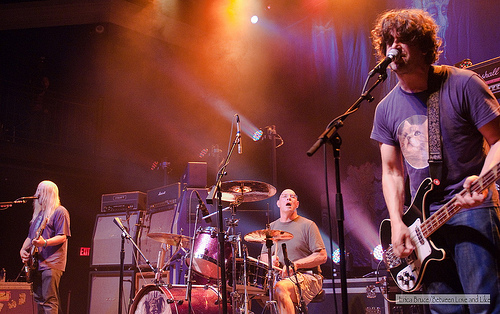
By the nd of the show Mascis chastises the audience for not moving (we obviously can’t see what they’re doing), saying he forgets that people don’t move in Washington, D.C.  But during the encore break, NPR host, Bob Boilen, points out that Mascis himself doesn’t move either–he just stands in front of that wall of Marshall stacks (Boilen wonders how he can hear anything anymore).  And looking at the pictures it’s comical the way he looks, surrounded by amps.  The picture above doesn’t fully do it justice, but check out the extra photos at the NPR page.  And while you’re there, listen to this show. It is amazing.  For a total slacker, Mascis can rock a guitar solo like nobody’s business.

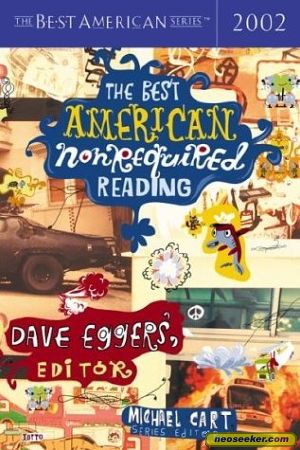
[READ: July 20, 2011] The Best American Non Required Reading

I’d been meaning to read this series for years (yup, Eggers fan), But I have a hard time starting “collections” because I feel like I’d rather be reading a novel.  Nevertheless, I have most of these Nonrequired books, so it seemed like I should dive into one and see what it was like (I don’t think the year really matters all that much–some of the articles are topical but most are not exactly).  Then Sarah said this would be a great book to read on vacation because it’s all short essays, and she was right.  It was perfect for late nights when I wanted something to read but didn’t feel like getting involved in the novel I was reading.

DAVE EGGERS-Introduction
Eggers’ introduction is actually a partial short story about kids who go swimming in pools around town. It reminded me of the opening of Life After God by Douglas Coupland, but of course, lots of kids did that so I’m not saying it was “lifted” from DC.  The story “ends” (it doesn’t really end so much as stop) with an interesting scene between two unlikely kids who get caught.

After this story Eggers includes these three notes about the collection: It’s not scientific, It’s alphabetical, and We had a lot of help with this.  Of the three, it’s the middle one that’s most useful because Eggers says that you shouldn’t necessarily read them in order just because they are printed this way: “In the first half of this collection, you get a good deal of hard journalism, primarily about war and refugees, from Afghanistan to the Sudan, followed immediately by a number of less serious pieces, about malls and Marilyn Manson.  We didn’t group anything by theme , and won’t be offended if you skip around.”  This was good to know (not that we needed the permission of course), but yes, the beginning of the book is pretty heavy. (more…)

Read Full Post »

SOUNDTRACK: MEGAFAUN-“Find Your Mark” (2008).

After listening to the new Megafaun track, I checked the NPR archives.  They have this one song from their debut available for a listen as well.

It’s hard to believe that this is the same band.  Or perhaps I should say that a band can change a lot in three years.  This song begins as a three-part near-a capella barbershop/bar trio.  It reminds me in many ways of a Fleet Foxes track, except they seems more rowdy.  The song merges into a delicate guitar picking section with all of the voices “ba ba ba” ing.  Then, that guitar melody expands to an electric guitar and full band sound.

The introduction to the track (from the NPR DJ says that the album may not be everyone’s cup of tea.  But I like this track so much (even though it is so very different from their 2011 release), that I need to listen to more from this band.  Spotify, here I come. [Actually the album has some pretty crazy noises on it!].

[READ: August 20, 2011] “The Losing End”

This is a strange story about a man named Lamb.  The reason it is strange is because the middle of the story–the exciting part, the part I most enjoyed–is not really the point of the story, at least if the ending is to be believed.

As the story opens, Lamb has just been to his father’s wake.  He is feeling adrift so he goes to a parking lot to sit and think.  In addition to his father, Lamb is also thinking about his wife and his girlfriend.  I’m a little unclear exactly what is happening with his wife (Cathy) but he definitely trying to get time away from her to spend it with Linnie. While he is sitting there lost in thought, a young girl in an ill-fitting tube top approaches him. (more…)

Read Full Post »

SOUNDTRACK: RA RA RIOT-Live at the Black Cat, Washington DC,  October 12, 2008 (2008).

I really like Ra Ra Riot’s album The Rhumb Line, and this concert is basically a showcase for that album.  There’ s an interview at the end of the show (all downloadable from NPR), in which the  band says that critics raved about their live show as much as their album.

I don’t really hear that the show is more energetic than the album (maybe visually they are wild), but it did sound fantastic.  It’s amazing to hear a rock band that is dominated by strings–the cello and violin are often louder than the guitar (but not in a competing/drown you out kind of way,  more of a strings do the melodies and the guitar adds bulk to the sound).

I always enjoy hearing a band that is grateful to their audience for showing up (this is most evident in young bands, who seem so much more genuine about their love of the audience) and Ra Ra Riot are certainly that .  They seem genuinely surprised at the turn out, and they play a great set accordingly.

There are two songs that aren’t on the album here “A Manner to Act” and the encore “Everest.”  They both feel like they came off the album, which bodes well for their second album, Orchard, which just came out in May.  Ra Ra Riot also do a great cover of the obscure Kate Bush song “Suspended in Gaffa.”  At the end of the show they tack on a cover of “Hounds of Love.”  Lead singer Wesley Miles has a wonderfully strong voice and he can reach some pretty high notes–not soprano or anything like that, just strong enough to be able to pull off a Kate Bush cover.

This is a great show.  And when you read about the tragedy they suffered just as they were starting to take off, their obsession with death may not be so surprising.  I’m looking forward to Orchard.

[READ: 1995 and August 18, 2011] Microserfs

After reading Life After God and thinking about Microserfs, I looked up Coupland’s bibliography and saw that indeed Microserfs came next.  And I was really excited to read it.  I have recently watched the JPod TV show and I knew that JPod was a kind of follow-up to Microserfs, so I wanted to see how much of it rang true.  And I’ve got to say that I really rather enjoyed this book.

While I was reading this, I started taking notes about what was happening in the book.  Not the plot, which is fairly straightforward, but about the zeitgeisty elements in the book.  And, since I’m a big fan of David Foster Wallace, I was also noting how many zeitgeisty things this book had in common with Infinite Jest.  I’m thinking of tying it all together in a separate post, maybe next week.  But I’ll mention a few things here.

My son also loved the cover of this book because it has a Lego dude on it and he has been really getting into Lego lately.

So Microserfs is the story of a bunch of underpaid, overworked coders who work for Microsoft.  The book is written as the journal of Daniel Underwood (Coupland still hadn’t really branched out of the first person narrative style, but the journal does allow for some interesting insights).  The story begins in Fall 1993.  I felt compelled to look up some ancient history to see what was happening in the computer world circa 1993 just for context.  In 1991, Apple released System 7.   In 1993, Windows introduced Windows NT, Intel released the first Pentium chip, Myst was released and Wired magazine launched.  In 1994, Al Gore coined the term Information Superhighway.  Yahoo is created.  The Netscape browser is introduced.  So we’re still in computer infancy here.  It’s pretty far-seeing of DC to write about this.

Daniel works at Microsoft with several friends.  Daniel is a bug tester, Michael (who has an office, not a cube) is a coder, Todd (a bodybuilder) is a bug tester.  There’s also Susan (smart and independent), Abe (secret millionaire) and Bug Barbecue (an old man–he’s like 35).  The five of them live in a house on “campus.”  There’s also Karla (a type A bossyboots who doesn’t like seeing time wasted) who works with them but lives up the street.

As the story opens, Michael has just received a flame email from Bill Gates himself and has locked himself in his office.  This leads to a very funny scene and ongoing joke in which the office mates feed slide two-dimensional food under his door and he vows to eat only things that are flat. (more…)

Read Full Post »

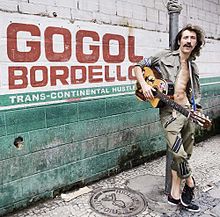
SOUNDTRACK: GOGOL BORDELLO-Trans-Continental Hustle (2010).

When I first heard Gogol Bordello, they were touring for this album (thanks NPR).  Consequently, I knew this album pretty well when I bought it.  At first I felt that it didn’t have the vibrancy of the live show (how could it?).  But after putting it aside for a few weeks, when I re-listened, I found the album (produced by Rick Rubin) to be everything I expect from Gogol Bordello: loud, frenetic fun, a bit of mayhem, and some great tunes that sound like traditional gypsy songs, but which I assume are not.

While I was listening to the album, I kept thinking of The Pogues.  They don’t really sound anything alike but they have that same feel of punk mixed with traditional music.  For The Pogues, it’s Irish trad, and for GB it’s a gypsy sound–I’m not sure if it is attributable to any specific locale.  But they have a common ground in a kind of Spanish-based trad style.  From the Pogues, you get a song like “Fiesta” which is overtly Spanish.  From GB, you get songs like “My Companjera” or “Uma Menina Uma Cigana.”  Singer/ringleader Eugene Hutz has been living in Brazil, and he has really embraced the culture (and the accent).  He also sings in a kind of drunken tenor (his accent is probably more understandable than MacGowan’s drunken warble, but not always).

I’m led to understand that previous albums were a bit more high-throttle from start to finish.  This disc has a couple of ballads.  At first they seem to not work as well, but in truth they help to pace the album somewhat.

It’s obvious this band will not suit everyone’s tastes, but if you’re looking for some high energy punk with some ethnic flare, GB is your band (and if you like skinny guys with no shirts and big mustaches, GB is definitely your band.  It is entirely conceivable that Hutz does not know how to work a button).

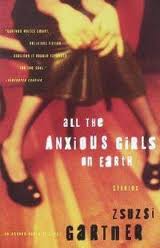
[READ: June 20, 2011] All the Anxious Girls on Earth

I’ve really enjoyed Zsuzsi’s stories in recent issues of The Walrus.  So much so that I wanted to get a copy of her new book.  It wasn’t available anywhere in the States yet, so I went back and got her first collection of short stories.

This collection felt to me like a younger, less sophisticated version of Zsuzsi’s later works that I liked so much.  This is not to say that I didn’t like them.  I just wasn’t as blown as w.

“How to Survive in the Bush”
I had to read the opening to this story twice for some reason.  The second read made much more sense and I was able to follow what was going on (I think there were a few terms that I didn’t know–a 1941 Tiger Moth, East Kootenays–that were given context after a few pages.  It transpires that this is a story o a woman who has given up her life to move to the boonies with/for her husband.  The whole story is written in second person which while typically inviting, I found alienating.  It made the story harder to read for me, but once I got into the groove of it I found it very rewarding. (more…)

Read Full Post »

SOUNDTRACK: fIREHOSE-“fROMOHIO” (1989).

After the punk of The Minutemen, you wouldn’t expect the sound of fROMOHIO to come from Mike Watt and friends.  The opening song, “Riddle of the Eighties” is quite poppy, but with a countryish flair.  In fact, much of the beginning of the disc sounds not unlike the Meat Puppets–southwestern punk.  Track two, “In My Mind,” has a wonderful latin/Mexican feel to it (singer Ed Crawford has that whole southwestern vibe down quite well, even if they are from Pedro).

The disc also has what I’ve learned is that peculiar SST Records sound–almost nonexistent bass, despite what Watt is accomplishing.  Actually the bass is there, and it’s mixed fine but it’s much lower than you might expect for what they’re playing.

Even track three “Whisperin’ While Hollerin'” which is all about the bass (with cool blasts of guitar over the top) doesn’t have a lot of low end in it.  The bass sounds crisp and clear (which is good), just not very deep.  “Mas Cojones” is a weird one.  Funk bass with disco guitars over the top and some odd spoken word from Watt.

The highlight is “What Gets Heard,” a great funky fast bassline with angular guitars and vocals by Watt.  Near the end of the disc, “Some Things” is another solid song, really typical of this period: great bass, great guitar work and yet still a lot of punk.  And “Liberty for Our Friend” is a great folk singalong, and I dare you not to singalong by the end.

There’s also some fun, unexpected bits.  There’s a pretty acoustic guitar solo called, “Vastopol” and two (!) drum solos “Let the Drummer Have Some,” and the wonderfully titled, “‘Nuf That Shit, George.”

And its all packaged as really short songs (most around 2 minutes, with late songs running longer).  It’s a fun disc and a worthy addition to the SST catalog.

[READ: October 25, 2010] “Caught”

After the seriousness of “My Father’s Brain,” this true story about Franzen’s wicked days in high school was tremendously enjoyable, possibly one of my favorite pieces that I’ve read by him.

The piece opens with the incredibly tempting story about students successfully pranked their high school by managing to get a tire over the top of a 34-foot flagpole.  This sets in motion Franzen and friends’ attempts to do the same to their school’s 40 foot flagpole (there’s even a diagram or three!).  The story is exciting and filled with secretive plotting as they try so many different ways to get that tire over the top of the flagpole.

There’s a great bit of self-deprecation from Franzen.  He admits that although one of his friends was far more architecturally-minded, he himself was far more persuasive.  Ultimately, their gang put his “Devices” to work, which are universally decried as pieces of shit.

Although I assumed that the tale would focus only on their attempts at flag pole ringing, in fact the group undertook many pranks.  At first they called themselves U.N.C.L.E., but then they changed their name to the far more amusing (with an incredibly involved explanation) DIOTI.  DIOTI undertake several delicious pranks including removing the clappers from all of the bells in the school (and leaving a series of poems as  clues for where they are) and piling all of the classroom desks into one room.  (The “centrally located” comment and its resultant embrace by the school is simply wonderful). (more…)

Read Full Post »

« Newer Posts