Feeds:
Posts
Comments

Archive for the ‘Political Humor’ Category

SOUNDTRACK: ROCKWELL KNUCKLES-You’re Fucking Out I’m Fucking In (2011).

I downloaded this disc a while ago because I really liked “Silly Human

I listened to it again recently and realized just how much I like the whole disc.  Rockwell Knuckles has a great delivery style—a basso profundo voice—and a great sense of melody both in his delivery and his backing music.  He captures the best of Chuck D and Ice T.  “Bullet Train Army” has such a cool melody line—and the fact that he raps along with it is fantastic.  Apparently the Bullet Train Army is his posse or something, because it appears a lot on the disc.

“Silly Human” is a fantastic song—a wispy futuristic keyboard riff fizzes away behind Rockwell’s super fast delivery and funny (but not really) lyrics.  The chorus is delivered super quickly in a cool descending melody line.  And I love that someone in the background is shouting Yes Yes! YES! as he deliveries his lines.  It reminds me in strange way of The Flaming Lips.  “Play Catch” shows off his diversity of styles with this more gentle song.  I like the way the verses end with a repeated word which seems like it’s going faster because the beasts speed up,  It’s a cool trick.

“Baking Soda” has a guest rapper (I really don’t like guest rappers, I’m here for Rockwell not Tef Poe, who immediately lost my respect by having his first rhyme end with bitch—lazy!).  I don’t really care for the music behind this one either—cheesy sax and horns.   It’s made up for with “Point of No Return.”  This song has a sung chorus with a weird sci-fi-sounding melody and some great lyrics.  I haven’t really mentioned the lyrics yet but they stand out here “the early bird catches the worm, but the first sponge catches the germs) and a reference to Sojourner Truth.

The lyrics are even better on “Unstoppable” (which has a cool synthy sound over the chorus): “My competition ‘s delayed I’m rocking digital/
Ive been around the world in a day not in the physical/Artistic freedom in what I say y’all are to literal.”

The simple riff behind “Intergalactic” is also cool.  At first I wasn’t sold on Theresa Payne’s backing vocals but I think it works quite well.  I particularly love the chorus of “Supercalifragilisticexpiala-futuristic”

There’s another great delivery melody on “Motto of Today” with more cool sci-fi backing music.  “You Got It” has the great fast beats and delivery that I love out of Atlanta, even though Rockwell is from St. Louis.  There’s even a cool binary joke in the lyrics (1001001).  Guest rapper Vandalyzm fares better, although there’s more curses than actual lyrics in his verse, I think.

“Nomanisan Island” also features Tef Poe, but I like him better on this track.  But maybe that’s because the chorus is great: “No man is an island and we are never stranded”  I’m not sure though that Tef Poe should be singing the line “black tea party, we’re coming to impeach” with Obama in the white house.

“Controlled” I assume has a sample for a chorus, it slows things down nicely and the sound of the drums is fantastic.  I’m partial to the lines “Stone cold like Medusa” and  “Shows about to start, I don’t know when it will end, son/ Puppet on a string controlled by Jim Henson” (whatever that means, I like it).

“Every Angle” has a groovy chorus that I like despite itself.  Rockwell makes it flow wonderfully.  And the final track, “Natural Born Leader” opens with a simple rocking guitar riff.  When the lyrics kick in, the song soars with 70s keyboards and big guitars.

This album is really fantastic.  And while there are plenty of deserving artists out there, Rockwell Knuckles is amazing and should be huge.  Don’t be put off by the album title or the cover, this album is more about melody than a cursing.

You can download the whole album here for free.

Oh, and the reason I chose this is because of a note I had written in the margins of GR, which I thought had read No Man is an Island, but which didn’t.  Oops.

[READ: Week of February 27] Gravity’s Rainbow 1.13-1.18

I found a few of this week’s sections to be more challenging to get through.  There are a lot of long passages that are meandering–often with an unclear narrator (although the narrator usually becomes apparent by the end).  During these section, it feels like the book is just drifting of into a reverie for a while before snapping out of it and getting back to the business at hand.  And that seem apt given all of the crazy stuff that happens in the book (all of the mental/psychological ideas).

After reading a few of the posts at Infinite Zombies this week, I have new eyes for the book.  When I first read all of the sex in the book, I thought again about Joyce’s Ulysses and all of the sex that he described (shockingly for the time) and how modern writers seem to revel in writing about sex–not pornographically, just “real.”  But now, after reading Christine’s post, I had to rethink this attitude on sex.  I’ve been surprised by Pynchon’s frequent use of the words “cock” and “cunt” as anatomical names.  “Cock” in particular is a word I don’t hear used all that often in fiction and it has (to my ear) a kind of crass/vulgar connotation. And what more needs to be said about “cunt.”  I wondered if this was a Pynchon thing or a 70s thing or an I’m-too-uptight thing, but in Christine’s post she writes: “One of the things I most loathe about the other Pynchon books I’ve read is the latent, creepy, old-man sex fetish” and “the constant phallic status updates (noted in my paperback as I.P.R.s [infantile penis reference]” (which is hilarious, by the way).  This has made me even more aware of all the sex in the book–although to what end I’m not sure yet.

Jeff’s post at Infinite Zombies focuses on Roger and Jessica (I know that wasn’t the point of the post, but the mind takes what it will) and makes me think of Roger as more of a protagonist of the story.  Even more than Pirate (who, coming first, I assumed was the focus).  And  this week’s reading reveals more importance for Roger.

So on to the read: (more…)

Read Full Post »

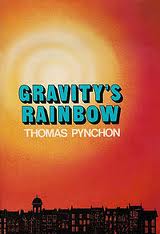
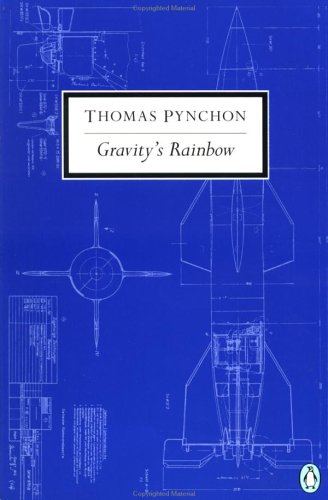
The edition I’m using.

SOUNDTRACK: KINCH-The Incandenza (2011).

I like this album more than I have any right to like an album that I bought purely for the name.  The album name is The Incandenza which is named after the main family in David Foster Wallace’s Infinite Jest.  The band name is Kinch which is named after what Buck Mulligan calls Stephen Dedalus in The Odyssey. That’s pretty high literary tributes.  So who cared if the music sucked.  But the thing is is that it doesn’t.  And I’ve been having a hard time writing about it because I like it so much and yet I don’t know what it is that grips me about the disc so intensely.  It’s not staggeringly original.  It’s more of an alt rock take on classic rock.  But even that doesn’t work because they use pianos prominently and the classic rock is more sound styles than sounds themselves.  Yet at the same time I hear a number of different band in the mix (and only a few of them use pianos).

“When I was Young” opens the disc with a great loud piano sound and a strong vocal line.  When the chorus comes in, the song picks up tempo and strings add intensity to what is already a catchy song.

“Evelyn” has a great stomping rock guitar sound.  At two and half minutes, it’s an amazing potential single with, again, a great chorus.  “45 Minutes” opens with screaming guitars and a great bass line that sounds like a classic song from The Jam.  “That’s Just the Mess That We’re In” features some horns that accentuate the chorus nicely.

“Once I was a Mainsail” starts like a pretty normal piano based rocker but the screaming chorus adds a great punk feel to the song.  “Tea Party Bomba” unravels its beginning into a great prog rock riff, with shades of Queen via Muse everywhere.  The same is true in “Bye Bye Bye Bye” which has a bombastic bridge (really showcasing the singer’s voice) until we get to the great shift to the quiet “I don’t think he ever knew.”  It’s a wonderful change of pace. It’s followed by the punky buzzy guitars and a simple melody of “Ocean”

“VHS” is another song that is just over 2 and a half minutes.  It begins quietly and (again) simply, this time with some gentle keyboard washes as the song build and builds adding drums and guitars.  It bleeds into “The Incandenza,” the longest song on the disc at just over 5 minutes.  It never feels like it’s 5 minutes long–another great bride with more sing along bits (and a great tempo change after the bridge) and a guitar and whistling solo make the song ever-interesting.  even if I don’t think it has anything to do with the Infinite Jest.

Kinch have a few other short albums out and I’m looking to get them as well, but in the meantime all of these great music can be streamed at their bandcamp site.

[READ: Week of February 20] Gravity’s Rainbow 1.1-1.12

This is my first time reading Gravity’s Rainbow.  And I know literally nothing about it.   I have always felt like I should read it (being a good modernist and a fan of Joyce and David Foster Wallace), but I never bothered to find out even a basic plot.  And it’s kind of fun going into this thing completely blind.  I had no idea even that it was set in England just Post WWII (1945).  So that was a surprise.  [Interestingly, having just read The Apothecary which was set in London right after WWII, it is cool to read another story set just around WWII and to hear similar things about the living conditions.]

But back to GR.  The only thing I have read before writing this post (aside from a few thoughts over at Infinite Zombies) was a comment (again, on IZ) that you will be confused while reading this book and that’s okay.  Phew.

Having said that I didn’t find it as confusing as I imagined.  (I’ve been intimidated by reading this book for fear of its difficulty).  I admit there are several scenes with pronouns that are somewhat elusive to me, and there’s a few other scenes where characters seem to be there without being fully introduced until later, but overall it’s not that bad.

The first section of the book seems like a lot of exposition–good, thorough exposition, which is also funny—but by section 1.12 we’re still meeting new characters.  It feels like serious plot things will happen later.   The book opens with a more or less famous line (Okay, I knew about that line before reading the book, but that doesn’t give any context).

And so, the screaming comes across the sky and the city is in the midst of an evacuation, but it is too late.  At least for some.  And the opening is a little confusing, as an evacuation might be.  It certainly seems like the end of everything, but then we also find out that some people are sleeping through it.  That this bomb is a localized attack.

Section 1.1 also introduces us to Lt. Capt. Geoffrey (“Pirate”) Prentice.  Pirate is just waking up when he notices that his flatmate Teddy Bloat is about to fall off of the minstrels’ gallery but Pirate manages to shove a cot in the way just as Teddy falls off the balcony.  Pirate is famous for his Banana Breakfasts (he’s the only person in England who has bananas).  And at this point the story settles down into a rather enjoyable domestic scene.  I mention in a post at Infinite Zombies that this opening scene of Pirate on the roof is reminiscent of the opening scene of Ulysses (I won’t go into that here).

The next scene is a raucous affair with a bunch of locals clamoring for their Breakfast plates.  The scene feels like a college dorm, although the participants are (I assume) older—Pirate himself is in his early 40s.

It’s time to mention Pynchon’s astonishing character names. I love them all, they are so weird and evocative without (always) being obvious.  So Teddy Bloat is a good name, but what about Coryson Throsp, the designer of their building.  And with the Breakfast comes names out of the woodwork:  Osbie Feel, Bartley Gobbitch, DeCoverley Fox, Maurice “Saxophone” Reed, Joaquin Stick.  I’m not going to go speculating about names in these posts, but I am sure going to highlight my favorites. (more…)

Read Full Post »

SOUNDTRACK: MITCHMATIC-“Why Don’t You Know” (2012).

This song reminds me in spirit of the old Fresh Prince songs–buoyant and fun, funny and a little silly.  And although it doesn’t sample I Dream of Jeannie, the mood is the same.

The track opens with a great sound of an old rotary phone.  When the music comes it, it’s completely loungey: strings and easy music propel this song to the heights of Cool.

The delivery style is gentle but fast and the lyrics are funny “I’m gonna tell you some reasons that you wanna date me.”

Mitchmatic is a Canadian rapper and his record is coming out soon on Old Ugly records.  Listen to the track at NPR and explore his stuff at his bandcamp site.

Darling I would like you so much more if you loved me back…

[READ: December 31, 2011 and January 24, 2012] “Wolves at the Door” and “Comment”

This is a blog post from Barry that deals with politics.  Although it was written in 2004 it is completely relevant to the current state of affairs in American politics.  I suppose it was ever thus, but it sure seems worse now.

He opens, “Stop me if I ‘m getting too cynical, but I think elections are won by the guy with the stupidest policies.”  He explains that it’s not because people are dumb; rather, it’s because when you are marketing to an entire country, “your best strategy is to scramble straight to the bottom of the barrel and start groping around in the muck there for the lowest common denominator.”  This is very true.

But I think the perfect summary for politics is (as Barry writes): “smart is complicated, but dumb is catchy.” (more…)

Read Full Post »

I have been getting The Washington Spectator for years and years.  I was delighted with it in the beginning when the editor had the wonderful name of Ben Franklin.  I am delighted now that publisher’s name is Hamilton Fish.  But aside from these two fascinating details, I have always enjoyed the content.  It was thoroughly researched and detailed.  And the little 4 page leaflet always looked like a newspaper in design and style, and it gave it a kind of gravitas–no flashy colors or pictures.

Well, here it is, Vol 37, Issue No 21 and they have finally changed the format.  And not only that, they have created a website and have a Facebook presence!  Welcome to the 20th century!

I say that jokingly because despite these changes (which look great by the way), The Spectator has not abandoned its old school journalism practice.  21st century news is pretty much all flash and brash–style over substance–quick reporting with no concern for accuracy and very little attention brought to retractions (can anyone say “climategate” (I wish they wouldn’t call it that)).  But The Spectator is exactly the opposite, and I am delighted to say that although they are now a lot more accessible, they have not lost any of their tenacity or thoroughness.

The redesign is quite nice.  There’s an image on the front page and now there are pull quotes in red, which stand out nicely on the pale paper.  Although I always liked the pull quote box in the middle off the front page, this new format allows for a couple of different pull quotes as well as an opportunity to mix things up a bit.  (more…)

Read Full Post »

SOUNDTRACK: SUFJAN STEVENS-The Age of Adz (2010).

Sufjan Stevens has released a bunch of albums of beautiful orchestral rock.  It is multi-layered and complex with classical elements and all kinds of cool instruments.

And this album starts out with a beautiful acoustic guitar melody and Sufjan’s delicate vocals.  Although it is a far more stripped down song than usual, “Futile Devices” seems like it is heading in the standard direction.  But anyone who heard Sufjan’s Christmas album number VIII knows that he has been having some fun with electronics.  And they show up with a vengeance on track two, “Too Much.”

All of the multilayered noise that was once orchestral and (some might say) precious has been replaced by a cacophony of gorgeous electronic noises.  The beginning of the song reminds me of the sounds in Skinny Puppy’s “Stairs and Flowers” (how many Sufjan Stevens reviews mention Skinny Puppy?).  The song is nothing like Skinny Puppy once the vocals kick in–it’s catchy and delicate–but those electronics underpin the whole thing, bringing his pastoralia into the twenty-first century.  When I first reviewed this song I didn’t like it but once you get absorbed by Sufjan’s world, it’s an enticing place to be,

“Age of Adz” takes this electronic nonsense even further with an 8 minute brew of strange sounds and choral voices.  But he always manages to throw in some catchy parts, no matter how strange the song gets.

For me one of the highlights of the disc is “I Walked” it features one of my favorite Sufjan things–falsetto vocals in a beautiful but unexpected melody.  And this song has them in spades.  “Now That I’m Older” has a very disconcerting sound–his voice is slowly warbled and mournful.  It’s a beautiful melody that is alienating at the same time.

“Get Real Get Right” returns to his earlier style somewhat (there’s more layers of music, although the electronica is still in place).   “Vesuvius” is a beautiful song and “All for Myself” is another of those great falsetto tracks that I like so much.

“I Want to Be Well” eventually turns into a manic electronic workout in which he repeats the chorus “I’m not fucking around.”

But nothing compares  to “Impossible Soul” a twenty-five minute (!) multi-part suite of electronic chaos.  It’s a fantastic song complete with autotune (used to very cool effect), repeated swelling choruses (it’s like a Polyphonic Spree tribute), electronic freakouts, and acoustic comedowns.  All in a positive, happy message.  I can’t stop listening to it.  “It’s not so impossible!”

Sufjan continues to impress me.

[READ: November 10, 2011] McSweeney’s #9

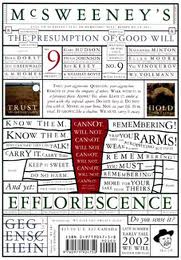
After the excesses of McSweeney’s #8, I was excited to get to the brevity (and urgency) of McSweeney’s #9.  This one is a paperback and looks like the first couple of issues.  The cover is mostly text with a hodgepodge of phrases and pleas.  You get things like: Thankful, Emboldened, The (Hot-Blooded/Life-Saving) Presumption of (Perpetual/Irrational (or More Likely, Irreducibly Rational) Good Will, Efflorescence, Our motto this time: We Give You Sweaty Hugs,” Alternative motto: ” We Are Out Looking,” GEGENSCHEIN (no more), and the promise: “We will Do Four This Year.”

This is the kind of issue that makes me love McSweeney’s.  There are some wonderful short stories, there are some nice essays and there are some dark moments all centered vaguely and tangentially around a theme.  There are some great authors here, too.

The back cover image is called Garden Variety by Scott Greene and it’s a fantastic painting.  You can see it here (navigate through the 2000-2004 paintings, but I have to say I really like the style of all of his work.

There are no letters and no nonsense in this issue.  So let’s get to it. (more…)

Read Full Post »

SOUNDTRACK: MOGWAI-Batcat (2008).

“Batcat” is one of my favorite Mogwai songs.  The melody is intense and the drumming is wonderful.  I picked up this single for the B sides (which will undoubtedly be collected somewhere one of these days anyhow, but that’s okay. 

It was very hard to pass up a song called “Stupid Prick Gets Chased by the Police and Loses His Slut Girlfriend”  Given that the song has “Chased” in the title, this is a surprisingly slow tune.  It builds slowly over a series of keyboard waves.  There’s also a slow guitar melody that keeps the piece grounded.  It’s one of their more subtle songs, which again, is rather surprising given the title.

“Devil Rides” is quite jarring in that it features vocals by Roky Erickson.  I don’t really know anything about Roky.  I picture him as a large, unkempt man with crazy hair and a beard.  His voice is otherworldly and seems to be maybe just a wee bit off from what the music is playing.  It’s a strange track and works very well with Mogwai’s history of slightly off-kilter vocalists. 

[READ: November 3, 2011] The Discomfort Zone

After reading The Corrections, I planned to read one of Franzen’s earlier novels.  But they were all quite long (even his debut!) and I wasn’t ready to get so immersed yet.  Then I found The Discomfort Zone in the biography section of the library.  It was less than 200 pages and seemed like just the thing.  It turns out, however, that I had read most of it already.  Three of the pieces were published in slightly different form in the New Yorker: “The Retreat,” (here as “Then Joy Breaks Through”) “The Comfort Zone,” (here as “Two Ponies”) “Caught” (Here as “Centrally Located”) and one “My Bird Problem” (here as “My Bird Problem”) which appears to be unchanged. 

That leaves two essays that were new to me: “House for Sale” and “The Foreign Language.”

The collection works as something of a biography, although really it’s not–it’s a collection of essays about his life, but I don’t think I would go so far as to say biography.   The book also doesn’t follow a chronological order. (more…)

Read Full Post »

SOUNDTRACK: COLIN STETSON-Live at All Tomorrow’s Parties, October 4, 2011 (2011).

In addition to playing SXSW, Colin Stetson also played All Tomorrow’s Parties, and NPR was there.  Unlike with SXSW, this set appears to be full length (about 50 minutes–which is a pretty amazing amount of time for him to blow that horn).  Like SXSW (and the album) Stetston starts with “Awake on Foreign Shores” and “Judges.”  What I love about this recording is that after Stetson finishes “Judges” a guy in the audience shouts (in a voice of total amazement) “That shit was off the hook!”  And he is right.  It’s not even worth me going into how amazing Steston is once again (check previous posts for  that), but man, just look at the size of that horn he’s playing (seriously, click on the link to see it bigger).

Stetson plays a few more songs from New History Warfare, Vol. 2: Judges like “The Righteous Wrath of an Honorable Man” (which is outstanding) and “A Dream of Water” (which works without Laurie Anderson, although he does say he’s sorry she’s not there).  He also introduces two news songs “Hunted 1” and “Hunted 2” which show new levels and new styles that Stetson employs.

This is a remarkable set, and Steston is clearly in his element (and the crowd is rapt).  The only problem I have is the recording level.  It must be very difficult to maintain recording levels for Stetson’s brand of noise–his louds are really loud–but you can’t hear him talk at all.  And most of the time, the introductions to his songs are worth hearing.  I’m sure if they tried to get the speaking level a little louder the music would have sacrificed though, so I think they made the right choice–I only wish there was a transcript available.

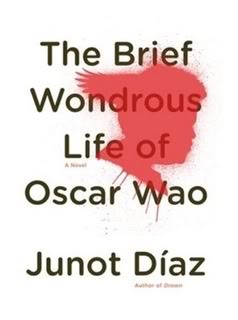
[READ: October 31, 2011] The Brief Wondrous Life of Oscar Wao

Apparently it’s pronounced, “Wow”, by the way.

Because of my new job, I don’t have a  full hour of lunch-time reading like I used to.  And so this book took considerably longer than I intended.  However, once I set aside some time to read it, I flew through the book.

I’m going to get this part out of the way because I was thinking about it throughout the book and I want to mention it without having it bog down the post.  This story reminded me a lot of Roberto Bolaño.  On the surface, sure this is because they are both writers from “Central America” (Diaz is originally from the Dominican Republic but moved to the US, while Bolaño is originally from Chile but moved to Mexico and then Spain).   But I’m not really talking about their origins so much as the style of storytelling.

Without going into a lot of Bolaño here, I’ll just say that Bolaño tends to write very detailed character studies–stories that follow one person throughout his whole life on something of a fruitless quest.  And the details of that person’s life include information about family members and distant relatives.  Further, Bolaño has written about the brutalities of both Chile and Mexico and how a person can survive in such a place.  Similarly, Díaz follows the life of Oscar and his extended family and he talks about the brutalities of the Dominican Republic.

This is in no way to suggest that there is any connection between the two writers. I mean, The Savage Detectives came out in the States in 2007 (same years as Oscar Wao) and while he certainly could have read it in Spanish, I have no evidence that he did (and as I recently found out, the first draft of the Oscar story was written in 2000).  Again, the parallels are only from my reading and have nothing to do with Díaz himself.

Okay, now that that’s out of my system…

This is the story of Oscar de Leon.  But more than that, this is the story of a fukú–a curse that befalls the de Leon family and follows them through several generations.  Oscar is the youngest member of the family and the person whom the narrator knows best.  So we see this fukú as it impacts Oscar.  And although the book is ostensibly about Oscar, it is about much more.

Oscar was born in Paterson, NJ (the town next to where I grew up!) and went to Don Bosco Tech High School (where many of my friends went).  Oscar is Dominican (his mother is from the DR, but he and his sister were born in NJ), but unlike every other Dominican male, Oscar is totally uncool, into geeky sci-fi and D&D and is clearly destined to be a virgin because he is fat with terrible hair and no social skills.

And, (no spoiler), as the title states, his life will be short. (more…)

Read Full Post »

SOUNDTRACK: MC PAUL BARMAN-It’s Very Stimulating (EP) (2001).

So is this guy a joke? Well, he’s very funny.  Very funny, in fact.  But to my ear, not in a novelty sort of way.  He’s got the kind of rhymes that make you laugh but still work upon multiple hearings.  And, yes, Paul Barman is a squeaky, Jewish boy from Ridgewood, New Jersey (again!) and he really can’t rap on the beat and he really doesn’t have much in the way of rhythm, but got awesome skills in the lyrics department and he has production from Prince Paul (that’s the kind of credentials that anyone would like).

The theme of this EP is Paul’s utter failure to get with women (even in his fantasies).  He’s crass and vulgar and yet he’s also quite smart and rather witty (“I think about all the pube I got while reading the Rubaiyat“) .  The music is more or less inconsequential.  As Prince Paul noted, the craziness comes from the lyrics, so you don’t want to overkill the song.  But there’s some great samples and some solid beat work as well.  Nevertheless, we’re here for the words.  So, sample a few of these rhymes:

“The Joy of Your World”

It was time to copulate but we didn’t want to populate
So my bold groin reached for my gold coin proooophylactic
I unwrapped it, you can’t know how I felt
It wasn’t a gold coin condom, it was chocolate Chanukah gelt
The white part crumbled on her tummy and the rest began to melt
Foiled again…..

“School Anthem” or “Senioritis” (this song was renamed for the reissue of the disc it seems)

Homework is tell major lies or plagiarise encyclopedias, so boring
Fresh-faced teachers want to tickle ’em
but a test-based curriculum excludes exploring

I’ll let a mystery gas out of my blistery ass
Just to disrupt the misery of history class

“Salvation Barmy”

She said, “Go get a haircut”
So I showed her my bare butt
Pulled down my Carhartts put my moon in her star-charts

“I’m Frickin’ Awesome” ( I love this especially for the Lila Acheson bit)

It’s nice to be hypnotized by a man you don’t despise yet
He had a type of flow and I can’t quite label it
All I know it made me want to take off my cableknit
Sweater, Oh he better be hetero
I hope they don’t catch us in the Lila Acheson
Wallace Wing when Paulus brings the mattress in–rudely
He backlashed my booty
like I was Susan Faludi over the Grace Rainey Rogers Room rostrum

“MTV Get Off The Air, Pt 2”  (the first two lines are fantastic, but the whole thing is genius).

Smirkin’ jocks with hackysacks
in Birkenstocks and khaki slacks
I’m the hypest lyricist
while they’re like, “What type of beer is this?”

Just wait until the full length for the utter genius that is “Cock Mobster” (how can be s o smart and so stupid at the same time?)

[READ: October 10, 2011] E Pluribus Venom

Like most people, I learned the name Shepard Fairey because of his iconic prints for Barack Obama.   In addition to supporting Obama, I really liked the design of the prints–simple, bold, an easy iconic style (which has since been lifted, morphed and used everywhere).  I know that many of Fairey’s prints actually come from other people’s original photos.  He has a print of Muhammed Ali in this book, and he clearly didn’t take the original photo (I don’t know where it came from).  But since all art is theft, I’m okay with Fairey taking someone else’s work and making something new from it.  I’ve always felt that attribution should be enough if you modify the original enough to call it different (which I feel this print does).  [The fact that he didn’t acknowledge the source does bug me, of course].  But that’s neither here nor there because this book predates all of that.

This book documents events that occurred in 2007.  The E Pluribus Venom show was based largely around two images that Fairey designed to reflect the two sides of capitalism.  The image to the right really doesn’t do any justice to the work itself, but you can kind of see that he created two-sided faux dollar bills.  The front showed all the good things that capitalism can do.  The back showed all of the evils that capitalism causes.  The images resemble dollars, but the text is straightforward in its message.  As with a lot of what Fairey does, it’s blunt and obvious but pretty cool.

As far as I’m concerned, though, this is the least interesting image in the book.  Although I love that they made dollar bill sized prints of these faux dollars and left them scattered around in cities to promote the show.  They way they were folded made them look at a glance like actual currency.  Very cool. (more…)

Read Full Post »

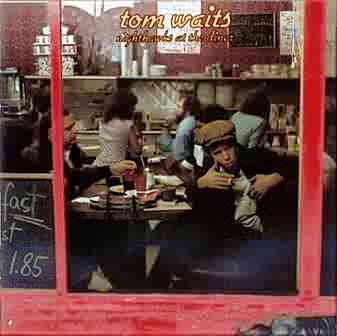
SOUNDTRACK: TOM WAITS-Nighthawks at the Diner (1975).

This is Waits’ third album, a live recording (!) which was actually recorded live in the studio. But not the way most bands record live in the studio. The producers brought in tables and chairs and created a bar-like atmosphere into the (evidently rather large) studio.  Then they invited fans in to watch the performance. Wild, man.

Just as wild is the bebopping and scatting that Waits does here. The opening “Emotional Weather Report” is all kinds of comical phrasing and silliness about himself.  It’s funny and quite enjoyable.  And it makes it feel like a nightclub.  He also introduces mos of his sings with a story, and for most of the songs, the introductions are almost longer than the song.  The two-minute intro to “On a Foggy Night” is full of Tom’s storytelling–but in a much more improv jazzy style.  Indeed, it’s not entirely clear when the intro ends and the song begins.

The intro to “Eggs and Sausage” has the very funny conceit that the food he has eaten in some greasy spoon is pretty frightening.  The veal came down to beat the shit out of his coffee, but the coffee wasnt strong enough to defend itself.  Nice.  “Better Off Without a Wife” he talks about having an evening just to yourself, you know, for pleasure.  We all do it, he says, but I’m not weird about it; I don’t tie myself up or anything.

Overall, this is a fun album.  It’s loose, the crowd is at ease and so is Tom.  It’s long album–about 70 minutes, which might be a little too long, but you get the whole vibe of a night out–good stories and good music.

[READ: September 21, 2011] “Starlight”

This story is four short pieces.  The titles should tell you everything you need to know about the content: “Mrs. Nixon Joins the Final Official Photograph,” “Mrs. Nixon reacts to RN: The memoirs of Richard Nixon,” “Brownie,” and “Mrs. Nixon’s Thoughts, Late-Night Walk, San Clemente”

So, clearly these are four short pieces that delve into the mind of Richard Nixon’s wife, Pat.  I don’t know a lot about her or about Nixon himself, really (I know all the highlights or low lights but I haven’t really ever looked into the man aside from what the sitcoms say about him).

So when I was reading the first excerpt I just couldn’t get into it.  I didn’t know who the people were for sure.  I assumed Ollie was Ollie North, but who knows.  I almost didn’t read any more, I was so uninspired by the first one.  But the next day I decided to try again.  (more…)

Read Full Post »

SOUNDTRACK: GUSTER-Easy Wonderful (2010).

This Guster album is confusing.  It’s rather short (compared to their other discs).  Combined with the (kind of flimsy) cardboard packaging, it feels almost like an EP.  It also seems to be kind of religious (although I don’t think it is)–like a themed EP.  And yet it isn’t off-putting or anything (a few mentions of Jesus is all, although that’s a lot more than usual).

But, like most of Guster’s releases, it’s super catchy kind of alternative jangly pop.  After one or two listens the songs are instantly recognizable.  There isn’t a bad song in the bunch.  However, they’re also mildly underwhelming compared to their previous releases.  The songs feel a bit more subtle, but really it seems like they might be just a little too smooth.  The dynamics aren’t quite as exciting as they have been.

Having said all that, the disc is still pretty great and I find myself humming a lot of these songs all day long.

[READ: June 18, 2011] Five Dials Number 12

Five Dials Number 12 has a theme explicitly stated on the cover.  The premise of the theme is that the Conservative Party of Britain had been claiming (in their TV ads and billboards) that Britain was broken.  This idea was relentlessly pushed across Britain.  And Five Dials wondered if people thought that that was true in general.  So they asked 42 citizens (no idea what kind of random sample it may have been, realistically) and they recorded the results.

The rest of the issue has some of the standard Five Dials material we’ve come to expect: essays and fiction, advice and lists.  The theme gives an interesting tone to the proceedings.

CRAIG TAYLOR-A Letter from the Editor: On Broken Britain and Nick Dewar
Taylor addresses much of what is said above.  David Cameron (I still can’t get used to him being Prime Minister, it’s still Gordon Brown in my head–I guess Cameron hasn’t done much yet) is the man who keeps trying to “mend our broken society.”  Even though (and statistics are similar in the U.S.):

They found that violent crime had almost halved since 1995, while crime generally fell by an extraordinary 45%. The figures for teenage pregnancies – a favourite of those talking about social decay – remain constant since Labour came to power in 1997; so too do those for teenage abortions.

The rest of the letter is devoted to the passing of Nick Dewar.  Dewar drew the illustrations for Five Dials Number One.  I really liked Dewar’s style, and his absurdist sensibilities.  Taylor says that Dewar’s color work was even better.  And I think he’s right. (more…)

Read Full Post »

« Newer Posts - Older Posts »