Feeds:
Posts
Comments

Archive for the ‘Nazis’ Category

movingSOUNDTRACK: BEACH HOUSE-Bloom (2012).

bloom  I loved Beach House’s previous album–the way it was magically lighter than air with swelling melodies and the unearthly vocals Victoria Legrand.  Bloom opens with “Myth” which continues the magic–the simple but beautiful opening melody and then a soaring chorus which is just amazing.

But something happens after that first song, and the album suddenly comes down to earth.  Perhaps it is the fairly conventional guitar and drum sound that opens “Wild” (it’ sa very cool 90’s ear guitar sound, but I feel like it doesn’t quite work with her voice.  The song is still pretty, but I kind of lose interest before it ends.

Similarly, I like the simple synth opening to “Lazuli” and her voice soars nicely here, but I’m not compelled to pay attention all the way through.  As I’m writing about the songs, I want to say that they are all pretty with nice melodies.  And as each song opens, I smile with recognition at the quality of the song.  But I keep drifting away from the song before each one ends.  Is it because each song is nearly five minutes?  Maybe.

The more I listen to the album the more I like most every song–there’s something about each one that I find engaging, and yet overall the album just doesn’t grip me as much as the previous album did.

It still sounds magical, but something is missing, and I’m not quite sure what that is.

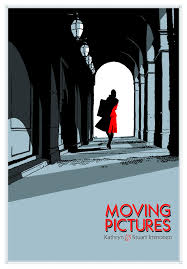
[READ: October 24, 2014] Moving Pictures

This graphic novel was simply fantastic.  It was one of the most powerful and moving stories I’ve read in graphic format in a long time.  I loved everything about it (even if some of the details of the story were a wee bit confusing–see below).  The story explores the relationships that formed during the Nazi occupation of Paris.  Specifically between a Canadian museum curator and a German soldier.

Primarily, I loved the artistic style of this book.  It is black and white with some very dark sections–especially in the interrogation room where harsh shadows obscure so much. As the book opens, we see a woman sitting at a table under a harsh lamp.  It is only when the POV shifts to her profile that we see the very fine and delicate lines that comprise her face.  And that balance of fine lines and huge swaths of black is really stunning.
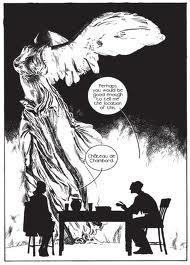
mobing2There is then a flashback.   The woman from the room, Ila, is speaking to another woman who looks more or less like her (it is hard to tell the women apart as they are both blonde, with such think lines for features).  They are at a train station and Ila is encouraging the other woman to take Ila’s papers and flee.  She says she won’t be needing them.

Then we return to the room, where a man, who we learn is Rolf the soldier, enters and begins interrogating her.  He asks her questions, but after a few, she asks him if he has been drinking–something is clearly unusual about this interrogation.  In the course of the questions, we learn that Ila is the curator at a museum.  And he begins asking her the locations of certain works of art. What is gorgeous here is that the two remain silhouetted, but the artistic pieces are blown up to full size as background images.  And they are wonderfully rendered.

Then he asks about some small things “hidden” in the basement.  And then he asks if she is still mad at him.  This interrogation seems more personal than political.  We also learn that he asked her to keep one small artifacts and that she can’t remember where it is. (more…)

Read Full Post »

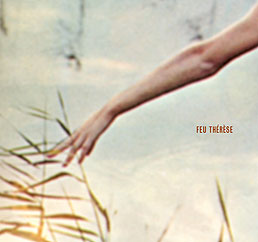
half pastSOUNDTRACK: FEU THÉRÈSE-Feu Thérèse [CST040] (2006).

feu1Feu Thérèse is a band created because of the hiatus of Le Fly Pan Am.  They offer a melange of styles, as befits the visual arts origins of several of the members.  And yet, there is a solid rhythm section that grounds the band in a wonderful way.

“Ferrari en Feu” opens with 3 minutes of pulsing waves of synths and electronic bird-call-like sounds. It’s unclear exactly what you’re listening to and it seems like the whole album will be a kind of ambient collection.  Then a proper rock song kicks in with chords and notes and drums–it has a cool psychedelic vibe and feels very late 60s.  “Mademoiselle Gentleman” has pulsing bass notes and staccato guitars with a layers of distorted laughing throughout (there’s no “singing” on the first two songs). At around 4 minutes (out of 6) the feedback squalls too and a simple steady beat.

“Tu n’avais qu’une oreille” seems like a traditional song–with singing (in the Serge Gainsbourg, dirty old man style of whisper/singing) which has a middle section that is quite conventional (with ahh ahhs) but again at 4 minutes, the song shifts into a faster drumming section (with more spoken words).  But then a lengthy trippy guitar solo shatters the mellowness.  “L’homme avec couer avec elle” starts with what sounds like horns.  At around 4 minutes in turns into a kind of western but with a crazy clarinet solo accompanied by sped up noises that sound like Pink Floyd’s Ummagumma.  There’s more psychedelic Pink Floyd styles on the final track, “Ce n’est pas les jardins du Luxembourg.”  The song opens with “drips” that sound like “Echoes.”  And then there’s more Ummagumma birds/animals (possibly distorted seagulls?).   At (yes) 4 minutes it turns into a trippy psychedelic organ based song (with Indian music as well).  The song is 12 minutes and leaves no sound unheard.

The music is experimental but it is not terribly “difficult.”  It’s actually quite a fun album which demands multiple listens.

[READ: April 24, 2014] Half Past Danger

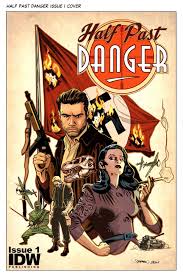
The tagline for this book (which is presented like a movie in a number of ways) is Dames. Dinosaurs. Danger.  And the cover features a giant Nazi flag in flames.  Sounds like pulp genius to me.

And so it is.  Stephen Mooney has been an artist for some great graphic novels over the years and this is his first book that he wrote on his own, based on a labor of love–having Nazis fight dinosaurs.  Like a dream come true.

So obviously, this is a story of an alternate past.  Set in 1943 in the South Pacific, an Army battalion is tracking an area when they discover a secret Nazi base.  There are not supposed to be any Nazis this far east, and yet there they are.   Sergeant Tommy “Irish” Flynn is surprised but he gets his team ready to take pictures and prepare a report.  But that loud rumble sounds like the biggest tank they have ever heard.  And then out steps a T-Rex (in a great reveal).  The T-Rex wipes out all of Irish’s company.  Irish escapes with a few photos and little else.

We jump cut to two months later where Irish is drinking in a bar in New York City.  In walks General Noble of the USMC and Elizabeth Huntington-Moss of British MI6.  They request his service.  He tells them to fuck off.  Actually no, he doesn’t.  This is a PG13 story, there’s a few “shite”s and an occasional “damn” but it is squarely in the realm of comics–implied sex, a lot of blood and a few mild words.  A brawl ensues, in which a Japanese fighter helps out Noble & Moss.  And soon Irish is recovering and being told what’s going on.  After some string reluctance, Irish agrees to go back to the island.

Noble proves to be a supremely tough and string fellow.  The Japanese soldier has defected to the U.S. after the non-respectful attack on Pearl Harbor.  And Moss is an enigma.  As they approach the island, there is plane trouble and a wonderfully cool scene in the water (which I won’t spoil but the art and graphics are terrifying and wonderfully drawn and colored–Mooney did the colors for the first chapter, while Jordie Bellaire did the other five).  (more…)

Read Full Post »

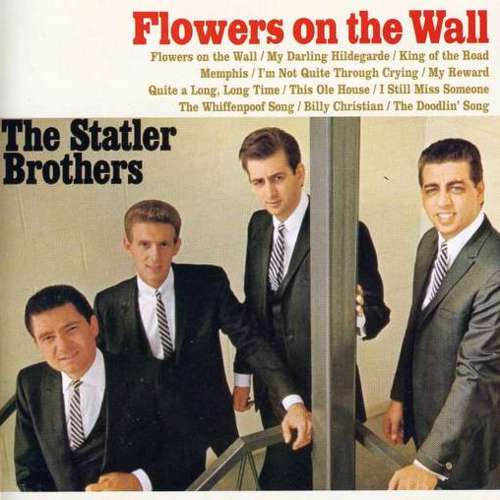
200px-FatesWorseThanDeathSOUNDTRACK: THE STATLER BROTHERS-“Flowers on the Wall” (1965).

flowersonthe Vonnegut mentions this Statler Brothers song in Palm Sunday as well.  I know this from Pulp Fiction–a song that I found very amusing and never would have guessed was a classic country song.  Country music was very different in 1965 than it is now.  I don’t even know if there was a folk or bluegrass category back then, and this song, with its banjo and bouncey acoustic guitar is a great example of the kind of country music I like.  And those harmonies!

This song certainly seems to be about insanity–about a man counting flowers on the wall, playing solitaire with a deck of 51 cards, smoking cigarettes and watching Captain KAN Kangaroo.  Don’t tell him he’s nothing to do.  What a weird little song.  And man is it catchy.  No wonder it was a #1 hit.

[READ: May 31, 2013] Fates Worse Than Death

After reading Palm Sunday I learned that Fates Worse Than Death was a kind of autobiographical sequel to that non fiction book.  I also learned that the two essays that make up Nothing is Lost Save Honor which is impossible to find (and for which I can’t even find a cover) are available in FwtD.  However, since there is no real contents or index, you do have to read the whole thing to find out which chapters contain the essays.  Or you can just look here and see that “The Worst Addiction of Them All” (which was published in The Nation) is in Chapter XIV and “Fates Worse Than Death” appears in Chapter XV.

The last time I read a bunch of Vonnegut together I got a bit burnt out on him and the same thing happened here.  The problem with Vonnegut’s nonfiction is that he tends to repeat himself.  A lot.  And while this book is ostensibly about the 1980s, he talks an awful lot about his family and his friends from the war and his other literary acquaintances., like he did in Palm Sunday.  In a number of places, he says that he doesn’t like to read himself in English, and it would seem that he doesn’t proofread to see if he said something already either.

This is not to say that the book is not worth reading.  Indeed, if you read Palm Sunday in the 80s and then this one in the 90s, you might not remember all of the details that pop up again, but when you read them days apart…well. (more…)

Read Full Post »

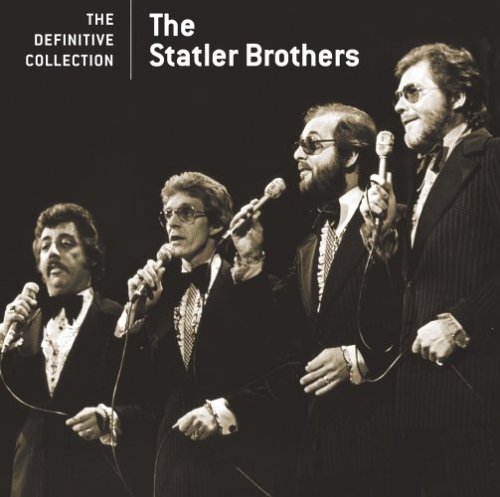
PalmSundayFrontandBackSOUNDTRACK: THE STATLER BROTHERS-“Class of ’57” (1972).

stalerI don’t know much about The Statler Brothers.  They are considered country, although this song is hardly country–it’s more folk with some bluegrass and, the real selling point–great harmonies (especially the bass singer with the big mustache).

The song is a wonderful coming of age song, sad and funny with a list of what happened to everyone in the class of ’57.  Like:

Betty runs a trailer park, Jan sells Tupperware,
Randy’s on an insane ward, Mary’s on welfare.
Charlie took a job with Ford, Joe took Freddie’s wife,
Charlotte took a millionaire, and Freddie took his life.

John is big in cattle, Ray is deep in debt,
Where Mavis finally wound up is anybody’s bet.

But the kicker comes at the chorus:

And the class of ’57 had its dreams,
Oh, we all thought we’d change the world with our great words and deeds.
Or maybe we just thought the world would change to fit our needs,
The class of ’57 had its dreams.

And then at the end:

And the class of ’57 had its dreams,
But living life from day to day is never like it seems.
Things get complicated when you get past eighteen,
But the class of ’57 had its dreams.

Vonnegut quotes the entirety of this song in the book and I’m glad he did, it’s a very moving song and really captures American life.

[READ: May 26, 2013] Palm Sunday

After writing several successful novels, Vonnegut paused to collect his thoughts.  And Palm Sunday begins: “This is a very great book by an American genius.”  It is also a “marvelous new literary form which combines the tidal power of a major novel with the bone-rattling immediacy of front-line journalism.”  After all the self praise, he decides that this collage–a collection of essays and speeches as well as a short story and a play which is all tied together with new pieces (in TV they would call this a clip show)–this new idea of a book should have a new name and he chooses: blivit (during his adolescence, this word was defined as “two pounds of shit in a one-pound bag.”  He proposes that all books combining facts and fiction be called blivits (which would even lead to a new category on the best seller list).  Until then, this great book should go on both lists.

This book is a collection of all manner of speeches and essays, but they are not arranged chronologically.  rather they are given a kind of narrative context.  What’s nice is that the table of contents lists what each of the items in the book is (or more specifically, what each small piece is when gathered under a certain topic).

Chapter 1 is The First Amendment in which he talks about Slaughterhouse Five being burned and how outraged he was by that–especially since the people so anxious to burn it hadn’t even read it (and the only “bad” thing is the word motherfucker).  The first speeches included are “Dear Mr. McCarthy” to the head of the school board where his books were burned and “Un-American Nonsense” an essay for the New York Times about his book being banned in New York State.  The next two are “God’s Law” for an A.C.L.U. fund raiser–it includes his confusion as to why people don’t support the A.C.L.U. which is working for all of our own civil liberties. (more…)

Read Full Post »

#20SOUNDTRACK: SUGAR-File Under: Easy Listening (1994).

fuelI  always thought File Under: Easy Listening was a very funny title.  But it’s possible that people took it too literally as it didn’t sell all that well. And in Mould’s autobiography he says he didn’t have much time to write songs for this disc and he thinks it suffered.  Of the three Sugar discs, this is definitely the weakest, although there are some great moments on it.

The disc opens with “Gift” which has some ragged distorted guitars. It’s got some noises and grungy sounding solos showing that FU:EL was a joke.  Although, the overall sound is kind of a cleaner version of the angry songs on Beaster.  “Company Book” is kind of a pounder, until the voice comes in and you realize…it’s not Mould!  It’s got a catchy chorus, but after the kind of underwhelming opener, it’s a strange place for a song that’s also not so dynamic.  Especially when it’s followed by “Your Favorite Thing” another great pop song from Mould—not top tier but a really strong second tier (although that bright, simple guitar solo is a real winner).  “What You Want It To Be” is a another decent song (the addition of that extra guitar playing the melody line really makes the song shine.  “Gee Angel” is also a high point.  A catchy song, but which never quite reaches the heights of the previous albums.

“Panama City Hotel” has the same feel as the opening of Beaster: bright acoustic guitars and a similar riff.  But it never really goes anywhere, and the 4 minutes seem.  The “do do do do’s” that open “Can’t Help You Anymore” are certainly the brightest spot on the album, and a big pop song as well.  “Granny Cool” has a nicely abrasive riff although it seems kind of mean spirited.  It’s funny that he tucked “Believe What You’re Saying” at the end of the album.  It’s a minor song but it sounds so bright on this album after the other songs. It’s really quite pretty.

And the closer, “Explode and Make Up” is one of Mould’s great angry songs.  Unlike Beaster, this one has a happy acoustic field—bnright guitars with that raging distorted guitar underneath.  It’s a great slow burner of a song and at five minutes it ends a somewhat lackluster album in a great way.

[READ: March 31, 2013] McSweeney’s #20

McSweeney’s #20 is an issue that I have read before.  At least I think I have.  My recollection is that it was the last one I read before I started writing about them on this blog.  I was hesitant to read it soon again, which is why I waited until now.  And while I remember the issue itself (with all of the art), I didn’t remember the stories.  So who knows if I actually read it six years ago.

Anyhow, this issue comes jam-packed with art.  Every fourth page has full-color artwork on it–many of them are quite famous.  It makes for a very beautiful book.

In between these artworks are a number of stories–ranging in size from 2 pages to 30-some pages.  There are no letters, and the explanatory and copyright information is on the cover of the book–which would be fine, except that it is covered up by a kind of 3-D artwork.  I wonder if the whole text is available anywhere?

The book also comes with a separate pamphlet–an excerpt from Chris Adrian’s Children’s Hospital.  I intend to read the novel eventually so I didn’t read the excerpt–although maybe if I put off the novel for six years I should just read the excerpt now. (more…)

Read Full Post »

alsion1SOUNDTRACK: THE DOUBLECLICKS-Pirates!  The PPDXYAR EP (2012).

pdxyarI wanted to explore more of The Doubleclicks’ music, and their site showed off this EP.  It was made for Talk Like a Pirate Day (you’re already sold, right?) and EP is a tribute to the Portland Pirate crew of PDXYAR (whatever that is).  The first song is “The Pirates of PDXYAR highlights what I’ve come to understand is the real Doubleclicks sound: ukulele and cello.  But this one also has a host of backing vocals (make and female).  The song is all about the pirates of PDXYAR and how they came to be and how the represent Portland.

The second song “How Not to Touch a Pirate” is a simpler song which insists that, tempting as it may seem, you should NOT be touching any of the pirates (this seems like a real inside joke).  Its amusing and would probably be funnier if I knew more about PDXYAR.  And oops, this song even has an F-bomb at the end–watch out!

The final track is a remix of “The Pirates of PDXYAR, ”  And mostly it allows more funny backing vocals.  It’s a better, funnier track because of it.

I’m not sold on The Doubleclicks yet.  I like them, but I think more in small doses.

So it turns out that PDXYAR is a Portland-based pirate crew, which you can read about on their website.  The lyrics to the song seem to explain  the origins of the pirates (kickstarter).  Frankly, I don’t know why the pirates (and the Doubleclicks) haven’t appeared on Portlandia yet.

[READ: February 7, 2013] Alison Dare: Little Miss Adventures 2

Volume 2 of Alison Dare is just as fun as Volume 1.  Although I admit the first story was a little confusing (I was never really sure exactly how these books were published originally, so it wasn’t clear that the first few stories were connected.  Although in retrospect it seems obvious enough.

In the first story, “What I Did on My Summer Vacation” it’s obvious that Alison doesn’t have much in the way of the excitement that girls expect from her.  So she makes up an elaborate story which all of the girls (except her two close friends) find wonderful   In “The Unbelievable Truth” we see what really happened (and we see that Alison’s story wasn’t far off, but that details make all the difference).

In “The Perfect Gift” the Blue Scarab (aka Alison’s dad) searches for the perfect gift for his daughter.  But that proves harder than he thought, especially when she accidentally takes a precious jewel that he has recovered in a mission.  In “A Day at the Museum” the girls open something they shouldn’t and unleash a plague.  This ties to the previous story in an unexpected way.  And in “The Gift Exchange” the previous two stories come together for a satisfying conclusion. (more…)

Read Full Post »

alsion1SOUNDTRACK: CHRISTINE LAVIN AND THE MISTLETONES-A Christmas / Kwanzaa / Solstice / Chanukah / Ramadan / Boxing Day Song” (2006).

lavinI’ve always liked Christine Lavin, but she has fallen off my radar in recent years.  I’m delighted that she’s still making cool (and funny) folk music. We quickly added this to our holiday playlist.

It’s an a Capella track done in a round.  It opens with Christine wishing everyone a Happy Christmas and a happy new year (to an original melody). And then a male voice wishes you a happy Kwannza, a hip hop happy Kwanzaa (if you celebrate Kwanzaa).  A third voice sings the same melody wishing happiness to all who celebrate Solstice.  A second male voice now wishes you a happy Chanukah.

Then, in perfect harmony, third female and then male voices throw in Ramadan and, amusingly, Boxing Day.  It’s a light-hearted take on multiculturalism, all wrapped up in a pretty melody.

[READ: January 1, 2013] Alison Dare: Little Miss Adventures

I recalled the Alison Dare comics from when I used to be an Oni Press fanboy (I still love Oni Press but I can’t keep track of comics anymore).  Anyhow, Alison Dare is an all ages comic, so I brought a copy home for Clark from the library.  But he didn’t like it.  I wondered if it was because the main character was a girl, but i think it’s because the comic is black and white–he really only likes color comics.  Huh.  I also found that it may have been a little confusing for him–the writing was style was really engaging but not exactly straightforward.  Maybe in a year or so he’d enjoy it.

But I enjoyed it.

This book collects the first three Alison Dare stories: (more…)

Read Full Post »

SOUNDTRACK: MOGWAI-Special Moves (2010).

This is Mogwai’s first live album and it really captures the band in all of its intense glory.  This is a good year for a Mogwai live recording because they play some of their newer song which are a bit more melodic (and sometime have words) but they also revisit their older songs–which still sound intense.  It’s a great overview of their career so far and it’s a great testament to how different their music sounds over the course of so many years–even though they still sound like Mogwai

We get two songs from Their (then) latest The Hawk is Howling –“I’m Jim Morrison I’m Dead” and “I Love You I’m Going to Blow up Your School.” Two songs from Mr Beast “Friend of the Night” and the stunning set closer “Glasgow Mega Snake.” Two from Happy Music “Hunted by a Freak” and “I Know You Are But What am I.” Two from Rock Action “You Dont Know Jesus” and “2 Rights Make 1 Wrong.”  From Come On Die Young we get “Cody” and from their debut, two classics: “Like Herod” (which is amazing live) and “Mogwai Fear Satan” (also amazing)–each one over 10 minutes long and full of the emotional release that we’ve come to expect from Mogwai.

This is a great place to start if you want to hear what Mogwai is all about.

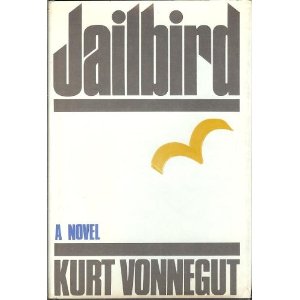
[READ: June 4, 2012] Jailbird

First off I want to say how neat it is that I took this book out of the library and that it’s from 1979.  Thirty-three years old!  Books are cool.

Anyhow, I have a stack of dozens of books I want to read, and yet somehow Vonnegut said, no, read me now.  In addition to Vonnegut books being relatively short, they are also very quick to read.  I read this in a couple of days, which is very satisfying.

My old boss at the library told me that she thought Vonnegut more or less stopped writing good books after Breakfast of Champions.  I disagree, but that has certainly colored the way I look at his later books before I read them–which one had she read that turned her off?  I kind of suspect it was this one.

In some ways this is a minor novel.  It’s fairly brief (240 pages, although there’s  30 page Prologue which I gather is from Vonnegut himself (you never know, he has so many layers going on)).  He explains some of the details that are in the book and several other interesting preface-type things.  I enjoyed the bit about the fan who wrote to Vonnegut and (Vonnegut claims) summed up all of his works in just seven words: “Love may fail, but courtesy will prevail.”  And that is the basic plot of this book. (more…)

Read Full Post »

SOUNDTRACK: tUnE-yArDs-Tiny Desk Concert #179 (December 1, 2011).

tUnE-yArDs perform three songs in this Tiny Desk concert.  Merrill Garbus doesn’t chat a lot between songs, but she’s clearly having a good time (witness them all jumping at the end of “You, Yes You” and how much she smiles at the end of the set.  This is a wonderful opportunity to see and hear her live sampling technique in a small setting (with close up cameras!).

Her voice sounds great–she pulls off all of those voices that she conjures on the record.  And her ability to sample herself and make it work is wonderful to witness (I never imagined that some of those “sirens” and “keyboards” are actually her voice).

The live band is also really hot.  The bassist really hold everything together and the horns sound great–duplicating the sound of the record with just enough flare to keep it original.

And to think she’s making all of  that guitar noise with a ukulele!  It’s pretty groovy.

Watch it here.

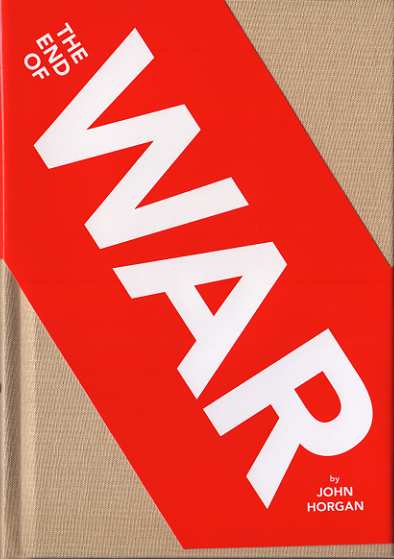
[READ: January 21, 2012] The End of War

This is a non-fiction book in which Horgan believes that in the not too distant future (his lifetime I believe), we will see the end of war.  Not the end of violence, nor anger nor aggression–he’s not crazy–but military campaigns against another country could be ended if we reversed our fatalism about war’s inevitability.

Horgan is a writer for Scientific American and in this book he uses the scientific method to show that ending war is utterly possible.  Now, although Horgan is himself kind of a pacifist (he’s not entirely one, this interview explains), his family is not–his father and grandfather are both veterans and his son is looking to enlist in the army.  Nevertheless, Horgan feels that war is not a viable way to solve problems and that the cost of human life is never worth it.

His research shows him that war should be thought of as a solvable, scientific problem—like curing cancer.  The difference is that cancer is outside of our control, while war is not.  But like cancer, war can infect any society–there is no “reason” for it, but it is like a virus–it infects all cultures, even peaceful ones.  If one culture is aggressive the peaceful neighbors need to prepare for war or move away.

Horgan anticipates skepticism, indeed, many of the sources he quotes are skeptics, and he deals with all of their arguments accordingly.  He looks at those who say that war is genetically part of humanity (as many people believe) or that the best way to prepare for peace is to prepare for war (as just about everyone seems to believe).  He looks at those who say that scarcity causes war (not necessarily true), to those who say that as long as there are guns there will be war (he disagrees).  He has a reasonable, believable argument for all of these doubts.  He even shows that the whole “alpha male, XXY chromosome” argument has been disproven and while men are more prone to violence, they are not more prone to wage war.

He also shows scientific evidence that war has not been around as long as people (or even apes) have existed.  Indeed, the first evidence for “war” (as opposed to violence) is 10,000 years ago (not much in humanity’s timeline).

He culls data from previous wars to show that the causes of wars can never be narrowed down to one thing.  And yet, rather than seeing this as a negative–that so many things cause war, he sees it as a positive–that causes of war are not monolithic and impervious to breakdown.

I was skeptical of this book when I started reading it.  I was willing to accept the various scientific answers that he showed (that war is not innate, for example) but my skepticism came because of what I guess you call the military industrial complex–that our military budget is huge and is not going to go down any time soon.  Just see how much protest is garnered by the miniscule amount that President Obama wants to reduce it.  [Everybody knows this truth but it’s worth seeing in print–our military budget is more than almost every other country combined.  China, who spends the next largest amount on their military has a budget that is 1/6 the size of ours.  That is shocking and depressing and a horrific waste of money].

But his point is that like with so many other things that we have outlawed or abolished over the years: slavery, apartheid, monarchy (as opposed to democracy), acceptance of torture; if we have enough consensus we can also abolish war.  He gives examples that it’s actually not as hard as we might think.  Germany and Japan become pacifist virtually overnight (it was forced on them, but they have taken to it with no problem) and even better, Sweden and Switzerland are pacifist voluntarily.

He also points out that war is already on the wane–although the United States was in two wars very recently, the warlike nature of the world is much less than it was even as recently as the first half of the 20th century.  The number of casualties from war has dropped dramatically compared to World War I.  We simply need to find ways to solve crises that do not involve killing people.

All of the chapters were interesting in this book (the book is more or less set up to deal with an issue per chapter).  Some of the chapters were a little long but at 186 pages (plus a bunch of citation pages) this book is short overall.  I appreciate all of his scientific rigor and his ability to show the arguments and then knock them down.

For me, the most interesting and satisfying chapter was the one that found that preparing for war, despite claims that it is necessary, actually does not keep a people safe. That the allocation of resources towards war removes resources from things that actually make people’s lives  better: art, culture, medicine, health.  Preparing for war doesn’t keep us safe, it actually harms us.

Similarly, he shows that competition for resources is not necessarily a cause for war.  To the contrary they have found that in some cultures scarcity brings out altruism.

In short, he says that the only thing that prevents us from abolishing wars is our fatalism that war is inevitable.  The more fatalistic we are about war the more we accept hawkish ideas which perpetuates more war. Once we stop believing that and we try to work towards the end, he believes that we war can end very quickly.

Horgan doesn’t really calm my fears about the military industrial complex–but who knows with enough popular opinion, maybe voters can change things.  It’s a wonderful thought.  And here’s hoping that this post can spread the good word.

And here’s an interview with Horgan that addresses a lot of these questions.

Read Full Post »

SOUNDTRACK: THE SWELL SEASON-Strict Joy (2009).

I bought this disc for Sarah after it came out.  I didn’t think that I would enjoy it that much because while I loved the movie Once, I wasn’t sure if I needed more from Glen and Marketa.  But then I found a whole slew of free concerts from NPR and I became hooked on the band.

The disc opens with “Low Rising” (what I think of as the “Van Morrison” song).  It gets better with each listen.  It’s a slow ballad which is followed by “Feeling the Pull,” a more up-tempo song that really highlights Marketa’s beautiful harmonies.  “In These Arms” is a gorgeous song.  The verses are downbeat and somber “if you stay…with that asshole…it will only lead to harm” but again the harmonies are gorgeous.  “The Rain” is a more rocking tune (within reason, of course).  It has an interesting middle section that quiets down, but it’s a solid folk rocking song.

“Fantasy Man” is Marketa’s first lead vocal song on the disc.  I like her voice but sometimes I find her lead songs to be a bit too wispy, too quiet.  I like this song, but it feels long (and at 5 minutes, it is).  “Paper Cup” is one of Glen’s quiet ballads.  It’s a pretty song.  “High Horses” is one that I didn’t know from the live sets, I guess it’s not too popular with the band, but I think it’s strong.  It runs a little long but that’s because it has a cool middle section that keeps building and building with more instruments and voices.  “The Verb” is another song that I didn’t know.  It has a cool intensity to it and while it doesn’t stand out as a hit, it’s certainly an enjoyable song.

“I Have Loved You Wrong” is another pretty Marketa song, but again it’s very slow and very long.  I don’t think I could buy her solo album because although her voice is lovely and her melodies are nice, they’re just so ephemeral I can’t really get into them.  “Love That Conquers” is an interesting song.  It sounds nothing like The Swell Season (must be the banjo).  It’s a nice addition to the album and should maybe have been placed a little earlier to break up the sound style a bit more.  “Back Broke” ends the disc very strongly.  Although I think the song works better live (with audience participation), the melody and tone of the song are somberly beautiful.

There are moments of this disc when it turns out to be what I feared the whole disc would be–bland folkiness. But overall this is an enjoyable album for a rainy day.  And Hansard really has an amazing voice.  However, I really like them better live.

[READ: December 26, 2011] Third Reich

I was pretty excited when I heard about this book, although I must admit I was a little concerned by the title.  Bolaño has a kind of weird Nazi fascination.  There is Nazi Literature in America and then a whole section of 2666 is given over to Nazi Germany.  He doesn’t like Nazis or anything but he writes about them a lot and it can be a little exhausting.  So it was with some relief that I learned that Third Reich is the name of a game that the main character plays.  It is a kind of historical reimagining kind of game (I guess like Risk but more specific and with more at stake).  It is set during the time of the Third Reich and the players represent various countries (or perhaps even powers).

I am giving up on explaining the game from here on because a) there’s a lot about the game in the book and b) I’m not sure if it wasn’t explained very thoroughly or if I just missed out on exactly what was happening.  During the book he talks about Hexes 65 through 68 and so on.  So I assume the map of the world is a hex grid.  But he never gives any context (or even a picture!–and this makes sense as it’s written as the diary of a well-regarded player who is not trying to teach us the game).  So while I understand the general tenets and play of the game (there’s a die (or dice) and tokens that reside on the board), the specifics are completely nebulous.  But that’s okay.  Because the game specifics don’t impact the book, but the game overall is at the heart of the book.  I think it’s neat that Bolaño invented a game (and several others games are named, but no details are given).  He is clearly very gifted at inventing people, games, things.

But as I said, the game is only a part of the book and in fact, the game details don’t enter into the book until about half way through. (more…)

Read Full Post »

« Newer Posts - Older Posts »