Feeds:
Posts
Comments

Archive for the ‘The Beach Boys’ Category

pinballSOUNDTRACK: RHEOSTATICSFall Nationals The Horseshoe Tavern Toronto, ON. Night 4 of 13 (November 13, 2003).

This was the 4th night of the Rheostatics 13 night Fall Nationals run at the Horseshoe.  Rheostatics Live has recordings of nights 1, 3, 4, 5 and 7.  It was guest vocalists night with this lineup: Reid Jamieson, Mike Bell, Andy Maize, Dennis Ellsworth, Justin Rutledge, Jen Foster, Ron Koop, Kurt Swinghammer,  Donna Orchard, Serena Ryder, Matthew Crowley, Paul Linklater, Leslie Stanwyck, Ford Pier, Dylan Hudecki, Jonathan Seet, Selena Martin, Amer Diab,  Jason Plumb, Jose Contreras, Silas White, Greg Smith Sounds, Paul MacLeod.

The show opens with the instrumental introduction of “Four Little Songs” which turns into a lovely version of “Song of Flight.”

The rest of the show sounds very different from other shows.  Obviously because of the different singers, but the band is quite restrained.  Not phoning it in, but holding back, allowing the singers to really stand out.  Songs are slower, fills are quieter and the band does feel more like a backing band (without the songs suffering).

And then the guest vocalists come in.  Reid Jamieson sings “PIN.” He has the same tone as Martin.  It’s a nice version.  As he gets off the stage he says. “I’m naming my first child Rheostatics.”  Someone warns him: “think of the school grounds.”

Mike Bell (from Dunville, Ontario and the post-hardcore band Chore) says “I just did a big shot of Buckley’s so bear with me.”  He sings “King of the Past” but has rather flat vocals.  The pace is slower too.

Dave tells the audience that it’s all guest vocalists and they are flattered that this could happen.  And then there’s Andy.  Andy Maize of Skydiggers sings “We Went West,” and says, “I lent my teleprompter to Mr Chretien for his farewell address, so I apologize for all my reading.”  He sings raspy and great and I think adds some gravitas to the song.

Dennis Ellsworth sings “Northern Wish.”  Dave asks him, “Do you favor the Melville version of the song?”  “I do.”  He has some gentle singing that works well with this song.  When it’s over, Dave announces, “Ladies and gentleman Ward MacLaurin Cornell [a Canadian broadcaster noted for hosting Hockey Night in Canada] because of Dennis’ jacket I guess.

Justin Rutledge sings “Feed Yourself.”  Dave says it’s not the first time he has fronted the group.  “The first time was 4 days after I turned 19 (that would be 1998) at the Rivoli.  He has a gravelly voice that sort of works with the song although he’s a little slow, maybe.  But he really gets into it.

Next up, “Here’s Jen Foster everybody.”  She sings the new song “The Tarleks” and adds an interesting spin to it with hr voice and delivery. There’s some fun wild guitar at the end.

Then Dave says, “Uh oh here’s the big money.”  Ron Koop of Tim Mech’s Peepshow sings “Introducing Happiness” but first he asks, “Is this Star Search?  I feel under-dressed.”  Dave says, “I want to know is there a name for your beard?”  “Dudley?” “Gunther?”  Dave says just “The Koop.”   He says, “I’m a backup singer I don’t know what to do without a bass in front of me.”  Dave notes air bass didn’t really take of like air guitar did.  Koop says he loves this song, and while not really lead vocal quality, he does a really fun job with it.

Kurt Swinghammer is a Canadian singer-songwriter and visual artist.  He and Dave have a chat about a club owner named Jimmy Scopas, it’s pretty funny.  While singing “It’s Easy To Be With You,” there’s a bunch of ad libs in the middle of the song.

Donna Orchard sings a kind of operatic “Jesus Was Once A Teenager, Too” which works nicely for the high notes.

Serena Ryder “The stage hog… can’t keep you away.  How’d your set go tonight?  “Really fun. I really enjoyed it a lot.”  Dave: “You guys like it?”  “That’s what they call popular acclaim.”  She does a cool trippy rendition of “Digital Beach.”

Matthew Crowley is a mumbly singer of this mumbly song, “Earth/Monstrous Hummingbirds.”  It’s a hard song and this version is a little disappointing.

Paul Linklater comes up to sing “California Dreamline.”  Dave shouts “Hey, Link, those dirty Toronto winters will get you every time.”   “You’re the bridge the half way point.”  This version is echoey and trippy and sounds very different, Linklater gets a little crazy carried away by the end.

Leslie Stanwyck from The Pursuit of Happiness and Universal Honey is gonna do a song [“Claire”] that appeared on two records…
Tim: “Is it not on the live record?”
Dave: “I don’t think so?” [It is]
Martin: “We like this one a lot.”
Dave to Leslie: “Are you familiar with the Howl Brothers version or the Rheostatics?”  Rheostatics!  Her version sounds great.

Ford Pier comes out and they tell him he’s got a lot of nerve going back into the archives.  Ford: “Entirely my own idea.”  They play “Chemical World,” a song from 1986, from “our second demo tape ever.”  They do a good job with it too.

Dylan Hudecki wonders, “How can I beat that?  This is so awesome.  I feel privileged.”  Tim describes the night as “Karaoke with a capital K.”  Hudecki says this a song [“Satan is the Whistler”] for all the people who went to Whistler and wondered what went wrong.  There’s lots of fun vocal nonsense at he end Martin even gets out his mechanical robotic voice.

Jonathan Seet does a sweet version of “Take Me in Your Hand,” and then Selena Martin comes out: “The word is dazzling.”

Selena says, “Pretty fuckin 70s, eh?”  Dave: “Look at you in your 70s outfit.  Any particular reason you chose “Dope Fiends?”  She says a friend made her a mixtape and “then I heard this fuckin’ song.   The rest is history.”  I wonder if it’s in a odd key—no one seems to be able to hit the notes.

Amer Diab gets the beloved “Horses.”  And he does a good job, but not as angry as Dave does it.

Jason Forrest Plumb was the lead singer and front man of the Waltons.  Dave asks how things are in Saskatchewan.  “Cold, snowy and the ‘Riders aren’t making it to the cup this year.   Bad calls all day that day.”  They play a slow and moody “Shaved Head.”

Jose Contreras, frontman for By Divine Right, José Contreras says, “Rheostatics changed my life.”  Dave: “for the better I hope.”  Jose: “For the better.   They taught me and a lot of other people a great lesson to dare to be glorious.”  He notes that this [“Triangles on the Wall”] is an autobiographical [he can’t get the word out] song.  “Am I singing this in the first person?  It’s kind of waltz in the key of D.”  He gets really into it with a bunch of ad-libbed jokes and whatnot.

Silas White does a good version of “Queer.”  In the end of the song Dave asks twice, Silas do you miss British Columbia?”  But we never hear the answer.

Dave says he’ll pay acoustic for this one.  Greg Smith the bassist Weakerthans, makes “Self Serve” sound a bit more twangy–“what went wrong with martin?  Is he on some kinda drug or something?”  As the song ends, they introduce Paul MacLeod also of Skydiggers (he sounds just like Martin at beginning of “Record Body Count.”  The song starts chaotic and fun and it’s a great ending to the main set.

Dave says they sent out an email about a week ago but since there are a lot of luddites among us, some people didn’t respond to the request to come up here.  So,”we will invite as may people as can fit on stage.  Don’t be shy.  Purple shirt guy be the first.  Lots of room, folks.”  They wonder if they can get the entire bar on stage.

The whole club sings “Legal Age Life,” with occasional singers stepping up to the mic.  And Dave shouting in the last verse: “Eagleson ripped off Bobby Orr.”

[READ: December 30, 2016] Hear the Wind Sing

After reading the Madras Press Murakami Slow Reader issue.  I decided it was time to read some more from the man himself.

So I decided to start with his first book–which I’d read about in the New Yorke essay.  Incidentally, the New Yorker essay that talks about his writing style is expanded on in the introduction to this version of the book (which is technically called Wind/Pinball and is a collection of the first two stories).

The essay is called “The Birth of My Kitchen-Table Fiction.”  While the New Yorker essay covers a lot of his life, this essay focuses on his early days–and gives more detail to some of the ideas he mentioned.  He says he hated the idea of working for a company so he opened a jazz club (it cost a lot less to do this back in 1974).  He shares details of the club and talks about how hard he worked.

Then he talks about the baseball game that inspired him to write.  In that previous essay he mentioned the game, but in this essay we get a lot more detail. He went to the Central League season opener: the Yakult Swallows vs the Hiroshima Carp (he was a Swallows fan, despite their perennially poor record).  He says he stretched out on the lawn with a beer and when he heard the crack of a bat, “for no reason and based on no grounds whatsoever, it suddenly struck me: I think I can write a novel.” (more…)

Read Full Post »

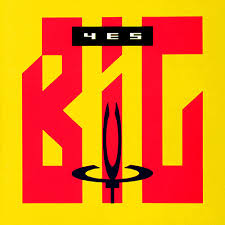
profxSOUNDTRACK: YES-Big Generator (1987).

big genAfter the huge success of 90125, Yes released that solos EP and then buckled down to make the follow up.  It took a few years and sounded an awful lot like 90125, although not as good. I remember enjoying the singles, but when I listened to it recently I felt that it didn’t hold up at all.

Wikipedia tells me that there was lots of trouble while making the album (really??).

Big Generator’s sessions dragged on for two years, largely because of creative differences. Guitarist Trevor Rabin was aiming to progress beyond 90125, while founding lead vocalist Jon Anderson was beginning to yearn for more traditional Yes music. Trevor Horn, who was a major factor in the success of Yes’ previous disc 90125, was part of the early recording sessions. However, he dropped out after a few months due in major part to his inability to get along with keyboardist Tony Kaye. Anderson stated that Horn had told Anderson to stay away from the rehearsal and recording sessions for three months, presumably so that Horn could develop material with the other band members.

Given all that, is it any surprise that the album isn’t all that good.  90125 inspired a lot of music, including this album.  So this album sounds more like a retread rather than a moving forward.

“Rhythm of Love” opens with lovely Beach Boys harmonies (although at this point I’m imagining more “Kokomo” than “California Dreaming” even if “Kokomo” came out 2 years later).  That opening guitar section sounds so much like a pop 80s song (in a not so good way).  The chorus is quite good although it takes that group harmony one level further into uncomfortably sterile pop land.

“Big Generator” sounds like the b-side follow up to 90125.  The guitars are meaner and there are more orchestral hits.  There’s some interesting sections that Yes of old might have played–but they are recorded very differently here.

“Shoot High, Aim Low” is fairly uninspired (even if it was popular on the radio) and at 7 minute it’s way too long.  “Almost Like Love” is another song that sounds so much like 80s pop, it’s kind of icky.  “Love Will Find a Way” is credited solely to Trevor Rabin who really did sort of take over the band in the 80s (what does Chris Squire do at band meetings anyway?).  It is also very poppy but it has some interesting guitars and textures.

“Final Eyes” would be good if it was 2 minutes, but once the second part of the song starts, it drifts into less interesting territory (especially at over 6 minutes).  “I’m Running” is quite polarizing for me.  I like the interesting bass line that opens the song (occasionally Squire does something cool on this disc), but the overall Caribbean Feel is just so wrong.  If the song ended at 3 minutes after that interesting guitar riff it would be much better.

“Holy Lamb (Song for Harmonic Convergence)” ends the disc.  It is written (surprise) entirely by Anderson.  It’s pretty good and a surprisingly decent ending to the album, although there’s an awful 80s synth sound on it.

This was the last Yes album I bought.  I think I heard about Union when it came out in 1991 and featured nearly every person who ever recorded a Yes song, but I wasn’t interested in it.  Since that album they have released 8 studio albums and countless live albums, but I’m content with what the past has given.

Incidentally, this whole travel through Yes started when Chris Squire died recently.  Squire is the only person to have played on every Yes album.  But as I said earlier, I often wonder what he was like to work with.  It seems like when new players come in they kind of take over the sound and Squire is often shunted to the background.  I don’t know a thing about him personally or professionally for that matter. I just know that he could play an amazing bass and wish he’d shown it off more.

[READ: May 20, 2015] Who Killed Professor X?

This graphic novel intrigued me, in part because it was originally written in Greek (can’t think of too many modern Greek books I’ve read–translated by Phil Holland) and in part because it is a comic about mathematics.

The Foreword explains that the book is intended for two kinds of readers: those who have some knowledge of mathematics and those who have no knowledge of mathematics…. The first category of readers can try to solve the problems and determine whether or not each suspect has a valid alibi, whereas the second can simply skip this step.

So the (fairly thin, I must admit) premise of this book is that Professor X was killed while at a conference for mathematicians.  The room was empty for 20 seconds, so the killer must have been more than x meters away from the Professor in order to be considered innocent.

The suspects (we learn later) are all of history’s greatest mathematicians.  They go only by first name in the story, but the end of the book gives biographies of all of the real people they were based on (from throughout history).

Each of their alibis is a mathematical explanation of why they could not be the killer.  And as the Foreword mentioned, if you know math (high school level or so) you could figure out where each suspect was based on the clues given. (more…)

Read Full Post »

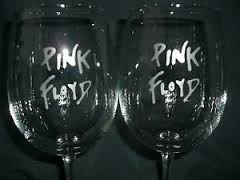
greatestSOUNDTRACK: PINK FLOYD-“The Hard Way” and “Wine Glasses” (1974).

glassThis book informed me about these two unreleased Pink Floyd songs (there’s a Wikipedia site that lists some fifty more !).  While the were unreleased in 1974 (from the abandoned Household Objects album), they were eventually released in 2011 on expanded versions of albums.

“The Hard Way” features some “percussion” that sounds like someone taking steps.  There’s a bass riff which I gather is from rubber bands (but very well tuned).  There’s clocks ticking and chiming and tape being unspooled.  It’s a neat idea and while it is absurd to think you could make a whole album with this kind of stuff (in 1974), it’s a surprisingly good sounding track.

“Wine Glasses” was apparently made with wine glasses.  It is all of 2 minutes long.  It was designed to be a full song but was eventually used in the introduction to “Shine on You Crazy Diamond.”  I never really considered that there were wine glasses making the sounds (and clearly there are synths added on top), but yeah, so that ‘s kinda neat.

[READ: November 25, 2014] The Greatest Albums You’ll Never Hear

I found this book at work and knew I had to read it.  I was actually surprised at how long it took me to read (there’s a lot of entries).

The title and subtitle pretty much say everything you need to know about this book (and if you need to read it or not).  This book collects a series of writers who give a brief history of some of the more famous (and some not so famous) albums that were never released.  It explains (as best they can) why the albums weren’t released and even gives a percentage chance of likelihood of the album ever seeing the light of day (interestingly, most seem to be a 3/10–they may have been able to use a 5 point scale).

I knew some of the records they talked about (The Beach Boys’ Smile, Neil Young’s Chrome Dreams), but was ignorant of quite a lot of them. And while big fans of the artists may know all of the details about their favorite lost album already (these are sketches, not exhaustive research), there will certainly be some new information.  For instance, I’m a huge Pink Floyd fan but had no idea about the two shelved works mentioned here.

I liked the way the book was done chronologically and grouped by decade.  It was also interesting to see how the “reasons” for the non-release morphed over the decades from “the record label didn’t like it” to “it was leaked online.”

The one major gripe I have with the book is that it is chock full of “imagined” album covers.  This in itself is okay, but it is not made explicitly clear that they are all imagined (credits are given at the bottom of each image, but it took me a few entries to realize these were just people’s ideas of what the covers could look like).  And most of them are gawdawful.  Just really lame and dull (as if they had 20 minutes to come up with an idea).  They mar an otherwise cool collection,especially since some of the unreleased records actually do have proposed covers (even if they were never released).  I see that there is in fact a paragraph about the covers in the front pages of the book, but it is almost hidden away.

In addition to the albums I’ve listed below, I learned some fascinating things.  That Bruce Springsteen has hundreds of songs that he wrote but never released for various reasons.  That Pink Floyd did try to make an album out of household objects (with no instruments).  That the Sex Pistols’ Never Mind the Bollocks was almost simultaneously released illicitly as Spunk.  And that Danger Mouse’s The Grey Album was recently remastered.

The end of the book includes two small sections: other favorites that were never released.  Not sure why they earned only a small column instead of a full entry, but that’s okay.  The second was albums that we eventually did see, like My Bloody Valentine’s MBV and Guns N’ Roses’ Chinese Democracy.

So if you ever wondered what happened to that long lost album, this may be the book for you.

A sampling of the unreleased records include:

  • The Beach Boys-Smile
  • Buffalo Springfield-Stampede
  • The Kinks-Four Respected Gentlemen
  • The Beatles-Get Back
  • Jeff Beck-The Motown Album
  • Jimi Hendrix-Black Gold
  • The Who-Lifehouse
  • Wicked Lester
  • Rolling Stones-American Tour ’72
  • CSN&Y-Human Highway
  • Pink Floyd-Household Objects (1974), Spare Brick 1982
  • Dusty Springfield-Longing
  • David Bowie-The Gouster (1975), Toy (2001)
  • Sex Pistols-Spunk
  • Neil Young -Homegrown (1975), Chrome Dreams (1976)
  • Frank Zappa-Läther
  • Beastie Boys-Country Mike’s Greatest Hits
  • Weezer-Songs from the Black Hole
  • Jeff Buckley-My Sweeetheart the Drunk
  • Van Halen-IV
  • Foo Fighters-The Million Dollar Demos
  • Green Day-Cigarettes and Valentines (the author doesn’t believe it was actually stolen)
  • Tapeworm (Trent Reznor and Maynard James Keenan among others)
  • Deftones-Eros
  • U2-Songs of Ascent
  • Beck-The Song Reader


Read Full Post »

2014-07SOUNDTRACK: SLOAN-Commonwealth [Spade Side–Andrew Scott] (2014).

commonFor Sloan’s 11th album, the four members of the band each wrote the songs of a side.  I originally thought that they recorded all of the music alone, but that seems to be wrong–and would hardly be a Sloan album).  In conjunction with the album, each guy was given a suit of cards (and an actual deck was made as well).  While this doesn’t necessarily mean the album is very different from their others (it still sounds very Sloan), it seems to have given the guys a bit more room to experiment.

The final side of Commonwealth is by drummer Andrew Scott.  Scott has written three singles for Sloan over the years: “500 Up”, “People of the Sky”, and “I’ve Gotta Try.”  But for this album, he has created a 17 minute and 49 second epic called “Forty-Eight Portraits.” This makes it seem like it could be 48 small songs which it isn’t.  But it also isn’t one long song exactly.  There are, by my count 15 sections–although there could be more or fewer depending on how you break it up.

So my demarcations:

  1. The song opens with a dog barking.  There’s complex percussion and a smattering of piano seemingly searching for a melody.
  2. At 3 minutes the first real song proper starts.  We’ll call it “You say you’re going with me.” There’s acoustic guitars and a bouncy melody.  It’s a great song with a neat guitar riff that overlays around 4 minutes in.  But
  3. At 4:23 the song changes dramatically.  It grinds to a slow pensive section, call it the “Don’t ask for a second chance.”  But it doesn’t last long,
  4. At 5:16, the next part jumps in, it’s a bit faster and feels like it could be an extension of the previous section.  Call it the “Do the things I do” section.  It speeds up
  5. At 5:41, to a similar style as the “first song.”  It has a sing along starting “How Does It Feel?”  It’s got one verse before a time signature change and instrumental break.
  6. At 6:40 the next section comes in.  Aggressive guitars and spoken word lyrics “There’s something happening here.”  It also has one of the few uses of the word “fucking” in a Sloan song.
  7. At 7:25 it shifts to a falsetto style and higher pitched guitars.  It’s vaguely Beach Boys-like for a verse “Do you think she loves you?” until
  8. At 7:48 it’s back to a reprise of the “How does it feel” section.
  9. At 8:15 it shifts to a new slow piano section.  This feels like the most fully realized song section of the epic.  “I can’t believe you never told me the truth.”   It leads into a big chorus sounding section (two lines) around 8:40 (“What it is us unsustainable”).  There’s even a repeat of this “verse” and  “chorus” as well.
  10. At 10:26 a new guitar section is introduced.  It works as a transition “You said you’re coming with me.” It morphs
  11. At 10:52 into a very cool slowed down section “I asked for a proper glass.”  And then
  12. At 11:22 the song again returns to the “How did it feel” section.
  13. At 12 minutes the song transitions with a “ba ba ba” and horns which move into the “Sometimes I feel like I’m slipping away” section.  The song feels like it might end at 13 minutes as the last notes seem to ring out.  But
  14. At 13:21, the song rebuilds again with the “inside a cloud” section.  This feels like the final section of the song is built around a similar construct. It’s a guitar riff that introduces a children’s chorus at around the 14 minute mark.  There’s a slow guitar solo and pizzicato strings that keep this section from being to easy, but that guitar riff and children’s section reunite the end which concludes with the spoken “W.W.L.R.D.?” (which I assume the L.R. refers to Lou Reed).
  15. At 16 minutes, the chaos of the beginning returns with a dog bark, but the concluding riff is strong and seems to really draw out the end.

I really haven’t listened to the lyrics that carefully to know exactly what’s going on, but I really enjoy the “choruses.”  While a 17 minute song is not everyone’s cup of tea, there are so many parts and so many interesting and catchy sections, that it feels like a whole collection of short songs rather than one long song.  It’s a cool experiment and one that I find myself singling out as I try to parse it a bit more.

[READ: October 11, 2014] “Part of the Main” and “Watching the Cop Show in Bed”

The Walrus’ summer reading issue presents three stories and two poems in which: “The Walrus presents fresh takes on old crimes.”  Each story is about a crime of some kind, but seemed from an unexpected way.  I rather enjoyed the way the writers played around with the crime genre to make them something very different.  These were two poems.

I’ve don’t normally review the poetry in The Walrus, but since I had four sides and only three stories it seemed worthwhile to throw the two poems in as well 9especially since the finally song was so unusual).

The first one “Part of the Main” is written with wonderfully evocative language as it talks about something so base.

The first stanza talks about the inevitability of the tide, of life.  With beautiful language like: “the contours of the and effaced by the saintly patience of the tide.”  But the second stanza shifts gears.  In it, the narrator says that you can show him dire things on the television: “bloated bellies…bomb blasts” and he will weep and clench his fists “but otherwise do nothing.”  It is sadly an uncomfortably relatable attitude. (more…)

Read Full Post »

clockworkSOUNDTRACK: FEU THÉRÈSE-Ça Va Cogner [CST049] (2007).

feu2Bands change sounds from one album to another all the time, but few as radically as this one. From weirdo psychedelic band to French new wave pop band, from 6 minute instrumentals to 2 and 3 minute songs with vocals.
At times the album feels like Kraftwerk meets Serge Gainsbourg (which I know is an unfair reduction, but when your singer mostly talk/sings in a deep French voice, the comparison is apt.  And yet the album is fairly poppy and catchy as well.

“A Nos Amours” opens the disc with three minutes of synth happiness. It even has a section where the music drops out and the bass resumes its place.  Recall in their debut that at 4 minutes of each song something radically different happened.  Now the songs just end. “Visage Sous Nylon” features the more Kraftwerk sound—but it’s an almost organic Kraftwerk (which I know makes no sense but there it is). “Les Deserts des Azurs” has a kind of Tangerine Dream feel with washes of analog synths.

“Le Bruit du Pollen La Nuit” has a weird kind of synthy 70 s rock feel but the music almost drops out entirely (but not quite) while the vocals (in French) are spoken. It feels like it’s mocking and serious at the same time.  It’s also got a discoey chorus singing “You’re just a just a just a pretty boy!”

“Nada” has a synthy almost disco feel.  “Ça Va Cogner” is just over 5 minutes long and consists of various delicate swells of synths.  I kept waiting to hear The Beach Boys “Wouldn’t It Be Nice” burst forth from the waves, until about half way in when it turns into a simple delicate melody and a children’s chorus. “Les Enfants” is a simple ditty with hummed lyrics.  It’s poppy and catchy as anything

“Ferrari en Feu Pt. 2” is a fast synth songs with slap bass. (Part 1 was on the debut and sounded nothing like this).  “La Nuit Est un Femme” is a slow synth track with a female backing vocals over a sung male lead. The end of the song adds some loud textures to this otherwise sweet song bringing in some really interesting tensions.  The disc ends with “Laisse Briller Tes Yeux Dans le Soleil,” a synthy instrumental that ends with cheesy charm.

This album is really wonderful–surprisingly catchy and dancey and yet exotic enough to not sound like anything else that (most) people are familiar with.  All of the Constellation albums are streaming on their site, but this one is especially worth checking out.

[READ: April 15, 2014] Tales from the Clockwork Empire Book 1

I was very intrigued by this book because of the steampunk nature and because I have a strange fascination with clockwork ideas–a technology that is precise and interesting yet which never really took off beyond clocks and small toys because other technologies were more powerful

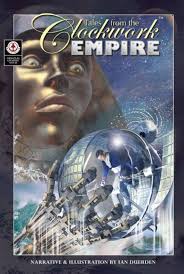
I thought that the cover was kind of interesting with this gigantic metal head holding ball.  But on closer look the man in the ball was very poorly computer rendered and that should have been a tip off.  For all of the people in the book have this same unfinished-rendered look.  It looks a lot like storyboards of unfinished versions of Pixar films.  I mean, really cheesy and really unfinished and really unsettling. This is especially noticeable on the rendering of Napoleon Bonaparte in the “end credits” of the book.

I hate to harp on the graphics, but this is a graphic novel after all.  All of the non human elements looks fine, many look even better than fine, bordering on photo realistic.  But the humans all seem ugh, creepy and stiff and just dropped on top of these scenes.  It is terribly distracting and may even make the dialogue feel stiffer than it actually is.  Because the dialogue felt very stiff and mechanical as well.

It is the kind of story that seems historically accurate in the details and works very hard to let you know that it is accurate.  Indeed, in the end of the book Duerden goes to great lengths to show the accuracies in the writing.  But there’s so little flow in the dialogue that it seems like a lecture.  Basically the entire book feels like, not a first draft, but like the draft before the final draft.  Like the book is going to go back to have a final polish to make the dialogue breezier and make the pictures look better.

This is all a shame since I haven;t eve talked about the story yet. (more…)

Read Full Post »

wz1 SOUNDTRACK: “WEIRD AL” YANKOVIC-Off the Deep End (1992).

Weird_Al_Yankovic_-_Off_the_Deep_EndIt was this “Weird Al” album that brought me back into the fold.  His parody of “Smells Like Teen Spirit” (“Smells Like Nirvana”) was hilarious.  And the video was even better.  It was enough for me to get this album (the cover of which even parodied Nevermind) and was a huge seller for Al.  This great cover makes the rest of the parodies seem so strangely one-hit wonderish (which is, of course Al’s bread and butter), but when you read the other parodied songs, it’s so amusingly “who?”

We have  “I Can’t Watch This” (“Can’t Touch This,” MC Hammer).  This parody is pretty funny as his TV stuff is usually very good.  “The White Stuff” (“The Right Stuff” New Kids on the Block–really??) is very very funny.  It works on a parody level and it works so well internally including the way the O-O-O-OREO fits in in both respects.  It’s probably his best overall parody for a song whose original I dislike.  “Taco Grande” is a parody of Rico Suave” (does anyone remember that song?).  This song also happens to be a favorite of mine–the way he says “Taco” in an oddly sexy way makes me laugh every time.  And, internally it works really well, too.  “The Plumbing Song” is a parody of Milli Vanilla.  While the plumbing  jokes are good, the actual chorus, the “punchline,” really doesn’t work.  Just like Milli Vanilli.

The originals are quite strong on this disc, too.  “Trigger Happy” is a Beach Boys style parody which actually is quite relevant in the big gun debate of 2013.  “I Was Only Kidding” is one of his anti-romantic songs, in which he says all of these romantic things and then takes it back.  It’s pretty funny, even with the Wayne’s World joke.  Wikipedia suggests that it’s a style parody of Tonio K, but I don’t know who that is or what he sounds like.  “When I Was Your Age” sounds a lot like a song from the UHF soundtrack–that same musical style, I wonder if the band works on the music together. It’s a funny song that’s all about old people yelling about how easy young people have it.  It’s a good one.

“Airline Amy” is an original song about a stewardess which doesn’t really do much for me.  But the final song on the disc “You Don’t Love me Anymore” is just outstanding.  It’s a funny acoustic ballad, an anti-romantic song with some very funny lines.  The video parodies Extreme’s “More Than Words,” even though the original song wasn’t a parody of that song (but since people thought it was he made the video reflect it). The video is awesome.

And of course, the polka medley is wonderful.  There’s such a weird mix of songs, and this one really dates the record (not in a bad way).  The previous medleys mixed a lot of different eras, but the songs in this one are of a very specific time: “Cradle of Love,” “Tom’s Diner,” “Love Shack,” “Pump Up the Jam,” “Losing My Religion” (the second R.E.M. nod from Al), “Do Me” (I don’t know the original but I love that he throws in a yodel at the end of it), “Cherry Pie,” “I Touch Myself,” “Dr Feelgood” and the unforgettable “Ice Ice Baby.”  It May be the only place where Metallica and “The Humpty Dance” play next to each other, too.

In a final nod to Nirvana, Al tossed in a 5 second piece of noise after ten minutes of silence which he called “Bite Me” (because Nevermind had a very noisy song called “Endless, Nameless” after some 30 minutes of silence).  My friend Matt has a very funny story about not knowing that “Bite Me” would come on and getting the crap scared out of him by it.  Al makes us laugh in many different ways.

[READ: February and March 2013] The Weird Zone series

wz2Readers will know that Clark and I love Tony Abbott.  We keep looking for his older, somewhat harder to find series, and this past month the library came through with The Weird Zone, eight books set in the small town of Grover’s Mill.  There’s a Secret Government UFO testing base at the north of the city, a dinosaur graveyard to the west of the city and Humongous Horror Movie Studio to the east.  Living in this weird triangle between these oddities can mean only one thing–Grover’s Mill, is known to the kids as the Weird Zone (their school is even call W.Reid Elementary).  The adults in town don’t seem to realize what’s going on (although, clearly they must) are called Zoners.

The Humongous Horror Movie studio is run by Mr Vickers.  His kids, Sean and Holly, are two of the five protagonist.  Although it’s a little funny that in book one, Sean is away at camp.  Mr Vickers makes a horror movie every week–they are terrible  but he shows them at the drive in and people come (perhaps because of the huge searchlights he waves around through the sky).  But having this crazy creature shop in town means that things are very rarely normal anyway.

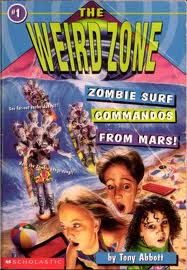
In Book One, Zombie Surf Commandos from Mars!, Liz Duffey, Holly Vickers and Jeff Ryan are enjoying a day at the beach of Lake Lake (named after someone named Lake) when a tidal wave surges forth from the water.  Riding that wave are a bunch of Martian zombies.  They march after the kids looking for brains! (more…)

Read Full Post »

Sarah suggested that I update my most hated and most favorite Christmas songs list as it has been THREE YEARS (!) since I last posted it.  I haven’t changes the list at all, but I have updated the comments (with one retraction!).

In my original post, Sarah chimed in with her two cents.  And I’m going to leave her original comments.  If she has changed her mind (she told me yesterday that she liked a song that she never liked before, she’ll have to do the updating herself).

Here’s my two new additions for this year.  Oh and by the way, in the original post, I mentioned a couple of songs that I didn’t include in my list because we don’t own copies of them.  And while that is fair, I feel compelled to mention them this year.  (more…)

Read Full Post »

SOUNDTRACK: SURFER BLOOD-Astro Coast (2009).

Surfer Blood is a confusing band.  Their music sounds like a whole bunch of different late-80’s alterna-rock bands that I love.  But their vocalist (and the music of the verses) doesn’t really fit that style–I’m not sure what those sound like) and some of it is drenched in a kind of Beach Boys-reverb that befits the Surfer part of their name.

It’s a fascinating amalgam of styles that works very well and which is chock full of catchy choruses.  “Floating Vibes” opens with a big loud guitar note, that quickly morphs into a catchy verse line.  Conversely, “Swim” opens with a strange shouty kind of introduction and then morphs into a crazily catchy chorus (also shouted).

“Harmonix” opens with a “rock n roll” 50s style riff, then jumps to cool guitar harmonics and then turns into a song that sounds unmistakably late 80s to me (although maybe it sounds like a song my friend Garry wrote back in the late 80s).

“Neighbor Riffs” is a rocking 2 minute instrumental, which is followed by “Twin Peaks,” a song that sounds unmistakably late 80s but I can’t decide why (it’s also great because it’s about, you know, Twin Peaks).  I’m confused by the next pair of songs: “Fast Jabroni” and “Slow Jabroni” as they do not seem related and the Fast song is much better.  In fact the combination of “Slow Jabroni” and the next song, “Anchorage” really drag the disc as those two songs are over 12 minutes in total (whereas most of the songs are in the 3-4 minute range).   Neither of the songs is bad (in fact “Anchorage” is pretty cool), they just both last too long.

As I try to process who this band sounds like, I’m going to let Carrie Brownstein provide the best description of them:

Sometimes an album comes from people who you can tell love some of the same music as you. And when they interpret the bands you both love, when they run it through their own brains and hearts and hands and amps, instead of sounding like a watered-down version of the progenitors, it sounds fresh and heartfelt and energized. That’s Surfer Blood for me.

And me too.

[READ: May 16, 2011] “We Come in Peace”

This is one of my favorite short stories that I’ve read in a long time.  It appeals to me for a number of reasons (I love the conceit of angels tinkering with humans), but it’s also very well written and thoroughly engaging.  I think the only disappointment about it is that it’s a short story and not a novel (although the intro to the story says that this is merely an excerpt from the short story which appears in full length in Gartner’s new collection of short stories, Better Living Through Plastic Explosives).

I feared that the story would be daunting at first because it includes a dramatis personae (which can be intimidating for a short story).  But the dramatis personae just tells us which angels are matched to which humans.  For yes, this is a story about five angels who are sent to earth to learn about the five senses.   Amusingly, this is spurred on because humans have discovered the extra taste sensation known as umami.

So, the five angels are sent to a Canadian suburb to inhabit the bodies of 5 students: Bashaar, an athlete and dancer who is beset by local radical muslims to get him to join; Stephan a good student (ie., dork) who is turned cool by his angel, much to his family’s dismay; Leo, a nice dude; Jason, the school bully, who is inhabited by a happy angel; and Jessica, an anorexic girl who suddenly eats, develops a nice body and becomes romantically involved with 16-year-old Cullen.  Each of the angels subsumes the personality of the kids (whose families are, needless to say, freaked out by the changes). (more…)

Read Full Post »

SOUNDTRACK: THE DUCKWORTH-LEWIS METHOD-The Duckworth Lewis Method (2009).

This is a CD released by the combined forces of Neil Hannon of The Divine Comedy and Thomas Walsh of Pugwash.  And if that weren’t enough of a sales pitch, the title of the band is a method of calculating cricket scores!  And even more…in concordance with that, this CD is largely about cricket.  Huzzah!  Buncha sellouts.

I don’t know a thing about cricket, but I know about great orchestral pop, and this disc has it in spades.  Some of the more obvious cricket songs are even understandable to non cricketers (the themes of “Jiggery Pokery” are familiar to anyone who has failed in a sport–and musically it sounds like a silent film soundtrack).

“The Age of Revolution” begins with an olde-fashioned soundtrack as well (jazz swing, including tap dancing) but quickly jumps into a dancey discoey verse (the two soundtracks blend surprisingly well in the chorus).  And the revolution?  Well, it has something to do with cricket.  Next, “Gentlemen and Players” is a wonderfully Divine Comedy-esque track complete with harpsichords.

“The Sweet Spot” is another discoey dancey track with some funky bass work (and innuendo whispered vocals).  And “Rain Stops Play” is a fun musical interlude.

“Mason on the Boundary” is the first track that seems distinctly Pugwash-y.  Hannon and Walsh have similar singing styles, and I find it hard to know who is who sometimes.  But this track is clearly Walsh’s and it’s very nice indeed.  Similarly, “Flatten the Hay” has that distinct Pugwash XTC/Beach Boys vibe and it’s quite good.

“The Nighwatchman” is also a very DC type song (it even sounds a bit like “The Frog Princess” but pulls away before being a repeat of that great single by introducing some very 70s sounding strings).  The rest of the disc follows in this same wonderfully orchestrated pop feel.  This a great record that, as far as obscure bands that get no statewide attention go, is top notch.

Oh, an it’s even more fun with headphones!

[READ: October 9, 2010] Skippy Dies

Wow, there’s a lot going on in this book.  It’s exhausting just trying to think of all the topics covered: boarding school life, failed romance (two big ones), life as a teacher, the appeal of pop singer Bethani, the Catholic priest sex scandal, drugs of all kinds, sneaking into a girls’ school, World War I, institutional cover ups, M-theory–which is pretty much the entire universe, and donuts.

But let’s start at the beginning.  Yes.  Skippy dies.  In the first couple of pages.  And what’s fascinating about this is that we don’t care.  I mean, in the scene where he dies, he’s not even the major character.  But then Skippy turns out to be more or less the glue of the book once the story proper begins.

Skippy resides at Seabrook school in Dublin (the best, most prestigious Christian academy in the country–sorry Gonzaga).   His roommate is Ruprecht (perhaps the strangest major character name I’ve read in a long time).  Ruprecht is a large boy who is incredibly smart (he will single-handedly raise the school’s average on the year’s final exams).  He is a computer geek who is obsessed with aliens and SETI.  And he hopes to be able to communicate with the other world by using techniques suggested in M-Theory.  The book does an admirable job explaining M-theory and string theory.  I’m not going to take up space here, but there’s a fine description at Wikipedia (or, if you don’t like Wikipedia, here’s an academic explanation that is written for the lay person).

Anyhow, Skippy and Ruprecht are two of a few dozen boys who reside full time at the school.  (Most of the other kids are day students).  And they have a cadre of half a dozen friends that they hang out with who make jokes at each other’s expense.  It’s a very realistically written entourage.  Mario is Italian and claims to have had sex with many many women (thanks to his lucky condom which he has had for three years).  Dennis is the ballbreaker.  He’s the abusive one (but by most standards, he’s not a bad guy).  And a few other hangers on.

This story of dorm life is a good one.  The boys are funny, their stories believable, even if they are all eccentric in their own way.  And then, one day, Skippy sees a girl playing frisbee at the girls’ school across the way (Ruprecht has a telescope which he uses for the stars, while eveyrone else uses it for the girls’ school).  And Skippy winds up becoming rather obsessed with the unknown “frisbee girl.”

This girls’ school plays a part in the story in another way too.  Carl and Barry are the Seabrook’s thugs.  When Barry hits upon the idea of selling ADD meds to the locals (as diet pills), it’s the girls’ school that he mostly preys on.  For yes, this story is also about drugs. (more…)

Read Full Post »

jokesSOUNDTRACK: THE FLAMING LIPS-Transmissions from the Satellite Heart (1993).

transIt’s easy to see how people could cry about the Lips moving to a major label.  I mean, comparing this to Hear It Is, they’re like different bands. Except that they’re not.  They’re still the same band, they’re just better, more refined, more mature (maybe) and they know how to use their previous experiments in a way that assists and strengthens the music.

Pretensions aside, this was the disc that scored them their biggest hit, “She Don’t Use Jelly.”  It’s a super catchy, slightly annoying, certainly borderline novelty song (except that all Lips songs are borderline novelty, they’re so weird).  I was thrilled when I saw the Lips on the Soft Bulletin tour and they not only played “Jelly,” they made a big party out of it with balloons and all kinds of fun.

“Jelly” isn’t entirely representative of the album, but, if you really listen to it, it’s not that far afield from the rest of the disc either.  “Turn It On” is the first time you can really hear all the elements of the Lips coalescing into what they would one day become.  Wayne’s voice is coming in close to what we know now, and the musicianship is quite good.  “Pilot Can at the Queer of God” (see, their titles haven’t sold out!) on an earlier disc would have been a messy shambles, but their refined sense makes this a fantastic song with cool backing vocals and everything.  A sort of punk Beach Boys if you will.

“Chewin the Apple of Your Eye” could actually have been a B-Side of Soft Bulletin, in its simple acousticness.  “Superhumans” starts showing off the kind of interesting drum sound that would be a staple of their later releases (this disc welcomes drummer and main contributor Steve Drozd, so that makes sense).

“Be My Head” is another fun Beach Boysesque song. It’s such a simple, happy song (complete with ahh’s in the background).  The distorted guitar isn’t overpowering.  The only thing that is decidedly not Brian Wilson is the lyrics (“You can be my head, I’m through with this one).

“Moth in the Incubator” seems to summarize their whole career in one song.  An acoustic intro, a noisy, crashing middle section and then a slight weird yet catchy as hell melody to close.

Track 9 is listed as “********” but its’ actually a song called “Plastic Jesus” from the film Cool Hand Luke.  A short acoustic song.

The disc ends with the really cool “Slow Nerve Action” a very simple riff, but it is played so differently from the rest of the album, (almost like a professional guitarist?!).  A simple song but very catchy.  An excellent end to a great disc.

[READ: January 26, 2009] Jokes Told in Heaven About Babies

I can’t really say how disappointed I was by this book.  And primarily I was disappointed because the title is awesome and has so much potential.  However, the title is neither accurate nor expounded upon.  That’s right, the book with probably the funniest title published in 2003 is misleading. (more…)

Read Full Post »

« Newer Posts - Older Posts »