Feeds:
Posts
Comments

Archive for the ‘Bob Dylan’ Category

academiaSOUNDTRACK: MARTIN TIELLI-“We didn’t even suspect that he was the poppy salesman.” (2001).

popptI wrote about this album once before, and while I made notes about it after listening to it again, I found out that they were pretty much exactly what I thought of the record four years ago.  So I’m going to simply repost the review here, but I’m going to add some new notes seamlessly intermingled.

Martin Tielli’s first solo disc is a proper solo release: it’s almost all him on acoustic guitar and his gorgeous alto voice.  I hadn’t listened to this disc in a while and I was delighted by how much of the disc I knew so well.

The opening track, “I’ll Never Tear Your Apart” is deceptively simple: beautiful harmonic’d guitars and his gentle voice.  There’s a great video to go with it here.  That is followed by the wonderful “My Sweet Relief” which sounds like a great Neil Young folk song: great verses an a strong chorus.  Lyrically, though, it is all Tielli.  “Double X” highlights Tielli’s beautiful acoustic guitar work.  It’s another great story song, this one about a destitute person hanging under a superstore with a K and an M.

“Voices in the Wilderness” is a simply beautiful song, a lovely guitar melody and Tielli’s high voice singing along.. I also love that the lyric  (mis)quotes Rush very nicely: “‘If you choose not to be free you still have made a choice,’ said a high and squeaky voice.”

“Farmer in the City” is the only track that Tielli didn’t write.  It’s a nearly 8-minute song by Scott Walker.  I had never listened to the original, but having now done so, I find the Walker version to be far superior.  Walker’s voice is so eccentric and wonderful.  So even though I love Martin’s voice, he just can’t compare to the original.   Also find Martin’s version to be just a little spare (the Walker version has lovely strings. Kevin Hearn plays celeste and Selina Martin plays wine glasses on the track.

It’s followed by the delightful “World in a Wall” which uses mice in the wall as a metaphor for a broken relationship (with wonderful detailed lines like: She’s like a mouse, I know she’s around It’s a gnawing sound. Leaves little brown poohs from a little pink bum.”

This is followed by “That’s How They Do It in Warsaw” which is the first really rocking song (it has bass and drums) and a voiceover in Polish by Kasia Zaton.

It’s coupled with a slightly less rocky but still loud track “How Can You Sleep?” (which makes another fun musical allusion, this time about Guided by Voices). It has a co-songwriting credit from Dave Bidini and has a kind of vocal allusion to Bob Dylan, although I doubt it is about him.

“She Said ‘We’re On Our Way Down’” is a song that I really want to enjoy more.  But It is so spare and Martin’s vocal line is so abstract, that I can never really get int it. But the guitar riff is really powerful and cool.  And yet, the song seems to eschew melody but then a gorgeous guitar or vocal line shines through and really sounds brilliant.  “From the Reel” is a beautiful, aching acoustic ballad.

The disc ends with the odd, seven minute “Wetbrain/Your War.”  The first part (wet brain) is kind of slow but it builds into a beautiful dark song about addiction.

This is a really beautiful album, although there are moments when I fell like Martin gets too delicate, it’s amazing to hear just what he can do when he’s on his own.

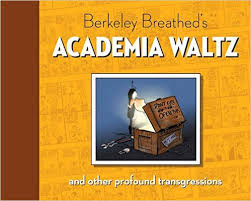
[READ: October 19, 2015] Academia Waltz

Way back a long time ago I was pretty excited to read all of the Bloom County reissue books.  Somehow I only got through Books 1 and 2, although I see now that five volumes were released in total.

Presumably at the end of that run, (which technically ended in 2011) comes this volume.  Academia Waltz is the strip that Breathed wrote back in college.  This book collects some (but apparently not all) of the strips.  It’s odd to not collect them all since there is also an art gallery with all kinds of original pieces (complete with edits and scribbled notes) that duplicate many of the earlier strips.

The first part collects pieces from Academia Waltz the 1979 collection.  The second part comes from Bowing Out, the 1980 Collection. (more…)

Read Full Post »

1968_12_28-200SOUNDTRACK: RHEOSTATICS-The Horseshoe Tavern, Toronto, ON (November 08, 2001).

horsetavThis is the final show for 2001 at the Rheostatics Live website.  This show is the second of eleven (11!) straight shows at The Horseshoe.  Since it was part of their Green Sprouts “week,” it is chock full of guests.

Kevin Hearn is playing this night (and a few others), but there’s also guest vocals from Sean Cullen and Gord Downie!

The recording is not quite two hours which I assume means that parts were cut off.  I mean, a Rheos show that’s under two hours during Green Sprouts week?  Unheard of.  Earlier that evening Bob Dylan was playing in town, so it seems like the early parts of the show were a bit quieter than usual.

The show stars with “Fat” which sounds like it may have been coming in from something else or that’s the intro music–hard to say exactly.  Then they play two new songs–“The Fire” (with a funny joke about someone’s folk apparatus (a harmonica)) and “We Went West.”  Then comes their first guest, Canadian comedian and songwriter Sean Cullen.  They play his Stompin’ Tom tribute/parody “I’ve Been Beaten All Over This Land.”

I love the version of “Junction Foil Ball” with th every amusing comment that a Globe and Mail reviewer described one part of the song as “a hippo jumping into a giant puddle of mud.”

There’s a very cool section that’s a Kevin special.  Songs from Group of 7 and Harmelodia: Boxcar Song, Landscape And Sky, The Blue Hysteria, Yellow Days Under A Lemon Sun, Easy To Be With You, Loving Arms and I Am Drumstein.

Then Gord Downie comes out–sadly his introduction is cut off, so we don’t get to hear what they say about him (or the fan reaction).  They start in the middle of his song “Chancellor” from Coke Machine Glow.  Then they play “Canada Geese.” And then Dave asks if they can sing one of the Rheos’ songs (“sure thing, Tim, uh, Dave”).  Ha.  And Gord sings “Take Me in Your Hand.”

There’s a great version of “Stolen Car” and they end the show with three songs from the then new album: “P.I.N.,” “Mumbletypeg” and “Satan is the Whistler.” It’s the best live version of “Satan” that I’ve heard so far–perfect whistling, and they don’t mess up the fast part at the end.

I’m sure the other ten nights were equally great.  But this is all we have to close out 2001.

[READ: May 12, 2015] “The Cafeteria”

I read this story because it was alluded to in David Albahari’s “Hitler in Chicago.”  In Albahari’s story, a character on a plane is reading Singer’s book and the person next to him asks if he knows Singer’s story about a woman seeing Hitler in New York.

Indeed, in this story, there is a woman who sees Hitler in New York, so it was a nice full circle, and I applaud Albahari for playing around with an extant story like that.

This story, translated from the Yiddish by Singer and Dorothy Straus, is set in Manhattan.  The narrator, Aaron, has lived there for nearly 30 years–about as long as he lived in Poland.  He has many friends who he meets up with in the cafeteria.  They speak Yiddish and talk about the Holocaust or the state of Israel.  He looks forward to talking with them but he is a busy many (writing novels or articles) so he can’t stay too long.

Most of the people he meets with are men, but one day a woman, who looked younger than the rest of them, appeared.  She spoke Polish, Russian and some Yiddish.  She had been in a prison camp in Russia.  The men hovered around her, listening to her every word–she was surprisingly upbeat. (more…)

Read Full Post »

Harpers-1404-302x410SOUNDTRACK: BECK/RECORD CLUB-VELVET UNDERGROUND: Velvet Underground & Nico (2010).

velvetAccording to the Beck/Record Club website:

Record Club is an informal meeting of various musicians to record an album in a day. The album chosen to be reinterpreted is used as a framework. Nothing is rehearsed or arranged ahead of time. A track is put up here once a week. As you will hear, some of the songs are rough renditions, often first takes that document what happened over the course of a day as opposed to a polished rendering. There is no intention to ‘add to’ the original work or attempt to recreate the power of the original recording. Only to play music and document what happens. And those who aren’t familiar with the albums in question will hopefully look for the songs in their definitive versions.

Introducing this first recording, Beck explains:

For this first edition, after lengthy deliberation and coming close to covering Digital Underground’s Sex Packets, all present voted in favor of the ‘other’ Underground’s The Velvet Underground & Nico. Participants included this time around are Nigel Godrich, Joey Waronker, Brian Lebarton, Bram Inscore, Yo, Giovanni Ribisi, Chris Holmes, and from Iceland, special guest Thorunn Magnusdottir, and myself. Thanks to everyone who helped put this together, and to all of you for indulging in this experiment. More soon.

That’s a lot of introduction for this record, which, as you have surmised is a full cover of the Velvet Underground’s debut album.  And, as the blurb promises, it is chaotic, but often charming.  I am not a huge Velvet Underground fan, although I have this and some of their other albums.  I appreciate them more for what they spawned than what they played.  But having said that I know this record pretty well.  I did make a point of not listening to the original before listening to this.

The track listing:

Sunday Morning (3:15).  This version is pretty faithful.  Beck sings and sounds a bit like Lou Reed.
I’m Waiting For The Man (4:04).  This song is very silly indeed–instruments detuned and loopy sounding.  It’s a little funny but a little annoying too.
Femme Fatale (2:42).  This is a straight version with Beck taking the Nico part and doing a nice job of it.
Venus In Furs (5:22).  This song is a little noisy & feedbacky but it’s a great version. Probably my favorite song of the bunch.
Run Run Run (4:25).  They’ve turned this into a little synth pop song.
All Tomorrow’s Parties (5:16).  This has vocals by Thorunn Magnusdottir.  She doesn’t quite have whatever Nico had and consequently although the songs tarts out pretty, the length and tempo turns it a little dull by the end.
Heroin (6:40).  This version is insane, with Brian Lebarton getting more and more frantic.  If the instruments didn’t sounds so cheap, the intensity would be pretty awesome.  But it’s a little wonky sounding (and a too long).
There She Goes Again (3:02).  This song is like “Waiting for the Man” detuned and silly.
I’ll Be Your Mirror (2:33).  This is a pretty version which would, once again sound a little better if the instruments didn’t sound cheap.
Black Angel’s Death Song (3:43). Beck sounds more like Dylan on this song, which i don’t know that well at all.
European Son (3:26).  This song is a little dull, I don’t recognize it.
Heroin (Bonus Alternate Version) (5:05).  This version of Heroin is a bit more reasonable than the other version, although I wish it had a little of the first version’s chaos.  Maybe a meeting of the two would be ideal.

So this is a fun project where talented friends get to make some music together.  It gets an even higher “grade” overall because he’s not releasing it officially, not asking money for it.  Not every song is a winner, but those that win are quite good.

[READ: March 17, 2014] “Family and Others”

Nadezhda Teffi was alive from 1872-1952 and wrote this in 1912.  It was translated from the Russian by Anna Summers.

This is a very simple story that doesn’t feel like a story so much as a friendly lecture about family.  The story begins with the statement that we tend to divide people in to family and others.  Which is true.  he continues that Family knows everything about us while Others know very little about us.  Sometimes when people get closer, they move from other to family.  However, it is the family that tends to give us the most grief.

When you are sick, others send you flowers but family interrogate you about when you caught the cold and what you were doing when you got it.  They don’t try to make you feel better, they want to know more about the problem.  He offers several similar situations in which family is less than cuddly with us.

(more…)

Read Full Post »

CV1_TNY_09_30_13Blitt.inddSOUNDTRACK:WOVEN HAND-Tiny Desk Concert #11 (January 9, 2009).

wovenWoven Hand is yet another band that I hadn’t heard of until this Tiny Desk concert (and I thought I knew a lot of bands).  They are a band, but for this Tiny Desk Concert David Eugene Edwards plays solo.  He has a cool baritone voice that has a nice ponderous quality.  This suits his chosen instrument–a mandolin-banjo hybrid made in 1887 by the Pullman Train Company (!)–perfectly.  Turns out that Edwards was the voice behind 16 Horsepower, so that explains some of the sound he’s going for.

The opener “Whistling Girl” and the closer “Kingdom of Ice” (which is practically a mini-epic) are beautiful slices of Americana made slightly more esoteric by the instrumentation and his voice.  I like them a lot.  The middle song he plays is a Bob Dylan song “As I Went Out One Morning.”  I know that I’m not a big Dylan fan, but I just can’t get over how many songs he has written that people cover.  I’d never heard this one, which with this instrumentation takes on a kind of fairy tale quality (which I assume the original doesn’t).

This makes me want to bust out my 16 Horsepower CD and to check out more from Woven Hand.  I enjoyed his solo performance so much I can’t imagine what a full band version would sound like.

[READ: January 7, 2014] “The Breeze”

I have really enjoyed Joshua Ferris’ work, so I was excited to read this.  But I was ultimately disappointed by this story.

The construction is interesting, so of.  It looks at multiple possible outcomes of a situation.  But I felt like even that was done a little too vaguely to be really effective.

It also features one of my most hated scenarios in real life and one which I guess I have no patience for in fiction.  It concerns a person who is bored, existentially bored.  So when she wants to do something, she proceeds to ask her partner what he wants to do.  Thus, Sarah asks her husband to come home from work early.  She is sitting on the balcony of their apartment enjoying a perfect spring breeze.  When he gets home, she is excited to have a wonderful excursion with him.  So she asks him “What do you want to do?”  And naturally he hasn’t thought of this at all, so he has no opinion.  But this makes her mad.  She asks if he doesn’t want to do anything.  He says he does. And then she asks him what.  I don’t know if this is a gender-specific scenario, but I have been in it many times in many different relationships and I know my parents went through it as well—my mother always complained about my father’s lack of wanting to do things and he would always say all she had to do was say what she wanted to do and he would do it.  So, I guess Ferris has tapped into something, but I hated reading about it. (more…)

Read Full Post »

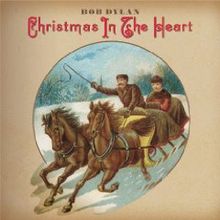
fivedials_no26SOUNDTRACK: BOB DYLAN-Christmas in the Heart (2009).

220px-Bob_Dylan_-_Christmas_in_the_HeartI have been a dabbler in Dylan over the years.  I like his hits, I like some of his albums, but I’ve never been a huge huge fan.  So the biggest surprise to me was that Bob Dylan now sounds like Tom Waits.  His voice is so crazily gravelly, it’s almost (almost) unrecognizable as Dylan.

That said, on some of the tracks it works very well–like he’s had too much to drink and is enjoying the revelry of these traditional songs.  I imagine him as a benevolent uncle trying to get the family to sing along.  And sing along they do.  He has a group of backing singers who sound like they are straight out of the forties and fifties (on some songs the women sing incredibly high especially compared to Dylan’s growl).  I’m not always sure it works, but when it does it’s quite something.

The first three songs are a lot of fun. However, when he gets to “Hark, the Herald Angels Sing,” it really sounds like he has hurt himself.  He seems to really strain on some of those notes–note the way he pronounces “herald” (heeerald).

The more secular songs fare better with “I’ll Be Home for Christmas” sounding especially Waitsian and being all the better for it.  Although I feel that perhaps he made up some lyrics–“presents on the tree?”  It’s interesting that in “O Come, All Ye Faithful” he sings the first verse in Latin (I don’t know that I’ve heard any other pop singers do that) and it works quite well.

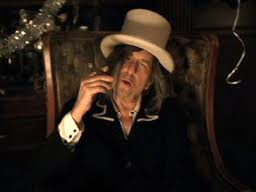
A less successful song is “Have Yourself a Merry Little Christmas” in which the music just seems to be too slow for him.  His verses end early and it seems like the backing singers are just out in the middle of nowhere.  Perhaps the best song is “Must Be Santa.”  I love this arrangement (by Brave Combo) and Dylan has a ton of fun with it (and the video is weirdly wonderful too).

“Christmas Blues” is a bit of a downer (as the title might suggest).  I’d never heard this song before and Dylan is well suited to it.  Dylan’s version of “The Little Drummer Boy” is also very good–he croons gently and his voice sounds really good.  I was surprised to hear him do “Christmas Island,” a song I have come to love this year–his version is quite fun as well, with the backing singer doing Aloha-ays.

Finally, “O Little Town of Bethlehem” is pitched a wee bit high for him (and the Waits voice is more scary than avuncular here).

So overall it’s a weird collection (to say nothing of the artwork–both the cover and the inside cover), but I think it’s well suited to the day after the festivities.

[READ: December 15, 2013] Five Dials #26

I was shocked to realize who many Five Dials issued I had put off reading (and that this one came out over a year ago!).  I knew 26 was a large issue, so I put it off.  And then put it off.  And then put it off, until Issue 29 came out.  (I read 29 before this one, which got me to jump back and tackle this large one).

I have to admit I did not enjoy this one as much as previous Five Dials.  The bulk of the issue was taken up with German short stories, and I don’t know if it was the choices of the editors, but (a few) of the stories just didn’t grab me at all.  Having said that, there were one or two that I thought were very good.  But with this being such a large issue, perhaps it deserved to be spaced out a little better–Weltanschauung fatigue, no doubt.

This issue starts with Letters from Our Glorious readers and other sources.
I feel like this is a new feature for Five Dials (although again, it has been a while).  There is applause for the Bears (From Issue #24) and the acknowledgement of Zsuzsi Gartner’s first adoptees of her story ideas (Issue #25 Pt 1).  There’s also the amusing story of a guy who got nailed at work for printing the color issue (something I used to do at my old job as well) and a refraining of answering spam.

CRAIG TAYLOR-On Ewen and German
Taylor doesn’t say much in this intro, since the “heavy lifting” is done by Anna Kelly.  He does mention Paul Ewen (and his food writing) and the first Five Dials questionnaire (which I assume it is too late (and too far away) for me to submit for that free HH book).

ANNA KELLY
She explains about wanting to know secrets, and how when she was little, learning Pig Latin was a such a huge boon to her secretive life.  Then her sister started studying German, and Anna herself was hooked.  She says that reading German works in German is like flying.  And she wants to share German language writers with us.  Of course, we won’t be reading them in German, so there will be no flying.  (more…)

Read Full Post »

dec2006SOUNDTRACK: HILMAR ÖRN HILMARSSON & SIGUR RÒS-Angels in the Universe (2000).

angelsThis disc often gets placed in the Sigur Rós discography even though it really isn’t one of their records. It is a soundtrack to the film Angels in the Universe, and it is primarily music composed and conducted by Hilmarsson.  There are 17 tracks on the disc and he is responsible for 15 of them.  The remaining 2 are indeed by Sigur Rós, but if you have the “Ny batteri” single, you’ve already got the two songs.

The Hilmarsson tracks are large airy string pieces (I don’t know the film or anything about it, but it makes it seem rather sad). There are some tracks in the middle that deviate somewhat–some drums and occasional bass, but for the most part the music sounds like a string score to a film.  Pretty, but not exceptional.  At no time does Sigur Rós play with the other performers.

It’s the last two track s that are by Sigur Rós.  “Bíum bíum bambaló” is a slow piece that begins with mostly percussion.  Apparently it is an Icelandic lullaby and their version is quite different from a lullaby.  By the end of the song, when the whole band kicks in it rocks really hard and proves to be a great song.  The final track, “Dánarfregnir og jarðarfarir” was a theme used for death announcements on Icelandic radio (whatever that means).  I love the way it builds from a simple melody into a full rock band version and then back again.  It’s very dramatic.  These songs are both really enjoyable.  I like them a lot.  But I’d just stick with the single.

[READ: November 9, 2013] “The Secret Mainstream”

This article was in Bissell’s book Magic Hours, which I read a while ago.  I recognized some of the material in the article, but not all of it, which I find disconcerting that I forgot so much.

This article is (as the subtitle states) all about Werner Herzog, a filmmaker whose films I have never seen.  Herzog is notorious both for his films (he has made over 50) and for his behavior (some rumors of which are true, others are not).

Bissell wonders what historians would make of our civilization if they based their understanding on Herzog’s work.

He also goes through many of Herzog’s film, starting with Fata Morgana, Herzog’s first overt confounding of the feature film/documentary boundary.  It is neither narrative not strictly factual.  In truth, what Herzog does is make a hyperrealized truth.  For instance, in a film about a blind woman he created images and had her say they were images she remembered).  David Lynch is a fan of Herzog and you can see elements of Herzog in Lynch’s filams (so maybe the adjective Lynchian could be Herzogian.

What Bissell is saying (and Herzog confirms) is that Herzog is an artist, not a journalist.  He is also quite funny.  The story about the 32 pound rooster and the two foot horse is very very funny.

And while Herzog takes his films seriously he doesn’t really plan them.  He says he doesn’t anticipate what his next project will be and he also doesn’t spend a lot of time working on his films.  Woyzeck (1979) was shot in 18 days and edited in four.  He also took less than a month to make Grizzly Man (probably his best known recent film).

And yet for a film like Aguirre: The Wrath of God (1972), a film about Spaniards searching for El Dorado and slowly going mad, Herzog’s crew and cast nearly went mad themselves.  Klaus Kinski, the lead actor has this to say in his autobiography: “I absolutely despise this murderous Herzog… Huge red ants should piss into his lying eyes, gobble up his balls, penetrate his asshole and eat his guts.”  Herzog himself says that he helped Kinski write that and many other anti-Herzog sections of that autobiography.

Bissell cites The White Diamond (2004) as one of Herzog’s best films (it is a documentary about Dr Graham Dorrington a researcher who wants to film Guyana from an experimental blimp.  Or The Great Ecstasy of the Woodcarver Steiner (1974) which is about competitive ski jumpers and shows jump after jump after jump landing badly. Little Dieter Needs to Fly (1997) is about the escape of a pilot from a prison camp in 1966.  He has Dieter open and close his door three times before entering because “most people don’t realize how important it is to have the privilege that we have to be able to open and close the door.  That is the habit I got into and so be it.”  Which is moving and impressive and totally false.  Dieter doesn’t do that in real life.  But Dieter understood what Herzog was going for and believed in the truth of it even is it’s not strictly true.  Herzog calls it the ecstatic truth.

I don’t recall how I felt about Herzog after reading this the first time, but I am certainly thinking about watching a bunch of his films.

Some recommendations from the article:

  • Fata Morgana (1970)
  • Land of Silence and Darkness (1971)
  • Aguirre:  The Wrath of God (1972)
  • The Great Ecstasy of the Woodcarver Steiner (1974)
  • The Enigma of Kasper Hauser (1974)
  • Strozek (1976)
  • Woyzeck (1979)
  • Fitzcarraldo (1982)
  • Lessons of Darkness (1992)
  • Little Dieter Needs to Fly (1997)
  • Grizzly Man (2004)
  • The White Diamond (2004)
  • Wild Blue Yonder (2005)
  • Rescue Dawn (2006)—which Herzog was working at the time of the article and which had a fairly large budget (for Herzog) of $10 million.  He even has name stars in it (Christian Bale, for one).  Bissell makes it sound very interesting, and certainly fascinating to watch being filmed.

Read Full Post »

jan2006 SOUNDTRACK: KURT WAGNER-Tiny Desk Concert #6 (October 8, 2008).

kurtI have never been a big fan of Lambchop.  It’s just not my kind of music—a little too slow for me.  But I really enjoyed Kurt Wagner in this Tiny Desk performance.  His guitar playing I really beautiful (I loved how he hit the high note on Bob Dylan’s  “You’re a Big Girl Now.”  He plays three Lambchop songs and two covers.

Wagner is from Nashville, and he has an air of Southern propriety about him–apologizing for taking up everyone’s time at work.  He sounds great doing the Dylan song, which I suppose is no real surprise.  The first Lambchop song is a pretty ballad called “Slipped Dissolved and Loosed.”

He is a charming and funny guy, joking about a few things (like working in an office) and then discussing about one of his songs, “National Talk Like a Pirate Day” (which is not as funny as the title might suggest).  Another song is titled “Sharing a Gibson with Martin Luther King Jr.” (and Wagner waves a fan of MLK Jr. (from a funeral home-(?)) to start the song.

The final song is a Don Williams song called “I Believe in You.”  I’ve never heard of him (and neither had anyone else in the studio).  It’s a really enjoyable, sweet song, and there’s a funny moment when sirens go past and he comments that at least they are in tune.  I still don’t think I’ll be listening to a lot of Lambchop, but I really liked this Tiny Desk show.

[READ: October 8, 2013] “Improvised, Explosive, & Divisive”

Two years after writing about his trip to Vietnam, Bissell returned to another war zone.  This time going to Iraq to get embedded (I suppose that’s the technical term for what he did) with some Marines at Camp Taqaddum in Iraq (17 miles from Baghdad).  This was during the Iraq war (and the Bush presidency), after Mission Accomplished, when the military was searching for a strategy for what to do in the situation.

This article shows interviews with Marines and makes assessments about our then current plans (such as they were) for how to extricate ourselves from a seemingly hopeless situation.  After Mission Accomplished the war went from a “war” to “stability and support operations against an insurgent element” or what is called MOOTW (military operations other than war).  And Bissell acknowledges that it barely seems like any resembling war in Iraq where the soldiers are headquartered.  They cannot drink alcohol, have sex or view pornography (they are trying to remain respectful of their host country), but at the same time they play softball and go to the gym, wear Co-Ed Naked Camel Watching T-shirts and have a Baskin-Robbins ice cream stand.  Not to mention DVD, video game consoles and Coke for sale in the PX.

Some of the article is technical—a side of the fighting that most readers probably don’t know. Like that the troops must be fully protected (and the vehicles as well) just to travel the relatively short distance between camps. (more…)

Read Full Post »

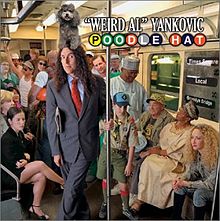
zita2SOUNDTRACK:poodle “WEIRD AL” YANKOVIC–Poodle Hat (2003).

I think of Poodle hat as a good Al album.  It won a Grammy even (the true sign of quality, right?).  But its the only one of his albums (along with Polka arty) to not even go gold!  That’s pretty amazing given that he’s usually platinum.  I read that stat before listening again and I wondered why this album tanked so bad.  Was it the title or the cover or what?  And why do I think fondly of the record?  Well, it turns out I think fondly of the record because of the final track, “Genius in France” a Frank Zappa style parody (which I assume was not terribly endearing to many people either).  But what about the rest of the album:

Couch Potato.  It’s a good parody of Eminem, but I never thought the original was that good to begin with–it’s pretty repetitive with no real drama.  And while the lyrics are funny, so as a lead off track it’s not that great.  “Hardware Store” is a weird song–lots of crazy sound effects and backing vocalists.  I want to like it more than I do–the fast singing is great the lyrics are all kinda funny but it doesn’t really resonate–the chorus, perhaps is not that great.  “Trash Day” is a parody of a song by Nelly, which I don’t know.  I’ll now show off my musical prejudice by saying that a lot of these aggressive R&B/rap songs sound very similar with no real hook, which I think makes the parodies harder to enjoy.  “Party at the Leper Colony” just seems like a bad idea (especially for Al’s umpeenth album).  It’s a rockabilly type song (a style I don’t like anyway), so another thumbs down.

“Angry White Boy Polka”is the first bright ray on the disc–mixing aggressive metal songs in the polka style is a pretty great idea, especially System of a Down, The Hives and The White Stripes.  Twisting the style of The Strokes twist is a pretty great idea too.  I really enjoyed the way the angry songs are utterly lightened with silly sound effects.  It’s very funny.

“Wanna Be Ur Lovr” is a song I never much liked until seeing him perform it live.  It’s a sexy song made up entirely of lame come on lines.  It’s petty funny but the live version utterly blows it away.  “A Complicated Song” is a parody of Avril Lavigne’s “Complicated”.  It seems like it might be just a silly parody until the first verse turns out to be about eating too much cheese.  I laughed so hard to find that the first rhyme was “constipated”  The other two verses can’t possibly live it to it but that first one is a big highlight (toilet humor it may be, but it’s good toilet humor).  “Why Does This Always Happen to Me?” features Ben Folds on piano (the piano is very good).  The song is a series of complaints about minor things within the context of real tragedy.  It’s a funny idea but the presentation doesn’t seem to work somehow.

“Ode to a Superhero” is a surprise because it uses Billy Joel’s “Piano Man” as the musical basis for a song about Spiderman.  It seems like a sure fire hit after “The Saga Begins.”  And it works quite well.  “Bob” is a series of palindromes (see the title) done in the style of Bob Dylan.  It’s very clever.  “Ebay” has been mocked for being so similar to an actual eBay commercial, but I think its very funny.  I never liked the original but I find myself singing this every time I think of eBay.  “Genius in France” features Dweezil Zappa on guitar, and beyond that it gets so many Frank Zappa things right.  It is weird and crazy and spot-on.  I love to think that it may have made some Zappa fans out of Weird Al fans.  And if you’re a Zappa fan, you must listen to this to see just how many great Zappa musical moments he throws in here (including vocals styles and potty jokes).

It’s pretty interesting how the back half of the album is so much better than the first half (that’s no way to sell albums, Al).  I can totally see why this album didn’t sell all that well. And I’m a little bummed that I didn’t enjoy it as much as I thought I would.

[READ: June 19, 2013] Legends of Zita the Spacegirl

I actually read this book first of the two (didn’t realize it was the second book in the series and, frankly from the title, how could I?).  But I’ll treat it like I read it second.

So this story picks up soon after the first ended.  But rather than Zita, we see a robot crawling through a junkyard.  The robot’s box says RECALLED and the name is Imprint-o-tron.  The robot sees a poster of Zita and is immediately overwhelmed by a crowd who is rushing to see her.  Imprint-o-tron paints itself to look like Zita as the crowd assembles.

And there we see, Piper introducing Zita, the girl who saved Scriptorius.  But she is nervous, and intimidated by the crowd and tells the truth, that it was Randy who blew up the bad guys.  But they aren’t buying it.  She signs autographs, gets exhausted and hides behind a rock where Imprint-o-tron sees her and immediately becomes her (but with circles instead of dots for eyes).  Zita delights in this doppelgänger and sends it out to do her singing work while she and Mouse run off to have fun.

But then the ambassador of the planet Lumponia informs them that  swarm of star hearts are heading for their planet and they as Zita for help.  Robot Zita agrees and when real Zita returns to the ship, robot Zita pushes her away and takes off with the crew. (more…)

Read Full Post »

herevilleSOUNDTRACKBRAVE COMBO/BOB DYLAN-“Must Be Santa” (1991).

bob dylanBrave Combo is a fun band that mixes more styles in one album than most bands do in their career.  While they primarily play polka, the also play everything from folk to rock to klezmer.  This song is an old song from Mitch Miller, but Brave Combo speed it up and spice it up with clarinets and fun instrumental frills.  It’s fast and furious.

And if that wasn’t strange enough, Bob Dylan covered the song–and clearly covered the Brave Combo version when he made his Christmas album in 2009.  Although Brave Combo didn’t write the song, Dylan’s cover is certainly in the polka style and he includes lyrics that Brave combo added:

Dasher, Dancer, Prancer, Vixen
Eisenhower, Kennedy, Johnson, Nixon
Dasher, Dancer, Prancer, Vixen
Carter, Reagan, Bush and Clinton.

Dylan singer faster than I’ve ever heard him.  It’s a hoot.  And the video is really funny too.

[READ: January 3, 2012] Hereville: How Mirka Met a Meteorite

I saw this book on the library shelf and the tagline (“Boldy Going Where No 11-Year-Old Orthodox Jewish Girl Has Gone Before”) made it sound like a lot of fun.  Upon reading it, I can see it’s not quite what thought it was.  It turned out to be much cooler.  This also proves to be the second book in this series, although you don’t need the first book to appreciate this one.

Mirka, an orthodox Jewish girl has been grounded (for fighting a troll with a sword.  Her stepmother, sick of her hanging around, offers to play Mirka in chess.  If Mirka wins, her punishment is over.  As with everything Mirka does, she is too brash, too hasty, which means that she will not win.  But her stepmother takes pity and allows her to go outside–if she stays out of trouble.  But because she is willful, Mirka runs right back to the troll.  The troll, angered at being defeated by such a stupid girl (his insults at her are great), creates a meteorite and sends it hurtling towards the town of Hereville.

Mirka consults with the witch who helped her defeat the troll in the first place and the witch changes the meteorite into a girl who is the exact copy of Mirka.  Although indeed, not an exact copy for Metty as she comes to be known is smarter, neater and better at basketball.  Mirka thinks it would be great to have this twin around to help with chores but Metty winds up eating all her food (they can’t both be in the same place at once) including the big feast at Shabbos and making her look bad.   (more…)

Read Full Post »

CV1_TNY_12_17_12Sorel.inddSOUNDTRACK: JONI MITCHELL-“The River” (2002).

joniMuch like Zadie Smith in the article, I was never much of a Joni Mitchell fan.  We may be one of the only houses in America without a copy of Blue somewhere.  Much of my ignorance about her comes from simply not being exposed to her.  Which also seems absurd and yet it is true.

I know her from covers, which should establish her as a great songwriter, if nothing else.  And by now I know a number of her songs, like this one.  This is kind of a Christmas song (it has the word Christmas in it), although it’s not very Christmassy.  I have a hard time believing that Zadie Smith’s husband never noticed that she is quoting the music from Jingle Bells in the beginning of the song though, as it’s really quite obvious.

It’s a  pretty song, and hey maybe it’s time to see what else is on Blue.

[READ: December 20, 2012] “Some Notes on Attunement”

I love hearing about Zadie Smith’s family–her hip black mother and her dorky white father.  I love that she embraces both sides of her life.  And when she writes about it, she presents it so fully.  So growing up her parents listened to Burning Spear and Chaka Khan and Duke Ellington and James Taylor and Bob Dylan and yet somehow never Joni Mitchell.  And she wonders how they didn’t know or perhaps why they didn’t like her.  [My parents were to old for folk music, so that’s my excuse].

She talks about the first time she heard Joni, at a college party (it was Blue, of course) and frowned at it.  Her friends, both black and white said, “You don’t like Joni?”  But, she explains, “Aged twenty, I listened to Joni Mitchell–a singer whom millions enjoy, who does not, after all, make an especially unusual or esoteric sound–and found he incomprehensible.”

And then at 33 she had another experience–listening to Joni Mitchell in a car with her husband on the way to Wales.  Which is where we hear her saying “And that bit’s just Jingle Bells.”  She says she didn’t expect to get much out of that line “and was surprised to see my husband smile, and pause for a moment to listen intently: “Actually that but is Jingle Bells–I never noticed that before.  It’s a song about winter…makes sense.”  Wait, how could he not hear that before??? (more…)

Read Full Post »

« Newer Posts - Older Posts »