Feeds:
Posts
Comments

Archive for the ‘McSweeney’s’ Category

SOUNDTRACK: OKX: A Tribute to Ok Computer (2010).

OK Computer is one of the best records of the 90s.  Every time I listen to it I hear something new and interesting.  So, why on earth would anyone want to cover the whole thing?  And how could you possibly do justice to this multi-layered masterpiece?

I can’t answer the first question, but the second question is more or less answered by this tribute which was orchestrated by Stereogum.

The answer is by stripping down the music to its bare essentials.  When I first listened to the songs I was really puzzled by how you could take a such a complex album and make Doveman’s version of “Airbag,” which is sort of drums and pianos.  Or gosh, where would you even begin to tackle “Paranoid Android?”  Well Slaraffenland create a bizarre symphonic version that excises many things–in fact half of the lyrics are missing–and yet keeps elements that touch on the original.  But it’s an interesting version of the song and shows  a bizarre sense of creativity.  And that is more or less what this tribute does–it makes new versions of these songs.

Mobius Band make a kind of Police-sounding version of “Subterranean Homesick Alien.”  Again, it radically changes the song, making it a fast and driving song (although I don’t care for the repeated “Uptights” and “Outsides” during the verses).

Vampire Weekend, one of the few bands that I actually knew in this collection (and whom I really like) do a very interesting, stripped down version of “Exit Music, for a Film.  The “film” they make is a haunted one, with eerie keyboards.  Again, it is clearly that song, but it sounds very different (and quite different from what Vampire Weekend usually sound like).

“Let Down” (by David Bazan’s Black Cloud) and “Karma Police” (by John Vanderslice) work on a similar principle: more vocals and less music.  The music is very stripped down, but the vocals harmonize interestingly.  Perhaps the only track that is more interesting than the original is “Fitter Happier” by Samson Delonga.  The original is a processed computer voice, but this version is a real person, intoning the directives in a fun, impassioned way.  There’s also good sound effects.

Cold War Kids take the riotous “Electioneering” and simplify it, with drums and vocals only to start.  It’s hard to listen to this song without the utter noise of the original.  “Climbing Up the Walls” is one of the more manic songs on this collection, with some interesting vocals from The Twilight Sad.

There are two versions of “No Surprises” in this collection.  Interestingly, they are both by women-fronted bands, and both treat the song as a very delicate ballad.  Both versions are rather successful.  Marissa Nadler’s version (the one included in sequence) is a little slower and more yearning, while Northern State’s version (which is listed as a B-Side) is a little fuller and I think better for it.  My Brightest Diamond cover “Lucky.”  They do an interesting orchestral version–very spooky.

Flash Hawk Parlor Ensemble (a side project of Chris Funk from The Decemberists) do a very weird electronic version of the song (with almost no lyrics).  It’s very processed and rather creepy (and the accompanying notes make it even more intriguing when you know what’s he doing).

The final B-side is “Polyethylene (Part 1 & 2),”  It’s a track from the Airbag single and it’s done by Chris Walla.  I don’t know this song very well (since it’s not on OK Computer), but it’s a weird one, that’s for sure.  This version is probably the most traditional sounding song of this collection: full guitars, normal sounding drums and only a slightly clipped singing voice (I don’t know what Walla normally sounds like).

So, In many ways this is a successful tribute album.  Nobody tries to duplicate the original and really no one tries to out-do it either.  These are all new versions taking aspects of the songs and running with them.  Obviously, I like the original better, but these are interesting covers.

[READ: November 5, 2011]  McSweeney’s #8

I had been reading all of the McSweeney’s issue starting from the beginning, but I had to take a breather.  I just resumed (and I have about ten left to go before I’ve read all of them).  This issue feels, retroactively like the final issue before McSweeney’s changed–one is tempted to say it has something to do with September 11th, but again, this is all retroactive speculation.  Of course, the introduction states that most of the work on this Issue was done between April and June of 2001, so  even though the publication date is 2002, it does stand as a pre 9/11 document.

But this issue is a wild creation–full of hoaxes and fakery and discussions of hoaxes and fakery but also with some seriousness thrown in–which makes for a fairly confusing issue and one that is rife with a kind of insider humor.

But there’s also a lot of non-fiction and interviews.  (The Believer’s first issue came out in March 2003, so it seems like maybe this was the last time they wanted to really inundate their books with anything other than fiction (Issue #9 has some non-fiction, but it’s by fiction writers).

This issue was also guest edited by Paul Maliszewski.  He offers a brief(ish) note to open the book, talking about his editing process and selection and about his black polydactyl cat.  Then he mentions finding a coupon in the phonebook for a painting class  which advertised “Learn to Paint Like the Old Masters” and he wonders which Old Masters people ask to be able to paint like–and there’s a fun little internal monologue about that.

The introduction then goes on to list the 100 stores that are the best places to find McSweeney’s.  There are many stores that I have heard of (I wonder what percentage still exist).  Sadly none were in New Jersey.

This issue also features lots of little cartoons from Marcel Dzama, of Canada. (more…)

Read Full Post »

SOUNDTRACK: QUEENSRŸCHE-The Warning (1984).

Queensrÿche fulfilled the promise of their debut EP with this album.  It takes the blueprint of the EP and expands it wonderfully.  They introduce some cool low vocal chants to compliment Tate’s soaring alto (like on “En Force”), they also introduce some wonderful effects and riffs and scales (also on “En Force”).

There’s also some really great, odd “keyboard” bits thrown in as kind of sound effects or jarring moments (“Deliverance”).  “Deliverance” also has great backing vocals, and I love the way the “Deliver Us” part of the song is quite different from the soaring of the rest of the vocals.  The back and forth of “No Sanctuary” also showcases the bands skills very well.

The band even shows signs that they’re not sticking to standard heavy metal.  On “N.M. 156” there’s some sci-fi chanting and the really cool section of the song in which Tate sings “Forgotten…Lost…Memories” and the “Lost” part is a completely unexpected note.   They were taking chances from the beginning.

“The Lady Wore Black” is updated with the stunning “Take Hold of the Flame,” a slightly more progressive version of that first song.  “Before the Storm” was the first song I heard from this album and it has always been my favorite on the record (this is one of those few albums where the better songs aren’t front loaded).  “We watch the sun rise and hope it won’t be our last” (they were always happy guys).

“Child of Fire” opens with a wonderful riff and the compelling, “the souls that are damned by the pain that you bring send you higher.”  The song settles down into a slow part and Tate growls “Damn you and the pain they must feel” and you can tell he means it (whatever else the song is about).

All this time I don’t think I ever realized that “Roads to Madness” was nine minutes long.  It is definitely foreshadowing the kind of epic work they would do later.  And it closes out the album in a cathartic blast.  It’s wonderfully pure metal from the mid-80s.

[READ: October 20, 2011] Celebrations of Curious Characters

I had never heard of Ricky Jay before getting this book, but apparently he is a reasonably well know radio personality (on KCRW), he is also an actor on Deadwood, and he’s a magician.  This book is a collection of his KCRW radio show broadcasts along with accompanying pictures from his vast collection of obscure ephemera.

There are forty-five entries in the book–each one is a page long (it’s an oversized book and they are two columns each).  Each essay is Jay’s take on a particular subject or, as the title says, curious character.  Jay is a collector of esoteric information, especially that related to magic and, for lack of a better word, freakish behavior.   One of the most enjoyable parts of the book are the pictures that accompany each entry.  The pictures come from Jay’s collection and each picture’s provenance is given in the back of the book.  So we get pictures like “The little Count Boruwlaski, engraving by A. van Assed ([London]) Borowlaski [sic], 1788). or Lithograph of Chung Ling Soo (Birmingham: J. Upton, c. 1912) or Frontispiece portrait from George Devol, Forty Years a Gambler on the Mississippi (Cincinnati: Devol & Haines, 1887).  Some of these photos you can see on his website.  Or you can enjoy this picture of a chicken firing a gun that is not in the book (it comes from his site). (more…)

Read Full Post »

SOUNDTRACK: NADA SURF-Plays Covers on World Cafe (May 13, 2010).

I didn’t even know that Nada Surf had released a covers album (sometimes things slip through the cracks), but when NPR previewed their new song, I learned that they played some covers for World Cafe (not downloadable, sadly) to promote the album. 

So I’m going to be investigating that covers album shortly.  In the meantime, we get this very enjoyable four-song set (three covers and one of their own tracks). 

The band chats with David Dye briefly (about 5 minutes) before busting into the songs (a wonderful explanation of Bill Fox and a mention of reading about him in The Believer).  Their own track is “Whose Authority” one of their many wonderful songs.

The three covers are “Love Goes On” (by the Go-Betweens), “Enjoy the Silence” (by Depeche Mode) and “Electrocution” (by Bill Fox).  I didn’t recognize the first song until the Ba-ba-ba chorus kicked in, although I admit I’m not terribly familiar with it.  Similarly, the final song by Bill Fox is very obscure (as is Fox himself).  Both of these two songs are played with jangly guitars and are poppy and quite enjoyable.

The Depeche Mode song is the one that I already really knew well.  And boy do they make it their own.  They turn it from a somber dirge (catchy but somber) into a more upbeat almost poppy folk song.  It will probably be a polarizing cover (if anyone cares enough about Nada Surf to listen) and while I don’t think it’s as good as the original, it works so well in the context of a Nada Surf show, that it’ hard to argue with it.

Nada Surf is one of the great unsung bands and it’s hard to believe they aren’t more successful.

[READ: October 21, 2011] Mission Street Food

With Lucky Peach, McSweeney’s entered into the world of food publishing.  I was surprised by how much I enjoyed Lucky Peach.  But when I received Mission Street Food, I was no longer in the frame of mind to get excited to read this book, which, as the subtitle says, promises recipes and ideas.  And when I first flipped through it, I got to the recipes pages and said, well, when will I ever read this?

Then one night recently I couldn’t sleep and Mission Street Food was there, so I read the Preface.  And Anthony Myint has a great writing style, a great flair for telling a story and a wonderful story to tell.  Needless  to say, I read almost the whole first section before falling asleep.  And I was excited to tackle the rest of the book.

I hate to sound like I think that McSweeney’s has changed the way food book publishing is done, because that would be unfair.  I don’t read food publishing as a rule.  I can’t even enjoy looking in my wife’s cooking magazines.  Seeing names of foods and recipes for preparing them just doesn’t do anything for me.  But maybe the narrative of those books is more interesting than I give them credit.  Maybe I should sit down with another foodie book and see what it’s all about. (more…)

Read Full Post »

SOUNDTRACK: KISS-Rock and Roll Over (1976).

After Alive!, Kiss released what I think of as the cartoon albums.  These next three discs all had cartoon covers, which also coincides with their huge ascent into fame.  I tend to think of Destroyer and Love Gun more than this one (maybe full-bodied pictures are more memorable than just their faces), even though this one has a huge share of important Kiss songs like “I Want You” (which has an amazingly long version on Alive II). 

I never really liked “Take Me,” there’s something about the chanting backing vocals that irks me (although “Put your hand in my pocket, grab onto my rocket” is one of my favorite Kiss couplets).  But “Calling Dr. Love” is a wonderful twisted song (the falsetto backing vocals are so doo wop, it’s funny to contemplate the band’s musical direction at this point).  I loved this song so much it even features in one of my first short stories

As an eight year old, I could never figure out what Gene would be doing in the “Ladies Room”–since he was a boy and all.  Naiveté is a wonderful thing to have as a young person listening to Kiss–I had no idea what was going on in most of the songs–I wonder if my parents bothered to listen to the lyrics at all.

I also never really liked “Baby Driver” all that much–I don’t know if it’s Peter’s voice, or that I can’t figure out what the hell this song is about but it’s still just okay to me–although I like the guitars at the end.   I love the solo in “Love ‘Em Leave ‘Em”–although the sentiment is not the best.  Of course, the sentiment in “Mr. Speed” cracks me up: “I’m so fast, that’s why the ladies call me Mr. Speed.”  Did that mean something different in 1976?

“See You in Your Dreams” was covered by Gene on his solo album, and I think I like that version better (it’s more theatrical).  Although this one has very interesting use of Beatlesesque harmonies.  “Hard Luck Woman” is wonderful song, and I do like Peter’s voice here, yes.  But who the hell is Rhett?  “Making Love” ends the disc.  I like the break in the middle and the awesome guitar solo.  Also, Paul’s vocals have some cool effects on them. 

This is a fun album.  Even the songs I don’t love are still songs that I like quite a bit.  It’s a nice contrast from the bombast of Destroyer.  The amazing thing is that both this album and Destroyer are barely over 30 minutes long.  Were they making albums so frequently that they didn’t have any more songs, or were they just following the Beatles model: make an album every 7 months to stay in the public’s eye?

[READ: October 2, 2011] Dogwalker

I can’t believe how quickly I read this book.  I wasn’t even planning on reading the whole thing just yet, but I started the first story and it was so quick to read and so enjoyable that I couldn’t stop.  I finished the whole book in a couple of hours (it helps that a number of stories are barely 4 pages and that it’s barely 150 pages).  The title of the book is something of a mystery as there are a lot of dogs in the stories, but walking is about the furthest thing from what happens to them.  I was also somewhat surprised to see how many of these pieces I had already read (Bradford was in five of the first six McSweeney’s issues). 

This collection is certainly not for everyone.  In fact when I recounted the story “Dogs,” Sarah was disgusted and said she would never read the story.  Bradford definitely pushes some boundaries, but they’re mostly in an attempt to find humor, so I think that’s cool. Sarah even admitted that the end of “Dogs” sounded funny (although she was still disgusted).  The two things I found odd about the stories were that two of them featured a three-legged dog, which seems a little lazy to me–although I don’t know what the dog might signify.  And two of them featured someone or something singing unexpectedly and the narrator getting a tape recorder to surreptitiously save this special recording.  Again, it’s a really unusual thing to happen at all, but to have that happen in two stories?

Aside from those little complaints, the stories were fun, funny and certainly weird. (more…)

Read Full Post »

SOUNDTRACK: HELLBENDER-Hellbender (1993).

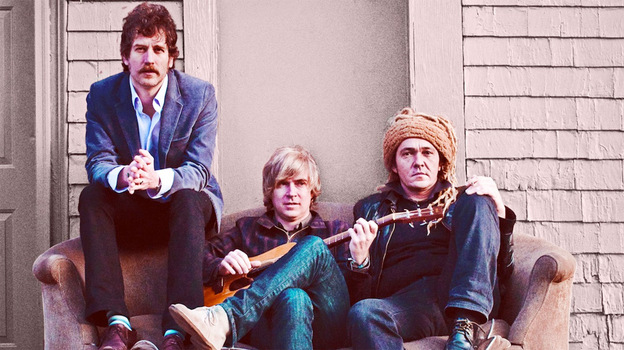
Hellbender is a band that Wells Tower was in before he became a professional writer.  He played guitar and sang backing vocals (and wrote some lyrics, but not on this album).  The drummer, Harrison Hayes is now the drummer for Les Savy Fav and the bassist and singer Al Burian is most notable for his zine Burn Collector (for a time he was the most famous former Hellbender, although I’d never heard of him).  They were always pretty small time, although their third album did receive some attention.

This first album is pretty rough–quickly made and cheaply mastered and yet there are good dynamics, cool breaks and a whole lot of punk.  Al Burian’s voice is in shouty punk mode (lyrics are not all decipherable) and although his voice works it’s a bit samey throughout the disc.  The drums don’t always sound great, but there are often cool drum breaks.  And the guitars are quite assured.  Despite the punk attitude, it’s not all flat out speed.

There are some dynamic breaks, like in the second track “Housebroken,” which has some cool moments when the drums highlight an unexpected tempo changed.  “Clocked Out” was the single they released prior to the CD and it has some real production values (and a very funny intro from a local DJ).  The guitar highlights the trebly end in a kind of ska riff which is quite different from the rest; there’s also some discernable bass lines and a cool bass/guitar solo (punk, yes, but branching out a bit).  It’s a great track.

“Two Twenty Two” made it onto a couple of local compilations.  It has a slightly less heavy feel, with some interesting guitar lines.  “Aisle Ten” has verses that end with some really heavy (reminding me of Metallica) riffs that really punctuate the vocals.  “Peeling” has some cool backing vocal chanting (as well as what sounds like an answering machine message) that sets it apart from the other songs.  “Clarence” has a really long instrumental opening (1 minute out of a 2 and a half-minute song) that shows of more of Burian’s bass lines.

“Couch” was the B-side to “Two Twenty Two” and it has better production values as well–and lots more dynamic parts.  The final song, Retread” is a sorta political song, “Do you remember when we were young–revolution seemed like fun.  I thought I could get things done by yelling at the top of my lungs.”  Not mind-blowing lyrically but a good sentiment nonetheless.

The band is very tight–their breaks and starts and stops are right on–many of their songs end suddenly and the band pulls it off very well.  When I first listened to the album, I thought it was kind of pedestrian, but after really listening, I realized this is a very well-formed debut. It’s an interesting addition to any punk fan’s collection and an interesting footnote for any fan of Wells Tower.  You can find a copy of the disc at Metro/Sea.

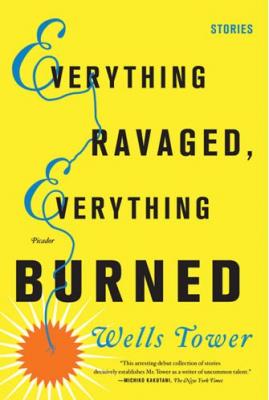
[READ: September 30, 2011] Everything Ravaged, Everything Burned

After talking about Wells Tower for a while and reading all of his uncollected stories and nonfiction, I finally got around to reading his short story collection.  And I think I have an interesting perspective on the book because at least two of the stories were totally reworked from their original release.  Not simply updating a thing or two, but totally revamped.  In my experience, aside from the David Foster Wallace essays that were truncated in their original form, this is the only book I know where the stories inside were totally rewritten for the compilation.

There are nine stories in the collection.  And I have to say as an overview to this book, I can’t get over how much I enjoyed them.  I mean, I knew I liked Tower from what I had read before, but I didn’t expect to enjoy this book quite so much because Tower writes a very manly kind of story.  He usually writes about tough guys and men who have a hard time interacting with their fathers and other situations that are out of my ken.  But Tower upends many conventions in his stories and his prose is tight and succinct and his stories are very quick to read and really enjoyable. (more…)

Read Full Post »

SOUNDTRACK: DINOSAUR JR.-Live at the 9:30 Club, Washington D.C. October 8, 2009 (2009).

This was one of the first shows I downloaded from NPR.  I’ve been a fan of Dinosaur Jr. since my friend Al turned me on to Green Mind back in college.

This is an amazing show created by the original Dino Jr. members.  This tour is in support of their second album since reuniting, Farm. This set-list is an outstanding mix of old songs, new songs, Barlow-sung songs and even some songs from when Barlow and Murph weren’t in the band.  (Green Mind is still my favorite album by them).

When the band reunited there was much joy, and I’ve said in reviews of the newer albums, I’m not entirely sure why.  I mean, Dino Jr has always been about Mascis, and it’s not like Barlow is such an unusual bassist (although Murph’s drumming is always solid).  I’ve nothing against Barlow (I love Sebadoh and Folk Implosion) or Murph, it just seems odd to get excited about having them back in the band aside from nostalgic reasons.

Having said that, the band sounds amazing (and yes, Barlow does get to sing on “Imagination Blind”).  What never really came across to me until hearing all of these great songs live was that Mascis has always been a great pop song writer.  These songs are catchy as hell. But Mascis buries them under loud squalling guitars and a voice that is almost whiny, almost off-key, a total slacker voice.  (But you’ll notice it is never actually off-key.  He must work very hard at that.)

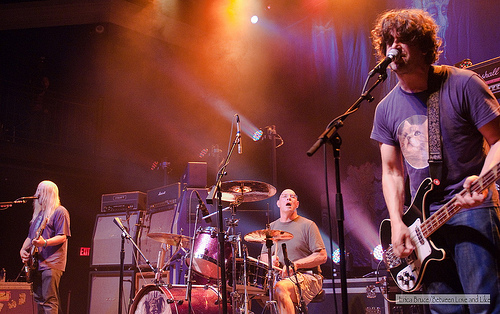
By the nd of the show Mascis chastises the audience for not moving (we obviously can’t see what they’re doing), saying he forgets that people don’t move in Washington, D.C.  But during the encore break, NPR host, Bob Boilen, points out that Mascis himself doesn’t move either–he just stands in front of that wall of Marshall stacks (Boilen wonders how he can hear anything anymore).  And looking at the pictures it’s comical the way he looks, surrounded by amps.  The picture above doesn’t fully do it justice, but check out the extra photos at the NPR page.  And while you’re there, listen to this show. It is amazing.  For a total slacker, Mascis can rock a guitar solo like nobody’s business.

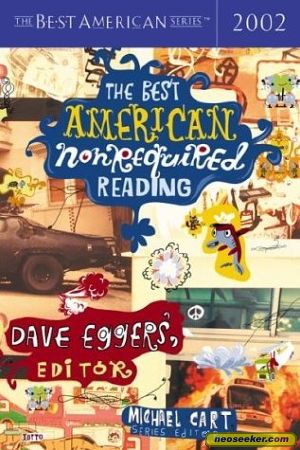
[READ: July 20, 2011] The Best American Non Required Reading

I’d been meaning to read this series for years (yup, Eggers fan), But I have a hard time starting “collections” because I feel like I’d rather be reading a novel.  Nevertheless, I have most of these Nonrequired books, so it seemed like I should dive into one and see what it was like (I don’t think the year really matters all that much–some of the articles are topical but most are not exactly).  Then Sarah said this would be a great book to read on vacation because it’s all short essays, and she was right.  It was perfect for late nights when I wanted something to read but didn’t feel like getting involved in the novel I was reading.

DAVE EGGERS-Introduction
Eggers’ introduction is actually a partial short story about kids who go swimming in pools around town. It reminded me of the opening of Life After God by Douglas Coupland, but of course, lots of kids did that so I’m not saying it was “lifted” from DC.  The story “ends” (it doesn’t really end so much as stop) with an interesting scene between two unlikely kids who get caught.

After this story Eggers includes these three notes about the collection: It’s not scientific, It’s alphabetical, and We had a lot of help with this.  Of the three, it’s the middle one that’s most useful because Eggers says that you shouldn’t necessarily read them in order just because they are printed this way: “In the first half of this collection, you get a good deal of hard journalism, primarily about war and refugees, from Afghanistan to the Sudan, followed immediately by a number of less serious pieces, about malls and Marilyn Manson.  We didn’t group anything by theme , and won’t be offended if you skip around.”  This was good to know (not that we needed the permission of course), but yes, the beginning of the book is pretty heavy. (more…)

Read Full Post »

SOUNDTRACK: RUSH-“You Can’t Fight It” (1973).

This is the B-Side of the first single Rush ever released (The A Side: a cover of “Not Fade Away”).  It was released briefly but has been long out of print.  Thankfully, people on the internets have access to all kinds of things. It’s pretty clearly Rush–Geddy sounds right, and it sounds like an Alex solo, so I think it’s fair to say that this is genuine.

It’s a pretty decent hard rock song from the 70s.  It sounds like it could be from any of the second tier bands back then.  It’s got some boogie and some swagger and it seems like it’s not about anything important (rock n roll, apparently).

While I’m obviously glad that Rush went on to bigger and better things, it’s fun hearing how confidently they fit into the context of music by their heroes.  This song has a cool riff, it’s quite heavy and it shows promise.

For a band that never releases B-sides or rarities or anything like that, I’ve been pretty surprised to see what is in their internet closet.

Enjoy!

(By the way, I’m not advocating the visuals of the video–I haven’t actually “watched” it–just the audio).

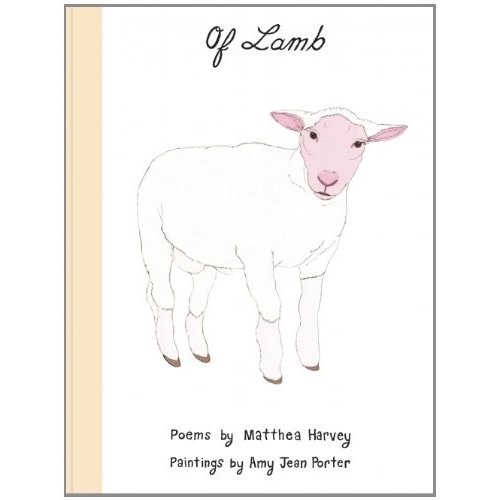
[READ: August 25, 2011] Of Lamb

This book is sort of subtitled: Poems by Matthea Harvey, Painting by Amy Jean Porter.

It’s the “poems” part that I have a hard time with, actually.  But let me get to that in a moment.

This book takes a nifty idea (an idea very similar to one that Jonathan Safran Foer is using in Tree of Codes, which, see tomorrow’s post) and fully realizes it.  But what’s funny is that she doesn’t tell you what this idea is until the afterword of the book.  So while I was reading it I wasn’t really sure what I was seeing.  The afterword made me say Oh, I get it now.  But I don’t feel that I can review it without explaining what she has done.  So, if you don’t want to know anything about the “secret” behind the book, skip the next paragraph.

[Spoiler?  Maybe.]

Okay, so essentially what Matthea has done is, she has taken a book at random (literally one she bought for $3 at a used book store), in this case, A Portrait of Charles Lamb, and she has created her poems out of that book.  In other words, on every page, she would find the words that she wanted to keep and she whited-out everything else (you can see an example in the book).  But rather than presenting the work like that, she had Amy Jean Porter make weird and cool paintings to go with every page’s worth of text (I assume Porter did the lettering as well?).  Since the book is about Charles Lamb, it was very convenient that his sister’s name was Mary.  So there was a Mary and a Lamb on almost every page.  Hence this sort of update of the Mary Had a Little Lamb story.

[end possible spoiler warning] (more…)

Read Full Post »

SOUNDTRACK: President Obama reading Where the Wild Things Are (2009).

A President who is literate!

Apparently my video won’t fit here unless I space this section out better.

I don’t really have anything to say, except that I enjoyed hearing him read this.

And it’s fun to watch the Secret Service pretend to be invisible.

One more line should do the trick.

See the video here.

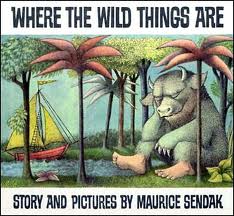
[READ: August 24, 2011] Wild Things

Okay, so this is a novel.  It is based on Where the Wild Things Are, the film by Spike Jonze and Where the Wild Things Are, the book by Maurice Sendak.  Obviously, Sendak’s book came first.  But, it’s only got about 60 words in it.  So, how do you make a film based on it?  Eggers and Jonze worked together for a long time to craft a screenplay and then (as Egger’s Acknowledgments explain) Jonze more or less took over the film and Eggers went off to write this book.

Hence, the book is fully titled:

The Wild Things: A Novel by Dave Eggers Adapted from the Illustrated Book “Where the Wild Things Are” by Maurice Sendak and Based on the Screenplay “Where the Wild Things Are” co-written by D.E. and Spike Jonze

I had read Egger’s except “Max” that was printed in the New Yorker ages ago and I liked it well enough, but it seemed so much like WTWTA, that I wasn’t sure what the point was (I didn’t realize it was an excerpt and, strangely enough, it’s an excerpt from several sections).  And since I had seen the film not too long ago (and honestly was kind of bored by it) I wasn’t really that excited about reading this.

But since I loved Zeitoun and this fur-covered book has been sitting near my bed for a couple of years now, I decided it was time.  And I really enjoyed it.

Well, here’s the thing.  This book is not a novelization of the film.  You notice that right away because the first chapter (which is awesome) is not in the film at all.  In it, Max rides his bike to his neighbor’s house.  His friend is not home but his mother is and when she sees Max all by himself and on his bike without a helmet she freaks out (even though they live about four houses apart).  His reaction and her overreactions are really very funny.

There are scenes from the movie in the book, of course.  It is adapted after all.  Indeed, it is more or less the same as the book, but there are many scenes which Eggers has added that really help to flesh out the story and give depth to everyone involved.  As a matter of fact, Max doesn’t reach the Wild Things’ Island until page 100 (out of 285 pages). (more…)

Read Full Post »

SOUNDTRACK: BILLY BRAGG-Live at the Newport Folk Festival (2009).

Billy Bragg is one of the great holdouts of aggressive political liberalism in music.  For every “American Idiot” that young bands play, Billy can whip out “There is Power in a Union” or the more prescient, “No Power without Accountability.”  Lyrics:

IMF, WTO,
I hear these words just every place I go
Who are these people? Who elected them?
And how do I replace them with some of my friends?

He’s an old school American folkie, despite the fact that he is so outrageously British that his singing accent is stronger than most British folks’ speaking voices.

But he’s not all politics (well, yes he is, but sometimes he disguises it).  Like on his minor hit “Sexuality.”  With some of the first gay positive lyrics I can remember hearing on the radio: “I’ve had relations with girls from many nations/I’ve made passes at women of all classes/And just because you’re gay I won’t turn you away/If you stick around I’m sure that we can find some common ground.”

Billy’s set is pretty great.  He plays the electric guitar for most of it (with an amusing moment where he switches to the acoustic guitar and references Dylan), and really, he needs no accompaniment.  He plays several of his own songs as well as a number of Woody Guthrie songs (both ones that Guthrie recorded and ones that Bragg and friends recorded for the Mermaid Avenue project).

Bragg also talks.  A lot.  His stage banter is as funny as it is impassioned.  And he urges people not to give in to cynicism about their newly elected President (the task is too great for him to please everyone).   Sometimes he comes across as really inspirational and other times as simply idealistic.

The only part of the show that I don’t really like is the “cover” of “One Love.”  I don’t particularly like the song to begin with and this version is 6 minutes long.  True, he modifies the lyric, but the basics are  the same.  Aside from that it’s a pretty rousing set (even if the DJs interrupt him about 40 minutes in, apparently thinking he was going to be end).

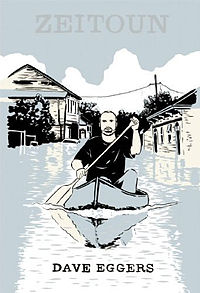
[READ: August 1, 2011] Zeitoun

I loved A Heartbreaking Work of Staggering Genius.  And I liked You Shall Know Our Velocity quite a bit too (and I just found out that YSKOV was rereleased as Sacrament with an extra 45 page section from Hand’s point of view–and that apparently there is only one copy available anywhere in the world and it costs $250!).

Anyhow, It was through Eggers that I found McSweeney’s (and its vast empire).  And yet during that time, I sort of gave up on reading Eggers’ published works.  When Zeitoun came out, I wasn’t all that interested to read it.  Mostly because I knew the book was about Hurricane Katrina, and I didn’t think I could handle a book about such a tragedy.

But recently, several people in book clubs had mentioned how good (and quick) of a read it was.  So I decided to give it a read.  And I’m really glad I did.

The book is about Abdulrahman Zeitoun, a Syrian born American.  He was living in New Orleans and was the owner of a very successful remodelling business (as well as the landlord of several properties around New Orleans).  Zeitoun is a hard-working, exceptionally conscientious man (the flashback to him running to work, carrying his broken bicycle on his back is as inspirational as it is amusing).  He rarely takes a vacation (much to his family’s chagrin) and oftentimes his wife has taken their kids on a vacation without him.  (One time they dragged into the car with his bags already in it without telling him they were going away for a weeklong vacation). (more…)

Read Full Post »

SOUNDTRACK: BLACK MOUNTAIN-Live at Sasquatch, May 30, 2011 (2011).

The previous Black Mountain live show I downloaded from NPR was a real disappointment.  For me the major problem was Amanda Webber’s voice–she applied a really harsh vibrato to the end of every single line.  It was so pronounced it sounded almost like a stutter.  I found it very distracting.

She doesn’t do that here, which automatically makes this set 100 times better (she has a minor vibrato on a few places, which is totally fine).  This Sasquatch concert covers songs from all three of their albums, which really showcases the diversity they explore within their trippy, space-rock, metal sound.  It works like a (brief) greatest hits for the band.

And the band sounds comfortable and fresh in this live setting (the guitars are fantastic and the keyboards add a wonderful spacey feel to the mix).  The two tracks of “Wucan” and “Tyrants” is particularly amazing; it’s interesting that they play four songs from their middle album and only three from their most recent.

Regardless, this release has won back my faith in Black Mountain live.

[READ: July 13, 2011] “The Gourmet Club”

I’d never heard of Tanizaki before and I haven’t really read that much Japanese fiction.  This translation by Paul McCarthy was really fantastic, and I never felt like I was reading a translation.

When I started this story (the first fiction from Lucky Peach), I was concerned that it was going to be the same kind of story as Neil Gaiman’s “Sunbird” (I realize “Sunbird” was published much later than “The Gourmet Club” originally written in 1919), but I’m glad it didn’t.

Essentially, this story focuses on five Japanese men who live to eat.  They are Epicurean to the highest degree, eating only the best at least once a day and often to bursting.  They go through all of the restaurants in Japan, traveling across the island to find new foods.  But they soon reach the end of their new food options. (more…)

Read Full Post »

« Newer Posts - Older Posts »