Feeds:
Posts
Comments

Archive for the ‘Magazines’ Category

SOUNDTRACK: GRINGO STAR-“Shadow’ (2011).

This song was forecast as a great Fall song on NPR.  The band’s name is perhaps too cutesy, but the music is interesting.  The verses are jangly and in no way prepare you for the Beatlesesque (ie., soaring harmonies) chorus that follows. 

There’s not a lot to the song, and on my first listen I wasn’t all that impressed in the beginning.  But by the end of the song I was won over. 

The song feels very familiar, but I can’t say that it sounds like anything in particular.  The ooo-ooohs in the chorus are really pretty, the intro guitar is more intricate than I realized.  And after just a few listens I was totally hooked.  It just seems like more of a summer record to me.

I’m curious to see what else is on this record. 

[READ: September 15, 2011] “A Hobo Memoir, 1936”

My company provided some links to interesting articles that are available on JSTOR, an electronic archiving resource.  If you have access to a university database, chances are you have access to these articles.  I was particularly struck by the fascinating subjects of a few of these pieces and for the next few posts I’m going to mention them.

I had to start with this article because for some reason my kids are obsessed with hobos.  I don’t really know how it came about–reading older kids’ stories, I suspect.  On our first train ride, we saw a freight car with a door open and there was much talk about hoboes sleeping in the cars and, hoo boy, it just escalated from there.  And, despite the fact that hobos haven’t really existed in eighty some years, once you keep an ear open for the word, you hear it quite a lot (Craig Ferguson was calling his audience hobos for a while–it’s a good comedy word).

This article contains an introduction by Elizabeth Rambeau, assistant editor of the magazine, who gives us a brief history of John Fawcett and of hobos in general.  Including this very informative distinction: a hobo is a transient person who looks for work while he travels, a tramp is a drifter who does not look for work and a bum is a stationary person who does not look for work.  So, be mindful of the epithets you use!  Fawcett, Rambeau tells us, was unlike most hoboes at the time.  Indeed, he wasn’t really a hobo at all.  He was the son of a wealthy doctor.  But he grew tired of his life at boarding school and decided to take a trip on the rails from West Virginia to Texas.  But he lived the hobo lifestyle, hopping trains, getting busted by the police, and not carrying any (or much, anyhow) money.  He even hung out with a hobo named Shorty.

The reason that this article is noteworthy (in terms of hobo literature) is that unlike other hobo memoirs from the time, Fawcett was an educated man and a decent writer in his own right (most hobo memoirs were recollections from the hobos themselves, written by ghostwriters).  This Memoir comes from meticulous diary entries that he kept during his entire trip.  And, of course, the article includes hobo signs, everyone’s favorite piece of folk art.  What’s interesting is that there are no extant records of original hobo signs.  They were made with chalk and all were ephemeral.  All of the signs we have are from people’s recollections and the signs included here were done by an art dept.

Fawcett’s original work comes from an unpublished 1991 book called Awakening of Conscience.  What we have is a twelve page excerpt.  In the author’s introduction, he explains his life situation, his family situation and his pressing need to have some freedom in his life.  In hindsight, he can’t imagine what kind of grief he put his parents through (he left a note saying he was going to a friend’s house but then took a month-long hobo journey) and he regrets that.   But he’s also pretty proud of what he did. (more…)

Read Full Post »

SOUNDTRACK: COSMO JARVIS-“My Day” (2011).

I learned about Cosmo Jarvis through NPR.  The DJs called it a love it AND hate it song.  But I find that I mostly love it.  The video is a blast to watch, but even without the video, the song is quite catchy and fun.  It’s a half punk song and half folkie/trad song.

So who the hell is Cosmo Jarvis?  Well, he was born in NJ, but is really from England.  He’s a filmmaker and musician and he’s had a hit with the song “Gay Pirates” that Stephen Fry raved about on his Twitter feed!  “Gay Pirates” is a fun shanty, but “My Day” is a full-on punk blast.

The song laments the state of things today and talks about how things were back in “my day” (which is of course funny since he’s 21).  The verses are a kind of folkie/storytelling style (but with electric guitars) and the end of each verse has a guitar riff that sounds traditional to me.  But when the chorus jumps in, it’s heavy, rocking, screaming punk.

Okay so the song is nearly 8 minutes long, which is probably overkill.  There’s a fairly lengthy instrumental bridge about 5 minutes in which features guitar and tin whistle solos.  And then the final 2 minutes are just fast metal screams of “My Day” with some wild soloing.  Yes, it’s too much (I’ll bet the single mix is awesome), but it’s still an enjoyable song.  Even without the video.

But you should watch the video, if only because it’s what the guys from Jackass would do if they were in a band and lived in the English countryside.

[READ: July 15, 2011] The Corrections

My company recently asked us if we had read any books over the summer.  I was able to pony up this review for our company newsletter.  I’ll be fleshing it out, but it’s pretty apt.

I’d put off reading this for a number of years, and I wish I had read it sooner.  It’s a very detailed look at one family: Elderly parents, thirty-something kids, and a few grandkids.  The depth of character development is amazing (and includes even depth of characters that the main characters interact with).  It’s a long book but it is very rewarding—comic scenes, moving scenes and one or two shocking moments.  It’s also the first time I’ve read a book where I thought, “even though I like this character, I think it would be better for everyone if he died.”  It’s an unnerving thing to think, but Franzen really makes you think about how family members impact one another.

It took me forever to start reading this book, obviously.  I wasn’t really interested in Franzen when all of the Oprah commotion came out, so I blew off this book entirely.  I’ve recently grown more interested in him.  But rather than reading his novels, I had decided to read all of Franzen’s New Yorker pieces.  (And even though I wanted to read Freedom when it came out, I felt that I should read this one first).  I wasn’t hesitant about reading it, I think I just wanted time to devote to it.  Much like I needed time to devote to writing up this post.  It’s been well over two months since I finished the book.

The Corrections is a wonderful, engaging story about three generations of the Lambert family (and many of the people they interact with).  The matriarch and patriarch of the family, Enid and Alfred, live in the midwestern town of St. Jude.  They have three children: Gary, a banker in Philadelphia who is (more or less unhappily) married with three children; Chip, a former school teacher and current playwright who sponges off of his younger sister while he tries to live the high life in New York City; Denise, a very successful chef who also lives in Philadelphia.  She has no children.  Gary’s children play a small but significant part in the story, keeping the three generations aspect working very well.

I found the first chapter a little slow and somewhat off-putting.  I read an excerpt from the novel in the New Yorker, which was a piece about Chip.  So I was surprised that the book opened with an older couple.  The chapter deals with Alfred and Enid.  Alfred’s dementia is hitting their household quite hard but Enid just feels that Alfred isn’t trying very hard.  Because Enid has very little in her life, she wants nothing more than to have her whole family together “one last time” for Christmas.  Enid and Alfred are long-married and this chapter picks up in the middle of a typical day.  So it takes a few pages to get up to speed.  Of course, once I did, I felt that the whole family was completely real and believable. (more…)

Read Full Post »

SOUNDTRACK: JONATHAN FRANZEN-Commencement Speech (audio) (2011).

You can hear the entire speech from the Kenyon College site.

[READ: May 28, 2011] Commencement Speech

On May 21, Jonathan Franzen gave a commencement speech to the students of Kenyon College.  When I think about my commencement speech (from Judy Woodruff of CNN), all I can remember is that I had never heard of her (and when I typed her name just now I got it almost entirely incorrect–the only thing right was the “wood” part).  I don’t recall a single thing that she said.  [It’s also fascinating that I can’t find any record of this speech anywhere online–what a different world it was twenty years ago].  I rather expect that most people feel this way about commencement speakers.  I have to wonder, if Jonathan Franzen had spoken at my college, would I have cared?  Is there even a chance that I would have read any of his novels (had they been published of course) when I was in college?  Would I be treating this any differently than my whatever speech in 1991?

But I like Jonathan Franzen and I wanted to read what he had to say. 

His speech is about love.  Love is kind of an odd topic for a commencement speech, isn’t it?   I mean, aren’t they supposed to talk about the Future and Jobs or something?  Or maybe even sunscreen?  But really, what is more useful for a 21-year-old to think about than Love.  Franzen hits the nail right on the head about Love, how it is a dangerous, risky proposition to put yourself out there, to take off your veneer and reveal all of your flaws–and hope someone will love you.  Not new or novel, but still true.

The way that Franzen gets into this subject is through technology.  It seems weird and artificial at first, but it’s a wonderful way to get into a young audience’s state of mind.  They were probably all looking at their iPhones while he was extolling the virtues of his new Blackberry (the old person’s phone, right?).  And when he segues into Facebook (who even knows if he has an account–but he seems to be well-versed with it, so maybe he does) you can imagine students raising their head in familiarity (maybe even updating their status) and wondering (as he puts it) if this 51-year-old guy is going to dis Facebook. (more…)

Read Full Post »

SOUNDTRACK: MEGAFAUN-“Find Your Mark” (2008).

After listening to the new Megafaun track, I checked the NPR archives.  They have this one song from their debut available for a listen as well.

It’s hard to believe that this is the same band.  Or perhaps I should say that a band can change a lot in three years.  This song begins as a three-part near-a capella barbershop/bar trio.  It reminds me in many ways of a Fleet Foxes track, except they seems more rowdy.  The song merges into a delicate guitar picking section with all of the voices “ba ba ba” ing.  Then, that guitar melody expands to an electric guitar and full band sound.

The introduction to the track (from the NPR DJ says that the album may not be everyone’s cup of tea.  But I like this track so much (even though it is so very different from their 2011 release), that I need to listen to more from this band.  Spotify, here I come. [Actually the album has some pretty crazy noises on it!].

[READ: August 20, 2011] “The Losing End”

This is a strange story about a man named Lamb.  The reason it is strange is because the middle of the story–the exciting part, the part I most enjoyed–is not really the point of the story, at least if the ending is to be believed.

As the story opens, Lamb has just been to his father’s wake.  He is feeling adrift so he goes to a parking lot to sit and think.  In addition to his father, Lamb is also thinking about his wife and his girlfriend.  I’m a little unclear exactly what is happening with his wife (Cathy) but he definitely trying to get time away from her to spend it with Linnie. While he is sitting there lost in thought, a young girl in an ill-fitting tube top approaches him. (more…)

Read Full Post »

SOUNDTRACK: MEGAFAUN-“Get Right” (2011).

I’ve never heard of Megafaun before, but this song is just wonderful.  It’s an 8 minute blast of psychedelia that covers and sometimes obscures a beautiful poppy song.  I hear overtones of Dinosaur Jr (but more for J. Mascis’ seemingly lazy style than for his crazy guitar riffing) and a bit of the Lemonheads in the folky pop feel.  Throw in a dose of My Bloody Valentine for the waves of sound and you get a perfectly lovely track.

The opening is a fairly simple, straightforward melody.  And his voice is so familiar-sounding.  There’s some cool squeaky/feedbacky guitars layered over the top of a hazy distorted sound.  By about four minutes, the song turns into an instrumental, with a guitar solo that comes in an out of the hazy chords.

This is a great song, and although the NPR write-up says this is the longest track, I imagine the rest must be equally as exciting.  Preview it on NPR.

[READ: September 1, 2011] “Asleep in the Lord”

This is a story about Mitchell, a formerly unhelpful person who never changed a diaper or helped a sick friend.  He has decided to change that, so he goes to Calcutta with the intention of joining Mother Teresa’s mission (and just how many stories involve Mother Teresa these days?—she even makes an appearance in the piece!).  He’s reluctant to do anything majorly gross, but he’s happy to hand out medicines (for what good they do).

After a few days, Mitchell is still somewhat surprised by his decision to go to Calcutta at all.  Then he meets Mike and Herb.  Herb is following the Bhagwan, but Mike is less grounded in who he is following here in India .  He came here because the economy tanked back home and he wanted somewhere to hide out for a few years.   As we learn more about Mitchell, we see that his intentions are understandably confused.  For really, like Mike, he also came to India to wait out the recession.   However, unlike Mike, he honestly did come to seek some kind of spiritual guidance.  Mike seems to be here for the easy sex–he has a picture of a young woman from Thailand who wanted “to marry him.”   (more…)

Read Full Post »

SOUNDTRACK: SPARKS-“Good Morning” (From the Basement) (2008).

I’ve enjoyed Sparks for a long time.  But I never got around to getting the album that this song comes from (Exotic Creatures from the Deep–which has two wonderful song titles: “Lighten Up, Morrissey” and “I Can’t Believe That You Would Fall for All The Crap In This Song.” 

“Good Morning” was the first single from the album.  It features a very bouncy keyboard opening which reminds me of Strangeways-era Smiths.  And then Russel Mael’s crazy falsetto comes pounding in on top of the whole thing. 

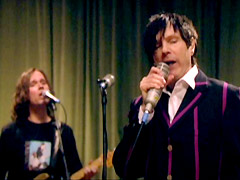
Visually, Sparks are fascinating because Ron Mael looks exactly the same as he has since day one: slicked back hair, thick glasses and a crazy little moustache.  This band is doubly fascinating because the two guitarists and bassist all have shoulder length hair and are wearing T-shirts with the new album cover on them.  In fact, the bassist and one guitarist look like they could be twins (the other guitarist is wearing a hat, so he messes with the identical-ness).  It’s an amusing scene to see.

This is a strange song, it’s catchy in its repetitiveness, but it’s got a cool bridge that breaks up the song into different parts (and the backing guys hit the high falsetto notes perfectly–I think I would have assumed they were women!).  This seems like a strange choice for a single and I can see wh it wasn’t a big hit.  (Most Sparks songs are kind of strange, so who knows which of their songs will catch on).  Of course, I don’t know the rest of the album so I don’t know if there was a more likely choice.  Nevertheless, I may have to investiagate this disc a bit more.

[READ: August 31, 2011] “My Chivalric Fiasco”

This is the second Saunders piece in a couple of weeks in two different publications (this seems to happen to him a lot–do I smell a new book coming out?).  This is one another of Saunders’ more corporate-mocking pieces.  He plays around with name brands and has a lot of trademarked and capitalized words.

But it starts off very unlike that whole realm. It seems to be set at a Ren Faire or some such thing.  On TorchLightNight the narrator sees Martha running through the woods saying, that guy is my boss.  Don Murray comes out of the woods after her, and it clear that something has gone on between them.  When Ted, the narrator, asks them what’s going on, they admit to a “voluntary” fling.  Then Don tells Ted that he has been promoted out of Janitorial; he is now a Pacing Guard.

The next day, Ted is given some KnightLyfe, a pill that helps him with medieval improv.  Until the pill kicks in, Ted is horrible in his role, but once it does, he (and the story) switch into a  kind of crazy Ren Faire “Olde” English: “Quoth Don Murray with a glassome wink, Ted you know what you and me should do sometime?” (more…)

Read Full Post »

SOUNDTRACK: EXPLOSIONS IN THE SKY-Take Care, Take Care, Take Care (2011).

I found out about Explosions in the Sky because of the events of 9/11.  Back when everyone was looking for albums to point fingers at in some kind of hysteria (that’s also how I found out about I am the World Trade Center who are not as exciting as Explosions…).

EITS make beautiful epic instrumental music (as well as the soundtrack for Friday Night Lights).  They play music in a similar vein to Mogwai, but they take their epic instrumentals in a different direction.  And this album is perhaps their most commercial to date (as commercial as you can be when you write 10 minute instrumentals).  And while “commercial” is not usually an adjective that I give as praise, for this album it is indeed.

Take Care, Take Care Take Care is a terrific album.  It ‘s not as visceral as past releases; rather, it seems like a more experienced band playing with their sound and tweaking it in subtle ways to make it less obviously dramatic but somehow more powerful.

On “Last Known Surroundings,” there are soaring guitars that give way to simple, pretty guitar riffs.  Martial drums propel the songs forward, even if they lead to unexpected places.  It’s soundtrack music that’s not background music.

Perhaps the biggest difference with this album and previous ones is that this album doesn’t quite live up to the band’s name.  There’s no major explosive crescendos.  There are noisy bits but they’re not climactic per se.   “Human Qualities” slows to a quiet drum beat and while you’d expect to come out of that with a cacophonous explosion, it doesn’t.  The explosion does come later, but only after it has worked up to it again.

“Trembling Hands” features “voices.”  Or maybe just one voice.  It’s on a loop that becomes more of a sound than a voice.  The song is only 3 minutes long, but it’s an intense 3 minutes–more great drum work on this one.

“Be Comfortable, Creature” has a beautiful delicate guitar opening that drifts into a kind of solo.  After 3 minutes it settles into the main riff, a winding guitar line that send you on a journey.  “Postcard from 1952” is a great song. It begins as quiet intertwining guitars and slowly builds and builds into a gorgeous rocking conclusion.  7 minutes of steady growth with a nice epilogue at the end.

The final song, “Let Me Back In” also has kind of spooky voices that appears throughout the song (distorted and repeated).  But you know this song is a winner from the get go (even if the opening chord structure is a bit like Duran Duran’s “Come Undone.”)  It’s a slow builder, a cool, moody ten minute piece.  When you get to the beautiful descending guitar riff that shoots out after about 2 minutes, it’s an ecstatic moment–air guitars are mandatory.

And let’s talk packaging.  The album comes in a gate-fold type of cardboard.  If you open it up all the way it can be folded into a little house (with windows and a door and a chimney).  That’s pretty cool, guys.

If I have one compliant about the album it’s that the quiets are really quiet and he louds are really loud.  That makes this a very difficult album to listen to say, at work, or basically anywhere where other people will be blown away by your speakers.  The middle of “Human Qualities” for instance, is really quiet, you feel like you need to turn it up to hear the drum beat–there’s too much volume fiddling (listening in the car by yourself negates any reason for this complaint, of course).

Keep it up, guys.

More “controversy” from the band

[READ: September 10, 2011] New Yorker essays

Ten years ago, The New Yorker published several short essays by famous and (to me anyway) not so famous writers.  They were all written directly in the aftermath of the attacks and they were moving and powerful.  I was going to wait until today to re-read them and post about them, but for various reasons, I decided to do it on May 12.

Now, ten years later, The New Yorker has published several more essays by famous and (to me anyway) not so famous writers.  I note that none of the authors are the same (that might have been interesting) although Zadie Smith does quote from John Updike’s piece of ten years ago.

The strange thing to me about these pieces is that ten years seems to have hindered the writers’ ability to focus on the incident and to talk about What It Means.  In this collection of essays, we have a few that talk about an individual and how his life has changed since 9/11.  These are pretty powerful, although it’s odd that they would talk about another person and not themselves. We have a couple of essays that talk about the writer him or herself, but these seem kind of unfocused.  And then we have ones that talk about the state oft he world; honestly, what can you say about that.

It’s possible that I’m jaded or in a bad mood and that’s why I didn’t appreciate these essays.  Or perhaps I’m just facing the futility of things.

This is not to say that I think that writing about 9/11 is easy (you’ll notice I’m not doing it).  Indeed, I think talking about it in any kind of meaningful, non-strident, non-cliched way is nigh impossible.

But these writers do give it a try.  And I am grateful for that. (more…)

Read Full Post »

SOUNDTRACK: RHEOSTATICS-Calling Out the Chords Vol 1 (2005).

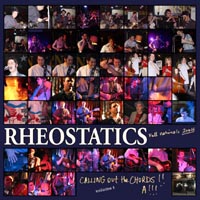
In addition to the Rheostatics’ main catalog, the cool label Zunior has released a couple of “official” bootlegs.  Calling Out the Chords Vol. 1 (no Vol. 2 has been released as of yet) is a collection of 2004 live recordings from The Legendary Horseshoe Tavern.  The Rheos do multiple nights at the Tavern, and this is a selection of songs from those shows.

It’s an interesting mix of essential live recordings and weird tracks that die-hards will appreciate but that newbies may scratch their heads at.  Some essential recordings are the wonderful version of “California Dreamline” that segues into a blistering version of “Horses.”  The version of “Mumbletypeg” with The Fall National Horns adding brass is also pretty great.

But there’s a number of songs here that are peculiar.  Great for fans, but perhaps hard to explain otherwise: an instrumental version of the 1996 song “Four Little Songs.”  I’m not sure why they went instrumental, as the lyrics are pretty essential, but there ya go.

There’s a crazy song “We’re All Living in a Chemical World” sung by special guest Ford Pier.  The intro says that this was one of Tim Vesely’s first songs, and it’s written in their early synth pop style (Pier is an insane vocalist too).  It’s quite a surprise.  And speaking of guests, there’s a lot of music from special guest Kevin Hearn (who has been with Barenaked Ladies since 1996–Hearn is a touring machine, apparently).  Anyhow, he contributes two songs to this disc “Who is that Man and Why is He Laughing?” and “Kevin’s Waltz” and he helps out on “I am Drummstein” and “Weiners and Beans.”   “I am Drummstein” and “Weiners and Beans” are unusual tracks as they come from their children’s album and their tribute to the Group of 7.

The final track is “Legal Age Life at Variety Store,” one of their staple live songs.  But this one has a twist contest in the middle.  Audience members are invited onstage to twist.  It is quite long (and without the actual visuals, it’s a bit hard to listen to more than once or twice) but it’s a fun way to hear the band interact with the audience and it shows what a fun live show they put on.

This is a great recording and a bargain for $5.55.

[READ: August 31, 2011] “Home”

I read this story twice.  The first  time, I didn’t really like it, I found it to be  kind of jumbled and confused.  I don’t know if that’s a typical reaction to this story or if I was feeling lazy, because the second time through I followed it okay and I enjoyed it quite a bit.

It’s a social commentary from Saunders, although exactly what the comment is is a bit unclear to me (even after the second reading).  The main character is a veteran who has just returned from one of the wars we’re fighting, “…the one that’s still going on.”  When he gets back home, his mother has shacked up with an unemployable guy, his sister won’t let him see her new baby and his wife has taken their son and has shacked up with some asshole he knew in high school.

And every time someone finds out he just got back from the war (like the sheriff who is evicting his mom), they all say, amusingly, as if by rote: Thank you for your service. (more…)

Read Full Post »

SOUNDTRACK:  MY MORNING JACKET-“Touch Me, I’m Going to Scream (Part 2)” (From the Basement) (2009).

As I mentioned, My Morning Jacket is one of the few bands that has two videos up on the From the Basement site.  So here is Part 2 of the song from yesterday.  While Part 1 is a beautiful, smooth, folkie kind of song, Part 2 delves into a more electronic sound.  It starts with some keyboard noodlings, morphs into a loud rocker and then ends with more keyboards noodlings. 

I enjoyed watching this because Jim James is playing the keyboardy parts on a very small contraption the size of an iPad.  It’s one of those new fangled instruments that make me show my age.  I gather it’s a sampler, but even looking at the buttons I have no idea what he’s doing with it.  About midway through the song, James puts down the keyboard object and pulls on the Flying V guitar for some good loud guitars. 

Again, the harmonies are fantastic and it’s cool to see the whole band sing along.  I also enjoyed watching the other guitarist play the slide on his guitar.  

By the end of the video, it’s amusing to see them all sink lower and lower to the ground as the music fades and regresses into tiny quiet twinklings.  Until, that is, the surprising (and unannounced) addition of the 6 second “Good Intentions.”

Jim James does not wear a cape during this song, by the way.

[READ: September 1, 2011] “Trading Stories”

I have still yet to read much Lahiri, a woman whom I know I should be reading.  And now that I just learned she won a Pulitzer, it seems even more egregious that I haven’t. 

This personal history is about growing up without books.  Her father was a librarian so they borrowed a lot of books; however, but she never really owned any.  [My wife and I are not that kind of librarian–books litter our house]. 

The story reveals Jhumpa as a child writing stories with a friend in school (even during recess).  They were immensely creative and inventive and they loved it.  But she slowly began losing interest in writing.  (more…)

Read Full Post »

SOUNDTRACK: MY MORNING JACKET-“Touch Me, I’m Going to Scream (Part 1)” (From the Basement) (2009).

My Morning Jacket is one of the few bands that has two videos up on the From the Basement site.  The two videos are parts one and two to the song “Touch Me, I’m Going to Scream” (which is kind of funny as the two parts are really quite unrelated and they seem to have been recorded not consecutively in the show.

As I mentioned in the Fleet Foxes review, I love seeing bands singing harmonies.  And the voices in My Morning Jacket songs are often soaring and, sometimes unbelievable (how does Jim James hit those notes?).  So this “concert” is visually satisfying in this regard.  Not to mention, Jim James wears a cape throughout the song!

It’s also very satisfying musically.  The band sounds great (as have all of the bands during these sessions).  “Touch Me” is a great catchy, sing along song from Evil Urges.  And this version is quite perfect.

[READ: August 30, 2011] “The Aquarium”

This is the first of the longer articles in the New Yorker’s 2011 Summer Fiction issue.  But despite the issue’s title, this is not a work of fiction (at least I hope it isn’t because it’s a shitty thing to make up).  So, assuming it is true:

Hemon found out that his nine-month old daughter had a brain tumor.  This essay details his life while dealing with this unthinkable issue and also trying to maintain a normal life for his three-year old daughter.  He tells this story in a surprisingly roundabout way.  Meaning, we don’t learn the fate of his daughter till nearly the end of the essay.  And in this way it mimics his own experience of finding out the fate of his daughter: one hundred and eight days after the initial diagnosis.  (more…)

Read Full Post »

« Newer Posts - Older Posts »