Feeds:
Posts
Comments

Archive for the ‘New Yorker’ Category

SOUNDTRACK: CAROLINA EYCK AND CLARICE JENSEN-Tiny Desk Concert #816 (January 11, 2019).
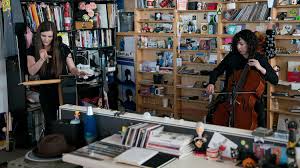
There have been a lot of bands I have first heard of on Tiny Desk and whom I hope to see live one day.  Carolina Eyck and Clarice Jensen are two women I would love to see live–together or separately.

The concert opens with a looping voice (Carolina’s) and what appears to be her using a theremin to play looped samples.  And then soon enough, she starts showing off how awesome she is at the futuristic 100-year-old instrument.

Carolina Eyck is the first to bring a theremin to the Tiny Desk. The early electronic instrument with the slithery sound was invented almost 100 years ago by Leon Theremin, a Soviet scientist with a penchant for espionage. It looks like a simple black metal box with a couple of protruding antennae, but to play the theremin like Eyck does, with her lyrical phrasing and precisely “fingered” articulation, takes a special kind of virtuosity.

After playing a remarkably sophisticated melody on the theremin (with suitable trippy effects here and there), for about three minutes, she explains how the instrument works.  She even shows a very precise scale.

The position of the hands influences electromagnetic fields to produce pitch and volume. Recognized as one of today’s preeminent theremin specialists, Eyck writes her own compositions, such as the pulsating “Delphic” which opens the set, and she’s got big shot composers writing theremin concertos for her.

Up next is Clarice Jensen with “her wonderful cello.”

Joining Eyck for this two-musician-in-one Tiny Desk is cellist Clarice Jensen. When she’s not making gorgeous, drone-infused albums like last year’s For This From That Will be Filled, Jensen directs one of today’s leading new music outfits, ACME, the American Contemporary Music Ensemble.

Jensen doesn’t explain what’s going on, but she makes some amazing sounds out of that instrument–she’s clearly got pedals and she modifies and loops the sounds she’s making.

“Three Leos,” composed by Jensen, offers her masterful art of looping the cello into symphonic layers of swirling, submerged choirs with a wistful tune soaring above.

Vak Eyck comes back for the final song, a wonderfully odd duet of cello and theremin.

The two musicians close with “Frequencies,” a piece jointly composed specifically for this Tiny Desk performance. Amid roiling figures in cello and melodies hovering in the theremin, listen closely for a wink at the NPR Morning Edition theme music.

Van Eyck make soaring sounds, while Jensen scratches and squeals the cello.  Within a minute Jensen is playing beautiful cello and Van Eyck is flicking melodies out of thin air.

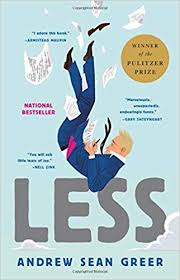
[READ: June 24, 2017] Less

It wasn’t until several chapters into this book that I realized I had read an excerpt from it (and that’s probably why I grabbed it in the first place).  I also had no idea it won the Pulitzer (PULL-It-ser, not PEW-lit-ser) until when I looked for some details about it just now.

It opens with a narrator talking about Arthur Less.  He describes him somewhat unflatteringly but more in a realistic-he’s-turning-fifty way, than a displeased way.

And soon the humor kicks in.

The driver who arrives to take Less to an interview assumes he is a woman because she found his previous novel’s female protagonist so compelling and persuasive that she was sure the book was written by a woman (and there was no author photo).  So she has been calling out for “Miss Arthur,” which he has ignored because he is not a woman.  This makes him late and, strangely, apologetic.

He is in New York to interview a famous author H. H. H. Mandern who has, at the last moment, come down with food poisoning.

It takes only ten pages to get the main plot out of the way:

Less is a failed novelist about to turn fifty. A wedding invitation arrived in the mail: his boyfriend of the past nine years is about to be married to someone else. He can’t say yes–it would be too awkward–and he can’t say no–it would look like defeat. The solution might just be on his desk –a series of invitations to half-baked literary events around the world.  Can he simply get out of town, and go around the world, as a way to avoid looking foolish? (more…)

Read Full Post »

SOUNDTRACK: MIGUEL ZENÓN feat. SPEKTRAL QUARTET-Tiny Desk Concert #814 (January 4, 2019).

When I saw that the artist was a quartet, I assumed this was classical music.  But then I saw that the main guy played saxophone.  So was this jazz?

In the end it doesn’t matter.  It’s glorious, modern instrumental music with instruments that at times fit so perfectly, you don;t realize there’s a reed in the strings.  And at times an instrument that stands out like its own unique thing.

Saxophonist Miguel Zenón is a big thinker — that much is clear from his recorded output, with its deep and inspiring connection to the folk traditions of his native Puerto Rico. But you also get that sense from his turn behind the Tiny Desk, where we can watch the concentration on his face and those of his adventurous band, the Spektral Quartet. This is life-affirming music with curious twists and turns, expertly performed by amazingly talented musicians.

The three songs work on mainly the same principle: fast, intricate string melodies with sudden time changes.  And a saxophone that either accompanies them or solos around them.

“Rosario” opens with the strings and sax playing an almost warm up sound before the pizzicato strings support the main sax melody.  There’s some very modern frenetic striking string music (with no sax) which is followed by the same strings with a lead sax solo over it.  The end of the piece features a delicately plucked cello and a lovely violin melody.

“Milagrosa” opens with everyone playing the same melody.  It’s fascinating how much the sax does not contribute–until it does.  But I’ll let the blurb talk about the amazing ending of this song:

There are two ways to marvel at the stunning unison playing that comes about three-quarters of the way through “Milagrosa.” First, listen with your eyes closed. The notes cascade at a such a fast clip, it can leave you breathless. Now, watch with your eyes open: It’s a joy to see Zenón and his band read the notes from the page, at times sneaking in visual cues with smiles just below the surface. It must be such a pleasure to make music like this.

The way the song starts and stops and starts again with such speed is really spellbinding.

He says that these songs were inspired by cultural and musical traditions from Puerto Rico.  Specifically, the final song, “Villabeño” alludes to a subgenre of Puerto Rican music–from the mountains

It is the quietest and lest intense song of the bunch.  The strings, even though they are largely playing staccato, are kind of hushed as Miguel plays the most jazzy solos of the set.  There’s a brief moment near the end where the strings come back to the fore, but it’s more as a supporting agent than a competitor.  It’s quite cool.

[READ: January 11, 2019] “Wrong Object”

I loved the way this story revealed the heart of itself.

It is written from the point of view of a therapist.  She writes that she has a new patient and he is very dull: “He is a nondescript man.”

He said his problem was himself–that his wife was thoroughly nice.  While she preferred a self-critical patient to a blamer, there was just nothing to him.  Usually her notebooks were full after a session, but she wrote very little about him: “Talks about wife, what a good person she is.  Annoying.”

She actually had to google him to find out even a little bit of information about him.  She felt bored by him.

She was about to suggest he seek a new therapist when he finally revealed what he had been holding back.

“I’m a pedophile,” he said. (more…)

Read Full Post »

SOUNDTRACK: HAROLD LÓPEZ-NUSSA-Tiny Desk Concert #812 (December 14, 2018).

This was the final Tiny Desk Concert of the year and it featured a pretty traditional jazz trio (piano, bass, drums) from Cuba.  There have been a number of Cuban musicians on Tiny Desk, but I always defer to the blurb:

Cuba is known as much for their pianists as their percussionists — you’ll see why with this performance.

They play three songs.  The first is “Elegua” which opens

with some help from a recording of famed Afro-Cuban folkloric singer Lázaro Ros. Ros is both a musical and spiritual guide for this performance; the trio dug deep into the ritual music of santeria for inspiration with “Eleguá,” a tribute to one of the Afro-Cuban deities.

After about two minutes, Harold plays a nifty staccato riff on the piano while the bass plays a cool  related melody.  The song runs about six minutes and mid way through Ros returns to recite over the music.

When the song is over, Harold introduces his “brothers.”  His literal brother Ruy on drums and his brother from an other mother and father Gastón on bass.

(Special mention should be made of Harold’s brother, Ruy López-Nussa, on drums, and bassist Gastón Joya, who both fill the spaces between the beats while elegantly leaving breathing room within the performances.)

Joya is a treat to watch as he has a contented smile on his face for much of the set.  But it’s Ruy who is the most fun.  With his suit and bow tie and the unconventional way he holds the sticks he is fascinating to watch.  He looks like he is trying to be funny, the way he is playing.  Maybe he is just having fun but his playing is spectacular.

“Preludio (to José Juan)” is shorter–quiet and pretty.  It opens with a lovely melody on the piano.  There’s brushes on the drums and a quiet, subtle bass solo on the middle.  The song is much shorter and the closing minute is just beautiful.

“Hialeah” has the recognizable piano riffs — called guajeos — that we can recognize as originating with Cuban dance music, but the trio deftly melds that rhythm to a complex jazz exploration, without compromising its dance able pulse.

The melodies are recognizable, and yet he is basically riffing with them.  The piece opens with frenetic finger work on the piano with some complex drumming.  The rhythm is playing a dancey melody with some wild soloing on his right hand.  By around 14 minute into the set, he is an amazing blur pf speed and melody.  After a brief one second pause they come back with a phenomenal little drum display.

[READ: January 11, 2019] “All Rivers”

I have really come to enjoy Amos Oz’s stories–they are never about what I think they will be about.

This one was surprising for the way it was constructed as well.

The narrator, Eliezer is fondly remembering a woman ,Tova, who has a profound impact on his life. He says the name Tova was simple and popular and, he felt, didn’t suit her, a young poetess.  He doesn’t remember the color of her eyes, although he does remember the color of her trousers–dark blue/gray and tattered coarse material.

As he is describing her he interrupts himself.  He explains that he wants to be systematic and do things in order, but that he keeps getting ahead of himself  Every time he thinks about her, everything rushes to be first. (more…)

Read Full Post »

 SOUNDTRACKLONELY LEARY-“Flaneur” (2018).

At the end of every year publications and sites post year end lists.  I like to look at them to see if I missed any albums of significance.  But my favorite year end list comes from Lars Gottrich at NPR.  For the past ten years, Viking’s Choice has posted a list of obscure and often overlooked bands.  Gottrich also has one of the broadest tastes of anyone I know (myself included–he likes a lot of genres I don’t).  

Since I’m behind on my posts at the beginning of this year, I’m taking this opportunity to highlight the bands that he mentions on this year’s list.  I’m only listening to the one song unless I’m inspired to listen to more.

One of the things that I love about Lars, and this list is a great example, is how effortlessly multicultural he is.  He doesn’t listen to music because it’s from somewhere, he listens to music wherever it;s from because he likes it.  So this band, with the decidedly English-sounding name Lonely Leary is actually from China.  Lars says that the

The excellent label Maybe Mars documents the current Chinese underground music scene, from the psych-rock of Chui Wan and surfy shoegaze of Dear Eloise to P.K. 14, Beijing’s experimental rock pioneers.

Lonely Leary is a post-punk band which sounds like they would fit right in with Protomartyr or even The Fall, Sonic Youth or Joy Division.  The fact that they are from China and sing in Chinese doesn’t affect the tone and overall feel of the music, it somehow makes it more intense (to my ears).

Lars describes their debut album as one “where noise needles into perversely kitschy surf riffs and hoarsely barked punctuation marks.”  Although I hear less kitschy and more Dead Kennedy’s guitar and feedback noise.

The sounds they achieve throughout the album are great.  “Flaneur” opens the disc with a screaming feedback followed by a rumbling bass.  There’s some great guitar lines from Song Ang (which remind me of Savages) and then Qiu Chi barks his dissatisfaction through to a satisfyingly Dead Kennedys-ish chorus.  There’s even some Savages-esque chanting as the song squeals to and end.

This is great stuff.

[READ: January 4, 2019]  “Father”

Here is a new year and a new essay from Sedaris that perfectly mixes emotional sadness and hilarious light-heartedness.

The night before his fathers 95th birthday, his father turned in the kitchen and fell.  David’s sister and brother-in-law discovered him the next day and brought him to the hospital.  They felt the most disturbing thing was his disorientation, including getting mad at the doctor: “you’re sure asking a lot of questions.”  He was lucid the following day, but he was quite weak.

David was in Princeton on the night his father fell [at a show that I could have been at–we opted not to go this year].   He called his father and said that he needed him to be alive long enough to see trump impeached.

A few months later, his father moved into a retirement home.  David and Hugh visited and at first he seemed out of it, but hr recognized both of them instantly.  The thing was that he was no injured.  He had tried to move his grandfather clock (one of the prized possessions he brought to the home) and it fell on him (for real).  Many family members called the clock Father Time, so David said to Hugh “When you’re 95 and Father Time literally knocks you to the ground, don’t you think he’s maybe trying to tell you something?” (more…)

Read Full Post »

SOUNDTRACKMIKE SCHIFLET-“00:00:00:00” (2018).

At the end of every year publications and sites post year end lists.  I like to look at them to see if I missed any albums of significance.  But my favorite year end list comes from Lars Gottrich at NPR.  For the past ten years, Viking’s Choice has posted a list of obscure and often overlooked bands.  Gottrich also has one of the broadest tastes of anyone I know (myself included–he likes a lot of genres I don’t).  

Since I’m behind on my posts at the beginning of this year, I’m taking this opportunity to highlight the bands that he mentions on this year’s list.  I’m only listening to the one song unless I’m inspired to listen to more.

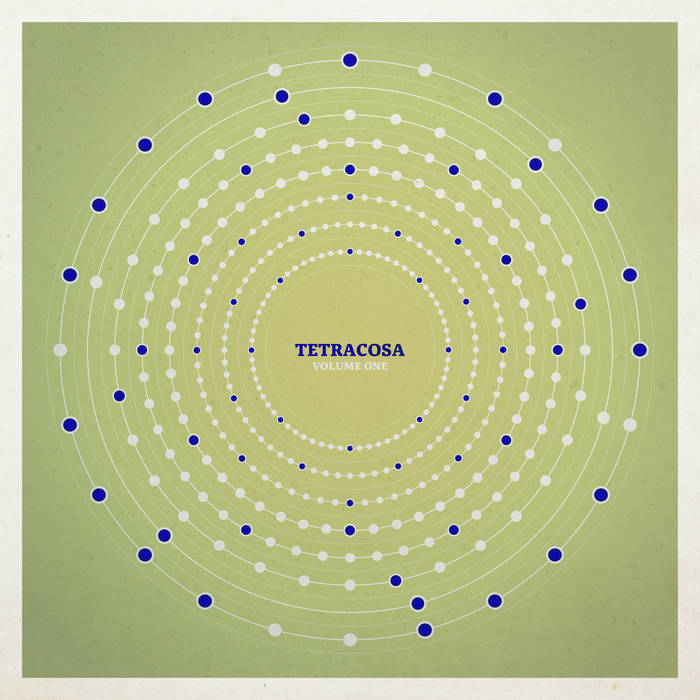
Mike Schiflet released a 24 hour drone composition this year called Tetracosa.  This is the opening movement from it.  It is fifteen and a half minutes of slightly disconcerting drone composed of “effervescent guitar, blasted noise and electro-acoustic detritus.”

The drone is surprisingly “fast-paced” if that can be said of something without a beat.  The sounds and textures change and undulate at a pretty good clip.  At times it feels soothing, but then it throws in a note that pushes things a little off-kilter.  At times it is soothing but then comes zapping electronics which would certainly make for restless sleep.

I cannot imagine listening to this for 24 hours, although it would be a fascinating day if you did.

[READ: January 4, 2019] “Philosophy of the Foot”

This is the first story of the year and Soomro’s first published story.

It is set in Karachi and there is a boatload of subtext in this story.  As well, of course, as a lot of cultural information that I don’t understand.

Amer is an adult male (the younger boy calls him “uncle”) who stops to talk to the shoe repair boy. The boy has a cart and equipment and he takes great care of the shoes he has.   He is very knowledgeable.

Amer goes into his apartment and talks to his mother asking if they have anything for the shoe boy.  The ayah (a native maid or nursemaid employed by Europeans in India) suggests that Amer’s father had a trunk full of shoes which they could have sold.  Instead, Amer takes an old pair of his father’s shoes to be repaired.  (more…)

Read Full Post »

SOUNDTRACK: KASVOT VÄXT-“Turtle in the Clouds” (1981/2018).

Back in 1994, Phish started covering a classic album for its Halloween costume. In 2015 they covered the Disney album: Chilling, Thrilling Sounds Of The Haunted House, which pretty much meant all bets were off.  So in 2018, they decided to cover an obscure Scandinavian prog rock band called Kasvot Växt and their sole album, í rokk.  This proved to be a big joke–they were a nonexistent band.  They had so much fun creating this band, that they even enlisted others to expand the joke.  This included impressively thorough reviews from WFMU and from AllMusic.

The joke is even in the name: when translated together Kasvot Växt and í rokk means “Faceplant into rock.”.

Here’s some more details they came up with:

The Scandinavian prog rock band purportedly consists of Jules Haugen of Norway, Cleif Jårvinen of Finland, and Horst and Georg Guomundurson of Iceland.  The album’s label, Elektrisk Tung, supposedly went out of business shortly after the LP’s release and little information about the record appears on the internet. Bassist Mike Gordon made a tape copy of í rokk in the mid-’80s and Phish would play it “over and over in the tour van in the early ’90s.” In the Playbill, guitarist Trey Anastasio insisted, “Every time the Halloween discussion comes up, we talk about Kasvot Växt. We honestly were worried we wouldn’t have the chops to pull it off or do justice to the sound, but when it came down to it, we just couldn’t resist any longer.”

The decision to go with an obscure album few have heard or even heard of appealed to the members of Phish. “We’ve paid tribute to so many legendary bands over the years, it felt right this time to do something that’s iconic to us but that most people won’t have heard of,” Gordon said as per the Phishbill. “And with these translations we’re really performing songs that have never been sung in English before.” Keyboardist Page McConnell added, “I love the mystery surrounding this whole thing. If those guys ever hear we did this I hope they’re excited because we absolutely intend it as a loving tribute.” As for what Phish fans can expect? “A weird, funky Norweigan dance album! Get out there and put your down on it!” exclaimed drummer Jon Fishman.

While the listings for the 10 tracks on the original í rokk were in a Scandinavian language, the titles appear in English in the Playbill. Phish called upon a Nordic linguist to translate the lyrics to English for tonight’s performance.

These songs do not really sound like a Norwegian prog rock band.  They do sound an awful lot like Phish (although with a more synthy vibe overall. The band has this part of their live show streaming on Spotify under the Kasvot Växt name.  And I’m ending the year by talking about each song.

This song is super funky–from the cool bass and keys sound to the lay it down riff.  It’s also got a fun singable chorus.

The juxtaposition of the two sections is great.  This is a highlight of the disc for sure.

[READ: December 20, 2018] “Acceptance Journey”

Carol moved to Rhinehorn for a six-month job at a private college.  She had also just broken up with her “boyfriend”: “More exactly, she’d run out of their motel room after he’d become enraged at her for singing “Ain’t Talkin’ ‘Bout Love” in the shower and accused her of wanting to sodomize him.”

Carol was 57 and divorced and had debt from her ex-husband’s failed life-coach business.  The temp job was routine and mindless, just what she wanted.  She intended to make friends with no one until one day the neighbor, Duane, called over to her.  He explained that his wife, Dana, knew the woman she was replacing (maternity leave) and teat they would love to have her for dinner.

It was a lovely family dinner.  The food was good, and the children were charming.  They prayed before eating.  And somehow it made Carol shy of seeing them again.  Where she used to walk in the neighborhood, she now felt the need to drive around.  She drove out of town on various roads looking at billboards.  One continued to catchy her eye.  It was for something called The Acceptance Journey. (more…)

Read Full Post »

SOUNDTRACK: H.E.R.-Tiny Desk Concert #811 (December 12, 2018).

I vaguely remember H.E.R. from the concert they mention below (my entire mention of that Concert which I did not like at all is that she has a nice voice).

It’s nice that she came back and her concert is much better than the guy she guested on.

H.E.R. stunned us as a special guest for Daniel Caesar’s Tiny Desk concert earlier this year, in an appearance that showcased her vocal mastery. That earned her an invite to play again, front-and-center. She attacked her second go ’round with more fervor than the first, highlighting her skills as a multi-instrumentalist, maneuvering between acoustic and electric guitars, then the Fender Rhodes.

She plays four songs.  The first “Going” (Interlude) is short and very cool.  A nice introduction to her electric guitar playing and her cool deepish voice.  It leads into “Feel A Way” which showcases her deep soulful voice.  Her backing singers are great, but the highlight for me is the instrumentation in the middle of song–the guitar and piano both play excellent riffs together.  It sounds fantastic–it’s a shame the singers have to vamp all over it.

For “Hard Place” she switches to an acoustic guitar which sounds even better with the piano.  The melodies and vocals are quite nice on this song, although I hate the way she sings the end the song–find a note and stick to it.

The final song is apparently her biggest hit and I hate it.  She switches to keys, which are lost among the piano.  But the problem for me is that she just goes off on that awful R&B warbling that plagues so many pop songs. I know that’s what people love, but I HATE it.  The pseudo-scatting at the tail end is much more preferable to that nonsense.  But man it makes the okay song just endless.

While H.E.R. stands for “Having Everything Revealed,” she’s an artist who’s built her reputation on a certain degree of anonymity. The cover art for her debut, 2016 EP, H.E.R. Volume 1, shows a woman’s silhouette over a blue backdrop. Her visuals never provide the audience a clear shot of her face and her signature accessory for every outfit is a pair of large, dark sunglasses.

Most other bands only get three songs.  I wish she did as well.

[READ: January 6, 2017] “Bedtimes”

This was a short, sad story about a marriage disintegrating.

And the way it was done was wonderfully subtle.

Thomas and Mary have grown children.  On Monday night, he is working on his laptop and Mary is Skypeing.  She decides that he is working all night so she goes to bed.  When he comes up an hour later, she is “sound asleep, face to the wall.”

On Tuesday, Mary takes their dogs for a walk around bedtime.  So Thomas decides to go up to bed.  When she comes up later, he is “Sound asleep, face to the wall”.

On Wednesday, she goes to sleep first. (more…)

Read Full Post »

SOUNDTRACK: DIRTY PROJECTORS-Tiny Desk Concert #809 (December 4, 2018).

In my head Dirty Projectors are a noisy, chaotic band who make weird songs.  But this Concert could not be further from that understanding.

The music is beautiful, the harmonies are outstanding and the instrumentation is gentle and pretty.

The blurb seems to suggest that the music is often quirky:

Dirty Projectors’ eighth album is often loving and forgiving. It’s full of the quirks of production and rhythm and rhyme that had me fall for their music when I first heard it about a dozen years ago.

and maybe some of their earlier music exaggerates the quirks.  But watching this band with their acoustic guitars and candles makes this a delightfully warm and sweet Tiny Desk.

When Dirty Projectors let us know they couldn’t make it to the band’s Tiny Desk performance until late in the day, we were sad because the clocks had recently turned back for the fall, we knew that our beautiful, natural light would be gone and it’d be dark. But with candles left over from a late-winter day performance by Rhye — and some LED panels and spots — we were set up right on time for David Longstreth to sing these words: “The sky has darkened, earth turned to hell / Some said a light got shined where darkness dwelt / So I won’t cry or collapse, overwhelmed / Time like a song just might rhyme with itself.”  What’s wonderful about this Tiny Desk Concert is watching these talented people arrange this complicated music without amplification and seeing the joy on their face when it all worked out.

The band plays three songs:

The first one, “That’s a Lifestyle” has such a delightful guitar melody.  I love it.  I also love that the three female singers sometimes harmonize, sometime follow and sometimes both.  Felicia Douglass (vocals, percussion, keys), sings “that’s a” over and over while Kristin Slipp (vocals, Rhodes, Wurlitzer), follows each instance with a series of words.  I also love that both Longstreth and Maia Friedman (vocals, guitar), are playing this wonderfully complex guitar section–while he sings leads and she contributes extra backing vocals as well.

“Right Now”  has a great middle section where Douglass sings the first “Now… Now” and then Friedman and Slipp harmonize the repeated “nows” after that.  Slipp plays an awesome little melody on the keyboard as well.  And all along there’s a rather complicated guitar going throughout.

Nat Baldwin (bass) switches between finger plucked and bowing on the upright bass to add yet more textures to the music.

“What Is The Time?” opens with a wonderfully complicated drum pattern (Mike Johnson) before settling down into more delicate folk.  There’s more gorgeous harmonies on the chorus and an amusing moment where the lyrics are “say hello” and Longstreth waves “Hey, NPR.”

All in all, this blew away all my expectations for Dirty Projectors and was a great Tiny Desk.  I’ll have to explore their music a little more.

[READ: January 18, 2017] “Spiderweb”

This is a very long story in which not a lot happens, but in which tension builds and builds between major characters.

The narrator goes to visit her aunt and uncle in Corrientes:

My aunt and my uncle were the custodians of the memory of my mother, their favorite sister, who was killed in a stupid accident when I was seventeen.

But the aunt isn’t happy about the situation: “You got married and we haven’t even met your husband!  How is that possible?  You’re hiding him from us?”  She explains: (more…)

Read Full Post »

SOUNDTRACK: JOEY ALEXANDER-Tiny Desk Concert #808 (November 30, 2018).

I‘d never heard of Joey Alexander before this show.  As is customary, I listened to this show for a while before I looked at it so I had no preconceived notions about Alexander.  He was just an amazing jazz pianist.

But I was also really impressed by the drums.   Kendrick Scott does some amazing things on the drums–the rhythms and sounds he gets from just a snare, bass, hi-hat and cymbal are wonderful.  And Reuben Rogers on bass keeps everything in line while the other two are just jamming everywhere.

But back to Alexander.  He has an amazing touch on the piano–the notes and frills are super fast and intense, and the chords he throws around are just great.  When you tune into the video, you can see that his fingers are miles long–he makes everything look effortless.

It doesn’t even matter that he’s 15, because honestly, the internet is full of teenagers who are amazing musicians. Although perhaps it is odd that a 15-year-old from Indonesia is playing jazz piano like nobody’s business.

When a baby grand piano rolls into the office for a Tiny Desk concert, you expect something special. But none of us could have imagined what it’s like to see 15-year old Joey Alexander play that piano with such mastery. The thing is, when you see him play live, you quickly forget his age and get lost in the intense focus of his performance. Alexander and his stellar supporting cast — Reuben Rogers on bass and Kendrick Scott on drums — form a tight trio, locking eyes as Alexander’s compositions unfold. The relaxed, seasoned veterans looked thrilled to be playing with Alexander at the Tiny Desk, and he was clearly inspired playing with them. The crowd was both mesmerized and humbled by the memories of what they were doing at 15.

Born in Indonesia, Alexander learned to play by listening to his father’s jazz albums. When he was just 10-years old, Wynton Marsalis invited him to play at a Jazz at Lincoln Center gala, and the young Alexander set the jazz world buzzing. He made his mark covering classics by Thelonious Monk and John Coltrane, but he’s now recording and performing more of his own compositions. He showcased that original work during his Tiny Desk performance. Alexander’s vigorously rhythmic playing was playful in the opening “Eclipse” (from his latest album of the same name), which he described as “spontaneous playing.”

It is fast and impressive the way he plays just about every note on the piano during the piece.

“Bali,” also from Eclipse, followed,

It is a much gentler piece, with Scott playing brushes.  The chord progressions are nice and there’s an occasional melodic riff that pops through.  There’s even an opportunity for Rogers to showcase his bass ability with a little “Solo” display.

“City Lights” (from his 2016 album Countdown) closed a set that ranks among the year’s finest jazz performances at the Tiny Desk.

This song is rambunctious and bouncy.  How much fun is it to watch both  Kendrick and Ruben (who are I assume both much older than 15) cheering on Alexander with jazz grunts and yeas of approval.  Scott gets a nifty little drum solo too.

All in all, it’s a great show.

[READ: January 14, 2018] “Lazy River”

This story is written as a metaphor and a reality.  It is set at a vacation resort in Almeria, “Somewhere in Southern Spain”.

Sadly, yesterday the river was green which made everything seem quite unnatural.

The narrator speaks of floating in the resort’s Lazy River and how, much like life, you can just float around in the Lazy River over and over, an ouroborous.  Some people like to assist the ease of things with flotation devices.  Others, less tattooed, often university educated, like to try to swim against the current–they are usually defeated by it fairly quirky.

The narrator and her compatriots (the “we” of the story) are British.  They hope to beat the resort by drinking the cost of their trip in alcohol–don’t tell anyone.  There is nobody French or German there so they can skip the paella and swordfish and eat all of the sausages and chips they like.

They have not been to the Moorish ruins or the mountains.  They are on vacation and will float on the river and not be judged.

The only people not lazing around are two bosomy girls–they lie out and sun themselves all day–constantly checking on their tans.  They put a lot of effort into the photos of themselves–setting the scene, clearing the garbage, working hard to make everything appear perfect,

Maybe a lazy river is the perfect metaphor for life.  Maybe the a trampoline is even better:

Life’s certainly an up-and-down, up-and-down sort of affair, although for children the downs seem to come as a surprise—almost as a delight, being so outrageous, so difficult to believe

There’s also a blood-red moon “don’t look at me, Southern Spain has the highest ratio of metaphor to realty of any place I’ve ever known.”

But clearly the resort workers are the actual workers the ones who had traveled long and hard to work here–the African hair braiders or the man who has to clean up the lazy River after all the vacationers soak in it.

Read Full Post »

SOUNDTRACK: ERASURE-Snow Globe (2013).

Rather than making a straight up Christmas album, Erasure created a hybrid of original songs and traditional songs for the holidays.  I’m not even sure if some of the original songs can be considered holiday songs at all.  What’s interesting is that while the songs are clearly Erasure (Andy Bell’s voice is unmistakable), they don’t exactly sound like Erasure.  Musician Vince Clarke said, “Everything about Christmas has been written already. We thought it would be more interesting to look into the darker side of the season. For a lot of people, Christmas is not a happy time.”  So a lot of the songs feel stripped down or perhaps eerie.

The first song “Bells of Love (Isabelle’s of Love)” is a song of hope.  It has an Erasure feel (especially in the chorus), but it’s definitely not as full as a typical song from them.  It may not be especially Christmasey what with these lyrics:

I don’t believe in your religion
I only know what I can see
So many sad, so many lonely
It’s only love that sets us free

But the sentiment is what’s at the heart of Christmas sprint

What we want
What we need
Is a touch of the healing hand
With a little emotion
Can you hear the bells of love?
One day they’ll be loud enough

“Gaudete” is absolutely wonderful.  It’s a 16th century Christmas Carol (which means “rejoice”).  Erasure could easily make an album doing this with traditional songs and it would be amazing.  They stick to the traditional melody, but it just feel so powerful.  The backing vocals, thee Latin, the bells and subtle bass.  Everything about this song is very cool.  It doesn’t really scream Christmas, but clearly it is a Christmas song.

“Make It Wonderful” has a cool synth riff after the chorus and a somewhat poppy feel.

“Sleep Quietly” is a by Ruth Heller (originally called “Sleep Quietly My Jesus”) who I can find no information about.  This version feels eerie for sure with the synth choices and the nearly whispered vocals by Bell.  These songs about Jesus seem odd for Erasure, since their song “Bells of Love” specifically mentions not believing.

“Silent Night” is a beautiful song and they do a lovely job with it–layered synths and Bell’s gently echoed vocals.  It’s lovely.  “Loving Man” feels most like an Erasure song–bouncy synths and clacking drums.

“The Christmas Song” is one of the most unsettling songs on the disc because Bell sings the song fairly traditionally, but the music sounds like an 8-bit video game.  That is until the chorus which sort of takes off in a dance direction.

Next up is a delicate take on “In the Bleak Midwinter.”  It is pretty and gentle and as with many of these songs I love the attention to care that they band put into the backing vocals and production.

“Blood on the Snow” hardly seems like a Christmas song, but it is about the snow.  It’s quite sinister, especially that powerful five-note bass line and those eerie mechanical synths sounds.  The lyrics make it seem like a take on the three wise men story, but with a darker twist

Star don’t lose your shine
Be sure to light the way
Your essence is divine
For these three gifts we bring
It’s only a small offering of time

“There’ll Be No Tomorrow” is a pure Erasure dance song.  It doesn’t feel bleak like the other songs because its got that whole “party like there’ll be no tomorrow vibe,” and yet lyrically that’s a pretty bleak thought:

All bets are off, the party’s on
So let’s away and drown out our sorrows
So don’t be late and celebrate
And party like there’ll be no tomorrow

“Midnight Clear” is the traditional song. Bells’ vocals are lovely.  The music is a little weird–deep almost ghostly backing vocals and a very cool, but unexpected, melody between verses.

“White Christmas” is definitely eerie.  And since the song is actually quite a sad song, it makes sense.  The vocals are distant and almost sound like they are over the phone.  In fact, with the intro and outro sound effects, it seems like maybe it’s meant to be sung on a train.  And again, there’s that spare mechanical music accompanying.

“Silver Bells” is a simple, pretty take on the song.  It’s softer than the other more mechanical songs, with some sweet backing vocals.  A slightly happy ending to a rather sad Christmas album.

[READ: December 17, 2018] “Deer Season”

Once again, I have ordered The Short Story Advent Calendar.  This is my third time reading the Calendar (thanks S.).  I never knew about the first one until it was long out of print (sigh).  Here’s what they say this year

Fourth time’s the charm.

After a restful spring, rowdy summer, and pretty reasonable fall, we are officially back at it again with another deluxe box set of 24 individually bound short stories to get you into the yuletide spirit.

The fourth annual Short Story Advent Calendar might be our most ambitious yet, with a range of stories hailing from eight different countries and three different originating languages (don’t worry, we got the English versions). This year’s edition features a special diecut lid and textured case. We also set a new personal best for material that has never before appeared in print.

Want a copy?  Order one here.

Like last year I’m pairing each story with a holiday disc from our personal collection.

This is the second story I have previously read in the New Yorker.   I assume that since I read it before I read it differently because I feel like I got more out of it this time.  On the original read it seemed like a guy writing a story about a girl who wants to have sex.  What I found interesting on this read was realizing that a young girl having sex in a small town can have consequences–and not the typical ones (she doesn’t get pregnant). (more…)

Read Full Post »

« Newer Posts - Older Posts »