Feeds:
Posts
Comments

Archive for the ‘Irish Writer’ Category

antgrassSOUNDTRACK: MARTIN TIELLI-Jane Bond, Waterloo, Ontario (September 29 2001).

jane bondThe second Martin Tielli solo show on Rheostaticslive comes two years after the first one.  It’s a new band and Martin’s debut solo album We Didn’t Even Suspect He Was the Poppy Salesman is due out soon (or just came out, it’s hard to be sure).   Although interestingly, he plays some songs that will wind up on his next solo album (which is years away). The show is at Jane Bond in Waterloo, and unlike the previous show, this one has massive audio problems. There are 4 songs that are nearly inaudible and the whole set is recorded very low.  Which is a bummer because the set is very good.

As seems to happen a lot to Martin, he is having all kinds of technical troubles and he gets shocked a number of times during the set (I don’ think I’ve ever heard of this happening to people before, but it seems to happen to him a lot.)  He also asks the crowd quite often if they can hear okay.

The show opens with the backing music of Talking Heads (which is quite loud).  And then Martin and company open the show with the slow Scott Walker song “Farmer in the City.”  Then they play a Nick Buzz song, “Love Steams” and Martin gets shocked so bad that he takes a break. He re-starts the song and it sounds really good.

Then inexplicably, Martin’s voice drops out and the bass gets really loud.  And the next four songs are really hard to enjoy. You can also hear the crowd really loud.  (Did Martin almost fall or something? there’s a big gasp from the audience at one point.  You can also hear someone loudly ask “You want a beer?”).

The audio slowly starts to improve from there.  By “She Said ‘We’re on Our Way Down'” it’s quiet but it’s very good otherwise.

Then Chris Gardiner comes out to help on “Waterstriders,” which is bit louder.  By the time “My Sweet Relief” comes in, the sound has gotten better (probably because it is a full rocking song) with a very country/twangy feel).  He tells a little story about the history of “That’s How They Do It in Warsaw” which is for Kasia (she recites the Polish on the album).  He tells a funny story about how she went to Warsaw and developed feelings for her cousin).

There’s a lot of funny banter in this set. Martin talks about a movie he was watching in a bar.  It was presumably on Show Case, and he described a woman being tied up and a man masturbating and then someone collects something in a syringe (presumably semen) and injects it into a vagina. What could it possibly have been?  It sounds like someone might have given him the answer, but we can’t hear it–so we’ll never know!  One of the band members shouts out that it was “Who’s the Boss.”

They play a great version of “Digital Beach” and “Shaved Head.”  “How Can you Sleep” has a great solo.

Also at the end of “Sgt Kraulis” (which is from the next album) they say it is last call (for everyone who is not on the stage).  There’s a funny comment where someone says, Watch how this law gets broken.   And they all order rye and cokes.  “Sgt Kraulis” has a funky opening (they play some of Abba’s “Mama Mia”).

The set ends with a nice version of “Take Me in Your Hand.”  And then a surprise (to me) of “Blue Hysteria.”  Then he plays the second part of “Wet Brain/Your War” (just the “Your War” part).

And he ends with a great version of “Record Body Count” and “a stolen song from borrowed tune,” the opener of the next album: “Beauty On.”

There’s so much great music here, it’s a bummer the quality isn’t better.

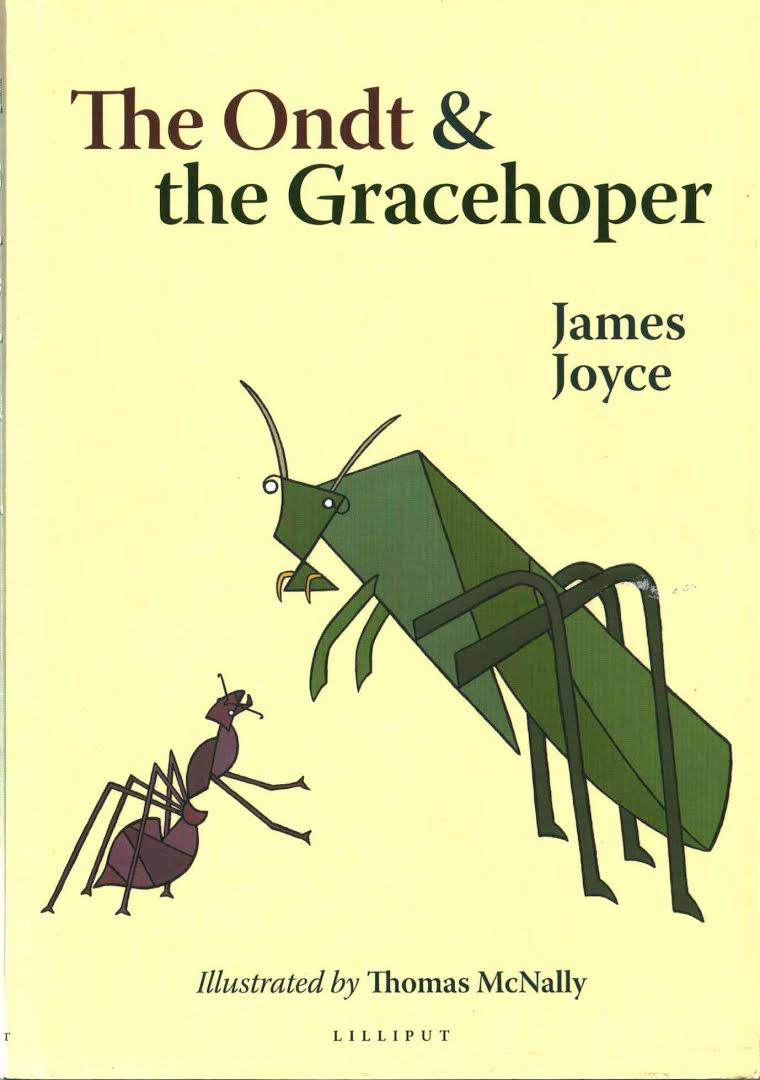
[READ: June 13, 2015] The Ondt & The Gracehoper

This fascinating book is an excerpt from Finnegans Wake (Book III Chapter I).  Thomas McNally has taken one of the fables in Joyce’s Wake and has illustrated it.  The book includes a few essays about the Wake and about expressionism and why McNally illustrated the book the way he did.

I have never read Finnegans Wake.  And I am fairly certain I never will.  I feel like this is a minor failing on my part, and yet it’s not pushing me to read this largely incomprehensible book.  So I was excited to see this weird little excerpt of the fabled difficult book (with pictures!)

In the introduction, McNally explains that despite everything we’ve heard about the Wake, it was, in fact, meant to be read and it is indeed, quite funny.  Joyce is playing around with language in incredible ways–throwing in multiple meanings in different languages in all kinds of words.  He says that for a first read, one should just read it–preferably aloud–and not worry about the various meanings that you are undoubtedly missing. (more…)

Read Full Post »

chancers SOUNDTRACK: BUILT TO SPILL-You in Reverse (2006).

reverseI love the audacity of coming back from a five-year hiatus and opening your disc with an 8 minute song that has lots and lots of instrumentals and solo sections.  And man is “Goin’ Against Your Mind” a good song (the band opened with this when I saw them and it awesome).  At around 5 minutes the songs slows down for a quieter section and then it builds back up again. I particularly love the roaring guitars in the back of the song (which I think are from Brett Netson—it is confusing that the band has a Brett Nelson and a Brett Netson in its line up).

“Traces” slows things down.  It has a simple but really catchy riff.  “Liar” is a bouncy, rather fun song with some pretty guitar work (two guitars in the middle) and a super catchy vocal melody. “Saturday” is a slowish ballad that is only 2:24.

“Wherever You Go” has a kid of Neil Young stomp to it, but it’s “Conventional Wisdom” that really opens up the beginning of the second half with a great riff and a fun chorus. The dual guitar solo that starts around 3 minutes in is fantastic.

I also love the guitar riffs in “Gone” and how at 3 minutes it turns into something else entirely with a big organ sound.  “Mess with Time,” which they played live, has a great staccato riff and a really interesting (to my ear Middle Easternish) guitar riff.   I also like the way it sounds like perhaps a circular saw blade is being used as percussion.  And how at 3:15 it turns into an entirely new song—an almost ska song riff with great bass lines.  “Just a Habit” is a mellow song with soaring electric guitar lines.   The disc ends with “The Wait,” a slower song that I don’t usually love.  But they played it live and in the live setting it took on a new vitality was really enjoyable.

This is an album I can put on an enjoy from start to finish.

[READ: August 7, 2015] Chancers

Chancers is a short three-act play set in Dublin after the collapse of the Irish economy.

There are four characters: Aiden and Dee who own a small shoppe; Gertie, an older lady who comes in regularly and never has a nice word for anyone and JP, Aiden’s mate.

In the first scene, we see that Dee is getting dressed up for a job interview.  She doesn’t imagine she’ll get the job, but they desperately need the money.  Aiden reveals that they have stopped offering certain services because they weren’t profitable enough.  When Gertie comes in, she mocks the two of them for trying, and for overreaching.  Gertie is nasty, undermining everything that Dee or Aiden says.

In the second scene, JP and Aiden are talking about a lottery ticket.  It seems that Gertie has bought a ticket that has won a huge windfall.  But when she brought the ticket in for him to check, Aiden instinctively told her it was a loser.  JP says that the first step has been taken now all they need to do is get that ticket for themselves so they can cash it in. (more…)

Read Full Post »

nymarc22SOUNDTRACK: YES-Tormato (1978).

TormatoTormato might be Yes’ most hated album (I think people grudgingly respect Topographic, but they hate Tormato).  I mean the cover is weird and, well, weird.  The songs are not bad but they sound so far from Yes of old, that it could possibly not be the same band.  And then there’s those lyrics.  I find myself blaming Jon Anderson for this middling period style of Yes music.  It seems like he was the impetus behind topographic and he has a number of songs that he wrote on the last two albums.  If Anderson is the flighty stratosphere, Squire and White are the ground.  And the ground is sorely lacking on the last two albums.

There’s no Roger Dean on this album either (more Hipgnosis with a giant tomato spill (get it, Tormato?  No I don’t really either.)  Wikipedia sheds some light, kind of:

Howe pitched the album’s original title of Yes Tor, referring to the highest point on Dartmoor, an area of moorland in Devon, England. Wakeman claimed to have thrown a tomato at the pictures taken for the album as he was disappointed with its design. The album’s title and cover was changed accordingly. Howe said it was someone at Hipgnosis who threw the tomato on purpose, something that he felt insulted about.  According to White, the band “couldn’t decide on the cover. I think Po … put a picture of a guy with divining sticks on the front.  He took it home one night and decided it wasn’t working. So he threw a tomato at it”. 

I always thought it was drumsticks not divining sticks.  Oh well.  So there that in no way clears up the tomato business.

So what about the music?Even though Squire shows up a bit more here, the overall sound of the album is really tinny—a problem that to me plagued Yes throughout this period—there’s just no low end to speak of, even when Squire does some rumbling lines.

“Future Times/Rejoice” opens with an interesting riff and some cool bass lines from Squire.  The song itself is bouncy and jaunty, moving along briskly with some wild riffs from Howe.  It’s kind of refreshing.  At 3 minutes the song slows down with some counting and replies from Anderson. The next section has a pretty classic Yes build up and then a return to the beginning of the song. There’s a very 70s sounding keyboard solo from Wakeman as the song reaches the end—which is a coda called Rejoice (starting at 5:44), which is mostly harmony voices until the repeat of musical themes from earlier.

Next comes the divisive “Don’t Kill the Whale” This is one of those major heart-on-your-sleeve songs.  Musically it’s pretty interesting with some wild soloing from Howe, but those lyrics: “don’t kill the whale, dig it.” It’s hard not to agree with the sentiment but it’s hard to sing along to at the same time. The synth solo is also astonishingly dated and kind of nauseating at the end.

“Madrigal” is a ballad played on a harpsichord with vocals from Anderson. By the end some classical guitar is played with it. It’s a pretty piece.

“Release/Release” is probably the most interesting track on the disc. It’s got a great riff from Howe and although (some of) the synths feel dated it rocks along like a good mid 70s rocker should. I like the audacity of having a “live” drum solo tacked into the middle of the song. It reminds me in style of a King Crimson track with the staccato voices, although it is not produced anywhere as well.

“Arriving UFO” is, indeed, about seeing UFOs.  The narrator is incredulous about them at the beginning of the song (which comes with very “eerier” keyboard notes) but I believe is a believer by the end. I do like the way the music builds for the bridge, although the chorus is bit much (as is the dreadful synth middle section). The solo section has some really bizarre sounds that I take to be “alien” conversation. Whether its made by guitar synth or voice I cannot say.

“Circus of Heaven” might just be the worst Yes song ever. It is all high notes (even the bass is high notes). Around 2 and a half minutes in the song shifts from its whimsical circus feel to a slightly more serious tone that hearkens back to better Yes moments, but it does not remain there.  Rather, the narrator asks his son what he thought of the circus of heaven and then Anderson’s actual son tells him that he’s not impressed. It’s hard to listen to I have to say.

There’s more high notes in “Onward” which is more orchestral washes and Anderson’s vocals over the top. It’s not really much of a song, frankly, even with the string arrangement.

“On the Silent Wings of Freedom” is nearly 8 minutes long.  It tries to hearken back to longer classic Yes songs but it never quite makes it.  It opens with some loud basslines, some fiddly Howe guitar bits and a lot of synths. But none of it sounds as interesting as previous long song intros. Even the wah wah bass sound isn’t as interesting as the early 70s bass sound. Anderson comes in almost 3 minutes in and around 3:30 the song picks up speed and the elements gel in a really good way. Around 4:45 the song slows down to an interesting instrumental section with bass and percussion.   After a return to vocals the fast part picks up again, although with a synth solo that is less than stellar.  There’s a lot of “la la las” in the song and a mention of “celestial seasons” which I hope came out before the tea brand.  The song isn’t bad, and if Yes didn’t have such a great catalog behind them I might actually say it ‘s quite good, but like the rest of the album it pales with their peak.

And that’s probably why Wakeman left again and, shocking, Jon Anderson split from the band too (which i find surprising since I feel like the past two albums were all about him).

Since almost every Yes album had different personnel, I’m going to keep a running tally here.   With the middling success of Going for the One, this line up stayed in place for a second album!

Chris Squire-bass
Jon Anderson-vocals
Alan White (#2)-drums
Rick Wakeman (#2)-keybaords
Steve Howe (#2)-guitar

[READ: March 22, 2015] “Sleep”

This story was written in direct address, from an “I” narrator to a “you” subject.  It really personalized the story and was interesting to watch as the story that started as one thing was able to travel to another thing entirely.

It begins with the narrator, an older man, talking in his mind to his young lover.  The younger man’s parents are concerned that the narrator is older, but they do like him.  I loved the way it was constructed with him reminiscing about how they met and about how the world allowed them to be together: “Germany, Ireland, the Internet, gay rights, Judaism, Catholicism, they have all brought us here.”  The beginning of the story really stresses their differences, which he finds charming:

“Like a good American you wear a T-shirt and boxers in bed.  I am wearing pajamas like a good Irishman.”

They have been sharing living space for a while, but the younger man is concerned that the older man’s dreams are plagued by nightmares.  The nightmares are so strong that the older man often screams out loud –but does not wake up. (more…)

Read Full Post »

gambler SOUNDTRACK: DakhaBrakha-Tiny Desk Concert #435 (April 25, 2015).

dkahDakhaBrakha are a band from Kiev, Ukraine.  There are four members, one man (unsure how he is dressed because he plays the accordion which covers his body) and three women.  The women are dressed in fetching white gowns (with lovely detail work done on them) and gigantic woolen “farmer’s hats.”

The women play drums, (with what looks like a wooden spoon), bongos a horn instruments that sounds a bit like a kazoo (I wish NPR gave more details here) and a cello.  They also provide most of the singing.

The first song, “Sho Z-Pod Duba”features bowed cello.  It opens with the male yelling quite loud and some wild yipping and shrieking from the women by the song’s end.

The second song, “Torokh” features lead vocals by the middle woman (the one with the kazoo).  But it also features interesting backing sounds and hums from the other two women.  The cellist (who is plucking the strings like an upright bass) also sings a partial lead vocal.  When the kazoo (which isn’t a kazoo at all, and is more like a penny whistle with some kind of vibrating piece on it) kicks in, the song goes utterly bonkers for a few measures.  The male singer starts yelling and the song is just insane until it stops and slowly builds again.

The end of “Torokh” and a lot of “Divka-Marusechka” has the women singing in the style of Le Mystère des Voix Bulgares (Bulgarian folk harmonies).  This song is the most unsettling of the three because the accordion and cello play an incessant drone that is a two note lurch.  The male sings lead while the females sing harmony and dissonant harmonies as well as a bird call kind of sound.  The end has one of the women signing an almost hip hop style while the other sings a higher, faster lyrics (all of which is in Ukrainian, so I have no idea what they are saying).

It is a strangely familiar music and yet it is also disconcerting.  I listened to it three times and I loved blasting it in my car–t woks great at loud volumes.  I also want to get one of those hats.

Check it out here.

[READ: March 28, 2015] Never Love a Gambler

This is a collection of three short stories from Irish writer Keith Ridgway.  They are quite dark and explore the criminal underbelly.

“Never Love a Gambler”
In this story we meet a family, the father of which is a gambler.  We meet his son and wife as they talk tough to the loan shark’s thug.  The son is pretty tough, standing up to Mossie, who gets the whole bar quiet when he walks in.  Mossie explains that he has been round to their house and they have some lovely things, but he can’t find the gambler himself.  They tell him that they don’t know where he is and then set out to try to find him.  In the meantime, they find a filthy homeless dog and a boy who is waiting to be picked up by his dad.  And they go on a quest together.  The stories converge in a dark but funny (but actually very dark) way. (more…)

Read Full Post »

CV1_TNY_04_14_14Blitt.inddSOUNDTRACK: SIMONE DINNERSTEIN-Tiny Desk Concert #362 (June 2, 2014).

simoneSimone Dinnerstein plays several of Bach’s two-part inventions.  And my jaw hits the floor.

I like Bach–I like his elaborate arrangements and the way he makes the piano (or harpsichord) sing.  But I never really thought about how hard these pieces are.  Watching Dinnerstein play these–simply watching the amazingness of her fingers–has blown me way.  And if I may say, her fingers aren’t long slender graceful things, they look a lot like mine.  So she doesn’t seem to have that advantage of an octave and a half reach or anything.  I am amazed that her two hands can work so independently.  And it sounds beautiful.

She groups them together into three segments and between each segment she talks a little about Bach and about playing these difficult pieces.  Her story about learning these as a child and then teaching them to children is really fascinating (and funny).

I have no idea how many Inventions Back wrote, but this set list is: Inventions Nos. 1, 6, 8, then Inventions Nos. 9, 10, and finally Inventions Nos. 12, 13, 14.

Check this out.

[READ: June 3, 2104] “Box Sets”

How can Roddy Doyle, who does funny so well, also do domestic unhappiness with such verisimilitude?

In this brief story, just as Ireland is getting through the worst of the economic depression and Sam and his wife Emer are feeling like they can exhale, Sam is let go from his job.  Now he’s been on the dole for three months.  And he is miserable.  The only good thing is that he has been watching box set seasons of all of the really good TV that everyone’s been talking about.  He feels foolish watching it all after the fuss about them has ended, but he’s still glad to watch it.  And Emer is great through the whole thing, always cheerful, always trying to make him feel better.  Always with a smile.  But Sam is getting darker and darker.

Then one night when Emer says they’re going to a friend’s house on Friday, Sam says he’d rather not.  He reminds her that at their last get together he was stumped when someone asked him what he did.  He just doesn’t want to go out anymore.  Emer tries to comfort him but fails.  He just gets madder until he throws a coffee mug and it shatters.  He takes the dog for a walk down to the seaside to cool off. (more…)

Read Full Post »

half pastSOUNDTRACK: FEU THÉRÈSE-Feu Thérèse [CST040] (2006).

feu1Feu Thérèse is a band created because of the hiatus of Le Fly Pan Am.  They offer a melange of styles, as befits the visual arts origins of several of the members.  And yet, there is a solid rhythm section that grounds the band in a wonderful way.

“Ferrari en Feu” opens with 3 minutes of pulsing waves of synths and electronic bird-call-like sounds. It’s unclear exactly what you’re listening to and it seems like the whole album will be a kind of ambient collection.  Then a proper rock song kicks in with chords and notes and drums–it has a cool psychedelic vibe and feels very late 60s.  “Mademoiselle Gentleman” has pulsing bass notes and staccato guitars with a layers of distorted laughing throughout (there’s no “singing” on the first two songs). At around 4 minutes (out of 6) the feedback squalls too and a simple steady beat.

“Tu n’avais qu’une oreille” seems like a traditional song–with singing (in the Serge Gainsbourg, dirty old man style of whisper/singing) which has a middle section that is quite conventional (with ahh ahhs) but again at 4 minutes, the song shifts into a faster drumming section (with more spoken words).  But then a lengthy trippy guitar solo shatters the mellowness.  “L’homme avec couer avec elle” starts with what sounds like horns.  At around 4 minutes in turns into a kind of western but with a crazy clarinet solo accompanied by sped up noises that sound like Pink Floyd’s Ummagumma.  There’s more psychedelic Pink Floyd styles on the final track, “Ce n’est pas les jardins du Luxembourg.”  The song opens with “drips” that sound like “Echoes.”  And then there’s more Ummagumma birds/animals (possibly distorted seagulls?).   At (yes) 4 minutes it turns into a trippy psychedelic organ based song (with Indian music as well).  The song is 12 minutes and leaves no sound unheard.

The music is experimental but it is not terribly “difficult.”  It’s actually quite a fun album which demands multiple listens.

[READ: April 24, 2014] Half Past Danger

The tagline for this book (which is presented like a movie in a number of ways) is Dames. Dinosaurs. Danger.  And the cover features a giant Nazi flag in flames.  Sounds like pulp genius to me.

And so it is.  Stephen Mooney has been an artist for some great graphic novels over the years and this is his first book that he wrote on his own, based on a labor of love–having Nazis fight dinosaurs.  Like a dream come true.

So obviously, this is a story of an alternate past.  Set in 1943 in the South Pacific, an Army battalion is tracking an area when they discover a secret Nazi base.  There are not supposed to be any Nazis this far east, and yet there they are.   Sergeant Tommy “Irish” Flynn is surprised but he gets his team ready to take pictures and prepare a report.  But that loud rumble sounds like the biggest tank they have ever heard.  And then out steps a T-Rex (in a great reveal).  The T-Rex wipes out all of Irish’s company.  Irish escapes with a few photos and little else.

We jump cut to two months later where Irish is drinking in a bar in New York City.  In walks General Noble of the USMC and Elizabeth Huntington-Moss of British MI6.  They request his service.  He tells them to fuck off.  Actually no, he doesn’t.  This is a PG13 story, there’s a few “shite”s and an occasional “damn” but it is squarely in the realm of comics–implied sex, a lot of blood and a few mild words.  A brawl ensues, in which a Japanese fighter helps out Noble & Moss.  And soon Irish is recovering and being told what’s going on.  After some string reluctance, Irish agrees to go back to the island.

Noble proves to be a supremely tough and string fellow.  The Japanese soldier has defected to the U.S. after the non-respectful attack on Pearl Harbor.  And Moss is an enigma.  As they approach the island, there is plane trouble and a wonderfully cool scene in the water (which I won’t spoil but the art and graphics are terrifying and wonderfully drawn and colored–Mooney did the colors for the first chapter, while Jordie Bellaire did the other five).  (more…)

Read Full Post »

[ATTENDED: April 4, 2014] Black 47

b47logo I was a fan of Black 47 when they first came out (even though my Irish friends dismissed them out of hand.  What with the “Bridie!” and the “Fiddlee diddlee deidely dee!” and, yeah, Larry Kirwan’s voice, they were just too much for actual Irishmen.  But Irish-Americans loved them.  And now 25 years after they burst onto the scene with “Funky Cieli,” they are calling it quits.

As far as I can tell Kirwan is the only original member left in the band (I’m not inclined to do the research on that).  Actually, I didn’t even realize they were still together.  But they have been releasing albums over the years–some of which have been lauded and other not so much.  (Kirwan has also published some books and is a host on Sirius FM).  They have a brand new going-away album called Last Call, and if the live versions of the songs were any indication, they sound quite good.  And Kirwan is just as political as ever: “If you’re Irish you have to be political.”

I actually saw Black 47 back in, oh, 1993.  I remembered the show, but had misremembered the venue.  It wasn’t a concert, it was a small club in Allston, Mass.  I don’t seem to have any photos.  The bar was packed, I could barely see the band, and I’m not even sure if the people there were there to see the band.  I don’t even know if there was a cover charge.  So it only seems fitting that this concert, one of their last on their farewell tour, should also be free.  As part of the Princeton University’s Fund for Irish Studies, the band played a free 90 minute set in the tiny Berlind Theater.

I have seen a few theater shows there, so I was a little surprised that the sound wasn’t great (well, mostly Kirwan’s lyrics were hard to understand, but that may be a common problem for him), but my seat was great–a few rows back in dead center. (more…)

Read Full Post »

ailisSOUNDTRACK: THE BLOW-“Parentheses” (2006).

blow1I learned about The Blow from NPR Music.  The lads played a new song by them, but this song, which is also available on NPR, is from 2006.  I don’t know anything else about The Blow.  But I do know that “Parentheses” is a delightful little pop confection (with enough elements of weirdness that explain why it was never a hit).

“Parentheses” immediately sounds like something I’ve heard before.  That chorus is just so perfect—“when you’re holding me, we make a pair of parentheses” that I can’t believe no one has thought of it before.  Of course, the bit in the verses about the deli aisle is certainly unexpected.

I normally don’t like the bap bap // bap drum beat, but it’s perfect here.  The stripped down nature of the music (simple chords on a few different keyboard sounds) accompanies this perfectly.  It’s sung with Khaela Maricich’s sweet and almost fragile (but not) voice.

It is so catchy I have now listened to it three times in a row.  And that little guitar tail at the end is very inviting as well.  I can’t believe this song wasn’t huge.

[READ: September 26, 2013] Desolate Heaven

I read this play because of my friend Ailish—I’ve never seen anyone with a name almost like hers—Ailís—before.  And, given the Irish name it is no surprise that the story is set in Ireland.  But rather than Dublin, it is set on a desolate beach.  We see two young girls: Orlaith (13) and Sive (12) messing about.  They are acting like adults—complaining about the beach and “the kids” and how everything is awful.  Despite some tensions, the girls bond over their difficult lives.  Each lives with a single parent and in each case, the parent is an invalid.  Each girl has to do everything for her parent in addition to going to school.  And in the next few scenes we see just how desperate their situations are: Sive’s mother has broken her pelvis (and has been unable to move for two years) and Orlaith’s father didn’t get up at all today because he didn’t feel he was able to.

In the next scene, we see the girls acting out a plan—to meet at the beach with as much money as they can grab.  And just like that, they are off on a road trip. (more…)

Read Full Post »

Two-Pints-Doyle-Roddy-9780224097819 SOUNDTRACK: BONNIE “PRINCE” BILLY-LIve on Mountain Stage (April 11, 2013).

bpbI saw Bonnie “Prince” Billy several years ago when he opened for Godspeed You Back Emperor.  His set was really good.  And yet I have never bought any of his music (his back catalog is just too intimidating to want to jump into).  But i still enjoy his music, and this Mountain Stage appearance shows off his songs and his between set humor.

He plays four songs here: “Oh How I Enjoy The Light,” “We Love Our Hole,” “Screaming Issue” and “You Remind Me Of Something (The Glory Goes).”

“We Love Our Hole” is from an Australian movie about surfing (and features some great baking vocals from Emmett Kelly and especially Cheyenne Marie Mize.  And “Screaming Issue” is a Loudon Wainwright song (it seems funny to me that he has so many songs but he chose to do a cover) and he does a great job of it.  “You Remind Me of Something” may be my favorite song of the set.

One of these days I’ll have to dive into his recorded work.  But, oh where to start?

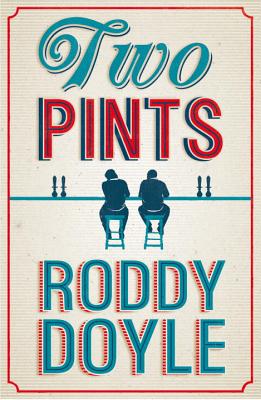
[READ: September 19, 2013] Two Pints

Two Pints is a delightful, short book that shows just how funny Roddy Doyle is.  I’m not sure how easy it is to find in the States, but if you’re a fan of Doyle’s humor, this is worth tracking down.

It is a series of conversations between two mates at the pub.  Each entry is dated starting with 24-5-11 (May 24, 2011 for us Americans) and ending 4-9-12 (September 9, 2012).  At first I thought that they were regular meetings, but they aren’t.  Some come weekly some more frequently.  But in each visit, the two men meet at their local with a pint to discuss the events of the day (often quite reluctantly).

Of course they also talk about their wives and kids and grand kids (the one crazy piece of nonsense is that one man (neither are named) keeps talking about buying wild animals for his kids (polar bears, hyenas and the lot).  It’s so strangely far-fetched for something that is otherwise down to earth, that I’m just not sure if Doyle was making a point or just being goofy.

But otherwise, one man begins talking and the other joins in.

They talk about Gaddafi (one of them thinks he’s the guy at the chipper, the other one is sure he’s spotted him working at the airport—the perfect hiding place).  They talk a lot about the Queen (it’s okay to hate the Brits again, phew) and The Pope (the mean German pope, not the nice new pope).  They talk about politics and voting.  They even talk about Anthony Weiner. (more…)

Read Full Post »

wilderSOUNDTRACK: WHITEHORSE-Live from Mountain Stage (May 16, 2012).

whitehorseWhitehorse is opening for Barenaked Ladies on the current leg of their tour (we’re going to see them in October).  I hadn’t heard of them.  Turns out Whitehorse is the duo of Luke Doucet and Melissa McClelland.  They are from Canada, which may be why they are touring with BNL–because they’re not very funny or very upbeat.

They play four songs in this Mountain Stage show.  I really like “Killing Time” which has a very alt-country feel—McClelland’s harmony vocals are great on the chorus, which has a very low down dirty feel.  I particularly like the lines:

Pimms in the cooler and daughter in the yard Playing California strip croquet

And

Tongue is a sharpened razor Little miss know it some But get her alone she cries I wanna go home Oh, this little piggy plays dumb.

They have some good stories too, like the one about “Emerald Isle” which is about Luke running a marathon in Ireland.  His Irish mother, who had never been to Ireland, flew out to meet him at the finish line and his wife, Melissa, flew in from Australia as well.  There are more great harmonies in this song which, while mournful has a wonderfully uplifting feel.  “Night Owls” is a very slow ballad which, while lyrically interesting, is a little too slow for my tastes.

For the final song, Melissa explains that the two of them had been playing solo and then they got married and still played solo.  And then they decided to join forces. “Broken One” was a song that Luke wrote for his ex-girlfriend (and it is mean); Melissa says that she fixed it for Whitehorse.  It’s a pretty standard country song with a honky tonk feel.  It has a great blow off line: “You gotta have a heart to have a broken one.”

There’s something about Canadian Country music that I like so much more than American country music.  I wonder what that is.

[READ: August 24, 2013] Wilderness

I recently stumbled upon this book at the library.  I was only vaguely aware that Doyle had written a children’s novel, but there it was on the shelf.  This is not a young child’s book, which is kind of a shame.  I know my son would love half of the book, but I didn’t think he was ready for the other half.

The two parts of the story are about different members of the same family.  The father, Frank, is the same.  He married a woman quite young and they had a daughter.  When the daughter was about 4 years old, the father and mother realized they could no longer live together.  After some fights, the mother left for America.  Where she stayed.  Gráinne, the daughter, is now 18 and she is a sullen, angry teenager.  Her dad is still okay, but most of the time she wants to treat him like he’s not.  But he seems okay with that and gives her space.  The crux of her story is that her mother has decided to come back after all these years.  And Gráinne now has to deal with that.

Her story is a little mature, (especially for my 8 year old son), and she has some pretty harsh things to say about her parents, (which I hope he doesn’t have yet).

The other half of the story concerns her half brothers, and I know my son would love this part.  Conveniently, the two stories are easy to demarcate–the ones with the boys are named Chapter 1 etc, the one with Gráinne are named things like The Bedroom, The Bus etc.  So I did consider telling him to read just those parts.  But maybe I’ll just wait.  Anyway, her half brothers, Johnny and Tom, belong to her dad and her stepmom, Sandra.  Sandra loves her boys and her husband and even Gráinne–most of the time.  But lately Gráinne has been a little much.  And Frank has encouraged Sandra to take the boys and go on a trip, just with them.  That will let her focus on the boys and give him some time with Gráinne. (more…)

Read Full Post »

« Newer Posts - Older Posts »