Feeds:
Posts
Comments

Archive for the ‘History’ Category

SOUNDTRACK: PHINEAS AND FERB-The Twelve Days of Christmas (2009).

12daysTo get you in the mood for the holidays, I present The Phineas and Ferb Twelve Days of Christmas.  Each character gets a wish, even Perry.  And of course, Ferb’s wish on the 12th day is great.

Obviously, Doofenschmirtz is the comic relief of the song (although most of the wishes are funny in themselves).  Doofenshmirtz hilariously wishes for the entire tri-state area and then slowly backs down to one state, admitting he was overreaching at the beginning.

I can’t find a video from the show, but there are plenty cobbled together on YouTube.  Like this one.  Enjoy!


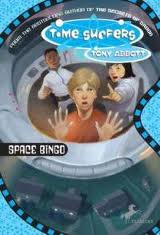
[READ: July 2012] Time Surfers series

We’re still working through all of the different Tony Abbott series.  And this series, Time Surfers, is another early collection of eight books about young kids going on adventures.  This series was also difficult to find (although it has recently come back into print (with much better illustrations).  The think I have yet been able to figure out about Abbott’s earlier series–they seem like he planned to do more.  Or more specifically, they seem unfinished.  I wonder if he gave up or if the publishers gave up on him.

So this series seems to have a few arcs in it.  New villains emerge, which is interesting, although as C. pointed out, what happened to Vorg from the first four books, he just seemed to go away.

Book #1, Space Bingo starts the series in an interesting way (Tony Abbott’s exposition is always interesting–indeed all of th ebooks open up with a scene the seems to be one thing but is revealed to be something else).  Ned Banks has moved to a new city far away from his home and his best friend.  He has to start a new school and he’s not too happy about it.  His sister has been calling him Nerd instead of Ned and the nickname is starting to spread, especially since such bad luck things are happening to him in school.  So he does what any clever kid would do–he creates a communicator (and tells his best friend Ernie how to make one) so that they can talk to each other whenever they want (and not have phone charges!).  When Ned turns the communicator on, however, it opens a time portal in his closet and two kids from the year 2099 come flying out. (more…)

Read Full Post »

41

SOUNDTRACK: SWANS-Live at All Tomorrow’s Parties, October 2, 2011 (2011).

swansatpBefore Swans released this year’s amazing The Seer, they toured supporting their previous album (with a number of songs from The Seer included). This set has two songs from The Seer, “The Apostate” and “The Seer, Pt 1” together they comprise 50 minutes of the nearly two hour show.  The set also includes “No Words No Thoughts” (24 minutes) and “Jim” (a teeny 6 minutes) from 2010’s My Father Will Guide Me Up a Rope to the Sky.  The final track is an eleven minute version of “I Crawled” which goes all the way back to 1984’s Young God EP.

I would never have thought of Swans as a jam band, and yet here they are, with 5 songs in 2 hours.  Although unlike jam bands, they aren’t showing off their musical chops or noodling solos, they are created expressive and moody soundscapes–not as scary as in days of old, but very intense nonetheless.

The set sounds great, although I imagine this would be more enjoyable to watch than to listen to (there a great swaths of music where there’ s not a lot happening).  I wonder what Gira is doing during these stretches.  My friend Phil (or Phillipe Puleo as Gira calls him here) plays drums on the album and on this tour, and I have to say he must be exhausted–man he hits the drums hard.

I listened to this show before I heard The Seer, but it didn’t prepare me for what the album would contain.  Now having heard that album, I appreciate this live show even more–they really master these long songs.  I am going to have to try to see them the next time they swing by.  I admit I used to be afraid at the thought of seeing them because their early music was so intense, but this seems to be a different Swans now, one that an old man like myself could even handle.

The set is no longer available on NPR.

[READ: December 10, 2012] McSweeney’s #41

The cover of this issue has a series of overlapping photographs of lightning.  I didn’t really look at it that closely at first and thought it was an interesting collage.  Indeed, Sarah said it looked like a science textbook of some kind.  But when I read the colophon, I learned that Cassandra C. Jones finds photographs of lightning and (without manipulating them digitally) places them together so that the lightning bolts create shapes.  And indeed, that is what is going on.  And it’s amazing!

The cover’s pictures create a greyhound running (front and back covers show different stages of the run).  There’s also circles and a rabbit running.  It’s incredibly creative and very cool.  You can see some of her work at her site.

The feature of this issue is that there are four stories from Australian Aboriginal Writers, a group that I can honestly say I have never read anything from before.  There’s also beautiful art work accompanying most of the longer stories, three gritty non-fiction pieces and some letters, most of which aren’t very silly at all.

LETTERS (more…)

Read Full Post »

hope1Congratulations, again, President Barack Obama!

Read Full Post »

SOUNDTRACK: FIRST AID KIT-Live on KEXP, April 1 2012 (2012).

I’d never heard of First Aid Kit before listening to this set.  They are primarily comprised of two Swedish sisters Klara and Johanna Söderberg– although there are other musicians on the album and live here.  And they’re quite a formidable band. They play a kind of folkie alt-country, but when the two sisters harmonize (one with a slightly disconcerting low voice) is sends chills up my spine   The chorus of  “The Lion’s Roar”: “I’m a god damned coward but then again so are you” makes the hairs on my next stand up.  “Emmylou” really highlights their songwriting skills.  They talk about this song in the chat with the DJ, and she admits that she wasn’t sure if the metaphor worked, but the DJ and I agree it does.

The harmonies on “Blue” are just spectacular and the subtle application strings and glockenspiel really flesh out the sound.   I’m thinking of them as a maybe a more dynamic/indie sounding Indigo Girls.

They DJ also mentions their cover of Fleet Foxes’ “Tiger Mountain Peasant Song,” which has garnered the attention of Fleet Foxes (and millions of views).  You can add to that number :

You can also hear their set.

[READ: October 16, 2012] “Fischer vs. Spassky”

This story opens with the unusual note that Marina cried for a long time after her husband died–she would bite her arm in grief, leaving marks that looked like “irregular postage stamps.”  Her husband died 30 years ago and she can still feel the marks tingle.

I say that note was unusual because the story is a flashback that is brought on by the death of Bobby Fischer.  Marina remembers back to  the monumental chess match between American Bobby Fischer and Russian Boris Spassky.  Although most of Soviet Russia supported Spassky, many Russian Jews supported Fischer because of the freedom he represented.

Indeed, Marina and her husband followed the match very closely and her husband even made a pact that if Fisher won, they would flee Russian for America.  Marina didn’t believe that he was serious, so she went about her daily life as any practical person would. (more…)

Read Full Post »

SOUNDTRACK: SISKIYOU-“Bad Days” (2012).

Siskiyou has had some medical problems and have canceled their recent tour.  They are also going on a brief haitus.  This is a shame as after their second album, they really had momentum and they sounded better than ever.

As a kind of peace offering to fans who would not be able to see the band, they recorded a cover of The Flaming Lip’s “Bad Days.”  The cover souds remarkably like the original, with one big difference: rather than squalls of feedback, Siskiyou uses only piano.  And it works very well, getting down  to the basics of the song and sounding a bit like Wayne Coyne singing.

It’s a nice tribute and  a nice “until later”

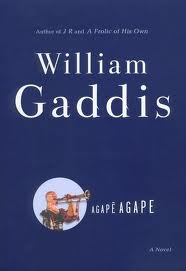
[READ: August 27, 2012] Agapē Agape

I have a long history with this book.

I was working at Baker and Taylor, a book supplier, when this book was released.  Some of the higher ups were able to get free books from the publishers they dealt with.  The guy who dealt Viking was not the friendliest guy, but since B&T paid absoluet crap wages, I was going try to get any books I could for free.   So, I asked for this book.  It was embarrassing enough to walk in and say this title with confidence, since I knew how it was pronounced (yes I took Greek in college), but knew he didn’t.  After some groveling, his reaction led me to think I wouldn’t be getting it.

But lo and behold a few weeks later it was sitting on my desk.

And now, ten years later, I’ve finally read it.

In JR, Jack Gibbs is writing a book with the name Agapē Agape, it is a jumbled history of the mechanization of the arts, starting with the player piano.  JR was finished in 1975–who knows for how long he had been working on it until then.  According to the Afterword of this book by Joseph Tabbi, Gaddis was pretty all-consumed by the idea of the player piano.  (It’s really quite an obsession).

This book is the culmination of all of Gaddis’ work on the player piano and how it removed all of the artistry from music (this theme of art and mechanization is in JR as well).   But rather than write this as an essay, which he didn’t think would be very effective, Gaddis decided to make this a novel.   I admit to not really knowing if he finished it–Gaddis died in 1998.  While it doesn’t feel unfinihsed, I’m just not sure if he was “done” with it. (more…)

Read Full Post »

SOUNDTRACKFUJIYA & MIYAGI-Live at Gibson Showroom, New York (2008).

This set is available for Download from KEXP.  I don’t know Fujiya & Miyagi all that well, but I really enjoy everything I’ve heard from them.  They place a keyboard-heavy, almost-dance music, but they use a lot of guitars to propel their songs further.

The most noteworthy thing about the band is the vocals–they are whispered (and often nonsensical–“Vanilla, strawberry, knickerbocker glory”) but the whisper seems to make the song move faster somehow–adding an almost sinister edge to the tracks (although sometimes it can feel sensual as well–it’s a neat trick).

This show has five songs from the album Lightbulbs–and it’s their first tour with a live drummer, which adds a nice complexity to their set.  One of these days I’m going to have to check out  their studio releases.

[READ: September 8, 2012] “My Journey to the Outer Limits of Funk”

Here’s another author I admire writing a short piece in Rolling Stone.  This one, unlike Lethem’s recent contribution, is about something he himself has done.  This article is a kind of music-based background explanation of his new book, Telegraph Avenue.

The premise of one of the plotlines is that two guys work in a record store, Brokeland Records, and are aficionados of jazz.  But he felt that was kind of dull, so Chabon delves into how he was able to get his characters to feel more interesting.  He didn’t wan them to just be “into jazz”–blah–he needed to add even more details so that they were more than just jazzies.  So he talks a bit about what he learned from Wax Poetics a magazine that refracted black popular culture through hip hop.   (more…)

Read Full Post »

SOUNDTRACK: PINK FLOYD-Alan’s Psychedelic Christmas (1970).

I’ve always loved Pink Floyd’s Atom Heart Mother.  I have no recollection of how I stumbled upon this live bootleg, but when I saw that it contained one of the few live recordings of “Alan’s Psychedelic Breakfast” I had to give it a listen.

So this show is from 1970 and was recorded in Sheffield just before Christmas (Nick Mason evidently introduced the show while wearing a Santa Claus suit).  The sound quality is pretty good given that it is 40 some years old.  There’s a bunch of hiss, and the quieter talking bits are hard to understand, but the music sounds fine.

So the show opens with “Alan’s Psychedelic Breakfast” and what is so silly (and I assume funny to watch (a little less funny on bootleg) is that the band made and ate breakfast on stage.  As Collectors Music reviews writes: “This is the only known live recording of ‘Alan’s Psychedelic Breakfast’ but also hosts an amazing performance by the band which included them making morning tea on stage which is audible. Just like most of their earlier performances, the performance of “Alan’s Psychedelic Breakfast” slightly differs from the album version due to some nice jamming done by the band, especially Gilmour with his delay pedal.” As I said, some of the audio is static and hard to make out in this song–the band is conversing during their tea, but who knows what they are saying.  And who know what is o the radio.

Then the band gets down to business.  One of things I love about this period Floyd which is so different from their later work is that the played really long spacey jams often with very few lyrics.  So we get a 12-minute version of “The Embryo” (the only available studio version is a very short one on Works which is quite a shame as the song is really good).  A 14-minute workout of “Fat Old Sun” which is usually only about 5 minutes.

There’s a great version of “Careful with that Axe Eugene” and “Set the Controls for the Heart of the Sun” (15 and 12 minutes respectively).

Then in a killer version of “Saucerful of Secrets,” just as they get to the end, there’s a power failure (at least according to the song title).  The band is rocking out just hitting the climax when suddenly all you can hear are un-miked drums.  Ha. After a couple of minutes, power comes back and they pick up from just before where they left off.

Then the band launches into a full 31-minute version of “Atom Heart Mother” complete with horns and choir  of voices.  It sounds quite good (the horns seem a little sketchy but that might be expected with such staccato music).

The set ends and the band needs an encore.  Apparently they couldn’t remember anything else because they just re-do the last few minutes of “Atom Heart Mother” again.

One of the things that cracks me up about these shows in the 70s in England, is that the audience is so polite. Their applause sounds like a classical theater rather than a rock show.  And with a bootleg you know they didn’t try to make the audience sound bigger than they are.

The whole package is a fun trip.

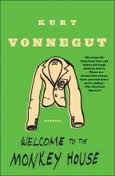
[READ: August 17, 2012] Welcome to the Monkey House

So this book is Vonnegut’s second collection of short stories.  But there’s a twist.  This collection contains all of the short stories from Canary in a Cat House except one. It also contains many of the stories he had written since then as well as stories not collected in Canary.  So you get basically 18 years worth of stories here.  And it’s interesting to see how much he has changed over those years (during which he wrote 5 novels, but not yet Slaughterhouse Five).

Since I read Canary a little while ago (see comments about the stories here), I knew that his 50’s era stories were influenced by WWII.  So it’s interesting to see how his stories from the 690s are not.  They deal more with day to day things and, of course, abstract concepts about humanity, although politics do enter the picture again once Kennedy is elected .

  • Where I Live (1964)

This was a good story to open with because it shows the then-later-period Vonnegut’s mindset and location.  This story is about Barnstable Village on Cape Cod (where I assume Vonnegut lived since there are a number of stories set on the Cape).  This is a very casually written story about an encyclopedia salesman who goes to the local library and sees that their two encyclopedias are from 1910 and 1938.  I enjoyed this line: “He said that many important things had happened since 1938, naming among others, penicillin and Hitler’s invasion of Poland.”  He is told to talk to the library directors who are at the yacht club.  I love the attitude that Vonnegut creates around the village which “has a policy of never accepting anything.  As a happy consequence, it changes about as fast as the rules of chess.” For really, this story is about the Village more than the encyclopedia salesman, and it’s an interesting look at people who move into a new place and want it to never change. (more…)

Read Full Post »

SOUNDTRACK: PHISH-Live Bait Vol 3 (2010).

This selection of free Phish songs is notable because of a couple of items.

  1. All of the songs were recorded at the Worcester Centrum in Worcester, MA.  Although the first three songs were recorded in 1993, the fourth song was recorded in 1997 and the final track was recorded in 1991.
  2. The first three songs were recorded on New Year’s Eve–technically on New Year’s Day.  The first track actually counts down the seconds until midnight, when the band bursts into Auld Lang Syne
  3. Probably the biggest deal of all: the band plays a version of “Runaway Jim” that lasts 58 minutes and 48 seconds.  That’s right, nearly an hour on one song.  I think if I went to see them live and they did that I’d be pissed, but it sounds great on this recording.  “Runaway Jim” is not one of my favorite songs, but this extended jam is really good–they break into several different sections and it doesn’t feel like a long version of this song so much as a bunch of different jams thrown together.  At one point it almost seems like the band thought they began with “Weekapaug Groove,” but they push back against that.  I’m very curious to know what happened after that song was over, but the end of the disc takes on an early recording of “Llama, ” a song I like quite a lot.

This is yet another great addition to the free Live Phish pantheon of music–I mean, an hour version of one song, how cool!

[READ: August 1, 2012] “Volumes of Knowledge”

Encyclopedias date back thousands of years–Pliny the elder tried to write everything he knew in Historia Naturalis and a Chinese emperor created a similar book Emperor’s Mirror in 220 A.D.  But the art and craft of creating books that contain all the world’s knowledge flourished in the 1700s.  Increased wealth and education in the French bourgeois, a flood of information and a decline of interest in religion all led to the desire to learn more.  The printing press helped to disseminate the information.

It was Denis Diderot, a French enlightenment polymath who best explained the concept of the encyclopedia:

the purpose of an encyclopedia is to collect knowledge disseminated around the globe; to set forth its general system to the men with whom we live, and transmit it to those who will come after us, so that the work of preceding centuries will not become useless to the centuries to come; and so that our offspring, becoming better instructed, will at the same time become more virtuous and happy, and that we should not die without having rendered a service to the human race in the future years to come.

But Diderot recognized the limits of a one-author encyclopedia: “I do not believe it is given to a single man to known all that can be known.”   From 1751 to 1772 he and his assistants edited more than 70,000 articles from 140 authors to create his first Encyclopedie.  Of course having many authors had drawbacks–differences in style, length and quality.  But Diderot shied away from nothing and in many locations the book was banned.  Some of the ideas in the book shook the very foundation of accepted ideas.  And many of the authors hoped to change the world.  Diderot himself even hoped to usurp religion with his knowledge: “It is not enough for us to know more than Christians, we must show them we are better.” (more…)

Read Full Post »

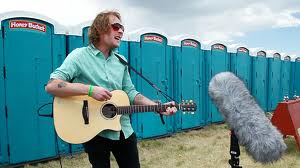
SOUNDTRACK: DEER TICK-“Main Street” (Field Recordings, July 18, 2012).

NPR created a bunch of Field Recordings at Sasquatch Music Festival.  I picked this one [Deer Tick Among the Honey Buckets]  primarily because it featured Deer Tick front man John McCauley singing front of a bunch of porta potties.

I actually don’t know much about Deer Tick, so I don’t know if they normally sound folky or what.  But this song, in its acoustic setting is very good.  John McCauley’s voice works great here.  There’s even a nice shout out to MCA.

There’s not a ton to it, and this alone won’t make me a fan, but I’ll certainly check out more by them.  It’s also a nice video to watch, especially for the amusing encore.

[READ: August 1, 2012] “The Use of Myth in History”

Most of the articles in Colonial Williamsburg have to do with, well, Colonial Williamsburg.  This one, however, talks about myths that we as Americans have created and continue to believe, from colonial times to more days.

The article opens by explaining that Patrick Henry’s famous “give me liberty or give me death” speech was written down forty-two years after the fact by William Wirt.  And he wrote it down from memory, so who knows what words Henry actually spoke.  But no doubt Wird got the gist right.  So the Henry speech is a myth–not necessarily wrong but not exactly true either.

Klein explains that some historians would like to remove the myths from history and focus only on the facts, but stories like Henry’s are so popular, so ingrained in our memories, that removing them would do more damage than the beloved myths do.  Indeed, some historians believe that myths are very important.  Micheal Gerson wrote, “We know that myths are not the same as lies” and John Thorn said “Historians have an obligation to embrace myth as the people’s history”

Klein writes that America’s mythology was largely created by writers from the early 1800s.  Pressure was building towards the War of 1812 and they needed support.  The mythology was designed to get people to forget about the ugly Revolutionary War.  And so stories were created just in time for the birth of public education in America to disseminate the stories.  And so mythological stories like George Washington and the cherry tree or the midnight ride of Paul Revere or Plymouth Rock or even Pocahontas became enshrined in textbooks.  Now, most myths are based on facts, but the truths were embellished and made more romantic and given a moral.  So, yes Patrick Henry did give a speech, the Pilgrims settled in Plymouth and Paul Revere did ride into the countryside to warn of the British invasion. but probably not exactly as we think they did.  So nineteenth century writers made George Washington the symbol of our country–a unifying power to embody a nation. (more…)

Read Full Post »

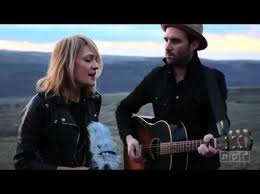
SOUNDTRACK: METRIC-“Synthetica” (Field Recordings, June 20, 2012).

After playing the Sasquatch festival, Emily Haines and James Shaw of Metric went behind the stadium and played a beautiful acoustic rendition of the title song from their latest album.  This Field Recording [Metric In A Non-Synthetic Situation] is just so wide open as to be inconceivable–especially since they’d just played a festival.

Metric make beautiful music which is rocking and usually full of all manner of electronic noises.  To hear Haines’ voice stripped from any effects shows just what a great and interesting voice she has.   It’s always nice to hear the song underneath the song.  This is a great version of the song.  Watch it here.

[READ: July 25, 2012] “Putting the Red in Redcoats”

Have you ever thought about how the redcoats’ coats became red?  No, me either.  Well, amazingly, it came from the Cochineal, the same bug that is still used today to color foods.

Cochineal bugs are pretty bizarre.  The female lives her entire life on a prickly pear cactus.  When she hatches, she clamps onto the prickly pear and starts feeding.  She grows to the size of a head of a pin. but never leaves the spot.  The male flies around, but only lives for a week.  The female lays eggs and the babies continue the process.

Although she is immobile, she is also armed with carminic acid, which predators don’t like.  Carminic acid is a vibrant red colorant.  Aztecs first mined this amazing color, which naturally impressed Spanish conquistadores who wanted to take it for themselves.  And they made a lot of money selling it to Europe.  But the Spanish never told anyone that the color came from bugs–they kept the secret for themselves.

Of course pirates and privateers would often hijack ships (one score captured 27 tons of cochineal!). (more…)

Read Full Post »

« Newer Posts - Older Posts »