Feeds:
Posts
Comments

Archive for the ‘Graphic Novel’ Category

raslSOUNDTRACK: METHOD OF THE W.O.R.M.-Cicatrix (2015).

motwormMETHOD OF THE W.O.R.M. is the project of one guy–known as Grimm.  Cicatrix is a collection of songs that spans decades (“begun long before the present digital day”) and recently remastered and released.

The blurb on CdBaby (where you can download the disc–it’s also on iTunes) notes that Method of the W.O.R.M. is “an industrial hard rock with a trip hop edge, intelligent grown up lyrics delving into the microcosm and macrocosm of our world. Influences run the gamut of NIN, Massive Attack, Cop Shoot Cop, Swans, Coil, Tricky, Skinny Puppy, Tom Waits and many others.”

There’s quite a diversity in that list even if the bands are similar, and you can hear the melding of influences.  And you can hear most of them in the songs. But what sets MotWORM apart from these bands is a keen sense of melody in the vocals.  Most industrial music tends to bury the vocals with distortion or just under the music.  But Grimm’s got a good (even pleasant) singing voice which elevates the songs above the din of lesser industrial bands.

While it’s not like pre-digital technology was all tape manipulation, it also wasn’t as easy as it is now.  And the complexity in these songs shows a lot of skill and attention to detail.

“No Flesh” opens the collection.  After some interesting noisy samples (steel drums?), a slow bassline enters (which also sounds sampled—it’s got a very 70’s sound).  The song slowly builds with more and more layers of sound until the vocals come in–a gentle singing that also builds.  There’s a Skinny Puppy feel in the music, but the vocals are very different from Puppy’s style.  “Purge” is the first of many songs with sampled dialogue, but it’s the sounds around the dialogue that are so interesting–squeaks and buzzes, radio tuners? who knows where they come from.  Once the verses start, the main music in this track is more synthy–a compelling riff that wends through the mix.  When the distorted guitars kick in, it takes the song to an entirely new level.

“Burned” showcases the vocals up front in the mix over a simple layered melody.  But there are actually a lot of vocals in this song, including a fascinating sample that opens and closes the track.  Grimm adds layers of vocals–harmonies (or not exactly)–distorted vocals and clean vocals.  I particularly like when the higher voice sings a new (very cool) melody in the middle of the song (the sampled voice melds nicely if creepily with this too).  This song is a real highlight.

“Tragic Rabbit” has some more interesting samples and a pulsing synth line with cool swirling sounds over the top of the vocals.  “As If a Dream” is a slow trippy number with an excellent processed sample.

“A Viral Method” introduces live drums (which sound great and were provided by Swans’ Phil Puleo).  It also has a great live guitar sound playing a fast riff and harmonics.  There’s more great harmony vocals. And a wild riff for the bridge (do I dare say a bit prog rock?).  Although I love the cool samples and layers in the earlier songs, this live instrumentation adds an excellent urgency to the music.  The only problem with this song is that it’s so short.

“Absolution” starts off quietly but after the distorted guitars, the chorus is super catchy–the way it seems like it’s going to end but rebuilds itself.  It’s really well crafted.  “A Moment of Silence” opens with a retro-sounding synth bass.  It’s a fairly minimal song with the vocals really taking over as that synth line drifts to the background and new sounds bubble up.  “Wasted” opens with distorted guitars kind of like a Ministry song, but the vocals are much cleaner, which brings an unexpected quality to what could have been a typical heavy song.  Especially the chorus which is musically bright (even if it’s lyrically dark).

“Freak-O” (what a great title) opens with some loud jackhammer type drums.  The song creeps along menacingly (with a great sample of someone shouting “You are one ugly son of a bitch!”).  I like the simple melody that simmers up from the noise by the end of the song.  “Miscreant” opens with quieter acoustic guitars before the drums kicks in and a menacing synth line takes over.  The vocals are quietly sung with an interesting effect placed on them.  The middle of the song has some wild sounds–I’m not entirely sure what’s happening with them, but it makes for an unsettling ambiance.

“I Love You Goodbye” is my favorite song on the disc.  It starts out simply with big guitars but quickly retreats into a much quieter verse.   There’s a great riff that throws in a slightly dissonant harmonic note that is just great.  But as the song builds into a unexpected bridge with horns, the song adds an dark carnivalesque atmosphere (and that harmonic note returns in a more prominent role).  It’s such an unusual riff and really bodes well for the interesting direction MotWORM might be heading (if they ever release anything else).

This is a real fun disc full of interesting sounds and samples.  If you like industrial music this is a disc totally worth checking out.

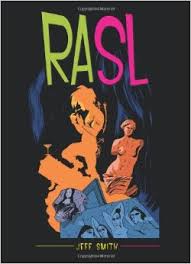
[READ: July 31, 2015] RASL

Jeff Smith is creator of Bone, one of my favorite comics ever.  As far as I can tell he hasn’t done a lot since Bone, but he sure did his research for this book.

The title is unfortunate (and is explained satisfactorily in the last few pages, but it’s still awkward and hard to manage).  But the work inside is extraordinary.  The story concerns dimension jumping, art theft and a whole lot of information about Nikolai Tesla.  It’s also more mature than Bone, in that there are a couple of (non-explicit) sex scenes.

In a nutshell, RASL (real name Dr. Robert Johnson) and his partner Miles are scientists.  They grew up together and studied the works of Tesla.  Miles married Maya, a beautiful scientist who has assisted them with their work over the years.  They delved deeply into the research that Tesla undertook (Resonant frequency, remote control, the earthquake machine, wireless communication) and used his ideas to create a machine that is something like a transporter/dimension hopper. They are working for the military but hope to be able to use the device to end wars (idealist scientists as they are).  Their small tests has been successful, but RASL believes that they need more testing to see if there are any effects when you use it on bigger subjects.

So he takes the machine and hops.  It turns out that each hop between dimensions takes its toll on his body and also tends to confuse matters.  (In one dimension, he checks his iPod and sees that Blonde on Blonde was recorded by Robert Zimmerman (I love that detail)).

We learn that RASL (who as the story opens has shaggy hair and cuts and bruises, unlike the composed scientist we see in flashbacks) has been jumping from dimension to dimension to steal precious works of art as a way to make some money.  There is also a really creepy-looking man whose face looks almost amphibian (Smith has some really disturbing characters in this book) chasing after him.  This man kills everyone that RASL knows in different dimensions because he is after something 9and he believes that the people in other dimensions are not real).  It is slowly revealed why RASL has been reduced to this state. (more…)

Read Full Post »

reunionSOUNDTRACK: KATE TEMPEST-Tiny Desk Concert #456 (July 21, 2015).

kateKate Tempest is a British poet/rapper (and darling of NPR).  She raps with a really heavy South London accent and raps about the “everyday.”  But because she is a poet, her lyrics are really incisive.  And, when she sings, she throws in some really catchy choruses as well.  Her song “Lonely Daze” surprises when the big catchy chorus come in.

Although she doesn’t do that for this Tiny Desk.

Rather, she opens with an incredibly moving poem called “Ballad of a Hero.”  It is an anti-war poem that takes an amazingly personal look at soldiers and the sons of soldiers.  The NPR blurb says “Kate Tempest will connect you with your emotions and the cold, callous world around you. You may cry.”  When I first started listening to her Tiny Desk, I wasn’t really paying attention to the words of this poem, but by the end, I was totally hooked, and yes, I did cry.

The final lines:

I don’t support the war my son.
I don’t believe it’s right,
but I do support the soldiers
that go off to war to fight.

Troops just like your daddy, son;
soldiers through and through.
Who wear their uniform with pride
and do what they’re told to do

When you’re grown my sweet, my love
Please don’t go fighting wars.
But fight the men that start them
or fight a cause that’s yours.

It seems so full of honour, yes,
So valiant, so bold,
But the men that send the armies in.
Send them in for gold.

Or they send them in for oil,
And they tell us it’s for Britain
but the men come home like Daddy
and spend their days just drinking.

Despite the intensity of the poem (and her other lyrics), it’s fun to watch her rap because she always seems to be smiling.  And on the two songs she does “The Beigeness” and “Truth” she is so into it.  Her hand gestures and emphasis really complete the song.  And there’s also the matter of her accent–so noticeable and strangely musical.

I don’t know what the original music of these songs is like.  I gather from the official titles (“The Beigeness (KwAkE BASS remix)” and “The Truth (KwAkE BASS remix)”) that they must sound different on the record.  And KwAkE BASS plays around with her voice, adding echoes and interesting effects that add to the music).

I’ve enjoyed everything I’ve heard from Tempest, I’m just not entirely sure I would listen to a whole album of hers.

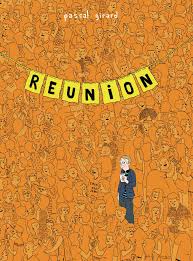
[READ: July 23, 2015] Reunion

When I saw this book by Girard in the library I immediately flashed back to reading his other book.   I recognized his style (the self-portrait of the main character Pascal made him look much older and more frumpy than he actually was.  But what I’d forgotten was just how much of a dick everyone in the book was.

And it’s even more so in the this book.

It’s clear that Girard has a style and that his humor comes from everyone in the book (including the protagonist) being jut awful.  Last time I wasn’t sure if it was just the way Helge Dascher translated the book (and again, it may be her since she does this one too) but I now think that Girard may just have a very poor opinion of people.

This book culminates in a ten-year reunion. And all of Pascal’s actions leads up to it. (more…)

Read Full Post »

essexSOUNDTRACK: SONGHOY BLUES-Tiny Desk Concert #455 (July 17, 2015).

songhoySonghoy Blues are from Mali.  They play an interesting style of rock/blues that follows rock conventions but subverts it as well.

“Sekou Oumarou” is a pretty straightforward bluesy number.  Until the vocals come in and you realize that they are not singing in English.  I think they are singing in French, but I’m not exactly sure.

It feels like the main instrument on “Al HassidiTerei” is the drums which, while keeping  pretty steady beat, don’t keep a simple 4/4.  This is not to say that the guitar and bass do nothing, because they play a cool riff and rhythm.  But they tend to keep the music pretty steady while the song plays on.  That is, except for the massively cool fuzzed out guitar solo at the end.

“Soubour” has a great classic rock style riff and when the guitarist stars going it sounds like it could be coming from the late 60s.  It’s a stellar track with a groovy psychedelic sound and wailing solo.

It’s tempting to want to like Songhoy Blues because of the politics and story behind the band (which is pretty intense), but they are so good that you don’t need to know anything about them to really get down to their great songs.

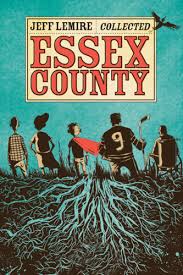
[READ: May 17, 2015] Essex County

I saw this book in the library.  I was intrigue by the hockey player on the cover (okay and that it was 500 pages).  When I saw that it was a 2011 selection in Canada Reads, I knew it had to be at least worth a look.

This graphic novel looks at several generations of people living in Essex County, Ontario, Canada.  It collects the three books Tales from the Farm, Ghost Stories and The Country Nurse as well as some other odds and ends.

The introduction by Darwyn Cooke is really great for contextualizing this piece, although i wish he hadn’t spoiled the scene with the hockey players (so maybe for maximum impact, don’t read this before reading the book itself–actually, read the whole thing except that 8th paragraph). (more…)

Read Full Post »

lostdogsSOUNDTRACK: GIRLPOOL-Tiny Desk Concert #454 (July 10, 2015).

girlpoolGirlpool is a duo consisting of Cleo Tucker (guitar) and Harmony Tividad (bass).  Both women sing and what’s interesting about their singing is that they don’t sing harmony–they sing in unison, which gives them an really interesting resonance.  And when they do hit the occasional harmony it sounds magical.

As for the guitar and bass, they are playing largely the same thing there as well–with occasional guitar soloing.

The band has a new album out.  It’s pretty short (10 songs in about 25 minutes), and it is as direct and unsettling as it is catchy.  The riffs are unexpected and the pair sound so honest and exposed.  It’s really quite something.  It has the air of a novelty (two people, no drums), but aside from a few lyrics that are thoughtful/funny, there’s no joking from these two.  You can see from this photo that Cleo is really into it.

They play three songs: “Before The World Was Big” (the title track of the new album) which has an unusually paced riff and Cleo & Harmony’s stark vocals.  The harmonies when they get to “One hundred, one million, billion, trillion times” is really great.  I also like how they start singing in a round to end the song.  “Ideal World” has an even simpler riff (with a very cool dissonant guitar notes every few lines) and some cool harmonies.  And Tucker’s wailing guitar solo at the end is pretty shocking.  “Cherry Picking” opens as a far slower song, but it picks up after the first verse and has one of the few times when Cleo and Harmony are playing different things on their instruments.  Their singing at the end is really intense.

I like their album a lot and this is a great Tiny Desk Concert.

[READ: May 18, 2015] Lost Dogs

I picked up Lemire’s Essex County at the library and while there I also saw Lost Dogs.  I didn’t know anything about Lemire, but Essex County looked really cool, so why not grab his other book while it’s there?

Well, this was Lemire’s first proper book. He started it while trying to finish the 24 hour challenge–a 24 page comic in 24 hours.  He failed the challenge but he loved what he was doing so much that he decided to finish up what he started and he made this first book.

I’m glad I read Essex County first because Lost Dogs is so rough, so sketchy, that I wouldn’t have realized how talented Lemire was from this book alone.  This book is definitely an “early days” kind of project–a way to see where he came from.  Not that the story isn’t good, but that it is very rough (intentionally so).  It also notes that in the reproduction the lettering was made to look nicer because no one wants to read sloppy lettering.

If nothing else, I will enjoy this quote from Timothy Callahan who says that Steven Soderbergh said “audiences will put up with poor picture quality as long as the sound is clear, but a crisp picture and problematic audio will turn off even the most eager viewers.”  Callahan adds “the same is true for comics, where slick lettering can help even the most chaotic sequence of images seem readable.”  So remember, make sure your letters are good! (more…)

Read Full Post »

herecoverSOUNDTRACK: CHRISTOPHER PAUL STELLING-Tiny Desk Concert #453 (July 6, 2015).

cpsSomehow after 450 some Tiny Desk Concerts I feel like I’ll know anyone that comes along.  But here’s yet another performer who I’d never heard of.  Christopher Paul Stelling plays an old beat up guitar (it ha a hole in it from where it has been worn down.  According to the NPR site:  That guitar, bought in Asheville, looks like a well-worn friend, with its dark bruised wood and his initials hand-carved into its body. Stelling marked the instrument a year after he bought it, when he made New York City his home in 2007.

Stelling plays some amazing fingerpicking and he backs it up with some catchy songs and interesting lyrics.  His voice is rough and reminds me a but of The Tallest Man on Earth.

He plays four songs.  The first “Castle,” is a really enjoyably folky song. His guitar work is amazing and almost as interesting as his lyrics (there’s some nice little twists i the words he sings). I was also amazed at how good the guitar sounded with the holes and carvings and all.

“Scarecrow” is more mellow, a bit sadder.  And when he tunes it up you can hear the resistance in the tuning pegs–that guitar has been through a lot.

“Horse” is a much faster completely intense song.  As the NPR site describes it: “Watch him lean in as if he’s about to lunge, his eyes bugged out, sometimes rolled back in his head revealing just the whites, skin blood-red, voice like a preacher on fire.”  The song is majorly intense, althouhg he kind of reminds me a bit of Chris Pratt’s character on P&R (but not in a funny way).  After the song he he says you see why I didn’t play that first

“Warm Enemy” reminds me of the guitar style of RT. A wild picking song, with some great runs throughout the piece.

It’s always cool to hear of a new artist who is really impressive.

[READ: May 10, 2015] Here

I read about this book when Five Dials devoted an entire issue to it.  And I’m so glad they did, because I probably wouldn’t have heard it about it elsewhere.  And it is fantastic.

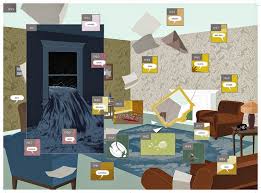
In the Five Dials issue they talked about how McGuire had first created a version of this book many years ago–it was 8 pages and ran in Raw Magazine.  Now in 2014, he has redesigned and thoroughly expanded the book, adding color and a ton more information.  And it is really astonishing.

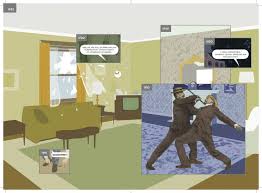
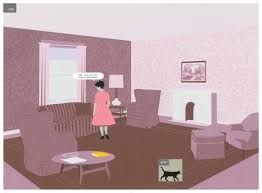
The book itself is quite simple.  We see a scene in a house.  It is a living room.  There is a window to the left, a fireplace to the right and various pieces of furniture.

The first page in the upper left corner says 2014.  There is a couch and little else.  Then there is a bookshelf.  And then the scene jumps back to 1957.  Same location, same angle, but (nearly) everything is different.  The furniture is chanced, there is wallpaper on the walls, there is a playpen in the center of the room.  Then the next page jumps back to 1942: the color scheme is maroon.

here3After a few pages it heads back to 1957 and we see our first person.  A woman saying “Now why did I come in here again?”  And then, the first break with the style–in the bottom right is a tiny box that says 1999 and there’s a cat in it.  And then the next page plays with things even more.  The woman from 1957 is still there as is the cat (who is licking her paw now), but the background is 1623 and the “house” is simply the woods.

The next page shows a scene from 1989 and in 1999 the cat leaves the room.

here2I’m not going to tell every page, obviously, but suffice to say that the next page goes all the way back to 8,000 BCE (while leaving the scene from 1989 in the book).

We see shots from 1763 (a lumberjack) and 1764 (a house being built).  And then in 1775 a colonial scene with, I believe, Ben Franklin.

here5Occasionally, there are a series of frames that show time passing in sequence like the children sitting on the couch in 1959, 1962, 1964, 1969, 1979 and 1983.  Or the one that shows Halloween parties from several years all on one page

The book also goes into the future with a small box showing 2017 and then 2050 with some interesting technology.  And then later forward to 10,175 with a strange creature in a wasteland,

The book is really amazing.  So much fun to look at and imagine the lives that were in this house.

For there is no plot. There is virtually no dialogue.  It is just snapshot after snapshot of a place and what people and creatures have done to it throughout history.  It is such an interesting idea (the original was quite revolutionary at least according to cartoonists) and while similar pieces have been made they don’t compare to the scope of this one.

Incidentally, the house is in Perth Amboy, New Jersey (and I believe is his childhood home).  It offers actual historical data as well as imagined information.  But he based many of his designs on photos from his family’s albums.

I’m so happy I got to look at the book.  And when I read it again, I’m going to try and read it in a vaguely sequential style just to see if there is a “story” to it.

Read Full Post »

gunner SOUNDTRACK: AND THE KIDS-Tiny Desk Concert #452 (June 30, 2015).

Ikids hadn’t heard of And The Kids before, but I was intrigued by their name and the lead singer’s look (is that a tattoo on her lip?).

But I didn’t like the way the first song started with a modified military “Glory Glory Hallelujah” musical refrain–it seemed strangely forced, especially for the first song I’d heard by them.  Although I may have liked it better if I knew the band better. It was a weird way to start.

Especially since I ultimate liked “Glory Glory.” (I am hearing a chorus of “I’ve been picking up floor milk” which is as fascinating as whatever the lyrics really are).  The drummer has great harmony vocals that really adds something to the song. I also love at around 2 and half minutes when the song turns into something very different—faster guitars with lead vocals by the drummer.  And even the bassist who has been quiet thus far chimes in with another layer of voices (and some interesting bass lines). It’s very cool.  So the song which started out kind of shaky really rocks out at the end.

The band trio, with a singer/guitarist, bassist and a great drummer.  There’s something about the lead singer’s guitar–it seems really big (maybe it’s just the head of the guitar?).  And the sound that the drummer gets is really great too—it may just be this recording, but the snare is really sharp.

For “All Day All Night” the drummer busts out a glockenspiel. It has a kind of shouted chorus that borders on dissonance but isn’t quite.  I like the way the song slows down (with the guitarist playing keyboard as it builds back up), the drummer plays the glockenspiel and the drums at the same time.  And the all three start singing with interesting harmonies. The ending whoo hoos are sharp and distinct as well.

“Cats Were Born” has a very interesting lyric: “The cats were born to kill for fun.”  But perhaps even more interesting than the words are the yodels and screams and yips that punctuate the song.  What’s also strange is the way the bassist seems so reticent to look goofy while the other two are wild.   The guitarist busted out a small four string guitar for this song which sounds really distinct. And the drummer really shines.  Through many of the songs she’s playing rim shots which is a distinctive sound in itself, but when she switches over to a faster style for the middle section, it’s really intense.

I don’t think any bands has gone so far from me not thinking much of them to being really won over by the end of their Tiny Desk.

[READ: February 26, 2015] Gunnerkrigg Court [1-14]

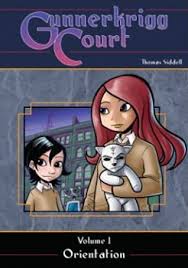
I discovered this book through my Goodreads account.  It was suggested because, well, I don’t recall, it had something to do with schools and supernatural and graphic novels or whatever.  There was also one that was suggested for Sarah (it was about boarding school and tea) which turned out to be Japanese softcore porn, so beware the Goodreads suggestions.

Although there was nothing to beware of with this book.

I actually thought Sarah would like it more because she loves boarding school fiction.  But she gave up on the book after a few stories.  Interestingly I almost did as well. It wasn’t that it was bad, in fact we both enjoyed the beginning.  But it was the kind of book that once you put it down, you didn’t feel compelled to pick it up again.  Perhaps because each chapter feels so self-contained–with no real cliffhanger–that it seemed like the stories were done.  And while the stories were good they weren’t awesome…so.  She gave up, but I continued

And I’m glad I did. (more…)

Read Full Post »

milkSOUNDTRACK: ANNA & ELIZABETH–Tiny Desk Concert #447 (June 8, 2015). 

annaelizAnna Roberts-Gevalt and Elizabeth LaPrelle are from different parts of the country but share a love of old stories and songs.  This Tiny Desk features three songs and one story (with visuals), and it’s quite different from pretty much anything I’ve ever seen.

“Long Time Traveling” is an a capella song that has a very olde sound of what I can only call “mountain music.”  The women have lovely harmonies reminiscent of O Brother, Where Art Thou?

And just when you think you’ve got these two figured out, they do “Lella Todd Crankie.”  This is a spoken word piece.  Anna (the taller one) explains that they would go into archives and listen to blank CDs of people telling stories from the old days.  And this is one that they memorized.  But just telling the story isn’t enough.  They have resurrected the “crankie” which is like a mural on a spool.  Each one is drawn and crafted to be hand-cranked and unfurled at the pace of a song.  This visual accompaniment (hand cranked by Elizabeth) follows the story as it is told, with visuals that relate perfectly to the story (I’m not sure who created those either).  Part of this story tells of how Miss Lella played fiddle, and as they get to that part, Anna starts playing the fiddle, and it is magical.

“Goin Cross The Mountain” is a war-based song on banjo and guitar with, again, great harmonies.  “Little Black Train” is a judgment day dark song sung with great harmonies and Anna’s twangy guitar.

I don’t think I could do a whole concert with them, but this little fifteen minute show is mesmerizing.

[READ: May 25, 2015] French Milk

I had gotten this book out at the same time of Age of License.  But since that one couldn’t be renewed (someone else wanted it) I read that first.  So, out of sequence, I now read this, her first book.  I’m kind of glad I did read it out of sequence, because the events of Age of License shed some light on this book, which is pretty neat.

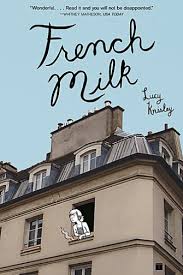
This book looks at the trip that Knisley and her mom took to France back in 2007.  They lived in a rental apartment for New Years and much of January.  The book sets the standard for her other books–lots of (really good but simple drawings–the sample faces on page 78 are really amazing–and belie the simplicity of her other “simpler” drawings ), many photos–rather blurry frankly, which is weird (see page 8 for an example), although the non blurry one of her mom in front of a nudie magazine is very funny.

We see some of her life before the trip.  We meet John, the awesome boyfriend (spoiler: she has broken up with him by Age of License).  She describes the airport, airplane (complete with kicking child) and arrival.  (The descriptions in License are more enjoyable–she had become a better writer by then).

Knisley is a foodie.  She talks a lot about the food they eat, including a bunch of foie gras and baguettes, sausages and the delicious French Milk (which she says is the best milk she’s ever had).

I enjoyed her descriptions of her apartment (and the creepy half-cat head on the door).  The strange standing screen which blocks nothing and has hunting fabric.

There’s also talk of them not paying attention to the world around them (like the execution of Saddam Hussein–although honestly if you’re on vacation for a month in France I think its okay to be oblivious although by 2015, it would be virtually impossible to be so oblivious).

They spend a lot of time in art museums, and she says by the end that she is basically sick on naked women, even if her favorite painting is “L’Origine du Monde.”  And I loved her disappointment to find out that famous Moulin Rouge is “a papier-mache windmill on the roof of a strip joint”

But as the book hits its final third, Knisley gets really bummed out.  She starts thinking about failure and that fact that she is turning (gasp) twenty-two.  And that’s when I wanted to throw the book against the wall.  A 22 year-old being whisked around Paris has no right to complain about financial responsibility–nor even does her mother have a right to talk to her about it on the trip.  The quote on page 125: “Even though I’m in my 20s, because I’m an only child, sometimes I feel a little like a spoiled brat…”  Well, it has nothing to do with being an only child if you can spend a month in France.  And when she says that her pie chart of her time management is spent 50% worrying 30% eating and 20% thinking about sex?  No, I will not accept that.  Go out and enjoy Paris for Christ’s sake.

I think its’ nice that her divorced parents are still friends and that he came to visit in France (how can a former English professor afford that?).

And then after a few more meals they are wending their way back home.  The flight back is hilarious and I love that they punished the person who complained about their DVD player by talking really loudly instead.

I can’t help but feel that each book has gotten progressively better.  And while I didn’t enjoy this one as much, I feel like each book has gotten better.  But how much more can she travel?

Read Full Post »

dispSOUNDTRACKTHE PRETTIOTS–Tiny Desk Concert #448 (June 15, 2015).

prettiotI hadn’t heard of the Prettiots before this set, but I loved them right from the bat.  The band plays super catchy, simple (funny) pop songs.  Kay Kasparhauser plays ukulele and lead vocals and bassist Lulu Prat sings great harmonies.  Kasparhauser is quite mobile, singing and bouncing around.  While Prat almost stares down the camera.  Meanwhile,  drummer Rachel Trachtenburg from the Trachtenburg Family Slideshow Players sits mostly stone faced as she thumps along on the drum.

Their songs are rather funny (even when they aren’t).  The first song “Boys (I Dated In High School)” names the boys she dated, whether they were good at sex and why she dumped them.  All with a call and response in the verses that’s fantastic.

“Stabler” is an ode to the guy From Law and Order, which I don’t watch, but I can still appreciate it.  It ups the musicianship a bit from the much simpler first song.

“Suicide Hotline” is a humorous look at a dark subject: The lyrics name check lots of famous suicides and starts with the lyric “On a scale of 1 to Plath I’m like a 4.”  Prat switches to guitar for this last song and it boosts the sound a bit.

I actually don’t know what the band really sounds like–I sort of picture them being bigger and more punk, and yet their lyrics work perfectly in this more acoustic style.  (They have two songs on Spotify and they are still quite acoustic in their sound).  I’m looking forward to hearing more from them.

[READ: July 15, 2015] Displacement

I enjoyed An Age of License, even if I didn’t always love Knisley’s attitude.  This book, which is sort of a companion to License (although not really, it’s more like another travelogue released around the same time as the first one), was something I wanted to read.

In a nutshell this book is another travelogue, but it is not anything like the previous one.  In this one, Lucy volunteers to go on a cruise with her 90 year old grandparents.  The grands wanted to go on the trip, but no one in the family felt that they should go alone.  Lucy thought it would be a good way to spend time with her grands and also to get a chance to enjoy a cruise (which she would never be able to afford).

Knisley ends each “chapter/day” of the cruise with a quote (and her own illustration) from a book that her grandfather wrote about being in the war.  A decade or so ago he decided to put down all of his memories about his time in the service.  He had them bound and gave a copy to each of his children.  And his stories are exciting and scary and thoughtful.  (I wouldn’t be surprised if Knisley had the whole book published with her illustrations–I’d certainly read it).  So, after a trying day with the grands, we get a perspective of the man she was looking after as a young man in a really serious situation. (more…)

Read Full Post »

ageSOUNDTRACK: GENEVIEVE-Tiny Desk Concert #446 (June 1, 2015).

genevieveI enjoy that the opening of this Tiny Desk Concert shows Genevieve “creating” her backup singers.  So that when she gets to the chorus and taps that loop pedal her harmonies really shine.

Genevieve is a poppy singer with a sometimes raspy but often really clean singing style.  She has a great voice and vibrant personality (and hair color).  Even though she is from Chicago, I hear some tinges of Bjõrk and maybe even Tori Amos in her voice.

Evidently she normally plays with a full band, but for this concert, she is accompanied only by Chris Faller who “plays all of the instruments.”

The first song “Colors” is played only with keyboards (and feels like it could use a little but more music–although her voice is powerful enough and that chorus is super catchy as is).  “The Enemy” is accompanied by an acoustic guitar and is a suitably mellower–a kind of sad ballad–which shows how powerful her voice is even in this more quiet setting (she has a lovely range).

The final song “Authority” feels like it might be a big raver (she adds hand claps that seem like the kind that might get the crowd going, but the claps are quiet and subtle here).  The chorus is big with lots of long-held notes and is super catchy.

Genevieve would probably be too pop for me in general, but the Tiny Desk Concerts tend to remove a lot of gloss and leave the heart of the musician.

[READ: May 15, 2015] An Age of License

I enjoyed Knisley’s Relish, so when I saw this in the library I decided to check it out.

Unlike Relish, which was about food, this book is about her travels outside of the country.  But like Relish, this book is another memoir/journal/autobiography.

Since I have been having a major Norway kick (thanks to Karl Ove Knausgaard and some great sites on Instagram) I was pretty excited to see that her travels began in Norway.  Her itinerary is short but very busy.  Fly into Iceland than immediately to Norway (for the Raptus Comics Fest in Bergen).  Then it’s off to Sweden (to visit a guy she knows in Stockholm).  Then to Berlin to join her friends on their honeymoon (which is not as tacky as it sounds). Then it’s off to France to visit her friend in Beaune, and then to hang out with her mom and her friends on Royan.  Finally a day in Paris before flying back home.  I’m exhausted just writing it all.

Knisley also has the headache of dealing with a breakup (to the nice guy who has been in her previous books) although he is kind enough  to babysit her cat while she is gone.

Every few pages has colored (watercolor I assume) drawings which add a nice touch to the otherwise black and white story.

Starting Sept 8th, she arrives in Norway.  We see the flight and other people on the flight.  We see a nice meal that she eats (Pinnekjott–someday I hope to get to the Scandinavian countries and eat food that I cannot pronounce).  Norway is fun–she goes to the Fest (where she gets to draw with Ethan Nicolle of “Axe Cop” (presumably his five-year old brother stayed home).  She shows students how to draw (her friend is a teacher), although she declines to eat Lutefisk (which she illustrates as Fish + Lye.  Lye??).  She also mentions that she was not only stalked, but that the boys who stalked her then made and published (and had it available at the following year’s Raptus Fest) a comic about stalking her–creepy! (more…)

Read Full Post »

dotaSOUNDTRACK: ASIA-Asia (1982).

asiaI’ll finish off this run through Yes with one final offshoot project–Asia.  Geoff Downes (who had only been on Drama) and Steve Howe joined forces for this pop outfit with a hint of prog.  Indeed, this is an album that is just chock full of poppiness–despite all of the trappings of prog rock–synths, connections to Yes, a cover by Roger Dean and Carl Palmer from Emerson Lake & Palmer on the drums.

This album was huge in 1982 & 1983.  They had so many hits from it (okay well, only 3 singles, but surely everyone knows this entire album, right?).

“Heat of the Moment” opens with nice big ringing guitars.  And while the drums aren’t fancy, they are quite distinctive.  The synth isn’t too dated sounding, and the middle part with the guitar slide still sounds cool.  And of course, the chorus is practically irresistible.  “Only Time Will Tell” has a totally recognizable keyboard riff.  While the riff itself hasn’t been copied, the sound has and yet at the time, Asia made it seem fresh.  This song is so simple as it starts with just keys and drums and John Wetton’s voice.  There’s great harmonies in the chorus and dramatic keyboard splashes.  And once again, Carl Palmer’s drums are big and loud yet understated.

“Sole Survivor” opens with some darker chords nut some interesting noodling going on, too. (I always thought t was interesting that Blue Oyster Cult released a song called “Sole Survivor” the year before).  Despite the darkness of the lyrics and the music the chorus is also very catchy (I also like how nearly every verse ends with a different keyboard sound or riff).  This song also has an interesting break where things get quiet and feel very wasteland like.

“One Step Closer” has a some interesting riffs and another catchy chorus.  This is probably my least favorite track on the disc even if it’s got a good chorus.  “Time Again” has a cool dramatic opening and then a nice speedy bassline to start off with.  I like the way the chorus leads to some quieter moments of unusual guitar and keyboard sounds.

Side two has some slightly longer, sightly less poppy songs. And yet to me all the songs on this side are really good as well.  “Wildest Dreams” is a song that is a bit over the top (as all prog should be).  I remember loving the dramatic “We fight” section.  It seems a but silly but it was still fun to sing along to.

“Without You” is a slower darker song but with another big chorus.  It also has the most prog rock sounding keyboard solos of the 1980s.  There’s some time changes and even a big bell!  “Cutting It Fine” opens with some mellow guitar and then a really interesting guitar sequence.   It moves along quickly and dramatically and then stops for a quiet piano solo section (with a build up of strings, martial drums and horns–the drama seems like it is leading to something big but it just kind of fades out, which is a bummer.

“Here Comes the Feeling” ends the disc in more dramatic fashion.   I love the way the bridge builds and builds (with the “now i can…” section that leads to the long held sung notes.).   The solo section has some very yes-like moments from Howe and over all ends the disc with some wonderful prog moments.

As with apparently every progressive rock band of the era, this one was full of lineup changes too (don’t even get me started on King Crimson).  The four stayed together for the next album, Alpha, but Steve Howe left after that and then various other incarnations have toured in one form or another to this day (in fact they’ve released about 20 albums over the years.  Who knew?).

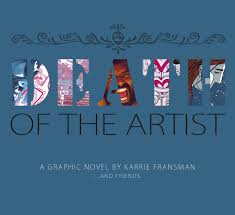
[READ: May 29, 2015] Death of the Artist

I grabbed this book from work because it looked interesting.  And it was.  I was more than a little confused as to how much is true.  And that was clearly the point.  Fransman totally pulled the wool over my eyes and I love her for that.

The premise of this book is that five artists are getting together for a weekend of debauchery.  They were friends in art school in Leeds when they were in their 20s.  Now, ten years later, they are reuniting in hopes of sparking creativity again.  Of the five only one is still doing anything “creative,” and they are all looking to reignite that spark.

And this book is the result of their week.

All five artists draw (or something) a story inspired by that weekend.  And in what turns out to be a pretty cool twist, Fransman has shaped the stories into a narrative. (more…)

Read Full Post »

« Newer Posts - Older Posts »