Feeds:
Posts
Comments

Archive for the ‘Graphic Novel’ Category

assclassSOUNDTRACK: OUGHT-More Than Any Other Day [CST103] (2014).
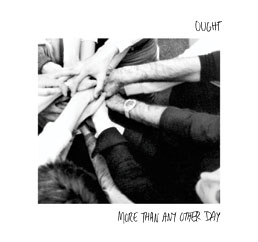
oughtmoreOught might just be the most straightforward band every released by Constellation Records. They are a rock/punk band with some spoken word singing that sound at times like Mark E. Smith.  However, the music is a bit catchier than The Fall’s with fast moments and really slow almost ambient stretches.

“Pleasant Heart” opens with a raw echoing guitar riff and chords that sound like nothing else on the album.   The song lurches through some great sounds and Beeler’s unusual chanting style of singing.  There’s also a cool bass line rumbling throughout the song built with lots of drum fills and chaos.

About half way through this six-minute song the bass and drums drop out leaving just a squeaky violin and harmonic guitar (this squeaky violin is possibly the only thing that makes this record sound like a Constellation release).  The bass comes back in slowly.  But it’s not until almost two minutes of this instrumental that the song resumes with a crunch and the lurching melody and verses continue until the end.

“Today More Than Any Other Day” was the first Ought song that really grabbed me.  It starts out slowly with some spare drums and meandering bass.  It doesn’t really feel like its going to resolve into anything.  By a minute and a half it’s finally starting to sound like something–a slow meandering song perhaps.  Around 2 minutes Beeler starts whispering “we’re sinking deeper, and sinking deeper.”  And then the song starts building and turning into something else .  We’re now half way through this 5 minutes song when the guitar starts chiming and he states “The name of this song is ‘Today more than any other day Parts 4-43.  So open up your textbooks … or any kind of reading material.”  And as the guitar plays the verses he recites various things that have happened today more than any other day (making a “decision between 2% and whole milk.”  A cool bass line starts playing as else drops away and he starts chanting a rather laconic “dah dah dah dah dah” following the bass.  It reminds me, strangely enough of the Dead Milkmen as its kind of not exactly out of tune but almost as if  not really caring.  But when the song resumes, it’s all right on again.  It’s a weird and wonderful, strangely catchy song.

“Habit” opens with a nice slow bass riff and chiming guitars.  It brings the intensity of the previous song down some.  And the vocals sound a little different, especially in the chorus, where the whole song take on a kind of Talking Heads vibe (the falsetto singing in particular).  It slows down toward the end with some scraping violins. The song is quite pretty in an alt-sorta way.

I love “The Weather Song” from the opening harmonics and intriguing bass line to the way the song suddenly ramps up for the chorus.  In addition to the catchy spoken opening there’s a great chorus of “I …. just wanna revel in your lies.”

“Forgiveness” is a relatively short 4 and a half minutes and opens with almost an organ sound.  A scraping violin sound joins the drones. After 2 minutes he sings in a very slow drawl “forgiveness is a drug that you take with a shrug.”  It has echoes of the Velvet Underground’s “Heroin” although it never changes tempo or intensity.

“Around Again” has a very 1980s guitar riff and whispered vocals until the whole band kicks in and it grows in intensity.  And then the whispered “go slow” returns the song to the beginning.  After 3 minutes, the song builds and then drops out with a spoken: “It’s coming. Why is it you can’t stand under the sun but you can stick your head into a bucket of water and breathe in deep” and then a whole new sound of dissonant guitar and thudded bass and drums “we have reached the intermission.”  But it’s not an intermission it goes through to the end of the song like this.

“Clarity!” opens with what sound to me like “Love Will Tear Us Apart” but with guitar chunks played over the top.  Slow harmonics and whispered vocals move the song forward.  After 2 minutes it rocks out, with a returning ringing high note and interesting sound effects.  And by the end the song comes to a plunging conclusion

“Gemini” opens with some low rumbling notes and then a sprinkling of keyboards.  There’s some scratchy guitars and a rumbling bass.  After 2 and a half minutes, the song’s punky parts take over with jagged guitars and screamed vocals.  The end of the song is mostly just two-note thumping while he screams “you wanted … wanted … wanted … wanted.”

I really like this album a lot.

I noticed that the lead singer changes his name on each release.  So, to help keep it straight:

PERSONNEL
Matt May: Keys
Ben Stidworthy: Bass
Tim Keen: Drums, Violin
Tim Beeler: Vocals, Guitar

[READ: September 20, 2016] Assassination Classroom 1

Assassination Classroom has a very strange and unsettling premise–the students of this classroom are being taught to assassinate their teacher.  Given the current climate of guns in the US, that’s probably not a comfortable position to take.  However, Matsui alters the premise to make it more palatable, and frankly more fun. The students’ teacher is actually an alien (or maybe not, but it is certainly not human).  He (I guess) is a multi-tentacled creature who can move at Mach 20, is exceptionally perceptive and can’t be harmed by most conventional weapons.  But wait, there’s more.  The students are sent to assassinate this particular creature because he blew a huge chunk out of the moon (it’s now a permanent crescent) and is planning to do the same to the earth in a year’s time.  But wait, there’s more.  One of his conditions for not blowing up the Earth sooner is that he be allowed to teach this particular classroom.  Although no one is sure why yet.

The class is 3-E, the lowest of the low, the worst students in the very prestigious Kunugigaoka Junior High.  The 3-E class are misfits–they were smart enough to get into the school, but they have done something wrong and they are treated very poorly because of it.  In fact, 3-E is used as a kind of cautionary tale for the other students–act up and you could wind up like them.  (Why they don’t just leave the school is not addressed).

The kids call the creature Koro Sensi (which is a pun on the Japanese “Koro senai” which means “can’t kill”), and it turns out he is actually a pretty great teacher.  He really seems to care about the kids.  So why would they want to kill him?  Well, aside from the destruction of the planet, there is also a ten billion yen reward (the amount seems to change some in the book, but it’s roughly 100 million dollars).  Of course, as the name implies, this guy is really hard to kill.  And when they try to kill him in a way he finds beneath them (they are training to be great assassins after all), his own revenge will be swift.  At the same time, he heartily encourages them to try their best to kill him–and he applauds their most creative efforts. (more…)

Read Full Post »

1979SOUNDTRACK: HAPPYNESS-Tiny Desk Concert #468 (September 4, 2015).

happynessHappyness are a trio from London: Benji Compston (guitar), Jonny Allan (bass) and Ash Cooper Drums).  They play mellow Britpop with rather clever lyrics.

The first song “Montreal Rock Band Somewhere” opens with a steady bass line and smatterings of guitar chords.  And when the guys  sing, Benji sings into a normal mic in a kind of deep whisper and the Jonny sings into a processed mic to make his voice sound kind of tinny (in harmony).  And the lyrics are great.  I like when the second chorus comes in and the processed vocals go up an octave for a really cool harmony effect.  And I mentioned the lyrics.  Here’s an interesting verse:

I’m wearing Win Butler’s hair / There’s a scalpless singer of a Montreal rock band somewhere / And he’s all right

Before the second song starts, they have a bit of fun while Benji tunes his guitar.  Everyone is standing around awkwardly and Benji tells Jonny to tell his whale joke.  Jonny says no and that it’s not his whale joke he took it off the internet and would like to put it back.

For the second song, “It’s On You” the guys switch places (it  was suave, kind of Bob Fosse-ish).  Benji sings into the processed microphone. The song also has some busy basslines but the guitar is more pronounced.  Hearing him sing in that processed tinny voice is really interesting.  More interesting lyrics: “You said I’m an anarchist, communist, feminist phlebotomist.”

Before the final song, they switch places again.  Benji says he’s “not the most flexible boy in this collection of people.”  “Who is?”  “Definitely [the bassist].”  Bob asks, “Who tells the best jokes?”  “Unintentionally [the drummer]  Jonny says to the drummer: “You could do the whale joke… don’t do the whale joke.”

The final song, “Weird Little Birthday Girl” is nearly 8 minutes long.  It opens with a cool bass riff and some lovely overlapping guitars.  There’s a nearly three-minute instrumental opening and when Jonny starts singing it has a distinctly Wilco quality (partly because oft he processing on his voice but also his delicate singing).  There’s a nice shout out to Prefab Sprout in the lyrics:

Its so easy to replace it / some things hurt more much more than cars and girls / an evening in an iron maiden / a morning in your funny little world.

I really enjoyed this set a lot and I’m intrigued that their album (on bandcamp) has some really short songs too.   I wonder if their sound is different on the record.  Guess I’ll have to give it a listen.

[READ: July 12, 2016] The Complete Peanuts 1979-1980

I foolishly thought that this book would play up the idea of moving into a new decade. But as I should have learned from years past, Schulz doesn’t really care about when it is.  His strip is mostly timeless.  There are of course references to time passing, but they are very minor.  So, on New Years when it  turns 1980, the strip heading says 1980, but there’s no other mention of it.

It’s also interesting how some things that he’s talked about in the past cycle again–many many years later.  In January 1979 Peppermint Patty is on a quest for a library card (we saw Sally get one like 5 years ago).  She says that once she gets one she wont leave home without it.  Marcie says Karl Malden will be happy to hear it. This is a reference to a an American Express card commercial that I remember hearing all the time when I was a kid (although I had o idea it was Malden doing it).  She also get a very funny line about junk food: “Life is more than carrot sticks, Marcie…what is a stomach that’s expecting a chocolate bar going to say when it gets a carrot stick?”

The World War I Flying Ace never really went away, but it seems to be making a resurgence in this year, with Snoopy wandering around speaking French and then later German to all the young ladies. (more…)

Read Full Post »

rollerSOUNDTRACK: SARAH NEUFELD-Hero Brother [CST095] (2013).

heroroSarah Neufeld is best known as the violinist for Arcade Fire. I wanted to like this disc more than I did.  There’s a lot of really good music and ideas, but the whole album felt a little lacking in excitement.

This solo album was recorded in Berlin by pianist and producer Nils Frahm, with Neufeld’s performances captured in a number of locations with site-specific acoustics, including an abandoned geodesic dome, an underground parking garage, and the legendary Studio P4 orchestral recording hall at the broadcast complex of the former GDR.

On track with a * you can hear the echo of the surroundings (although I’m not sure which is which).

*”Tower” is a repeat of three notes quickly bowed with an echoed ghostly voice floating over the top of the melody. Its lasts but 2 minutes and then disappears.  “Hero Brother” has repeated low notes flanked by high notes until the main fast riff spirals out.  About a minute in, a stomping drum comes in and her playing sounds a bit more folksy. It’s an interesting twist on the more formal earlier style.  I love that it ends almost starkly in the middle, allowing those last notes to resonate.

*”Dirt” begins with high pitches notes that seem to echo and resonate forever.  And then she switches to a spritely somewhat upbeat melody of quick notes. The third part of the song luxuriates in slow bowing—long notes that linger.  “You are the Field”  begins slowly with some bending notes that descend and then ascend.  It’s interesting to hear her slide up and down the neck while some of the main notes remain the same.

*”Breathing Black Ground” has slow echoed note, but about mid way through a low note anchors the pieces as the high notes play a melancholy melody while Nils Frahm plays the harmonium.  “They Live On” is primarily plucked strings until her echoed voice sails over the top. This piece is more pretty than the others but is still rather stark.

“Wrong Thought” has a kind of sci-fi sound as it opens.  A kind of piercing high note is resolved into some lowers notes and then a cool melody.  The ending few notes are a pretty series that rise from the darkness of the main piece.  “Right Through” is a series of three notes played in different location on the fret. It is lonely sounding until some higher notes begin to appear as well.  And then Sarah’s ghostly voice emerges from the background with a kind of haunted phrasing.  It’s quite lovely and then things become quite raucous with some very fast fiddling.

“Forcelessness” opens with a series of three high pitches notes that are quite breathtaking. The notes descend slowly through the melody as a piano plays long held notes to accent the descent. It’s by far my favorite on the disc.  The disc ends with *”Below” which is slow and melancholy with her voice echoing in.

I guess I was expecting there to be more virtuoso pieces rather than a kind of moody ambient record.  Most of the melodies are pretty, but  there’s not a lot of diversity.

[READ: February 12, 2016] Rollergirl

Oh boy, did I love this story.  And not just because it’ about roller derby (although that is quite a lot of it).  I loved it because it had a protagonist who felt she didn’t have a personality or a “thing” and managed to not only get one, but to get an unsuaul one–and to make friends doing it

This story is a bout Astrid Vazquez (an unlikely name if ever there was).  Astrid’s mom always wants her and her best friend, Nicole, to do cultural things.  So they go to museums, to the opera, poetry readings, that sort of thing.  It’s not always fun.  But on this night she takes them to a warehouse where the see a roller derby match!

Astrid (who loves to wear black and is the tomboy of the two) is hooked immediately.  Nicole, who is more prissy and does ballet, is interested but a little freaked out.  And when they discover that there is a roller derby camp for the summer. Astrid assumes they will both sign up and become derby superstars like their new heroine Rainbow Bite (is there anything better than roller derby names?).

But Nicole quietly informs her that she is not doing that.  Not only doesn’t she want to but she actually wants to go to ballet camp this summer.  So there.

And that’s when the opening scene where Nicole is with the horrible, awful, super mean Rachel.  Rachel is the one who came up with the nickname Ass-turd (which maybe makes this not so much a children’s book, but it’s the only bad part). (more…)

Read Full Post »

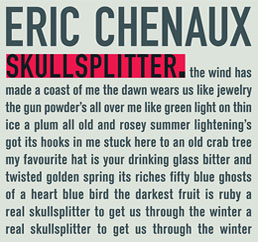
shadowSOUNDTRACK: ERIC CHENAUX-Skullsplitter [CST112] (2015).

chenAn album named Skullsplitter sounds like it should be really heavy and loud.  But if you know Chenaux, you know that that’s not his thing at all.  So what wins?

The traditional Chenaux wins.  At times light and beautiful and at times wobbly and disorienting, Skullsplitter sounds like many other Chenaux releases.  And you either like him or you don’t. His slow songs, vibratoed guitar and really delicate voice either win you or not.

“Have I Lost My Eyes?” has one of the most wobbly guitars I can thing of (even for him).  The slow electric guitar solo is pretty much perpetually played with wah-wah bar in motion.  After 90 second of this, Chenaux’s delicate tenor voice comes in and sings a melody that is not exactly suited to the music, but which doesn’t sound off, either.  Classic Chenaux.

Alternating with the vocal pieces are instrumentals.  Chenaux plays a lot of ringing and delicate solos and overdubs them.  And the instrumentation is pretty varied: Voice, electric guitar, un-amplified electric guitar, nylon-string guitar, speakers, melodica and electronics.  “The Pouget” is roughly two minutes long.  “My Romance” has a kind of warbling guitar solo over some mellotron.  “The Henri Favourite” is another 2 minute slow piece with a slow guitar solo played over some keyboards.  The last instrumental is quite different.  “La Vieux Favori” changes the tone with a bowed sound (although you can see there’s no violin listed–he must be bowing the guitar).  It doesn’t have the same smoothness as the other songs, although it is certainly interesting, especially near the end when it is just that bowed instrument with no accompaniment.

“Skullsplitter” is, as I said, a mellow song just like the others.  His voice is relaxing and calming and the music is also mellow with waves of keys.  I’ve never really tried to figures out the words to any of his songs before–he sings so slowly it’s kind of hard to follow the thoughts.  But the lyrics to this song are the cover art.  And seeing them printed, I still don’t know what they mean.

“Spring Has Been a Long Time Coming” is the most friendly song of the bunch–music and vocals meld perfectly, and Chenaux’s guitar sounds beautiful.  The 8-minute “Poor Time” has a jazzy feel as it unfurls slowly.  It intersperses his vocals with a delicate but wildly-wah-wahed solo.  The final track, “Summer & Time” ends the disc with some pretty acoustic guitars and Chenuaux’s delicately soaring voice.

[READ: June 1, 2016] Lighter Than My Shadow

I was looking on the shelves in the library for some books and I saw this book on the shelf next to them. I loved the title, Lighter Than My Shadow and when I pulled it off the shelf, I really liked the drawing style that Green employs.

I genuinely had no idea that this book was going to be about woman suffering from body issues and anorexia.  It all seems obvious, but i didn’t look that closely at first.  Such a topic could be really hard to read about, but I was also really surprised and delighted at how good the book was.

She covers her mental state in all capacities.  And she really demonstrates the way her body rebelled against herself.  In fact, this was the most compelling and complete look at anorexia that I have ever seen.

There is something about the way her drawings style–simple figures and even simpler backgrounds work perfectly in this story.  She is able to show herself getting thinner without resorting to shocking illustrations (well, there are one or two mildly shocking ones).  The most effective part of the book is the black scribble that hovers around her representing her interior self. (more…)

Read Full Post »

goblinSOUNDTRACK: AURORA-Tiny Desk Concert #486 (November 9, 2015).

auroraAurora is a Norwegian singer (I was sure her accent was Irish, so I was pretty surprised).  She was just 19 when she recorded this.

Aurora is a beguiling performer to watch because her sincerity comes through with everything she does–from her hand gestures, to the power of her voice, to the intensity of her face, which only relaxes when the song is truly over.

All three songs are just her accompanied by an acoustic guitarist (who sings backing vocals).

“Runaway” is a beautiful song of despair: “I can’t take it anymore…but I kept running for a soft place to fall.”

Between songs she seems completely moved by her words.  Once she composes herself, she has a nice chat with everyone.  Then she says she’s going to scream a bit high, “is that fine?”  Interestingly, her loud is not as loud as many other singers who don’t ask permission.

aurora2“Murder Song (5,4,3,2,1)” begins with her beautifully singing “5,4,3,2,1.”  And then the song gets pretty dark and a little disturbing. For she is killed in the first line of the song, and she is so passionate about it she sways and moves her hands in time with the “Oh oh ohs.”  I think things somehow work out though–it’s a little hard to parse.

“Running with the Wolves” has a pretty spooky chorus of the two of them singing the title in falsetto.  She’s pretty intense as she sings this song, making varied emotional faces.  And the fact that she looks to be about 12 makes them seem even more intense.

I found watching her to be a bit disconcerting, and I’d love to know more about her.  There were many parts of her songs that I liked a lot.  And I’m curious to hear what she’d sound like with full instrumentation.

[READ: September 9, 2016] Nobody Likes a Goblin

I wrote this about Hatke’s previous picture book (which I loved), Julia’s House for Lost Creatures:

I don’t normally write about kids’ picture books (if I did my whole blog would be about them as we read so many).  But this one gets a special mention because a) it was published by First Second and b) I love Ben Hatke’s drawing style so much.

Hatke has drawn books for slightly older kids, but he also does sweet (and slightly weird) books like this for littler kids.

This book really shows that nobody likes a goblin (even if he is creepy cute). (more…)

Read Full Post »

robotSOUNDTRACK: PAOLO ANGELI-Tiny Desk Concert #480 (October 20, 2015).

paoloPaolo Angeli is kind of a one-man band.  But not in a novelty sense.  Rather, he is an accomplished guitarist who decided to modify his guitar.  First a little and then a lot.

Angeli plays a Sardinian guitar which is several steps lower (and bigger) than a traditional guitar (and is bigger accordingly).  And he has added a whole bunch of strange gadgets and toys to alter and enhance the sound.

Notable additions: a set of electronic foot pedals that allow him to play little piano pads which hit the bass strings–he can play lead guitar notes and play complex bass patterns with his feet on the same strings.  He is somehow able to make the guitar sound like an electric and an acoustic at the same time.  There are propellers in the body which make a continuous buzzing sound on the strings.  There’ even a mobile phone for a drone.  I don’t think he uses it in this show, but he jokes that in concert he takes away peoples’ phones when they don’t turn them off and he uses them in his guitar.  He also plays the strings with a bow.

Anything else?  Yes.  Crossing the center of the guitar perpendicularly are another set of “strings.”  He seems to bang on these a few times for more dissonance, and maybe they are what the propeller is playing?  There’s also a set of strings that extend from the guitar head to the base about three inches above where one normally plucks the strings.  These extra strings are primary there for bowing, but they are quite loose and make some interesting scratching sounds on the final song.  There’s also a big spring attached to the bottom for percussion.

Not all of the effects are necessarily pleasant. The buzzing of the propellers is kind of harsh and the giant spring makes some crazy noises.  But his guitar playing is rally very pretty.

Oh and he sings too.

Well, not on the first song, the 12 minute “Mascaratu.”  Although he does whistle (it’s unclear if the deep breaths that he takes are meant to be a part of the song or not).  It opens with beautiful acoustic (fairly traditional) soloing, including some nice harmonics.  And then he flicks a switch and suddenly it sounds electronic.  And you can see and hear the foot pedals at work.  And then he turns on the propeller and starts using the bow.  About 4 minutes in he starts playing chords and the song comes fully alive.  By 7 minutes, he is playing the foot pedals and a lovely acoustic melody which he then trades off for a fast bowing solo.  The song proceeds in different directions and then ends with a lovely bowed solo.

He jokes that “Corsicana” is “Tom Waits vacationing in Sardinia, singing a traditional song in his own way.”  He places a damper/washer type thing under the strings which makes all of the notes sound flat and dead and metallic–yes like Tom Waits.  The bass line is even a bit like Les Claypool.  After an interesting certainly Waitsian solo, he sings what I assume are traditional lyrics (in a traditionally high tenor).  It’s about 7 minutes long.

He asks if there is time for a short song, which proves to be the 8 minute “Brida.”  For this song he uses many items to create a “prepared guitar.” He says that a “prepared guitar comes from the prepared piano which comes from John Cage.”  He wedges all kinds of little things (like binder clips) into the strings.  The song begins as a kind of noisy, chaotic solo.  In the middle of the song he plays some really fast acoustic chords.  Then it’s back to the bow–it’s cool to watch him bowing while the bass pedals are tapping away.  Then he added the buzzing propeller sound and starts hitting the piece of wood at the bottom for percussion.  This includes hitting the big spring for that weird sound and slowly slowly bowing those top strings making a creepy sound.

Angeli is a pretty ingenious player and he is a lot of fun to watch up close–he flips switches, and turns pedals and plays barefoot.  But not everything he does sounds pretty.  And some of the sections seemed to go on a bit long.   I thought I would be fascinated by everything he did but there were times when I couldn’t tell if he was playing something or just showing off the things his guitar could do.

But he is personable and funny and certainly a likable guy.

[READ: March 11, 2016] Little Robot

I love Ben Hatke.  His drawing style is wonderfully cartoonish and cute but with the ability to go a little dark and mildly scary on a dime. He also loves to draw strange-looking aliens and creatures.  Or in this case, robots.

One thing that I thought was especially cool about this book was that there are hardly any words in it.  And there doesn’t need to be.  I kind of wish it was all done without words, but that might turn it into a different kind of story, so I think it was  good choice to include dialogue, but to keep it minimal.

The story opens on a dark night as a truck drives across a bridge.  It hits a bump and a box falls out.  The box bounces over the bridge and lands in the river.

The next morning a little girls wakes up in a trailer park.  She climbs out the window and runs off.  There’s a moment when she seems to be afraid of the kids by the school bus (and the neighbor–there’s clearly a back story here that I wonder what it’s all about–I love that about his stories–there’s stories behind them).  And then she runs down to the water. (more…)

Read Full Post »

jerusalemSOUNDTRACK: JERUSALEM IN MY HEART-If He Dies, If If If If If If [CST114] (2015).

ififif Since 2005, Jerusalem In My Heart has been Radwan Ghazi Moumneh (all music) and Charles-Andre Coderre (all visuals).  This is only their second album, however, because they were always more of a live band.

Obviously there’s no real visual component to the record.

Since I don’t know all that much about this band, I rely on the Constellation records website for my information.  Thus:

Moumneh expands his compositional palette on If He Dies, If If If If If If, exploring new deconstructions and juxtapositions of both traditional and popular Arab musical currents, with an album that oscillates between powerfully emotive vocal tunes and instrumental works that primarily make use of Radwan’s expressive acoustic playing on buzuk as a point of departure.

The album’s first song “Al Affaq, Lau Mat, Lau Lau Lau Lau Lau Lau (The Hypocrite, If He Dies, If If If If If If)” opens the disc with a short piece of processed vocals.  The Arabic traditional voice is mildly auto-tuned which sounds kind of cool.  [FROM CST: One of Moumneh’s finest melismatic a cappella vocal performances].

Track 2, “A Granular Buzuk” is a 7-minute instrumental piece of Moumneh on buzuk with pulsing electronic background music.  [CST: the buzuk is processed, re-sampled and otherwise disrupted through Radwan’s real-time custom signal patches]. As with a lot of this record, pretty instrumental passages are interrupted and taken over by noise—this time a kind of mechanical scratching.  It ends with some quietly ringing percussion as the electronics all slowly drift away.

“7ebr El 3oyoun (Ink From The Eyes)” is a vocal track with an electronic drone.  It sounds traditional and mournful, but about 3 minutes in, a drum and buzuk keeps time and the song grows a bit more upbeat.  [CST: languidly plaintive vocals set against a gradually accelerating riff underpinned by hand percussion].

“Qala Li Kafa Kafa Kafa Kafa Kafa Kafa (To Me He Said Enough Enough Enough Enough Enough Enough)” has incredibly loud static with a buzuk playing in the background.   After a minute and a half the static drops away and the background is filled with a quiet pulsing kind of static.  You can finally hear the instrument being played in all its glory.  [CST: a scabrous white noise intervention wherein the entire audio mix is fed through a contact mic placed in Radwan’s mouth].

“Lau Ridyou Bil Hijaz (What If The Hijaz Was Enough?)” is mostly synth–again an old sound with metronymic electronic percussion and quiet vocals. It’s all kind of muffled and very retro.  [CST: Moumneh continues to channel his love for Arabic pop and Casio/cassette culture with this silky lo-fi dance].

“Ta3mani; Ta3meitu (He Fed Me; I Fed Him)” is a faster piece.  Echoed vocals and drones rest behind a fast buzuk melody.  [CST: he pays homage to the until-recently-exiled Kurdish poet and singer Sivan Perwer on this traditional-minded, unadorned folk tune].

“Ah Ya Mal El Sham (Oh The Money of Syria)” opens with a loud vocal and a flute mirroring the voice.  It runs for seven-minutes and ends quietly.  [CST: a tour-de-force drone piece built from Bansuri flute (performed by guest player Dave Gossage)].

The disc ends with “2asmar Sa7ar (The Brown One Cast A Spell),” a fast buzuk solo played over the relaxing sounds of oceans waves.  It has a cool melody and runs quickly and then calmly for some five-minutes before the disc ends with more waves lapping against the shore.  [CST delicate acoustic number set against the sound of waves recorded on a beach in Lebanon].

As with the previous record, song titles employ the transliterative characters used in Arabic phone texting, which I think is pretty cool.

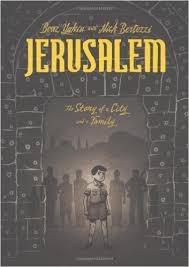
[READ: March 30, 2016] Jerusalem

With a title and subtitle like that you know this isn’t going to be a fun and lighthearted story.  And it is not.  The introduction explains how this is the story of a family, but it is more about the land and the strife that has been there for generations.

A lengthy history of Jerusalem is given, but for the purposes of this story the most recent action is the 1929 dispute over prayer rights which led to riots.  And then the British imposed the White Paper of 1939 which blocked Jewish immigration and was in place as the Nazis were riding to power. This led many Palestinian Jews to regard the British as hostile. And yet many Palestinian Jews joined the British army to fight the Nazis in Italy and the Middle East.  At the same time there were underground forces of Palestinian Jews who were attacking the British.

The action of this story takes place in 1945.

There is also a history of the Halaby family about whom this story is concerned.  Yakov Halaby was born after a series of girls were born in his family.  His father vowed that if they had another son they would move to Jerusalem.  After Izak was born they did so.  But Yakov was jealous from the start.  And he made Izak’s life miserable.  Eventually Izak left and married an Egyptian woman and they both moved back to Jerusalem. (more…)

Read Full Post »

1975SOUNDTRACK: ESKIMEAUX-Tiny Desk Concert #466 (August 28, 2015).

esquimeauxEskimeaux is Gabrielle Smith, who is the keyboardist in Bellows, a band that played a Tiny Desk Concert just a few months before this one.  As far as her stage name,

as an adopted child, Smith discovered that her biological father is Tlingit Eskimo; she describes the -eaux suffix as “just a playful jumble of letters that represents the way I record — a confusing layering of sounds that somehow coalesce into something simple.”.

Smith sings three songs in less than ten minutes.  She has a pretty, unaffected voice–just clean and clear vocals.  For the first two songs it’s just her and her guitar

“Folly” is a simple song as you might expect from just a strummed electric guitar.  But there’s something about the way she sings her lines in a series of rising notes that is really inviting.  She also has a nice way with words.  Like:

In my dreams you’re a bathtub running / You are warm and tender / And bubbling

“A Hug Too Long” is a faster song with a simple but interesting guitar riff that’s followed by a simple but interesting vocal melody.  Again, her clear voice fits perfectly with the music.  It features the intriguing chorus: “You went to work, I went to New Brunswick.”

Her final song is “I Admit I’m Scared.”  She has her bandmates from Bellows come out to sing with her.   There’s no extra instrumentation, but Smith sings in a slightly deeper register and Bellows fleshes out sections of the song (they even do a kind of deadpan synchronized move after each chorus).   Another great line of hers is: “And everything I said spewed like sparklers from my mouth.  They looked pretty as they flew but now they’re useless and burnt out.”  As the song ends, everyone sings louder “If I had a dime for every time I’m freaking out” which leads to a  dramatic climax before the final resolution: “We could fly around the world / Or just get out of your parents’ house.”

Bob jokes at the end that they can come back any time with a new band.  She says they have five other bands (including Told Slant and Small Wonder).  He says “you could come in every Tuesday.”

Bellows isn’t that different from Eskimeaux in style–pretty, quiet songs that are articulate and almost deadpan.  But having Smith sing (and presumably write) changes the way the style is created.  Which is pretty cool.

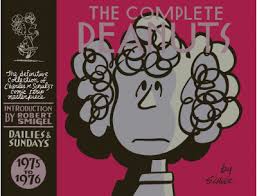
[READ: June 8, 2016] The Complete Peanuts 1975-1976

I really enjoyed this book a lot.  In the introduction, Robert Smigel talks about how it seems like in this era, Schulz turned a corner a bit to become more absurd.  The jokes are sillier, with new characters and some crazy ideas–like talking buildings, pitching mounds and body parts.  He wonders if it was Schulz’ happy marriage or just a desire to take some chances rather than repeating himself.  But whatever the case, the book is really fun.  I especially love the Peppermint Patty/Marcie strips in which Schulz just seems to be having a great time.  I also love all of the jokes with Sally in which she makes herself laugh with some awful puns–I just imagine Schulz cracking himself up and not being able to wait to draw the strips.

But for all of the newness of the strips, Peanuts is always seasonal.  So 1975 beings with ice skating and snowmen.  Linus has made a snowman reclining and reading a book. Charlie asks if it’s Robert Frost and Linus snarks “You said it, I didn’t.”

Patty has been falling asleep a lot in school–her dad is away–and Snoopy makes as terrible watchdog for her.  More funny Patty moments are when she is being so decisive about true false questions.  “Irrefutably true, understandably false, intrinsically false, inherently false, charmingly true.”  To which Franklin asks “Charmingly?”  Patty also becomes the first disciple of the Great Pumpkin–but she blows it by asking for a gift, as if the Great Pumpkin is some kind of Santa Claus. (more…)

Read Full Post »

1973SOUNDTRACK: LUCINDA WILLIAMS-Tiny Desk Concert #412 (December 20, 2014).

lucindaI set tiny, manageable goals for this blog.  They often change over the course of the year, but I like to see if I can complete them.  One such goal was to write about all of the Tiny Desk Concerts from 2014.  And here’s the final one.  (Another such goal is to write about the remainder of the 2016 shows, which is doable).  I also want to write about all of the rest of the First Second Graphic Novels (there’s about 20 of them left).  Insignificant goals that I find satisfying to complete.

I’ve never been a fan of Lucinda Williams.  Although, while I’d certainly heard of her, I obviously didn’t know any of her music. The blurb talks about her distinctive voice.  And it is certainly that.  About 20 years ago a sort of friend of mine saw her open for somebody else and she dismissed Williams as trying to sound like a different singer (wish I could remember who it was).  The irony that Williams has been around since the late 1970s was not lost on me.

But Williams has changed her style over the years.  She originally sang country and has morphed into more of a folk and now a blues style.  This Tiny Desk Concert focuses on her bluesy songs.  I know she’s something of a legend, but I found her demeanor through the whole show off-putting until the end, when she loosened up a bit.

She sings four songs.  “Something Wicked This Way Comes” is rocking blues song.  And I have to say I was pretty shocked by her voice–rough and raspy and sounding not a little hungover.  Her lead guitarist was really the start for me, effortlessly playing some great groovy licks.

For “Cold Day in Hell” (she laughs at saying the title) she straps on an acoustic guitar and then sings like Tom Waits.  That seems like a joke, but the structure of the verses is pure Tom Waits–I would have even suggested he wrote the song.

The third song is the more bluesy “Protection.”  There seems something so inauthentic about this song.  I just don’t believe her rendition of it–I don’t believe that she actually needs protection.  It’s really disconcerting.

She finally smiles after this song and says “Now I’m kinda getting used to this … I’m not a wake yet, that’s what the thing is.  She straps on her guitar and says this is based on the story of the West Memphis Three.  It’ my favorite song of the four–she seems to really get into it.

But all the same, I really don’t like her voice all that much–she’s got a weird drawl and sounds like there are some marbles in her mouth. It’s very strange.  I listened to a bit of a song from a live show from 1989 and her voice was quite pretty–deep, yes, but very pretty.  By 2007, her voice has changed–it’s deeper, with a pronounced drawl.  At a show in 2013, she sounded kind of pretty again.  So, I don’t know what to make of it.  I’ll have to just go back to not listening to her.

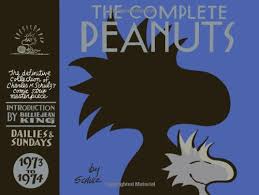
[READ: June 8, 2016] The Complete Peanuts 1973-1974

I really enjoyed this volume a lot.  There were a lot of really funny jokes and the characters are really nicely distributed by now.  I don’t want to say that Schulz hit his stride around this time, because he’s been pretty solid right from the start, but this book was easily my favorite so far.  Possibly because it contained so much of Marcie and Patty who have easily become my favorites.

The year starts off somewhat inauspiciously with the anticlimactic return of Poochie.  She shows up, realizes that Snoopy isn’t a cute puppy anymore and leaves.  Never to be seen again.

More interesting is that Linus decides that since Charlie has been their manager for so long and worked so hard that they ought to throw him a commemorative dinner. They plan it for a couple of weeks and when he finally hears about it, his smile is awesome.  They even get Joe Schlobotnick to agree to come. Of course, then Marcie starts saying that they’d all be hypocrites if they actually showed up and said nice things about him since he’s a terrible manager.  And so they cancel it at the last-minute–while Charlie is there. (more…)

Read Full Post »

rjSOUNDTRACK: YUSUF/CAT STEVENS-Tiny Desk Concert #411 December 9, 2014).

catAs this Tiny Desk Concert opens, Bob Boilen tells his story of being 17 years old and saving up money to buy a guitar so he could learn Cat Steven’s “Father and Son.”  He says he’s now old and has a son and the song still means a lot.  And that introduction makes the song even that more emotional when he plays it later.

It’s a shame that he is so known for the controversy about the fatwa back in the 1980s, but his conversion to Islam is pretty interesting: “In 1976, Cat Stevens almost drowned off the coast of Malibu. In his panic, he says, he shouted, “Oh, God! If you save me, I will work for you” — at which point he recalls a wave that came and carried him ashore. He converted to Islam, changed his name and left the pop world after one last album in 1978.”

He released his first non-spiritual album in decades in 20o6.  He released another one in 2014, which was a record of some originals mixed with standards and blues covers.  He plays two songs from this album here (which is a bit of a disappointment, as I could have easily listened to him play the entire Greatest Hits album).  But these two songs are quite nice.  “I was Raised in Babylon” is a bit dark, although his voice sounds great.  “Doors” was originally written for the musical Moonshadow.  It’s a delicate ballad.  And it also as a religious impact with the final line being “God made everything just right.”

In between these two he says he doesn’t know what to play next, but he has some kind of gadget that he scrolls through.  And he chooses “The First Cut is the Deepest.”  He comments maybe some people know I wrote this one, it wasn’t Rod Stewart.  I really like this song a lot.  It sounds different from the record because it’s just him and his guitar, but his voice is unmistakable. and he sounds great.  And if it makes him feel better, I’ve never even heard the Rod Stewart version.

He dedicates “Father and Son” to Bob and it’s just as beautiful as the original.  And yes, it should make you tear up, especially if you have a child.

After listening to this Tiny Desk I really wanted to see him play live.  I know that he is currently on tour and will actually be in Philly on this very night.  There are still tickets available, but since the cheapest seats cost nearly $200, I’ll be skipping this one.

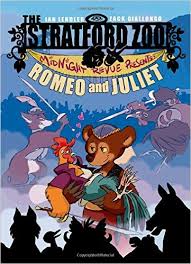
[READ: April 4, 2016] The Stratford Zoo Midnight Revue Presents Romeo and Juliet

I really enjoyed the first book in this series, in which the zoo animals put on a play of Macbeth.  Well, the zoo is ready again for their next performance.  I enjoyed that the audience is aware of the previous play–the kids are even wondering why it’s another tale of woe instead of something happy.  Later when the lion (who was in Macbeth) comes out, someone addresses him as the character from that play.

What I thought was interesting about the way this play was done was that they made the story kid friendly.  I liked this and that it allowed me to share this story with my kids.  Rather than being lovers, Romeo and Juliet want to have a play date, and rather than killing themselves at the end, they wind up hibernating. (more…)

Read Full Post »

« Newer Posts - Older Posts »