Feeds:
Posts
Comments

Archive for the ‘Graphic Novel’ Category

secret-2SOUNDTRACK: SANDRO PERRI-Spaced Out EP [CST101] (2013).

cst101cover_258x242Sandro Perri, plays jazzy music and sings in a gentle falsetto. I really enjoyed his album Impossible Spaces a lot.  This 10″ EP is composed  of 3 remixes from that album.  I happen to really dislike remixes that basically take one aspect of a song, add drums to it and repeat for 5 minutes.  Most dance remixes are pretty inane.  These are a step above that.

The three tracks are Love & Light (Larry Gus – Panamix), Wolfman (Le Révélateur – Sky Mix), and How Will I? (Imugem Orihasam – Outlook Mix).

The original of Love and Life is a pretty, jazzy number with some great sounding drums and synth notes.

The remix opens with some really fast clicking and some cool wild bass synth.  Then Perri’s voice is manipulated into a kind of repeating note.  Once the song starts properly there’s a cool drums beat and repeats of Perri singing “hey” along with his voice played low in the mix.  And that’s Brett much it.  It’s simple but insanely catchy/dancey.  The song pauses in the middle and then resumes with new vocal snippets The Constellation site says the remix “employs over 500 samples extracted from the song’s stems. The result is an intricate, dense, exuberantly satisfying groove-based track that chops and channels the woozy rhythmic complexity and mellifluous vocal of the original.”

“Wolfman” is a ten minute track that I love–it has so many components and different styles. But this remix strips away pretty much all of it.  It is basically 5 and a half minutes of drums with some wavering synth lines.  About 3 minutes in some ooh oohs from the original track come in, but it’s so removed from the track that I almost wonder why bother.  Well, Constellation is there to tell us: Roger Tellier-Craig (Fly Pan Am, Pas Chic Chic), reworks “Wolfman” as a beautifully building swarm of layered loops and long delays – an homage of sorts to Perri’s own Polmo Polpo sound palette.”  And if that’s what you are expecting, he does it well.

I also love the original of “How Will I.”  This version is very strange.  The music is stripped almost all away with just some occasional sprinkling of piano and rumblings of low notes in the background.  There are additions of synths and percussion but otherwise it is largely a stripped down song.  What I loved about the original was the music—the flutes and everything–and it’s all gone.  I do love at 7 minutes when the bass rumbles through the song, but otherwise its pretty samey.  Constellation tells us: “Japanese producer Imugem Orihasam (Fragil) extrapolates a sweet and loose abstract-House vibe from the original, bringing the highly detailed swing of the song’s live drum tracks to the fore, allowing Perri’s vocal to unfurl against a minimal, skittering, plunderphonic arrangement.”

So, this is not a release I would play very much.

[READ: October 3, 2016] Secret Coders: Paths and Portals

Secret Coders ended with a  pretty big cliffhanger.

Hopper and Eni are on to something big at their school, Stately Academy.  They have just discovered a robot which (through their own programming) has opened up a portal to a secret underground lab. But it is the lab of Mr Bee.  Oh, and that bully Josh has decided he wants to help them.  Hopper says no way, but Josh doesn’t give up.  However, he’s kind of a coward and a little dumb and Hopper is really quite mean to him back.

Eventually they all start working together–Josh has mad typing skills.  And the beginning of the book shows the trio learning to write a program for the Robot Turtle to run. Coding isn’t a terribly exciting thing to watch, but Yang and Holmes do it in a cool way that makes it rather enjoyable.  Even (or maybe especially) when the kids screw up.

But they do succeed.  Which leads to an even more secret room with dozens of robot turtles off all sizes  And that’s when Mr Bee reveals a bit about himself and Stately Academy. (more…)

Read Full Post »

19893 SOUNDTRACK: TEDDY ABRAMS-Tiny Desk Concert #491 (November 30, 2015).

teddyTeddy Abrams is a young piano player (he was 28 in 2015) and he was recently made conductor of the Louisville Orchestra.  Here’s some fun details from the Tiny Desk blurb:

For his first week on the job in Louisville, Abrams played jazz piano in the streets and took his orchestra players into nightclubs and African-American churches. PBS made a web series on his first season.  Earlier this year, he put two first symphonies on the same program — Brahms’ First and a debut symphony by Sebastian Chang, a composer still in his 20s — just to gauge audience reaction. Abrams filled the hall by giving out free tickets to first-time symphonygoers. He was happy to hear that many of them liked the new piece best, saying they appreciated hearing the composer introduce it onstage.

Abrams plays three pieces.  Two originals and one from Beethoven.  The first, “Big Band,” [from the blurb: swirls with jazz history. Hints of Thelonious Monk fly by, along with tips of the hat to the stride style from the early 20th century] is a fun and fast piece with Abrams playing fun and bouncy rhythms and very fast solo runs.  It’s infectious.

Abrams decided to begin the opening movement of Beethoven: Sonata No. 30 in E, Op. 109, I. Vivace, ma non troppo with a short improvisation, noting that the great composer was known for riffing at the piano for hours on end and was often getting into improvisation battles.  At he end, he says that we shouldn’t have been able to tell where the improv ended and the song properly began (although fans of the song could probably tell).  By the end of his life Beethoven was experimenting and some of his later stuff is pretty out there and modern.  That may be true if you know classical music, but it just sounded pretty to me.

He ends the set with a bluesy number, “The Long Goodbye,” [from the blurb: describing it as a slow ballad halfway between “My Funny Valentine” and “Somewhere Over the Rainbow”].  It is indeed a wonderful conglomeration of jazzy melodies.  A lovely and fun piece that is familiar but new at the same time.

[READ: July 26, 2016] The Complete Peanuts 1983-1984

As 1983 opens, Schroeder finally goes on the attack against Lucy “I have resolved not to be so serious..I’m going to try to laugh more” and then he pulls the piano out from under her and laughs like crazy.

For the past few books there have been a lot of jokes with Schroeder’s musical staves like Snoopy crawling through them.  Most have invoked Woodstock interacting with them.  As Schulz tends to do he will go on tears were he makes similar jokes every day for a week and then drops the joke for a while.  There’s also been some strips with Woodstock singing .  In one of my favorite, he is singing and the rain comes and actually washes the notes away from the stave. Even funnier is in Nov 1984 whee the rain comes and makes the notes droop really low.

For Valentine’s Day this year, Linus did not send Sally a card and she is very upset. Charlie says he should punch Linus in the nose.  But he says instead that Linus should just walk into his fist.  Charlie holds out his fist but Lucy walks into it instead.  That’s pretty funny.

More abuse for Lucy comes from Linus.  he gets a small bit of revenge by using Snoopy as a strange catapult and launching a snowball at her.

In the summer of 1983 while Snoopy is on a hike with the troops, the birds Bill and Harriet run off and get married and they stay in Point Lobos. (more…)

Read Full Post »

secretSOUNDTRACK: CLUES-Endless Forever 7″ [CST064] (2009).

  cluesClues was a band who played rock songs that fused a lot of different styles–often within one song.  They released one album which was fantastic and then basically went on hiatus (that was six years ago).  This 7″ was a tour artifact that Constellation has made available.

It has two songs–a band-made remix of one song from the album and a demo of another album track..

“Ledmonton (Endless Forever Version)” is an unusual but fun song with lots of different sections.  All of them sound unrelated to each other and yet each part is quite catchy and it works wonderfully as a whole.  This remix doesn’t change the song all that much.  It makes it a little softer and fuzzier.  “You Have My Eyes Now (Demonstration Version)” feels like a demo compared to the final version, but it’s really full sounding–just not as full as the album.

This release is more for completists of the band or, since they put out one album and disbanded, any fan of their recorded output might just enjoy this.

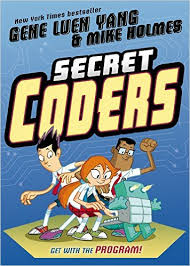
[READ: October 1, 2016] Secret Coders

Beloved artist/author Gene Luen Yang came back in 2015 with a new series called Secret Coders.

There is a kind of introductory section that implies the whole story is a lot more meta than it might at first seem–but it is not resolved yet so it’s hard to be sure of that.

The story opens on middle-schooler Hopper.  She is very unhappy to have moved to this new town and a new school.  In addition to missing everyone back home, the sh cool is decidedly weirdo.  There are birds with four eyes, the groundskeeper’s doors are locked and the custodian Mr Bee is really mean.   Plus the whole place looks haunted and there are huge numbers painted all over the buildings (but not in any actual order).

Hopper is pretty abrasive. In fact I’d say she’s downright unlikable–I find her rather offputting, myself.  Of course, she’s also unhappy and the first people that she meets make fun of her (and throw pudding at her), so she is quite snippy with people.  But she’s also not afraid to stand up for herself, which is cool.  When she learns who threw the pudding at her, she fights back–not realizing that the guy is a huge basketball player.  But he doesn’t fight her.  Rather, he chooses to walk away. (more…)

Read Full Post »

black-daimons SOUNDTRACK: LAST EX-Last Ex [CST107] (2014).

last-exOne of the things I love about Constellation Records is that you often never know what you’re getting.  They used to very specifically release a certain kind of music, but they’re now just releasing interesting and exciting music.  But also, a band name can’t really tell you what to expect from this label.

So who knows what a band like Last Ex will sound like.  And how cool that their first few songs on this are so good.

The disc’s sides are split into Side X and Side XX.

“Hotel Blues” opens with some scattered drums and chords.  It has  vaguely early-Pink Floyd feel to it.  But around a minute in, the synths pick up a repetitive melody and the bass and drums kick in to give it a very Can or Kraftwerk vibe.  The song is fairly straightforward, but there are sprinklings of notes—sometimes slightly off and vibrated that add some very cool textures to this pulsing track. It’s really groovy and fun.  But it’s “Girl Seizure” that I find so strangely compelling.  Again, over simple repetitive drum and bass, the guitar (or keyboards) play warbling notes that are unsettling and yet enticing.  The song quiets to almost nothing and then resumes in much the same way—and you welcome that weird warble and its of Moog feeling.  At just under 3 minutes its just the right length.

“Flûte magique” slows things down with some simple arpeggios.  There’s not a lot to the song, but it is wonderfully soothing as the bass notes tick away and then the guitar notes rise higher and higher.  The song picks up speed as it goes along and leads to a middle section that’s almost stiffly funky, if that’s possible.  The ending gets a little louder as it thuds to a conclusion.

“It’s Not Chris” opens with some static and strange noises and some soaring keyboards.  About a minute and a half in a strange staccato organ melody comes in with a violin sound doing a kind of solo over the top.  It’s all a little strange but it drops out in the middle to a kind of sinister pulsing, and when the melody resumes, it seems strangely comfortable again.  The end of the song has some high-pitched violin notes that sound almost like a theremin.

“Resurrection Drive” is mostly drums and echoed surf guitar chords. After a minute or so some strings are added to the mix.  It’s only 2 minutes long but it introduces some interesting tension.

Side XX has a quieter feel overall.  “Nell’s Theme” opens with acoustic guitars playing a simple, pretty four-note melody.  The song slowly grows more complex as a violin is added to the song. With about 30 seconds remaining, everything drops away save for a mournful violin.

Thudding bass and picked notes echo through “Trop tard.”  It has a slow, spacey feel (like mid-period Pink Floyd).  A guitar is added and it speeds up some but still sounds of the era and then settles back down to a languid pace.  “Cape Fear” is less than 2 minutes of swirling outer space sounding synths—a creepy, lonely feeling.

“Cité d’or” has more slow pulsing rhythms and more echoing surf guitars and the whole thing feels rather tension filled.  Some squealing  feedback intersperses the surf guitar.   “Hotel Blues Returns” for 1:43.  It’s primarily the drumming pattern of “Hotel Blues” with some swirling synth noises (it’s good for headphones).  “Hotel Kiss” ends the disc with sirens and then a slow thudding drum and more noir guitars.  This could be used in a Twin Peaks scene.

So this album is an interesting mix of rocking songs with unsettling noises and mellower songs with cool synth effects.  It’s a great find.

[READ: September 24, 2016] The Black Diamond Detective Agency

I read this book a while ago, but I never posted about it.  And that gave me the opportunity to re-read it and, frankly, to enjoy it more.

This is the third book by Eddie Campbell that I have read.  I have found his stories to be complicated and hard to follow on first read.  They really demand a second and even a third read.  Part of it is that he writes complicated and somewhat intentionally convoluted narratives.  And part is because of his drawing style.

I love the cover of this book, how it is set up to look like an Old West placard: ORPHANS! MAYHEM! TERROR!  “In This the most recent offering from The First Second Quality line of Books.  An epic take of a newly industrialized America as revealed in words and pictures by the inimitable Mr Eddie Campbell.  Based upon  the manuscript of a Kinematographic play by Mr C. Gaby Mitchell.”

And its this last part that I missed when I first read it–that it was based on a screenplay.  And this book does resemble a screenplay.  However, I noted that in my other posts about Campbell that I’ve said of this book: I liked and didn’t like this book.  Well, which is it?

The story is incredibly complicated–with double and triple crosses.  And the visuals call for mistaken identity and hidden identity as well as new characters who all look vaguely the same–like pale photographs of turn of the century urban gangsters. But the story is really interesting. So I liked it, although I think I’d like to see it more as a film. (more…)

Read Full Post »

orcsSOUNDTRACK: AVEC LE SOLEIL DE SA BOUCHE-Zubberdust! [CST106] (2014).

cst106cover_258x242Avec le soleil sortant de sa bouche (With the sun out of his mouth–no translation for Zubberdust) is the creation of former Fly Pan Am bassist Jean-Sebastien Truchy.  With this album he has created a fascinating hybrid of near Krautrock repetitions with some King Crimson guitar lines and time signatures.  And interesting sung almost operatic male vocals.  Technically the disc has four songs, but songs 1 and 3 are extended suites broken into chapters.

“Face à l’instant” (Face Now parts I-IV) is the first suite.  This disc opens like Ministry–with an aggressive, fast, pounding guitar riff for 8 bars, a sharp pause and continuation of same.  After four measures of that, a quirky quiet instrumental takes over and at about a minute the heavy guitars return. Part 2 of the song starts with a funky, slightly off-kilter sounding guitar line and whistling.   About a minute into this secretion the song shifts to a quiet sequence of overlapping riffs and sounds.  About 5 minutes in, the voices start singing in wordless chants–it’s strangely catchy and slightly militaristic at the same time.  The song builds with voices until it climaxes with a stop.  Then a complex drumming pattern begins Part 3. The guitars lines resume and there are several vocals sections (I assume singing in French) that add a lot of tension to the song.  Midway through this part the song stops and that aggressive introductory guitar pummeling resumes, this time changing keys and not letting up.  New sounds and super heavy drumming are added as this brings part three to a climax.  Part 4 returns to quieter playing (and sounds a bit like Fly Pan Am in the way the guitar line as intersect.  The final section continues with the vocals and rhythms of the other three and then ends with some dramatic keyboard chords playing us out.

“Super pastiche fantastique” (Super fantastic pastiche) is the other suite.  It opens with some complex drumming and then several sequences of notes–guitar and synth that meld nicely.  Part 1 is just 3 minutes and by the end some electronic noises start overtaking the melodies.   Part 2 opens with the same melody but the electronics have been replaced by a wah-wahed guitar and more synth lines.  The song is complex and repetitive, with the only non-repeating part being the singer’s voice (no idea what he’s even saying).  The second half of part 2 (which is 7 minutes in total) ends with some sung vocals (not unlike David Byrne).  Part 3 is a 90 second interlude of very quick tinkling strings that are overwhelmed by noise and static and thudding drums.  The end of the track seems to be building up to part 4 which picks up the momentum into a great instrumental motif–intertwining guitars and electronics all with a cool bass line underneath.  After 2 and a half minutes the  song drops to drums and a funky guitar line with all kind of noises and static and voices working as transition to the cool bass line that comes in around 3 minutes.  As the song careens towards the end, the pace picks up and you can hear some intense screaming of vocals way in the distance.  The song cleans up and plays that great fast riff right up until the end when it abruptly ceases.

Tracks 2 and 4 are weird pastiches of sound. “Déja hier…” (Already yesterday…) is a four-minute song.  Interesting music plays very quietly in the background before it gets overwritten by conversation and static.  You can occasionally hear the song being played behind the noise, but it’s mostly just a weird kind of muffled noise.  “À partir de dorénavant” (From now) is similar.  You can hear a distant muddy drum and what sounds like la dinner party–tons of conversations going on at once.  It seems like the disc is going to end with 3 minutes of this, but a keyboard melody begins to slowly overtake the din.

The last minute or so is this interesting sci-f sounding synth line with warbling effects and an interesting, mellow bass.  Although it’s nowhere near as complicated as the rest of the album, it’s a cool way to end and almost feels like a segue into something else.

This album has a whole lot of styles and genres blended together into a (mostly) very cool mix of sounds.  I like it a lot, although I’ll probably skips tracks 2 and 4 most of the time.

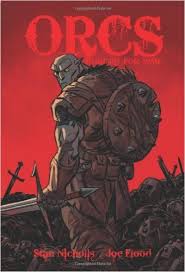
[READ: June 15, 2016] Orcs: Forged for War

This book was a little hard to learn about because Stan Nicholls has written several novels in the Orcs series.  So when you look up his books you get a confusing list of the series and other things.  This book is not part of the series, but it is part of the overall Orcs arc. It comes just before the First Blood Trilogy.

In the intro, Nicholls tells us lot more about his whole Orcs oeuvre.  He points out that unlike Tolkien (whom he loved) his Orcs are not mindless brutes. In fact, in his books, the orcs are the heroes and the humans are the ones who have along and messed things up.  He says that anyone unfamiliar with his orcs books should have no trouble following this book.

And that is true to a degree.  One thing that it behooves an author/artist to do is to make sure that everyone understands who all of the characters/races are in his/her book.  He does give a brief summary in the intro, but that doesn’t really help because there’s no visual guide.

Humans are divided into two camps.  The Manifold (Manis) pursue ancient pagan ways.  The Unity (Unis) are monotheistic.  They are both fanatics but the Unis have more bigotry and demagoguery.

This book opens with the Unis fighting the Manis.  And then the Orcs enter the fray but it’s not always clear whose side the Orcs on, if any. Regardless of which side they are on, they are willing to fight and kill whomever (there is much much bloodhsed and a shocking amount of vulgarity in the book). (more…)

Read Full Post »

clowns SOUNDTRACK: LE FLY PAN AM: N’écoutez pas [CST031] (2004).

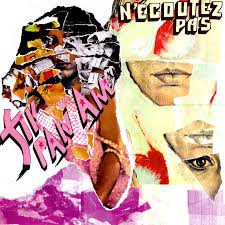
flypanam31N’écoutez pas (Do Not Listen) was the third and final full length album from Constellation’s Fly Pan Am (or in this case Le Fly Pan Am).  There are several short tracks on the disc as well as two 11 minutes songs

“Brûlez suivant, suivante!” (Burn Next, Next!) Opens the disc and hints that it’s going to be a standard rock album—4×4 drums and a dense buzzy electric guitar.  And even when the song proper starts, there’s chanted worded in French and some noisy guitar—its very far from the bass and funky glitchy stuff of previous albums.  The song has very conventional element—a drum break where one might clap along and what sounds like people singing lalalalalala, but all under a veneer of noise and decay that makes it anything but poppy.  There’s a deep voice speaking insistently in French and way in the background a person screaming.  So, really it’s rather unconventional, but within a relatively “normal” framework.  “Ex éleveurs de renards argentés” (Ex breeders silver foxes) is the noise of completely detuned guitars getting plucked and strummed for 30 seconds until a piano plays a chord and all else stops.  It seems like a song will begin but, no, more noises—industrial waves and cars honking takes over.  And then a cacophony of voices begins talking all over each other (including a couple in English).  It’s all over after about 2 minutes.

“Autant zig-zag” (As much zig-zag) is a totally apt name for this song.  This is the first 11 minute track.  After a minute or so introduction, the song comes in with a propulsive bass (not funky at all like the last album) and the song feels like it’s ready to rock.  And it does.  It keeps up this rhythm for a bit and then shifts to a new part with wordless vocals.  There’s even a call and response section with sung words and ooh ooohs as response.  The song shifts to a kind of pummeling section that continues for several minutes until the end.  It contains pretty much everything the band does.  “Buvez nos larmes de métal” (Drink our metal tears) is a noise collage with dramatic movie soundtrack type music played behind the static and distant voices and noises.

“Pas à pas step until” (Step by Step until) has a commanding one, two, three, pause, four, riff going on that is at once catchy and noisy.  The song proper comes in with whispered singing and a wild bass line.  Alexandre St-Onge contributes his wonderful chaos to this song which has some really catchy backing vocals in it

“…” opens side two with what sounds like a voice repeating Fly Pan Am over an over amidst the sound of someone else chewing.  It segues into “Très très ‘retro'” “Very Very ‘Retro’” is the other 11 minute song.  It has two guests, Dominique Petrin on vocals and Tim Heck on electronics.  The song opens with a high-pitched bass and some great counterpoint rhythms.   There’s more hidden vocals throughout the song  Around three minutes in, the bass gets funky.  This runs on for several minutes with some interesting sound effects thrown in until there’s a loud pop and silence.   And then another pop and organ music takes over.  At about 9 minute the song resumes the funky bass line. Again, the band has crammed a lot of stuff into this song.

“Vos rêves revers” (Your dreams setback) has a nice bass sound with some ringing guitar notes.  There’s whispered vocals that sing a melody of sorts.  It’s a fairly conventional song—catchy and bouncy with vocals and everything (true they are whispered and hushed vocals but they do follow a melody line).  At about 4 minutes (of 6), the songs crashes unto itself with the drums and the guitars seeming to fall apart

“Ce sale désir éfilé qui sortant de ma bouche” (This dirty tapered desire coming out of my mouth) has a deep echoing drum kick which keeps a beat.  In the distant background a keening voice kind of follows the melody.  The disc ends with “Le faux pas aimer vous souhaite d’être follement ami” (The false not love you madly want to be friend).  It’s a one minute song with sliding guitars and rock drums which propel this to as close to punk as the band has gotten.  There’s chanting and excitement and fun and then the whole song unravels after about 40 seconds at the end with a sloppy piano denouement.

And that was it from this avant-garde band. The members went on to make lots of other music, Jonathan Parant went on to form Feu Thérèse. Felix Morel has played drums with all kind of interesting bands including Et Sans.  Roger Tellier-Craig has been in Et Sans and Set Fire to Flames among others.  And Jean-Sebastian Truchy has played in several bands including Avec le soleil sortant de sa bouche.

[READ: February 6, 2016] City of Clowns

In the afterword to this book, Alarcón explains how it as written.  He lived in Lima, Peru for a year, teaching.  But while he was there, he had writer’s block.  So he moved to a farmhouse in the middle of America–pure solitude.  And there he wrote the story “City of Clowns” (which I read back in 2013 in the New Yorker) in English.  Sheila Alvarado talked to him about turning the book into a graphic novel.  And so it was completed (after much labor, he says) in a slightly condensed Spanish edition to be released in Spain.  And then, eventually, it was translated into English again, from the Spanish graphic novel.

Since the story really doesn’t change from the short story version, I’m going to put my original comments here:

It opens with Oscarcito going to the hospital because his father died the night before.  He finds his mother mopping floors because his father’s bill was unpaid.  And in that very first paragraph, she introduces her son to Carmela—the woman whom his father left them for.  She was mopping the floor with Oscarcito’s  mother.  He is confused and enraged by this.

His half brothers are also there.  He had never met them before, preferring to stay away from his father’s other life.  But he saw them in front of him and clearly saw that they were related to him.  But the most galling thing was that although he was the oldest of all the children, they were clearly the chosen children—after all, his father stayed with them.

Then we learn about his father’s life.  He was born in Cerro de Pasco and moved to Lima when his young family was still young.  He worked hard in semi-legitimate businesses and then brought his family to the city.  Young Oscarcito, age 8, loved it.  But his mother hated missing her family in Cerro de Pasco.  And now they were living with his father who was practically a stranger. His father worked hard and succeeded, but he was rarely home.

Between flashbacks to his father’s story we see that Oscarcito is now a reporter for the local newspaper and he has been asked to write about the clowns that are prevalent around the city.  Oscarcito is on a bus when a clown approaches.  The clown is pelted by water balloons but still manages to climb aboard the bus and peddle his wares—gaining a few coins for his “act.”  Oscarcito is not interested in the subject and puts it off.

So he travels to his mother’s house to see how she is doing, but a neighbor there tells him she has been living with Carmela since his father got sick.  His mother was embarrassed by this and asked the neighbor not to say anything to him.

His mother had been a cleaning lady since they moved to Lima.  She worked for the Azcártes, a wealthy local family who treated her very well and treated Oscarcito practically like their own son.  Oscar was even sent to a nice school where he was welcomed until they realized where he was from.  Gangs would steal anything from anyone, and were called Piranhas.  And that became Oscar’s nickname at school.  And soon he was made fun of by just about everyone, but especially by one boy.

A flashback then shows that Oscarcito went to work with his father doing construction on a few occasions—they worked very hard on expansions of people’s houses—working hard and working well and making good improvements.  But all the while, they were waiting patiently until they could rob them of all of their fine things.

So when he found his father was working for the father of the boy who made fun of him, he wanted in, and he stole the boy’s suit.

Finally, after putting off his article for ages, Oscarcito meets and interviews a clown.  And that clown tells him how he started and invites him along.  And Oscarcito does.  He finds that he likes the anonymity of the job.

All of the threads come to a head as the story reaches its close—where Oscar will confront his mother and deal with his newfound joy at being a clown.

The ending was very powerful and I enjoyed this story immensely.

There are few details from the original story that have been changed (and I amended my comments accordingly).

There is also an extra scene added of him dating a girl named Carla who walked on stilts.  There’s an erotic moment which is really interesting and which brings a whole new level of fascination to Oscar’s clown life.

Obviously the biggest change is Alvarado’s illustrations.  She does an excellent job recreating these scenes much as I imagined them.  I really  enjoyed the way she worked within the mens’ professions–putting words on bricks as his father was laying them, hanging papers up to dry with text on them, and using excellent distinctions of black and white to show the different settings in Oscar’s life.

The biggest change I think is the depiction of Oscar in his clown suit.  It’s nothing like I imagined and is all the better for it.  Alarcón says that now this is “its true and definitive form” of the book, and I imagine that this is what I will think of when I think of the story.

For ease of searching, I include: Daniel Alarcon.


Read Full Post »

1981 SOUNDTRACK: SON LITTLE-Tiny Desk Concert #496 (December 18, 2015).

sonlittleI know of Son Little, although only vaguely.  WXPN has played his song “The River” quite a lot, although I don’t think I’ve heard anything else.

For this Tiny Desk Concert, he’s really stripped down–just his acoustic guitar, a percussionist (Jabari Exum playing a djembe with accoutrements) and a backing vocalist, his sister Megan Livingston.  His playing is even pretty stripped down–his chords are minimal, almost more like accents for most of the songs (although he does play louder from time to time).

As such, this really celebrates his voice which is strong and almost gospel-like.

He plays three songs. “Lay Down,” is a quiet soulful song with perfectly spare accompaniment.  When it ends, everyone seems adorably shy with Little saying, “just mildly awkward enough.”

“Your Love Will Blow Me Away When My Heart Aches” is a bit bigger–Little sings a bit louder and plays louder chords, but it is still quite minimal.

He ends with “The River” which is certainly stripped down from the radio version.  It opens with some claps and he encourages everyone to clap along although “If you’re like clap challenged then maybe… don’t–you know who you are.”  The song has that bluesy rock feel even in this understated form.  And while I like the original better, this is a great version–that quiet clapping and percussion is really nice.

[READ: July 26, 2016] The Complete Peanuts 1981-1982

So far the 1980s see Schulz settling into a few consistent themes in his strips–regular motifs that he mines over and over again.  Although it’s interesting to see how they have morphed over the decades.

Patty is constantly falling asleep in school (and getting D minuses), Snoopy continues to write funny/bad jokes and gets rejection letters about his books (this is usually pretty funny but it’s also surprising as Snoopy is usually the “successful” one); Snoopy also plays a lawyer a lot in these strips.

1981 begins where 1980 left off with Patty loving the story of Hans Brinker.  1981 also has a lengthy section about Valentines Day (a subject that gets more emphasis in some years than others), although this year Sally is the major protagonist (and her Sweet Babboo her object).  1982 also has a Valentine’s Day with Sally–she gets her hand stuck in the Valentine’s Day cards box.

Schulz used to do bible instruction which is why he quotes it so much.  And he occasionally peppers his strips with religious commentary.  There’s a joke about school prayer–Patty has to go up to the board and when her teacher falls ill she shouts “school prayer works, Marcie.”  There’s an amusing joke that Snoopy used to teach Sunday School at the Daisy Hill Puppy Farm.

Although the running jokes are funny, I love when he gets a new idea.  Like the a fun twist on the dog ate my homework joke when Snoopy as the WWI pilot steals Sally’s homework claiming it is the enemy’s secret papers and he eats them.

Sometimes Schulz gives a one-off joke that’s just silly and funny like when Woodstock “poofs” a dandelion and it “poofs” him back. (more…)

Read Full Post »

coin2 hiddenSOUNDTRACK: MATANA ROBERTS-Coin Coin: Chapter 2 Mississippi Moonchile [CST098] (2013).

The first chapter of this series was a sprawling disc of free-form jazz and spoken word.  It was interesting and strange with a powerful message (not always elegantly delivered).  It felt too long, but I think it was done live which would make it more understandable as a long presentation.

Chapter 2 is quite different.  It is much shorter, but it has 18 tracks that flow seamlessly (and often without apparent logic) into each other.  Most of the songs are quite short as well.

“invocation” is a sultry jazz number (Matana Roberts plays saxophone).  There’s also piano, trumpet, double bass and drums.  One thing that I didn’t like about the first chapter was Robert’s “poetry slam” deliver of her spoken words.  This album more or less erases that all together with the inclusion of Jeremiah Abiah on “operatic tenor vocals.”  I don’t know what he’s saying (if anything) most of the time, but his voice soars above the jazzy din.

“humility draws down blue” starts in the middle of a trumpet solo and lasts for a minute and a half.  “all nations” is only 8 seconds long and seems to coincide with a vocal line from Abiah.  “twelve sighed” settles things down some.

The first real change comes with “river ruby dues,” which opens with a gentle piano motif, and Abiah’s vocals.  Roberts’ sax solo plays throughout.  There are somewhat recognizable motifs played throughout the album.  I was sure I heard parts of “Pop Goes the Weasel.”

“amma jerusalem school” also opens with a new melody–a four note sax line–without a doubt the prettiest melody of the disc.  About mid-way through the song, Roberts begins speaking/reciting.  There’s a lot going on in her saga.  When that ends, more instrumentals continue and “responsory” has a lovely falsetto singing section.

This half of the album has been fairly conventional jazz: rather pretty with some nice melodies—far more conventional than Chapter 1.

Although by “the labor of their lips,” things have become a bit more avant-garde.  But even that doesn’t last too long and by “was the sacred day,” a pretty melody has resumed and more spoken word comes in, this time in stream of consciousness.  It’s a story of childhood with some happy and some sad details including: “they didn’t like black people at the hospital. you could use a room but no nurses would attend to you.” and the story of a woman getting whipped for not saying ‘sir.’   Interspersed through this tale is a sung line “I sing because I’m happy I sing because I’m free.”

‘woman red racked’ features Robert’s singing voice—pretty and pained—with some nice, deep backing voices accompanying.  Interestingly, this vocal part ends with them singing “Amen,” but the song is not over… a sax solo emerges from this and plays a kind of wild section with Abiah’s vocals until the end.

“thanks be you” is a spoken piece, a story told to a child about the past “there are some things I just can’t tell you about” which references a lot of childhood songs.  It ends with the repeated refrain “Mississippi is a beautiful place.”

This disc is only 48 minutes and it feels just about the right length,  “benediction” ends the disc with a quietly sung song with another singer accompanying her: their voices sound great together.

As with the first one, the narrative is a little unclear.  The main thrust of the story is obvious and effective, but it would be hard to diagram the story.  Nonetheless, her use of jazz and traditional sources (“red ruby dues,” “woman red racked” and “benediction” are based on traditional American folk songs), make for an evocative look into slavery from the point of view of one family.

[READ: March 20. 2016] Hidden

Having recently read the Resistance trilogy I am much more aware of France’s role in WWII.  But that could never have prepared me for this children’s book about the Holocaust.  (written by Loïc Dauvillier, translated from the French by Alexis Siegel with illustrations by Marc Lizano and Greg Salsedo).

The book opens on a little girl.  She wakes up in bed and hears her grandmother crying.  When she asks what’s wrong her grandmother tells her about the “nightmare she was having.”

And that nightmare is her story as a young Jewish girl in occupied France and how her life was brutally upended.  This is all told with fairly cute little characters with oversized heads.

I’ve never heard this story from the point of view of a child before.  Her grandmother was a little girl going to school.  She and her friends did everything that you’d expect little kids to do and the story starts out very sweetly.  Then one day she comes home and her father says that they must all be sheriffs–wear the yellow star on their lapel.  Once they stray doing that, she is effectively shunned.  But she has no idea why–why does everyone hate the sheriff? (more…)

Read Full Post »

class3 SOUNDTRACK: OUGHT-Sun Coming Down [CST115] (2015).

oughtsunSun Coming Down changes but also enhances the sound that Ought worked with on their debut. This album is faster overall–with fewer slow and mellow sections.  It is jittery and sometimes hostile but very much alive.

And yet as with the debut you can hear inspirations from The Fall and trippier Sonic Youth throughout the album.  And there’s more than a hint of No Wave sprinkled throughout.

Notice that Tim Beeler is now known as Tim Darcy.  But the band is the same and Matt May’s fuzzed-out keys often sound like a second guitar.  And drummer Tim Keen and bassist Ben Stidworthy keep the pace perfectly.


“Men for Miles” has a very Mark E. Smith feel–especially in the chorus–a kind of spoken/shouted style.  But that’s not the only way that Ben “sings.” There are actual sung parts like the “tear to your eye” section.   The music is kind of like Protomarytr–aggressively, slightly angular but mostly fast and propulsive.  I love the guitar riff which is surprising and yet catchy at the same time.  And amid a quieter moment, he asks, “Excuse me, did you say there’s a chance of bringing this whole fucker down?”

“Passionate Turn” is a but less intense, but it has a nicely sung verse and a cool, unusual chanted chorus.  There’s also a nifty guitar riff right after the chorus.  The steady rhythm of the bass really keeps the song moving along.

“The Combo” has aggressive guitars and a lumbering bass and drum line combined with some noisy guitars and more of that Mark E Smith chanting vocal.    The middle section grows almost pummeling with the noisy guitars and jackhammer drums as he chants “it’s a little bit strange” in a voice that sounds like he’s almost mocking punk singers.  It’s a surprise about 2/3 of the way in when the vocals grow almost positive: “Jubilation coming.”  It’s one of two songs on the disc that are just over 3 minutes but which still pack a lot of music in.

“Sun’s Coming Down” opens with a ringing feedbacking guitar and some noisy soloing.  “I am talking out of my ass because my heart is not open.”  About half way through, he starts saying “just like that, it changes” and the music follows suit–it changes to a slower thumping drum with some vocals “oooh oohhoohhoooh.”  The song reaches its end with a guitar that sounds like a police siren before returning to that calming “oooooh.”

I love the way “Beautiful Blue Sky” opens.  The guitar riff sounds very familiar in tone, and when the other guitars and noises come in it has  very Sonic Youth feel, with a pretty guitar riff. And then some spoken words enter over some abrasive scratchy guitar “warplanes, condo” that morph into a series of clichéd phrases: “beautiful weather today, how’s the family, how’s your health been, fancy seeing you here.”  The middle section slows things down with “I am now longer afraid to die because that is all I have left.  Yes.  I am now longer afraid to dance tonight because that is all I have left.”  And the ecstatic way he says “Yes” is surprisingly powerful as it sounds so different–almost ecstatic– from the rest of his delivery

“Celebration” is a much shorter piece with a sort of angrily chanted “Celebration.”  There’s buzzy guitars and a feedback-seeming drone behind the music.  It all leads up to a slow down where he chants, “All right, I’ll take it!” in a rather louche voice.

“On the Line” begins with the vocals sung quietly over a buzzing drone.  Slowly a synth line comes in.  The song sounds like nothing else on the disc until  the drums and guitars come bursting forth and the song blisters along.  And then it settles back to the quieter section with spoken word recitation.   The changes are abrupt and switch between a mellow poetry and garage rock.

“Never Better” opens with an aggressive riff and keening vocals.   It has a quieter chorus but the song never flags in intensity.

Even though it is obviously the same band, their three discs really explore many different facets of their sound.  I’m really looking forward to what the come out with next.

PERSONNEL
Matt May: Keys, Vocals
Ben Stidworthy: Bass
Tim Keen: Drums, Violin
Tim Darcy: Vocals, Guitar

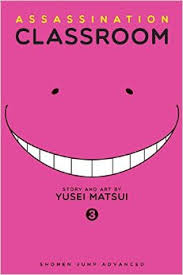
[READ: September 24, 2016] Assassination Classroom 3

I looked up this series online and saw that there are currently 21 volumes in it!  (11 are translated into English so far).  I can’t imagine how he can keep this story going (and at a pretty fast pace until the Earth will be destroyed) for so many more books!

This book begins with the students still on vacation in Kyoto.  Two of the girls have been captured by other students.  It’s a disturbing chapter with the implication that these boys have done things to girls before.  But Koro Sensei’s book about field trips actually covers the event of a kidnapping!  So the rest of the class is on it.  It even suggest where they might find the culprits (how did he know?).  It’s also a really big book and can be used as a weapon.  And our class comes out unharmed.

In the next chapter a new assassin named Red Eye is sent to take out Koro Sensei.  Red Eye is a sniper but he is baffled by Koro Sensei–who is able to stop a bullet with a dumpling.  Koro Sensei proves to be such a good teacher that even the Red Eye can learn something from him.

After a light episode in which the kids try to learn about Koro Sensei (and Irina’s) past girlfriends/boyfriends, a new student is added to the class.  But this student is a computer named Autonomous Intelligence Fixed Artillery.   It is a fast learning computer (with a pretty girl as its avatar).  And it is designed to learn from its mistakes.  It estimates that bu the end of the day it will have a .03% chance of killing Koro Sensei but by the end of the month it will be 90%.  So it begins class by opening fire on Koro Sensei (despite the fact that it breaks the class rules and disrupts class).  And then the kids have to clean up the mess of BBs.  In fact the kids are so annoyed that they tape the machine up so it’s guns can’t come out.  Eventually Koro Sensei teaches it that it needs to respect the fellow students or it will never blend in.  Koro upgrades the machine who actually seems to enjoy learning.  This is pretty fun sequence of chapters.

In the next section, Koro Sensei is affected by humidity–his head swells to a crazy size.  But that proves to be a diversion compared to the real plot that follows–revenge on a cheating girlfriend and her jerky boyfriend.  It’s very funny and quite elaborate.

The final chapter of the book is all about Irina.  She is trying to teach them to speak without an accent but the kids can’t seem to get their Ls and Rs correct.  She says that if they can’t get them straight, she will have to French kiss them (totes inappropes–although the previous chapter revealed that she was 20, which is much better than the mid 30s I assumed she was).  But we soon see that Irina’s “handler,” the guy who sent gave her the assignment, determines that she is no longer the right assassin for the job.  She is pissed but her services are no longer useful.

The book end with Koro Sensei proposing a test between Irina and her handler to see which one is the better assassin!

This manga is written in the traditional style of right to left, which is fun.  It is translated by Tetsuichiro Miyaki with an English adaptation (whatever that means) by Bryant Turnage.

Read Full Post »

assclass2 ought-once-moreSOUNDTRACK: OUGHT-Once More With Feeling… [CST108] (2014).

This EP came hot on the heels of their debut record.  It reworks a couple of older songs and has a largely improvised jam as well. It sounds pretty different from the previous record.

From the Constellation website: Discussion of a tour-only release that would grab a couple of the band’s self-recorded early tunes and commit them to vinyl shifted by the end of spring towards a realization that Ought might update this material to reflect how the songs have evolved on stage and in concert. … This yielded new recordings of two early pieces, “Pill” and “New Calm Pt. 2” (the self-recorded 2012 versions of which remain available on Ought’s Bandcamp) along with the brand new, more experimental and largely instrumental “New Calm Pt. 3.”. The non-album track “Waiting” from the More Than Any Other Day sessions (and the first tune to be given out via Constellation when we announced the Ought signing) rounds out this 24-minute EP….  In light of this new/freshly recorded material, it seemed unfair to restrict the Once More With Feeling… EP to tour-only status.

“Pill” sounds unlike anything else they’ve done.  It is mellow with Beeler Darcy’s (note the name change) singing as opposed to chanting/speaking voice.  I like that it is a fairly conventional sounding song and the way it builds slowly.  There’s a great bass line that enters after a bout 2 minutes.  The song feels meandering but it never wanders much from its mellow path (with some louder chords in between verses).  By around 4 minutes the song begins to build with a noisy solo and smashing drums that bring out the punkiness of the band. (That solo!).  But they never lose the basic momentum of the song—and the bass keeps things constant with that riff at the end of each segment.  This song also appears on their New Calm EP from 2012 which you can hear here).

“New Calm Pt 2” is a super catchy rocking song.   It starts with him saying “Oh I love this one.”  This is basically a song that encourages the audience to participate.  He tells us, “Hear  me now I am dead inside.  That’s the refrain.”  It’s a fun catchy bouncy riff repeated through pretty much the whole song.  The lyrics are pretty strange and seem arbitrary but are a lot of fun.  “Who invited Paul Simon?  I didn’t invite him.”  “I think everybody’s here now.  Everybody put your arms in the air.  That’s the generally accepted sign for not having a care.”  The song “ends” for about two minutes of him encouraging everyone to sing along to the “Da da da dah da da” section.  “It’s the part where we all sing together.”  “I have the microphone but you can sing it as well….”  And about ten times he says, “last time” then sings it again.

Interestingly, the original version of this song (on their bandcamp site) is much slower but has all of the same words

“New Calm Pt 3,” is the exact opposite of Pt2.  The lyrics are spoken slowly (“That is some good clear water an ocean of air rushes over your head”) while he guitar is a wall of noise and chaos.  The drums are loud in the mix with a lot of crashing cymbals and high hats.  The last three minutes are just some noisy guitar sounds.  And the notes say: “New Calm Pt. 3” ‘was recorded during this EP session, taken from an 20 or so minute long (maybe longer, can’t remember lol) improvised piece.’  And it seems like it.

“Waiting” is a faster, more propulsive song—with a cool bass line and alt 90s guitars.  The song grows in intensity with a wild screeching solo.  This EP is not as compelling overall as the album, but it has some fantastic moments, especially “Part 2.”

PERSONNEL
Matt May: Keys
Ben Stidworthy: Bass
Tim Keen: Drums
Tim Beeler Darcy: Vocals, Guitar

[READ: September 22, 2016] Assassination Classroom 2

Book 2 opens with a handy “the story thus far” which nicely sums up some important details from Book 1:

A mysterious creature showed up in our junior high classroom claiming that he had attacked the moon and promising to destroy the earth next March.  And then…he took over as our teacher.  The leaders of the world had no choice but to rely on the students of Class 3-E to do the job.  For a reward of ten million dollars.  Will the students of the so called End class, filled with loser sand rejects be able to kill their target by graduation?

Tabby was interested in this series–the cover of the big smiling Koro Sensei is pretty appealing.  But it is rated for teens and is all about killing your teacher.  I didn’t think I should let her.  Well, book 2 gets a bit more intense. In part, this is because there is a new professional assassin hired.  Irina Jelavich is a sexy lady with intense cleavage (which the junior high boys are well aware of).  She has killed many many people.  And Koro Sensei–despite not being human–seems to be not immune to her charms.  Shiota notes that his 5th weakness is boobs.

Despite her aggressive flirting (or maybe because of it) the kids don’t much like her.  Also because they want to win the $10 million themselves–not for her.  And she’s not very nice.  She tells them not to call her Miss Irina–she’s not a teacher after all (even though she is pretending to be one to blend).  So they call her Ms Hella-bitch (wonder how that worked in Japanese?) which gets her super angry.  But Ms Jelavich has it all figured out.  She plans to lure Koro Sensei to the shed where pleasure and pain awaits him. Of course he’s not so easily fooled. And she is made to appear ridiculous (I won’t speculate on what actually happened to her).

But her failure emboldens the students who are no longer impressed by her.  And soon she is made to actually agree to be a languages teacher–being an assassin she has learned how to say key phrases in multiple languages.

A new wrinkle appears in the book, though.  Koro Sensei has been working very hard helping each student succeed in his or her own way–he has even cloned himself (the students are concerned since he seems exhausted).  And when the school gathers for an assembly–rather than 3-E being put in its place and mocked, the students seem to be feeling pretty good about themselves.

And that’s when the principal steps in.  He lets Koro Sensei know in no uncertain terms that 3-E must fail their tests–that’s how the other students succeed–through fear of being like 3-E.  Koro Sensei has other ideas though.  He tells the class that if the 3-E students don’t score to a certain percentage he will flatten the school.  But he doesn’t know how serious the principal is about the status quo.  As Koro is preparing his students, the principal is trying to modify things.  This is upsetting Koro (and don’t forget that the students are still trying to kill him as well).

The last two chapters of the book see the students of a field trip to Kyoto.  And things change mightily when the students are away from school. For one thing, they aren’t under the protection of the school–against strangers or, worse yet, aggressive fellow students who want them in their place.

And as the book ends a new character is introduced, a psychic, Saiki, and he is here for a sweet bun–the very one that Koro Sensei wants to buy as well. The book end with the two of them having a very strange bonding moment.  I don’t know how this story can be stretched out into a number of volumes but clearly he has a lot of twists and turns planned ahead for us.

This book is rated T for teen.  Despite the cute grinning covers, it’s not for kids..

This manga is written in the traditional style of right to left, which is fun.  It is translated by Tetsuichiro Miyaki with an English adaptation (whatever that means) by Bryant Turnage.

Read Full Post »

« Newer Posts - Older Posts »