Feeds:
Posts
Comments

Archive for the ‘Funny (ha ha)’ Category

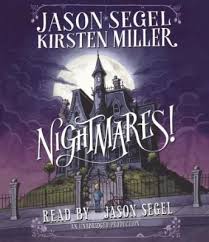
[LISTENED TO: December 2016] Nightmares! The Sleepwalker Tonic

2I though the first Nightmares! book was great.  I had listened to both of these books before, but what was fun about listening this time is that the end of book one gives a little hint at what book two would be about.

Towards the end of Book One, the story tells us that Charlotte’s business was doing well, although a new store had opened up in the next town and was also doing very well–possibly taking away her customers.

And that’s essentially what book two is about.  (No, not about small town commerce).

But let’s back up.  In book one, Charlie Laird and his three friends Paige, Alfie and Rocco prevented the evil president of the Netherworld from taking over the waking world.

Back up some more.  Nightmares aren’t bad.  They are there to frighten us, yes, but their goal is for us to face our fears and come out stronger.  They don’t want to hurt any of us. But the nightmares have an enemy–the goblins.  The goblins have been forced out of the nightmare realm never to return.  And they are constantly trying to get back into the Netherworld. (more…)

Read Full Post »

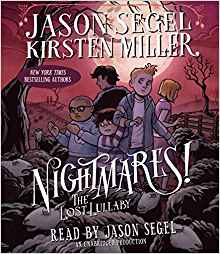
[LISTENED TO: Summer 2016 & November 2016] Nightmares!

nightmresI loved Jason Segel on How I Met Your Mother.  I loved that Jason Segel was instrumental in bringing The Muppets back to the big screen.  And now I love that Jason Segel has written a series of really enjoyable–funny and frightening–children’s books.

This book is about–wait for it–nightmares.  But not in the way that you might expect.  Segel (and Miller–I have no idea how much she contributed to the book) have created a realm where Nightmares live.  It is a wonderfully realized and very well thought out world.  And I am really impressed with how well the whole story works.

It is the story of Charlie Laird.  Charlie is a pretty normal kid.  He does okay in school, he has friends, his family loves him.  But three years ago his mom died unexpectedly.  It was a harsh blow to him and his family.  Charlie has never really gotten over it.  And what has made it especially tough is that Charlie’s dad recently got remarried.  Apparently he got over it just fine.

If that weren’t bad enough, Charlie’s family moved from his old house–the house he grew up in and loved–into the mansion on the hill.  Not a far move–still in the city of Cypress Creek–but worlds apart from what he was used to.  Or what he wanted.

The mansion has always been there in town. It is huge and…it is purple.  It towers over the whole town–you can’t avoid looking at it–and it has always been rather creepy.  It was built a long time ago by Silas DeChant, and it has been in the DeChant family ever since.  So it makes sense that Charlie’s new stepmother, Charlotte, who is a DeChant, would want to live there.

But Charlie hates it  And he hates Charlotte, and he hates anything that tries to get him to see reason about his horrible stepmonster (I didn’t like the lazy use of this term, but it is rather appropriate). (more…)

Read Full Post »

[LISTENED TO: June 29, 2016] No Girls Allowed (Dogs Okay) 

Scab McNally is a clever fourth-grade kid who is always inventing things. But he’s also kind of selfish and pretty mean to his sister.  Isabelle is his twin but because she really uses her brain (She is smart times ten) she has been bumped up from 4th grade to 5th grade.

Isabelle doesn’t understand Scab’s brand of cleverness (and mischievousness) and so she writes a daily news report about all of the things that Scab has done to her (and done at school) through the day.  She reads this to her parents every night.  It’s pretty hard for Scab to catch a break at this point.

But obviously, the more Isabelle tells on him the more things he does to her.  He puts cheese in her underwear drawer and dead bugs in her room.

This is all some background to the fact that more than anything else Scab wants a dog.  (There seem to be a lot of books about kids who desperately want a dog).  Scab’s best friend has a dog, Oscar–a wiener dog.  And Scab is super jealous but always happy to help out with Oscar.  Of course, since Isabelle is always attaining on him, his parents don’t think he is responsible to own a dog. (more…)

Read Full Post »

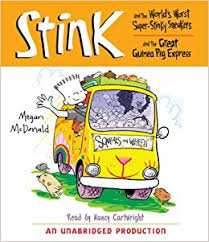
[LISTENED TO: April 15, 2016] Stink: the World’s Worst Super-Stinky Sneakers & the Great Guinea Pig Express

T. was listening to this book in her room and I said, hey, that’s Bart Simpson.  And indeed, the book was being read by Nancy Cartwright, the voice of Bart (as well as Nelson, Ralph, and dozens of other minor characters).  The next day we went on a car ride and she asked to listen to the stories.  So we did.  I heard the end of the Guinea Pig story and then all of the sneaker story.  Well, I couldn’t have a half finished story in my head so I had to listen to the beginning of the guinea pig story too, and call it all finished.

I knew of Stink from the Judy Moody books.  Stink is Judy’s younger brother (and she’s pretty awful in these books.  I don’t recall if she was awful in her own books).  But that could just be because this is about Stink and not her.  We learn how Stink got his name: Judy started singing a song about him in which stink was the chorus.  And it just stuck.

Stink goes by Stink in school and elsewhere.  And apparently he has a super duper sniffer (this may just be a coincidence and not a side effect of being called Stink).  (more…)

Read Full Post »

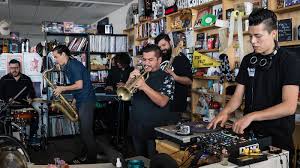
SOUNDTRACK: TROKER-Tiny Desk Concert #621 May 19, 2017).

Troker has instantly jumped to being my favorite jazz band.  And why is that?  because they have a turntablist and he is outstanding.  He adds sound effects, solos and all kinds of great additions to their jazzy fare and elevates it to someplace exciting.

Which is not to stay that their jazz is poor, because it’s not at  all.  There’s a groovy keyboard sound, a sax, a trumpet and a fantastic bassist

“Principe Charro” begins with some fun keys (from Christian Jimenez) and a high bass line (from Samo Gonzalez) before the band enter the main horn riffs (all with a groovy bass line underneath).  But it’s those turntables (from DJ Sonicko) that really stand out.  I feel like in many songs you can’t always tell when a turntable is active, but it’s really apparent in this set.  Check out around the 1:15 mark while there’s a solo and the turntable is doing a solo of its own–or adding effects to the end of the solos.   And there’s a great moment around 2:30 where the turntable and trumpeter (Chay Flores) have a duel–all with a very cool, deep bassline underneath.  There’s a sensational break with a great cheer before the song starts again–with the crowd fully behind them now.

“One Thousand Million Eyes” is normally an instrumental song (as most of their songs are), but they have a vocalist Solange Prat to sing lyrics.  It’s interesting that the lyrics are in English since the band is from Guadalajara, Mexico and they speak only in Spanish (with subtitles!).   There’s some outstanding turntable  effects on this song–cool spacey sounds and what not.  I like Prat’s voice, but I’m digging the instrumental side more.

I love the way the music starts out with some cool sounds from the turntable.  And that thumping bass.

“Chapala Blues” is about a lake that’s near where they live.  It’s got a great bass riff to open–slow and loping-with some great atmospheric sounds from the turntable.  There’s even whale songs.  The middle of the song has a great drum “solo” (from Frankie Mares) which isn’t really a solo, just the drummer having a ball while the horns are playing quieter music.   Midway through, it gets very atmospheric with some cool synth sounds and a lone sax (from Chay Flores).

“Tequila Death” begins with some ticking clock sounds and a somewhat menacing, but then funky, bass line with a cool fuzzy effect on it).  Like the other songs it is fun and dancabale.  During the breaks they sample (on the turntable) the “one, two, tres, quatro” from “Wooly Bully” by Sam the Sham & the Pharaohs.  It’s a great set and I really hope I can see them live sometime.


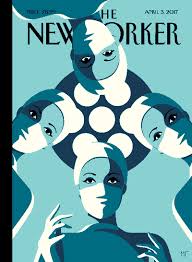
[READ: April 3, 2017] “Signal

I enjoyed Lanchester’s previous story which was also about a very rich person in London.  In this story it’s not the protagonist who is rich, rather it is his old, dear friend. Although, “Michael wasn’t my oldest friend and he wasn’t my closest friend, but he was older than any of the ones who were closer and closer than any of the ones who were older, so he had a special status, as part of the furniture of my life, the kind of friend who when you’re asked how you met you have to think for a while to remember.”  I love that.

But the crux was that Michael was his richest friend–by a long shot.  The story begins with the narrator telling his children “You aren’t allowed to ask for the Wi-Fi password before you say hello,”  The kids point out that Uncle Mike is nice and won’t care.  And the dad says, “that that is true, it’s just not what you do.”  “You chat for a bit, and then you ask for the Wi-Fi password.  It’s just one of the rules.”

I love also that the narrator doesn’t exactly seem to know why Michael is so rich.  “He’d drifted through Cambridge doing something scientific–engineering or maths, I think it was.”  And then after “going off to try something a bit different…he had ascended to some new stratosphere of international wealth.”

And, since he and his family were genuine friends of Michael, they reaped the rewards of that lifestyle whenever they hung out. (more…)

Read Full Post »

SOUNDTRACK: AIMEE MANN-Tiny Desk Concert #618 (May 8, 2017).

Aimee Mann is pretty legendary at this point.  Starting out in ’til Tuesday, she has since made a name for herself as a solo artist (and collaborator).  Her solo albums are sweetly sad: she writes pretty melodies with rather downcast lyrics that sometimes have humor in them.  She has done a previous Tiny Desk with Ted Leo–they were called The Both.

Her voice is calm and kind of deep and she casts rather an imposing figure given her height.  I saw her live about ten years ago and while I don’t remember all that much from it, I know I enjoyed her.

I have a few of her albums, but I haven’t really gotten anything recently because she’s a bit to melancholy for me, and I feel like her songs tend to sound a bit the same–I keep waiting for all of these songs to end with the chorus of “I’ve Had It” (one of her earlier songs that I rather like).

Despite these criticisms, there’s no doubt that her songs are quite lovely, and when Jonathan Coulton sings backing vocals it’s pretty great.

She plays four songs from her new album, Mental Illness. On “Rollercoasters” it’s just her and Coluton.  The second song is “You Never Loved Me”–“It’s another cheery, optimistic number.”  For this track, Aimee plays guitar and is joined by Paul Bryan on bass and Jamie Edwards on piano.  The band fleshes out the sound nicely, with a good bottom end.

The title of “Goose Snow Cone” is never explained, which is a shame.  There’s a lovely guitar melody on this song.   “Patient Zero” opens with a backing ooooh vocal.  There’s some great deep bass notes from the piano and I love the way the end of the song features the guys singing a chorus while Aimee sings a counterpoint vocal.  It’s my favorite moment in the show.

[READ: March 2, 2017] “The I.O.U.”

I didn’t think I’d read any storied by Fitzgerald (aside from Gatsby) but it turns out I had read a short story by him about five years ago.  I described it as enjoyable but slight.

This story from 1920 is clever and funny and was previously unpublished.

I enjoyed the initial construct:

The above is not my real name—the fellow it belongs to gave me his permission to sign it to this story. My real name I shall not divulge. I am a publisher. I accept long novels about young love written by old maids in South Dakota, detective stories concerning wealthy clubmen and female apaches with “wide dark eyes,” essays about the menace of this and that and the color of the moon in Tahiti by college professors and other unemployed. I accept no novels by authors under fifteen years old. All the columnists and communists (I can never get these two words straight) abuse me because they say I want money. I do—I want it terribly. My wife needs it. My children use it all the time.

Interesting opening, right?

So the unnamed publisher tells his story that six months ago he contracted for a book that was going to be a sure thing.  It was by Dr Harden, the psychic Research man.  He had published Harden’s first book in 1913 and it was a huge success.  This one promised to be even bigger.  The crux was that Harden’s nephew had been killed in the war and Dr. Harden had been able to contact him with psychic powers.  Harden was a distinguished psychologist–no fruitcake–and his book was neither callous nor credulous.  He even mentions in the book how a man named Wilkins had comes to his door claiming that his deceased nephew owed him three dollars and eighty cents–but Dr Harden refused to ask his dead nephew about the money–that was like praying to the saints about a lost umbrella.

When the book was finally done (and it looked beautiful), they sent copies everywhere–300,000 first print run.

The book was a success already and he decided to visit Dr Harden to celebrate.  He hopped on the train with some free copies of the book.  He handed them out to people on the train

Before we came to Trenton, a lady with a lorgnette in one of the staterooms was suspiciously turning the pages of hers, the young man who had the upper of my section was deeply engrossed in his, and a girl with reddish hair and peculiarly mellow eyes was playing tic-tac-toe in the back of a third.

The publisher fell asleep and when he woke he saw the man reading the book seemed deeply agitated.  The publisher asked him what the matter was and the man said that the value of the book depended entirely on whether the young man was actually dead or alive.  The publishers said the the man must be in Paradise not–in Purgatory.  The man said it would be even more embarrassing if he were in a third place.

Like where?

Like Yonkers.

For, it turns out that the man reading the book was in fact Cosgrove P. Harden: “I am not dead; I have never been dead, and after reading that book I will never again feel it quite safe to die.”

I loved this joke:

The girl across the aisle was so startled at my cry of grief and astonishment that she put down a tic instead of a tac.

The rest of the story concerns our publisher’s attempts to figure out what to do about this mess.  Surely the not-dead boy wouldn’t spoil all of the fun (and money).  They wind up going to the doctor’s house where the publisher meets Thalia, the woman who was in love with Cosgrove.  And she is angry at the Doctor for humiliating Cosgrove in death.

And the publisher gets an idea.

So he plays out his idea as best he can and things seem to be going along pretty smoothly but then Fitzgerald does something rather unexpected and I really got a kick out of it.  It turned this story which was pretty funny into a story that was pretty funny and really clever as well.

I wonder why it was never published.

Read Full Post »
SOUNDTRACK: ANTONIO LIZANA-Tiny Desk Concert #615 (April 28, 2017).

I am fascinated by Lizana, but more for his voice than anything else.  Lizana’s singing voice/style sounds a lot like the lead singer of Gipsy Kings (musicians from Arles and Montpellier in the south of France, who perform in the Spanish language with an Andalusian accent).  Lizana is from Spain, but he has that same strained and fascinating delivery.  The blurb here hints that maybe that is just the style of flamenco:

In many ways, the traditions of flamenco and jazz could not be further apart, but in the hands of a few Spanish jazz musicians, these two worlds commingle and find common ground. Antonio Lizana is one such musician, both a saxophonist and vocalist with one foot firmly planted in each tradition. As a vocalist he has mastered the Moorish, note-bending improvisations that make flamenco singing so beguiling, while the fluidity of ideas he expresses as a saxophonist place him in the time-honored tradition of composing while playing.

Indeed, between jazz-like saxophone, Lizana sings flamenco vocals.  For these three songs, Lizana and Jonatan Pacheco (percussion) and Andreas Arnold (guitar) play quite a mix and it works very well.  The band is also quite multicultural as well as Andreas is from Germany and Jonatan is from Spain (and he plays a mean box drum).

“Airegría” is about 6 minutes long.  It begins with hims singing over the percussion.  It after a minute and a half that the guitar comes in and not until almost 2 and a half minutes before the sax comes in.  The guitar is kind of staccato while the sax is pretty fluid.

Introducing the band he says, “We’re very happy to be here playing.  We have today on the stage or on the desk…”

“Déjate Sentir” more conventionally jazzy sax but the main melody comes from his kind of scat singing.  Ad I find tat when the guitar kicks in I prefer him singing to guitar rather than playing the sax–I suppose traditional flamenco over jazz. But I can appreciate the sax too–especially when it seems to push aside the flamenco style for a bit.

“Viento De La Mar” is a smoother song with some pretty guitar and light jazzy sax.  My favorite moments comes in the middle with the chiming percussion and the big ending.

[READ: June 24, 2016] Big Bad Ironclad

How cool is this series?  It is so cool that this is the official author bio:

The spy Nathan Hale was executed in 1776.  The author Nathan Hale was born in 1976.

Nathan Hale is the author/illustrator’s real name and he uses the spy Nathan Hale as the narrator of his stories about history (or in this case the future–for the spy, that is).

The book begins on September 22, 1776 as Nathan Hale is about to be hung for treason.  The British soldier in charge of the execution is cross, but the executioner himself is kind of giddy because Hale is going to tell another tale.

After some amusing introductions, designed to antagonize the solider, Hale settles in to tell the story of the iron ships (iron doesn’t float!).

And thus he begins the story of the Merrimack and the Monitor.  The year is 1861 and Abraham Lincoln has just been elected.

Hale uses some very funny narrative devices to get some of the salient battle points across, like General Scott’s anaconda plan–surround the enemy and squeeze.  But how can they do that with only four, yes four, ships?

The North’s man in charge was Gideon Welles, nicknamed Father Neptune.  Stephen Mallory is in charge of the confederate navy–the executioner dubs him “sharkface.”  And in the most amusing nod to comics, Gustavus Fox (Foxy) is rendered as a fox (he’s a cute li’l fox). (more…)

Read Full Post »

SOUNDTRACK: DANILO BRITO-Tiny Desk Concert #619 (May 12, 2017).

This is a pretty great  introduction to the music of Danilo Brito:

After four chords, the notes start to fly — Danilo Brito and his four collaborators, three Brazilians and one American, are off like jackrabbits in front of a hound, having hustled their instruments to the Tiny Desk at the end of a North American tour.

Brito plays the mandolin, and boy how his finger fly.

Brito a 32-year-old mandolin player, made his first record when he was a teenager, plays a type of music called choro (pronounced “shore-oo”).  It’s said that choro started in the streets and back yards and made its way to the concert hall. Brazilian musicians of all genres have drawn on choro, from popular composer Antonio Carlos Jobim to Heitor Villa Lobos, one of the giants of Latin American classical music. Its literal translation from the Portuguese is “to cry,” but in Brito’s dextrous hands a better translation may be “crying out to be heard.”

They play five songs.  “Sussuarana” is just full of amazing finger work.  The pace is breakneck and exhausting.  How does he do it?.  There are two guitars (Carlos Moura (7-string guitar) and Guilherme Girardi (guitar)) playing chords and the mandolin zipping all over the place.  In the background, Lucas Arantes plays a small guitar called the cavaquinho and Brian Rice (the American) keeps the beat on the pandeiro.

Between songs he has a translator explain that they are playing “a little bit of Brazilian instrumental music.”  He says this style of music started around 1860, mixing jazz and classical and African music.”

“Lamentos” is a much sadder song (as you might imagine), but it is gorgeous.  For “Tica” Arantes and Rice step aside.  “Tica” is his own composition.  It is a waltz in two tempos.  There’s some wonderful lead lines that run up and down the instrument.  It’s fascinating that while his lines are still fast the rest of the musicians are at a slower pace.  There’s a lovely middle section of delicate guitar, but once it ends they take off again.

The next song is “Melodia Sentimental” it sounds like the soundtrack of a weepy romance film–heart string tugging.

Brito and his colleagues play their arrangement of Villa Lobos’ “Melodia Sentimental,” originally written for voice and orchestra.  What you’re actually hearing is a kind of formal Rodas de Choro, the circles of players who developed this music more than a century ago and have carried it on to the present.

Only — in the backyards, they don’t wear suits and ties.

The final song “Pega Ratão” is also an original piece.  It is short and never stops.  It is great watching his fingers fly.

[READ: June 12, 2016] One Dead Spy

How cool is this series?  It is so cool that this is the official author bio:

The spy Nathan Hale was executed in 1776.  The author Nathan Hale was born in 1976.

Nathan Hale is the author/illustrator’s real name and he uses the spy Nathan Hale as the narrator of his stories about history (or in this case the future–for the spy, that is).

This is the first book in the series so it begins with the historical Nathan being brought up to the gallows.  The people are all there to watch a hanging, but they are disappointed that the guy to be hung is a spy, not the arsonist.  And then Hale is brought up to the British soldier and the executioner (who looks at Hale and say “This is awkward”).

Hale mutters his famous last words: I regret that I have but one life to give for my country.  And as that happens a The Big Huge Book of American History comes down and swallows Hale and then lets him back out because he just “made history.” (more…)

Read Full Post »

SOUNDTRACK:  CHICANO BATMAN-Tiny Desk Concert #613(April 17, 2017).

In the blurb for this show, Felix says that he was sol by their name.  And I am too.  It’s a great name.  And yet it is not entirely useful in terms of musical style.  But he summarizes pretty nicely:

a sound that perfectly captures dark lounges, quinceañera dances, car shows and backyard parties.

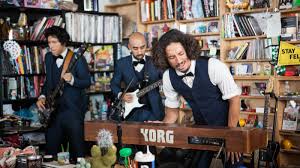
That lounge sound is completely evident with the keyboard tone–old fashioned and bachelor pad-like.  But this is no bachelor pad music, because behind the keys are some groovy and at time funky bass (from Eduardo Arenas) and some cool guitar wah wahs (from Carlos Arevalo) and more.

Holding it all together is Gabriel Villa on drums and then on keys and guitar and vocals is Bardo Martinez.  Martinez sings in such a cool, laid-back manner.  It’s often a gentle falsetto but it always feel like he is just chillin’ and singing these groovy songs.

And they also wears suits with bow ties.

“Freedom is Free” is a delicate and groovy song with lots of wah wah guitar and a cool echoing guitar solo.  It’s also got a great bass line.  The song is sweet and catchy with a great wah wah build up at the sudden ending.

“Friendship (Is A Small Boat In A Storm)” has been quite popular on the radio here and man is it catchy.  The loungey organ and vocals are a great start, but the way the chorus just burst forth after the first verse–the backing singers (Nya Parker Brown and Piya Malik) hit the marks perfectly and then the staccato guitar riffs after that.  Its irresistible. (Parker Brown and Malik are from the band 79.5 and have been touring with them).

The ladies leave for the final song, “Jealousy.”  There’s a great funky bass line and fun drums before the song turns rather mellow.  I love the between chorus riffs.  Although I find the main song a little too slow, it probably works well between faster songs.

And they are all so polite and charming, I’m sure I’d enjoy seeing them live.

[READ: February 20, 2017] “The Prairie Wife”

I recently read another story by Sittenfeld in the New Yorker and really enjoyed it.  And this one was not only great and wonderfully written, it was full of surprises.

It’s hard to write about without giving away some of the surprises because they were so good.

But here’s a spoiler free attempt.

Kirsten is married with two kids.  The family has a routine and it involves Kirsten waking up and getting the boys up in time for school.  But lately she has been using her morning time to look at Lucy Headrick’s Twitter feed. (more…)

Read Full Post »

SOUNDTRACK: LJOVA AND THE KONTRABAND-Tiny Desk Concert #612 (April 14, 2017).

Ljova and the Kontraband play a rollicking blend of gypsy music with a twist.

There’s a viola, an accordion, an upright bass and a hand drum.  And they play rollicking fast trad music as well as delicate sow ballads.

Ljova and the Kontraband embraces Western classical, jazz and an array of international styles including tango and Eastern European and Balkan folk music. These top-flight musicians, who hail from Russia, Lithuania, the U.S. and Switzerland, pile all of these sounds atop of each other with great glee, and emerge with creations that alight on totally new and exciting terrain.

The band is led by the composer, arranger and viola player Ljova (Lev Zhurbin), who comes by this musical eclecticism naturally: the Moscow native, who comes from a family heavily involved in the arts, has worked with an astonishingly wide and starry group of collaborators, including Jay Z, the Bollywood queen Asha Bhosle and cellist Yo-Yo Ma and the Silk Road Ensemble. In this Kontraband setting, he and his bandmates (including Ljova’s wife, the preternaturally sweet-voiced, Lithuanian-born singer Inna Barmash) create performances of deep earthiness, fragile tenderness, ebullient humor and quicksilver shifts in texture.

“Love Potion, Expired” is one of those fast songs with twists and turns and all kinds of solos.  The middle section is practically a percussion solo by Mathias Künzli (from Switzerland).  While the strings and accordion are sort of fiddling away on a couple of notes, Künzli (on his box drum) plays a sophisticated solo on the box which also includes all manner of percussion–cymbals, clackers, shakers, finger cymbals and other things that clatter (he even includes his thigh at one point).

It’s followed by an appropriately wild accordion solo (and that instrument is gorgeous) by Patrick Farrell (from Michigan).  The song is played at breakneck speed and is really fun.

The second song introduces us to Inna Barmash (Ljova’s wife). She explains that “Ven Ikh Zol Hobn Fligelekh (If I Had Wings)” is a Yiddish folk song from Western Ukraine.  She says the beginning of the poem is translated as “If I had wings I would fly to you if i had chains I would pull you to me.”  It id played as pizzicato and strummed viola while Inna sings.

But the heart of their Tiny Desk Concert was the song “By the Campfire,” whose words have a long, strange history that goes back to the Middle Ages. The words originally come from 12th-century Germany; Ljova’s grandfather, a noted translator, translated this poem from German to Russian, which Ljova uses in his musical setting.

Barmash gave us her own English translation of this unsettling, stunning, and perhaps even prophetic text: “Lies and spite command the world / Suffocate its consciousness, / Truth is poisoned, dead is law / Honor killed — obscene extolled! / … And the wisdom of our days / Teaches theft, deceit and hate.”

There are a couple of parts to this song.  As it begins, the accordion sounds like flutes.  Barmash sings beautifully for a few verses.  And then in the middle she sings a long sustained note that seems to signal the band to start on a chaotic section with everyone playing things crazily for a few seconds.  Then she does another long note and the song turns into traditional Russian type of dance.  There are many parts and this song goes through all of them.

Before the final song Ljova apologizes for disturbing their lunch.  “Walking on Willoughby” was written by Patrick, it’s a fun, wild polka that’s seven minutes long.   There are many parts to this song as well.  At times the viola and accordion play off of each other.  There’s several opportunities from each of them to solo held together by that thumping bass by Jordan Morton (from Syracuse).

The middle slows down to a one two count as the accordion plays a disjointed sounding solo.  There’s even more after that as this song just spirals in all directions.

[READ: July 10, 2016] Lunch Lady and the Schoolwide Scuffle

This appears to be the final book of the Lunch Lady series.  The book ends on something of a cliffhanger but to the best of my knowledge, no book has come out after this one.

But don’t be sad because this is a very satisfying conclusion.

As we left book 9, Lunch Lady had been fired.  She is so despondent that when the opening pages feature bad guys doing bad things, she’s not even there to stop them. It’s the fifth bank to be robbed in two weeks and Lunch Lady is just lounging about eating ice cream.  Egads!

But even worse, the school is a shambles–the superintendent has put a portrait of herself in every room (even the bathrooms).  Te teachers have been replaced by convicts, the principal has been replaced by Mr Edison who was put away in book 3 and even more shocking, Milmoe is being nice to them–he realizes he’s in over his head as student council president. (more…)

Read Full Post »

« Newer Posts - Older Posts »