Feeds:
Posts
Comments

Archive for the ‘Funny (ha ha)’ Category

SOUNDTRACK: SELF-“Trunk Fulla Amps” (2000).

I bought an album by Self many years ago.  They had since released several other discs, but I hadn’t heard any of them.  Then, they came out with this fantastic and very vulgar song.  It reeks of one-hit wonder status and yet it is super catchy (and rather funny).

The lyrics, simply enough: “I got a trunk fulla amps motherfucker.”  But each verse showcases the main guy from Self’s vocal tricks.  “I gotta trunk fulla amps motherfucker, like E.L.O. (Mama!)” or “like Glenn Danzig (Mutherrr!)”.  Plus the song itself rocks like nobody’s business.

I don’t even remember of the rest of the album is any good, but this song will spruce up any mix CD (that’s not afraid of dirty words).

[READ: July 3, 2010] “The Pilot”

What a perfect time to read the New Yorker‘s 20 under 40 stories than a 4th of July holiday at Long Beach Island?

This first story, “The Pilot” is by one of my new favorite authors, Joshua Ferris.  This piece is a simple story about an invitation to a party.  But the twist in the story is that the invitation is sent by email, and the recipient of the email, a neurotic Hollywood guy, spends the bulk of the beginning of the story wondering whether he really should have received the invitation or if it was some kind of mass mailing mistake (since the invite was sent to a large group that was bcc’d).

The party is given by Kate Lovelt.  She’s celebrating the wrapping of the very successful third season of “Death in the Family,” a sitcom with an excellent premise that will no doubt be turned into a show in real life soon enough.   Really, read the story just for the description of “Death” and let’s see how quickly it comes true.  Lawrence is trying to put the wraps on his pilot, but he keeps procrastinating.  He’s also a recovering alcoholic. (more…)

Read Full Post »

SOUNDTRACK: ROB SZABO-“If I Could Do It All Again” (2003).

Rob Szabo is a singer-songwriter.  And this song is a pretty traditional singer-songwriter song.  It’s got some humor, it’s got some cliches.  In some ways he reminds me of Jill Sobule (lyrically, not vocally, obviously) or maybe Loudon Wainwright III.

Szabo has a number of albums out already.  I listened to a few others songs on his radio station and I enjoyed them.  He strikes me as the kind of musician that the more you listen, and the more carefully you listen, the more rewarding his music is.

I wasn’t all that impressed by “If I Could Do It All Again,” but the other tracks were certainly good.  And I could easily enjoy listening to his stuff when the mood was right.

[READ: June 15, 2010] “Stet”

This was probably my favorite story of the bunch.  It’s funny, it’s dark and its very Canadian.  I suppose that if you want to write a “Canadian story” it’s easy to set it where he does (so you can mention a LOT of Canadiana) but this story works beyond the surface.

And the surface is that this story is set in a Canadian newspaper.  Mansour, Fabien and Matt are trying to meet a deadline.  They bemoan their late hours, their hard work, their horrible bosses and the inevitable decline of newspapers. (more…)

Read Full Post »

We’d seen ads for this show (who hasn’t?) but we weren’t that interested.   It’s on Starz for crying out loud, and it’s a summer fill in show.  Then we found out the credentials of the show:  The auteur behind the much missed Veronica Mars (Rob Thomas) is a producer/writer/creator.  (As is Paul Rudd! And Dan Etheridge (who has worked with Kevin Smith quite a lot).

The show stars a number of great actors: Ken Marino, Jane Lynch!, Ryan Hansen (Dick Casablancas from Veronica Mars), Martin Starr (playing a major jerk), and two actors who get pretty high billing that I didn’t know: Adam Scott and Lizzy Caplan. (more…)

Read Full Post »

I’m very late to this show, I know.  But then I have an excuse: I don’t like watching TV/movies/etc on my computer.  So, even when I watched the awesome Dr Horrible, and the commentary  told me all about Felicia Day’s online show, I didn’t investigate.

It took our friend Megan telling us that we could Instant Watch it on TiVo before we decided to check it out.   And the only reason I’m glad it took so long to watch is because we were able to watch all three seasons back to back (to back). (more…)

Read Full Post »

SOUNDTRACK: DANGER MOUSE AND SPARKLEHORSE present: Dark Night of the Soul (2010).

Seems like most things that Danger Mouse touches involve lawsuits.  I’m not entirely sure why this disc had such a hard time seeing the light of day.  But it is due for a proper release in July.  Although by now, surely everyone has obtained a copy of the music, so why would anyone give EMI any money for the disc (since they hid it away in the first place).

The name that is not listed above is David Lynch, who is an important contributor to the project.  He creates all the visuals (and the visuals in the book that was the original release format).  He also contributed vocals to two tracks on the CD.  (His vocals are weird and spacey, just like him…and if you remember his voice from Twin Peaks, just imagine Gordon singing (but with lots of effects).

The rest of the disc is jam packed with interesting singers: Wayne Coyne (from The Flaming Lips), Gruff Rhys (from Super Furry Animals), Jason Lytle (from Grandaddy) on my two favorite tracks, Julian Casablancas (from The Strokes), Black Francis, Iggy Pop, James Mercer (from The Shins), Nina Persson (from The Cardigans), Suzanne Vega, and Vic Chesnutt.

I’m not sure if Danger Mouse and Mark Linkous wrote the music already knowing who the singers were going to be, but musically the tracks work very well.  And yet, despite the different sounds by the different singers, the overall tone and mood of the disc is very consistent: processed and scratchy, melodies hidden deep under noises and effects.   Even the more “upbeat” songs (James Mercer, Nina Persson) are dark meanderings.

It took me a few listens before I really saw how good this album was.  On the surface, it’s a samey sounding disc.  But once you dig beneath, there’s some really great melodies, and it’s fascinating how well the songs stay unified yet reflect the individual singers.

EMI is going to have to pull out all the stops to make it a worthy purchase for those of us who have already found the disc.  Since The Lynch book was way overpriced for my purchase, (and they surely won’t include it with this CD), they need to include at least a few dozen Lynch photos (and more).  And with a list price of  $19 (NINETEEN!) and an Amazon price of $15, the disc should clean your house and improve your wireless connection too.

[READ: June 1, 2010] Bloom County Vol. 1

Boy, did I ever love Bloom County.  Back in high school I had more drawings of Opus and crew in my locker than anything else.  (I used to reproduce the cartoons by hand, I was never one of those “cut out of the paper” people.)  And so, there are tons of punch lines that I still remember twenty-five years later.

And yet, despite my fondness for the cartoon (and the fact that I owned (and read many times)) all of the collected books, I was amazed at how much of the early strips I had no memory of, at all.  True, some of the really early ones are here for the first time in collected form (according to an interview there are hundreds of comics in collected form for the first time in these volumes).   But those early 1980 comics…wha? (more…)

Read Full Post »

SOUNDTRACK: BEATLES-Rubber Soul (1965).

After the breakthrough of Help!, the Beatles followed up with their first proper album that is full of all original songs and which really pushes the envelope.

The opening song, “Drive My Car” opens the disc with a unique sound and style.  And yet, lyrically, “Baby you can drive my car, and baby I love you,” is as lame as The Doors, “Hello, I love you won’t you tell me your name?” in terms of dealing with the opposite sex.

But with “Norwegian Wood” things really get interesting.  It introduces the sitar–the first inclination towards their flirtation with Eastern/Indian influences.  And I can’t help but think it must have been rather shocking in a rock song in 1965.  It also features “Nowhere Man,” a song featured in the Yellow Submarine movie.  The song is a standout, from the harmonies to the language play.

I suppose everyone knows a person named Michelle who hates the song “Michelle.”

They really mix up the styles on  this disc (while always sounding like The Beatles). “What Goes On” is a sort of country tinged rocker, while “Girl” feels sort of tin pan alley ish, (the big sighs during the chorus are a bit excessive, but work within the song).

The disc ends with the really distrubing, murderous boyfriend lyrics of “Run for Your Life.”  I’m not sure what inspired this song, but frankly it’s lyrics are really dreadful. It’s not the first “I’ll kill you if you date someone else” song and it’s certainly not the last, but it mars an otherwise really catchy song.

Amazingly, all of the songs still clock in under 3 minutes, except “You Won’t See Me”.  While Rubber Soul is probably their first fully realized disc, it’s not until the next album (just a few months down the line) that they blow the lid of the joint.

[READ: May 28, 2010] Something’s Not Quite Right

This book almost doesn’t count a there are virtually no words (one per page). But the book is so awesome that it has to be included just because.

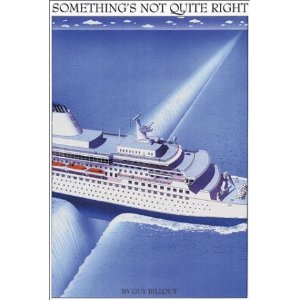
Something’s Not Quite Right is 32 pages of oversized pictures in which, yes, something is not quite right.  Note the cover illustration for an idea.

So, each page features a brilliantly rendered piece of art.  There’s a caption for each picture which reflects (often humorously) on the picture.  The book is a children’s book (Clark enjoyed the nonsense very much).  But even adults will say, Whoa, cool, when they look at these pictures that are just…wrong. (more…)

Read Full Post »

There’s a new (reasonably) new show called “Minute to Win It.”  The premise was so delightful, so “I want to do that” that I of course set up a TiVo Season Pass for it.

Basically, contestants have 60 seconds to complete really stupid, yet slightly challenging tasks.  And, unlike a lot of shows in this vein, there’s no threat of violence, there’s no crazy embarrassment, there’s no nonsense.   Simply: can you empty two tissue boxes, one hand per box in 60 seconds.  Or, can you flick a box of raisins from underneath a bottle and keep the bottle standing.  Or, can you kick a shoe across the rink onto a table and have it stay there.

Genius.  Stupid human tricks.  Best show ever.  Until you watch it. (more…)

Read Full Post »

SOUNDTRACK: LED ZEPPELIN-The Song Remains the Same (1978).

I don’t normally try to have my soundtracks correspond to the book. But since Andrew suggested that Mastodon’s Leviathan was a good match, I decided I’d try to have all six Soundtracks relate to the book some how.

The obvious starting point was Led Zeppelin’s “Moby Dick” and where better to look than at the over-the-top live version contained here.

As a classic rock guy, I grew up worshiping Led Zeppelin.  And I have no way of objectively talking about their music, really.  However, when I was in college, some guys in my dorm played this particular release all the time and claimed it to be the best CD in the history of music.

And thus, I have a delightfully convoluted relationship to this live album.  I used to really dislike it: extended jams of silliness rather than rocking live tracks.  However, as I’ve gotten older, and I’ve begun enjoying jam bands more, I see the enjoyment of this kind of show.  And yet I read a review of this very disc the other day that described it as being a few shows past Led Zep’s prime, and I think that’s pretty valid.

I haven’t heard any of the other recently released live discs (which are supposed to be amazing).  But this one feels overblown and pretentious.  And there’s nothing wrong with that if that’s the kind of band you are, but Led Zep was not that (until later);  they were meaty and heavy.

This version of “Moby Dick” is 12-minutes long.  Over 10 minutes of it is a drum solo.  This always reminds me of the line from Dazed & Confused: “Man, I ain’t belivin’ that shit about Bonham’s 1-hour drum solo…I mean, 1 hour on drums…you couldn’t handle that shit on strong acid, man.”  The rest of the disc is the same way: long solos that don’t really showcase virtuosity, they just sort of go on and on.  I do like the kevboard solo in one of the songs, but the “ah ah” part in “Dazed and Confused” is pretty silly.

In some ways, the song “Moby-Dick” (and the album itself) is like the book: a product of its time.  In 2010 , if you played a ten-minute drum solo (even Rush have added electronic horns and a swing number  to Neil’s drum solo) you’d be mocked.  But back in the 70s, it was a badge or honor.  Similarly, Moby-Dick seems quaint and weird to most contemporary readers.  And yet, put in context, it’s funny and surprisingly forward thinking.  And I suppose the music does make a good background for reading it, too.

[READ: Week of May 24, 2010] Moby-Dick [Chapters 1-18]

So, the instigators at Infinite Zombies are hosting a read along for Moby-Dick (and yes, the hyphen is supposed to be there).  I’m going to be a contributing writer to this shindig, so I’m going to curtail what I say here somewhat [see my post about religion, here]. Also, unlike Infinite Jest and 2666 which had difficult, multi-charactered, multi-layered, confusing plots, Moby-Dick is fairly straightforward.  And so, there’s not a great need for in-depth story summary (not to mention each of the 100+ chapters is titled, so you know what’s going to happen in each one!).

But with that out of the way, let’s see what I can say about this book.  Oh, one more thing, I’ve been trying to include page numbers in my citations, but there are just too many versions of this book (and I am using one for my reading and another for my copy-and-paste-quotes–the whole book is available at that link), so I’m just going with Chapters.

I was joking with some friends recently that their sister thinks Moby-Dick is very funny.  And I have to say I was surprised about how funny it was, too.  Not gut-busting funny, mind you, but funny enough. (more…)

Read Full Post »

SOUNDTRACK: FRIGHTENED RABBIT-The Winter of Mixed Drinks (2010).

I enjoyed Frightened Rabbit’s previous disc ever so much: a twisted blend of rocking folk music and very dark lyrics.  The fact that a number of these songs were used in Chuck was a treat for me.

I’ve never heard their first disc, so I don’t know how much their songwriting changed from disc 1 to disc 2.  But there’s a pretty huge leap from disc 2 to disc 3.

The most notable track has got to be “Swim Until You Can’t See Land.”   And it’s notable for having a really rocking and catchy and undeniable chorus.  They liked it so much, they reprise it later in the disc (with new instrumentation and such) on “Man/Bag of Sand.”

The rest of the disc sounds like Frightened Rabbit, but like the full band version.  There’s just so much music, that it actually distracts a bit from the lyrics (on the previous disc, the lyrics were certainly more of the focus).  There’s even a string arrangement on “Living in Colour.”

And yet despite all of these changes, they never lose what makes FR special: that voice and that outlook.  Although I’m sure I would have enjoyed if this disc was similar to the previous one, I’m always delighted to see a band take some chances and try something different.  And here they did, and it works wonderfully.

[READ: May 19, 2010] “Ash”

On April 14, Iceland’s volcano Eyjafjallajokull erupted.  And here, barely a month later, Roddy Doyle has written a story in which that eruption plays a role.  I’m impressed enough that he could get a coherent story written in that short amount of time, but I’m amazed that it was squeezed so quickly into The New Yorker‘s fiction schedule.  Admittedly, I don’t know how The New Yorker does anything, so I don’t know if they had a slot open (doubtful) or if they had to push back other stories (unlikely) or maybe he was slotted to give them something else, and whipped this out instead?  Beats me.  Whatever the reason, I was really surprised to see this here. (more…)

Read Full Post »

SOUNDTRACK: THE BEATLES-Beatles for Sale (1964).

After the riotous fun of A Hard Day’s Night, I expected that this disc would not only continue the fun, but also be full of songs that I’d heard all the time on the radio.

But wow, this disc is kind of a downer.  “I’m a Loser.”  Really? It’s catchy as all get out but what happened to these guys in this last year?  “Baby’s in Black.”  Wow, these guys are serious now.  The opener, “No Reply” is all about getting rejected.  And “I’ll Follow the Sun” is about leaving and losing a friend.

But there are some good times as well. The cover of “Rock n Roll Music” is a little too stiff for such a rollicking song (kind of like how “Roll Over Beethoven was a little too stiff previously).  But “Eight Days a Week” is a rocking good time.  Fun for all and the first sign that the fun Beatles haven’t grown up completely.

The second half of the disc I barely recognized at all.  One or two songs were kind of familiar, but I wasn’t singing along with abandon.

Yet despite my unfamiliarity, the disc shows remarkable progression in songwriting, in structure (and even recording techniques–again, the liner notes were really informative about the technology they used).  I doubt many people consider this their favorite Beatles disc, but I think it’s a fine transition into what’s to come.

It’s also quite surprising to see how much their hair has grown in a year.

[READ: May 16, 2010] “Lost in the Funhouse”

I read this short story because it is something of the foundation of David Foster Wallace’s story “Westward the Course of Empire Takes Its Way.”  This story is part of Barth’s larger collection also called Lost in the Funhouse.  And, based on this story, I’m looking forward to reading the rest of the collection.  But this story works in an of itself and, since it forms the backbone of the other story I’m going to mention it by itself.

This story is written in a thoroughly postmodern way.  As the story opens, with the enigmatic line, “For whom is the funhouse fun?,” we are introduced to Ambrose.  Ambrose has come with his family to the shore for “the holiday, the occasion of their visit is Independence Day, the most important secular holiday of the United States of America.”

Shortly after this italicized part, the story interrupts itself with this:

Italics are also employed, in fiction stories especially, for “outside,” intrusive, or artificial voices, such as radio announcements, the texts of telegrams and newspaper articles, et cetera. They should be used sparingly.

And so it goes with the rest of the story.  The author (one assumes) interrupts the flow of the narrative, letting the reader know that there is far more at foot here than just the story of Ambrose at the beach.

The story eventually gets back to the matter at hand: Ambrose, his brother Peter and Peter’s girlfriend Magda are driving with Ambrose’ parents to Ocean City.  This trip is made three times a year but this is the first time that Magda has come with them.  They play car games (spot the towers), and generally act like a family on a long car trip.

At this point the author interrupts again to note that:

So far there’s been no real dialogue, very little sensory detail, and nothing in the way of a theme. And a long time has gone by already without anything happening; it makes a person wonder.

Oh, and all along it is quite apparent that Ambrose is, as the title suggests, lost in the funhouse at the beach.

When they finally arrive at the beach, there has been an oil spill and no one wants to swim, so they stay on the boardwalk (not under the boardwalk).  Then the family decides to go for a swim in the pool.  At which point the author jumps in again and stops the meandering:

There’s no point in going farther; this isn’t getting anybody anywhere; they haven’t even come to the funhouse yet. Ambrose is off the track, in some new or old part of the place that’s not supposed to be used; he strayed into it by some one-in-a-million chance….

When the funhouse is finally mentioned as an activity, there is general hilarity and nudging and winking about what happens in funhouses (which Ambrose is too young to understand).  At this point, it’s worth noting that Ambrose has a pretty big crush on Magda.  He has spent many an afternoon with her while the three of them were playing (although she clearly thinks nothing of it).  When he suggests that he and Magda go in the funhouse together, everyone wonders what he’s thinking, but no one says anything (again, he’s too young).

Ultimately, the three kids make it to the funhouse, the entrance of which blows girls’ skirts up (and then Ambrose realizes the point of the funhouse!).  And he realizes that the funhouse is not meant for him.  And then he gets lost.

From there the story turns into fantasy, imagination and future possibilities.

It’s a fascinating piece of work.  I certainly wouldn’t want all of my stories to be constructed in this way, but I really appreciate this point of view and the, in my opinion, funny intrusions that break the fourth wall.

For reasons I’m not entirely clear about, the whole story is available here as a Word doc.

Read Full Post »

« Newer Posts - Older Posts »