Feeds:
Posts
Comments

Archive for the ‘Funny (ha ha)’ Category

SOUNDTRACK: PUBLIC ENEMY-Fear of a Black Planet (1990).

NPR recently broadcast a PE show from the All Tomorrow’s Parties Festival.  I didn’t know that PE was still touring, so that was a surprise to me.  The show was largely a celebration of Fear of a Black Planet, which meant that I had to go back and listen to the original.

Man, is this a solid album.  The lyrics pack a punch even twenty years later and what is perhaps more amazing is that the sound collages that Terminator X created, which were something of an oppressive sonic assault are now fairly mainstream-sounding (forward thinking or what?).

What I like about this (and most PE) albums, is that  they have little skits between songs, but unlike most rap skits they’re not one-not jokes that you listen to once and then skip every future time.  A wonderful skit (for lack of a better word) is “Incident at 66.6 FM” in which we hear an amazing amount of racist epithets thrown at PE apparently on the radio.  Or the rather disturbing “Meet the G That Killed Me.”  “Anti-Nigger Machine” is a great collage of samples like “Think” and James Brown and a dozen more songs.

“Can’t Do Nuttin for Ya, Man!” is a (sort of) comic song from Flav that is catchy as anything. While “Reggie Jax” is a confusingly titled song that has nothing to do with baseball, but everything to do with funk.

Of course, this disc has some of PE’s best songs as well.  From the awesome “911 is a Joke” to one of the best rap songs ever, “Welcome to the Terrordome” (my favorite story of this song is when I was wearing a  Welcome to the Terrordome shirt and my philosophy professor asked me quite pointedly, “What in the hell is a terrordome.”  That was a fun conversation).  “Terrordome” is still amazing–powerful, musically intense and for all of its lyrical acuity, it still has funny moments….boing.

And of course, “Burn Hollywood Burn” is an amazing critique of the movie industry (and it’s catchy too).  I got Black Caesar back at the crib, right Lar?

I’ve always been a little confused by “Pollywannacracker.”  Not lyrically, but vocally, as Chuck’s (is it really Chuck?) voice is treated in a surprisingly tinny way.  I liked the song more on this listen than any other, I guess in the past it just kind of snuck by me.

The album is a little front loaded with greatness.   “Power to the People” is another powerful song, but it’s not quite as memorable as the other tracks.  “Fear of a Black Planet” has some really cool sounds on it (where did they get that “black man, black woman, black baby” sample?).   “Revolutionary Generation” is a great track in which Chuck and Flav stand up for black women: “R-E-S-P-E-C-T, my sister’s not my enemy.”  Not your average rap subject.

And the last couple of proper songs, “B Side Wins Again” and “War at 33 1/3” are fast paced and furious, but they don’t really have much in the way of a hook.  Nevertheless, lyrically they are really great, and I love to hear Chuck D flow that quickly.

The biggest surprise for me is the censored version of “Fight the Power” (the song that got me into PE in the first place, thanks Spike).  It’s really surprising to me that PE allowed their music to be bleeped–unless it was just for a deliberate radio play (which I can accept).  Although they also list a title as “Leave This Off You Fu*Kin Charts” (did I buy a Columbia House version or something?)

This is an amazing album, one that still sounds fresh and sadly, is still relevant.

[READ: October 15, 2011] Between Parentheses

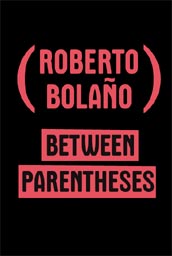
I never expected to get so addicted to Roberto Bolaño.  And despite his death, there is no shortage of works coming out in English (that is one of the advantages to reading a translated author–even death doesn’t cease the available materials).  Indeed, this year alone, New Directions is publishing Between Parentheses, and Tres and FSG is publishing The Third Reich (a collection of non fiction, a collection of poetry and a novel respectively).

When I really get into an author, I fall for his or her works, not necessarily him or her as a person (heck, some author are downright jerks).  But there are some authors that I want to know about, personally.  Bolaño is a pretty polarizing figure–he seems obnoxious, his works don’t shy away from very specific opinions, and sometimes it’s unclear what kind of views Bolaño himself has in his works (or if he’s even telling the truth about his so-called truths).  One thing in particular is the constant use of the word “faggot.”  It is used often in 2666 (and I know that is a translator’s choice, but still) and used derogatorily.  Now, clearly the context is everything for something like that.  But it seems to speak badly of Bolaño.  And yet, when reading these essays he is not homophobic in the least.  He is obviously well aware of institutionalized homophobia in Latin America, and he is obviously not supportive of it.

But that’s just one interesting thing about this book.  So let me back up. (more…)

Read Full Post »

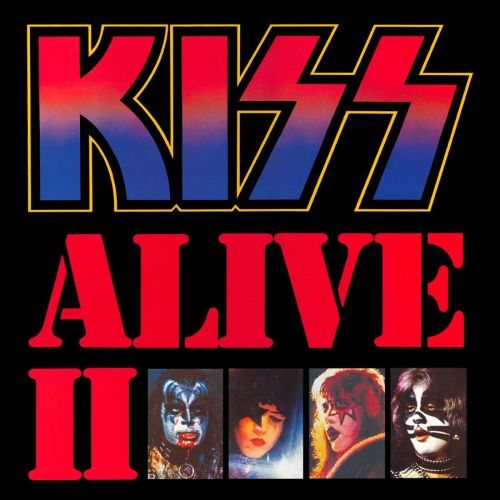
SOUNDTRACK: KISS-Alive II (1978).

There’s not too many million-selling albums that have a man covered in blood on the cover.  And yet here is one.  (I’ve always been confused why Paul and Ace both look like they are not wearing the white makeup in these photos).  I must have listened to this 4 sided LP a thousand times as a kid (my poor mother–what did she do while I monopolized the only stereo in the house and made her listen to Paul Stanley rambling on and on? 

“Detroit Rock City” and “King of the Night Time World” open the concert just like they open Destroyer.  But unlike on Destroyer, the next songs keep up the fast pace with “Ladies Room” and “Makin’ Love.”  All four of these songs are a bit faster, a bit louder a but more intense than the album versions (especially the Destroyer tracks, which have all of the bombast removed).  This first side ends with an energy-packed “Love Gun.”  I mean, holy cow, what an opening, it’s all nonstop heavy rock.  Even though I like, nay, love the originals, these version have so much energy, so much presence (they would have it even without the crazed fans screaming–which is practically like static it is so continuous) that they blow away the studio versions.

“Calling Dr. Love” is a much faster tempo (with a wonderful intro about “rock and roll pneumonia”) and “Christine Sixteen” loses the piano (which I admit I liked, but it works great without it), and it’s far creepier here.  “Shock Me” picks up some rock from the studio version, but more importantly, it picks up a crazy guitar solo (which is yes, much better seen than heard).  “Hard Luck Woman” to me sounds funny in this setting.  Don’t get me wrong, I love it, but it’s hard to imagine them playing it amidst all the chaos of the rest of the show.  And then “Tomorrow and Tonight” is fine in this context, but you can kind of feel the fans wishing for “Rock and Roll All Nite.” 

Side three opens with “I Stole Your Love” which rocks equally as hard live.  It’s followed by “Beth” perhaps the strangest thing on a live album.  From what I’ve seen, Peter comes down from behind the drums, sits in the front of the stage and sings his mega-hit to piped-in piano music.  I guess it was something of a break for the rest of the band.  It’s followed by a truly intense version of “God of Thunder”–faster and heavier than the original and very cool.  The only surprise is that it contains a drum solo–the solo is not the surprise (it is the 70s after all), the surprise is that “God of Thunder” is so obviously Gene’s song, it seems odd that they would break it up with a drum solo (although if memory serves, he uses the time to clean off all the blood from his face and guitar).  “I Want You” sounds really great in this version (the guitars are wicked) and it gives Paul a chance to show some vocal acrobatics.

The LP version featured this awesome gatefold inner photo which I have to say may have really set the bar high for other bands in terms of concert awesomeness.  My vinyl copy has pencil lines etched into the cardboard from the number of times I traced the picture.  (Thanks to Porcelain Theology, a blog I am enjoying very much, for this picture).  The live portion of the show ends with “Shout It out Loud” which works as a very solid anthem to end the concert.

The fourth side of the LP always confused me.  When I was young and didn’t really understand how to read credits, I assumed that whoever’s name was after the song was the person who sang it (generally true, but not always).  So, when side four featured covers and songs written by people not in the band, it blew my mind.  I also didn’t understand why there were five non-live, indeed, brand new songs on this live album (they didn’t want to release any songs that were also on Alive!–perhaps the last time they didn’t reissue music).  I respect this decision, but at the same time, how much cooler would this concert be with “100,000 Years” or “Deuce” included? 

The five songs actually aren’t bad, but they don’t really have all that much excitement to them.  “All American Man” is a surprisingly gritty song from Paul and “Larger Than Life” is pretty interesting musically (and I just realized that love means penis in this song too and that it’s actually a pretty funny brag song).  “Rocket Ride” is probably the best song on this side.  Ace didn’t contribute to any of the other songs on this side, but he goes out with a blaze!  The chorus is a little cheesy but the verses are really cool, and the solo rocks. 

How I miss the excess of the 70s.

[READ: October 1, 2011] “Flick Chicks”

Mindy Kaling is a writer for and actor on The Office.  She is very funny.  I’m not sure if she has written for the New Yorker before, but I like her and wanted to include her here (just to get some of her magic mojo to appear on my blog).  This piece is labelled an “L.A. Postcard” and it is more or less broken into two parts. 

The introduction shows Mindy sitting down to pitch a new movie.  She claims that all TV writers want to write for movies because “At the Oscars, the most famous person there is, like, Angelina Jolie.  At the Emmys the huge, exciting celebrity is Bethenny Frankel.”  [I actually don’t even know if Bethenny Frankel is a real person, so I guess that proves the point].  Although this year there has been a lot of chatter about the movies stars who are now on TV shows–see the New Yorker event Bravura Television.  William H. Macy and Jeremy Irons  may not be Angelina Jolie, but they’re still pretty awesome.

Anyhow, the joke of her movie pitch is that she wants to write a romantic comedy, but the studio is now focusing solely on making movies based on board games (see the existence of Battleship: The Movie).  Pretty darn funny. (more…)

Read Full Post »

SOUNDTRACK: DINOSAUR JR.-Live at the 9:30 Club, Washington D.C. October 8, 2009 (2009).

This was one of the first shows I downloaded from NPR.  I’ve been a fan of Dinosaur Jr. since my friend Al turned me on to Green Mind back in college.

This is an amazing show created by the original Dino Jr. members.  This tour is in support of their second album since reuniting, Farm. This set-list is an outstanding mix of old songs, new songs, Barlow-sung songs and even some songs from when Barlow and Murph weren’t in the band.  (Green Mind is still my favorite album by them).

When the band reunited there was much joy, and I’ve said in reviews of the newer albums, I’m not entirely sure why.  I mean, Dino Jr has always been about Mascis, and it’s not like Barlow is such an unusual bassist (although Murph’s drumming is always solid).  I’ve nothing against Barlow (I love Sebadoh and Folk Implosion) or Murph, it just seems odd to get excited about having them back in the band aside from nostalgic reasons.

Having said that, the band sounds amazing (and yes, Barlow does get to sing on “Imagination Blind”).  What never really came across to me until hearing all of these great songs live was that Mascis has always been a great pop song writer.  These songs are catchy as hell. But Mascis buries them under loud squalling guitars and a voice that is almost whiny, almost off-key, a total slacker voice.  (But you’ll notice it is never actually off-key.  He must work very hard at that.)

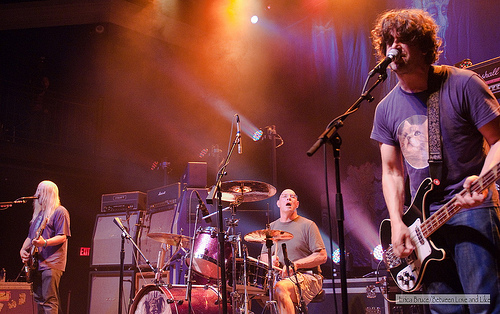
By the nd of the show Mascis chastises the audience for not moving (we obviously can’t see what they’re doing), saying he forgets that people don’t move in Washington, D.C.  But during the encore break, NPR host, Bob Boilen, points out that Mascis himself doesn’t move either–he just stands in front of that wall of Marshall stacks (Boilen wonders how he can hear anything anymore).  And looking at the pictures it’s comical the way he looks, surrounded by amps.  The picture above doesn’t fully do it justice, but check out the extra photos at the NPR page.  And while you’re there, listen to this show. It is amazing.  For a total slacker, Mascis can rock a guitar solo like nobody’s business.

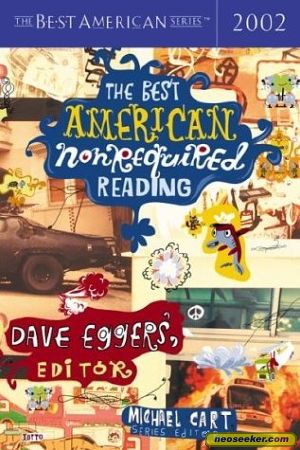
[READ: July 20, 2011] The Best American Non Required Reading

I’d been meaning to read this series for years (yup, Eggers fan), But I have a hard time starting “collections” because I feel like I’d rather be reading a novel.  Nevertheless, I have most of these Nonrequired books, so it seemed like I should dive into one and see what it was like (I don’t think the year really matters all that much–some of the articles are topical but most are not exactly).  Then Sarah said this would be a great book to read on vacation because it’s all short essays, and she was right.  It was perfect for late nights when I wanted something to read but didn’t feel like getting involved in the novel I was reading.

DAVE EGGERS-Introduction
Eggers’ introduction is actually a partial short story about kids who go swimming in pools around town. It reminded me of the opening of Life After God by Douglas Coupland, but of course, lots of kids did that so I’m not saying it was “lifted” from DC.  The story “ends” (it doesn’t really end so much as stop) with an interesting scene between two unlikely kids who get caught.

After this story Eggers includes these three notes about the collection: It’s not scientific, It’s alphabetical, and We had a lot of help with this.  Of the three, it’s the middle one that’s most useful because Eggers says that you shouldn’t necessarily read them in order just because they are printed this way: “In the first half of this collection, you get a good deal of hard journalism, primarily about war and refugees, from Afghanistan to the Sudan, followed immediately by a number of less serious pieces, about malls and Marilyn Manson.  We didn’t group anything by theme , and won’t be offended if you skip around.”  This was good to know (not that we needed the permission of course), but yes, the beginning of the book is pretty heavy. (more…)

Read Full Post »

SOUNDTRACK: SPARKS-“Good Morning” (From the Basement) (2008).

I’ve enjoyed Sparks for a long time.  But I never got around to getting the album that this song comes from (Exotic Creatures from the Deep–which has two wonderful song titles: “Lighten Up, Morrissey” and “I Can’t Believe That You Would Fall for All The Crap In This Song.” 

“Good Morning” was the first single from the album.  It features a very bouncy keyboard opening which reminds me of Strangeways-era Smiths.  And then Russel Mael’s crazy falsetto comes pounding in on top of the whole thing. 

Visually, Sparks are fascinating because Ron Mael looks exactly the same as he has since day one: slicked back hair, thick glasses and a crazy little moustache.  This band is doubly fascinating because the two guitarists and bassist all have shoulder length hair and are wearing T-shirts with the new album cover on them.  In fact, the bassist and one guitarist look like they could be twins (the other guitarist is wearing a hat, so he messes with the identical-ness).  It’s an amusing scene to see.

This is a strange song, it’s catchy in its repetitiveness, but it’s got a cool bridge that breaks up the song into different parts (and the backing guys hit the high falsetto notes perfectly–I think I would have assumed they were women!).  This seems like a strange choice for a single and I can see wh it wasn’t a big hit.  (Most Sparks songs are kind of strange, so who knows which of their songs will catch on).  Of course, I don’t know the rest of the album so I don’t know if there was a more likely choice.  Nevertheless, I may have to investiagate this disc a bit more.

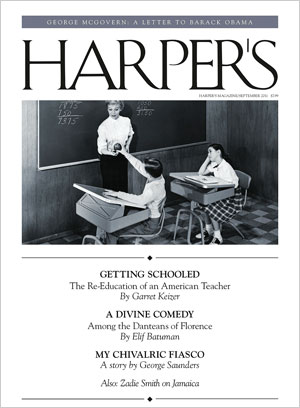
[READ: August 31, 2011] “My Chivalric Fiasco”

This is the second Saunders piece in a couple of weeks in two different publications (this seems to happen to him a lot–do I smell a new book coming out?).  This is one another of Saunders’ more corporate-mocking pieces.  He plays around with name brands and has a lot of trademarked and capitalized words.

But it starts off very unlike that whole realm. It seems to be set at a Ren Faire or some such thing.  On TorchLightNight the narrator sees Martha running through the woods saying, that guy is my boss.  Don Murray comes out of the woods after her, and it clear that something has gone on between them.  When Ted, the narrator, asks them what’s going on, they admit to a “voluntary” fling.  Then Don tells Ted that he has been promoted out of Janitorial; he is now a Pacing Guard.

The next day, Ted is given some KnightLyfe, a pill that helps him with medieval improv.  Until the pill kicks in, Ted is horrible in his role, but once it does, he (and the story) switch into a  kind of crazy Ren Faire “Olde” English: “Quoth Don Murray with a glassome wink, Ted you know what you and me should do sometime?” (more…)

Read Full Post »

SOUNDTRACK: RUSH-“Not Fade Away” (1973).

I never understood this song.  Grammatically it drives me nuts.  “Love is real, not fade away.”  Why would someone write that?  Anyone with even a rudimentary grasp of English would know that that is just a horrible way to speak.  Okay, I got that off my chest.

So this is the first single that Rush ever released.  You can find out information about it on the web (of course, I didn’t know it existed until a couple of days ago).

What we get here is a pretty rocking version of this rock n roll standard.  The band has some nice group vocals on the chorus.  I like the echoed chanting of the chorus before the solo kicks in.  And I love the rough sound that Alex’s guitar has as the song opens.

As I noted the other day with the concert from circa 1974, the band was really all about Alex’s guitar work back then.  Geddy doesn’t do anything impressive on the bass (a couple of fills, but nothing special).  But Alex’s guitar solo is amazing (and you can hear snippets of future guitar solos buried in this solo).

It’s funny to me that when they recorded their covers EP Flashback, that they didn’t include this song, too.

Check it out:

The B-side comes tomorrow!

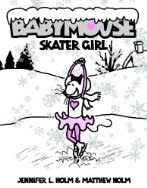
[READ: March 12, 2011] Babymouse: Skater Girl

Well, fair enough, I said that I liked Babymouse: Dragonslayer because it had a plot.  This story has a plot, too.  Interestingly, it ties in kind of nicely to the Dragonslayer story, too.  (It’s all about winning something).

As the story opens, Babymouse feels bad because she never wins anything.  She’s looking at all of the trophies which she has not won; then there’s an amusing fantasy of all the things she has won (honorable mention for spelling the word “the” correctly; honorable mention at the swim competition for “getting wet”; and amusingly, archenemy Felicia Furrypaws’ trophy for worst whiskers).

But despite her complaints about not being good at anything, we quickly see that she is actually very good at ice skating.  She rules the pond in town–until the big hockey players crash into her, that is).  She even daydreams of winning a skating trophy. (more…)

Read Full Post »

SOUNDTRACK: NEIL YOUNG-Trans (1982).

By most standards this Neil Young album is a disaster.  It’s so bad that despite updating his entire catalog and releasing all kinds of bootleg concerts, he has never issued this disc on CD in the States.  So, just what’s so awful about this disc?

Well, mostly it’s awful as a Neil Young disc.  Meaning, if you like Neil Young (either flavor: country/folk or hard rock/grunge) this disc is a big fat HUH??  Neil Young has gone all synthy?  And not just synth but computerized synthy–sometimes his voice is utterly like a computer.  It’s a travesty, it’s a shame, it’s an incredible surprise.  Unless you listen to it without thinking of it as a Neil Young record.

But after all that introduction, the biggest surprise is the first song.  You’ve been prepped for this weird album full of computer nonsense and you get the fairly standard (if a little dull) rockabilly type music of “A Little Thing Called Love.”  It’s a pretty standard Neil Young song for the time.  Hmm, maybe the album isn’t that weird.

Well, then comes “Computer Age” and the keyboards kick in.  Interestingly, to me anyhow, this is the year that Rush released Signals.  Signals was the album where Rush fans said Woah, what’s with the keyboards guys.  Similarly, “Computer Age” makes you say, geez, was there a sale on keyboards in Canada?  The keyboards are kind of thin and wheedly, but the real surprise comes in the processed vocals (Rush never went that far).  The vocals are basically the 1980s equivalent of auto-tune (no idea how they did this back then).  Because the song is all about the computer age it kind of makes sense that he would use this weird robotic voice.  Sometimes it’s the only voice, although he also uses the computer voice as a high-pitched harmony over his normal singing voice.

“We R in Control” sounds like it might be a heavy rocker (anemic production notwithstanding) until we get more computer vocals.  Again, conceptually it works (its all about the dominance of CCTV), but it is pretty weird as a Neil Young song.

And then comes yet another shock, “Transformer Man.”  Yes, THAT “Transformer Man,” except not.  This original version of the song is sung entirely in a processed super high pitched computer voice that is almost hard to understand).  The only “normal’ part of the song is the occasional chorus and the “do do do dos.”  It sounds like a weird cover.  Sarah, who loves Neil Young, practically ran out of the room when she heard this version.

“Computer Cowboy (aka Syscrusher)” continues in that same vein.  Musically it’s a bit more experimental (and the computer vocals are in a much lower register).  Although I think it’s probably the least interesting of these songs.

Just to confuse the listener further, “Hold On to Your Love” is a conventional poppy song–no computer anything (aside from occasional keyboard notes).  Then comes the 8 minute “Sample and Hold” the most computerized song of the bunch and one of the weirder, cooler songs on the disc.  It really feels like a complete song–all vocodered out with multiple layers of vocals, not thin and lacking substance like some of the tracks.  It opens with personal stats (hair: blonde, eyes: blue) and proceeds through a litany of repeated “new design, new design” motifs.

This is followed by a remake of “Mr Soul” previously only on Decade.  This is a new vocodered-harmonies version of the song.

The biggest failure of the disc to me is “Like an Inca” it’s nine minutes of virtually the same guitar riff.  The chorus is pretty wonderful, but it’s a very minor part of the song itself.  It is fairly traditional Neil song, I just wish it were much shorter.

So, this travesty of a disc is actually pretty interesting and, for me, pretty enjoyable.  Most of these synthy songs sound kind of weak but I think that has more to do with the production of the time. I’d love to hear newly recorded versions of these songs (with or without the vocoder) to see what he could do with a great production team behind him.

Trans is not a Neil Young disc in any conventional sense, but as an experiment, as a document of early 80s synth music, it not only holds up, it actually pushes a lot of envelopes.   I’m not saying he was trying to out Kraftwerk Kraftwerk or anything like that, but for a folk/rock singer to take chances like this was pretty admirable.  Shame everybody hated it.

[READ: July 5, 2011] Five Dials 19

Five Dials 19 is the Parenting Issue.  But rather than offering parenting advice, the writers simply talk about what it’s like to be a parent, or to have a parent.  It was one of the most enjoyable Five Dials issues I have read so far.

CRAIG TAYLOR & DIEDRE DOLAN-On Foreign Bureuas and Parenting Issues
I enjoyed Taylor’s introduction, in which he explains that he is not very useful for a parenting issue   That most of the duties will be taken on by Diedre Dolan in NYC.  They are currently in her house working while her daughter plays in the next room.  His ending comment was hilarious:

Also, as is traditional at most newsweeklies, someone just put a plastic tiara on my head and then ran away laughing at me.

I resist Parenting magazines, from Parents to Parenting to Fretful Mother, they all offer some sound advice but only after they offer heaps and heaps of guilt and impossible standards.  So I was delighted to see that Five Dials would take an approach to parenting that I fully approve of.  Dolan writes:

Nobody knows what works. Most people just make some choices and defend them for the next 18 to 50 years – claiming nurture (good manners) or nature (crippling shyness) when it suits them best.

And indeed, the magazine made me feel a lot better about my skills (or lack) as a parent. (more…)

Read Full Post »

SOUNDTRACK: THE SWELL SEASON-Tiny Desk Concert #24 (August 10, 2009).

I was going through the NPR recordings that I’ve downloaded and discovered that I had four from The Swell Season.  This Tiny Desk concert is the shortest of the four recordings (although it’s one of the longest Tint Desk concerts–most are about 10-15 minutes, this one is over 33 and has an encore!).  Glen Hansard is charismatic and funny as he says he feels foolish playing just a few songs and would they mind if he played one or two more.

I usually prefer the louder Swell Season songs, but the quieter songs work well in this situation (especially when the NPR staff helps out with backing vocals).  He plays the same songs that you’ll hear a lot on these NPR recordings (“In These Arms,” “Low Rising,” ‘Feeling the Pull” and the highlight of the show: “When Your Mind’s Made Up.”

I’ve liked this song from the first time I heard it in Once.  Every live version I’ve heard is great.  And this one is no exception.  He brings so much emotion to the end of this song as it gets louder and louder and his voice (man he can hold a note) gets louder and more strained.  It’s truly a great musical moment.

And, of course, Markéta Irglová is there as well.  She only sings one song, but her gorgeous harmonies are all over the session (no piano, though).

This is the most subdued of the four concerts, but it’s a good one.  (The NPR halls must have been ringing with his voice during this one!)

[READ: August 21, 2011] JPod

JPod holds a special distinction on this blog.  It is the first book that I have read twice during my time of writing this blog.  It’s also the only book that now follows this pattern:  I read the book, I watched the TV show based on the book, I reread the book.  So now I have the actors from the show in my head as I re-read what happened to them (hi Alan Thicke!).

I’ve been on this Coupland kick (which will now come to a halt for a bit, but will pick up again in the not too distant future) and since I just read Microserfs, I wanted to read this book right on its heels as it is seen as kind of a sequel (but not really at all) possibly because it, like Microserfs has Lego people on the cover.

So let’s get things out of the way first.  This book is not related to Microserfs in any way (except that there’s a (different) character named Ethan, it’s set in a techie world of computer programmers and there are huge swaths of pages that are, if not wasted, then certainly not very practical in terms of reading–more on that).  But there are no overlapping characters, it’s not set in the same country and there’s lots more violence.

The book starts off with a series of pages that tell you the book is not going to be terribly conventional. There’s a series of super large-font words (like in Microserfs) of random ideas.  They’re followed by a break-free four-page rant (in a  different font from the rest of the book) about modern life and technology.  It’s hard to read, but it really conveys a sense of the world we’re entering.

When the book proper starts, Douglas Coupland is mentioned in the first few pages (in a very disparaging way).

“Oh God. I feel like a refugee from a Douglas Coupland novel.”
That asshole?”
“Who does he think he is?”

Then the story kicks into gear. (more…)

Read Full Post »

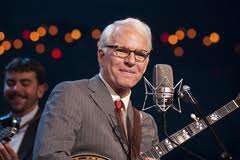
SOUNDTRACK: STEVE MARTIN & THE STEEP CANYON RANGERS-“Athiests Don’t Have No Songs” (2010).

We watched this Steve Martin performance on Austin City Limits last night.  Who knew that Steve Martin (yes, that Steve Martin) won a Grammy in the bluegrass category!  I’m not a huge fan of bluegrass–basically I like it enough for a few songs, but a half an hour is a bit much.

Nevertheless, Steve Martin is an amazing banjo player.  Anyone who has his comedy albums from the 70s knows that.  He used to play banjo between jokes (“Oh…death and grief and sorry and murder).  Now he tells jokes between banjo songs (the joke about the Grammy is very funny).

This song does not feature his amazing banjo playing but it is very funny indeed.

I just love the crazy notes that Martin hits near the end, which sounds so out of tune and yet fit very well together.

[READ: July 27, 2011] Five Dials 18b

The bulk of this short special issue is the five poems by Michael Robbins, a poet with whom I am unfamiliar.  The only other items included here are Craig Taylor’s Letter and Laurence Scott’s Currentish Events about Galliano and Gaddafi.  Since Five Dials issues are of varying sizes to begin with, it was unclear why this issue was a “b” and not the next issue, but Taylor sets us all straight.

CRAIG TAYLOR-A Letter from the Editor: On Spring and Robbins
They got into the publishing gig to be able to comment on things as they occur.  So this special issue is designed to usher in Spring and to introduce the world to the new poet whose title “Aliens v Predator” so impressed them that they asked him for five more. (more…)

Read Full Post »

SOUNDTRACK: RA RA RIOT-Live at the Black Cat, Washington DC,  October 12, 2008 (2008).

I really like Ra Ra Riot’s album The Rhumb Line, and this concert is basically a showcase for that album.  There’ s an interview at the end of the show (all downloadable from NPR), in which the  band says that critics raved about their live show as much as their album.

I don’t really hear that the show is more energetic than the album (maybe visually they are wild), but it did sound fantastic.  It’s amazing to hear a rock band that is dominated by strings–the cello and violin are often louder than the guitar (but not in a competing/drown you out kind of way,  more of a strings do the melodies and the guitar adds bulk to the sound).

I always enjoy hearing a band that is grateful to their audience for showing up (this is most evident in young bands, who seem so much more genuine about their love of the audience) and Ra Ra Riot are certainly that .  They seem genuinely surprised at the turn out, and they play a great set accordingly.

There are two songs that aren’t on the album here “A Manner to Act” and the encore “Everest.”  They both feel like they came off the album, which bodes well for their second album, Orchard, which just came out in May.  Ra Ra Riot also do a great cover of the obscure Kate Bush song “Suspended in Gaffa.”  At the end of the show they tack on a cover of “Hounds of Love.”  Lead singer Wesley Miles has a wonderfully strong voice and he can reach some pretty high notes–not soprano or anything like that, just strong enough to be able to pull off a Kate Bush cover.

This is a great show.  And when you read about the tragedy they suffered just as they were starting to take off, their obsession with death may not be so surprising.  I’m looking forward to Orchard.

[READ: 1995 and August 18, 2011] Microserfs

After reading Life After God and thinking about Microserfs, I looked up Coupland’s bibliography and saw that indeed Microserfs came next.  And I was really excited to read it.  I have recently watched the JPod TV show and I knew that JPod was a kind of follow-up to Microserfs, so I wanted to see how much of it rang true.  And I’ve got to say that I really rather enjoyed this book.

While I was reading this, I started taking notes about what was happening in the book.  Not the plot, which is fairly straightforward, but about the zeitgeisty elements in the book.  And, since I’m a big fan of David Foster Wallace, I was also noting how many zeitgeisty things this book had in common with Infinite Jest.  I’m thinking of tying it all together in a separate post, maybe next week.  But I’ll mention a few things here.

My son also loved the cover of this book because it has a Lego dude on it and he has been really getting into Lego lately.

So Microserfs is the story of a bunch of underpaid, overworked coders who work for Microsoft.  The book is written as the journal of Daniel Underwood (Coupland still hadn’t really branched out of the first person narrative style, but the journal does allow for some interesting insights).  The story begins in Fall 1993.  I felt compelled to look up some ancient history to see what was happening in the computer world circa 1993 just for context.  In 1991, Apple released System 7.   In 1993, Windows introduced Windows NT, Intel released the first Pentium chip, Myst was released and Wired magazine launched.  In 1994, Al Gore coined the term Information Superhighway.  Yahoo is created.  The Netscape browser is introduced.  So we’re still in computer infancy here.  It’s pretty far-seeing of DC to write about this.

Daniel works at Microsoft with several friends.  Daniel is a bug tester, Michael (who has an office, not a cube) is a coder, Todd (a bodybuilder) is a bug tester.  There’s also Susan (smart and independent), Abe (secret millionaire) and Bug Barbecue (an old man–he’s like 35).  The five of them live in a house on “campus.”  There’s also Karla (a type A bossyboots who doesn’t like seeing time wasted) who works with them but lives up the street.

As the story opens, Michael has just received a flame email from Bill Gates himself and has locked himself in his office.  This leads to a very funny scene and ongoing joke in which the office mates feed slide two-dimensional food under his door and he vows to eat only things that are flat. (more…)

Read Full Post »

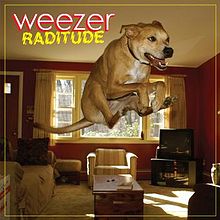
SOUNDTRACK: WEEZER-Raditude (2009).

I didn’t buy this Weezer album when it came out because I had heard really bad things about it (like the “guests”), but when I saw it cheap I decided to check it out.  This has to be the most polarizing Weezer album of them all.  I listened to it twice yesterday.  The first time I thought I had been too harsh on it.  The second time I thought it was godawful.  It’s amazing what a couple of hours can do.

It opens with a wonderful bit of poppy wordplay ala Cheap Trick: “(If You’re Wondering If I Want You To) I Want You To.”  It’s catchy as anything and is a wonderful start to the album, even if it is probably their poppiest song ever.  From there though, the album really degenerates.  And mostly it’s because it’s so dumb.  I mean the album title should tell you what you’re in for, but who would have expected the moronic sub-pop-metal of “The Girl Got Hot” or even the reprehensible lyrics of “I’m Your Daddy” “You are my baby tonight And I’m your daddy.”  It’s just creepy.  Or gah, a song about the mall?  “In the Mall.”  It’s not even worth mocking.  And really, try to picture Rivers Cuomo in a mall.  Any mall.

But nothing could prepare anyone for “Can’t Stop Partying.”  Unlike Andrew WK’s ouvre, which is so sincere about partying that you can’t take it seriously, this song really seems to be about the guys partying.  It’s laughable.  The anemic rap but Li’l Wayne certainly doesn’t help.

Even the collaboration with Indian musicians on “Love is the Answer” (yes, seriously) doesn’t really work.  It feels like they wrote the song and then said, “Hey let’s throw some sitar on it.”  It’s not enough to be exciting but too much to ignore.

This is not to say that these songs aren’t catchy.  I mean, geez, I still have “Can’t Stop Partying” in my head while I’m listening to something else.   Rivers knows how to write a pop trifle.  And the more he writes songs like this, it makes me thing that Pinkerton was the fluke.  Which is fine. The music world needs poppy songs, right?

[READ: early August 2011] various nonfictions

I thought about doing individual posts for all of Arthur Bradford’s non-fiction that’s available on his website (that’s right,  yet another author that I have read short uncollected pieces by without having read any of his bigger works–I’m looking at you Wells Tower).  Bradford has links to all of his nonfiction ( I assume) on his website.  There are 12 links in total.  One is to his blog (which I’m not reviewing).  The rest are for articles covering a pretty broad array of topics from a pretty broad variety of sources.  (more…)

Read Full Post »

« Newer Posts - Older Posts »