Feeds:
Posts
Comments

Archive for the ‘Film & TV’ Category

SOUNDTRACK: COCTEAU TWINS-“Frosty the Snowman” (1993).

Cocteau Twins released Snow, a “holiday” EP in 1993.  Their version of “Winter Wonderland” is quite sublime.  This version of “Frosty the Snowman” on the other hand is a bit…off.

I don’t know if the tempo is too fast (I think that may be it), or if the lyrics are too silly (even if the Twins weren’t filled with gravitas, most of the time you couldn’t hear what they were saying anyhow) or if they just can’t get their brand of lush to envelope the song, but it just doesn’t quite work for me.

[READ: December 13, 2011] “The Tragedie of Frosty the Snowman”

My work director sent this article around as an amusing academic piece for the holidays.  It’s a short article (one and a half pages) but it does a good job of analysing the real tragedy that is Frosty the Snowman: “Frosty’s tragedy is not simply that he must melt, thaw, resolve into etc.–this is merely the common fate of all men, persons, who are made out of snow.”

The tragedy of Frosty is personal, for he has an inner greatness.  When he encounters the magic hat he claims to be coming “back again someday.”   But can he every really understand that?  [We watched this special just the other day, and it must be said that Frosty, who seems to be quite naive and unaware (what’s a traffic light?) is also quite savvy about a lot of things that he should not know–winter flowers, frozen boxcars]. (more…)

Read Full Post »

SOUNDTRACK: WOODY GUTHRIE-“The Car Song” (1944).

Several years ago when I was first buying music for our kids, I found a number of Woody Guthrie discs.  I always liked Woody Guthrie in theory (this guitar kills fascists and all that).  But I was unfamiliar with his children’s music.

I was surprised by his stuff for one major reason (Besides the fact that he looks like Sean Penn).  This was later confirmed by his son Arlo when Arlo tried to work with his father’s masters: Woody didn’t really believe in rhythm or conventional timing or anything like that.  And that’s fine, but when it’s combined with the primitive recording equipment that Guthrie had access to, these songs sound, shall we say, rough.

Of course, Woody is mostly known for his excellent lyrics (This Land is Your Land).  So it’s especially funny to hear “Car Song” in which the first verse (according to Woody’s official site) is:

Brrrm brm brm brm brm brm brm, brrrm b’ brrrm,
Brrrm brm brm brm brm brm brrrm b’ brrrm,
Brrrm brm brm brm brm brm brrrm b’ brrrm.
Brrrm brm brm brm brm brm brrrm.

Arlo has said that Woody wasn’t exactly a good dad, but it’s clear that Woody expressed his love for his kids in song.  And this song is a fun and silly one that any kid can enjoy (as long as they don’t mind the really raw recording quality).

[READ: December 4, 2011] Babymouse Burns Rubber

This is the last Babymouse book that I had to read before getting caught up with all of the books (except for 2011’s Christmas book, which is the most recent release!).  It’s number 12, and it continues the later book’s excellent streak.  I was a bit concerned about the book when it opened because it begins with a NASCAR fantasy and I don’t watch NASCAR.  But as with most of the opening fantasies, it doesn’t bear on the actual plot of the book.

This book features a lot of screen time for Babymouse’s friend Wilson (it’s always good to see him and nice to see him get so much attention).  We quickly learn that Wilson is the go-to man when something breaks.  More to the point, he’s the go-to man (or ferret, I guess) that Babymouse goes to whenever she needs something (homework help, fixing a bicycle, whatever).  And Wilson is happy to help (what are friends for?).

When Wilson fixes Babymouse’s bicycle (again–Babymouse is a terrible driver) Wilson shows off his new car!  This car is one for the downhill derby–he’s wanted to race for years and he’s finally old enough to participate.  When Babymouse hears that there’s a race which she could actually enter she gets very excited and wonders what she’ll wear.  Wilson points out that she actually has to build her car first.

Of course, Babymouse can’t build anything, so she asks Wilson for “help.”  And more help and more help.  But now Wilson’s car needs work of its own.  Oh, and let’s not forget that in this year’s race is three-time derby winner Chuck E. Cheetah (nice) who is likely going to win again this year.  (more…)

Read Full Post »

Sarah suggested that I update my most hated and most favorite Christmas songs list as it has been THREE YEARS (!) since I last posted it.  I haven’t changes the list at all, but I have updated the comments (with one retraction!).

In my original post, Sarah chimed in with her two cents.  And I’m going to leave her original comments.  If she has changed her mind (she told me yesterday that she liked a song that she never liked before, she’ll have to do the updating herself).

Here’s my two new additions for this year.  Oh and by the way, in the original post, I mentioned a couple of songs that I didn’t include in my list because we don’t own copies of them.  And while that is fair, I feel compelled to mention them this year.  (more…)

Read Full Post »

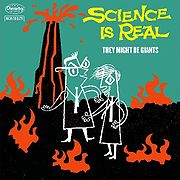
SOUNDTRACK: THEY MIGHT BE GIANTS-“Science is Real” (2009).

Indeed, I do love They Might Be Giants.  I love how their Here Comes series went from letters to numbers to science.  When you hear news of science being questioned from all sorts of places, it’s nice to have some super catchy songs to reinforce science fact.

“Science is real. From the Big Bang to DNA.”  It’s a great way to open an entire album full of interesting scientific knowledge (from the band who covered “The Sun is a Mass of Incandescent Gas,” which gets updated here into a more accurate lyrical song).  My kids love this album, and it makes me proud when they sing along to the great catchy, short songs contained within.  I especially love that the lyrics don’t eschew fun for truth:

I like the stories
About angels, unicorns and elves
Now I like those stories
As much as anybody else
But when I’m seeking knowledge
Either simple or abstract
The facts are with science.

This is a rocking guitar song, fun for the whole family.  Sing it with me…  “Science is real!”

[READ: December 4, 2011] Babymouse: Mad Scientist

I’m almost caught up to the Babymouse series!  This one even came out this year!!  There’s only the Christmas one left–wonder if I’ll be able to get it from the library in time.

This book also introduces a new character, Squish.  I actually found out about Squish before Babymouse, because I received a prepub of the first Squish book.  And now I get to see Squish’s origin story.

This was a really enjoyable book.  After reading the two music-themes ones, I was wondering if the Holms could keep up the interest for 14 books, but they really brought it back with this one.

After some funny jokes about science experiments (and the state of her room) we get a good fantasy sequence set aboard the USS Cupcake (with an unexpectedy funny Star Trek joke from the homeroom teacher).

And now they have a new science teacher (after the experiment went awry with their previous science teacher).  Mr Shelldon is obsessed, and I mean obsessed with molds.  He wants the class to enter the science fair (and encourages them to do research on molds!) (more…)

Read Full Post »

SOUNDTRACK: DUPLEX!-“Freaky Rhesus” (2005).

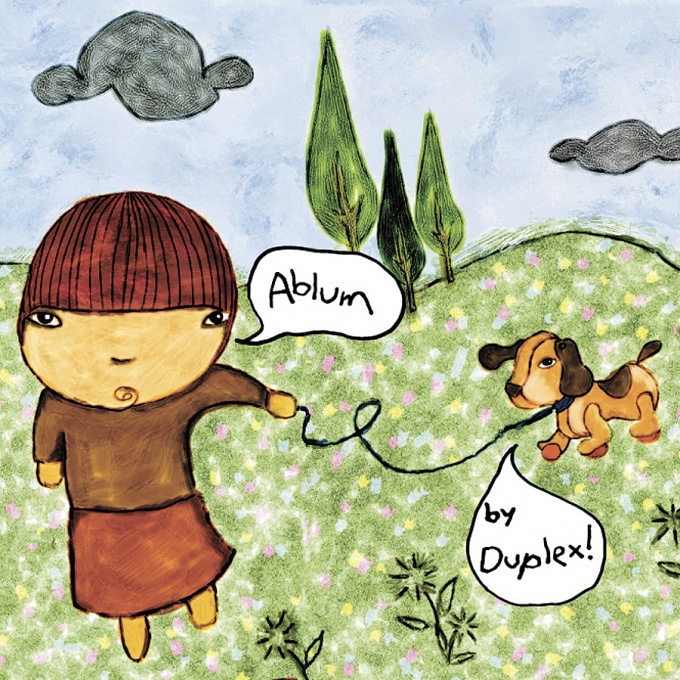
This strange littles song comes from the Duplex! album called Ablum (no typo there).

I’ve been aware of the disc for a while, but never had a chance to listen to it.  Duplex! is a kind of Canadian indie supergroup for kids (although I actually don’t know music from the bands that the members are originally from).  I’m going to investigate this album a little more, but for now, I’ve got this song to enjoy.

This is a simple keyboard/drum melody (it sounds like a simple kid’s song), although there is a funny clarinet melody).  This might be like a weak They Might Be Giants song, except the lyrics are kind of fun.

Yes, it is about a monkey in the zoo.  The chorus is particularly funny:

here’s where the story gets a little boring
he only ever had one wish
he was dreaming of bananas all the time bananas
especially the Cavendish
which he ate and he ate and he ate until he finished.

This ablum came out before the huge spate of children’s music by indie folks, and perhaps it’s a little weak.  But it’s sure more interesting than Kidz Bop.

[READ: December 4, 2011] Babymouse: The Musical

I do admit to wondering what this book could have in terms of plot.  I mean, there’s going to be a musical and something will go wrong, right?  True.  Very true.

The plot seems a little thinner than most of the Babymouse books, but that’s more than made up for by the wonderful flashes to famous musicals.

Normally I try to mention the specific allusions in the dream sequences, but man, they are just all over the place here: from Phantom of the Opera to High School Musical (no Glee though, this book came out first).  (more…)

Read Full Post »

SOUNDTRACKPEARL JAM-Austin City Limits (2009).

Pearl Jam records (and sells) most of their shows and they occasionally videotape them as well.  But they don’t do TV all that much (excepting the recent Late Late Show episodes).  There seemed to be something special, or at least different, about Pearl Jam on Austin City Limits.  Think of it almost like Unplugged Updated.

It opens slow with Eddie on an acoustic guitar and strings behind him.  In fact, the whole set seems less heavy than many of their sets.  But that’s not to say that the band doesn’t rock out, because they do.

The first six songs of the set come from Backspacer.   And then they bust out “Army Reserve” (which makes sense given who is in the audience, see below).  Then there’s a wonderfully raucous version of “Do the Evolution” (one of my favorite PJ songs).

After that riotous track, they bring the strings out for one more song.  It’s a rather funny little joke because it’s just the strings and Eddie on acoustic guitar playing “Lukin,” the 80-second song that is so fast you can barely hear the words.

For an extra treat, touring mate Ben Harper comes out to play slide guitar on “Red Mosquito” (which is always a treat).  And the set ends with an amazing version of “Porch” with a super long guitar solo in which Mike McCready really shows off his chops.  There’s even a moment where Mike and Stone are riffing off each other, classic rock style.
The set ends the Eddie talking about playing for the wounded veterans in the audience and how it was quite moving for him given all they have done for us.  Over the closing credits you see the band mingling with the veterans (including a guy who has lost a leg).  It’s all surprisingly touching for a rock show.

[READ: November 20, 2011] “Perchance to Dream”

A while back I read all of the Jonathan Franzen articles that were published in The New Yorker.  I thought I had read everything he’d published until I realized I had forgotten to read this piece (possibly his most famous) that was published in Harper’s.  It fits in well with this weekend’s theme because it was mentioned in Evan Hughes’ article that I talked about yesterday and because David Foster Wallace is mentioned in it.

As with most of Franzen’s non-fiction, it’s not easy to write about critically unless I want to argue with him, which I don’t necessarily want to do.  So instead, I’ll try to summarize.  Of course, this is a long and somewhat difficult article, so let’s see what we can do with it.

The first surreal thing is when you see the byline: “Jonathan Franzen is the author of two novels, The Twenty-Seventh City and Strong Motion, and is writing a third.”  It’s hard to imagine he got a huge article in Harper’s before he wrote The Corrections.

The second surreal thing comes in the text: It opens with “The country was preparing for war ecstatically, whipped on by William Safire (for whom Saddam Hussein was ‘this generation’s Hitler’) and George Bush, whose approval stood at 89 percent.”  And it is only a few paragraphs later when he mentions Patriot missiles that it clicked that this was written in 1996 and not 2001 and that he was talking about the 1991 Iraq invasion.  He mentions this as a prelude, saying that he was trying to sequester himself in order to start writing again.

Then he talks about Paula Fox’s novel Desperate Characters as a benchmark in terms of insight and personal conflict, even if it is so crazily outdated (that someone would throw an inkwell!).   He talks about this book quite a bit. I’m, not sure I found it compelling enough to want to read, but it’s always interesting to hear a fan write about a book I’ve never heard of.  He will return to this book throughout the essay. (more…)

Read Full Post »

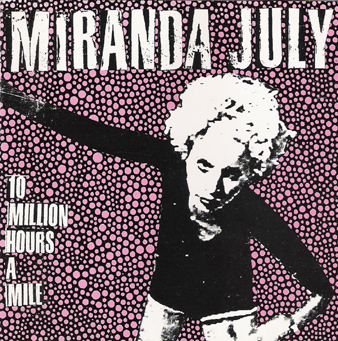
SOUNDTRACK: MIRANDA JULY-10 Million Hours a Mile (1997).
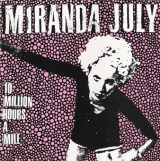
I only listened to this again after mentioning it below (I wrote about the book before the CD).  I vaguely recalled this CD, but I recall buying it mostly because it came from the unquestionable Kill Rock Starts and must have gotten a good write up in some alternative rag that I read.

Basically, this is a series of performance pieces, most of which are set to music (the music is spare and basic if it’s there at all).  She has multiple characters, most of whom are having a rough time. 

The one thing that is overwhelmingly noticeable to me is that just about all of her characters seems to have some kind of stutter or vocal tic, which I have to say may bring verisimilitude but is also rather irritating to listen to.

Indeed, I think this is where my opinion of July stems from (see below).  These are artsy pieces that were kind of the rage back in the late 90s– riot grrl takes of one-woman shows.  They were interesting and maybe good for one listen, but not much else. 

In hindsight, and seeing the kind of work that July has done since, it is easy to see that this is a collection of character studies like the ones that would inform her later work.

The rather strange thing is that the titles of the songs don’t match up to the performances (at least on Spotify or allmusic), I wonder what’s up with that. 

There are some interesting scenes laid out here, although I find July’s delivery to be off-putting–it’s in that sPOKEn WOrd styLE where THINGS are inFLECted in a TERRibly deLIBerate MANneR.  I KNOW that that KIND of emPHASis is meant to be…

….draMATic, but I’m rather glad that people have stopped doing it.

The eleven minute “How’s My Driving” is a decent example of the kind of things she does (although most of the pieces are more like 3-4 minutes).  In this piece, a man (July’s voice) goes to a peep show and talks to “Penny.”  Their plot line is a bizarre story in which the details of each reveal disturbing similarities until the ending is a Twilight Zone twist.  This is interspersed with a girl named Penny who talks about how she first started lying, although she says driving.  It’s an interesting although somewhat forced metaphor, but it’s enjoyable.  The stories intertwine, growing more and more intense.   Although it could probably be a bit shorter.

In “Hotel Voulez-Vous” a young girl (or boy) goes back in time to the titular hotel to convince her parents not to have her.  The execution is interesting but flawed.

“The F-A-T-E” is a cool story about letting fate be your guide, but the crazy voice-noises she makes are very off-putting and kind of take away from what could be a cool twisted tale.

I guess my opinion of this album work hasn’t changed all that much.  It’s got moments of interest but seems to be a little too coffee shop/navel gazing and being weird rather than good.  But hey, she was young then, right? 

[READ: December 6, 2011] It Chooses You

I have this weird kind of relationship with Miranda July’s works.  I am hesitant to read/view something, but I seem to enjoy it in the end.  I’m not sure why I am so hesitant, there just seems something off-putting about, if not her, then maybe the “fame” that surrounds her.  Like if she hadn’t earned her accolades.

I first found her back in 1997 when her 10 Million Hours a Mile CD was released on Kill Rock Stars.   So she was kind of indie cool.  And I guess she still is indie cool, but I guess it was the quality of the CD–it seems goofy at best, that makes me question the quality of her art.

But that may have finally changed with this book.

I began reading this book with that same sense of trepidation about her art–that I wouldn’t really like it.  Why?  Because, as with the CD, it’s seems to be all about her.  And I feel like a lot of her work is about her.  Nothing wrong with that, but sometimes you think, aw who cares. 

What she’s talking about is her upcoming film, The Future (which has since been released).  She is stuck in massive writer’s block .  She hates her script and doesn’t want to look at it anymore.  So, as many people do, she starts flipping through the PennySaver(more…)

Read Full Post »

SOUNDTRACK: ULVER-Perdition City: An Interior Soundtrack (2000).

Uver’s previous EP hinted at what would come next–electronic ambient tunes.  But it didn’t quite prepare anyone for this–a soundtrack to a film that doesn’t exist.  And yet with a title like Perdition City, you can pretty well anticipate the music that’s coming: think noir.

It is more electronica, and yet it is not just electronica.  The opening song “Lost in Moments” has a saxophone (!) solo.  And the song sounds like a perfect David Lynch/noir soundtrack to a dark and stormy night. 

What’s novel about the approach are the electronic noises and eccentric drum beats that punctuate the track.  The second track, “Porn Piece or The Scars of Cold Kisses” is broken into two parts: the first is a low, rumbling section with skittery noises and the second part has soulful singing (Garm, the only consistent member of Ulver (who goes by a different name on just about every record) has a surprising range of voices at his disposal).

“Hallways of Always,” “Tomorrow Never Knows” and “The Future Sound of Music” are sort of ambient tracks.  “Hallways” is quiet while “Future” grows in volume and chaos as the song proceeds.  “Tomorrow” is the most menacing of the three, projecting a state of noise and tension.  The interesting thing about these tracks is that although they seem like pretty conventional electronic instrumentals, they are actually fairly complicated in detail.  Some of the electronic pieces go on a bit too long, but as they are meant to be atmospheric rather than narrative, I guess that’s okay.

“We Are the Dead” bring in vocals again.  This time, it’s a spoken word narration over distorted radio voices.  And “Dead City Centers” also brings back some vocals.  Although only after about 4 minutes of noises and tension.  This time the vocals are more ominous (as the music grows more intense).

“Catalept” is the most interesting track on the disc–a remix of music from Psycho.  While the final song “Nowhere/Catastrophe” is an actual song–verses and vocals!  It’s a fairly soft song but it has moments of darkness that are quite cool. 

As a soundtrack this works wonders.  And if Ulver wanted to get into the soundtrack business, apparently their model of “making up your own soundtrack” worked.  Since this release they have recorded the soundtracks for two external films. 

As an overall release it’s a bit all over the place–jazzy sax, electronica, spoken word.  The mood is pretty consistent though, and although I don’t think I would do what the liner notes recommend: “This is music for the stations before and after sleep.  Headphones and darkness recommended,” I still enjoyed it.

[READ:  November 5, 2011] “Alma”

This is a very short story that falls pretty squarely into standard Junot Díaz territory (he says, having read like four pieces by him). 

I’m fascinated by these stories because Díaz is all about women being super hot and yet they are never objectified.  Well, in some ways they are of course–he lingers over their bodies as he describes them, but they are never just a body.  They are often smart or interesting, they are strong and powerful, and even when they are victimized (some by cheating boyfriends, others by far worse), they either fight back or get themselves to safety.  It’s nice to read about powerful women,even if the point of view is from her boyfriend.

This is the story of a young man falling hard for a hot woman (with a beautiful ass).  What fascinates me about Junot Díaz’s stories is that the women that his narrators fall for are Dominican, but they are also alternative to their culture.  So in this case, Alma is a “Sonic Youth, comic-book-reading alternatina” which makes me like her already. (more…)

Read Full Post »

SOUNDTRACK: MY MORNING JACKET-“Our World” (2011).

This song comes from the The Green Album, the grown- up-bands-cover-the-Muppets album.  I can’t remember if I knew this song to begin with or if I have just listened to this record enough that it sounds so familiar.

Although MMJ have been getting into some crazy electronic and heavy music as of late, this is a very mellow song.  It opens with a banjo!  And while more instruments come in, it stays pretty true to what you’d think the Muppets would sing.

(Aha, thanks internet.  It appeared in Emmet Otter’s Jugband Christmas).   It’s a really pretty song (Paul Williams knew his way around a ballad, huh?) and this is a very nice cover.

[READ: April 16, 2011] Babymouse: Beach Babe

This the third Babymouse book opens with Babymouse dreaming (of course).  But this time she’s dreaming of surfing!  And she can hang ten (and other surfing lingo) with the best of them.  Until a card says “Too Terrible to See.”  But when she wakes up she has wonderful news…it’s the last day of school!

We also see, to my understanding, the first real encounter with Squeak, Babymouse’s little brother.  When Babymouse runs for the bus, Squeak follows her calling out her name.  She tells him to go home and we see poor Squeak by the side of the road, looking dejected.

But we’re soon back at school, and during the film strip, Babymouse imagines she is the Little Mermaid.  But when she wakes up, the bell rings and school’s out for the summer!

When her parents tell them they’re going on vacation, she has an instant flashback to their terrible vacation last year (and the lack of “facilities” at the camp ground).  But this vacation is going to be different–they’re going to the beach!  And she is super excited…until the drive takes for-

ev-

er.

There’s even a surprising dream sequence about all the trees that she sees on the way down.

When they finally arrive, there’s all the usual beach fun and danger (sunburn!) and Babymouse gets to try her hand at surfing like in her dreams.

It was right around this time that I guessed that the beach that Matthew Holm was drawing was at the Jersey Shore.  And indeed, it is.  The end credits say that the Holms used to vacation at the Jersey Shore.

The book ends with that other classic childhood trauma–having a younger sibling and getting tired of playing with him or her on vacation.  When Babymouse complains about Squeak once too often, he takes it very personally.  And suddenly the story becomes a little frightening and quite touching.

For a snarky series, this one is surprisingly moving.  I wonder if having this book third helped establish that sensitive side of Babymouse (which seems to be missing in later books).  Good for you Babymouse!

Read Full Post »

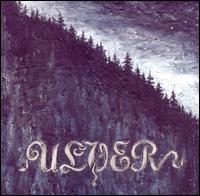
SOUNDTRACK: ULVER-Bergtatt (1994).

Ulver has some music in the soundtrack to Until the Light Takes Us and my friend Lar pointed me to a location where you could download a bunch of their music (this was before Spotify of course). 

So I grabbed a few of their albums expecting to hear some brutal death metal.  And I kind of did, but I also heard classical guitar, flute solos and chanting.   So this album’s full title is Bergtatt – Et eeventyr i 5 capitler (“Taken into the Mountain – An Adventure in 5 Chapters”) and it comes in at a whopping 35 minutes–not bad for an epic.

The opening track (“I Troldskog faren vild” (“Lost in the Forest of Trolls”)) is fascinating–a kind of chanting vocals over a quietly-mixed-in-the-background black metal.  The music is so quiet (and yet clearly black metal) that it almost comes across as ambient noise, especially over the multilayered chanting (I have no idea what language they are singing in).  It ends with a pretty acoustic guitar passage that segues into a very traditional sounding heavy metal section–with a catchy solo that takes us to the end.

“Soelen gaaer bag Aase need” (“The Sun Sets Behind Hills”) opens with, of course, a flute solo.  It’s a minute long and quite melancholy before blasting into the fastest of heavy black metal complete with growling vocals and nonstop pummeling.  But after a minute of that it’s back to the layered chanting like in the first song.  The song ends with a conflation of the two–the chanting metal with the growling black metal underneath.  It’s quite a sound.

Track three “Graablick blev hun vaer” (“Graablick Watches Her Closely”)opens with a lengthy acoustic guitar intro–not complicated, but quite pretty and unlike the poor recording quality of the metal, it seems to be recorded with high quality equipment.  After about 45 seconds that gives way to more black metal.  In a strange twist, the black metal section just fades out, replaced by more acoustic guitar and what seems like the end of the song.  But instead, there is a strange quiet section–not music, but sounds–like someone walking around in the cold forest with crunchy noises and little else.  For almost two minutes.  Until the black metal comes back with a vengeance.

Slow guitar with slow chanting opens track 4 “Een Stemme locker” (“A Voice Beckons”) (the shortest at only 4 minutes).  And the amazing thing is that it doesn’t change into something else.  It is a nice folk song.

The final song “Bergtatt – Ind i Fjeldkamrene” (“Bergtatt – Into the Mountain Chambers”) has a blistering opening followed by some of the most intricate acoustic guitars on the record.  It morphs into a very urgent-sounding black metal section which lasts about 5 minutes.   But just to keep us on our toes, the song (and the disc) end with more classic acoustic guitar.

There is a story here (allmusic says it is a Norse legend about maidens being abducted by denizens of the underworld) and that might help explain the music madness.  But as a musical composition it works quite well.  The chanting over the black metal is really effective and the acoustic instruments bring a nice sonic change from the pounding metal. 

This is not for everyone obviously, but the diversity makes this an interesting introduction into the black metal scene.  Baby steps. 

[READ: November 4, 2011] “Apocalypse”

This is the final non-fiction essay of Junot Díaz that I could find online.  The other one comes from GQ and is called “Summer Love”, but there’s no access to it online. 

In this essay, Díaz looks at the impact of the earthquake that devastated Haiti now that it has been over a year.  Díaz was born in the Dominican Republic which has a long and very brutal history with the people of Haiti–they share a land mass after all.  But rather than looking only at Haiti and how it was devastated, Díaz takes this as an opportunity to see what the earthquake reveals about our country and the state of the world.

The essay is broken down into eight parts.  The first revisits what happened.  The second discusses the meanings of apocalypse, which sets up the “theme” of this essay.  The First: the actual end of the world (which for the thousands of people who died, the earthquake was); Second: the catastrophes that resemble the end of the world (given the destruction of Haiti and the devastation that still lingers, this is certainly applicable); Third: a disruptive event that provokes revelation.

Díaz is going to explore this third option to see what this earthquake reveals. 

What Díaz uncovers is that the earthquake was not so much a natural disaster as a social disaster–a disaster of our creating.  The tsunami that hit Asia in 2004 was a social disaster because the coral reefs that might have protected the coasts were decimated to encourage shipping.  Hurricane Katrina was also a social disaster–years of neglect, the Bush administration’s selling of the wetlands to developers and the decimation of the New Orleans Corp of Engineers budget by 80 percent all contributed to a situation where Katrina could be so devastating.

Then he talks looks at the history of Haiti.  I had known some of this story, but not as much as he provides here–the constant abuse of the citizens, the constant abuse of their finances (both from simple theft and from French and American planning that changed their economy).  There’s also the story of “Papa Doc” Duvalier.  Basically Haiti was a disaster waiting to happen. 

Díaz goes into great detail about the global economy and how it impacted the poor in Haiti and he shows that it doesn’t take a lot of extrapolation to see it reflected in the rest of the world as well.  With the constant rise in standards for the wealthy and the constant abuse that the poor take, it’s not hard to see that Haiti could easily happen here.  If not in our lifetime, then certainly in our childrens’.

But Díaz has hope.  (more…)

Read Full Post »

« Newer Posts - Older Posts »