Feeds:
Posts
Comments

Archive for the ‘Film & TV’ Category

1975SOUNDTRACK: ESKIMEAUX-Tiny Desk Concert #466 (August 28, 2015).

esquimeauxEskimeaux is Gabrielle Smith, who is the keyboardist in Bellows, a band that played a Tiny Desk Concert just a few months before this one.  As far as her stage name,

as an adopted child, Smith discovered that her biological father is Tlingit Eskimo; she describes the -eaux suffix as “just a playful jumble of letters that represents the way I record — a confusing layering of sounds that somehow coalesce into something simple.”.

Smith sings three songs in less than ten minutes.  She has a pretty, unaffected voice–just clean and clear vocals.  For the first two songs it’s just her and her guitar

“Folly” is a simple song as you might expect from just a strummed electric guitar.  But there’s something about the way she sings her lines in a series of rising notes that is really inviting.  She also has a nice way with words.  Like:

In my dreams you’re a bathtub running / You are warm and tender / And bubbling

“A Hug Too Long” is a faster song with a simple but interesting guitar riff that’s followed by a simple but interesting vocal melody.  Again, her clear voice fits perfectly with the music.  It features the intriguing chorus: “You went to work, I went to New Brunswick.”

Her final song is “I Admit I’m Scared.”  She has her bandmates from Bellows come out to sing with her.   There’s no extra instrumentation, but Smith sings in a slightly deeper register and Bellows fleshes out sections of the song (they even do a kind of deadpan synchronized move after each chorus).   Another great line of hers is: “And everything I said spewed like sparklers from my mouth.  They looked pretty as they flew but now they’re useless and burnt out.”  As the song ends, everyone sings louder “If I had a dime for every time I’m freaking out” which leads to a  dramatic climax before the final resolution: “We could fly around the world / Or just get out of your parents’ house.”

Bob jokes at the end that they can come back any time with a new band.  She says they have five other bands (including Told Slant and Small Wonder).  He says “you could come in every Tuesday.”

Bellows isn’t that different from Eskimeaux in style–pretty, quiet songs that are articulate and almost deadpan.  But having Smith sing (and presumably write) changes the way the style is created.  Which is pretty cool.

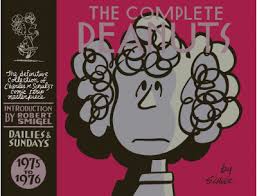
[READ: June 8, 2016] The Complete Peanuts 1975-1976

I really enjoyed this book a lot.  In the introduction, Robert Smigel talks about how it seems like in this era, Schulz turned a corner a bit to become more absurd.  The jokes are sillier, with new characters and some crazy ideas–like talking buildings, pitching mounds and body parts.  He wonders if it was Schulz’ happy marriage or just a desire to take some chances rather than repeating himself.  But whatever the case, the book is really fun.  I especially love the Peppermint Patty/Marcie strips in which Schulz just seems to be having a great time.  I also love all of the jokes with Sally in which she makes herself laugh with some awful puns–I just imagine Schulz cracking himself up and not being able to wait to draw the strips.

But for all of the newness of the strips, Peanuts is always seasonal.  So 1975 beings with ice skating and snowmen.  Linus has made a snowman reclining and reading a book. Charlie asks if it’s Robert Frost and Linus snarks “You said it, I didn’t.”

Patty has been falling asleep a lot in school–her dad is away–and Snoopy makes as terrible watchdog for her.  More funny Patty moments are when she is being so decisive about true false questions.  “Irrefutably true, understandably false, intrinsically false, inherently false, charmingly true.”  To which Franklin asks “Charmingly?”  Patty also becomes the first disciple of the Great Pumpkin–but she blows it by asking for a gift, as if the Great Pumpkin is some kind of Santa Claus. (more…)

Read Full Post »

1973SOUNDTRACK: LUCINDA WILLIAMS-Tiny Desk Concert #412 (December 20, 2014).

lucindaI set tiny, manageable goals for this blog.  They often change over the course of the year, but I like to see if I can complete them.  One such goal was to write about all of the Tiny Desk Concerts from 2014.  And here’s the final one.  (Another such goal is to write about the remainder of the 2016 shows, which is doable).  I also want to write about all of the rest of the First Second Graphic Novels (there’s about 20 of them left).  Insignificant goals that I find satisfying to complete.

I’ve never been a fan of Lucinda Williams.  Although, while I’d certainly heard of her, I obviously didn’t know any of her music. The blurb talks about her distinctive voice.  And it is certainly that.  About 20 years ago a sort of friend of mine saw her open for somebody else and she dismissed Williams as trying to sound like a different singer (wish I could remember who it was).  The irony that Williams has been around since the late 1970s was not lost on me.

But Williams has changed her style over the years.  She originally sang country and has morphed into more of a folk and now a blues style.  This Tiny Desk Concert focuses on her bluesy songs.  I know she’s something of a legend, but I found her demeanor through the whole show off-putting until the end, when she loosened up a bit.

She sings four songs.  “Something Wicked This Way Comes” is rocking blues song.  And I have to say I was pretty shocked by her voice–rough and raspy and sounding not a little hungover.  Her lead guitarist was really the start for me, effortlessly playing some great groovy licks.

For “Cold Day in Hell” (she laughs at saying the title) she straps on an acoustic guitar and then sings like Tom Waits.  That seems like a joke, but the structure of the verses is pure Tom Waits–I would have even suggested he wrote the song.

The third song is the more bluesy “Protection.”  There seems something so inauthentic about this song.  I just don’t believe her rendition of it–I don’t believe that she actually needs protection.  It’s really disconcerting.

She finally smiles after this song and says “Now I’m kinda getting used to this … I’m not a wake yet, that’s what the thing is.  She straps on her guitar and says this is based on the story of the West Memphis Three.  It’ my favorite song of the four–she seems to really get into it.

But all the same, I really don’t like her voice all that much–she’s got a weird drawl and sounds like there are some marbles in her mouth. It’s very strange.  I listened to a bit of a song from a live show from 1989 and her voice was quite pretty–deep, yes, but very pretty.  By 2007, her voice has changed–it’s deeper, with a pronounced drawl.  At a show in 2013, she sounded kind of pretty again.  So, I don’t know what to make of it.  I’ll have to just go back to not listening to her.

[READ: June 8, 2016] The Complete Peanuts 1973-1974

I really enjoyed this volume a lot.  There were a lot of really funny jokes and the characters are really nicely distributed by now.  I don’t want to say that Schulz hit his stride around this time, because he’s been pretty solid right from the start, but this book was easily my favorite so far.  Possibly because it contained so much of Marcie and Patty who have easily become my favorites.

The year starts off somewhat inauspiciously with the anticlimactic return of Poochie.  She shows up, realizes that Snoopy isn’t a cute puppy anymore and leaves.  Never to be seen again.

More interesting is that Linus decides that since Charlie has been their manager for so long and worked so hard that they ought to throw him a commemorative dinner. They plan it for a couple of weeks and when he finally hears about it, his smile is awesome.  They even get Joe Schlobotnick to agree to come. Of course, then Marcie starts saying that they’d all be hypocrites if they actually showed up and said nice things about him since he’s a terrible manager.  And so they cancel it at the last-minute–while Charlie is there. (more…)

Read Full Post »

rjSOUNDTRACK: YUSUF/CAT STEVENS-Tiny Desk Concert #411 December 9, 2014).

catAs this Tiny Desk Concert opens, Bob Boilen tells his story of being 17 years old and saving up money to buy a guitar so he could learn Cat Steven’s “Father and Son.”  He says he’s now old and has a son and the song still means a lot.  And that introduction makes the song even that more emotional when he plays it later.

It’s a shame that he is so known for the controversy about the fatwa back in the 1980s, but his conversion to Islam is pretty interesting: “In 1976, Cat Stevens almost drowned off the coast of Malibu. In his panic, he says, he shouted, “Oh, God! If you save me, I will work for you” — at which point he recalls a wave that came and carried him ashore. He converted to Islam, changed his name and left the pop world after one last album in 1978.”

He released his first non-spiritual album in decades in 20o6.  He released another one in 2014, which was a record of some originals mixed with standards and blues covers.  He plays two songs from this album here (which is a bit of a disappointment, as I could have easily listened to him play the entire Greatest Hits album).  But these two songs are quite nice.  “I was Raised in Babylon” is a bit dark, although his voice sounds great.  “Doors” was originally written for the musical Moonshadow.  It’s a delicate ballad.  And it also as a religious impact with the final line being “God made everything just right.”

In between these two he says he doesn’t know what to play next, but he has some kind of gadget that he scrolls through.  And he chooses “The First Cut is the Deepest.”  He comments maybe some people know I wrote this one, it wasn’t Rod Stewart.  I really like this song a lot.  It sounds different from the record because it’s just him and his guitar, but his voice is unmistakable. and he sounds great.  And if it makes him feel better, I’ve never even heard the Rod Stewart version.

He dedicates “Father and Son” to Bob and it’s just as beautiful as the original.  And yes, it should make you tear up, especially if you have a child.

After listening to this Tiny Desk I really wanted to see him play live.  I know that he is currently on tour and will actually be in Philly on this very night.  There are still tickets available, but since the cheapest seats cost nearly $200, I’ll be skipping this one.

[READ: April 4, 2016] The Stratford Zoo Midnight Revue Presents Romeo and Juliet

I really enjoyed the first book in this series, in which the zoo animals put on a play of Macbeth.  Well, the zoo is ready again for their next performance.  I enjoyed that the audience is aware of the previous play–the kids are even wondering why it’s another tale of woe instead of something happy.  Later when the lion (who was in Macbeth) comes out, someone addresses him as the character from that play.

What I thought was interesting about the way this play was done was that they made the story kid friendly.  I liked this and that it allowed me to share this story with my kids.  Rather than being lovers, Romeo and Juliet want to have a play date, and rather than killing themselves at the end, they wind up hibernating. (more…)

Read Full Post »

town-boy SOUNDTRACK: DUBLIN GUITAR QUARTET-Tiny Desk Concert #409 (May 15, 2015).

dgqWhen I first listened to this brief concert for some reason I didn’t realize that the quartet were playing Philip Glass.  Of course, once he stated that that’s who they were playing, it became quite obvious–but having Glass played on acoustic guitars instead of synths or violins, is quite an unusual experience.

The music is still rigidly repetitive, but there is a great deal of warmth added with the guitars (and the human element as well).

The Dublin Guitar Quarter has been around since 2002 and they play pretty much only contemporary and new pieces (despite being dressed in suits and playing on “classical” guitars).

They play two pieces, with two and three movements of each piece respectively.  They were originally recorded for strings, so these guitar transcriptions change things quite a lot (especially in Mishima).

The first piece is called “Company.”  They play Movements 2 and 3. What’s most impressive about the first piece is that you can hear all of the musical lines.  Glass often interweaves line up line of music ad you can see each guitarist playing these lines on high guitar notes and low notes while the other play accompaniment–transcribing these must have been a real challenge.

The loud chords are practically heavy metal chords on the guitar as opposed to what the strings might sound like.  And for all of the repetition, these two movements of clock in at less than four-minutes total.

It’s interesting to listen to the original after this and hear how it’s clearly the same piece but it sounds so very different.  From tone to drama, everything is changed.

The final pieces are three movements from Mishima.  In Mvt 3 there is some fast picking while the other three play chords.  It’s also fun to watch them all doing similar but distinct things through the middle of the movement.  This doesn’t have the fast lines that Glass is known for but it has a lot of loud repetitive notes.

What’s so interesting is that original is full of drums–and parts of only drums.  Obviously these aren’t present here, but the music resonates in a similar (but again, distinct) way.

Mt 2 is a slow meditative piece, and is far shorter than the original (which is also full of drums).

The final piece opens with some chords and then grows very beautiful as the Glass riff takes on an almost prog rock feel because of the guitar and the way the bass notes contrast so wonderfully with it.  It is short in this and the original and is great excerpt to listen to.

  • Glass: String Quartet No. 2, “Company,” Mvts. II & III
  • Glass: String Quartet No. 3, “Mishima,” Mvt. III, “1934: Grandmother & Kimitake”
  • Glass: String Quartet No. 3, “Mishima,” Mvt. II, “November 25: Ichigaya”
  • Glass: String Quartet No. 3, “Mishima,” Mvt. XI, “1962: Body Building”

[READ: March 24, 2015] Town Boy

This book was written (and drawn) in 1980.  First Second books had it translated and published in 2007.

I found Lat’s first book, Kampung Boy to be quite charming.  It was about a boy growing up in a small village in Malaysia in the 1950s.  This is the sequel and it is about moving from the village into the town and being a teenager.

This book is a little less episodic than the first.  Most of the story is laid out as text on one page and a drawing on the next.  But the drawings also have speech bubbles, so there’s a lot of different things going on. (more…)

Read Full Post »

imperiumSOUNDTRACK: PAT BENATAR & NEIL GIRALDO-Tiny Desk Concert #407 (November 24, 2014).

benatarI never liked Pat Benatar.  Back in the day she was all over MTV (and even in Fast Time at Ridgemont High) and I just didn’t like her.  I’m not sure why, although I was particularly bitter about “Hell is for Children” (being a child myself).  Of course, I still know all of her singles really well.

But I haven’t thought about her in probably a decade.  And then  around 2014 that she was playing with Neil Giraldo in some kind of acoustic tour.  I recognized his name but didn’t know they were married or anything like that.

And so here they are doing a Tiny Desk Concert–all acoustic–with him playing guitar and contributing backing vocals.  Over the decades, Benatar’s voice has changed a bit–she sounds gruffer and it really suits her. (more…)

Read Full Post »

overpoSOUNDTRACK: J. MASCIS-Tiny Desk Concert #406 (November 22, 2014).

mascisJ. Mascis is best known as a wailing guitarist who plays in front of a wall of speakers with Dinosaur Jr.  But for this Tiny Desk Concert he busts out an acoustic guitar and plays some songs from his solo album (as well as an old Dino classic).

“Stumble” is sung in Mascis’ delicate falsetto.  They zoom in on him singing and its amazing how he doesn’t seem to be straining in any way doing this really high voice.  After all the falsetto, his saying “Thanks” in a deep voice is really kind of funny.

For the second song, he busts out the classic “Little Fury Thing.”  This acoustic version sounds really good–so simple and clean.  The original is great burst of loud rocking and it’s amazing that the song can sound so good stripped down. His voice is much deeper for this song .  I love at the end how he plays the strings really really fast but continues to swing in his most languid style.

The third song is actually two songs.  He switches guitars (and is apparently using sheet music) to play “Drifter/Heal the Star.”  The first part is a lengthy, really pretty instrumental.  For all of Mascis’ noise and rocking out, he knows how to write beautiful, lovely melodies.  The main melody is played on the high strings alternating some great strumming on the low strings for the “chorus.”   I could listen to this for ages.

The song segues into “Heal the Star” which sounds very Mascis–his most Mascis voice and strumming style.  Although for the chorus he’s back to the falsetto vocals again.  The solo a the end is great as he plays chords on the lowers strings while soloing ion the high strings (there must be a different tuning to make this sound so good).

I saw Dinosaur Jr a couple of months ago and I’m going to see them in November again.  I love Mascis’ loudness, but it’s wonderful to hear him play these quiet pieces too.

[READ: April 1, 2016] Overpowered!

I loved the premise of this book right from the start.  I mean, the cover alone is great, and flipping through it, there are some wonderful images of men with great mustaches in turbans doing all manner of hypnosis to people.  What I didn’t expect (but probably should have if I’d read his bio on the back) is that Green himself is a practicing hypnotherapist (in addition to being an actor and performer who has created such characters as “US Country music star Tina C and pensioner rap star Ida Barr.”

It turns out that Green has been interested in hypnosis for a long time.  He learned how to do it and then wanted to set the record straight for what hypnosis actually is as opposed to what we believe it is.

So this proves to be a thorough (and very funny) history of hypnosis through the years.   He says the book is called “Overpowered” because “I’m fascinated by the delight human beings derive from the idea of being taken over.  Being conscious may be beneficial, but it is also hard work.” (more…)

Read Full Post »

1971 SOUNDTRACK: DAVÍD GARZA-Tiny Desk Concert #405 (November 15, 2014).

garzaI first heard of Garza back in 1998 with his minor hit “Discoball World.”  I really liked it.  And then I assumed he just went away.  But apparently he didn’t.

The first song, “Texas is My Hometown” is a slow jazzy song about how much he loves Texas.  He sounds like an old-timey crooner, except that he references all kinds of contemporary musicians.

And then he plays “Discoball World.”  It sounds quite different because it’s all acoustic guitar (although his strumming is pretty intense).  I prefer the original, but he’s really intense while singing this version.

He says he was walking around DC and he ran into his favorite singer in the whole world.  Then he invites Gaby Moreno to sing the final song, an old Spanish song their grandparents used to sing.  And indeed, with wonderful flair, he plays a beautiful Spanish guitar.  Gaby sings lead (in Spanish) on the whole song and her voice is really amazing.  She can hold a note for a really long time and then really powers through a loud note.  He does backing ooohss when needed, but Gaby is the star of this song.  Until, that is, he plays some great guitar at the end, very percussive, very powerful.

It’s a good set.

[READ: June 1, 2016] The Complete Peanuts 1971-1972

I took some time off from my Peanuts reading–I needed a break after fifteen years.  And it was fun to come back to the strip really looking forward to the 1970s.

There seem to be three big consistent ideas in these two years.  Woodstock becomes very prominent, Sally gets to complain about school a lot and Peppermint Patty comes into her own, with strips about her and Chuck, her and Franklin and her and Marcie (who is finally named!).

1971 starts off auspiciously with Charlie saying that this is going to be his year of decision–he’s going to start making changes.  But Lucy interrupts saying that she is going to spend the whole year regretting the past-“Forget the future!” (more…)

Read Full Post »

stuffedSOUNDTRACK: BIO RITMO-Tiny Desk Concert #392 (September 29, 2014).

bioritBio Ritmo is a nine-piece band that has played salsa music for 23 years (as of 2014).  The back beat and rhythm is pure salsa–there’s a drummer (who has that classic salsa drum sound) and two bongo players.  There’s shakers and scrapers and timbales and congas and a cowbell.

The four horns players (two trumpets, sax and trombone) punctuate all o the right notes to get you moving along.

The first song is “La Via.”  The main driving force seems to be the keyboard, which was unexpected–it adds a kind of Latin jazz feel to the proceedings.  I love the way the keyboards shift from a Latin feel to a more groovy 70s feel before the vocals start.  There’s a cool break in the middle of the song when it stops and we get a few pounding notes before the song resumes.  Classic salsa.

“Picaresca”has fun dancey rhythm and a lengthy trumpet solo, giving it another interesting salsa/jazz feel.  The keyboard solo sounds a little cheesey here–like they need better sounds on that program, but it’s the drums “solo” in the middle that makes this song so much fun.  It’s a great instrumental.

“Perdido” goes through many different genres.  He explains that it begins like a Puerto Rican dance from the 1800s and then goes “into other stuff.”  The opening does indeed sound like an old song and after a few verses it morphs into modern salsa once again.

I really enjoyed this set a lot.  Most salsa music sounds the same to me, but I really like it when I hear it. On the downside, this is the first Tiny Desk Concert where I felt like the band wasn’t mic’d effectively.  The vocals are really quiet (almost inaudible at times), and when the trombonist does a solo it’s also a little too quiet.  But the main focus is the percussion and that’s plenty loud!

[READ: May 10, 2016] Stuffed

I have had to interlibrary loan a lot of the rest of the First Second books because my library system doesn’t have them.  Usually if a library doesn’t have an older book it’s because not many people read it any more so they got rid of it.  That doesn’t necessarily mean the book is bad, but it doesn’t  give you a ton of confidence about it.  But this book defied every expectation and wound up being outstanding!

I assumed this title would be a cautionary tale about someone eating too much.  I had no idea what I was actually in for!

As the book opens, we meet Tim. He works for a benefits department of an insurance company (it sounds awful).  He gets a call that his father is dying.  He rushes to the hospital just in time  to see his father insult him once more before breathing his last.  His father’s estate is to be split between himself and his half-brother, Ollie.  No one has seen Ollie in ages.  When they do track him down, he is now known as “Free Spirit.” (more…)

Read Full Post »

tny 5.26.08 cvr.inddSOUNDTRACK: PACIFICA QUARTET-Tiny Desk Concert #383 (August 18, 2014).

pacificaIn this Tiny Desk Concert, the Pacifica Quartet explore the world of a single composer, Dmitri Shostakovich.  They will play three movements from different Shostakovich quartets

The quartet consists of Simin Ganatra and Sibbi Bernhardsson on violins, Masumi Per Rostad on viola and Brandon Vamos on cello.

I’m going to quote a ton from the NPR blurb because they know from what they speak.  But I’m going to chime in that these pieces are really cool.  I like Shostakovich, but haven’t really devoted a lot of time to him. His music seems at times playful and at other times very dark.

In the first piece I love how that three note motif recurs in different places and then the piece turns into a delicate pizzicato section.

The second piece is so light-hearted as it starts–pastoral and lovely.  But there hangs a slightly menacing version of that pastoral riff.  I especially enjoyed watching the cellist bow aggressively.  It goes a little crazy towards the end but somehow remains upbeat.

The final piece plays off of the notes of Shostakovich’s initials (they explain all about this in the intro and what the S and H are in terms of musical notes).  It’s amazing to think that these different parts play with those four notes in a different way.  It’s an intense piece and reminds me a bit of Psycho.

From the blurb [with my comments in brackets]:

With the arguable exception of Béla Bartók’s six string quartets, it’s generally accepted that the 15 by Dmitri Shostakovich are the strongest body of quartets since Beethoven….  The Shostakovich quartets are intense, like page-turning thrillers, as they pull you into his world. They are dark and introspective, witty and sarcastic, and stained with the Soviet-era violence and hardship the composer lived through.

Quartet No. 7 in F-sharp minor, Op. 108 (1960) Allegretto
Eerie pizzicato and piercing stabs in the violins help color the twitchy, even sinister, opening movement of the Seventh Quartet. Stalin might have been dead since 1953, but hard-line Soviet politics (including the violent suppression of the 1956 Hungarian uprising) were still in place. The music’s lightness and transparency create a crepuscular feel.

Quartet No. 3 in F major, Op. 73 (1946) Allegretto
The Third Quartet’s first movement looks back to a slightly more pleasant time before World War II. At one point Shostakovich considered a subtitle: “Calm unawareness of the future cataclysm.” The jaunty opening theme, like Haydn after a few beers [now that is a hilarious line], is among the most lighthearted in the 15 quartets. But the mood sobers with an intense double fugue before returning to the opening music and a flashy final page.

Quartet No. 8 in C minor, Op. 110 (1960) Allegro molto
The Eighth Quartet is Shostakovich’s most popular — and one of his most hair-raising. He dedicated it to victims of fascism and war while at the same time creating his own epitaph. The entire quartet is built on a foundation of four notes that spell out his first initial and the first three letters of his last name [watch in the beginning of the piece as they demonstrate these notes]. The second movement juxtaposes violent energy with a tweaked version of a Jewish folk theme from an earlier work.

[READ: February 27, 2016] “The Full Glass”

I never understand how the New Yorker selects what it will publish each week.  Sometimes authors can go for years without a piece and sometimes they can go just a couple of months.  Such is the case with 2008 where there have been many duplicate authors in the span of a few months.  Updike’s last story in the magazine was in January of 2008–that’s barely five months.

Anyway, this story is written from the point of view of a man turning eighty.

He talks about retiring from his job as a wood floor re finisher in Connecticut.  He’s admitting he is his age and is taking a ton of pills every day and what not.

And he reflects on a many things in his life.  Like the bliss of a cold glass of water.  He hates the thought of drinking 8 glasses a day, but a cold glass at night is wonderful [I concur]. (more…)

Read Full Post »

[ATTENDED: August 7, 2016] Pearl Jam

2016-08-07 18.26.10After the excitement of seeing Pearl Jam at the Wells Fargo Center, we were psyched out of our minds to go to Fenway.  I didn’t realize that Fenway has a regular concert series.  I’d assumed that Pearl Jam were the first band to play there–they weren’t–but that didn’t detract in any way from the coolness of the venue.

Neither of us are baseball fans, although when I lived in Boston two decades ago, I did attend a couple of games at Fenway because it is a landmark (and when I was a kid I loved baseball, so duh).  But we knew that the venue would make the show even more special.

We’d have loved to have gone to both shows, but unlike some people, we couldn’t get tickets for both nights.  However, through a small piece of luck, I won tickets to a screening of Friday night’s show on Saturday night.  What?  Well, each night is filmed.  So the film crew filmed Friday night, then edited the footage together and had it ready on the next night as a really nicely edited package at the House of Blues (across the street from Fenway) on Saturday night.

It seemed kind of dumb to go to a music venue to watch a movie.  And Sarah and I were skeptical about going.  But we did and we had a  great time.  I’ve watched live DVDs and it’s always an okay thing to do–fun, but never like you were really there. But this was different. Having a group of some 600 people in a club–with bars and good lighting and excellent sound–it made it feel (almost) like a real concert.  And even though we laughed at the people who were clapping and cheering (as if the band were actually there), and taking videos of the screen (my battery died or I would have grabbed a few screen shots too), we were caught up in the excitement on several occasions as well. (more…)

Read Full Post »

« Newer Posts - Older Posts »