Feeds:
Posts
Comments

Archive for the ‘Film & TV’ Category

SOUNDTRACK: NEGATIVLAND-Escape From Noise (1987).

This was my introduction to Negativland.  And I loved it.  I loved everything about his album.  I used to play songs from it on my college radio show all the time.

I loved that the first track, “Announcement” opens with this ponderous statement

This announcement from the producers of this record contains important information for radio program directors, and is not for broadcast. The first cut on this record has been cross-format-focused for airplay success. As you well know, a record must break on radio in order to actually provide a living for the artists involved. Up until now, you’ve had to make these record-breaking decisions on your own, relying only on perplexing intangibilities like taste and intuition. But now, there’s a better way.  The cut that follows is the product of newly-developed compositional techniques, based on state-of-the-art marketing analysis technology. This cut has been analytically designed to break on radio. And it will, sooner or later.

After a count down comes the “radio hit” they call “Quiet Please” which opens with a cacophony of noise–smashing cymbals jagged guitars and bizarre sound effects with a man yelling “Quiet Please!”  It’s insane and really quite catchy–at least by 2019 standards.

After we hear David say, “I’m going to record all the noise,”, his mom talks about how much noise they don’t have there before a Girl says Michael Jackson and then a loud voice lists a whole bunch of 1980s bands indulging Weird Al and David…Booie (Bowie).

AND WE ESPECIALLY CALL FOR THE JUDGMENT IN THIS HOUR AND THE DESTROYING OF ROCK MUSIC DIRECTED SPECIFICALLY AGAINST CHILDREN AND WORKING SPECIFICALLY THROUGH THESE INDIVIDUALS FOR WHOM WE CALL FOR THE JUDGMENT IN THE SACRED FIRE IN THIS HOUR BEFORE THE THRONE OF ALMIGHTY GOD

This rant is followed by a catchy bouncy synth riff which opens the next song “Escape from Noise.”  It continues the premise of breaking music on the radio.  But then a man starts shouting about the noise all around us.  “Is there any escape from noise?”  This line always made me chuckle: IT’S NO WONDER YOU’RE EXHAUSTED AFTER A DAY OF SHOPPING.

Then David states in his inimitable voice:

Supposing you’re watching the Playboy Channel, (“Ooooh yes! Oh….”) and it’s just about time for them to have an orgasm(“….Oh! Oh! Harder! Oh! Oh! I think I’m gonna explode! Oh! Oh!”) When all of a sudden: Wham! The horrible noise comes in, and completely destroys your orgasm on the Playboy Channel. (“Oh yes-“).

“The Playboy Channel” also features Jello Biafra, flushing a toilet.

The bouncy riff returns for “Stress in Marriage.”  Along with other various song snippets, the announcer tells us, there’s enough built-in stress in marriage without noise contributing.

“Nesbitt’s Lime Soda Song” is a straight up folk song (and very catchy too.  But there’s a surprisingly dramatic temp throughout as a bee gets into the last bottle of the previous lime soda.

I brought a case of Nehi, and Double Cola, too
A half a dozen Upper 10’s, and good old Mountain Dew
I bought a quart of Cola-Up, to get me through the day
But just one bottle of Nesbitt’s Lime Soda
And we had to throw it away

“Over the Hiccups” features a little girl (Louisa Michaels) singing “Over the Rainbow” while suffering from the hiccups  It’s cute and bizarre.

“Sycamore” is a fascinating song that splices spoken clips about guns and a planned community.

“Car Bomb” is two minutes of thumping drums and screaming vocals.  Each “verse” ends in a shout of CAR BOMB! and a humongous explosion.  It’s awesome.

“Methods of Torture” has various synth sounds and then describes how sound was used as methods of torture: “put someone’s head in side a bell and ring it.  And eventually they’ll go insane.

“Yellow Black and Rectangular” is a pretty song–various bell-like sounds looping while a man and woman talk about a sign that’s yellow and black with wedge shapes inside.  The splicing is exquisite.

“Backstage Pass” has samples of presumably Jerry Garcia and Mickey Hart (see below) with a sitar, I guess?  Not the best song on the record, for sure (and an homophobic slur).  But it leads into the masterpiece that is “Christianity Is Stupid.”

“Christianity Is Stupid” is a four-minute track that samples the propaganda movie If Footmen Tire You, What Will Horses Do?, with primarily the narrator saying over and over “Christianity is Stupid, Communism is Good.  Give up!”    It’s awesome.

Shop as usual and avoid panic buying.

You can only follow that up with something more ridiculous and sublime: “Time Zones.”  I’m not sure why, but this track was a personal favorite among myself and my friends.  After a musical interlude, a narrator talks about the Soviet Union before a transistor radio begins talking about how many time zones there are in the Soviet Union.  Eleven.  Eleven.

“You Don’t Even Live Here” is a great recording of a hearing in which a woman yells about a nuclear reactor being built in their community.  It’s pretty inspiring, actually (even if it is rather distorted).  The music is pretty cool, too.

“The Way of It” ends the disc in a kind of recap–”this is not the way of it…all that shouting, all that noise.”  Followed by “Endscape” a little cheering section to close the record.

I haven’t listened to this is many years, but it sounded even better this time through.  This album is so far ahead of it’s time it’s ridiculous.  Its not even funny.

The creators of this masterpiece were:

  • Mark Hosler: Singing, synthesizers, guitars, voice tapes, percussions, rhythm loops, bomb parts, David manipulation, tiny metal banjo, recorder, lots of other noises, mix
  • Don Joyce: Yelling, talking tapes, electric tympani, synthesizer, lyrics, singing, Booper bee, bomb parts and assembly, noises everywhere, mix
  • Chris Grigg: Drums, synthesizer, singing, computer & software, field recordings, mix
  • David Wills: Talking, shortwave, family tape, bomb parts, regular Booper
  • Richard Lyons: Singing, lyrics, voice
With contributions from
  • Ian Allen: Helicopter (on “Sycamore”), Rhythm Loop (on “Car Bomb”), Bell (on “Time Zones”)
  • Jello Biafra c/o Dead Kennedys: Toilet Flushing (on “The Playboy Channel”)
  • Das c/o Big City Orchestra: Voice Tapes (on “Quiet Please”)
  • Dina Emerson: Wordless Vocals (on “You Don’t Even Live Here”)
  • Steve Fisk: Optigan and Voice Tapes (on “Michael Jackson”)
  • Tera Freedman: Voice Tape (on “Backstage Pass”)
  • Phil Freihofner: Bomb Parts (on “Car Bomb”)
  • Ray Briem: radio talk show host (on “Time Zones”)
  • Ed Markmann: Paid Voice
  • Fred Frith: Urban Drum and Halfspeed Violin (on “Michael Jackson”)
  • Jerry Garcia c/o Grateful Dead: Mouth Sounds and Chimes (on “Backstage Pass”)
  • Alexander Hacke c/o Einstürzende Neubauten: Metal Noises (on “Christianity Is Stupid”)
  • Mickey Hart c/o Grateful Dead: Percussion and Processed Animals (on “Backstage Pass”)
  • Tom Herman c/o Tripod Jimmie: Torture Guitars (on “Methods of Torture”)
  • Henry Kaiser: Doublespeed Disco Guitars (on “Quiet Please”)
  • Louisa Michaels c/o Step One Nursery School: Singing (on “Over the Hiccups”)
  • Mark Mothersbaugh c/o Devo: Jazz Bass, Jimi Hendrix, E-cussion, Saxophone and Noises (on “The Playboy Channel”)
  • The Residents Hoots and Clanging (on “You Don’t Even Live Here”)
  • Rev. Ivan Stang c/o The Church of the SubGenius: Larynx (on “Christianity Is Stupid”)
  • Rand Weatherwax c/o CBS: Orchestra Hits and E-cussion (on “Quiet Please”)
  • Rob Wortman c/o Kingshouse: Leaf blower (on “You Don’t Even Live Here”)

[READ: April 20, 2019] “Quality Time”

This story was sitting on my kitchen table and my mother-in-law picked it up and wondered why I had a 19 year-old story from the New Yorker.  She bristled at the early sentence: “She had her husband’s permission.”

This shaped my view of the story before I read it and I looked at it with a 2019 viewpoint to see if the story was retrograde.

The fact that a woman is hit by a car and killed didn’t help very much.  Especially since, although her death affects him, it is never given a justification.  Nor is it even a plot point, per se. (more…)

Read Full Post »

SOUNDTRACK: A-Hi-Fi Serious (2002).

Many bands are hard to search for online.  A may have topped the roster of most unsearchable bands (they were named in 1993 way before Google was even a thought and when they would be at the front of record store racks).  A are also the alphabetically first CD I own.  So my collection literally goes from A to Z

A are a band from Suffolk England.   They formed in 1993, broke up in 2005 and have been sort of reuniting off and on every since.

Their second album A vs. Monkey Kong was well received and this, their third album had a solid single in “Nothing.”  I’m not sure how I heard of them (probably well reviewed in Q magazine back in 2002) so I grabbed this album.  This album comes with a Quicktime video!  When I learned about this band back in 2002, scads of information were not available about them.  So as I was looking them up I learned all kinds of things about them (like that they cite Rush as an influence).  And that this album name comes from the name of the hi-fi electronics store Alan Partridge buys a stereo from in the last episode of I’m Alan Partridge series 1.

This album is pretty punky/grungy.  Lead singer Jason Perry has a distinctive voice with some good power.

There are all kinds of hit-making elements in here.  Big crunching guitars coupled with soaring vocals dominate most of the songs, like “Nothing” and “Pacific Ocean.”   “The Distance” also revels in the grunge punk guitar sound with a totally metal guitar solo

Songs like “Something’s Going On” have a distinctly pop-punk bratty sound.  So does “Starbucks” with the line: “don’t wanna get a job at Starbucks”  The title track also works in this snarky, funny, catchy vein.

“Six O’Clock” mixes some cool electronics in the verses while the chorus is, once again, big and catchy.  “Going Down” has a much smoother sound with anything distinctive coming from his vocal delivery.

“Took It Away” does the quiet/loud verse thing very well.  Some deliberate glitching is a fun surprise too.  While “The Springs” introduces acoustic guitar and lots of oohs–a real flick-your-lighters kind of song.  “W.D.Y.C.A.I.” is also catchy with a sing along (woah oh) bridge and a super poppy chorus.

“Shut Yer Face” sounds like the quintessential grunge song–snarky lyrics, big grungy guitars, and a soaring chorus.  It even has vulgarish lyrics, record scratching and other samples!  And man is it catchy.  If this didn’t crack the States for them, nothing would.

[READ: April 15, 2019] “Djinn”

I was shocked to see that Esquire had published a story by Russell Banks in both March and June of 2000.  I was also shocked to see that a man gets shot in this one as well (that’s four of the first five stories in Esquire in 2000 in which someone is shot).

This is a story of a man who works in Hopewell, New Jersey.  They manufacture and sell women’s and children’s high end rubberized sandals.  The sandals were manufactured in Gbandeh, the second-largest city in the Democratic Republic of Katonga, a recently desocialized West African nation.

One of his jobs was to travel to Gbandeh and make the acquaintance of the local managers with hopes of facilitating communication.  And of course to make sure the Katongans could adapt the the fast paced technology in place. (more…)

Read Full Post »

SOUNDTRACK: MAJOR HIT-Robert De Niro at the Tony Awards Remix (2018).

Who is Major Hit?  No idea.

Is this remix very good?  Not really.  It’s only a minute or so.

Is it hilarious?  Yes.

Is it satisfying?  Hell Yes.

Will you listen to it more than once?  Probably not.

But will you feel a little bit better about your taxes after hearing this?  Well, probably not.

Actually, it might make you feel a little better.  And you probably find yourself quoting De Niro, too.


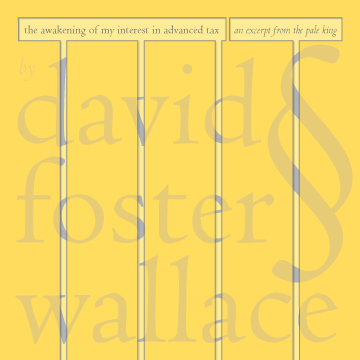
[READ: April 4, 2019] The Awakening of My Interest in Advanced Tax

Madras Press publishes limited-edition short stories and novella-length booklets and distributes the proceeds to a growing list of non-profit organizations chosen by our authors. For this particular book, proceeds to benefit Proceeds to benefit Granada House.

Originally appearing at the heart of The Pale King, David Foster Wallace’s posthumous semi-novel, this extended monologue brilliantly rambles its way around the circumstances that brought its narrator out of his ‘wastoid’ childhood and into maturity at the IRS. Along the way, he falls under the spell of a fake Jesuit, considers the true meaning of a soap opera station break, and narrowly escapes a gruesome death on the subway.

This is the final Madras Press book that I had left to read.  Since I has already read The Pale King, I was in no hurry to read this one.  But now it’s nice to say that I’ve finished all of the Madras Press books.  And that I could post this just in time for the massive Republican tax scam in which thanks to trump and his evil puppet mcconnell, my tax return dropped over $3,000.  Bastards.   May they all rot in prison.  And then hell.

Interestingly, back when I read this during Pale Summer (2014), this entire section was one week’s reading.  So my post from that week is still relevant.    It is posted almost in its entirety below:

This book is an excerpt from The Pale King.  In the book, it is almost 100 pages of one person’s testimony.  Without the novel for context, this excerpt stands on its own just fine.  It is basically an unnamed person’s introduction.  This narrator is so detail oriented that everything gets the same amount of importance–snowfall, the way to score drugs, the effects of drugs, Christian roommates, his father’s death, his mother’s lesibianism, oh and taxation.

So much of it is “irrelevant,” that I hate to get bogged down in details.  So this is a basic outline of ideas until the more “important” pieces of information surface.

For the most part, this is all inside one man’s head as he talks about his life in college, after college, and into the Service.  Mostly this is simply a wonderful character study, full of neuroses and problems that many people face at some point (to one degree or another).  The interviewee states that “A good bit of it I don’t remember… from what I understand, I’m supposed to explain how I arrived at this career.”

Initially he was something of a nihilist, whose response to everything was “whatever.”  A common name for this kind of nihilist at the time was wastoid.  He drifted in and out of several colleges over the years, taking abstract psychology classes.  He says that his drifting was typical of family dramas in the 1970s–son is feckless, mother sticks up for son, father squeezes sons shoes, etc. They lived in Chicago, his father was a cost systems supervisor for the City of Chicago. (more…)

Read Full Post »

[ATTENDED: April 7, 2019] Muse

Three years ago (I can’t believe it was that long), I saw Muse at this very arena.

It was an incredible spectacle.  And I knew that I would see them again if they came back.

And here they were.

The last tour was in support of their Drones album and it was a marvel of technological excess–drones floating all over the place and marvels of wirelessness.

They had said that this album and tour was meant to more humanizing.  But that did not mean less spectacle! (more…)

Read Full Post »

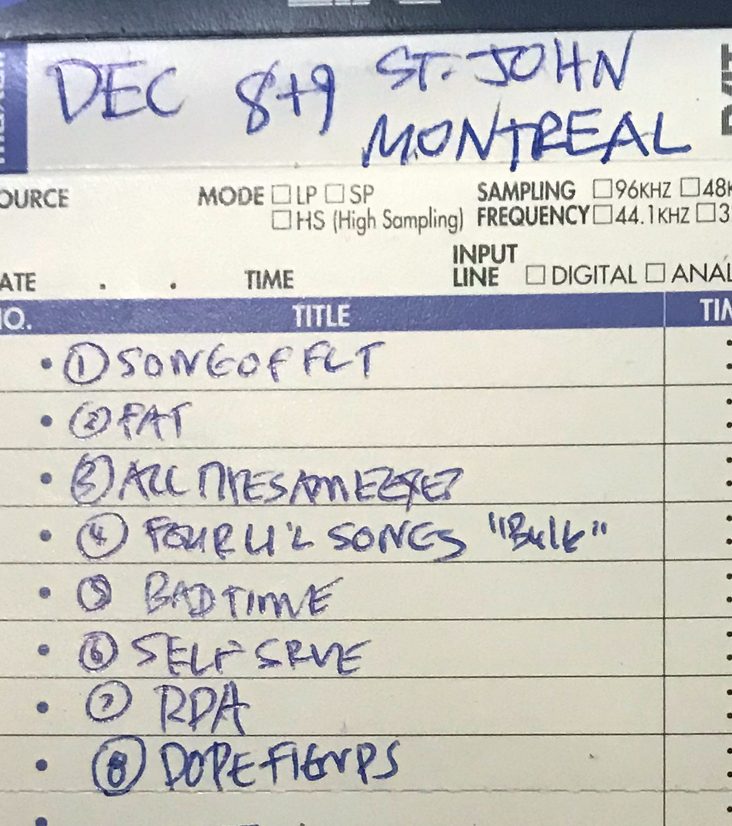
SOUNDTRACK: RHEOSTATICS-Harbour Station, Saint John, NB (December 08, 1996).

This is the 20th night of the 24 date Canadian Tour opening for The Tragically Hip on their Trouble At The Henhouse Tour.

This show opens with a Stompin’ Tom recording of “Bud the Spud.”  Then there’s some tuning up and some cool noises from Martin as they prepare to soar with “Song of Flight.”

They follow it with “Fat” and after the line, “I drank pop, ate Pez, laid down and played dumb” Dave explains, “I wasn’t really sick.”  They whole song is fun and they tack on a melody of “Artenings Made of Gold” at the end.

“All the Same Eyes” rocks a much faster than usual.  At the end, Tim says, “Get well soon, Willow.”  Wonder who that was.

Dave thanks St. John and describes the show as “a little matinee affair.  It’s like going to see a movie on a Sunday.”  He continues, “We’re from Toronto.  Actually we’re from Etobicoke.  We went to Vancouver, all the way to St John and now we’re crossing back.”

A fun “Motorino” is followed by “Four Little Songs” which Dave promises is “Four songs in One.  Honest.”  Tim: “What a deal.”

After the song Dave asks, “What was that last bit of shouting?  For “Record Body Count?”  We see we have some Green Sprouts in the audience.  They’re standing.  See them over there.  What are your names?  Rob is the leader I can tell because I heard his name.”

Instead of “RBC” they play “Bad Time to Be Poor” which segues into a nice “Self Serve Gas Station” in which Martin asks, “What went wrong with Nimrod?”  The ending has Martin playing a lengthy series of notes that just bumps abruptly into a ripping “RDA.”  Tim says “Bye,” at the end of the song but they jump into “Dope Fiends” instead.  Tim’s backing vocals sound particularly excellent during the end part.

After the roaring ending, the rhythm guitar picks out a lovely melody while Martin soars away.   Its a nifty denouement.

[READ: April 29, 2019 Science Comics: Sharks

Joe Flood has drawn many of the Science Comics books and this time he writes and draws it.  This one is all about sharks.  And what I found fascinating about this book is that there’s a bunch I didn’t know about sharks, but there’s not a lot to know about them overall.

The book opens with an introduction from David Shiffman a marine conservation biologist.  Then Flood gets right into it by talking about how the movie Jaws has unfairly harmed the reputation of sharks.  We must never forget that the sharks were here first (for millions of years–their ancestors go back 420 million years) and we are trespassing on their turf.

Like most of these Science Comics, there’s a narrative.  And the “story” of this book is of a stupid ship’s captain in the hunt for a shark.  He;s an ignorant and rather unpleasant guy but our guide is here to set him and us straight,.

We are also helped by out friend Red Snapper who is justifiably afraid of sharks. (more…)

Read Full Post »

SOUNDTRACK: RHEOSTATICS-Scotiabank Centre Halifax NS (December 07, 1996).

This is the 19th night of the 24 date Canadian Tour opening for The Tragically Hip on their Trouble At The Henhouse Tour.

The show starts with Dorothy introducing “Somewhere Over the Rainbow” and then she begins singing the song.  After a verse, the acoustic guitar comes strumming in and Tim announces that “This one’s for Wilf Carter.”  [Wilf Carter, known as Montana Slim in the United States, was a Canadian Country and Western singer, songwriter, guitarist, and yodeller. Widely acknowledged as the father of Canadian country music.  He died on Dec 5].

It sounds great.  the final strains of guitar lead into a beautiful “California Dreamline.”  It’s followed by a “Fan Letter to Michael Jackson” that features a middle “dance” section, with Dave chanting: “Tuesday night at the discotheque, I can dance, what the heck.  I’m an Uzbek.  Wer’e all freakin’ Uzbeks.

The ending feedback segues into the introductory noises of “Motorino.”  Martin says it comes from their new album.  “It’s called The Blue Hysteria its about not having much money.  Dave: “That’s the green hysteria, martin.”  Tim:  “Blue hysteria as about playing your stereo too loud and blowing it up.”  That’s a sort of introduction to “Bad Time to be Poor.”

Dave says “It’s great to be in hockey rink, The Moosehead Dome.  We played in the Devonshire Arena last night, a private affair.  It was hockey though, not rock.  We’re all a little sore, a little better off, a little stronger in character.

Up next is “Sweet Rich Beautiful Mine,” during which Martin drops out of an entire verse–the music sounds great through.  You hear someone asks “want to do it again?”  but they press on and martin platys the noisy guitars that lead into RICH!

Then comes “two big songs back to back,” a ripping “Feed Yourself”  followed by a full 8 minute “A Mid-Winter Night’s Dream.”  It begins with a pretty, meandering guitar melody that Martin songs along to (in a high falsetto, la la l a)–its  quite lovely.  Then it segues into a roaring version of “Midwinter.”  The band sounds great and the feedbacking noise martin generates before the end is just amazing.

This might be my favorite version of the song.  It’s a show-stopper indeed.

[READ: March 20, 2019] Science Comics: Robots and Drones

I have enjoyed every Science Comic that has come out.  Most of them seem almost too full of information.  But this one was actually one of the less jam-packed books.  And that was kind of nice.

After an introduction from Sabine Hauert, the co-founder of Robohub.org, we are taken to a prototype robot from 350 BCE (!).  In Tarentum Italy, we see a “mechanical” bird created by Archytas.  It flies (perhaps on a string) and crashes instantly.   The bird snaps out of it and introduces himself –call him Pouli.  Pouli was the first machine to ever fly and he will take us through the past and future of robots and drones.

Pouli tries to break our familiarity with what a robot is by showing a simple robot–the coffeemaker.  It has as simple job.  It’s a modern version of the automaton.  Of course we have more sophisticated R/C cars and roombas now.  Some day soon there will be self-driving cars. (more…)

Read Full Post »

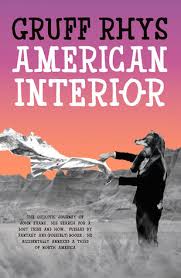
SOUNDTRACK: GRUFF RHYS–American Interior (2013).

Gruff Rhys was (is?) the singer and composer in Super Furry Animals, a fantastic indie-pop band from Wales.   After several years with SFA and several solo albums, Gruff decided to do something a little different.  Actually, everything he does is a little different, as this quote from The Guardian explains:

“The touring musician can feel like the puppet of consumer forces,” he writes, bemoaning the way that “cities have now been renamed ‘markets’ and entire countries downgraded to ‘territories'”. So, over the last five or so years, he has come up with the idea of “investigative touring”: combining the standard one-show-a‑night ritual with creative fieldwork. In 2009, he went to Patagonia to trace the roots of a disgraced relative called Dafydd Jones, and the Welsh diaspora in South America more generally, and played a series of solo concerts, as well as making a film titled Separado!. Now, Rhys has reprised the same approach to tell another story, and poured the results into four creations: an album, another film, an ambitious app, and this book – all titled American Interior, and based on the brief life of John Evans: another far-flung relative of the singer, who left Wales to travel to North America in the early 1790s.

So yes, there’s a film and a book and this CD.  This album is a delightful blend of acoustic and electronic pop and folk.  Rhys’ voice is wonderfully subdued and with his Welsh accent coming in from time to time, it makes everything he sings somehow feel warm and safe (even when it’s not).   Rhys creates songs that sound like they came from the 1970s (but better), but he also explores all kinds of sonic textures–folk songs, rocking songs, dancing song, even songs in Welsh.

“American Exterior” is a 30 second intro with 8-bit sounds and the repeated “American Interior” until the piano and drum-based (from Kliph Scurlock) “American Interior” begins.  It’s a catchy song with the repeated (and harmonized) titular refrain after each line and it’s a great introduction to the vibe of the record.  It’s followed by the super catchy stomping “100 Unread Messages” which just rocks along with a great chorus.  You can see Gruff “composing” the lyrics to this in the book.

“The Whether (Or Not)” introduces some electronic elements to this song.  It’s basically a great pop song with splashes of keys and some cool stabs of acoustic guitar.  “The Last Conquistador” and “The Lost Tribes” are gentler synthy songs, as many of these are.  “Liberty (Is Where We’ll Be)” returns to the acoustic sound with some really beautiful piano.

“Allweddellau Allweddol” (English translation: Key Keyboards) is the only all-Welsh song on the record and it romps and stomps and is as much fun as that title suggests it would be.  There’s even a children’s choir singing on it (maybe?).

“The Swamp” is a simple electronics and drumming pattern which leaps right into “Iolo” one of the most fun songs on the record.  It’s a nod to the Welsh poet who inspired but backed out of Evans’ expedition at the last-minute but also a rollicking good time with the chanted “yoloyoloyoloyolo” and great tribal drums from Kliph.

The end of the album slows things down with “Walk Into the Wilderness” a slow aching ballad and the final two animal-related songs.  “Year of the Dog” is kind of a mellow opus when it is joined by the instrumental coda “Tiger’s Tale.”  Both songs feature goregous pedal steel guitar from Maggie Bjorklund.

Gruff Rhys is an amazing songwriter.  He could write the history of an obscure Welshman and still get great catchy songs out of it.  And that’s exactly what he’s done here.

[READ: December 2018] American Interior

How to explain this book?

I’ll start by saying that I loved it.  I was delighted by Rhys’ experiences and, by the end, I was genuinely disappointed to read that Evans’ trip didn’t pan out (even though I knew it didn’t).  The only compliant I have about the book is that I wish he had given a pronunciation guide for all of the welsh words in there, because I can’t even imagine how you say things like Ieuan Ab Ifan or Gwredog Uchaf or Dafydd Ddu Eryri (which is helpfully translated as Black David of Snowdonia, but not given a pronunciation guide).  But what about the contents?

The subtitle gives a pretty good explanation but barely covers the half of it.

Here’s a summary from The Guardian to whet one’s appetite for Rhys himself and for what he’s on about here:

[John] Evans was a farmhand and weaver from Waunfawr on the edge of Snowdonia, who was in pursuit of something fantastical: a supposed tribe of Welsh-speaking Native Americans said to live at the top of the Missouri river, who were reckoned to owe their existence to the mythical Prince Madog, a native of Gwynedd who folklore claimed had successfully sailed to the New World in 1170. In 1580, this story was hyped up by Elizabeth I’s court mathematician and occultist John Dee (born of Welsh parents), in an attempt to contest the Spanish claim to American territory. Two centuries later, with the opening of new frontiers, talk of a tribe called the Madogwys and “forts deemed to be of Welsh origin” began to swirl anew around Wales and North America, and became tangled up in the revolutionary fervour of the time, along with a radical Welsh spirit partly founded in nonconformist Christianity.

All this was moulded into a proposal made by a self-styled druid named Iolo Morganwg (“a genius”, but “also a fraud of the highest order”, says Rhys), who “called for the Americans, in the light of Madog’s legacy, to present the Welsh with their own tract of land in the new country of the free, so that the Welsh could leave their condemned royalist homeland”. Morganwg stayed put in Cowbridge, near Cardiff (the site of his “radical grocery” shop is now occupied by a branch of Costa Coffee), but Evans was inspired by his visions, and eventually set sail.

Rhys goes on a “journey of verification”, following Evans’s route from Baltimore, through such cities as Pittsburgh and Cincinnati, and then up the Missouri river to the ancestral home of the Mandan tribe of Native Americans, who had been rumoured to be the Welsh-speakers of myth, and among whom Evans lived, in territory argued over by the British and Spanish. Along the way, he does solo performances built around music and a PowerPoint-assisted talk about Evans’s story, keeps appointments with historians, and also tries to glimpse the America that Evans found through the cracks in a landscape of diners, what some people call “campgrounds”, and Native American reservations.

The Guardian’s review also talks about why the book works: (more…)

Read Full Post »

SOUNDTRACK: RHEOSTATICS-Marine Midland Arena, Buffalo, NY (November 26, 1996).

This is the 13th night of the 24 date Canadian Tour opening for The Tragically Hip on their Trouble At The Henhouse Tour.

It’s also only the second Rheostatics show recorded in the United States on the Rheostatics Live website.  There was an earlier recording of this show which was not a soundboard show.  My complaints about the show were mostly about the audience.  And you can’t hear them on this.  The recording is much clearer too.

They opened the show to “Ding Dong the Witch is Dead” from the Wizard of Oz.   There’s no graceful segue into the music, Martin just starts playing “A Midwinter Night’s Dream.”  It sounds perfect.  Everyone is tight and right with the sounds and Martin hits those high note perfectly.  It’s an amazing and bold introduction to the band if you didn’t know them.

“Fat” is next.  It’s more conventional, but there’s some really amazing guitar work from Martin.  And the band is really into it by the end.  It sounds fantastic.  “All the Same Eyes” is up next and it sounds rocking and fluid.

Tim introduces the band in this way:
We’re the Rheostatics from Toronto, Canada.

Then Dave says:
We’re B.T.O. from Red Deer, Alberta.
We’re The Spoons from Burlington, Ontario.
We are every Canadian band that ever was and some that haven’t even been born yet.

The play “Motorino” which is dedicated to Brad May, the Buffalo Sabres player.  It’s a bit chaotic, and Martin sounds a bit unhinged, but I love that he speak/sings in Italian.

Tamara Williamson joins them for “Sweet Rich Beautiful Mine.”  She and Martin sound great together.  I love that she gets a few solo moments.  And when they both hit those incredibly high notes–she goes even higher than him–goosebumps!  Martin breathes very heavily into the mic after the song–it’s so hard to tell if he’s having fun or is really going mental.

Don says “So far all of these songs have been from our brand new record.  And this next one is too.  And I think the only place it’s available in the States is right here in the lobby.”

They play a great “Bad Time to Be Poor” which Dave dedicates to “Chrissy?” “for playing our record.”  I feel like Tim emphasizes the “don’t give a shit no more” line.  He sings the whole song very clearly, which is nice.  Then they move on to a great “Self-Serve Gas Station” with excellent backing vocals from Tim.

Dave says “To all those people in the cheap seats, we can hear your cheers.  We appreciate them.”

The roaring ending segues into the quiet opening of the final song “Fan Letter to Michael Jackson.”  Instead of shouting “Michael” the first time around, Dave shouts “Triumph!”

During the verse, Dave says, “I see two angels with funny lights on their heads in the 11th row.  It’s like some kind of dream or something.”

Martin plays some fun wild soloing including a bit of “Sweet Child of Mine.”  There’s some wildness by the end with them all singing parts and martin soloing but they tack on a quieter ending, with martin noodling about and Dave whispering “big white buffalo”  Tim and martin end it with several falsetto “It feels good to be alive”.

As they leave, they thank The Tragically Hip, the best guys in the land.

[READ: March 23, 2019] “Childhood”

Mark is bringing his son Reuben to a doctor’s appointment.  They stopped at an Indian restaurant which caps off a pretty amazing trip so far since there was so much usual in their routine.  Riding a bus, strange smells.  A year earlier he wouldn’t have set foot in such a strange restaurant.   He was eight now and seemed to be doing better.

He could now read proficiently in English and French and seemed to remember the lyric to every song he heard.  He even got invited to friend’s houses.

Although group dynamics were still awkward.  There were also fits of temper and absent-mindedness.  And general spaciness.  But was all this normal?  What was the margin of error?

School wasn’t always a help–“report cards were composed in a language that bore only a faint resemblance to English.  Parent-teacher conferences had thepolite, anxious feel of second dates.”

Mark wonders about his only childhood, did he have any really distinct memories before he was turned eight?  Or twelve?  Everything felt like a brown haze.

So he and his wife put off the appointment until “it felt too irresponsible an cowardly not to.  And then they put it off some more” (more…)

Read Full Post »

[ATTENDED: March 23, 2019] Guster [rescheduled from January 17]

Back in January, Guster postponed their Philadelphia concert because they were going to be on Late Night with Seth Myers.  They rescheduled it for mid-March and decided that it would be a 20th Anniversary celebration of their 1999 album Lost and Gone Forever.  So although the date change sucked at the time, the new show promised to be freakin amazing.

And, as it turned out, this was the best and the worst Guster concert that S. and I have seen together (number 7 for both of us).

Why the worst?  The worst because we arrived later than we intended and wound up further back than we wanted to.  Which is not the end of the world.  But, when you’re in the back in the Fillmore, you are near the bar and all the people talking.  A lot.  Even people who claimed to love the band, even people who commented on how good they sounded (they did), even people who would sing along loudly to parts of songs, all of these people also talked through huge swaths of the show.

One woman shouted to her friends during a quiet part and I had to say something.  It was really dreadful.  I though that during the intermission, people would pile out to get drinks and we could move closer, but nope, it was jam packed.

So aside from the worst crowd I’ve ever experienced, the show was great.  The band was in amazing form, they sounded great–and the venue helped them to sound great.  It was definitely one of the best sounding shows I’ve seen from them. (more…)

Read Full Post »

SOUNDTRACK: FRAGILE ROCK-“Smile More” Tiny Desk Family Hour (March 12, 2019).

These next two shows were recorded at NPR’s SXSW Showcase.

The SXSW Music Festival is pleased to announce the first-ever Tiny Desk Family Hour showcase, an evening of music by artists who have played NPR Music’s Tiny Desk Concert, at Central Presbyterian Church on Tuesday, March 12 from 8-11pm.

It’s hard to talk seriously about Fragile Rock since they are a band of puppets.  Literally.

To say that Fragile Rock sent the evening hurtling sideways would be an understatement, as the band unleashed a torrent of faux-grim hilarity and chaos when it wasn’t urging the audience to shout out its prescribed antidepressants or berating fans for grinning along. (“We don’t appreciate your smiles,” seethed Brently Heilbron, in the persona of wounded frontpuppet Milo S. “You wouldn’t do that to Conor Oberst.”

And yet they are a good punk band and their lyrics have become even more pointed.  Especially this one.  They explain:

This is a song that Nick and I wrote reflecting on the #metoo and #timesup movements (that’s right lady in the back snapping your fingers you are correct).

This is a great punk blast and frankly it’s nice to hear a song sung by the female vocalists instead of the Fred Schneider-sounding male lead singer.

For “Smile More,” the spotlight shifted to Emily Cawood (performing as Briex Cocteau) and Megan Thornton (aka Nic Hole), who spent two minutes savaging the patriarchy. “Don’t tell me to smile more, don’t tell me what my mouth is for, from a man who started every war,” Thornton and her puppet shouted in unison. And, see, here’s the secret to Fragile Rock’s raucous, ridiculous charm: Subtract the puppets, the stage antics and the silliness of all, and you’re still left with some pretty damned good songs.

And nice succinct lyrics:

You could have had it all
You blew it didn’t you
I’m gonna watch you fall and
Never ever pity you
You’re purposeless
Your license is expired
Your services are no longer required

Your time has come and gone….time’s up!

All in two minutes.

[READ: March 14, 2019] Florida

When I started reading this book, I instantly remembered reading “Ghosts and Empties” in the New Yorker.  I assumed and was pleased that this was a full novel built out of that story.  Why?  Because nowhere on this book does it say that these are short stories.   Not on the cover, not on the front page, nor the back page.  It’s somewhere on the fly leaf, but since Groff also writes novels, it’s a bit of an oddity to not say “stories” somewhere on it.  I looked at the Table of Contents, obviously, but just assumed those where chapter headings.

I was exited to read the fuller story of the woman who walks at night.  And then I found out that the next “chapter” was a new story.  It turned out to be a fantastic story.  So that’s all good.  I don’t mind reading short stories at all, it was just a surprise.

It also turned out that I have read five of these short stores before (she is often printed in the New Yorker–the other stories were in different journals which I put in brackets after each title).

“Ghosts and Empties” (New Yorker, July 20, 2015)
I see now that I didn’t really enjoy this story the first time I read it (and yet it stayed with me all these years).  But I did enjoy it more this time (I still find it unsatisfying that the opening parental freakout part is never really addressed).  But basically this is a story in which woman walks around her neighborhood every night and observes things changing–for better or worse.  Old nuns dying, new houses being built, neighbors changing.  All in the heat of Florida. (more…)

Read Full Post »

« Newer Posts - Older Posts »