[ATTENDED: September 30, 2023] All Things Go [Day 1]
Sometime in April, my daughter asked if we could go to the All Things Go Festival. I had never heard of this Festival and assumed the answer was no. But then I saw that it was at the Merriweather Post Pavilion which is exactly three hours away from us. So when tickets went on sale, I managed to get two pre-sale tickets for Sunday. And then when they went on proper sale, I managed to score two more for Saturday.
If I had managed to get tickets to see boygenius at the Mann Center, we would have blown off this day, but that didn’t happen, so we hunkered down for our first Festival day (and her first Festival).
I was excited for the Festival too, as there were a bunch of bands that I wanted to see. But this was a Festival for her, so I told her, that I wanted to arrive in time to see Sudan Archives and then the rest of the day was up to her. I wanted to see Maggie Rogers and a few other bands during the day, but I’d go where she wanted.
I’ll write a separate post for each band we saw.
The Festival was set up very nicely with the Chrysalis Stage within easy walking distance from the main stage (and from the food and merch). And there was free parking.
We arrived and, even though we had VIP entrance passes, we waited on line, not quite realizing how it worked. Well, they sent us back to get our wristbands which allowed us quick entrance (very useful on Sunday). These wrist bands also go us a swag bag full of weird goodies.
The rest was a Festival. The food was overpriced, the bathrooms were inadequate, the water lines were really long. At least it was September and not July. The first day worked out great weather-wise as it was overcast and a little cooler.
I felt a little bad because we didn’t stop for lunch on the way down (tight schedule), so I made my daughter wait in line for food so I could see Sudan Archives. I told her, that it was the last time that I’d make her do anything like this, and she was cool with it.
I enjoyed Sudan Archives in the sun, she sat in the shade and enjoyed the video screens. (more…)
[DID NOT ATTEND: July 29, 2023] ALT 104.5 Fishtown FestivALT Block Party
I received a notification that Portugal. The Man were going to be playing at The Fillmore. They are a band who are high on my “wanna see” list. So I grabbed a ticket even though I had a ticket for another show that night.
Then I learned a short time later that the Portugal. The Man show was part of this ALT 104.5 Fishtown FestivALT Block Party. It’s an all-day affair in three locations. Much of it is free, although the Portugal. show is not. Well, then it turned out that we were picking up my daughter from camp that day–so that knocked out going into town early. And then we got invited to a farewell party for a friend who was leaving the area. So there went the evening show. I tried to resell my tickets but I guess Portugal. The Man is not on the top of everyone’s “must see” list.
As for the free bands, it’s amazing how much TikTok is making new bands into favorites.
[DID NOT ATTEND: July 31-August 2, 2020] Newport Folk Festival
We went to Newport Folk Festival in 2019. We’ve had a kind of understanding that we would try to go again. So this year, when tickets were announced I jumped online and managed to score four of them!
Then it turned out that the weekend would be massive conflict.
So, after seeing just who would be there, we felt that the whole fest was kind of a big shrug. And it would be no loss to sell the tickets back. Fortunately, Newport has a great system where you just put the tickets back in the pool and who ever is next gets them. (more…)
[DID NOT ATTEND: December 17-18, 2022] Champagne Jam 2022
Every year for quite some time, The Front Bottoms have been doing a Champagne Jam at the close of the calendar year. Brooklyn Vegan talked about in 2019:
The Front Bottoms‘ annual holiday concert Champagne Jam has taken place in NYC and NJ in the past, and this year it moves to Philadelphia. It happens December 21 (the Saturday before Christmas) at The Fillmore Philly Complex.
2022 saw them return to Philly, which has three venues all more or less connected. I don’t know how the set times are structured–if there’s any way to see everyone (probably not). But then again, I dind;t want to see everyone.
I bought my son and I tickets to the Saturday December 17 show figuring it was one last opportunity to see The Front Bottoms (since we kept missing them for one reason or another). Then we wound up scheduling our own holiday jam for the same night.
So we weren’t going to go to the Friday night show anyhow, but here’s the full lineup:
Friday, December 16, 2022 in the Lobby
DJ Spicy Brown
Friday, December 16 2022 at The Foundry
Flycatcher are from New Brunswick, NJ According to The Deli
Flycatcher are a four-piece rock combo hailing from New Brunswick, New Jersey, three of whom have immaculately sculpted facial hair (well ok one of them has a bushy beard but still it’s neatly trimmed and shaped). On the musical side of things Flycatcher carry on in the fine tradition of immaculately sculpted extremely catchy power-pop-that-rocks made in the Tristate Area with oft-witty lyrics and a distinctly que será, será attitude as established by such legendary acts as Fountains of Wayne, The Feelies, The Smithereens, and the ripe-for-revival Cucumbers.
They sound like they are worth checking out–the one song I’ve listened to is pretty slackery.
Sweet Pill is an emo band from New Jersey. The band consists of vocalist Zayna Youssef, guitarist Jayce Williams, guitarist Sean McCall, bassist Ryan Cullen, and drummer Chris Kearney. The video I watched for High Hopes was super catchy (and set in a bowling alley).
Another Michael is a band who have opened for a bunch of shows I haven’t gone to. They play a kind of mellow indie rock with lead Michael’s vocals veering into R&B styles. Not quite my thing. But that’s only one dud in a bill I didn’t even think about going to.
Slothrust are from Boston. In a review from The Revue (in Canada) from 2021, they talk about an evolving band:
In the 8 years we’ve been covering Slothrust, we’ve seen the band change a lot musically. They’ve shifted from the early days of jazz-infused grunge, which eventually grew into much bigger and less easy to classify sounds. Each record feels like a rebirth, from Everyone Else having a fine polish on that distinctive Slothrust sound but expanding on it at the same time. The Pact felt like an even more diverse records, with the band diving more into electronic sounds and even diving into poppier sounds. It set up any future releases nicely to dive even more into the trio’s widening approach. Their latest record, Parallel Timeline, heralds yet another rebirth of the band. “Cranium” kicks off the record and immediately sets the tone. This is a slower Slothrust, as the chugging basslines and heavy drums are nowhere to be found. All the things that make Leah Wellbaum stand out as an artist, however, are on full display. Her voice, her surreal lyrics, and, at about halfway through the song, her guitar work. “Once More For The Ocean” hits a bit harder, kicking of with a ripping guitar solo, but it stays a bit in that pop realm with a bunch of sections that just beg to be sung along with.
Sounds like a really good night and some bands I should be on the look out for.
Friday, December 16, 2022 at Fillmore Philadelphia
Lunar Vacation I saw Lunar Vacation open for The Beths and they were great. I’d happily see them again.
Emperor X is from Louisville, Kentucky (and presumably not the Emperor X from Berlin). He plays a kind of low-fi pop that I see is described as a “bummer jam” which is absolutely not my thing.
Joyce Manor is a punk band from California who I always think are someone else. Their latest album 40 oz to Fresno was described by The New York Times (!!!) as “relentlessly tuneful 17-minute collection of all-killer, no-filler power-pop.” I rather like their clean punk sound.
The Front Bottoms are the stars of the night and the main attraction. They were, no doubt fantastic, and I love that they give a lot of other New Jersey bands a platform.
Saturday, December 17, 2022 at Brooklyn Bowl
Shannen Moser I’ve seen Shannen Moser twice. Her intense folk songs are quite good
Shane Henderson was the singer of Valencia and now does mostly production.
Tom May has “lived the dream” of being a full time, working, self-supporting folk musician. Tom is also the founder and host of the nationally-syndicated live radio program, River City Folk.
Kevin Devine is someone I love and I was really looking forward to seeing his set–and hoping that it didn’t conflict with any of the other headliners.
Saturday, December 17, 2022 at The Foundry
Riverby are from Philly. They are a fun indie rock band with a loose sound (and a cover of “Walk Through the Fire” from Buffy the Vampire Slayer.
Hotline TNT is the shoegaze/indie rock project of singer-songwriter Will Anderson (a.k.a. Flip Sandy). The project began after Anderson moved from Vancouver to Minneapolis. Now based in New York, Anderson still handles the songwriting himself and has played live shows with several different lineups.
Kid Sister is a rapper who has appeared with Sault.
Saturday, December 17, 2022 at Fillmore Philadelphia
Prince Daddy & The Hyena is an American rock band from Albany, New York, formed in 2014 described as indie rock with punk and “slacker” influences
Soul Glo is a band I really want to see. They are an extreme punk band and will probably scare the heck out of me. It would have been safest to see them amid all of these other bands
Titus Andronicus is a band I should probably love, but I just can’t get into them.
The Front Bottoms headlining a second night.
This seems like a really fun festival.
Jordan Norris nicely posted a video of The Front Bottoms from both shows
Friday night:
Saturday night
Also
Also, The Flycatcher review had these two videos (because of a song called sodas in the freezer)
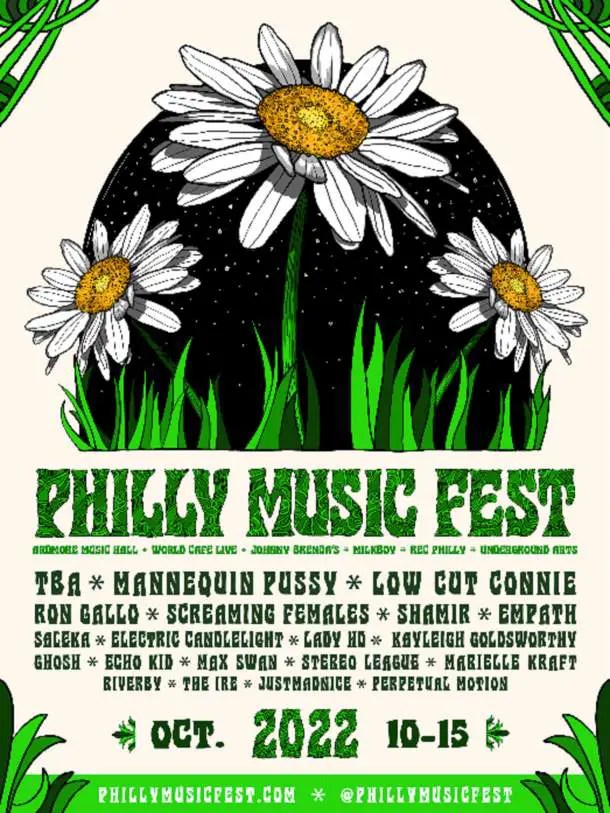
[DID NOT ATTEND: October 10-15, 2022] Philly Music Fest 2022
Every year since 2019 I have participated in Philly Music Fest in some way. But this year I wound up giving the whole thing a miss.
Philly Music Fest is a non-profit endeavor focused exclusively on local bands, with all proceeds donated to local music education charities. Philly Music Fest features both established and up and coming artists, showcasing the diversity of the Philadelphia music scene.
It wasn’t because of a bad lineup or anything, it was that I had tickets to other shows every night. I wound up not going to all of those shows anyway, but basically I was already booked for the whole Fest.
This year’s line up was even bigger than last year’s
October 10, 2022 at Ardmore Music Hall
Marielle Kraft is a poignant indie pop singer-songwriter
Electric Candlelight is a heavy psychedelic band that I was supposed to see open for Fuzz
Mt. Joy is a band I’ve heard on the radio a bunch who I don’t particularly like, so not so great in the headliner here.
October 11, 2022 at Ardmore Music Hall
Stereo League is apparently impossible to describe using concrete words as I can’t figure out what their music sounds like from the blurbs I’ve read.
Salika is an R&B singer
Mt. Joy of the two nights I wouldn’t have picked this one anyhow.
October 12, 2022 at World Cafe Live
Perpetual Motion is described as dynamic acoustic jazz who play blues, rock, jazz, and world music
Kayleigh Goldsworthy is a folk singer who I saw open for Frank Turner. She was great.
Ron Gallo is not Vincent Gallo, which is what I think every time I see his name. Ron is an indie guy who I’ve never heard but who must be pretty popular or interesting if he keeps popping up.
Lady HD is a kind of psychedelic pop band whose name reminds me too much of that Lady A fracas that bubbled up a few years ago.
Low Cut Connie is one of the bigger bands at the festival. I’d never want to see them, but I like some of their songs.
October 13, 2022 at Johnny Brenda’s
This was the night I would have gone to
The Ire is a four-piece goth-tinged post-punk band. I like their overall sound.
Ghosh is a band I’ve wanted to see: they’re pissed off, informed, and ready to party.
Screaming Females are terrific and even better live. I thought this would sell out in a second.
October 14, 2022 at REC Philly
This was a free show. A night of hip hop and beat curated by Working on Dying who I’ve never heard of of
October 14, 2022 at The Dolphin
The Dolphin is a new-ish venue that I’ve yet to check out.
Max Swan is saxophonist, vocalist, and producer influenced y likes of Stevie Wonder, James Blake.
Echo Kid is two guys from RFA. This is a hazier, no-holds-barred, psychedelic reimagining of the way they’d approach their songwriting process with a languorous sense of ease, effortless genre-blending, and an amalgam of intentional recorded conversation
Shamir is an artist I’d like to see live. They keep popping up as an opening act and then something happens and I don’t see them. Here’s another miss.
October 15, 2022 at Underground Arts
This would have been my pick for show of the Fest, if I hadn’t already been overbooked.
Justmadnice is blues-dipped psychedelic jazz.
Riverby are a fun indie rock band with a loose sound (and a cover of “Walk Through the Fire” from Buffy the Vampire Slayer.
Empath is a band I was supposed to see open for Fucked Up but the couldn’t make the rescheduled date. They are kind of noisy and poppy and punky and are probably very fun live.
Mannequin Pussy is one of my favorite new(ish) bands. They are amazing live and are always worth seeing.
[DID NOT ATTEND: September 24, 2022] Frantic City 2022
When I saw this show listed, I knew that it would be a fun opportunity for my son and I to go to a Festival. Only one day, kinda far but not too far, and headlined by his favorite band Car Seat Headrest.
The whole lineup was pretty exciting, in fact,
Car Seat Headrest
Yo La Tengo
Snail Mail
Titus Andronicus
Superchunk
Rocket from the Crypt
Protomartyr
Murder City Devils
Shannon and the Clams
The Raveonettes
Samiam
Control Top
And Fred Armisen will serve as host, so you can expect his specific brand of musical comedy to move the acts along.
I wasn’t sure what time we were going to arrive. I wanted to see Control Top, who it looked like would go on first, then I was kind of okay with not seeing some of the other bands.
I feel like I should know Samiam, but I don’t exactly. I feel like I don’t like The Raveonettes. I didn’t really want to see Shannon and the Clams. I don’t know Murder City Devils. I have seen Protomartyr, and would have been happy to see them again. I liked the first Rocket from the Crypt album, but haven’t thought of them in years. I have seen Superchunk twice in the last few years and don’t need to see them again, although they are great. I have not see Titus Andronicus who I don’t love, but who I understand are amazing live.
I do want to see Snail Mail (who I was supposed to see in April, but didn’t). I have liked Yo La Tengo for years and have never seen them. And then there was Car Seat Headrest, whom we had both seen in April.
Then on September 17, Car Seat Headrest pulled out of the Festival because of Will Toledo’s health.
I probably should have turned in the tickets right then, but I didn’t want the Festival to crumble from people returning their tickets–I do hope it comes back next year.
But that really put the kibosh on my son’s desire to see the festival.
On the day of, he said he really didn’t want to go and honestly that was fine by me.
[DID NOT ATTEND: September 16-22, 2022] Xponential Music Festival
We went to this festival with the family back in 2016. It was really hot. The kids were in the in-between age where they didn’t really like the music but were too old to just enjoy being outside.
But we saw some really good bands.
It has felt like since then, the bands haven’t been all that interesting. Although I do like that it’s in September and not July.
These headliners were not interesting to me at all. We had seen The War on Drugs and it was a great show, but I didn’t need to see them again. And the rest just weren’t very interesting to me.
In fact, usually the headliners are kind of irrelevant because the fun is in the side stages.
There were certainly a few performers I would have enjoyed seeing. But most of them we have seen fairy recently.
The only band I haven’t seen who I’d like to is Catbite and maybe Sarah Shook & The Disarmers. But neither one was worth going to a festival for.
I saw The Menzingers open for Weezer back in 2016 and really enjoyed them. I’d been wanting to see them again mostly because I was really far from the band when I saw them and couldn’t really get into it the way I might have liked.
So when they were listed as headlining two nights of Philly Music Fest I knew I had to see them. Especially in a small place like Ardmore Music Hall.
I have only been to Ardmore a couple of times. My favorite show there was Marco Benevento where the sound was outstanding. Even right up against the stage. Well, for this show I was right up against the stage (although as more and more people crowded into the place, I moved away from the band’s more devoted (and a little crazy) fans. But apparently I never got far back enough because literally all I could hear the whole show was Tom May’s guitar. And May tends to play lead licks and solos, so I never really got the backing chords of Greg Barnett unless May wasn’t playing anything (which happened from time to time).
Obviously it was more fun being able to see bassist Eric Keen and drummer Joe Godino (who I couldn’t see at all last time), but it was weird having the sound so disjointed. Throughout the set I tries moving further and further away from the stage, but I was never able to get further to the middle. (more…)
Philly Music Fest started in 2017. I went to a show in 2019–a great line up! Last year was online only, but this year it was back. The lineup was different and wonderful. And, thankfully, the two bands I wanted to see most were on the same bill.
I hadn’t heard of highnoon. Artist Kennedy Freeman launched Highnoon in 2019. Now Highnoon is led by Kennedy Freeman with longtime collaborator, Justin Roth on drums, Brendan Simpson on guitar, and Nathan Avila on bass.
I listened to their music and found it pretty and quiet. Their new EP, Divers is their first body of work since their debut record, Semi Sweet.
I wasn’t expecting a pretty rocking set from this seemingly quiet foursome. Actually, singer Freeman maintained a pretty quiet level throughout, but she was counterbalanced by some pretty wild guitar shredding from Simpson. I took some really cool videos of Simpson’s playing, but at this time, Instagram decided that it would no longer allow me to move my video up or down to get the main part of the video into focus. (more…)
I’ve enjoyed Kathleen Edwards’ music for years. Her album Voyageur is just stunning.
But when that album came out back in 2012, I wasn’t really going to many shows. It wasn’t until a few years later that I got the concert bug again and put Kathleen on my “gotta see” list.
But Kathleen had other ideas. After Voyageur, she took a break from music. In 2014, she launched a coffee house in Stittsville, Ottawa called Quitters. And it seemed like she might never play again (even though she said she would). So I left her on my “maybe, someday” list.
Then in 2019, she played the WXPNFest (the same weekend that we were going to the Newport Folk Festival–I was a wee bit surprised she didn’t play Newport too). I kind of assumed that it was a one-off return and that would be that.
But an album soon followed. And then earlier this year it was announced that she was playing The Met Philly. But as an opening act for Jason Isbell, who I did not want to see. [It’s one thing going to a show for the opening act, but it’s another if you don’t actually like the headline]. So, again, I was out of luck.
But then she announced a show in New York City at Le Poisson Rouge. And even though LPR is hugely inconvenient for me and it cost extra in tolls and parking, I’m so glad I went to the LPR show rather than the other two. If for no other reason than the other two shows were all of 9 songs while this one was 16. And the LPR crowd were there to see her! And they sang along, and she was pretty tickled with us all. (more…)
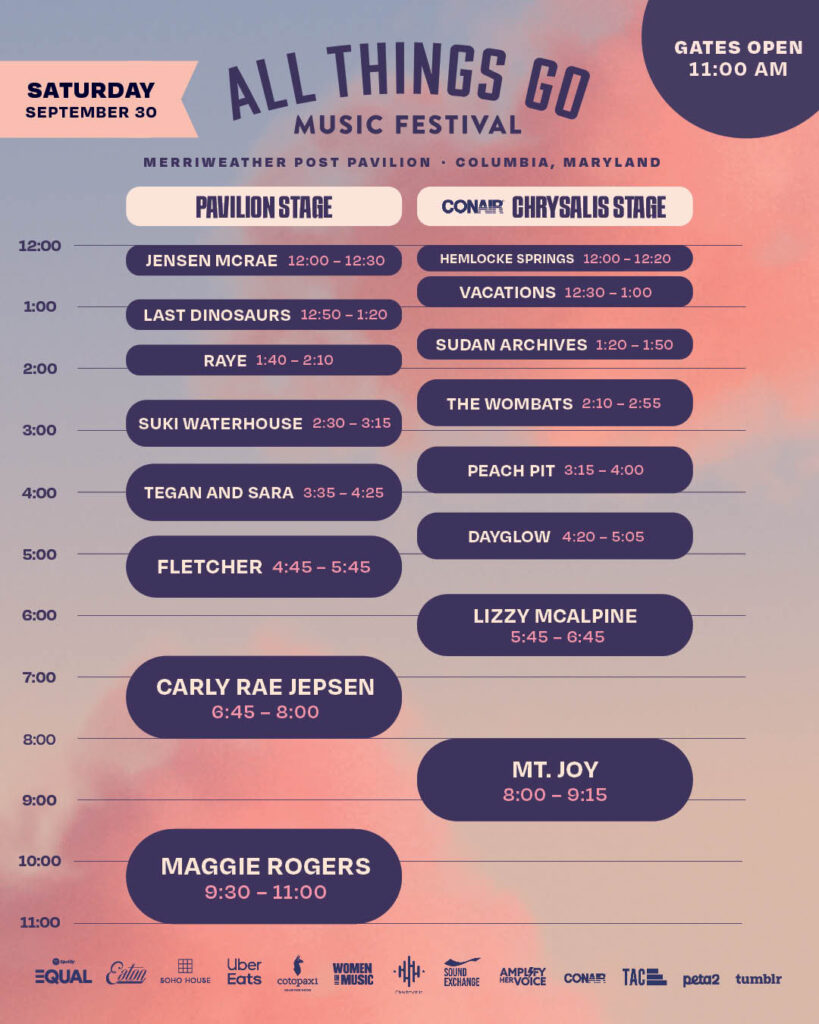 Sometime in April, my daughter asked if we could go to the All Things Go Festival. I had never heard of this Festival and assumed the answer was no. But then I saw that it was at the Merriweather Post Pavilion which is exactly three hours away from us. So when tickets went on sale, I managed to get two pre-sale tickets for Sunday. And then when they went on proper sale, I managed to score two more for Saturday.






 I Just Read About That...