Feeds:
Posts
Comments

Archive for the ‘Fears’ Category

[LISTENED TO: August 2017] The Trouble with Twins

I grabbed this book because it seemed kind of interesting.  I see also that this book was released in the UK as Missing Arabella, which I think is a slightly better title).  I wasn’t entirely sure if we’d like it.  I mean, we don’t have twins and this is about twins and I wasn’t sure that our 12-year-old boy would like a book about twin girls.

But holy cow was this book outstanding!  It was utterly hilarious and the way it was read aloud was genius.

The book begins with this wonderful setup:

And so it begins in front of the fire, the story of two twin sisters.  One remains with her family in their lovely country house, where yellow roses perfume the air.  The other waits for her in another house, where she stands alone at huge arched windows.  She is restless, pacing wooden floors that creak in the night when a cat jumps down from the bed to chase at shadows.

And then in different typeface:

“What are their names?” the girls asks.  “The sisters.”
“Arabella and Henrietta.”
“Are they lonely,” asks the girl.
“They belong together,” says the mother.  “And it makes them sad to be apart.”
“Can’t you tell a happy story?” the girl asks.
“With puppies and a garden?”
“Yes!” says the girl.
“I’m only telling it the way my mother told it to me,” the mother says.
“And will there be puppies?” the girls persists.  “Or only gloomy girls at windows?”

(more…)

Read Full Post »

SOUNDTRACK: TASH SULTANA-Tiny Desk Concert #610 (April 7, 2017).

Tash Sultana is a force of nature.  I’d heard her song “Jungle” a bunch of times on the radio before seeing this.  I thought it was interesting and kind of catchy with some cool guitar work.  But it never occurred to me that Sultana was doing the whole thing BY HERSELF!

For this Tiny Desk, she recreates that song (and two others) entirely by herself with loops and loops and effects and all kinds of good stuff.

As “Jungle” opens, Tash plays the guitar chords and loops them.  And then she plays the opening riff.  And loops it.  And then more riffs on top and loops them.  She creates a huge sound for about a minute and a half.  Then when all that sounds good, she starts playing the drum machine.

It’s so much fum watching her dance around her little area (barefoot, mind you) tapping pedals and setting effects on and off.  And when she starts soloing, she’s got a perpetually big smile on her face just really enjoying all of the work she;s doing and the sounds she’s making.

She finally starts singing and she’s got two microphones–the chorus gets the second microphone which has a processor and echo to totally change her sounds.

And then towards the end of the song she starts messing around with a solo and has all kinds of effects at hand for whichever part of the solo she’s doing, including a wild, ass-kicking, classic-rock style solo that all mellows out into  sweetly echoed section and a gentle guitar ending.  The song itself isn’t that complicated, but holy cow she packs so much into its 7 minutes.

So who the hell is Tash Sultana?

This 21-year-old Maltese-Australian got a guitar from her grandfather when she was three, she says, and has played it every day since. It’s astonishing to watch Sultana’s fluidity on her instrument, like a natural extension of her body. (She also plays bass, saxophone, trumpet, flute and more, but kept it “simple” at the Tiny Desk.) I thought I had a lot of energy — watching her bounce from guitar to drum machine to two separate microphones — and then hopping barefoot from looping pedal to effect pedal as she builds her songs was exhilarating and exhausting.

She says she wrote “Notion” when she was having a difficult time with myself… and someone else.

It opens with that her singing “oohs” into that processed mic and it sounds otherworldly.  And then again she jumps around from guitar to drum machine looping more and more.  Although it’s interesting that most of the song stays kind of mellow.  Her melody is very pretty and her voice is great.  The only trouble is it’s kind of hard to understand what she;s singing.  But its fun that she’s singing some of the song without playing anything else (it’s all being looped) and how intensely she sings it.

After playing the song for some 9 minutes, she hits some pedals and the just takes off on a wailing guitar solo.

“Blackbird” is very different–it’s all played on acoustic guitar.  There’s no looping.  She says she wrote this while in New Zealand.  She was wandering and got lost in a cave.

But acoustic doesn’t mean simple folk song.  She plays some great riffs with her right hand while hammering-on with her left hand. The part around 19:15 is just fascinating to watch.  She must have an alternate tuning as well because when she plays opens strings it sounds great (and it’s 12 string as well, so it sounds even more full).

After singing a few verses she plays an incredibly fast section.

There’s just so much going on, and I have no idea if all of that is part of the songs or if she’s just going off into her own world.

I was so impressed by this set that I just got tickets to her when she comes to the area in a few weeks.

[READ: January 31, 2017] “Mo Willems’s Funny Failures”

I have never really written about Mo Willems, even though my family loves his books (I’ve even got an autographed copy of one of them).

The Piggy and Gerald books are wonderful first readers (and are fun for adults too) and Pigeon is the best bad-tempered character around.

Since I like Rivka Galchen and post about just about everything she writes, I wanted to include this here.  It is a biographical essay based on a few interviews she had with Willems. (more…)

Read Full Post »

SOUNDTRACK: MAREN MORRIS-Tiny Desk Concert #603 (March 6, 2017).

Maren Morris is hugely successful, but I had never heard of her.  It turns out that

Four days before the 26-year-old strolled into NPR’s offices, she’d pulled off a mighty duet with Alicia Keys during the 59th annual Grammys ceremony and taken home the evening’s award for Best Country Solo Performance.

Despite the “big, crossover-friendly gestures on her major-label debut,” she’s out of my musical area.  But I can see why people like her–she has major pop leanings in her delivery and its sprinkled with pop country that everyone seems to like.

And that first song is really fun.  Of course, the music sounds so much like Steve Miller’s “The Joker” that that may be why it feels so catchy.  There’s a weird almost hip hop delivery to the song despite its obvious country bass.  I mean check out the words:

Boy I’d be rich, head to toe Prada
Benz in the driveway, yacht in the water
Vegas at the Mandarin, high roller gambling
Me and Diddy drippin’ diamonds like Marilyn
No I wouldn’t be covered in all your IOU’s
Every promise you made me would have some real value
‘Cause all the little lies rolling on your lips
Is money falling from the sky (ka-ching, ka-ching) shit I’d be rich

The blurb continues:

She’s cultivated a soulful, irreverent pop-country aesthetic that trades in trucks, bros and beer for a vintage Mercedes, female friendships and boxed wine — and which owes much of its charm to details that shine in a stripped-down setting. Take, for instance, the cash-register ka-ching that punctuates the chorus of the oh-so-sick burn “Rich,” or the intimate, after-hours raggedness in her voice as she sings of jaded heartache in “I Could Use A Love Song.”

So I can respect that.

“I Could Use A Love Song” feels country but her delivery has a massive pop song styling (that’s the crossover appeal, I guess).

She jokes that this is the quickest show she’s ever done.  She sounds genuinely shocked that she won a Grammy the other night.

The final song “My Church,”  is very country sounding (that bass) and singing that she “cussed on a Sunday.”

It’s my least favorite of the three.  I particularly dislike the R&B inflections at the end which puts my two least favorite musical genres together.

But overall she is adorable and charming and she looks to be about 12 years old up there with those two larger musicians supporting her.  And even if I won’t listen to her, I wish her success because she seems really sweet.

[READ: January 11, 2017] “Most Die Young”

I enjoyed this story quite a lot.  I loved how it was structured and the surprising twists it had.

The title comes from a statement by Professor Cruze: “young” means under the age of 38.  Cruze was referring to a Malaysian tribe known as the Pawong.  The Pawong, she explained, have no defenses or weapons.  They are an easy target.  It doesn’t even occur to them that they could respond to attackers.

The narrator first heard about this tribe from her ex-boyfriend Glauber (Glauber is a name, in case you’re wondering).  He mentioned the Pawong tribe as an insult to her saying that she was ruled by fear and could be made a God of the Pawong tribe.

Professor Cruze explained that shyness, fear and timidity are highly valued among the Powang.  To be angry is not to be human; but to be fearful is. (more…)

Read Full Post »

SOUNDTRACK: SHOVELS AND ROPE-Tiny Desk Concert #304 (September 16, 2013).

This Tiny Desk Concert starts with the most fun opening of any—the duo of Shovels & Rope brought their dog along, and as they are warming up, the dog roams around, getting pet by people and sneaking treats.

As the blurb notes:

But once Cary Ann Hearst and Michael Trent showed up, the office quickly lost sight of the approaching performance, as the murmurs began: “There’s a dog in the office there’s a dog in the office there’s a dog in the office!” You could practically see our coworkers’ brains short out from a combination of cognitive dissonance and canine adoration.

I’ve enjoyed Shovels and Rope’s punky folky country music, But I didn’t know much about them:

As endearing as our new friend was, Shovels & Rope soon won back the crowd’s attention [with] the husband-and-wife duo’s mix of rowdy folk-rock and rootsy balladeering. After opening with the plaintive ballad “Carnival,” the South Carolina duo ripped through one of its signature rockers — “Birmingham,” during which the pair held eye contact sweetly while singing in unison — before closing with “Bad Luck,” a clattering gem for which the two swap instruments (he on guitar, she on drums). The song, originally from a Michael Trent solo album, most recently appeared on a deluxe version of Shovels & Rope’s 2012 debut, the winning and appropriately titled O’ Be Joyful.

The band’s music is definitely steeped in country and yet there’s something about it that I like—they have country spirit without all the twang—or perhaps it’s just the gorgeous harmonies that elevate it above pedestrian country fare.

“Carnival” is a slow, sweet song.  She plays guitars, he plays keys and he gets a harmonica solo.  For “Birmingham,” he jumps up and switches to drums. And it’s amazing how much power that simple drum beat puts into these songs.  This is a hootin’, hollerin’, country stompin’ song.  There’s a punky element to it- sort of an X vibe (although I think its more like The Knitters than X) with their voices mingling.

As that song ends, they switch places–he takes guitar she takes the drums.  Before starting, he asks, “Where’d our dog go?  Anyone got a line on a hound dog?”  She jokes, “If your ham sandwich is half eaten?”  Then corrects: “He won’t half eat it, he’ll get it all.”

The final song “Bad Luck” is a big stompin’ fun song. There’s simple loud punky drums and she hollers the vocals for extra fun

The dog even gets an on-screen handshake at the end (and then the duo shake each others’ hands, too).

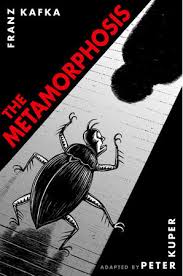
[READ: July 30, 2016] The Metamorphosis

I’ve been enjoying the art of Peter Kuper lately.  So I found a few of his older books, like this adaptation of The Metamorphosis, which is pretty great.

I don’t know if this is meant to be a complete telling of the story.  I’ve read it a few times, but I don’t know all of the details.

I liked that he clearly doesn’t include all of the dialogue or text–it’s not a comprehensive version of the story.  Rather, he uses a the art to move the story along.

The cockroach is drawn in Kuper’s very blocky, very robotic style–it’s cool and creepy.  But not bug-creepy just inhuman-creepy.

As the book opens, he flashes back to his life and job as a traveling salesman .  He hates the work–it is exhausting–and if his parents didn’t need the money he would have quit a long time ago.

But while he’s thinking all this he realized that he is late for work.  He tries to get up and that’s when the limitations of being a cockroach really hit him.

His supervisor comes to tell him that he is fired because of poor performance and when his family sees him, they are disgusted by him.

Only his sister Grete treats him kindly–bringing him scraps of foot (real food at first and then rotting food, since he is a bug). We learn that in the family only Grete and Gregor are close–their father is distant and cold.  The father is really annoyed at Gregor the bug still being in the house–how do they even know he is that creature or if he is even still “in” there.  He throws an apple at Gregor and it gets embedded in his back (ew).

Without Gregor’s income the family must take in lodgers, who are bossy and inconsiderate  Gregor wants them out but when they see him, they freak out and storm out without paying.

Can a story like this find any happiness at the end?  Well, sort of, in a very unexpected place.

Even though this is primarily a visual work, it really conveys the horrors of the original in a very clever way.

Read Full Post »

SOUNDTRACK: HEM-Tiny Desk Concert #306 (September 28, 2013).

Hem is one of All Songs Considered‘s earliest discoveries. Back in 2002, we received a beautiful and unique album called Rabbit Songs. It was a homey, fireside kind of record, with a sound that could be called country or Americana, and the arrangements by Dan Messé made it feel quaint and warm. To top it off, there was singer Sally Ellyson, an untrained natural talent with an effortless yet breathtaking voice. Hem has gone on to make five more albums since Rabbit Songs; their latest, Departure and Farewell, finds the group still writing songs that feel as if they’ve always been there.

Bob is quite right about the feel of this band, the drums are actually foot stomping and piano tapping, and that makes the band sound like they are siting around cozy room with friends.   And then there’s her voice.  There’s nothing specific about it that stands out, and yet it really does.  Her voice feels incredibly warm and welcoming, making you want to stop and listen.  And perhaps it’s something about the recording which makes everything feel soft (but not muddy) and warm.

And even in the songs themselves, it feels like friends hanging out.  During “Walking Past The Graveyard, Not Breathing” they say “go George” as the intro to the bass solo and then “go Heather” for the violin solo.   “Tourniquet” has some great lyrics, between the alliteration at the beginning and the great metaphor of the song, I was so taken with the lyrics that I didn’t even realize how pretty the melody was:

Brooklyn, I’m broken — I’m breaking apart
Oh Brooklyn, your bridges are bound up in light —
Every artery’s clogged as you pull the belt tight —
And this tourniquet turns even tighter until
Traffic comes to a standstill

When the song suddenly takes off near the end (but only briefly) it really elevates the song which was already delightful.  Introducing the final song, “Seven Angels” she says they are excited to be there, playing in this format.  She says the song can be seen as a lullaby–she likes to sing it for her sister.  She says she doesn’t write the songs but she can pretend this one is hers.

It’s hard to imagine this band playing a venue much larger than this one–they seems right at home in a small space.

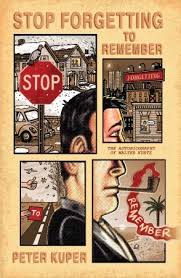
[READ: July 31, 2016] Stop Forgetting to Remember

This is a fascinating story about the comics artist Walter Kurtz.  I know very little about Peter Kuper, but I gather that this is sort of his life but written as an autobiography of somebody else.  (For instance, Kurtz was born on the same day as Kuper).

The back cover blurb also states how daring it was for Kurtz to write all of this –showing the embarrassing details, etc.: “My spouse would have killed me!”

This book is a collection of “stories” (not sure if they were ever published separately) that are joined by the narrative thread of Kurtz telling us about his life.  And the “occasion” for this reflection is the pending birth of his first child.  He is freaking out a bit–when he was young he never wanted kids, and then maybe he was cool with it, but recently he’s become terrified again.  He’s particularly afraid because he’s engaged with the world and he sees that as each month goes by, things get worse: AIDS, global warming, overpopulation, famine, wars (and that’s just 1996). (more…)

Read Full Post »

SOUNDTRACK: ALSARAH & THE NUBATONES-Tiny Desk Concert #585 (December 9, 2016).

The Tiny Desk Concerts have introduced me to a ton of bands I’ve never heard of before.  They’ve also introduced me to styles of music I’ve never heard before.  Alsarah and the Nubatones play music inspired by her home country of Sudan.  But I believe she (they) include pop elements to make the music more accessible (and danceable).

And this Concert was great–I listened to it over and over.

The instrumentation is all fairly simple: Rami El Aasser plays all kinds of percussion.  I love the sound that he gets out of that hand drum.  Brandon Terzic plays an amazing oud and  Mawuena Kodjovi’s bass holds the whole thing together in an incredible way–something that I think this traditional music lacks.

But most important are the singers’ voices.  Alsarah sounds great by herself but when she and Nahid harmonize, it is enchanting.  Especially in the chorus of the first song, “Ya Watan” when their voices work together so perfectly

But what’s Alsarah’s deal?  The blurb is really helpful:

When singer Alsarah left her native Sudan, she was just a child who’d shown an interest in music. She’s said it served as her coping mechanism during a subsequent transition to life here in the U.S. That passion led her to a university degree in ethnomusicology.

It also drew her to musicians who were passionate about the intersection of culture, music and migration. Together, their one-of-a-kind expression has been called “East African retro pop.” But that tag only scratches the surface: In their hands, the music pulses, breathes and comes alive with a mix of tradition and contemporary influences.

I don’t know what the song names mean, but I love “Ya Watan.”  The song is really catchy, but when the bass did a big slide at the end of the middle slow section to announce the final part, I was hooked.

I have no idea why there’s a 3 in this titular word, but that makes me even more intrigued by “3roos Elneel.”  Before the song she says (in perfectly unaccented English), “I’m going to tell a story because I think I can do whatever I want.”

She says that the song is inspired by “girls music” performed at wedding ceremonies in Sudan.  But she tries to merge it with an old myth.  The Nile River would flood every season because the gods were angry and lonely.  So the Sudanese people would sacrifice the most beautiful maiden in the village.  But she wonders what happens after she goes in the river.  And what happens next season when there’s a new girl–that’s a lotta wives.  So, she likes to think there’s trade off.  You go in to the river and do 3 months as a Nile god bride and then you swim off.  Maybe the bottom of the Nile is full of ex-Nile-god-divorcees giving birth to mermaids.  Yes, she claims mermaids as a Nubian invention.

The song begins with a call and response. It sounds rather traditional.  But after a few lines, the song stops with a four-beat clap-along section.  And then everything shifts.  First the bass plays a cool riff then the oud joins in with some fast playing and then the percussion makes it utterly danceable.  There’s even a cool oud solo.

The first section of “Fulani” is the chorus repeating the word Fulani over and over (in call and response style), but it’s done in wonderfully melodious fashion, including a catchy stop start section with more clapping.

The song is really great and I love the way all the instruments are able to make the song fade out.

This music was totally captivating.

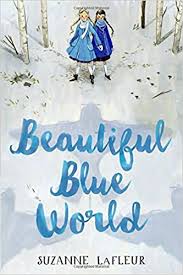
[READ:January 27,2017] Beautiful Blue World

Sarah brought this book home and read us a little bit of it and I decided I had to read it, too.

The part she told us about was about a girl taking a test to see if she would be useful for the army.  But it was no ordinary test, it was more like Bletchley Circle–puzzles and observations more than facts.  That sounded great.

What she didn’t tell us was the general set up of the story.

So, this story feels like a World War II story, with a country like England being attacked by a country like Germany.  But what makes this book special is that these are not the countries. The countries are called Sofarende (the attackees) and Tyssia (the attackers). But despite these countries having fantastical names, the story feels very real.

(more…)

Read Full Post »

SOUNDTRACK: THE WESTERLIES-Tiny Desk Concert #576 (November 2, 2016).

The Westerlies call themselves “an accidental brass quartet,” (two trumpets and two trombones).  I don’t know if a brass quartet has a “standard make up,” but having only two instruments seems to make for an unexpected sound–one that feels more like a marching band than a swing or big band, but which is clearly not playing marching band music.  “Trumpeters Riley Mulherkar and Zubin Hensler and trombonists Andy Clausen and Willem de Koch can blow hard — after all, this is a brass band — but the surprise comes in their soft tones and subtle phrasing.”

The band doesn’t only play standards either.  For this Tiny Desk, they play three originals:

Clausen provides two tunes, beginning with “New Berlin, New York,” which sports a snappy theme, standing out like a bright tie on a smart suit. A scurrying pattern of interlocking notes furnishes the underlying fabric.  [I really like the staccato trombone notes which are really fast and bouncy.  Mulherkar  gets a pretty cool solo in the middle of the piece, but it sounds best when the two trumpets play together.  And yet there is another moment later on where it’s just one trumpet and one trombone and it sounds very cool.  I love watching the trombone play all of those fast notes].

Hensler’s “Run On Down” evokes the calm beauty of Washington’s San Juan Islands, north of the band’s former home base. [I love that he can get a different sound out of his trumpet without seeming to do anything different in his playing style. The song opens with two lonely sounding trumpets.  Midway through Clausen plays a sound like a person talking or humming.  I didn’t know you could change the tone and sound of a trombone like that].

Clausen ‘s closing number, “Rue Des Rosiers,” conjures up the circus-like vibe of a Parisian street scene. A whimsical theme gradually coalesces from fragments and grows into a rollicking amusement. [He introduces the piece by saying it was “inspired by a crazy old man riding a tricycle down the street of Paris. It was a giant tricycle and was wearing a beautiful bejeweled vest and there were windmills and horns and was something straight out of the circus.”  And boy, does this ever evoke circus music with the opening bass notes and the screaming trumpet.  The song slows down before building up into a rollicking circus piece.  And when one trumpet and one trombone put a mute on the sound gets all the more wild.  The piece ends with a variation on the traditional circus music before concluding].

[READ: June 2, 2016] Copper

After enjoying Kabuishi’s Explorer series I saw this book by him.

Copper was his first “comic strip” creation.  The story follows a boy named Copper who is quiet adventuresome and his dog Fred who is practical–and tries to keep him out of trouble.

In the introduction, Kabuishi says that the first comic (called Rocket Pack Fantasy) reflected his inner life at the time.  This proved to be his first published comic.  It was pretty dark (and black and white).  In that first one, he imagines wearing a rocket pack and then dropping bombs on a city.

But after a few more strips, Copper became more optimistic and Fred was there to question that optimism.  Kabuishi also added color. (more…)

Read Full Post »

SOUNDTRACK: RENÉ MARIE-Tiny Desk Concert #557 (August 12, 2016).

René Marie has a classic jazz singer’s voice.  She has the tones and bounce perfectly.  In fact, her entire performance is timeless–one would be hard press to guess when this was recorded (if you didn’t know).

Her first song “Colorado River Song” was inspired by an NPR coincidence:

René Marie was answering phones at Denver’s jazz radio station KUVO when she sat down across from a fellow volunteer fundraiser. He would soon invite her on a canoeing trip and, without yet having seen the eponymous river, she wrote the giddy “Colorado River Song” on the way there.

She said had never been canoeing before and she was so excited that wrote this song on the way to the river.

Her voice sounds great, especially when she does some mild scatting in the middle of the song.  There’s a great jazzy piano solo, too.  She accompanied by her Experiment In Truth band (John Chin on piano, Elias Bailey on bass, Quentin Baxter on drums).

“This is (Not) a Protest Song” covers serious topics, but sing in a gentle and caring way.   She sings of her homeless brother and her crazy Aunt who fell through the health care cracks (not sure if these are actual relatives, but it doesn’t matter).  This song is a bit less jazzy (although it has some cool jazzy bass lines).  It’s a surprisingly upbeat song although none of it is in a hurry to get anywhere, it just sounds great.

“Sound Of Red” is a bit faster with a pretty wild (relatively) piano solo. She also has a lot of fun teaching everyone to do her dance moves–put your weight on it.

And the sweet canoeing trip has a very sweet ending:

In the audience [for this Tiny Desk Concert] was the bold KUVO volunteer from that day 10 years ago. His name is Jesse, and they’re now married and live in her home state of Virginia;

[READ: April 1, 2016] Sunny Side Up

The Holms siblings are responsible for the Babymouse series.  It took me a little while to get used to their artistic style in such realistic story (no mice or amoebas), but it doesn’t detract from the story at all.

I especially loved this story because it reflected my childhood in the settings (although not the story).  I loved seeing the images from the 1970s (like Tab in the soda machine and going to the iron-on T-shirt store down at the shore).  There’s even a Polaroid camera!

The story is told in flashbacks, and I have to say that if I hadn’t been told that there was a sad element to the story, I wouldn’t have guessed that at first.  But once I knew there was a sad section, my anticipation of the sadness proved to be worse than what the actual sad part was, so phew. (more…)

Read Full Post »

mc mcSOUNDTRACK: CHEYENNE MIZE-Tiny Desk Concert #289 (July 20, 2013).

Cheyenne Mize is yet another musician I’d never heard of performing behind the Tiny Desk.  The blurb tells us:

Behind Bob Boilen’s desk at the NPR Music offices, Mize — a multi-talented singer, instrumentalist and music therapist — reduces her band to a duo for three songs from Among the Grey. Naturally, this entailed showcasing some of the album’s quieter, moodier moments (the slinky “Raymaker,” the dreamy “Whole Heart”) before closing with the more forceful “Wait for It.” But along the way, Mize’s voice rings out assertively in every style and setting.

As it turns out, her voice was the problem for me and I can’t really place why.  I like her voice and I like her music I just feel like they don’t go together somehow.

For “Raymaker,” it’s just her on a 4 string guitar and her partner on a box drum.  I really love the sound she gets out of that little four string guitar and he gets some great sounds out of the box drum.  I can’t decide if maybe with a fuller musical sound I’d like her singing more.

For “Whole Heart” she plays a hollow-bodied electric guitar and the drummer plays an electric guitar.  The song is quieter (presumably because of no drums).  I like this song a bit more–the chorus is especially nice–and I feel like her voice works a bit better here.  The guitar interplay in the middle is really delightful as well.

For the final song, “Wait for It,” she switches to violin.  She says it’s both a blessing and a curse I’ve never been able to decide which instrument to play.  “Sometimes it’s helpful and sometimes it just means I have to carry a lot of instruments around.”   She gets a great raw scratchy sound out of the violin.   The drummer stays on the same guitar and adds little background notes.  This song has a great rocking vibe.  And again, the chorus is a neat chord change.  And yes I think her voice works good here too, so it must have been that first song.

And yet for all that I really like the sounds her instruments make more than anything else .

[READ: April 27, 2016] A True Story Based on Lies!

I was unfamiliar with the artists McDermott & McGough.  But I really liked the cover and title of this piece.  I have since learned from Wikipedia that

David McDermott and Peter McGough are best known for using alternative historical processes in their photography, particularly the 19th century techniques of cyanotype, gum bichromate, platinum and palladium. Among the subjects they approach are popular art and culture, religion, medicine, advertising, fashion and sexual behavior.

This particular collection plays around with time–they create works that seems like they are older than they actually are.  And in fact, this is something the artists did in their daily life as well:

From 1980 through 1995, McDermott & McGough dressed, lived, and worked as artists and “men about town”, circa 1900-1928: they wore top hats and detachable collars, and converted a townhouse on Avenue C in New York City’s East Village, which was lit only by candlelight, to its authentic mid-19th century ideal. “We were experimenting in time,” says McDermott, “trying to build an environment and a fantasy we could live and work in.”

This collection looks at advertising from the 1950s and updates it with contemporary additions.  I assume that they are actually painting and re-creating the earlier ads and not simply using the originals.  In their titles they indicate the date that the painting could have been created and then the date that it was created. (more…)

Read Full Post »

SOUNDTRACK: THE NATIONAL-Tiny Desk Concert #279 (June 10, 2013).

I rather like The National and yet I haven’t spent much time really listening to them.  This Tiny Desk Concert really shows them off well.  It is extremely winning and enjoyable.

I enjoyed this part of the introduction:

we’d gotten word that the group would strip its sound way down for the occasion, sticking to two acoustic guitars and a bit of hand percussion. What we got instead was a fully fleshed-out septet, complete with horns and piano; the band showed up at 9:30 to rehearse and sound-check.

Though singer Matt Berninger had barely rested his voice from a show in the area the night before, The National dutifully performed gorgeous acoustic renditions of four tracks from its fine new album, Trouble Will Find Me.

I like the way the first song “This is the Last Time” starts quietly with just some acoustic guitars (playing quite interesting chords too) but builds, adding more and more instruments.  It grows and grows until it hits a new section where there’s a trumpet solo that fits perfectly in the song.  This new section introduces the second half of the song which never returns to the first part.  The backing vocals–between the guys singing the lines and the other guys singing the high “ahhh” that almost sounds like a horn–also work great together.  It’s a wonderfully full song.

“I Need My Girl” has a cool part with the two guitars.  They play a simple picked melody, but after the second verse, the second guitars plays it one step after the first, making it sound like an echo. And again that lone trumpet sounds terrific here.  This song is a bit more mellow.  In fact, this whole acoustic vibe sounds different from what I expect from the band.

The third song “Pink Rabbits” begins as primarily piano with lots of backing vocals.  But again the song builds slowly (with trumpet and trombone).  And again, after the horns go down there’s a backing voice that sounds a bit like muted trumpet.

Through the whole concert, I love Berninger’s casual demeanor while singing–hands in pockets, gently swaying.

Bob tells them that they are performing Tiny Desk’s first encore.  The blurb notes that the band:

even treated the hundreds of worshipful gawkers to Building 2.0’s first-ever Tiny Desk encore, in response to a roar of applause that could be heard in the far reaches of the newsroom downstairs.

Berninger says this is usually when they run back stage to piss but we’ll just go behind your desk.  Bob jokes that it’s no different from the trombone spit that he sees back there.

Berninger introduces “Sea of Love” by saying this is the only song we’ve ever written with a harmonica in it…and its the last one.

The full band sings and it sounds terrific.  I especially like the pause in the line “they say love is a virtue don’t….they” is pretty dramatic.  And I am tickled by the final lines of the song (while the backing singers do some great work: “I see you rushing down / tell me how to reach you / I see you rushing down / what did Harvard teach you.”

The National are usually more dramatic, I believe–almost theatrical, but this quieter version is really quite enjoyable.

[READ: April 2, 2016] Feathers

Jorge Corona introduces this book by explaining that he had an idea for a Beauty and the Beast kind of story that features a boy with feathers.  And it slowly expanded into the story we have here.

The story opens with a bright white city in the distance.  In the foreground, there’s some dark Victorian-looking houses.  And as we zoom in, we learn that the dark city is known as the Maze.  And in this Maze live the poor.  Little kids, called “mice” are street urchins who run all over the Maze.  And then there’s a man with a beard.  The man finds a baby in an alley.  The baby is born with feathers and he decides to take the boy in and raise him.

The scene jumps to eleven years later.  The boy, known as Poe has grown up and has stayed hidden.  He still has feathers and he goes out at night, but no one knows about him.  People just speak of the ghost–Poe–who swoops down unseen and does things (mostly to help the poorest) and then flees. (more…)

Read Full Post »

« Newer Posts - Older Posts »