Feeds:
Posts
Comments

Archive for the ‘Essays’ Category

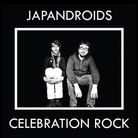
SOUNDTRACK: JAPANDROIDS-“Fire’s Highway” (2012).

I regret dismissing the suggestions of the NPR folks the other day.  As the more I dig into their suggestions, the more I like–seems their selections are better than their descriptions of said selections.  Take this description of the Japandoids’ album: “snarling punk meets the fist-in-the-air anthemics of Born to Run-era Springsteen and his modern-day equivalents in The Gaslight Anthem.”  I’ve never really liked Springsteen (I know, a Jersey boy, too).  I think it’s more about production (and saxophone) than anything else.  So, comparing bands to him is never a sell for me (even if it may be true).  To me, this sounds much more like a low-key Arcade Fire (with literally no pretensions to anything–I mean, there’s only 2 Japandroids).  Granted, Arcade Fire owe a lot to Springsteen too, but they do something different with his sound, which is why I like them.  [I’m not going to be able to argue my way out of this].

Anyhow, this song is a four minutes of punky guitars and a stupidly catchy chorus.  The fact that it’s only two guys makes it all the more remarkable that it sounds like a full band.  And perhaps, the biggest difference for me is the singer’s voice which feels very early 90s alt rock/punk.  Whatever it is, I’m a fan and will certainly be listening to more of this album.

[READ: June 14, 2012] “The Clockwork Condition”

Like most young men of a certain bent, I loved A Clockwork Orange.  I’ve watched it dozens of times and I’ve read the book.  What I especially like about the story is that my feelings about it change as I get older—which, while not the point exactly, is certainly a theme in the story–how age makes things seem different.  The most important thing I learned from this article is that there was an epilogue in the British version of the book that was not available in the American version (or the film).  And it seems to be pretty important.  What a strange thing to leave out.

Incidentally, Burgess wrote the book in 1962 and the film came out in 1973, which is why he was wrote this in 1973.  He says he was asked about Issues that arose from the film.  And he talks a lot about them.

But he also gives a lot of background.  The title of the book comes from the expression “as queer as a clockwork orange” which is Cockney slang for something so weird it subverts nature.  It was a perfect title for an idea he was going to write about—how people suggested using aversion therapy to change juvenile delinquent behavior.

So this article goes on for a pretty long time, raising all kinds of questions.  It’s really articulate and fascinating and really makes me want to re-read the anti-authoritarian novels I read in high school: 1984, It Can’t Happen Here, Brave New World.   He even talks about B.F. Skinner, who proposed that aversion therapy (which is what Alex gets in the book/movie) was wrong and that positive reinforcement was always more effective.  Skinner worked with animals (Burgess jokes about that) and the whole “you get more flies with honey” attitude works better for training animals he says.  The same is true for people.  Besides, aversion therapy removes freewill. (more…)

Read Full Post »

SOUNDTRACK: SQUAREPUSHER-Solo Electric Bass 1 (2009).

Yesterday I said that one Squarepusher CD was enough for me.  I did some digging and found out that he has put out a whole bunch of CDs.  And, to the surprise of me, at least, not all of them are crazy electronic music.   This CD, as the title states, is a collection of electric bass solo songs.  The songs were performed live as part of the Jazz à la Villette 2007 festival and were played on an electric six-string bass with no pedals or effects.

And that is all you get—serious solo bass songs.  The man behind Squarepusher, Tom Jenkinson, is apparently a virtuoso musician (who knew?) and these songs really show off his chops (just listen to the insanity of “Seb-1.05” (catchy title, eh?)).  He can play some impressive Spanish-sounding songs–that would probably sound better on a guitar, but sound more impressive on a bass (“Seb-1.06”).  He’s got some great slap stuff going on (“Seb-1.03”), and he really knows from melody (also “Seb-1.03”).  True, 12 all bass songs can meld into one another, but the crowd really loves it (and like a lot of things, seeing it is probably more impressive than just hearing it).

It’s not exactly “fun” listening (even if you love bass solos).  Only 850 copies of the disc were released, so it’s not like they expected a big audience for this.  But it is pretty neat to hear a) how good he is and b) that his main musical output is noisy electronic noodling.  That gives me even more respect for his electronic output.

[READ: June 5, 2012] “The Spider Women”

Margaret Atwood is another author I wish I had read more of—and I’m getting there.  I often wonder if I should just read an author start to finish and be done with him or her or if that just leads to madness.

Much like Miéville says in the previous essay, children don’t read genres, they just read what they like.  I loved Atwood’s idea that “below a certain age, [children] don’t distinguish between ‘true’ and ‘not true,’ because they see no reason why a white rabbit shouldn’t possess a pocket watch, that whales shouldn’t talk, or that sentient beings shouldn’t live on other planets and travel around in spaceships.”  After all, sometimes reality lives under the bed and has sharp claws. (more…)

Read Full Post »

SOUNDTRACK: SQUAREPUSHER-“Dark Steering” (2012).

Hot on the heels of a review of LMFAO I get to the other side of the spectrum in electronic music—Squarepusher.   There’s no big choruses, heck there’s no words, but this music shares something with LMFAO.  Well, actually it really doesn’t—except maybe keyboards.

Squarepusher play dark angular music. It’s very electronic and alien (and sounds like it may have been used in the background of Skinny Puppy songs back in the day). It’s abrasive and the sounds are otherworldly and yet in this song, there’s a melody to it.  I have but one Squarepusher CD—that’s probably enough for me.  But I am always interested to hear new music by him.  It’s impressive the way he can take a song that starts out so noisy and get it to sound like real music by the end.  It like the science fiction of music.

[READ: June 5, 2012] “Forward Thinking”

I have read only one book by China Miéville—Perdido Street Station.  I found it to be quite challenging for a bunch of reasons and figured I wouldn’t read more by him.  And yet I find that images from that book stay with me to this day (at least ten years on).  So maybe it’s time to give him another shot.  But where to start?

This entry in the New Yorker’s Sci-Fi issue is written as an “E-mail sent back in time to a young science-fiction fan.”  And I loved it.  I enjoyed how it started (with the author knowing that E-mail doesn’t exist at the time the recipient will get this—so who will it show up?)  And I loved the central question: “How did you get into this stuff?”  The sender knows that the kid will get asked this a lot, but the question should be turned around: “How did you get out of it?”  Because all kids love sci-fi concepts.  It’s just that some move away from it as they get older.

Miéville includes a few key moments in (his) sci-fi history: Page 40 of “The Tale of Mr. Jeremy Fisher” by Beatrix Potter.  What?  Indeed, for this is the first time that (you) will be ware of knowing something the protagonist doesn’t—that there’s  fish coming up to get him.

Next is Chapter 13 of Golem100 by Alfred Bester.  I have never heard of this book.  Although Miéville does warn us about it—he read it far too young and there’s some sadistic violence in it, what attracted him (and me, now) is the disrespect for text—part of the story is a musical score, another is a picture.  It sounds cool.  And of course it is long out of print. (more…)

Read Full Post »

SOUNDTRACK: TARKIO-three song demo (from Omnibus) 1997.

These three songs are part of a demo released in 1997.  I actually assumed that Omnibus would have collected all of Tarkio’s releases (how many more can there be?), but I learned that “omnibus” means “a book containing reprints of a number of works.”  So there ya go.

Nearly every review of Omnibus complains about the size of the release.  Some complain that the songs are too long (which is something else entirely), but many seem to suggest that 27 songs is too many for this collection.  I don’t quite understand this attitude, because if it were the collected works, there would be no reason to complain.  As such, I suspect I am the only person who wishes there was a little bit more–like why not the other two songs from this demo?

And demo is a rather unfair name for this, because it sounds wonderful.  (I suspect a demo from 1997 could be recorded with much better equipment than a demo from say 1984).  And these three songs are really something.  I suppose also, listening to these songs in this manner–not as a two disc set but as an original demo of three songs, makes them seem like maybe there isn’t too much of a good thing.

“This Rollercoaster Ride” opens with an interesting pseudo Middle Eastern violin.  But it quickly settles down into a very catchy rock/folk song.  It sounds very Decemberists, and it’s extremely catchy.  “Following Camden Down” is a beautiful song (the reminds me of The Replacements’ “Skyway”).  Meloy’s voice sounds subdued and not as immediately notable as he normally does.  It’s a wonderful little song.  “Slow Down” is a bouncy folk number (with dominant violin).  It’s got a rocky alt feel, although it still reads as traditional folk.

True, none of these songs reach the delirious heights of the best Decemberists songs, but they’re a nice step towards the kind of music Meloy and friends would put out next.

[READ: June 5, 2012] “Take Me Home”

This issue of the New Yorker is devoted to Science Fiction (see the cover).   In addition to five stories (which I assume are science-fiction-y) we also get five (more or less) one-page pieces from masters of the genre (genre being a dirty word, we’ll find).  When I first saw the names of these writers, I thought they were each creating a cool one-page story.  So I was a little disappointed to realize that these are “personal histories” with sci-fi.  But I shouldn’t have been disappointed, because even though these are short, they are really impactful–and come on, they’re classic writers.

I’m surprised by the fact that I haven’t read more Ray Bradbury.  I know I’ve read Fahrenheit 451 and I’m sure I’ve read some of his stories, but I haven’t even scratched the surface–he has written so much!  Indeed, I was surprised to hear that he was still alive (in fairness, he is 92).

This piece begins with Bradbury’s recollections of his introduction to sci-fi with Buck Rogers (1928) and John Carter of Mars (not Disney’s creation, but a series of stories by Edgar Rice Burroughs). (more…)

Read Full Post »

SOUNDTRACK: MAC LETHAL-“You’re vs. Your” (2012).

Mac Lethal is a YouTube sensation (he did the pancakes video that I liked quite a bit).  And, yes, he does actually have albums for sale.  He raps really fast (so fast that I wondered if it was sped up–I don’t believe so).  I am 100% behind the sentiment of this song (possessive vs contractions, this is something you used to know).

I’m a grammar freak, so it bothers me when I see these common mistakes made.  It’s nice to hear a song about it (even if it’s not a terribly catchy song or anything).

I like his name dropping and his lecture is pretty effective.  I’m a little confused by the big dick reference/joke at the end of the song…it’s not really relevant.  But his fast tongue is really impressive.  As for his singing….mmm, stick to rapping.

I like the T-shirt!

[READ: May 15, 2012] Science News Letter

I’ve mentioned before when my company sends out links to articles that are interesting or cool.  This is the second time a link to a Science News Letter has gone out.  I swear if I had time, I would love to read all of these.  I wonder how often it was published?

This letter has only two articles in it–one from Physics and one from Archaeology.

The Archaeology one is called “Find Sacred Kitten in Bronze Cat Coffin.”  And indeed, two metallurgy experts were cleaning a bronze cat (which had “bronze disease”) and inside of it they found the bones of a fetal cat.  This was one of the first times that actual bones were discovered in one of these cat idols.  There’s even a (kind of creepy) picture of the bronze statue with the far creepier caption: Cat Coffin.

The Physics article is headlined: Fifth Dimension is New Realm Entered by Professor Einstein”  What?  How cool is that… “Professor Einstein!”  Einstein died in 1955, so it’s not weird that he’d be in a Science Letter.  But still!  Einstein talking about his current theories?!  The subtitle is “Celebrating Sixtieth Birthday, Scientist Wants New Dimension To Account for Electro-Magnetic Effects.” (more…)

Read Full Post »

SOUNDTRACK: THE GREAT GAMBLE-Book One (2012).

My friend Matt has worked at a school in Pennsylvania for years. He wrote to tell me that a few kids who graduated from his school had formed a band and have released a CD.  It’s streaming (and downloadable) on bandcamp at their site.

I have lots of friends in bands, and I’ve listened to lots of demos, so I wasn’t expecting very much.  But the first thing I noticed when I listened was how good this sounds–professional and, yes, like a “real” album.  This isn’t just a bunch of guys jamming in their garage.  What makes this even more striking is that the music is heavy progressive metal–not something you just whip out in a quick take.  This is complicated, interesting music.  I’m hearing a kind of Dream Theater meets King’s X vibe going on.  And man, it’s really good.

This is multi-step heavy rock (complete with a synth player/violinist!). The only song that is less than 9 minutes is the 90 second introduction called “The Marketplace.”  Otherwise, we’ve got three songs over ten minutes and one over 16!  Who even knew young bands did stuff like this anymore?

Al Joseph plays lead guitar and sings lead vocals.  His guitar speed is very impressive and his vocals sound not unlike Dug Pinnick from King’s X (noticeable on the opening track, especially) .  Matt Weaver plays violin and keyboards.  The keyboards offer more than just a fuller sound.  On “Release the Kraken” they provide some cool sci-fi sound effects.  At about five minutes in, “Release the Kraken” slows down to a quiet middle section that really showcases Steve Michael’s drums.  And then comes the blistering guitar solo.  It’s followed quickly but a slight diversion and then a wholly different style of solo.  It’s really something.

If “Release the Kraken” wasn’t a good enough prog rock title, how bout “Legends of the Symmetria.”  This one has a very Dream Theater feel for the opening.  But the vocals sound very different–dual vocals with great low harmony.  There’s a cool pre-chorus (I guess) at about 3 minutes.  This song is definitely a heavy one.  At about 4 minutes, the song slows down into a pretty classical guitar section,where Chris Joseph on plays bass gets to show off a bit (although he seems to be the most understated of the 4 players).  There’s some great drumming at the end of the song, too.

“The Ghost of Three Reflections” is a slow builder of a song.  There’s some quiet parts (with beautiful harmonies) and a guitar solo that sounds clear and perfect (I’m hyping the production so much because it sounds so good).  The guitar solo section in this one strikes me as something that might suit two guitarists better–maybe two more different styles of soloing, but he pulls it off well, especially when by the end, he has shifted to a very different style, and the music changes along with it).  I love the bass section at the 8 minute mark, which reminds me of something Rush might have done back in the mid 70s.  The song kind of merges into “Breach At Fort Mycenae” which opens with the same kind of staggered sound as the end of the previous song.  The violin gets an airing in the middle of this song and it’s a cool treat.  I could definitely use more violin in these songs, although maybe little bits are a treat.  There’s a few times when I don’t like the production choices–maybe there needs to be a bit more music behind some of these solos so it doesn’t just sound like two players soloing against each other.

The disc ends with the big one, the sixteen minute, “The Sleepwalker Pt. 1 – Tears of Dagon” [I love that it’s a Part One and it’s 16 minutes long].  When the vocals kick in at about 3 minutes, the harmonies are gorgeous.  I love the bass guitar break at 5 minutes.  Although there’s something about the keyboard sound that I don’t like–maybe they’re not big enough?  But I love the crazy guitar solo at the 9 minute mark of this track (I’m a sucker for dissonant scales).

This is an amazing debut CD and I hope these guys go far (they’re going from Scranton to Boston for school, but I hope they can go further than that).  They are tight as a drum, stopping and starting perfectly, keeping all of the rhythms and time changes perfectly.  They really have done their prog rock homework.  The only gripe is as I’ve said, some sections don’t feel “big” enough.  If you’re going to write a 16 minute song, you don’t want sections that sound small–you want your backing guitars or bass guitars to be a little louder so it sounds like the song is still going.  But other than that, there’s not much room for improvement.

I downloaded their CD, (and yes, I paid for it…that will help with college, eh?).  But my real complaint is that on the computer, the album cover is awesome–if you look at it from an angle, there’s a whole scene behind the large logo (try it, it works here too).  But when you print it out, you lose all of that.  The images are there, but the effect is gone.  This is a band that calls out for full color packaging and maybe even a gatefold sleeve!  (The bottom of the cover says Ο υπνoβάτης which means The Sleepwalker).

Good jobs guys!  You’ve done NEPA proud!

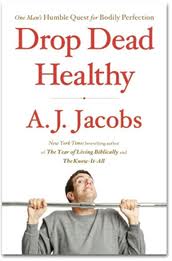
[READ: May 15, 2012] Drop Dead Healthy

Sarah got me this latest A.J. Jacobs book for my birthday.  At first I didn’t think I wanted to read it because I feared what a book all about being in good shape would be—nagging, obnoxious, making me feel bad about my vices. But I should have leaned from all of my A.J. Jacobs experience that he is completely NOT about that.

Jacobs occasionally enters into preposterous forays of Self-Improvement.  In the first book of his I read, The  Guinea Pig Diaries, he tried various weird experiments to see what it was like to be a woman, radically honest, a unitasker, etc.  His other books have been about self-improvement.  He read the encyclopedia from A-Z, he did a year trying to live like out of the bible (I will get to these eventually).  In this book, he is on a quest to be the healthiest person in the world.

It’s an impossible task.  And, frankly, a foolish one.  But he decides he will take two years and focus on individual parts of his body one month at a time.  I’m going say right up front I feared that this book would make me feel bad about all the things I don’t do for myself.   But well, a) Jacobs is a funny writer, so at least you’re laughing.  b) Jacobs is either in bad shape or plays up his badshapedness so that the average person doesn’t feel too bad off.  c) He is so over the top in his quest that no one would ever think about doing all of the things, but we can take what he learned and apply little bits to ourselves.  What is nice is that he tries to get two if not balanced opinions then perhaps fringe opinions to balance out–trying one extreme then another to see which work.

He Breaks His Categories Down thusly: stomach (eating right, the perfect food), the heart, the ears (the quest for quiet), the butt (avoiding sitting too much), the immune system (germs), genitals, nervous system, lower intestine (better bowels), adrenal gland (lowering stress), brain, endocrine system (removing toxins), teeth, feet, lungs, skin, inside of the eyelid (sleep), bladder, gonads, nose, hands, back, eyes, and skull.  Each category is designed to be a month-long workout of that organ/item–some things he keeps doing after the month is over making his workout regime something like 5 hours a day.  And at the beginning of each month he lists the stats for what he accomplished.

I’m not going to talk about all of his body parts, but I will mention a few that i enjoyed the most. (more…)

Read Full Post »

SOUNDTRACK: EVANGELISTA-In Animal Tongue [CST082] (2011).

Evangelista is probably my least favorite band on the Constellation label.  I’m especially surprised/disappointed in this because I loved Carla Bozulich’s earlier bands.  I’ve said before that I find her vocals to be weirdly and wonderfully disconcerting.  And when it’s played over aggressive confident music it works wonders.  But when it’s paired with music that is also kind of abstract and untethered, it just sounds like a mess.

After that introduction, I’ll say that this album is their best release yet.  Her voice (the Constellation site suggests her melodies are “largely improvised” (!)) sounds like it always does–unsettling, haunting, compelling, drawing you into whatever world she is invoking.   The title track is the most intriguing–the music is subdued, drawing you in even more.   “Black Jesus” is also compelling in that it is one of her more subtle releases.

“Bells Ring Fire” has the catchiest section, practically a singalong.  “Die Alone” reverts back to that old nebulous style where there’s just nothing to grab on to.  Indeed, “Enter the Prince” and “Hatching” both have interesting sound effects (especially “Hatching”) but they’re not really compelling as songs.

I think the real problem with these songs is that they’re all too long.  Since they don’t have any hooks in them, since there’s nothing to really grab you and make you want to like them, having them come in around 5 minutes is just too much to ask of the listener.  Some of these songs would be inetresting for two or three minutes, but by 5 I’ve given up.

Check it our for yourself here

[READ: May 15, 2012] “Reading Graffiti in the Early Modern Book”

This may be the most current scholarly article I have read from JSTOR.  Part of the fun of reading the JSTOR scholarly articles is that they are usually old enough that you can have either a) contemporary knowledge about what the author got right or wrong or b) a fun nostalgia based upon the word choices or references that are in the text.  So with this one, which is not even two years old, there’s neither of those possibilities.  What’s also interesting is how the article is clearly current–the references that Scott-Warren uses are contemporaneous (“the Banksy of his day?”)

So what is this article about anyhow?  Well, Scott-Warren looks at the notes and scribbles that people have written in their books.  But not just your average textbook or library book, he goes back very far to the “early modern” period and sees that people have been graffiting their books since there were books.  He mentions how anyone studying books from that era will see all kinds of things on the pages of the book, from scribbles to pressed flowers to even the rust outline of scissors.  But he wants to focus on what people have written.  And he wants to see of any of these notations are comparable to graffiti in the current sense of the word.

He discusses current definitions (including tagging) to explain that graffiti is all about saying “I am here.”  (He even interviews a graffiti artist named Claw).  Then he goes back to 1434 and sees a Latin inscription from Jan van Eyck on his painting Arnolfini Double Portrait that more or less says “Jan van Eyck has been here.”  Although it is his own painting it has a feel of graffiti, of making a public note that you exist.  Similar inscriptions can be found in many books of the period as well.  There is a 1565 edition of a book with a heavily flourished signature, there’s a 1548 edition book with a doodle that may include a self-portrait.  There’s even a bible that has been inscribed by every member of the family (daughter Mildred’s is stunningly ornate).  Another book has the owner’s signature about fifty times throughout the book.  Are these words to the world?  Public notations?  or something else?

Scott-Warren wonders if these markings can be considered “pen-trials”–pens were hard to use back then, the ink was homemade and paper was scarce.  Another possibility is that they were an attempt to prove and expand on literacy.  A third possibility was ownership. Like the graffiti in a 1685 Indian Bible, written in Massachusett: “I Nannahdinnoo, this is my book…I, I Nannahdinnoo, own this forever.  Because I bought it with my money”

I especially enjoyed the book that had written, under the name Walter Vaughn, “This book belongs not to Walter Vaughn but to James Vaughn because his later father John Vaughn gave this book in his last will and testament to the same James Vaughn and therefore the said James is the true owner of the book” (1582).

In addition to the I of graffiti Scott-Warren looks at the “was here” aspect.  In a 1549 History of Italy, there is an inscription noting that the owner had been to Venice.

The key to all of this seems to be its public-ness.  Some inscriptions were prayers that were clearly meant for others to read.  In another case, the person wrote his opinion about the booksmith where the book was purchased.  There’s even some graffiti that is like trash talking of others.

I enjoyed this article because there were lots of pictures of the inscriptions, although i could have used a few more, frankly.  It was also curious to think about why people wrote things in books long ago–who exactly did they think would be reading their copy of a book?  Was it just a public act of disobedience at a time when a public act had to be very self-contained?

Read Full Post »

SOUNDTRACK: SANDRO PERRI-Impossible Spaces [CST085] (2011).

This album has become one of my favorite releases of the year.  I simply can’t stop listening to it.  And the funny thing is that on first listen I thought it was too treacly, too “sweet,” especially for Constellation Records (home to the over-the-top Godspeed You Black Emperor amongst other wonderful bands).  But after a listen or two, I heard all of the genius that is present in this record–so many different layers of music, and so many interesting instrumental choices. Indeed, it does come off as sweet, but there’s really nothing wrong with that.

This album gives me a happy pick me up without being cloying in any way.  That’s a great accomplishment.

“Changes” opens kind of all over the place, with some noisey guitars and really high bass notes.  But once the shk shk of the shakers comes in, the sing settles into a great groove (and there’s a cool bassline that really holds the song together).  After about 3 minutes, it turns into a cool light funk jam, with retro keyboards, buzzed out guitar solos and some funky drums.  It’s unlike anything you’ll hear anywhere else.  “Love & Light” is one of the shorter pieces at just under 4 minutes.  It’s different from the other tracks, in that Perri’s vocals seem to be the dominant motif, rather than the cool music.  I like the song, but it’s probably my least favorite here.  “How Will I?” uses a similar multi-tracked vocal style but it has some wonderful flute moments (yes flute) that make the song bubbly and happy.  The song kind of drifts around the ether in a kind of jazzy world until about 5 minutes in, when the bassier notes anchor the song with great contrasting notes.  And the electronic ending is as cool as it is disconcerting.

“Futureactive Kid (Part 1)” is a shuffling minor key number that’s just over 3 minutes, it features a cool bass clarinet and backwards guitars to propel the song.  The backwards guitar solo segues into the uplifting (literally, the keyboards just go higher and higher into space. “Futureactive Kid (Part 2)” features fretless bass, a flute solo and My Bloody Valentine-esque sound effects (although radically simplified from MBV’s standards).  It fades out only to introduce my favorite song in forever–“Wolfman.”  I can’t get enough of this song.  It’s a simple structure, but at ten minutes long, it deviates in amazingly complex ways.  It has so many cool aspects that I love–I love the chord changes at the end of each verse.  I totally love the guitar solo that goes up and down the scale for an impossibly long run–well over 100 notes by my count.  I also love that the end of each section features a different guitar style playing the simple chord progression–from acoustic to loud solo to full band playing those same notes–so by the end of the ten minutes you ‘re not sure what to expect.   By the time the flute solo comes in at nearly 7 minutes, I’m totally committed to the song and wherever it’s going to take me.  So when it gets a bit of an electronic ending, I’m ready to go there with it.  Oh and lyrically the song is just as curious as the music.

The final song “Impossible Spaces” is a beautiful, quiet guitar song which is actually easy to sing along to.  It quiet a departure from the rest of the record, but it ties things together very nicely.  I have listened to this record so much lately, I just can’t get enough of it.

You can stream the whole thing here.

[READ: May 10, 2012] Conversations with David Foster Wallace

This is a book that collects interviews with David Foster Wallace.  Although DFW was reticent about d0ing interviews (as the introduction states), he did do quite a lot of them–often at the same haunts.  This book contains 22 interviews that span from 1987-2008.

The conversations are in chronological order, which is really a treat because you get to see DFW’s opinion (and his addiction to nicotine) evolve over the years.  You also get to see the topics that he was really focused on at one time and whether or not they stayed with him until the final interview.  DFW was outspoken about certain things, especially entertainment, which is unsurprising.  But he was also a big advocate of truth, honesty, realness.  It’s amazing seeing him when he lets his guard down. Although his honesty is there for all to see in his work, he is better known for his difficulty with language or his humor.  So seeing him without the multiple revision is quite enlightening.

The first pieces, “David Foster Wallace: A Profile” published after his first novel The Broom of the System launched Viking’s paperback imprint actually looks into his classroom a little bit and shows him interacting with a student (I wonder if she knows she is in this book?).  It seems sweet and almost naive compared to what is to come next.  And, for anyone who is familiar with him from later in, it’s a wonderful look behind the scenes.  There’s also a number of pieces from The Wall Street Journal.  Like the second piece in the book, the worryingly named, “A Whiz Kid and His Wacky First Novel.”  It’s not a bad piece at all, but man, headlines can be delicate matters. (more…)

Read Full Post »

SOUNDTRACK: LAMBCHOP- “2B2” (2012).

I don’t have much exposure to Lambchop.  I know of  them mostly as a slow, country-type band.  And that’s why I haven’t listened to them much.  So I picked one song from their latest album, Mr. M, to talk about (because they are associated with Five Dials, see below).

And, indeed, they are slow.  I wouldn’t say country so much as roots, maybe, traditional folk or something.  It’s certainly slow.  This song reminds me in someways of Tindersticks, although a very stripped down Tindertsicks.  Of course, what I like about Tindertsicks is that they are not stripped down.  So this song kind of leaves me a little flat.  I like it, but I’ve already got music that’s like this ti listen to.

I’ll bet though, that it would make great background music to an engaging story (see below).  I wonder what song they chose to remix.  It’s be crazy if I picked it.

[READ: May 3, 2012] Five Dials 23

Five Dials 23 was recently released with quite little fanfare.  That may be because it is like an appetizer for the soon to be released Issue 24 which promises to be very large.

Five Dials 23 contains only one piece (and an Letter from the Editor).  The piece is by Javier Marías, whom I’ve read and enjoyed and have put on my list of authors to explore more.

CRAIG TAYLOR-“On That Fiction Feeling and Lambchop”

Craig Taylor’s introduction wonderfully encapsulates why I prefer to read fiction to non-fiction.  I have friends who say they only like to read non-fiction because at least they’re learning something (or some variant of that).  And while it’s compelling to argue that you learn stuff from fiction too, it’s not always easy to prove.  So Taylor’s Letter from the Editor is where I can point people in the future:

I remember it happened when I read part of Runaway by Alice Munro, specifically the three linked short stories ‘Chance’, ‘Soon’ and ‘Silence’. I remember the names of the North London streets I was compelled to walk – from Messina Avenue to Woodchurch Road to Greencroft Gardens – just to free myself from the sensation that had blossomed within me after I set down the book. During that walk, the neighbourhood seemed raw and responsive. I was unsettled, but in the best possible way; I was in the midst of experiencing the kind of sadness that can only be induced by fiction, which is more potent sadness than most. Also in this jumble of sensation brought on by Munro was a vow to live better, to somehow dodge the mistakes of her characters. There was a bit of a ‘what the hell am I doing with my life?’; a bit of a ‘pay attention to the details’; a bit of an ‘appreciate life more’. In short, the great inner churning that comes at the end of a few extraordinary pieces of fiction.

The details aren’t relevant, it’s the overall mood and idea that he conjures that is.  Although he mentioned Munro, he begins to talk about The Leopard by Tomasi di Lampedusa.  How this debut (and only) novel has left a strong impact not only on him and many more who have read it but also on Marías.  And that that it was Marías’ essay is about: The Leopard.

The second half of his introduction talks about the next issue and that a 10″ vinyl album will be released with it.  It will feature a double A side with author Hollis Hampton-Jones reading from her novel Comes the Night, while backed by Lambchop.  The other side features a remix of a song by Lambchop from their Mr. M album.  The end of the Letter from the Editot is given over to Hampton-Jones and her remembrance of the recording session.  (It’s very cool).

EMILY ROBERTSON and TUCKER NICHOLS drew the cool pictures of leopards.

JAVIER MARÍAS-“Hating The Leopard

This essay, translated by Margaret Jull Costa,talks about the novel The Leopard and how as a novelist, Marías hates it, even though as a reader, he loves it.

I love the surprising way he opens this: There is no such thing as the indispensable author or novel.”  Because even if the best novelist in the world never wrote, the world woul dnot be different.  I also love this insight, which I actually used recently when talking about Ulysses to someone (yes, I’m that guy) that books which “aspired to being ‘modern’ or ‘original’… leads inevitably to an early senescence or, as others might say, they become ‘dated.’  …. They can sometimes seem slightly old-fashioned or, if you prefer, dated, precisely because they were so innovative, bold, confident, original and ambitious.”  But he quickly points out that The Leopard does not fall into this dated category.

Before explaining why The Leopard has stayed with him, he gives some basic background about its publication and near lack of publication.  Indeed, Tomasi di Lampedusa (how do you say that last name?) died before it was published (but not before receiving several rejection letters).  What’s especially surprising is why he wrote the novel in the first place: “the relative late success of his cousin, the poet Lucio Piccolo…led Lampedusa to make the following comment in a letter: ‘Being absolutely certain that I was no more of a fool than he, I sat down at my desk and wrote a novel.'”  Nothing inspires like jealousy!  He also wrote because he was a solitary person.  He was married, but he seems to spend a lot of time alone.  He wanted the book published but not at the expense of his heirs (that’s nice).

Marías talks a bit about why he finds the book so extraordinary (although he says that so much has been written about the novel that he is reluctant to add more).  But one thing that impressed upon him was how the book is about preparing for death, but how, “Death stalks the book not in any insistent way, but tenuously, respectfully, modestly, almost as part of life and not necessarily the most important part either.”  As far as hating the book, Marías feels that perhaps some novelists have earned the right to hate it.

I always enjoy Five Dials.  I can only hope that my posting about it here can get more people to check it out.  Now to see why my library doesn’t have a  copy of The Leopard.

For ease of searching I include: Javier Marias.

Read Full Post »

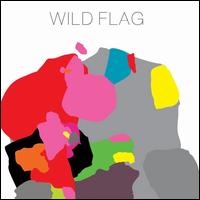
SOUNDTRACK: WILD FLAG-Wild Flag (2011).

For reasons unclear to me now, I wasn’t psyched when I heard about this band.  Despite the fact that it was 2/3 of Sleater-Kinney and the force behind Helium joining together, I didn’t jump for joy.  But now that I have listened to the album a million times, I can say that it is one of the best albums not only of that year, but of many years.  Man is it good.

Sleater-Kinney was a great band, they were melodic and tuneful but also abrasive and occasionally off-putting.  Who knew that the majority of the adhesiveness came from Corinne Tucker (well, she was the screamer, admittedly).  It’s pretty clear that Carrie Brownstein is bringing a ton of melody (and a wee bit of amativeness) to the mix.  Mary Timony always included trippy imagery and a weird kind of whispered/loud singing voice.  The tunes are so catchy so strong, so singalongable.

There’s little moments in each song that are amazing.  The backing vocals (and the pitch shift in the chorus) in “Romance”.  The way “Something Came Over Me” sounds so different from “Romance” (and is clearly a Timony-sung song).  I absolutely love the guitar “solo” that begins each verse and how it stands out but fits in so nicely as a baritone guitar sound (I assume from Carrie?)  “Boom” is just a full-on rocker with some great guitar pyrotechnics and Carrie’s more extreme vocals.  And man is it catchy.

“Glass Tambourine” is a cool trippy psychedelic workout  that’s still catchy and interesting.  “Endless Talk” has a strange British retro vibe.  (Carrie seems to be singing with a kind of punk British voice).  And there’s lot of keyboards.  It’s great that the album has so many different sounds, but still sounds cohesive.  “Short Version” has some great guitar soloing in the front and back.  “Electric Band” is like a perfect pop song–great backing vocals, great poppy solos and a cool video to boot.  “Future Crimes” is another amazing tune, with a keyboard solo!

“Racehorse” is probably my least favorite song on the disc.  It’s got some cool parts and some interesting swagger (and I like the live versions where they really jam) but the album version feels a little dragged out (although the chorus is really hot).  The disc ends with the wonderful “Black Tiles” which could easily be a Helium song, but which still sounds very Wild Flag.

And, I can’t say it enough, Janet Weiss is amazing on drums.  I feel badly because I tend to leave out the keyboardist–because I don’t know who she is or the band that she came from.  But her keyboards play an essential role in the music.  They fill out the spaces that the two guitars don;t always fill.  They even introduce the opening of the album.

If you go back through previous posts you’ll see I’ve mentioned them 3 times already because they have special bond with NPR and three of their concerts are available there.  I can’t wait for more from them.

[READ: May 8, 2012] Grantland 2

I was surprised at how much I enjoyed Grantland #1.  So I was pretty excited to get Grantland #2.  #2 has all of the elements that I loved about #1–non-sports articles about entertainment (video games, music, TV), and sports articles that are short and digestible for a non-sports fan.  This issue also features a number of really long articles about basketball.  I like basketball fine, but I can’t say I paid any attention to the lockout.  Thus, much of this was lost on me. It probably doesn’t help that I don’t know any sports people either.

I may have said this last time, but I will reiterate for Issue #3–for those of us who don’t follow sports, or those of us who may not remember back to September when most of these articles were written, or heck, for people who are going to read this in ten years’ time:  For certain articles, can you give us an epilogue about what happened after the article was written.  If you speculate about  the lockout. Have an epilogue to say about how the lockout turned out.  If you talk about a game 5 of a series and the series didn’t end, have an epilogue that tells us how the series ended.  It doesn’t have to even fit the style of the article, just a few words: so and so ended like this. It can show how prescient the writers were.  And it can help us complete the stories.

So, despite a few articles that I thought were too long, (although probably aren’t if you love basketball) I really enjoyed this issue of Grantland, too. (more…)

Read Full Post »

« Newer Posts - Older Posts »