Feeds:
Posts
Comments

Archive for the ‘Essays’ Category

SOUNDTRACK: CIAN NUGENT-“My War Blues” (2012).

I’ve never heard of Cian Nugent before (pronounced KEE-en).  He’s an Irish guitarist (his guitar playing reminds me of José González).  And this is a cover (but not really) of Black Flag’s “My War.”  What it really is is a solo acoustic guitar workout that is inspired by the riff of “My War” (there’s no vocals).  I love Black Flag and I can say that if I didn’t know that bit of information, I would never have guessed a connection.  But having said that, this song is an inspired workout.

He plays some wonderfully dissonant slow notes as the song opens.  From there, it picks up speed as Cian tests out some new variations.  And then he gets into the solo section, sounding like an inspired Richard Thompson, he plays one of he meanest acoustic guitar solos I’ve heard in ages.  At times angry, at times jaunty, and all the while keeping the beat on the low strings.

I’m going to have to check out more by this guy.

To hear this track, check out NPR.  You’re one of them.

[READ: May 15, 2012] “First Atlanta and Then the World”

This article comes from the archives, one of three monthly suggestions from my work that I enjoy checking out.  It’s a brief history of the rise of Coca-Cola from small idea to global behemoth.  But, and here’s the kicker, it comes from a local publication: The Georgia Historical Quarterly, so there is no (real) politicking in the article.  There’s nothing about global hegemony, there’s nothing about high fructose corn syrup and nothing about obesity (it was written in 1987, back in less politicized days).  And I have to say, this made it more fun to read.  Not because I have any vested interest in promoting the worlds’ most recognized brand, but because the Coca-Cola story is pretty fascinating.  And it’s interesting to read it from a local perspective.

I don’t know how scholarly The Georgia Historical Quarterly is (since it’s on JSTOR I know it has certain aspects of scholarship—it’s not just a booster for Georgia), but the tone of this article is very light, very fun.  It makes for an interesting read. (more…)

Read Full Post »

SOUNDTRACK: OKKERVIL RIVER-“All You Little Suckers” from Score! 20 Years of Merge Records: The Covers (2009).

 This is another cover of an East River Pipe song.  (I get the feeling that Merge has signed maybe six bands in total).  I didn’t mind this cover so much when I listened to it the first few times—it’s weirdly high-pitched towards the end and kind of melodramatic all through, but I didn’t find it awful.

But once I heard the original, I decided that I didn’t like the cover much.  The original is simple and understated, highlighting the melody.  Plus it’s nearly half as long as the cover.  Why the cover is as ponderous as it is, I don’t know.  Score one for the original.

[READ: April 29, 2012] “My Mother, Myself”

Another article from The New York Times and another article that changes what we think of Rivka Galchen.  In this one, we meet Rivka’s mother, the driving force behind her life choices.  In other words, she insisted that Rivka would keep being a doctor.

As we know from other articles, Rivka no longer wanted to be a doctor (again, I still haven’t read if she finished school or not).  And she was hoping to use the experiment that comprises this article as a test.  She would be going to Guatemala for three weeks of immersion learning of Spanish.  She would also be participating in a trial study for a vaccine for traveler’s diarrhea (for the cost of room and board and study). (more…)

Read Full Post »

SOUNDTRACK: THE HIVE DWELLERS-“My Noise” from Score! 20 Years of Merge Records: The Covers (2009).

The Score! collection finally produced a cover I do not like.  I don’t know anything about The Hive Dwellers, but this feels more like a joke than a cover.  The voice is the voice I make when I’m making fun of a song.  And the instrumentation is a series of strange keyboard notes and random drum noises.  I might like it if it weren’t a cover–and I guess I do respect them for going so different from the original.  But man there’s not much to recommend here.

Go for the Superchunk original, without a doubt.

[READ: April 27, 2012] “case notes of a medical student, east harlem, psychiatric ER, winter 2002”

I try not to have the same author two days in a row, but I included this to show what a fascinating career Galchen has had and how incredibly different her published works can be.  So, yesterday it was an article about Borges.  Today it’s about her work in a psychiatric ward.

Triple Canopy is an online journal of some kind–I’ve actually never heard of it before.  It’s graphically interesting with lots of pictures and a cool interface.

This article is about nine slides long.  It printed on one page with very small type.  Galchen offers an introduction as to just what she was doing in the ER (exhaustion from three years of medical school and an opportunity to stop touching people for a month).  Although she admits her heart wasn’t in it. (more…)

Read Full Post »

SOUNDTRACK: TRACY THORN & JENS LEKMAN-“Yeah! Oh Yeah! from Score! 20 Years of Merge Records: The Covers (2009).

This cover makes me think that I like The Magnetic Fields for their songs, but not really for their singing or arrangements.  This song is pretty hilarious (every yeah oh yeah is in response to something awful (Do you want to break my heart?  Yeah, yeah, Oh yeah!).  The cover by the wonderful Tracy Thorn & Jens Lekman is much more understated than the original, with simple instrumentation.

The original is a chiming, kind of noisy track.  While the cover has Thorns beautiful voice languorously singing the lines while Lekman chimes in.  The backing music is delicate and almost sweet (a nice contrast to the lyrics).  I think the song is fantastic, but once again, I like the cover more than the original.  This is especially surprising as the cover is actually slower than the original.  But, really, it’s hard  to pass on Jens Lekman.

[READ: April 30, 2012] “Borges on Pleasure Island”

When I browsed for Rivka Galchen articles the other day, I found a few published works that were not in Harper’s or The New Yorker.  So, yes, I’m going to write about them here.  And since I’m caught up with the end of Gravity’s Rainbow, these short non-fictions were a nice balm.

I have been encountering a lot about Borges lately.  Roberto Bolaño loves him, there was a recent article in Harper’s about him (a review of some new translations called “The purloined Borges: Translation and traduction” by Edgardo Krebs) and now I get this article.  This article is a strange one–and I’m not entirely sure where it would have appeared in the Times.  It’s strange because it’s kind of a review of a new collection of Borges’ work (this one called On Writing, the first of three Borges’ related works published that month).  Although really she only talks about one essay, “Literary Pleasure.” (more…)

Read Full Post »

SOUNDTRACK: THE NEW PORNOGRAPHERS-“Don’t Destroy This Night from Score! 20 Years of Merge Records: The Covers (2009).

 This is one of my favorite tracks on this compilation.  The New Pornographers grab this song and don’t let go.  It’s loud and catchy and wonderful.  I didn’t know the original of this song either (evidently I don’t know any bands on Merge Records except for Superchunk).

The original is by the Rock*A*Teens, whom I don’t know at all.  I listened  to the original and while the chorus is very similar, the verses are much slower (which is funny given their name).  The Rock*A*Teens version is even kind of moody.  The New Pornographers don’t really increase the pace at all, but there’s something about it that make it seem brighter, poppier.

Once again, I like both versions, but the New Pornographers edge out a bit.

[READ: April 6, 2012] “Dream Machine”

After reading all of those Harper’s pieces by Rivka Galchen, I decided to see if she’d written anything else that I could get my hands on.  Turns out that she has written this essay for the New Yorker (and a short story that I hadn’t seen as well as a few other short pieces).

This essay is about quantum computing.  I had recently read something about the potential of quantum computers, so I was intrigued to read this more lengthy and detailed piece.   As she states: “With one millionth of the hardware of an ordinary laptop, a quantum computer could store as many bits of information as there are particles in the universe.”  Not bad, eh?

It could also do what other computers only dream of (heck, it could probably even dream).  The key is that quantum computers are not binary.  Regular computers do either 1 or 0.  That’s all.  Quantum computers can do 1 and 0 and both–all at the same time.  Exactly what that means is a bit harder to grasp, and although the article helped, my summary is about as good as I can do.

For the article, Galchen talked with David Deutsch, the “founding father” of quantum computing (as well as a few other physicists). Deutsch believes that if quantum computers work, it validates the Many Worlds Interpretation (which is just what it sounds like).  But many physicists who believe in the potential for quantum computing either do not care about or simply avoid talking about Many Worlds. (more…)

Read Full Post »

[ATTENDED: April 11, 2012] David Sedaris

I have enjoyed David Sedaris for a number of years now.  When our friend Melissa went to see him a few years ago, she said he was hilarious.  I’ve heard several readings done by him and had to agree with her–he’s very funny live.

I find that he’s much funnier when I hear him read his stuff than when I read it myself.  Indeed, when I read his stories I try to imagine it in his voice, just so it will be funnier.  Turns out he does a much better David Sedaris than I do.  Each of the stories was very funny (tear-inducingly funny) and very typically Sedaris.

This show was him on stage reading from a number of his pieces and from his diary.  I didn’t know the first piece, called “Understanding Owls,” which was about Owls and taxidermy.  It was also about trying to find the perfect Valentine’s Day gift for his boyfriend of 20 years (wow!), Hugh.  He wanted to buy a stuffed owl because of a long running joke about all of the owl tchotchkes in their house.  The setup alone was hilarious and the sequence in the taxidermist was very funny and rather uncomfortable. (more…)

Read Full Post »

SOUNDTRACK: ST. VINCENT AND THE NATIONAL-“Sleep All Summer” from Score! 20 Years of Merge Records: The Covers (2009).

This cover is by The National with St. Vincent singing a duet with The National’s singer.  The original, by Crooked Fingers, is also a male/female duet, so this works nicely.  Indeed, having listened to the original, there’s not a lot of difference between these two versions.

The singer from The National has a distinctively deep voice.  And I really like St Vincent, although on this song, she’s not really doing anything amazing, she’s just singing (very nicely, but she could be anyone).

It’s a perfectly nice song, in both versions.  The original is a bit more interesting musically, but I like the vocals in the new version better.

[READ: March 15, 2012] “Gentleman’s Servant”

If you have read my other three posts about articles from Colonial Williamsburg, you have seen the cover of this magazine.  And, man, does it make me uncomfortable.  About as uncomfortable as I feared this article was going to make me.  I almost didn’t read it.  In the previous article I mentioned how the photos look…wrong.  And none look more wrong to me than the series of pictures for this article.

However, this article was not about slaves exactly.  It was more about servants or valets.  The article immediately puts us at our ease by telling us that there are schools today that teach how to be a valet, primarily in England.  And they make it out to be not such a bad gig.  It puts me in mind of Jeeves and Wooster, and what a lark it must all be.

Of course in the 18th century things were quite different (although it is described as similar duties–caring for the master and the master’s clothes and horse and such).  This paragraph tucks in a key phrase as it tries to make it all seem casual: (more…)

Read Full Post »

SOUNDTRACK: BRIGHT EYES-“Papa was a Rodeo” from Score! 20 Years of Merge Records: The Covers (2009).

I don’t especially like Bright Eyes.  But, as with Ryan Adams, his covers are quite good.  The Magnetic Fields are pretty distinctive when it comes to lyric and melody.  I’ve enjoyed a lot of their recordings, and once you get into The Magnetic Field’s mindset it’s hard to imagine anyone else singing his songs (that voice!).  But if you haven’t heard a song for a while, it’s fun to hear a new interpretation.

And I really like what Bright Eyes does with this song–especially the backing vocals and harmonies at the end of “one night stand.”  And–personal preference–the covers is paced a little faster, which I like, too.

[READ: April 2, 2012] “Disaster Aversion”

This is the final article by Rivka Galchen in Harper’s.  One would never expect an article with that title to be as personal as this one was–but I think Harper’s has a way of bringing that aspect out of writers].  For instance, the opening line is, “Like many a girl with a long-dead father I refer to myself as a girl rather than as a woman, and I gravitate to place I suspect my father, dead fifteen years now, might haunt.”  Her father wa sa professor–which means that Rivka needed to go see the Whitney’s Buckminster Fuller Retrospective (which sounds awesome, frankly).  I love this comment, which feel so true: “My father either admired Buckminster Fuller tremendously or thought he was a tremendous fool.  I can’t remember which.”

Rivka doesn’t know all of the details of her father’s work, but she knows the basics, so when she started doing some investigation into storm and weather modification, she was right in her father’s area.  Her research led to a Project STORMFURY from the 1960s.  And she grew interested in modifying hurricanes.

The article basically details her attempts to speak to weather scientists and to ask them questions about current and future opportunities for reducing the damages done by hurricanes.  As with much non-fiction, it doesn’t seem worth it for me to summarize her research–just read the article, its quite enjoyable.

But the fun part comes from the scientist she had a really hard time interviewing.  She spends most of the article puzzling about why this renowned scientist won’t speak to her–won’t even see her.  She has many reasons at her disposal for why the man won’t speak to her–the man knew her father and maybe his eccentric and at times confrontational behavior put him off of her family. The true is far more amusing. (more…)

Read Full Post »

SOUNDTRACK: RYAN ADAMS-“Like a Fool” from Score! 20 Years of Merge Records: The Covers (2009).

I don’t particularly like Ryan Adams’ songs, so I was surprised how much I liked this cover of a Superchunk song.  The cover has an interesting vibe, a kind of Pearl Jam (in the guitars) meets Radiohead (in the vocals) sound.  It’s not too different from the original, although, as with many of these covers, I like the recording quality better.  I know I love my lo-fi world, and I love Superchunk but these newer versions just sound better.

Adams has a good voice, and he adds just enough orchestration to make the song a wee bit more interesting than the original.

[READ: March 15, 2012] “Department of Deportment: Stances and Dances Made the Eighteenth-Century Man–and Woman”

This article was intriguing but wasn’t quite about what I wanted it to be about.  Also, what was weird about this article–not so much with the others in the magazine so far, is that the photographs look simply too modern.  Usually for period pieces there is a hint of aging done to the film.  Obviously for the magazine they want the best possible quality photo, but it just looks really…fake?  Obviously modern people in old homes and dress.

The other thing that is odd to me about this article is that it begins with the idea that the reader doesn’t know what deportment means, or  that we misunderstand its meaning.  The true meaning–upright behavior and moral uprightness–doesn’t seem that hard to grasp.

However, despite these criticisms the article has some interesting history to impart.  The idea was that Gentlemen and Ladies were educated and would act with honor.  And part of that honor was the way one stood and acted.  Thus, Gentlemen had to maintain deportment.  Etiquette books also taught how to treat people of equal–and lower–standing.  Some people tried to appear gentlemanly by quickly learning deportment–but rules were complex and fakers were easily caught.  And those who were caught were punished by being thrown out of  a party or by public ridicule. (more…)

Read Full Post »

SOUNDTRACK: TOKYO POLICE CLUB “Cheer It On (Trey Told Em Remix)” and “Cut Cut Paste” from Viva Piñata! (2008).

Tokyo Police Club released one of the best LPs of short blasts of rock in a long time.  “Cheer It On” is a great song that name-checks the band and which I could listen to over and over.  It’s a hot punk blast.  This remix totally changes the song (which is better than just tweaking it or repeating the chorus over and over).  Trey makes it a discoey song (with the wah hoo! from “Celebration,” I believe) and big rubber disco bass lines over the music.  It really changes the sound. I like the original a lot better, but I enjoy a remix that actually remixes.

“Cut Cut Paste” is a studio release and it shows TPC in their element–a short fast song.  I love the way it starts out with a shifting guitar sound.  It has a great manic intensity.  Tokyo Police Club is definitely one of my favorite new bands.

[READ: March 20, 2012] Science News Letter

I’ve mentioned before when my company sends out links to articles that are interesting or cool.  Most of the time they are highly academic (that’s the kind of work I’m in), but they also do more general information as well.

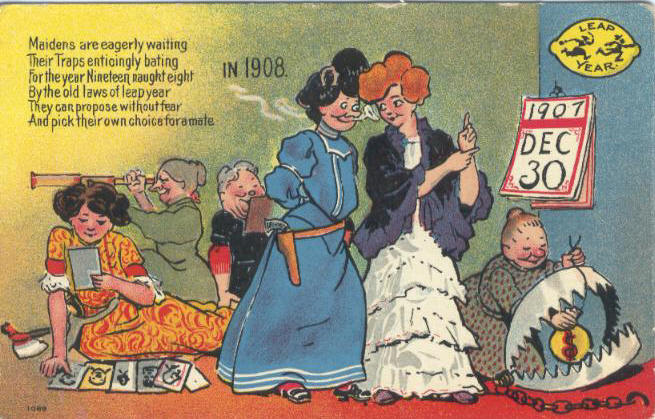
So this particular page was sent to us because of the article “Marriages Are Seldom Higher in Leap Year” (since this is a leap year).  There was a tradition in Britain and Ireland that on a leap year, women could propose to men (see the postcard below).

But this article (really only three paragraphs) which is addressed to “Marriage Shy Bachelors” says that only twice since the Civil War has the marriage rate been higher in a leap year (1896 and 1920) in America. And that in 1952 the supply of available unmarried persons has been depleted by the spurt in marriages following World War II.  Rest easy single guys! (more…)

Read Full Post »

« Newer Posts - Older Posts »