Feeds:
Posts
Comments

Archive for the ‘Drinking’ Category

SOUNDTRACK: RHEOSTATICS-The Horseshoe Tavern, Toronto Ontario (August 11 1994).

This is a monster show.  Nearly three hours long!  I’ve said before that I’d love to have professional recordings of certain shows and this would absolutely be one of them. Most of the show sounds pretty good although near the end the audience starts talking a little too loud. But man, what a set list.

This is one of the last shows Dave Clark played before leaving the band. This show was on the same day Introducing Happiness was reviewed as a new release in Now Magazine. (See the review below right).  The Setlist was a carefully constructed chronologically arranged 36 song, 2-set night.

They open the showing by thanking everyone for coming out on short notice, whatever that means.  Dave says they had 35 songs on the list  (they play 36 in total).

The first four songs are from Greatest Hits
Higher & Higher, Crescent Moon, Canadian Dream (which hasn’t gotten much play in the available shows) and Ditch Pigs.  They joke about their older songs: because we play some older music sometimes, like now, we forget the words, right Tim?  They also thank “anybody who helped us last night to cut our live track and video of Claire.”

The next song is “Royal Albert (Joey II)” which never appeared on an album, formally, so who knows how old it actually is.

Then there are five from Melville  (+1 later on)

A slow “Saskatchewan” builds very big by the end with Dave taking some of the last verse.  Tim observes that it’s a rough start tonight, although it all sounds quite good.  “Chanson sans Ruelles” has a quiet middle with a brushed section on drums.  When the song is over, because it is sung in French, Clark chimes: Tim Vesely for Governor General.  Bidini agrees saying, “he is Ray Hnatyshyn of rock.”  Upon assigning the rest of the cabinet: Bidini would be minister of sport; Tielli would be Finance Minister (of course) and Clark would be Minister of National Resources he is a national resource unto himself.

They start “When Winter Comes” and then they state:   at this point in When Winter Comes we’d like to express individually what the review in Now Magazine meant to us (if you click on the image it seems to come out a little more clearly).  Each of the four sings something.  Bidini: “nothing sweet nothing.”  Clark recites to the rhythm of his drum beats: “you know, Dave, I really like the things that they say all day but I got to know so I can tell you.”  Giving up he says, I love that Sloan album they gave one N–it’s better than the last one it’s better it’s cooler… why be mean to such a good band?  Bidini chimes in: “So the reason our album sucked is because Dave Clark listened to Sloan too much, obviously.”  Martin kind of mumbles his response but it’s something along the lines of, “I guess it mad me sad but it’s just another thing for a shirt.”  Tim says 1) we have to work really hard to complete that hoser rock opera.  The other thing is that its my weekly paycheck … 120 bucks?”  The rest of the song sounds great.

Clark: the next song [“It”] is one of my favorites and we don’t play it enough.  It’s followed by a fairly slow version of “Record Body Count” that gets the crowd really riled up.

“Woodstuck” is also not on a record.  But it’s a great song which they introduce as an “ode to a friend of ours who was really really into the hippie culture.”  1994 is the 25th anniversary of Woodstock (and the Woodstock ’94 concert).  Dave says to someone “you got that at the original Woodstock at the Pizza Pizza kiosk. Woodstock ’94 is brought to you by Pizza Pizza and their new… herbal pizza.”   In the “intermission” of the song Bidini throws in the lyrics to “Blitzkrieg Bop” with the same melody as the main song.

Referencing something, Bidini says Dan Aykroyd walked by and he was really polite, he said “excuse me,” which is pretty nice.  Clark jokes, “Did you say Ghostbusters?”

Next there’s 8 from whale music (+2 songs later)

“Sickening Song” sounds great and bright.  Afterward Dave sees “Matthew” and says “You got engaged?  Cool, congratulations young lovers. It’s our second Green Sprouts anulmen….no engagement.”

“Who” sounds good but they have a little trouble with those last few thump thump notes.  Soul Glue adds a heavy rocking coda to it.

Dave starts “Queer” by chanting “We’re here, we’re queer, we will not go away.”  At the end, Dave recite sa poem that ends, “Acceptance, forgiveness, and love.” which he says is from Broadway Danny Rose.  They also throw in a verse from “Good Guys and Bad Guys” from Camper Van Beethoven.

During he first verse of “Self Serve Gas Station,” the tape gets a little wonky.  And Martin’s changes the line: “What went wrong with Martin?  Is he stoned?” Someone shouts “yeaahh” and there’s the retort: “how do you know?”

Martin plays the blistering riff to RDA a few times before they take off with the song.  And then it’s time for a short break.

Clark announces, “we’re back.  This song is called “You Shook Me All Night Long with a Shaved Head.”  “Shaved Head” is quite pretty and slow.  They introduce James Gray of Blue Rodeo on keyboards and Tim plays accordion for “What’s Going On?”

They play 2 from the Whale Music Soundtrack.  About “Song of Flight” Dave says, “we played that song in Kingston and a smallish college student did a bird dance in 7/8.”  And then for those who got a free single at the Bathurst Street Theater, they play “Torque, Torque.”

Then there’s 10 from Introducing Happiness (+1 song later).  They introduce “Claire” as “Wet Home Alabama.”  After Fan Letter to Michael Jackson, they say, “The king is dead long live Lisa Marie and Michael.  Congrats to Michael on his wedding… that’s three Green Sprouts weddings.”

After mentioning a convoy, Bidini asks Clark “What was your CB handle?”  “Fuzzy Wuzzy.  I played CB with my best friend–it was strictly platonic.”

As Earth/Monstrous Hummingbird opens, you can hear a lot more crowd noise.  Talk of “I’d like to hear that recording.”

After “Me and Stupid,” Dave says “I’m afraid that when we go to England and play in front of  packed house of 150 British screaming Moxy Fruvous fans and we get up there to play California Dreamline” this is all that’ll come out  (some crazy nonsense noises) and they’ll love us and we’ll be on the cover of all the music magazines and we’ll never be able to face anybody in Canada again.”  Clark disagrees: “bullshit don’t believe your own mythology.”

“The Woods Are Full of Cuckoos” is “about a great Canadian band.”  And “Artenings Full of Gold” is weirder than ever, the “digging a hole” section sounds very much like Zappa (with high-pitched laughing whoooos).

Really fast PROD after which Clark asks, “how’s it feel to be in Ontario after the legal drinking hour?”

In the beginning of “California Dreamline,”Martin messes up and has to start over.  And then they all mess up…hold on false start.  Someone jokes, “Sounded like the Stones alright.”  They resume mid-song.  Martin says, “Stop.  Fuck this song let’s move on.”

So they pick right up with “Horses.”  Its fast and powerful and at the end he chants: “help break the owners of Major League Baseball, boycott professional sports.”  Speaking of sports, “Might as well award the Montreal Expos works series champion right here and now, ok.”  Then Dave says, “to my friend Steve from Hamilton…that didn’t count the CFL in that boycott of professional sports, all teams except the Hamilton Tigers.”

Bidini continues, “You braved the cold and blizzard conditions… oh it’s August, sorry.  So our record came out Tuesday with general release in October when they’ll play the Bathurst Theater.  He gives a plea to “Help Canadians music dominate worldwide in the 1990s.”   Clark, “And don’t forget those condoms when they’re at the Commonwealth Games.”

They come back for an encore with “Row.”  It’s sweet and quiet—not a really exciting encore, honestly.  But it’s followed by a romping “Legal Age Life,” which gets everyone really moving.

Such a great show.  It’s shows like this that make me wish that a) I knew about the band back then and b) I had actually seen them live.

[READ: June 5, 2017] Clean, Cleaner, Cleanest

This short story is a brief description of an older woman’s life.  Not a lot happens in terms of plot, but it is a wonderful story full of detail and character with a satisfying ending.

Marie is a maid at a motel.  She has worked there for nearly 30 years.  She is Catholic and goes to confession often.  But “she was more flexibly Catholic than strictly Catholic, so she did believe in birth control.”  The condoms she found stopped bothering her because safe sex was better than abortion.

Over the years she had seen the drug users go from needles to pipes to meth and now back to needles.

She also learned to be clinical about the messes she cleaned up: feces and urine to made it sound like she was helping people rather than dealing with the worst of them. (more…)

Read Full Post »

 SOUNDTRACK: GABRIEL GARZÓN MONTANO Tiny Desk Concert #623 (May 26, 2017)

I have no idea who Gabriel Garzón Montano is.  The blurb suggests that even if I don’t know, others certainly do.

I was, admittedly, thrown for a loop when Gabriel Garzón-Montano told me that he wanted to perform unaccompanied, just him and a piano. The meticulousness of his work is clear on his debut album, Jardin, a three-year creative process in which Gabriel plays most of the instruments, tracking them to two-inch tape, layering its overall sound. Jardin takes its title as an umbrella; fruits, bugs and other plants are the driving metaphors tying together this dense work, which blooms over successive listens. Garzón-Montano doesn’t necessarily wear his heart on his sleeve — he forces you to listen and peel the layers back.

Garzón-Montano’s career trajectory veers wide — living with Philip Glass for a year while his late mother played in the composer’s ensemble, sitting under the minimal maestro’s piano as he practiced; Lenny Kravitz making possible his first tour experience; while Drake exposed Gabriel’s sound to the masses.

That decision to go it alone at the Tiny Desk made sense, though, the moment he started to play; his talent is left elegantly exposed in this unadorned performance. He says his visit to the Tiny Desk “with just piano and vocal reminds me of what is lost when a song is fully produced and arranged — it was an exciting and vulnerable experience. I was nervous for this one.”

Here then, are three songs from Jardin, along with the song that introduced Gabriel to the world… laid bare.

When I listened to this the first time I thought he played 2 longish songs but indeed, there are 4 shortish songs.

I really love the piano sound he gets but the r&b style of pop singing is not my thing and so many “babys.”

I singled out a few things in the songs.  The line in “My Balloon” “I’ll get back on my balloon and meet my baby on the moon” I find endearing even if it is kinda dumb.  I enjoyed the way “Long Ears” came seamlessly from the first song.  It starts with a high note and falsetto vocals. It’s much more interesting than the first song.  And the second half of “Long Ears” is quite interesting, almost dissonant–although I could do without the you you you section.

I thought the first line of “6 8” was “fuck me real slowly,” which was disconcerting.  Especially since a later line was “I’m just like a baby drooling over you.”  But I believe it is “rock me real slowly.”  It segues cleanly into the final song, “Crawl.”  I think he stars in the same falsetto but then switches to a deeper voice.  I love the bouncy middle section that sounds like a musical.  Although once again there’s too much oo ooo ooo ooo.

All of those vocalizings sound especially flat during an under produced occasion such as this.

[READ: April 26, 2017] “You Are Happy?”

This story was fairly straightforward, but it opened up a cultural aspect that I had no idea about.

The main character is Laskshman, an Indian boy living in the United States.  As the story opens, we see Lakshman’s grandmother telling Lakshman’s father that he should break his wife’s arms and legs to prevent her from getting to the bottle.

Lakshman’s mother is an alcoholic, and, apparently, there is no greater disgrace for an Indian woman.  At parties–parties that were usually segregated–she often joined the men and drank and gave her opinions, to the disgust of all present.

She had begun drinking was Lakshman was 8 and they moved to America.   But by the time he was 9 she was drinking during dinner.  When he turned 11 she was drinking during the day.  His father had had enough.  He stated matter of factly that she was a drunkard.  Their marriage had been arranged and they never grew to love one another.  This certainly didn’t help. (more…)

Read Full Post »

SOUNDTRACK: TIM DARCY-Tiny Desk Concert #620 (May 15, 2017).

I really like Darcy’s band Ought, but I don’t really like this solo concert.  In Ought, I find his voice contrasts nicely with the punky music (and his arch delivery of the kind-of-spoken-words if entertaining to me).  But here he’s singing some pretty straightforward songs and I find his affected delivery to be kind of annoying.  The blurb name checks Roy Orbison and I’ve never liked Orbison’s voice either.  So I guess that makes sense

Darcy plays four songs–he’s on guitar for three of them.

“Still Waking Up” is first. He says that “Joan Pt. 1, 2” is more of a rocker on the record but he’s taking it down–wonder if I’d like it more as a rocker?  Musically I like the way it switches gears for Part 2 and I like his voice a lot more for this second part.  “Sledgehammer And The Rose” is a new one.  I like the slinky guitar lines at the end of each verse. For the final song, “What’d You Release?” Toronto songwriter Charlotte Cornfield plays piano (with no guitar).  His voice is a bit deeper on this one and it works pretty well with the slowness of the piano.

But I gather I’d prefer him with his band.

[READ: March 22 2017] “Herman Melville, Volume 1”

The previous Lodato story that I read concerned a young meth addict.  This one concerns a twenty year old homeless girl.

She remains unnamed throughout the story and we learn snippets of her past.  Her father apparently committed suicide recently and she has nobody else.  Her only thought about him is that she hopes someone is watering the grapefruit tree in his backyard.

She had been experimenting with running away–she gathered a lot of her stuff and some money and would head to the Greyhound station.  She would hang out there for a while and then ultimately go home. Then one day Evan was there.  He smiled at her and commented on her skateboard and banjo.  She began to cry and he held her and they have been togetehr for the past seven months.  He has even proposed to her (although nether one has mentioned in since, so who knows if it meant anything).

(more…)

Read Full Post »

SOUNDTRACK: alt-J-Tiny Desk Concert #614 (April 24, 2017).

Alt-J have been reduced to a trio.  And their sound has gotten even more delicate and almost pastoral.

Bob Boilen loves Alt-J, and that’s why they’ve been invited back for a second time.  He explains:

As the primary booker of the Tiny Desk Concerts, I have this self-imposed rule: No artist can come back for a second visit unless there’s something wholly different about what they’re doing. The first time alt-J played the Tiny Desk, in 2012, they came as a four-piece; electric guitar, bass, keyboards and drums. They were a pretty new band, their album had been out a few months and they were playing in clubs for a couple hundred people, not much more.

In the five years since the band visited it has found quite a few new fans. When I heard cuts from the newest album Relaxer a few months ago I flipped and tried to think of a way to bring them back. So I wrote them, saying I’d love to have them again but that it would have to be wholly, out-of-the-box different. I told them I’d hire a brass band, an African kora player if need be, a string section… They took up the challenge. They told me to find a cellist and two violinists.

I wrote to my friend Carol Anne Bosco, a cellist, who turned out to be a huge fan of the band and helped find two violinists for the performance. About four days before the performance the band sent the string parts, written by their friend Will Gardner.

On Monday morning, the English band met the American string players and they all gathered behind my desk. As they worked their way through a first pass at “Three Worn Words,” I noticed them and relieved — alt-J had actually never heard the string arrangements, this was the first time. They sounded beautiful. By noon, NPR employees and friends gathered around my desk to witness this astonishing concert from alt-J, including two new songs and two old favorites. Magic.

“3WW” is the first single and it sounds very different.  The song opens with a lengthy instrumental, and then the keyboardist Gus Unger-Hamilton sings lead.  It sounds quite a lot like an old English balladeer song.  Then standard lead singer Joe Newman takes over.  His unusual voice is especially recognizable but the song still stays quite mellow until the moment where the strings burst forth …but just for a bit until they sing the practically whispered, “I just want t love you in my own language.”

“In Cold Blood” sounds a bit more like their old style with a very interesting drums pattern from Thom Green: lots of fast snares and toms.  The synths feel almost Ren-Faire like.  There’s also a fun section of “la la las.”  I only wish I knew what they were singing about.

“Warm Foothills” is primarily piano and strings.  There’s a very delicate falsetto vocals (and even a whistle).  All three of these songs are new.  It’s interesting to realize that these songs won’t sound like this anywhere else or on record because they have the strings only for this show.

They then say they’re going to play something from their first album, to mutters of pleasure and when he says “taro” there’s a whoop or two and Joe jokingly goes “Yes!!”  This is a quiet guitar-base song and the strings really bring out elements of it.

alt-J are certainly a weird band but they have slowly won me over.

I happened to check Wikipedia about the band and found this interesting tidbit (veracity in question of course): “The band’s unusual sound stems from the fact that due to living in student halls, where noise had to be kept to a minimum, they were unable to use bass guitars or bass drums. Thom Sonny Green suffers from Alport syndrome, a rare genetic disease which causes hearing and kidney failure. As a result, he is about 80 percent deaf.”

[READ: March 8, 2017] “Crazy They Call Me”

I usually love everything that Zadie Smith does.  But this story didn’t do very much for me.

It is a kind of inner monologue of Billie Holiday.  I’ve always liked Holiday’s voice but I don’t know much about her life.  Like I didn’t know that Billie Holiday wasn’t her real name–which was Eleanora Fagan.  But I don’t think that that’s what made me not love the story much.

I assume this story takes place near the end of her life “you certainly don’t go out anyplace less than dressed, not these days.”  She is saying goodbye both to Elenora Fagan and even to Billie: “There is only Lady Day.”

Lady Day is mostly thinking to herself about her life. How she doesn’t really like other women, is mostly a man’s lady. (more…)

Read Full Post »

SOUNDTRACK: SAN FERMIN-Tiny Desk Concert #315 (October 28, 2013).

When I first heard San Fermin I was immediately grabbed by the female lead voice (the song was “Sonsick”).  It was so powerful and gripping. I didn’t realize then that the female leads were the lead singers of Lucius (who I also didn’t know at the time).  San Fermin is the creation of Ellis Ludwig-Leone.

Since then I have enjoyed other songs by them as well, although I find that the songs sung by Allen Tate to be somewhat less exciting to me– I feel like his voice could one day hit me as amazing but it’s almost a little to understated for me.  And yet musically I love the orchestration and chamber poppiness.  As Bob writes:

San Fermin’s music bursts with ambition, talent and extreme joy. Its self-titled debut is charged with great storytelling and amazing vocals by both Allen Tate and Lucius singers Holly Laessig and Jess Wolfe. Then there are the arrangements: little gems that turn these songs into cinematic vignettes using trumpet, sax, keyboard, violin, guitar and drums.

San Fermin is the musical vision of Ellis Ludwig-Leone, who wrote these songs with Tate’s dark, rich voice in mind. Here at the Tiny Desk, Rae Cassidy makes the album’s female vocal parts her own.

So it’s interesting that the songs were meant for Tate.  I want just some more oomph from him.  especially here in this set.  And that’s because Rae Cassidy absolutely rules this set.

“Oh Darling” begins with a gentle piano and Cassidy’s pretty, delicate voice.  After a verse from her, Tate’s voice comes in and it’s almost comically low and formal (and actually perhaps a bit too quiet).  But when they all come in and sing it is just beautiful–the women in particular.

For “Sonsick” Cassidy sings lead with just drums.  As the song builds there’s a great chorus where the backing vocals (including Tate) sing in falsetto.  This version is quite stripped down compared to the recorded version and it really allows Cassidy’s voice to shine.  When she hits those incredibly high notes with such power, it gives me chills.

In the final song, “Renaissance!” Tate sings lead over a slow piano and violin.  The women sing backing vocals.  I like the way that the song builds in intensity with more instruments, but his voice is a little too flat for me–although he does kick in extra at the end.

There’s a really stunning version of the first two songs with the band singing live in a street and cafe and France.

Incidentally, Cassidy has since left the band and gone solo, and I wish her much success.

[READ: December 28, 2016] Humans of New York Stories

Sarah got me this book for Christmas.  I knew of Humans of New York, of course, but I wasn’t a follower of it.  So while I knew of it I didn’t really know that much about it.

There’s a brief introduction to this book (which is his second HONY book) in which he explains that HONY grew from five years of experimenting.  It evolved from a photography blog to a storytelling blog.  His original inspiration was to photograph 10,000 New Yorkers.  But then he decided to start including quotes from some of them.

He started interviewing people and found their stories became the real heart of the blog.  Of course, he thanks the community of readers and participants, because without them, he has nothing.

The rest of the book–425 pages–collects the photos and the stories. (more…)

Read Full Post »

Frank Conniff–Twenty Five Mystery Science Theater 3000 Films That Changed My Life in No Way Whatsoever (2016)

tvfrankSOUNDTRACK: TA-KU & WAFIA-Tiny Desk Concert #577 (November 6, 2016).

Ta-ku & Wafia are Australian, and I knew nothing else about them.  So:

The chemistry between Australian singer-producer Ta-ku and his fellow Aussie singer-songwriter Wafia becomes apparent the instant you hear their voices intertwined in song. On their first collaborative EP, (m)edian, they draw on their individual experiences to touch on subjects like compromise in relationships as they trade verses and harmonize over hollow melodies.  With production characterized by weary low-end rumbles and resonant keys, the two float above the music, playing off each other’s harmonies.

Although the blurb mentions a few bands that the duo sounds like I couldn’t help thinking they sound The xx (although a bit poppier).

“Treading Water” especially sounds like The xx.  Both of their voices sound really close to that band (although Wafia’s high notes and r&b inclinations do impact that somewhat).  It’s funny that they are just sitting there with their eyes closed, hands folded singing gently.

“Me in the Middle” is another pretty, simple keyboard song with depth in the lyrics and vocals.

Introducing, “Love Somebody,” she says its their favorite on their EP and he interjects Go but it now, which makes her giggle.  Her voice is really quite lovely.  I could see them hitting big both in pop circles and in some alternative circles if they market themselves well.

[READ: November 10, 2016] 25 MST3K Films that Changed My Life in No Way Whatsoever

As you might guess from the title, Frank Conniff was involved with MST3K.  He was TV’s Frank and, as we learn from this book, he was the guy who was forced to watch every movie first and decide whether it could be used for the show.  This “job” was created because they had watched a bit of Sidehackers and decided it would be fun to use.  So Comedy Central bought the rights (“They paid in the high two figures”) and then discovered that there was a brutal rape scene (“don’t know why I need to cal it a ‘brutal’ rape scene any kind of rape ,loud or quiet, violent or Cosby-style, is brutal”) that would sure be hard to joke about (they edited it out for the show which “had a minimal effect on the overall mediocrity of the project.”

The book opens with an FBI warning like the videotapes except for this book it stands for Federal Bureau of Incoherence because the document contains “many pop culture references that are obscure, out of date, annoying and of no practical use to anyone.”   So each chapter goes through and explains these obscure references for us all. (more…)

Read Full Post »

SOUNDTRACK: HEM-Tiny Desk Concert #306 (September 28, 2013).

Hem is one of All Songs Considered‘s earliest discoveries. Back in 2002, we received a beautiful and unique album called Rabbit Songs. It was a homey, fireside kind of record, with a sound that could be called country or Americana, and the arrangements by Dan Messé made it feel quaint and warm. To top it off, there was singer Sally Ellyson, an untrained natural talent with an effortless yet breathtaking voice. Hem has gone on to make five more albums since Rabbit Songs; their latest, Departure and Farewell, finds the group still writing songs that feel as if they’ve always been there.

Bob is quite right about the feel of this band, the drums are actually foot stomping and piano tapping, and that makes the band sound like they are siting around cozy room with friends.   And then there’s her voice.  There’s nothing specific about it that stands out, and yet it really does.  Her voice feels incredibly warm and welcoming, making you want to stop and listen.  And perhaps it’s something about the recording which makes everything feel soft (but not muddy) and warm.

And even in the songs themselves, it feels like friends hanging out.  During “Walking Past The Graveyard, Not Breathing” they say “go George” as the intro to the bass solo and then “go Heather” for the violin solo.   “Tourniquet” has some great lyrics, between the alliteration at the beginning and the great metaphor of the song, I was so taken with the lyrics that I didn’t even realize how pretty the melody was:

Brooklyn, I’m broken — I’m breaking apart
Oh Brooklyn, your bridges are bound up in light —
Every artery’s clogged as you pull the belt tight —
And this tourniquet turns even tighter until
Traffic comes to a standstill

When the song suddenly takes off near the end (but only briefly) it really elevates the song which was already delightful.  Introducing the final song, “Seven Angels” she says they are excited to be there, playing in this format.  She says the song can be seen as a lullaby–she likes to sing it for her sister.  She says she doesn’t write the songs but she can pretend this one is hers.

It’s hard to imagine this band playing a venue much larger than this one–they seems right at home in a small space.

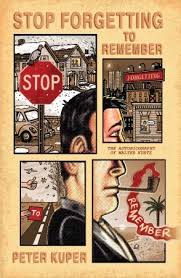
[READ: July 31, 2016] Stop Forgetting to Remember

This is a fascinating story about the comics artist Walter Kurtz.  I know very little about Peter Kuper, but I gather that this is sort of his life but written as an autobiography of somebody else.  (For instance, Kurtz was born on the same day as Kuper).

The back cover blurb also states how daring it was for Kurtz to write all of this –showing the embarrassing details, etc.: “My spouse would have killed me!”

This book is a collection of “stories” (not sure if they were ever published separately) that are joined by the narrative thread of Kurtz telling us about his life.  And the “occasion” for this reflection is the pending birth of his first child.  He is freaking out a bit–when he was young he never wanted kids, and then maybe he was cool with it, but recently he’s become terrified again.  He’s particularly afraid because he’s engaged with the world and he sees that as each month goes by, things get worse: AIDS, global warming, overpopulation, famine, wars (and that’s just 1996). (more…)

Read Full Post »

SOUNDTRACK: RENÉ MARIE-Tiny Desk Concert #557 (August 12, 2016).

René Marie has a classic jazz singer’s voice.  She has the tones and bounce perfectly.  In fact, her entire performance is timeless–one would be hard press to guess when this was recorded (if you didn’t know).

Her first song “Colorado River Song” was inspired by an NPR coincidence:

René Marie was answering phones at Denver’s jazz radio station KUVO when she sat down across from a fellow volunteer fundraiser. He would soon invite her on a canoeing trip and, without yet having seen the eponymous river, she wrote the giddy “Colorado River Song” on the way there.

She said had never been canoeing before and she was so excited that wrote this song on the way to the river.

Her voice sounds great, especially when she does some mild scatting in the middle of the song.  There’s a great jazzy piano solo, too.  She accompanied by her Experiment In Truth band (John Chin on piano, Elias Bailey on bass, Quentin Baxter on drums).

“This is (Not) a Protest Song” covers serious topics, but sing in a gentle and caring way.   She sings of her homeless brother and her crazy Aunt who fell through the health care cracks (not sure if these are actual relatives, but it doesn’t matter).  This song is a bit less jazzy (although it has some cool jazzy bass lines).  It’s a surprisingly upbeat song although none of it is in a hurry to get anywhere, it just sounds great.

“Sound Of Red” is a bit faster with a pretty wild (relatively) piano solo. She also has a lot of fun teaching everyone to do her dance moves–put your weight on it.

And the sweet canoeing trip has a very sweet ending:

In the audience [for this Tiny Desk Concert] was the bold KUVO volunteer from that day 10 years ago. His name is Jesse, and they’re now married and live in her home state of Virginia;

[READ: April 1, 2016] Sunny Side Up

The Holms siblings are responsible for the Babymouse series.  It took me a little while to get used to their artistic style in such realistic story (no mice or amoebas), but it doesn’t detract from the story at all.

I especially loved this story because it reflected my childhood in the settings (although not the story).  I loved seeing the images from the 1970s (like Tab in the soda machine and going to the iron-on T-shirt store down at the shore).  There’s even a Polaroid camera!

The story is told in flashbacks, and I have to say that if I hadn’t been told that there was a sad element to the story, I wouldn’t have guessed that at first.  But once I knew there was a sad section, my anticipation of the sadness proved to be worse than what the actual sad part was, so phew. (more…)

Read Full Post »

SOUNDTRACK: PATTY GRIFFIN-Tiny Desk Concert #282 (June 24, 2013).

I have Patty Griffin’s first two albums—I like her folkie sensibilities and her voice which I tend to think of as a little unusual.  And yet it’s not unusual here at all.  She sings powerfully and beautifully.

For this Tiny Desk Concert she’s playing some from her then new release:

she takes care to balance the exquisite mourning of “Faithful Son” — and the sweetly somber “That Kind of Lonely,” which Griffin describes as “a song about finally letting go of your delayed adolescence” — by closing her set with the playfully bawdy, kindly celebratory “Get Ready Marie.” Inspired by a favorite photo of her grandparents, the song finds Griffin viewing two complicated lives with the generous, hopeful eye she’s been casting on her subjects for three fruitful decades now.

She opens with “Faithful Son.” I love how the middle of this has a cool section where the two acoustic guitars (played by Griffin and Dave Pulkingham) face each other and strum hard for a bit.  The problem for me with this song is that the baritone guitar (played by Craig Ross) is either out of tune or the Ross hits a few wrong notes.  Since it resonates a bit louder than anything else, it’s really noticeable.  The accordion (played by John Deaderick) isn’t loud enough either.

“That Kind Of Lonely” is, as noted, a song about finally letting go of your delayed adolescence.  It’s a pretty, quiet number.  A good contrast to “Get Ready Marie.”  She says she is always picking on her family for stories.  She says she got this idea from a photograph of her grandparents taken just after they wed in the 1920s.  Her grandmother is looking at the camera like maybe she made the biggest mistake of her life and her grandfather (who looks really handsome) looks like he can’t wait to get his hands on her. They had a wild relationship—plates were lying.  This is a comic bawdy song that sounds like a traditional drinking song with some great lyrics:

No this isn’t the end of our story
No our marriage stuck like a habit
But I had a good hunch, when she kissed me a bunch
She could do other things like a rabbit

It’s in ¾ time and the accordion is louder here and it all sounds terrific.  It’s hard to believe that she’s been playing for 30 years, but she sure sounds like a pro.

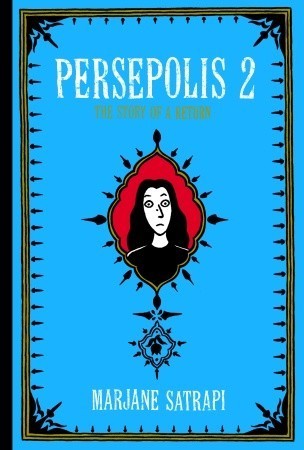
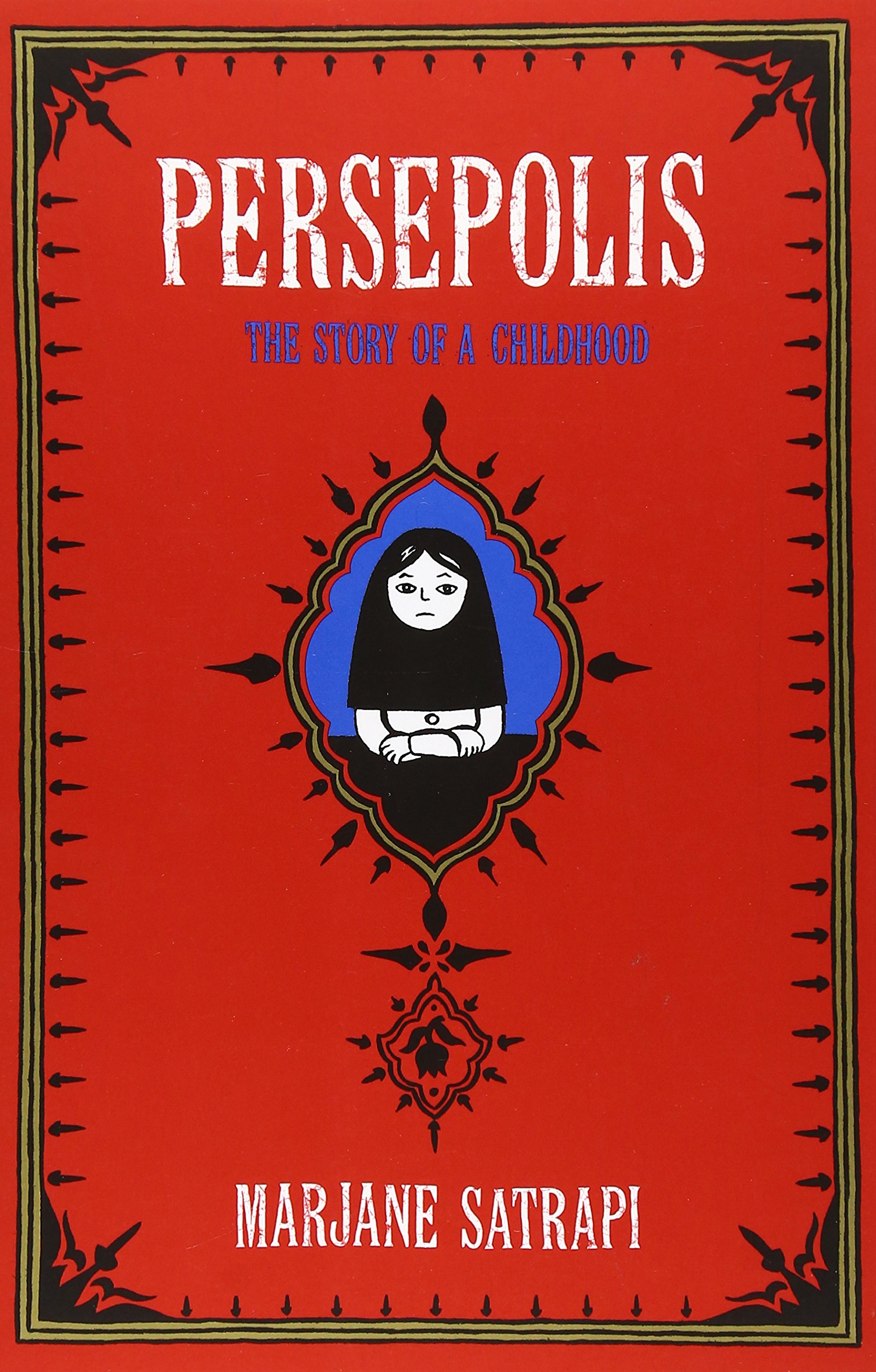
[READ: March 26, 2016] Persepolis 2

I found Persepolis to be an amazing book.  A peek inside a regime that was sort of mythically wicked during my childhood. Marjane’s personal story was interesting of course, but I enjoyed seeing just what was happening in this world that seemed so mysterious when I was growing up.

This sequel is a little less exciting because it is more or less about a lonely teenager in Europe.  I think if the first book wasn’t so groundbreaking, this one wouldn’t feel as disappointing.  Her story is interesting and her experiences are story-worthy, but compared to the first book this one is the awkward teenage years.

We see that Marjane’s being sent to Europe didn’t go quite as planned.  She stayed with her mom’s friend.  But the friend fought with her husband all the time and their house was not a happy one. They felt that they couldn’t look after Marjane so they sent her to boarding school in Vienna–Marjane didn’t speak German. (more…)

Read Full Post »

SOUNDTRACK: BILLY BRAGG-Tiny Desk Concert #281 (June 17, 2013).

I really like Billy Bragg.  Not necessarily all of his music, but I like a lot of it and I certainly love what he stands for.  If you like his instantly recognizable voice (which I do), then just about anything he does sounds good.  But no doubt some songs are catchier than others.

Bragg played a Tiny Desk Concert in 2016 with someone else as part of a duo.  I’d listened to that one first, but I liked this one more.

For this one he is accompanied on the first two songs by dobro player C.J. Hillman.

Bragg talks a lot–he has many lengthy stories between songs–and he’s pretty much always funny or thoughtful.  He introduces the first song by saying that moving into a new building always has troubles–you’ll always need someone to fix things up.  With that, his first song is called “Handyman Blues.”

It’s a great story song.  I especially like this line:

Don’t be expecting me to put up shelves or build a garden shed / but I can write a song about how much I love you instead.

It’s amusing that in the next song workers actually interrupt his song.  They were “met with lot of hammering on our rooftop by some real handymen as they put the finishing touches on NPR’s new home.”

For the second song they

channeled the spirit of legendary American folksinger Woody Guthrie, with whom Bragg collaborated — albeit posthumously, in Guthrie’s case — when he took Guthrie’s unsung words and set them to song with the help of Wilco. Here, he takes a song Guthrie himself co-opted and altered: a gospel tune (“This World Is Not My Home”) he’d turned into an anthem against inaction.

Bragg introduces this song as saying he took it over when the U.S. was having the debate about universal health care.  He says that people still face all the same problems that this classic song talks about–people losing homes to banks or families struggling to make ends meet.  But the middle verse is about a wife who dies on the floor for want of proper health care.  Bragg says that that doesn’t happen in his country anymore and it’s hard for people in his country to imagine that a generous country like the US still hasn’t resolved that issue (and five years later things are even worse with Trumpcare–#ITMFA #RESIST).

Guthrie called the song “I Ain’t Got No Home (In This World Anymore”).  After he sings a verse, the hammering starts and they pause the song to wait for the work to finish before he re-starts the song.  In the meantime they talk about what his band should do in Washington.  Someone says the National Archives and he jokes the Nashville Archive?  He says that they really enjoyed Nashville.  Then he mentions the National Archive to CJ and says

We can find out how the Americans started the war of 1812.  (chuckles).  I just played Annapolis, they’re still sore about it over there.  Never mind who won the war but who started it.

It’s another nice story song.  The dobro works perfectly with it.

“Sexuality” is the only song on this set that I knew.  It’s an old favorite that is serious and funny as well (and very progressive for when it was written).  It sounds terrific and is super catchy.  Although he comments that the acoustics aren’t that great in this new building–there’s not much bounce back off the walls “for those of us who technically aren’t great singers.  But for those of us who are buskers like myself, it’s not bad.”

Introducing the final song, “No One Knows Nothing Anymore” he says he read an article on the BBC about a kid who proved that economics professors were wrong and the article commented that “the trouble with economics is that no one knows nothing anymore.”  He says that had just written a song with that same name, so he’s with the zeitgeist.

He also interjects that there will be pedants–“and there are one or two who listen to NPR, I’m sure” who will write in to say it should be ‘no one knows anything any more.’  But the first thing they teach you at songwriting school is that alliteration trumps grammar.

And then he starts strumming “Sexuality “and says “Oh, I’ve just played that.”

“No One Knows Nothing Anymore” is a nice folkie, very-Billy Bragg song–good melody and really good lyrics.

At the end, as the camera fades to black he says “Chris, pass the hat around.”

I’m so happy that Billy Bragg is still making music.

[READ: March 26, 2016] Persepolis

This graphic novel is legendary, and I’m embarrassed it has taken me 13 years to read it.

Persepolis is a memoir of a young girl growing up in Iran during the 70s and 80s.  I appreciated the contextualizing introduction in which she explains the history of the country.

The introduction lays out a basic outline of the history of Iran and the Middle East (that goes all the way back to B.C years).  She explains that Iran has always been a rich nation and has constantly been under attack.  When oil was discovered, the West came calling.  Great Britain wielded a powerful influence over Iranian economy.  During WWII, Iran remained neutral but then was invaded by the west.

The Prime Minister of Iran (not the Shah) nationalized the oil industry in 1951 which led to an embargo and a coup organized by the CIA.  The leader, Reza Shah was succeeded by his son, Mohammad Reza Shah–known simply as the Shah of Iran.  The Shah stayed in power until 1979 when he fled to escape the Islamic Revolution.

She says that since the Islamic revolution Iran has been associated with fundamentalism, fanaticism and terrorism, but she knows that this is far from the truth.  And that’s what inspired her to writ this book.

(more…)

Read Full Post »

« Newer Posts - Older Posts »