Feeds:
Posts
Comments

Archive for the ‘Decadence’ Category

SOUNDTRACK: STEVE MARTIN & THE STEEP CANYON RANGERS-“Athiests Don’t Have No Songs” (2010).

We watched this Steve Martin performance on Austin City Limits last night.  Who knew that Steve Martin (yes, that Steve Martin) won a Grammy in the bluegrass category!  I’m not a huge fan of bluegrass–basically I like it enough for a few songs, but a half an hour is a bit much.

Nevertheless, Steve Martin is an amazing banjo player.  Anyone who has his comedy albums from the 70s knows that.  He used to play banjo between jokes (“Oh…death and grief and sorry and murder).  Now he tells jokes between banjo songs (the joke about the Grammy is very funny).

This song does not feature his amazing banjo playing but it is very funny indeed.

I just love the crazy notes that Martin hits near the end, which sounds so out of tune and yet fit very well together.

[READ: July 27, 2011] Five Dials 18b

The bulk of this short special issue is the five poems by Michael Robbins, a poet with whom I am unfamiliar.  The only other items included here are Craig Taylor’s Letter and Laurence Scott’s Currentish Events about Galliano and Gaddafi.  Since Five Dials issues are of varying sizes to begin with, it was unclear why this issue was a “b” and not the next issue, but Taylor sets us all straight.

CRAIG TAYLOR-A Letter from the Editor: On Spring and Robbins
They got into the publishing gig to be able to comment on things as they occur.  So this special issue is designed to usher in Spring and to introduce the world to the new poet whose title “Aliens v Predator” so impressed them that they asked him for five more. (more…)

Read Full Post »

SOUNDTRACK: RUSH-“Garden Road” (1974).

So the bootleg that I mentioned yesterday was in fact incomplete.  On the Up the Downstair site, the track list includes “What You’re Doing” and “Garden Road.”  When I wrote to the cool host of Up the Downstair, he said that these two songs were available on You Tube and that he’d try to find them and add them to the site.

So in the meantime, I got to listen to the song on YouTube.  This is a song that the band wrote but which they never recorded (same is true for “Fancy Dancer”).  I have to imagine that they wrote these songs for their second album (along with “In the End” which they kept) around the time that Neil Peart joined the band.  Once they realized that Neil could write better lyrics, they scrapped these two heavy rockers.  Both songs have great riffs, even if lyrically they’re pretty poor.

The song rocks pretty well, although the solo seems to have been put to better use in “Working Man.”  I enjoy how the song breaks for the shouts of the Garden Road chorus (kind of like “Bad Boy”–perhaps it was a “thing” for them).  I rather like this song, and I think I like it better than a couple of the songs on Rush.

Check it out.

Maybe it’s time to release these old chestnuts for the fans?

[READ: August 10, 2011] Life After God

After the success of Shampoo Planet, Douglas Coupland wrote several short books (which were really short stories).  They were compiled in Life After God.  To me this book also stands out as another odd one from DC, because it is very tiny.  Not in length, but in height.  It’s a small book, about the size of a mass market paperback.  But it makes sense that it was made this short because it is written with lots of short paragraphs that lead to page breaks (kind of like Vonnegut).

For instance, the first story contains at most two paragraphs per “chapter” about–16 lines of text and then a page break.  At the top of each page is a drawing from DC himself which illustrates to a small degree the information on the page.  It leads to incredibly fast reading and even though the book is 360 pages, you can polish it off pretty quickly.

But what’s it about?  Well, mostly the stories seem autobiographical (even though they are classified as fiction.  And actually, I don’t know anything about DC’s personal life so I don’t know if they are based on anything real, although I do know he doesn’t have any kids, so those can’t be true at any rate).  There are eight stories.  They are all told from the first person and are more or less directed at “you.”  They all seem to deal with existential crises of some sort.  They are honest and emotional.  To my ear, sometimes they seem a little forced, maybe it’s contextual, but it’s hard to write this kind of massively introspective piece and have it sound “real.”  (But maybe I’m not very introspective about things like this myself). (more…)

Read Full Post »

SOUNDTRACK: BASIA BULAT-“In the Night” (2008).

I recently came across Basia Bulat via NPR.  She played a Tiny Desk concert and I discovered that she had several other entries in the NPR canon.

Basia is Canadian (of Polish descent); she has a beautiful strong mid-range/throaty voice and a great sense of melody.  She also has a bit of a gimmick: she plays all kinds of instruments (guitar, piano, sax, etc) including some really weird and unexpected instruments: Zither, pianoette (!) and autoharp–a couple of years before PJ Harvey brought it back to the mainstream.

pianoette

“In the Night” is a wonderfully chipper poppy song.  And that autoharp gives it just a tinge of “huh?’ that makes it more than just a simple pop song.  The beat is fast and energetic, the harmonies are wonderful and the melody is top-notch.

I really like this song a lot, and the other snippets of songs that I’ve heard from her are equally wonderful.   I’ve even noticed that lately she’s been singing a song in Polish!

[READ: July 12, 2011] “Gastronomania”

I’m not going to go crazy reviewing all of the book reviews in Harper’s (that way lies madness), but occasionally an author I like writes a bit that I want to mention.  So Will Self, who I like but have not read a lot of, wrote this essay/book review about food.  He reviews three books, but what I especially liked about it was his introduction, which uses Luis Buñuel’s Le fantôme de la liberté [The Phantom of Liberty] as its starting point.  In the film (which I have not seen), the house’s dining room is actually a well…watch this clip:

It’s a wonderfully bizarre introduction to an essay about food.

It was unclear to me what made Will Self suitable to review three books about cooking.  And then (news to me) he revealed that he used to be a food critic (columns are collected in his book Junk Mail) and that Anton Ego in Ratatouille (yes that Ratatouille) bears “an uncanny, if not legally actionable” resemblance to him.

This essay was so much fun.  Self is as viciously negative about these books as he apparently was about food back in the day.  But he’s not dismissive of them as cookbooks per se, he’s more about trashing the current worship of food (and many other things too of course). (more…)

Read Full Post »

SOUNDTRACK: GUSTER-Easy Wonderful (2010).

This Guster album is confusing.  It’s rather short (compared to their other discs).  Combined with the (kind of flimsy) cardboard packaging, it feels almost like an EP.  It also seems to be kind of religious (although I don’t think it is)–like a themed EP.  And yet it isn’t off-putting or anything (a few mentions of Jesus is all, although that’s a lot more than usual).

But, like most of Guster’s releases, it’s super catchy kind of alternative jangly pop.  After one or two listens the songs are instantly recognizable.  There isn’t a bad song in the bunch.  However, they’re also mildly underwhelming compared to their previous releases.  The songs feel a bit more subtle, but really it seems like they might be just a little too smooth.  The dynamics aren’t quite as exciting as they have been.

Having said all that, the disc is still pretty great and I find myself humming a lot of these songs all day long.

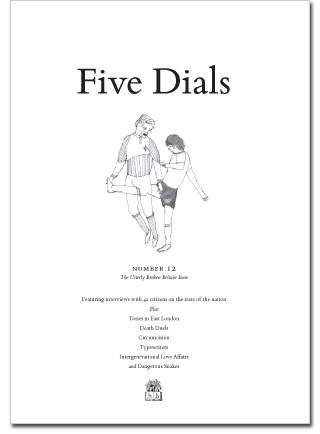
[READ: June 18, 2011] Five Dials Number 12

Five Dials Number 12 has a theme explicitly stated on the cover.  The premise of the theme is that the Conservative Party of Britain had been claiming (in their TV ads and billboards) that Britain was broken.  This idea was relentlessly pushed across Britain.  And Five Dials wondered if people thought that that was true in general.  So they asked 42 citizens (no idea what kind of random sample it may have been, realistically) and they recorded the results.

The rest of the issue has some of the standard Five Dials material we’ve come to expect: essays and fiction, advice and lists.  The theme gives an interesting tone to the proceedings.

CRAIG TAYLOR-A Letter from the Editor: On Broken Britain and Nick Dewar
Taylor addresses much of what is said above.  David Cameron (I still can’t get used to him being Prime Minister, it’s still Gordon Brown in my head–I guess Cameron hasn’t done much yet) is the man who keeps trying to “mend our broken society.”  Even though (and statistics are similar in the U.S.):

They found that violent crime had almost halved since 1995, while crime generally fell by an extraordinary 45%. The figures for teenage pregnancies – a favourite of those talking about social decay – remain constant since Labour came to power in 1997; so too do those for teenage abortions.

The rest of the letter is devoted to the passing of Nick Dewar.  Dewar drew the illustrations for Five Dials Number One.  I really liked Dewar’s style, and his absurdist sensibilities.  Taylor says that Dewar’s color work was even better.  And I think he’s right. (more…)

Read Full Post »

SOUNDTRACK: THE KOPECKY FAMILY BAND-Tiny Desk Concert #131 (June 6, 2011).

I’d never heard of The Kopecky Family Band, but the write-up about them was pretty interesting, so I decided to give the Tiny Desk concert a listen.  The band (all 7 of them) play a great collective of music: two guitars (acoustic & electic) bass, cello, violin, drums and keyboard.  They play a sort of traditional folk with a very full sound.

Indeed, they remind me an awful lot of The Head and the Heart (the singer’s voice in particular), although they are from different edges of the continent and have been playing music about as long as each other (indeed, The Kopecky Family Band released an EP in 2008 whereas Head and the Heart formed in 2009).

And the Kopecky website offers lots of free music (which is very cool).

“Howlin’ at the Moon” is a full acoustic sounding track.  “Birds” has a simply gorgeous whistle/xylophone melody that is as beautiful as it is catchy.  “Disaster” is a tender ballad with wonderful harmonies.  And “Red Devil” is a somewhat more rocking song, which really helps to demonstrate the bands’ diversity.

And the band is charming.  Keyboardist/singer Kelsey admits to having left a trinket of some kind of the office bookshelves (which are littered with things).  It’s a wonderful set, and because of it, I downloaded the band’s first EP from their site.

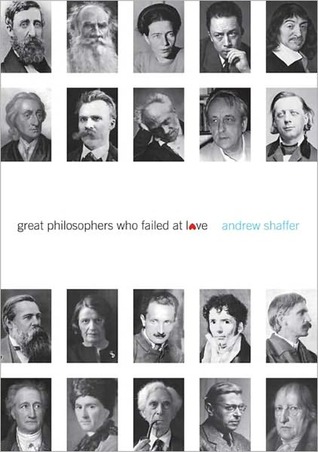
[READ: June 5, 2011] Great Philosophers Who Failed at Love

Shaffer was signing books at BEA this year.  My coworker told me that he was very funny and that he signed her book in an amusing way.  He happened to be signing at the table next to the line I was on. Sadly, he finished before I was able to get to him.  But I was pretty close to the beginning of the line, so I asked if I could grab a copy of his book, which I did (although no autograph for me).

This is a silly book of nonfiction.  It looks at thirty-seven philosopher or thinkers and their utter failure at love.  Each man (and occasional woman) has had some distinguishing characteristic that made them pretty lousy in the emotional range.

The title of the book is funny and is meant to be kind of surprising: these smart folks were terrible at love.  Of course, spending a minute or two thinking about who these people were and what they did, it’s not surprising that they were lousy at love.  These were intellectuals, people who spend most of their time in their own mind.  Of course they couldn’t have a serious relationship.

Nevertheless, these stories are all more or less amusing (Louis Althusser accidentally strangled his wife to death(!) which isn’t amusing per se, but the story of it is, kind of).  Shaffer does a great job at keeping each entry brief but really retaining the salient points of the thinker’s philosophy and a cogent example of his or her lousiness at love.  He also throws in some amusingly snarky comments of his own as he goes along.

I was delighted that the book order was done alphabetically rather than chronologically.  A chronological list would have been a little too samey in terms of each person’s context.  The alphabetical list allows for jumping around from say Plato to Ayn Rand which keeps the stories interesting and fresh.

At the end of each person’s piece, there’s an “In His Own Words” which offers a quote that details his or her written philosophy regarding love.

Dare I say that this is an ideal bathroom book?   It certainly is. And it makes you feel a little better about yourself (if you haven’t for instance, adopted your mistress as your daughter (Sartre)).

Read Full Post »

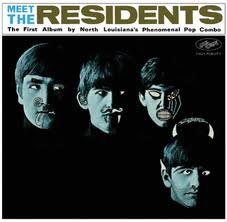
SOUNDTRACK: THE RESIDENTS-Meet the Residents plus Santa Dog EP (1973/1972).

Like a proto- Negativland meets Primus, The Residents took the world by storm in 1973.  Their debut album (pictured here) bore the unmistakable tagline: The First Album by North Louisiana’s Phenomenal Pop Combo.  And so it is.

Read more about the album in the Jon Savage essay below.

“Boots” is a sampled and remashed version of “These Boots Are Made for Walking.”  “Gylum Bardot” sounds like a Primus demo.  “Breath and Length” is noise and noise and effects and a soothing female vocal singing the title.   “Consuelo’s Departure” is a noisy soundtrack to nothing and “Smelly Tongues” sounds like a hammered dulcimer with a menacing bassline behind it until the vocals come in: “Smelly tongues looked just as they felt”.   And all 6 of these songs last less than ten minutes total.

“Rest Aria” changes tempo of things.  It’s five minutes long.  It starts as a simple piano track (slightly out of tune) but it slowly adds crazy horns and what sounds like children’s instruments.  The other longish song, “Spotted Pinto Beans” comes with a kind of faux chorus (female and then male) singing a kind of call and response which is overtaken by noise.

The one-minute “Skratz” comes between these two longer songs and is mostly  mumbling spoken vocal.  “Infant Tango” sounds like a normal song.  It opens with a funky wah wahed guitar.  Of course, the skronking horns and mumbled bass vocals tell you this is not going to be a hit.  It runs 6 minutes long with a strange little “guitar solo” in the middle.

“Seasoned Greetings” (with it’s weird holiday wishes at the end) segues into the 9 minute “N-Er-Gee (Crisis Blues”).  “N-Er-Gee” is a piano “melody” which is really someone banging the same notes very hard on the piano.  The voice on both tracks sounds like the aural equivalent of blackface until the sample (a very long sample that apparently voided placement on some releases) of “Nobody But You” morphs into a manipulated sampling of the word “boogaloo” and eventually becomes a dissonant chant of the title.

The appended Santa Dog is a bit more song-like.  Totally weird songs yes, but there’s actual melodies and lyrics.  Like on “Fire”: “Santa dog’s a Jesus fetus.”  “Aircraft Damage” is mostly a bunch of people reciting bizarre lyrics over each other.  The whole EP was about 12 minutes.  It’s weird but more palatable than the LP.

Despite how much this album foreshadowed loony alternative bands in the future, there is a clear predecessor in Trout Mask Replica.  Although Captain Beefheart followed a (relatively) more conventional song structure, you can hear elements of the Beefheart within.  This album is also notable for being made in the early 70s when the technology to do this easily was very far away.  You could whip this album up in a few minutes now, but back then with splice and paste, it would take ages.

It did not sell as well as the similarly titled Meet the Beatles.

[READ: June 16, 2011] Five Dials Number 11

Five Dials Number 10 was a special issue, but Number 11 goes back to the format we know.  It sort of has a theme about lists.   It contains half a dozen short essays and one long short story by Paul Murray (author of Skippy Dies).  This issue is also something of a surprise as it weighs in at a fairly small 16 pages (sometimes smaller is perfectly fine).  The issue also raised a couple of totally weird coincidences which I will point out as they come up.

CRAIG TAYLOR-A Letter from the Editor: On Wilton’s and Lists
Number 10 was designed to be ready for an evening at Wilton’s Music Hall on February 26th.  But the real theme of the issue is lists.  In part this is inspired by the Raymond Chandler entry, it’s also inspired because Taylor keeps lists around the office.  At the end of the letter he provides a list of all of the notes he’d left to himself in the office.  Some are about the issue (Paul Murray manuscript), other are seemingly more random (USA 5 Canada 3, men’s Olympic ice hockey result;  Canada 7-Russia 3, men’s Olympic ice hockey result; ‘Range Life’–Pavement).  And the one that is most coincidental to me–(The Umbrellas of Cherbourg–Jacques Demy).  This is coincidental because on the day that I read this, my friend Lar wrote a post about this very movie, which was completely unknown to me. (more…)

Read Full Post »

SOUNDTRACK: MOGWAI: GovernmentCommissions: BBC Sessions 1996-2003 (2005).

It’s unlikely that Mogwai will ever release a greatest hits (well, someone probably will, but the band themselves don’t seem likely to do so).  As such, this compilation of BBC Recordings will certainly work well as one.

As I’ve mentioned many times, the BBC recordings are universally superb.  The quality of the recordings is unmatched.  And, typically the band takes the sessions very seriously.  The major different between these sessions and the official studio release is that the band is playing these songs live.  They are mixed well and sound great but they are live, so you can catch occasional subtle differences.

Mogwai, despite their seemingly improvised sound (all those noises and such) can recreate everything they do perfectly, and their live shows are tight and deliberate (except for the occasional moments where they really let loose).

The ten songs here span their career and are not played in chronological order.  This allows all of these wonderful songs to play off the tensions of each other.  And it shows that their later songs, which are less intense than their earlier ones, are still quite awesome and in a live setting don’t really lack for intensity after all.

The highlight of this disc is the scorching eighteen minute version of “Like Herod.”  The original is intense and amazing, and this live version allows them to play with the original in small ways, including allowing the quietness to really stretch out before they blow the speakers off the wall with the noise section of the track.

Even though I’m a fan of Mogwai, I don’t hear a radical difference between these versions and the originals.  Or should I say, it’s obvious which song they are playing.  There are some obvious subtleties and differences as befitting a live album, but unlike some live discs you don’t immediately notice that this version is “live.”

And that works well for both fans of the band (because as you listen and you hear the subtleties) and for newcomers–(because you’re not listening to weird, poorly recorded versions or versions that are for fans only).  And so, you get ten great Mogwai tracks.  Just enough to make you want to get some more.

[READ: June 11, 2011] The Burned Children of America

I found this book when I was looking for other publications by Zadie Smith.  This book kept cropping up in searches, but I could never really narrow down exactly what it was.  As best as I can tell, it is a British version of a collection of American authors that was originally published in Italy (!).  Editors Marco Cassini and Martina Testa work for minimum fax, an Italian independent publisher.  In 2001, they somehow managed to collect stories from these young, fresh American authors into an Italian anthology (I can’t tell if the stories were translated into Italian or not).

Then, Hamish Hamilton (publisher of Five Dials) decided to release a British version of the book.  They got Zadie Smith to write the introduction (and apparently appended a story by Jonathan Safran Foer (which was not in the original, but which is in the Italian re-publication).  This led to the new rather unwieldy title.  It was not published in America, (all of the stories have appeared in some form–magazine or anthology–in America), but it’s cool to have them all in one place.

The title must come from the David Foster Wallace story contained within: “Incarnations of Burned Children,” which is one of his most horrific stories, but it sets a kind of tone for the work that’s included within (something which Zadie addresses in her introduction): why are these young successful American writers so sad?  So be prepared, this is not a feel good anthology (although the stories are very good).
Oh, and if you care about this kind of thing, the male to female ratio is actually quite good (for an anthology like this): 11 men and 8 women.

ZADIE SMITH-Introduction
Zadie Smith was a fan of David Foster Wallace (she wrote a  lengthy review of the ten-year anniversary of Brief Interviews with Hideous Men which is republished in her book Changing My Mind), so she is an ideal choice to introduce this book.  Especially when she provides a quote from DFW’s interview in 1995 about how living in America in the late 90s has a kind of “lostness” to it.  With this in mind, she sets out the concerns of this collection of great stories: fear of death and advertising.

Zadie gives some wonderful insight into each of these stories. The introduction was designed to be read after the book, and I’m glad I waited because while she doesn’t exactly spoil anything, she provides a wonderful perspective on each piece and also offers some ideas about the stories that I hadn’t considered.  And it’s funny, too. (more…)

Read Full Post »

SOUNDTRACK: MY MORNING JACKET-It Still Moves (2003).

I discovered My Morning Jacket through their awesome live album Okonokos.  Most of that album comprised songs from their previous disc, Z.  But there were a number of tracks from this record as well.  So I was thrilled to put this in for the first time and recognize a number of these epic tracks (4 songs are over 6 minutes).

It Still Moves is a soaring, gorgeous record of folk rock plus.  Some of their tracks are rooted in Americana, but they have wonderful touches of psychedelia and soaring sounds (choruses, guitars, voices).  It’s a great combination that never settles into one style of sound, and as much as it stays out of the reach of commercialism, it embraces catchiness.

And for an album that seems like it might resist the average listener, there’ some amazing stuff here.  The opening three songs are absolute stunners–catchy and interesting.  “Magheeta” is a slowish opener; “Dancefloors'” has a great riff and ends with a cool boogie of horns and pianos; and “Golden” is a shuffle song with terrific harmonies.

“Masterplan” is the first really slow song, but it has a dramatic buildup that is wonderful.  It’s followed by the first of the soaring guitar songs on the disc.  “One Big Holiday” opens with a cool tight guitar riff which turns into a soaring guitar riff of joy.  The second one is “Run Thru” which is one of my favorite songs of the past few years.  It opens with a slow soaring guitar riff that is totally catchy.  By midway it turns into a dancey discoey song for a few measures and then returns with the great riff.  It’s excellent.

“I Will Sing You Songs” is a 9 minute slow boiler of a track.  It’s very slow, almost lazily paced, but it’s never dull (credit Jim James’  amazing voice for keeping the whole proceeding interesting).  “Rollin’ Back” opens a bit like “Waiting for the Worms” from Pink Floyd the Wall (soaring oooh ooohs), but quickly settles into a slow roots song.

The end of the disc is a bit slow and meandering (the last song especially is practically a sleepytime ballad) but it works for the overall feel of the disc.  The whole enterprise is a bit long–it’s hard to listen all at one setting.  But nevertheless, it’s a great record with some amazing songs ion it.

[READ: May 9, 2011] “He Knew”

I rather enjoyed the last story by Antrim that I read, but I didn’t care for this one at all.  And that was pretty much because I didn’t care about the characters at all.

The story is about an out of work actor, Stephen (who is on antidepressants) and his very tall wife Alice (who is on Valium).  They’re sort of pathetic and it’s not even entirely clear if the like each other (or is that the anxiety speaking?).  She accuses him of wanting to sleep with every woman he talks to, and he looks longingly at most other women he sees. (more…)

Read Full Post »

SOUNDTRACK: PEARL JAM-East Rutherford, NJ 6.3.06 (2006).

This concert was a free download with the purchase of Backspacer. I chose this because this is the show that I should have gone to.  [How many concerts have I seen at the Meadowlands–or whatever it is called now?].  Not to mention, this is the last concert date of the first leg of the tour, and the last concerts are usually a little longer, a little wilder, a little more fun.

And there’s a number of reasons why this is true during this show.

The first is the technical flaw.  Midway through their fifth song, “Animal” there is some kind of power failure (the flaw with audio from concerts is that you have no idea what’s really going on).  The song shuts down, there’s some crowd chanting and then the power comes back on.  This gives Eddie Vedder a chance to make a Springsteen joke (did he leave for tour without paying the electric bill) and the band resumes, even more intense than before.

There are a number of Springsteen moments during the show.  They thank him for introducing them to the Community Food Bank of New Jersey–where proceeds from this night’s show go).  Later, Eddie’s explains that his failure to figure out the chords to Springsteen’s “Atlantic City” led to his creating the song “Gone”.  And Eddie’s “Pre-Opener” (sadly not on the download, but you can hear it here) is a cover of Springsteen’s “No Surrender.”

Springsteen aside, this is a great show.  The download is three discs long (the first disc is 25 minutes or so and comprises the audio from up to the power failure).  But even with the confusion, the band sounds wonderful.  They run through all kinds of songs from throughout their career, “Even Flow,” “Alive,” “Why Go,” “Black,” “Porch,” and “Garden” from Ten.  “Animal,” “Rats” and “Leash” from Vs. “Last Exit,” “Whipping” and “Corduroy” from Vitalogy, “Habit” and “Lukin” from No Code, “In Hiding” from Yield. “Love Boat Captain” and “I am Mine” from Riot Act, and about half of the songs from Pearl Jam.  There’s also a whole bunch of songs from Lost Dogs: “Hard to Imagine,” “Yellow Ledbetter,” “Last Kiss” and “Don’t Gimme No Lip” and even “State of Love and Trust” and “Crazy Mary.”

The show is a pretty rocking show overall.  In fact, as you can see above they don’t even play their more crowd pleasing ballads (“Betterman,” “Daughter”).  And the set in no way suffers from it.

This show also has a special guest and a special announcement.  Vedder explains that June 3 is West Memphis 3 Recognition Day.  Wikipedia says The WM3 are three teenagers who were tried and convicted of the murders of three little boys in West Memphis, Arkansas in 1993 by a prosecution team that put forth the idea that the only purported motive in the case was that the slayings were part of a Satanic ritual. In July 2007, new forensic evidence was presented in the case, including evidence that none of the DNA collected at the crime scene matched the defendants, but did match Terry Hobbs, the stepfather of one of the victims, along with DNA from a friend of Hobbs’ whom he had been with on the day of the murders.

The WM3.org site shows that many musicians are behind them, offering support and free music.   A new trial date has been tentatively set for October 2011.  If they are found not guilty they would have spent eighteen years in jail for nothing.  Damien Echols (who was sentenced to death) co wrote “Army Reserve” with Vedder, and Echols’ wife says a few words on stage.

Another great moment comes in “Crazy Mary” when Boom Gaspar and Mike McCready have a kind of dueling organ vs guitar solo.   It goes on for several minutes and Gaspar’s Hammond sounds great.  Later in the show, Vedder toasts the crowd for being great.  It may also be the only toast to incorporate the phrase “fucking assholes” (as in if people don’t think you were amazing, they’re fucking assholes).

One of the great things about Pearl Jam shows is that they pack a lot of music into them.  I was especially mindful that when they came out for their second encore, they played nine more songs for about 30 minutes.  Not a bad encore at all.

This is a great set if you’re looking for live Pearl Jam.

[READ: May 24, 2011] Breakfast of Champions

I read this whole book during my trip to BEA.  I read it while on the bus (two and a half hours total) and then while waiting on line for various author signings.  I don’t know that I’ve ever read a book in such a short period before.  It’s not a long book by any means and it is full of illustrations (more on that later).  It was an ideal book to choose for a day of book reading.

So the novel is actually set up as a story within a story.  The Preface explains that the story is written by Philboyd Stuge (Vonnegut has a lot of fun with names).  It explains that “Breakfast of Champions” is a trademark of General Mills and he is neither  associated with GM nor disparaging them by using the phrase so much (it doesn’t occur frequently until much later in the book).  Stuge explains some of the background information about ideas in the book (that people are actually robots and how Armistice Day was a better name for the holiday than Veterans’ Day).  He also explains that he is writing this book as a 50th birthday present to himself (Vonnegut was born in 1922).  And for his 50th birthday, he is going to act childishly and draw illustrations in the book.  So I found this picture from the novel
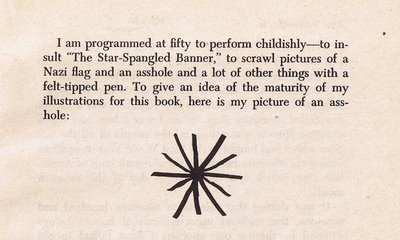
That may give you an idea of what to expect inside (although most of the illustrations are “better” than that one).

What is especially helpful about the story is that it tells you what will happen as it goes along.  So the novel starts:

This is a tale of a meeting of two lonesome, skinny, fairly old white men on a planet which was dying fast.

One of them was a science fiction writer named Kilgore Trout.  He was a nobody at the time, and he supposed his life was over.  He was mistaken.  As a consequence of the meeting, he became one of the most beloved and respected human beings in history.

The man he met was an automobile dealer, a Pontiac dealer named Dwayne Hoover.  Dwayne Hoover was on the brink of going insane.

And that is literally the story.  So why is the book 297 pages long then?  Vonnegut is really out to talk about contemporary society:  America mostly, but not exclusively.  And does he ever. (more…)

Read Full Post »

SOUNDTRACK: SURFER BLOOD-Astro Coast (2009).

Surfer Blood is a confusing band.  Their music sounds like a whole bunch of different late-80’s alterna-rock bands that I love.  But their vocalist (and the music of the verses) doesn’t really fit that style–I’m not sure what those sound like) and some of it is drenched in a kind of Beach Boys-reverb that befits the Surfer part of their name.

It’s a fascinating amalgam of styles that works very well and which is chock full of catchy choruses.  “Floating Vibes” opens with a big loud guitar note, that quickly morphs into a catchy verse line.  Conversely, “Swim” opens with a strange shouty kind of introduction and then morphs into a crazily catchy chorus (also shouted).

“Harmonix” opens with a “rock n roll” 50s style riff, then jumps to cool guitar harmonics and then turns into a song that sounds unmistakably late 80s to me (although maybe it sounds like a song my friend Garry wrote back in the late 80s).

“Neighbor Riffs” is a rocking 2 minute instrumental, which is followed by “Twin Peaks,” a song that sounds unmistakably late 80s but I can’t decide why (it’s also great because it’s about, you know, Twin Peaks).  I’m confused by the next pair of songs: “Fast Jabroni” and “Slow Jabroni” as they do not seem related and the Fast song is much better.  In fact the combination of “Slow Jabroni” and the next song, “Anchorage” really drag the disc as those two songs are over 12 minutes in total (whereas most of the songs are in the 3-4 minute range).   Neither of the songs is bad (in fact “Anchorage” is pretty cool), they just both last too long.

As I try to process who this band sounds like, I’m going to let Carrie Brownstein provide the best description of them:

Sometimes an album comes from people who you can tell love some of the same music as you. And when they interpret the bands you both love, when they run it through their own brains and hearts and hands and amps, instead of sounding like a watered-down version of the progenitors, it sounds fresh and heartfelt and energized. That’s Surfer Blood for me.

And me too.

[READ: May 16, 2011] “We Come in Peace”

This is one of my favorite short stories that I’ve read in a long time.  It appeals to me for a number of reasons (I love the conceit of angels tinkering with humans), but it’s also very well written and thoroughly engaging.  I think the only disappointment about it is that it’s a short story and not a novel (although the intro to the story says that this is merely an excerpt from the short story which appears in full length in Gartner’s new collection of short stories, Better Living Through Plastic Explosives).

I feared that the story would be daunting at first because it includes a dramatis personae (which can be intimidating for a short story).  But the dramatis personae just tells us which angels are matched to which humans.  For yes, this is a story about five angels who are sent to earth to learn about the five senses.   Amusingly, this is spurred on because humans have discovered the extra taste sensation known as umami.

So, the five angels are sent to a Canadian suburb to inhabit the bodies of 5 students: Bashaar, an athlete and dancer who is beset by local radical muslims to get him to join; Stephan a good student (ie., dork) who is turned cool by his angel, much to his family’s dismay; Leo, a nice dude; Jason, the school bully, who is inhabited by a happy angel; and Jessica, an anorexic girl who suddenly eats, develops a nice body and becomes romantically involved with 16-year-old Cullen.  Each of the angels subsumes the personality of the kids (whose families are, needless to say, freaked out by the changes). (more…)

Read Full Post »

« Newer Posts - Older Posts »