Feeds:
Posts
Comments

Archive for the ‘Death’ Category

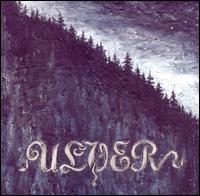
SOUNDTRACK: ULVER-Bergtatt (1994).

Ulver has some music in the soundtrack to Until the Light Takes Us and my friend Lar pointed me to a location where you could download a bunch of their music (this was before Spotify of course). 

So I grabbed a few of their albums expecting to hear some brutal death metal.  And I kind of did, but I also heard classical guitar, flute solos and chanting.   So this album’s full title is Bergtatt – Et eeventyr i 5 capitler (“Taken into the Mountain – An Adventure in 5 Chapters”) and it comes in at a whopping 35 minutes–not bad for an epic.

The opening track (“I Troldskog faren vild” (“Lost in the Forest of Trolls”)) is fascinating–a kind of chanting vocals over a quietly-mixed-in-the-background black metal.  The music is so quiet (and yet clearly black metal) that it almost comes across as ambient noise, especially over the multilayered chanting (I have no idea what language they are singing in).  It ends with a pretty acoustic guitar passage that segues into a very traditional sounding heavy metal section–with a catchy solo that takes us to the end.

“Soelen gaaer bag Aase need” (“The Sun Sets Behind Hills”) opens with, of course, a flute solo.  It’s a minute long and quite melancholy before blasting into the fastest of heavy black metal complete with growling vocals and nonstop pummeling.  But after a minute of that it’s back to the layered chanting like in the first song.  The song ends with a conflation of the two–the chanting metal with the growling black metal underneath.  It’s quite a sound.

Track three “Graablick blev hun vaer” (“Graablick Watches Her Closely”)opens with a lengthy acoustic guitar intro–not complicated, but quite pretty and unlike the poor recording quality of the metal, it seems to be recorded with high quality equipment.  After about 45 seconds that gives way to more black metal.  In a strange twist, the black metal section just fades out, replaced by more acoustic guitar and what seems like the end of the song.  But instead, there is a strange quiet section–not music, but sounds–like someone walking around in the cold forest with crunchy noises and little else.  For almost two minutes.  Until the black metal comes back with a vengeance.

Slow guitar with slow chanting opens track 4 “Een Stemme locker” (“A Voice Beckons”) (the shortest at only 4 minutes).  And the amazing thing is that it doesn’t change into something else.  It is a nice folk song.

The final song “Bergtatt – Ind i Fjeldkamrene” (“Bergtatt – Into the Mountain Chambers”) has a blistering opening followed by some of the most intricate acoustic guitars on the record.  It morphs into a very urgent-sounding black metal section which lasts about 5 minutes.   But just to keep us on our toes, the song (and the disc) end with more classic acoustic guitar.

There is a story here (allmusic says it is a Norse legend about maidens being abducted by denizens of the underworld) and that might help explain the music madness.  But as a musical composition it works quite well.  The chanting over the black metal is really effective and the acoustic instruments bring a nice sonic change from the pounding metal. 

This is not for everyone obviously, but the diversity makes this an interesting introduction into the black metal scene.  Baby steps. 

[READ: November 4, 2011] “Apocalypse”

This is the final non-fiction essay of Junot Díaz that I could find online.  The other one comes from GQ and is called “Summer Love”, but there’s no access to it online. 

In this essay, Díaz looks at the impact of the earthquake that devastated Haiti now that it has been over a year.  Díaz was born in the Dominican Republic which has a long and very brutal history with the people of Haiti–they share a land mass after all.  But rather than looking only at Haiti and how it was devastated, Díaz takes this as an opportunity to see what the earthquake reveals about our country and the state of the world.

The essay is broken down into eight parts.  The first revisits what happened.  The second discusses the meanings of apocalypse, which sets up the “theme” of this essay.  The First: the actual end of the world (which for the thousands of people who died, the earthquake was); Second: the catastrophes that resemble the end of the world (given the destruction of Haiti and the devastation that still lingers, this is certainly applicable); Third: a disruptive event that provokes revelation.

Díaz is going to explore this third option to see what this earthquake reveals. 

What Díaz uncovers is that the earthquake was not so much a natural disaster as a social disaster–a disaster of our creating.  The tsunami that hit Asia in 2004 was a social disaster because the coral reefs that might have protected the coasts were decimated to encourage shipping.  Hurricane Katrina was also a social disaster–years of neglect, the Bush administration’s selling of the wetlands to developers and the decimation of the New Orleans Corp of Engineers budget by 80 percent all contributed to a situation where Katrina could be so devastating.

Then he talks looks at the history of Haiti.  I had known some of this story, but not as much as he provides here–the constant abuse of the citizens, the constant abuse of their finances (both from simple theft and from French and American planning that changed their economy).  There’s also the story of “Papa Doc” Duvalier.  Basically Haiti was a disaster waiting to happen. 

Díaz goes into great detail about the global economy and how it impacted the poor in Haiti and he shows that it doesn’t take a lot of extrapolation to see it reflected in the rest of the world as well.  With the constant rise in standards for the wealthy and the constant abuse that the poor take, it’s not hard to see that Haiti could easily happen here.  If not in our lifetime, then certainly in our childrens’.

But Díaz has hope.  (more…)

Read Full Post »

SOUNDTRACK: SUFJAN STEVENS-The Age of Adz (2010).

Sufjan Stevens has released a bunch of albums of beautiful orchestral rock.  It is multi-layered and complex with classical elements and all kinds of cool instruments.

And this album starts out with a beautiful acoustic guitar melody and Sufjan’s delicate vocals.  Although it is a far more stripped down song than usual, “Futile Devices” seems like it is heading in the standard direction.  But anyone who heard Sufjan’s Christmas album number VIII knows that he has been having some fun with electronics.  And they show up with a vengeance on track two, “Too Much.”

All of the multilayered noise that was once orchestral and (some might say) precious has been replaced by a cacophony of gorgeous electronic noises.  The beginning of the song reminds me of the sounds in Skinny Puppy’s “Stairs and Flowers” (how many Sufjan Stevens reviews mention Skinny Puppy?).  The song is nothing like Skinny Puppy once the vocals kick in–it’s catchy and delicate–but those electronics underpin the whole thing, bringing his pastoralia into the twenty-first century.  When I first reviewed this song I didn’t like it but once you get absorbed by Sufjan’s world, it’s an enticing place to be,

“Age of Adz” takes this electronic nonsense even further with an 8 minute brew of strange sounds and choral voices.  But he always manages to throw in some catchy parts, no matter how strange the song gets.

For me one of the highlights of the disc is “I Walked” it features one of my favorite Sufjan things–falsetto vocals in a beautiful but unexpected melody.  And this song has them in spades.  “Now That I’m Older” has a very disconcerting sound–his voice is slowly warbled and mournful.  It’s a beautiful melody that is alienating at the same time.

“Get Real Get Right” returns to his earlier style somewhat (there’s more layers of music, although the electronica is still in place).   “Vesuvius” is a beautiful song and “All for Myself” is another of those great falsetto tracks that I like so much.

“I Want to Be Well” eventually turns into a manic electronic workout in which he repeats the chorus “I’m not fucking around.”

But nothing compares  to “Impossible Soul” a twenty-five minute (!) multi-part suite of electronic chaos.  It’s a fantastic song complete with autotune (used to very cool effect), repeated swelling choruses (it’s like a Polyphonic Spree tribute), electronic freakouts, and acoustic comedowns.  All in a positive, happy message.  I can’t stop listening to it.  “It’s not so impossible!”

Sufjan continues to impress me.

[READ: November 10, 2011] McSweeney’s #9

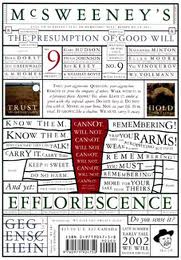
After the excesses of McSweeney’s #8, I was excited to get to the brevity (and urgency) of McSweeney’s #9.  This one is a paperback and looks like the first couple of issues.  The cover is mostly text with a hodgepodge of phrases and pleas.  You get things like: Thankful, Emboldened, The (Hot-Blooded/Life-Saving) Presumption of (Perpetual/Irrational (or More Likely, Irreducibly Rational) Good Will, Efflorescence, Our motto this time: We Give You Sweaty Hugs,” Alternative motto: ” We Are Out Looking,” GEGENSCHEIN (no more), and the promise: “We will Do Four This Year.”

This is the kind of issue that makes me love McSweeney’s.  There are some wonderful short stories, there are some nice essays and there are some dark moments all centered vaguely and tangentially around a theme.  There are some great authors here, too.

The back cover image is called Garden Variety by Scott Greene and it’s a fantastic painting.  You can see it here (navigate through the 2000-2004 paintings, but I have to say I really like the style of all of his work.

There are no letters and no nonsense in this issue.  So let’s get to it. (more…)

Read Full Post »

SOUNDTRACK: SEMISONIC-The Great Divide (1996).

Before Semisonic took over the world (and irritated everyone) with “Closing Time,” they were a band that formed out of the ashes of Trip Shakespeare.  Dan Wilson created Semisonic evidently because he wanted to be more poppy (which he perfected in “Closing Time,” obviously).

This album came out two years before “Closing Time” and it is a wonderful collection of alternapop.  There’s nothing terribly aggressive or weird in this collection, but neither is there anything so commercial that you want to scream.

The highlight for me is “Down in Flames.”  It goes in a few unexpected directions (especially with that screechy solo).  It’s a little dark, but it’s really catchy without ever pandering to Top 40 sensibilities.  It’s a really great song.

Some other highlights are the first three songs on the disc: “F.N.T.” is a poppy delight, “If I Run” has some great hooks and “Delicious” is a slinky sexy song with some unexpected moments.

Even a song like “Across the Great Divide” which isn’t the best on the disc has some nice surprises-when the vocals suddenly go falsetto.

There’s a couple of clunkers in the middle.  “Temptation” is a little too pop ballady for my liking and “No One Else” is a little bland.  I think their more uptempo songs are their strongest.

But “The Prize” is a satisfying pop rocker.  And “Brand New Baby” has some surprising pop vocals and a wonderful third part that is worth getting to the end of the album for.  While “Falling” is a surprisingly dark but catchy number (a Semisonic trait it seems).

The end of the album is rather unremarkable, but it’s still a solid collection of songs with nothing overplayable.  Sometimes one hit wonders are unfairly labelled as such.

[READ: November 8, 2011] “Sun City”

This was a fascinating story because it went in directions that I never anticipated.

I found the opening a little confusing as there were several women mentioned and no real relationship is given among them.  But it turns out that Vera and Bev are “roommates” and Rose is Vera’s granddaughter.  Vera just died (unexpectedly at 87) and Rose has travelled out to Arizona to go through her things.  Rose’s mom (Vera’s daughter) had a falling out with Vera years ago and won’t be going to the house.

Vera loved Rose but was somewhat disappointed in her–she was single and a bartender.  But Vera was not disappointed that Rose is a lesbian.  And Vera’s acceptance of that led Rose to believe that Vera and Bev were more than “roommates” as well. (more…)

Read Full Post »

SOUNDTRACK: OKX: A Tribute to Ok Computer (2010).

OK Computer is one of the best records of the 90s.  Every time I listen to it I hear something new and interesting.  So, why on earth would anyone want to cover the whole thing?  And how could you possibly do justice to this multi-layered masterpiece?

I can’t answer the first question, but the second question is more or less answered by this tribute which was orchestrated by Stereogum.

The answer is by stripping down the music to its bare essentials.  When I first listened to the songs I was really puzzled by how you could take a such a complex album and make Doveman’s version of “Airbag,” which is sort of drums and pianos.  Or gosh, where would you even begin to tackle “Paranoid Android?”  Well Slaraffenland create a bizarre symphonic version that excises many things–in fact half of the lyrics are missing–and yet keeps elements that touch on the original.  But it’s an interesting version of the song and shows  a bizarre sense of creativity.  And that is more or less what this tribute does–it makes new versions of these songs.

Mobius Band make a kind of Police-sounding version of “Subterranean Homesick Alien.”  Again, it radically changes the song, making it a fast and driving song (although I don’t care for the repeated “Uptights” and “Outsides” during the verses).

Vampire Weekend, one of the few bands that I actually knew in this collection (and whom I really like) do a very interesting, stripped down version of “Exit Music, for a Film.  The “film” they make is a haunted one, with eerie keyboards.  Again, it is clearly that song, but it sounds very different (and quite different from what Vampire Weekend usually sound like).

“Let Down” (by David Bazan’s Black Cloud) and “Karma Police” (by John Vanderslice) work on a similar principle: more vocals and less music.  The music is very stripped down, but the vocals harmonize interestingly.  Perhaps the only track that is more interesting than the original is “Fitter Happier” by Samson Delonga.  The original is a processed computer voice, but this version is a real person, intoning the directives in a fun, impassioned way.  There’s also good sound effects.

Cold War Kids take the riotous “Electioneering” and simplify it, with drums and vocals only to start.  It’s hard to listen to this song without the utter noise of the original.  “Climbing Up the Walls” is one of the more manic songs on this collection, with some interesting vocals from The Twilight Sad.

There are two versions of “No Surprises” in this collection.  Interestingly, they are both by women-fronted bands, and both treat the song as a very delicate ballad.  Both versions are rather successful.  Marissa Nadler’s version (the one included in sequence) is a little slower and more yearning, while Northern State’s version (which is listed as a B-Side) is a little fuller and I think better for it.  My Brightest Diamond cover “Lucky.”  They do an interesting orchestral version–very spooky.

Flash Hawk Parlor Ensemble (a side project of Chris Funk from The Decemberists) do a very weird electronic version of the song (with almost no lyrics).  It’s very processed and rather creepy (and the accompanying notes make it even more intriguing when you know what’s he doing).

The final B-side is “Polyethylene (Part 1 & 2),”  It’s a track from the Airbag single and it’s done by Chris Walla.  I don’t know this song very well (since it’s not on OK Computer), but it’s a weird one, that’s for sure.  This version is probably the most traditional sounding song of this collection: full guitars, normal sounding drums and only a slightly clipped singing voice (I don’t know what Walla normally sounds like).

So, In many ways this is a successful tribute album.  Nobody tries to duplicate the original and really no one tries to out-do it either.  These are all new versions taking aspects of the songs and running with them.  Obviously, I like the original better, but these are interesting covers.

[READ: November 5, 2011]  McSweeney’s #8

I had been reading all of the McSweeney’s issue starting from the beginning, but I had to take a breather.  I just resumed (and I have about ten left to go before I’ve read all of them).  This issue feels, retroactively like the final issue before McSweeney’s changed–one is tempted to say it has something to do with September 11th, but again, this is all retroactive speculation.  Of course, the introduction states that most of the work on this Issue was done between April and June of 2001, so  even though the publication date is 2002, it does stand as a pre 9/11 document.

But this issue is a wild creation–full of hoaxes and fakery and discussions of hoaxes and fakery but also with some seriousness thrown in–which makes for a fairly confusing issue and one that is rife with a kind of insider humor.

But there’s also a lot of non-fiction and interviews.  (The Believer’s first issue came out in March 2003, so it seems like maybe this was the last time they wanted to really inundate their books with anything other than fiction (Issue #9 has some non-fiction, but it’s by fiction writers).

This issue was also guest edited by Paul Maliszewski.  He offers a brief(ish) note to open the book, talking about his editing process and selection and about his black polydactyl cat.  Then he mentions finding a coupon in the phonebook for a painting class  which advertised “Learn to Paint Like the Old Masters” and he wonders which Old Masters people ask to be able to paint like–and there’s a fun little internal monologue about that.

The introduction then goes on to list the 100 stores that are the best places to find McSweeney’s.  There are many stores that I have heard of (I wonder what percentage still exist).  Sadly none were in New Jersey.

This issue also features lots of little cartoons from Marcel Dzama, of Canada. (more…)

Read Full Post »

SOUNDTRACK: MOGWAI-Batcat (2008).

“Batcat” is one of my favorite Mogwai songs.  The melody is intense and the drumming is wonderful.  I picked up this single for the B sides (which will undoubtedly be collected somewhere one of these days anyhow, but that’s okay. 

It was very hard to pass up a song called “Stupid Prick Gets Chased by the Police and Loses His Slut Girlfriend”  Given that the song has “Chased” in the title, this is a surprisingly slow tune.  It builds slowly over a series of keyboard waves.  There’s also a slow guitar melody that keeps the piece grounded.  It’s one of their more subtle songs, which again, is rather surprising given the title.

“Devil Rides” is quite jarring in that it features vocals by Roky Erickson.  I don’t really know anything about Roky.  I picture him as a large, unkempt man with crazy hair and a beard.  His voice is otherworldly and seems to be maybe just a wee bit off from what the music is playing.  It’s a strange track and works very well with Mogwai’s history of slightly off-kilter vocalists. 

[READ: November 3, 2011] The Discomfort Zone

After reading The Corrections, I planned to read one of Franzen’s earlier novels.  But they were all quite long (even his debut!) and I wasn’t ready to get so immersed yet.  Then I found The Discomfort Zone in the biography section of the library.  It was less than 200 pages and seemed like just the thing.  It turns out, however, that I had read most of it already.  Three of the pieces were published in slightly different form in the New Yorker: “The Retreat,” (here as “Then Joy Breaks Through”) “The Comfort Zone,” (here as “Two Ponies”) “Caught” (Here as “Centrally Located”) and one “My Bird Problem” (here as “My Bird Problem”) which appears to be unchanged. 

That leaves two essays that were new to me: “House for Sale” and “The Foreign Language.”

The collection works as something of a biography, although really it’s not–it’s a collection of essays about his life, but I don’t think I would go so far as to say biography.   The book also doesn’t follow a chronological order. (more…)

Read Full Post »

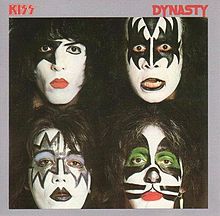
SOUNDTRACK: KISS-Dynasty (1979).

I was pretty excited to buy this album when it came out–a new Kiss album that wasn’t solo albums!  Woo hoo!  And the fact that it was disco?  Well, even though I said I “hated disco,” I didn’t really know what disco sounded like then (and really, aside from the middle “I Was Made for Lovin’ You” it’s not really a disco record) and plus my other favorite band was the Village People (and really, that makes a lot of sense–tw0 bands in over-the-top costumes talking about sexuality that I totally didn’t understand).

So, this album is hard for me to be critical about because it was such an essential part of my childhood, especially “I Was Made for Lovin’ You.”  I love it, and yet I can listen critically and appreciate that it’s really not that good.

But I’ll move on to the other songs.  “Sure Know Something” and “Magic Touch” really don’t seem that out of place chronologically with, say, the Kiss solo albums–they sound an awful lot like something off of Paul’s album.  So, despite the sort of slinky 70’s bass on “Sure Know Something”, they can’t have been that much of a surprise.  The guitar solos are short but have some interesting Ace sounds (I like the harmonics on “Magic Touch”).  It seems that while the other guys were embracing disco, Paul was keeping the Kiss sound alive.

Then there’s the Ace songs.  “2,000 Man” made total sense as an Ace song. I had no idea it was a Rolling Stones cover until fairly recently (and I like Ace’s version much better).  “Hard Times” feels like the sequel to “New York Groove.”  Not the music so much although maybe a little, but the lyrics–now that he’s in the city here’s what happened–the gritty reality. It’s one of Ace’s great, lost songs.  And check it out, Ace sings on three songs here!  (Guess having a #1 hit wasn’t lost on the Kiss powers).  “Save Your Love” has a cool descending chorus and a nice bass feel to it.  Ace certainly wins on this record.

Peter got only one song, “Dirty Livin'”.  In fact, this is the only song that Peter had anything to do with (his drums were re-recorded by Anton Fig).  It reminds me (in retrospect) of the Rolling Stones disco era even more than “2,000 Man,” the backing vocals remind me of something like “Shattered.”  I always liked this guitar solos on this (cool feedback).  Although I liked the song (along with the rest of the album), I don’t think it holds up very well.

Gene only gets two songs.  It amuses me how little he has to do with these late 70s albums even though he is always the leader of the band.  I always liked “Charisma” (I had to look the word up back then) even though it is, admittedly, rather discoey and really not very good.  It is fun to ask “What is my…charisma?”  But “X-Ray Eyes is the better Gene song on this record.  It harkens back to earlier Kiss songs and even has a bit of menace in it.

So, Dynasty was a huge hit for the band.  And they even got to mock it in Detroit Rock City the movie.  Cynical marketing ploy or genuine fondness for disco?  Who would ever know.

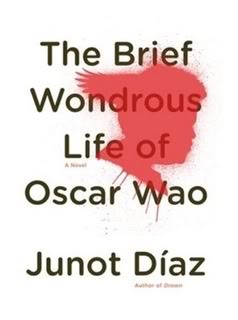
[READ: November 1, 2011] “The Brief Wondrous Life of Oscar Wao”

Readers of this blog know that after finding an author I like, I will try to read everything that he or she has written.  Close readers will know that if a writer is reasonably young and reasonably unpublished, I will try to read his or her uncollected work as well.  Well, I really enjoyed Oscar Wao the novel, so I decided to see what else Díaz had written. There’s really not a lot, to be perfectly frank.  There’s his short story collection Drown and a few fiction pieces published here and there (mostly in the New Yorker) and a few non-fiction pieces as well.

So this “short story” from the New Yorker (with the same title as the novel) is in fact an early, mostly the same, version of the Oscar story in the novel.  The thing here is to note the date: 2000(!).  The novel came out in 2007.  So, Junot had been working with this character for easily five years (giving time for the publishing industry to get a book out and all). The remarkable thing the is just how accomplished and polished this piece is and how much of it was used in the novel.

I’m curious to know whether this was written as a short story (it’s quite a long short story) or if it was always intended as a part of a novel.  Interestingly, when you read this story by itself and you realize that it is pretty much all of Oscar’s story in the novel, you realize just how little of Oscar is actually in the novel.  The novel is about Oscar, obviously, but it is really about his family and the fukú that was placed on them by the Trujillo clan.  Oscar is sort of the touchstone for the fukú, and the person whom the narrator knows most intimately but his story is also brief. (more…)

Read Full Post »

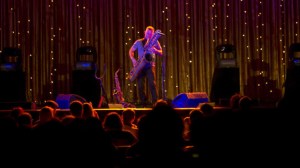
SOUNDTRACK: COLIN STETSON-Live at All Tomorrow’s Parties, October 4, 2011 (2011).

In addition to playing SXSW, Colin Stetson also played All Tomorrow’s Parties, and NPR was there.  Unlike with SXSW, this set appears to be full length (about 50 minutes–which is a pretty amazing amount of time for him to blow that horn).  Like SXSW (and the album) Stetston starts with “Awake on Foreign Shores” and “Judges.”  What I love about this recording is that after Stetson finishes “Judges” a guy in the audience shouts (in a voice of total amazement) “That shit was off the hook!”  And he is right.  It’s not even worth me going into how amazing Steston is once again (check previous posts for  that), but man, just look at the size of that horn he’s playing (seriously, click on the link to see it bigger).

Stetson plays a few more songs from New History Warfare, Vol. 2: Judges like “The Righteous Wrath of an Honorable Man” (which is outstanding) and “A Dream of Water” (which works without Laurie Anderson, although he does say he’s sorry she’s not there).  He also introduces two news songs “Hunted 1” and “Hunted 2” which show new levels and new styles that Stetson employs.

This is a remarkable set, and Steston is clearly in his element (and the crowd is rapt).  The only problem I have is the recording level.  It must be very difficult to maintain recording levels for Stetson’s brand of noise–his louds are really loud–but you can’t hear him talk at all.  And most of the time, the introductions to his songs are worth hearing.  I’m sure if they tried to get the speaking level a little louder the music would have sacrificed though, so I think they made the right choice–I only wish there was a transcript available.

[READ: October 31, 2011] The Brief Wondrous Life of Oscar Wao

Apparently it’s pronounced, “Wow”, by the way.

Because of my new job, I don’t have a  full hour of lunch-time reading like I used to.  And so this book took considerably longer than I intended.  However, once I set aside some time to read it, I flew through the book.

I’m going to get this part out of the way because I was thinking about it throughout the book and I want to mention it without having it bog down the post.  This story reminded me a lot of Roberto Bolaño.  On the surface, sure this is because they are both writers from “Central America” (Diaz is originally from the Dominican Republic but moved to the US, while Bolaño is originally from Chile but moved to Mexico and then Spain).   But I’m not really talking about their origins so much as the style of storytelling.

Without going into a lot of Bolaño here, I’ll just say that Bolaño tends to write very detailed character studies–stories that follow one person throughout his whole life on something of a fruitless quest.  And the details of that person’s life include information about family members and distant relatives.  Further, Bolaño has written about the brutalities of both Chile and Mexico and how a person can survive in such a place.  Similarly, Díaz follows the life of Oscar and his extended family and he talks about the brutalities of the Dominican Republic.

This is in no way to suggest that there is any connection between the two writers. I mean, The Savage Detectives came out in the States in 2007 (same years as Oscar Wao) and while he certainly could have read it in Spanish, I have no evidence that he did (and as I recently found out, the first draft of the Oscar story was written in 2000).  Again, the parallels are only from my reading and have nothing to do with Díaz himself.

Okay, now that that’s out of my system…

This is the story of Oscar de Leon.  But more than that, this is the story of a fukú–a curse that befalls the de Leon family and follows them through several generations.  Oscar is the youngest member of the family and the person whom the narrator knows best.  So we see this fukú as it impacts Oscar.  And although the book is ostensibly about Oscar, it is about much more.

Oscar was born in Paterson, NJ (the town next to where I grew up!) and went to Don Bosco Tech High School (where many of my friends went).  Oscar is Dominican (his mother is from the DR, but he and his sister were born in NJ), but unlike every other Dominican male, Oscar is totally uncool, into geeky sci-fi and D&D and is clearly destined to be a virgin because he is fat with terrible hair and no social skills.

And, (no spoiler), as the title states, his life will be short. (more…)

Read Full Post »

SOUNDTRACK: LONELY ISLAND-Incredibad (2008).

Since I enjoyed the second Lonely Island album, I figured I’d check out the first one as well.  I mean it had “Lazy Sunday” on it after all.  But in this case my initial instincts we pretty correct. There are a  few songs on here that are funny and worth the time–and you’ve heard them all already.  The rest are filler–mildly funny songs that are too long by half (even when they are under two minutes).

The opening song, “Who Said We’re Wack” is only a minute and change and it overstays its welcome after about fifteen seconds.  Although, as I’m finding with a lot of the tracks, there are little bits that are funny, like the “raise your hands in the air” bit of this song.  “Santana DVX” is an amusing little skit about Carlos Santana making his own champagne.  Again, kind of funny, but not that funny.  And worse yet is that they keep reusing the joke throughout the disc.  “I’m on a Boat” is like the demo version of “I Just had Sex.”  It’s the same premise, with the same repeated joke, but you can get a lot more mileage out of having sex than about riding a boat.  At this point I have to wonder how many of these songs were skits (I don’t watch SNL as a rule) and I wonder if they are funnier with visuals added.

“Jizz in My Pants” is the first really funny thing on the disc.  The best part is that it starts out so seriously and then the absurdity gets faster and faster.  It’s very clever.  Although musically it sounds like The Flight of the Conchords might do it better.  “Sax Man” features the mighty Jack Black, and it’s funny, but I have to say that having the sax man play more bad notes (and not synthesized ones) as opposed to all that silence, and maybe having Black get even angrier would have been much funnier.

“Lazy Sunday” is still a highlight, a funny track with, and I think this is the key, new lyrics in every verse, not simple repetitiveness as humor (the old SNL standby).  And of course, “Dick in a Box” is still hilarious (oh, Timberlake, I can’t hate you).

However, that repetitiveness is a problem on “Like a Boss” (although parts of it are very funny) or “Boombox” (is boiled goose supposed to be funny?) although at least the chorus is catchy.  “We Like Sportz” is amusing but I feel like they aren’t dorky enough.  

Then, why does “Dreamgirl” turn into an ad for Chex Mix?   I know it is “sponsored by Chex Mix” but why?  It seems lazy.   And I simply don’t understand “Punch You in the Jeans” or “The Old Saloon” they just seem like stupid filler or in the case of “Jeans,” an attempt at at catchphrase generator or something.   

As on their follow-up, the skits are lame: “Normal Guy” is awful and “Shrooms” is boring.  But at least there’s only two skits.

Finally “Space Olympics” seems like a funny concept but what happens to the song?  It has potential to be a really amusing concept about actual space olympics, but it drifts off into a completely different direction.  Where’d the focus go? 

“Natalie’s Rap” on the other hand is focused, brutal and unexpected.  It is really, really funny.

All in all, this is an excellent place to hear a few good tracks and a whole lot of filler. I’m really happy that the sequel was so much better as it speaks to the possibility of even better stuff in the future.

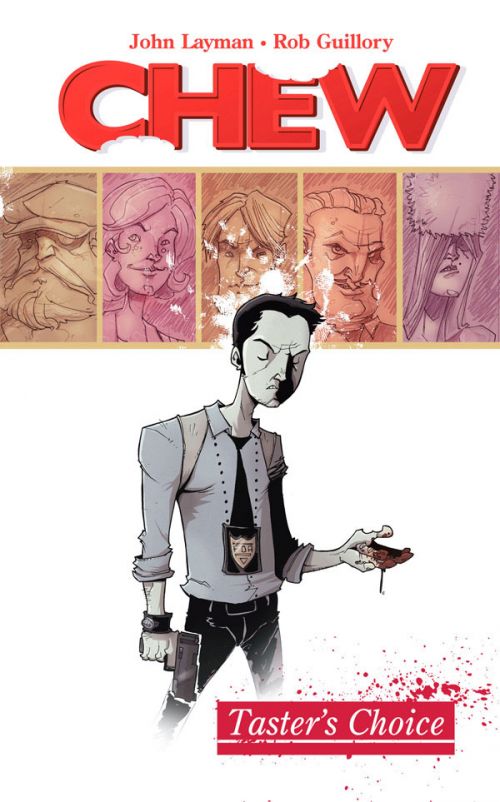
[READ: October 30, 2011] Chew: Volume Two

As Sarah wrote in her post, I was pretty happy to have Volume Two of Chew in the house after finishing up Volume One (I’m only bummed that I don’t have Volume Three!!).

Volume Two continues the adventures of our favorite cibopath (see the previous entry for the explanations of all of these awesome ideas).  As the book opens we see that Tony Chu’s former partner, John Colby is back.  We knew he was still alive, but we didn’t know how alive he might be–after all, he had a cleaver in his face last time we saw him.  But he has been repaired, with the latest in technology, by the FDA.  And now Chu and Colby are back together, bickering as ever with new superpowers (the scene where Colby shows off what he can do is awesome). 

Chapter Two (Issue Seven if you’re keeping track), introduces Lin Sae Woo.  When I mentioned last time that Guillory draws grotesque characters, I had her in mind.  Lin Sae Woo is an aggressive, angry woman and she is drawn to reflect that. But she also has an absurd body shape.  Her breasts are preposterous–not even superhero large, stupidly large and the rest of her can barely keep up.  I can’t even decide if she’s supposed to be sexy, she is so ridiculous.  But she makes a formidable foe (even if she’s on the same side as Chu). (more…)

Read Full Post »

SOUNDTRACK: LONELY ISLAND-Turtleneck & Chain (2011).

I liked “Lazy Sunday” quite a lot, but I didn’t feel compelled to get the album.  Then, when I heard Samberg on NPR, it made quite a compelling case for this second album.  So I decided to check it out.

Most comedy albums are juvenile, so let’s get that out of the way.  This is juvenile.  And, as with most SNL-derived humor, it’s a one note joke that gets stretched out.  The good news is that very few of the songs stretch too long (only one is more than three minutes) and the music itself is quite good–which allows for repeatedly listens.

The opening, “We’re Back!” is really quite funny.  It’s all about how the three guys have really tiny penises.  Ha ha, but it’s delivered with such great gangsta rap style that it is very, very funny.  “Mama” is a wonderful tribute to the singers’ Moms.  The song is interrupted by said mother over and over.  On this one, the joke might go on too much, but overall, it’s very funny.

The longest song is “Jack Sparrow” and it is one of the best ones on the disc.  It features Michael Bolton (!) singing his heart out about his love for the Pirates of the Caribbean movies–which is funny enough, but the guys are rapping behind him about something else entirely.  They keep trying to stop Bolton from hijacking the song.  It’s very well done (and man, say what you will, Bolton can belt out a song).

“Attracted to Us” goes on a bit too long (and at less than 2 minutes that’s a bad sign) and “Rocky” in which one of the dorky guys talks about fighting Rocky (ala The Fresh Prince) is a super long SNL skit (which is not a compliment).

“Turtleneck & Chain” features Snoop Dog and is just fantastic–I love hearing Snoop Dog rap this geek shit.  “Shy Ronnie 2: Ronnie & Clyde” also works very well with Rihanna on vocals.  The song itself is catchy and the joke, when it finally comes, is really good.

“Motherlover” is a sequel to “Dick in a Box” (“this is the second best idea we ever had”) and Justin Timberlake continues to impress me in his new role as a funny guy.  This is a gross song but it’s really crazy catchy (Timberlake must have written the chorus).

One of my favorite songs on the disc is “Threw It on the Ground.”  Musically, I think it’s fantastic and lyrically it is pretty funny.  I wish that they had had some better examples of things to throw on the ground (the cell phone joke is lame and they get kind of lazy by the end), but I get this song stuck in my head a lot.  Another song guaranteed to stay in your head forever is “I Just Had Sex,” a childish and silly song that is outrageously catchy.  And if it’s in your head it won’t leave.  (And yes it’s funny).

“Japan” is a crazy and funny look at Japanese culture while “After Party” is a bit one note.  “No Homo” on the other hand brings in a full circle hardcore joke that is at once offensive and hilarious. 

“The Creep” is pretty unsuccessful even with the help of Nicki Minaj–the video helps a little, but not enough.  As with most rap albums, the skits are the weakest link.  Without a song behind them the skits are good for one or two listens and some not even that (“Falcor vs Atreyu”?  “My Mic”? these wouldn’t even be funny if they were improvised, and yet they seem very deliberately planned–boy I hope there wasn’t more than one take).

Overall, this is a funny rap parody/tribute album.  It’s obvious that the guys love rap and they are quite successful in their stylings.  None of it works as well as “Weird Al”‘s “White and Nerdy” but honestly whatever could?  But “Weird Al” is PG, and Lonely Island fills in as the adult pranksters.

[READ: October 28, 2011] Chew: Volume One

Sarah gave me this book after reading the recommendation on The Hub.  She said it was really good but it was really gross.  And that’s quite an accurate assessment.

One thing that I liked about this book was that it had not one but two really cool ideas that run through the series.  Either one would be a compelling-enough premise, but putting them together makes for an excellent story with lots of possibilities.

The story is about Tony Chu, who is a policeman.  He is also cibopathic, which means that when he eats anything (except beets for some reason), he instantly knows the history of that food: eating fruits and vegetables shows him the tree it grew on and how it was harvested;  eating meat, well, just let your imagination go on that one.  That’s a pretty great premise.  But when he gets a murderer’s blood on his lips and he instantly knows the names and locations of all of his victims, well, that ups the intensity (and the grossness).

The second great premise is that the government has outlawed chicken because of the avian flu.  Millions of people died from the flu and now only chicken-substitutes are used.  There is now a black market for real chicken, including speakeasys, and the FDA is hot on the heels of all traffickers.  And yet, there is a small group of rebels who believe that the whole avian flu thing is a sham (including Tony’s brother Chow).  They don’t postulate why the sham was created, but they are out to set the record straight. 

Put these two ideas together and you get a hell of a story. (more…)

Read Full Post »

SOUNDTRACK: YEASAYER-Odd Blood (2010).

Sometimes albums have a single that is nothing like the rest of the album.  So you buy the album and hate everything but that one song.  This album is almost the exact opposite.  It opens with a song that is so odd–noisy and with massively manipulated vocals, that you would never guess the rest of the album is like some of the best Depeche Mode-friendly pop in the last thirty years.

That opening song, “Children” is creepy, with lots of percussion and atmosphere.  And it gives you no expectation for what comes next: “Ambling Alp” a bouncy track with a super catchy chorus.  This track reminds me of Erasure at their heyday.

“Madder Red” seems to be comprised mostly of (rather nice) backing vocals) with lead vocals done in a mellow Depeche Mode style.  “O.N.E.” sounds pretty much exactly like a keyboard-heavy alt-radio hit from 1991 (it’s fantastic).  And “Love Me Girl” with its tremendous dual-vocals sounds like one of the best pre-guitar Depeche Mode songs ever.  It’s amazing. 

And yet for all of  this talk of sounding like mid 80s alt rock, Yeasayer adds enough new ideas–recording techniques, fullness of sound and current studio tricks that they don’t sound dated.  Or like a rip off.

The frantic keyboard lines of “Rome” propel that song, while “Strange Reunions” slows things down considerably.  Things pick up again with the chanting and the cool keyboards (and great post chorus riff) of “Mondegreen.” 

The disc ends with “Grizelda.”  It continues with this current groove.  Not the best song, but a decent ending to a great disc.  Just don’t let that first song scare you off of what’s inside.

[READ:  October 21, 2011] “Sez Ner

Sez Ner is evidently a place.  And this story is a snapshot of a day or two of that place. 

Sez Ner has a swineherd, a cowherd, some other farmhands and a priest.  This snapshot shows the men in their daily lives: accepting the fate of the dying animals, pushing the living animals to the edges of abuse and/or not really caring that much about them.  Some animals escape.  Some die.

The priest blesses everyone, takes his bounty and leaves. (more…)

Read Full Post »

« Newer Posts - Older Posts »