Feeds:
Posts
Comments

Archive for the ‘Death’ Category

SOUNDTRACKBABE THE BLUE OX-“Basketball” (1998).

This was the first song I’d ever heard from Babe the Blue Ox, and I was hooked (sadly, The Way We Were, where this song is from was their last album).  This is also my favorite songs about sports (and it will never be played in an arena).

It opens with this great funky keyboard over a cool walking bass line.  And after a verse about playing basketball, we get the gorgeous bridge: “pass it to me, I am free, look there’s no one guarding me) sung by one of the women in the band (who sounds vaguely like Edie Brickell).  When the chorus kicks in “And when she gives it to me, I am as high as can be” both singers harmonize wonderfully.

There’s even a cool instrumental break.

Everything about this song is catchy and wonderful.  And it should have been huge.

[READ: December 21, 2011] Grantland

McSweeney’s seems to keep trying to push me away.  Or maybe they are just trying to push me out of my comfort zone.  First they publish Lucky Peach, a magazine about cooking (with recipes that contain ingredients that I couldn’t find anywhere).  I don’t read cooking magazines, but I loved this one.  Now they publish Grantland, a book about sports.  I don’t follow sports.  At all.  I used to play sports and I used to watch sports, and then when I got out of college, I did neither.  I have a very good knowledge of most sports (so I can still follow any game that’s on), but as for actual people playing the games right now–I’m ignorant.  So, why on earth would I want to read this book about sports?

I was pretty sure I would finally not be getting this book until I read the author list: Chuck Klosterman, Colson Whitehead (!), Malcolm Gladwell (?)  I knew this was going to be no ordinary sports book.

So it turns out (and I didn’t know this until just now) that the book is a collection of works from the website Grantland, which is created and run by Bill Simmons.  I haven’t explored the site but it sure looks interesting enough–longish articles about sports and culture and all kinds of interesting things.  And evidently this issue is a sort of best of the website.  The whole Grantland experience, including this book, are connected to ESPN, indeed, ESPN gets a copyright for the book, McSweeney’s is just the publisher.

And this volume was wonderful.  I couldn’t put it down.  I even wound up putting aside a book I was in the middle of to read it.  None of the articles are terribly long and, despite the basketball textured cover (which is very cool–no one can walk by and not touch it) the variety of sports covered is wonderful: from boxing to cricket!  And there are short stories and essays about the entertainment industry as well (articles on Shia LeBeouf and Amy Winehouse (!)).

If I had one complaint about the book it’s that many of the articles don’t give a time from when they were written.  I assume they are all fairly recent but since I don’t follow sports I can’t say for sure.  The other problem is that several of the stories end with a game/match unresolved.  Clearly they have been resolved since then, but even one line saying what happened would be comforting for those of us not glued to ESPN. (more…)

Read Full Post »

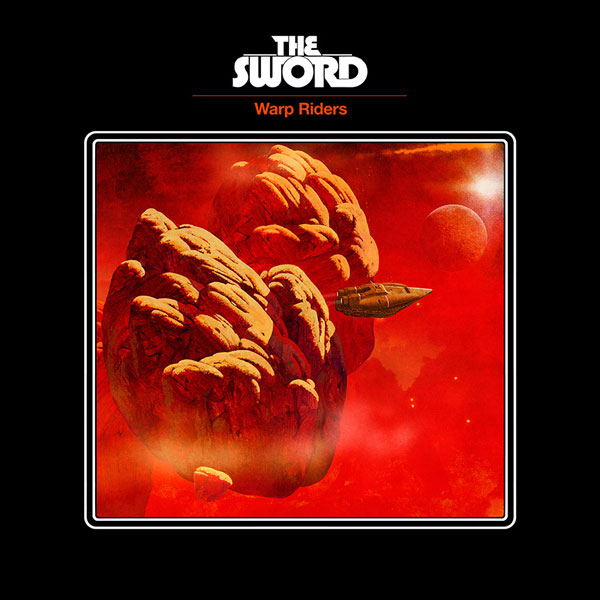
SOUNDTRACK: THE SWORD-Warp Riders (2010).

I have heard some great things about this disc from The Sword–that it was old school metal who usually sang about swords (duh) and sorcery but were warping into the future on this disc.  I put the disc on and was blown away by the opening track, the instrumental “Acheron/Unearthing The Orb.”  It sounds very 80s metal: heavy guitars, and great riffs coupled with tremendous solos.  The second song opens just as strong but then something weird happened.  I hated the lead singer’s voice (my discussion of their previous disc came to the same conclusion).  It doesn’t do ANYTHING that 80s metal should do–it’s neither growling nor yelly nor operatic.  In fact, once the vocals kick in, the song takes on a distinctly non-metal feel.  More specifically, it feels like heavy classic rock from the 70s.  The guitars are still heavy as anything, but the melody and vocals change things.

I really didn’t like the album all of a sudden, until I listened a few times and accepted that this blend actually worked.  Once I acknowledged that it wasn’t what I thought it would be, I wasn’t disappointed by it anymore, and I was able to really enjoy it.  “Tres Brujas” has a simply wonderful sing along chorus that I can’t get out of my head.  And it continues in this vein–heavy riffs (the guitars on “The Chromancer 1: Hubris” and “The Chromancer II: Nemesis” (love the names!) are really heavy) and surprisingly catchy choruses. 

The biggest surprise comes with the song “Night City” which sounds like, well, like Thin Lizzy.  The macho riffs, the swagger, the lyrics, it’s all Lynott.  And once I realized that, I really understood what The Sword was all about, and the disc has been in heavy rotation ever since.  I don’t mean to say that I had to analyze the disc to “get” it, but once it all clicked, it clicked really well.

[READ: December 13, 2011] “The Pharmacist from Jena”

This is my first story from Michael Dahlie and I have to say that I was hooked from the start. 

The story is set in 1912, when the narrator was sent from his home in Stockholm to Winslow, Indiana.  He was sent to work with his uncle as a pharmacist’s assistant. 

It’s in the second paragraph, after the exposition, that things take off: “My uncle was a passionate lover of cocaine and had situated himself in such a way that he supplied nearly all the nearby interested parties.”  He was also renowned as a great “voluptuary and eroticist.”

There is a real plot, which gets established late in the story, but in the beginning, the story is all about the narrator’s adjustment to this life.  How his aunt seemed to believe he was a girl and decorated the room accordingly.  How his uncle had a fight with a bear (long story) in that very girl-themed room (long story) and how the room was soon, no longer girl-themed.

One thing I really liked about the story was the narration.  Like: “At the time I was living in Winslow, it was fashionable for wives of wealthy men to suffer from mental disorders.”

His uncle experimented with shock therapy, but he mostly used it for erotic experimentation.  The end of the shock experiments occurred when a local husband found out what the good doctor was doing (from the burns that his wife received at the doctors hands).  (more…)

Read Full Post »

SOUNDTRACK: LAND OF KUSH’S EGYPTIAN LIGHT ORCHESTRA-Monogamy [CST066] (2011).

The Land of Kush makes music that I would describe as challenging to Western ears.  Sam Shalibi has always played middle eastern music (he’s a master of the oud) and he has usually incorporates it with varying degrees of poppiness into a western style.  The LoKELO is one of the most overt blendings of the two styles.

Land of Kush pretty much throws all rules into the wind.  My first listen to this record I thought it was just too all over the place to be any good.  But after really digging in to it…man, is it solidly cool.

The first track “The 1st and the Last” has a robotic voice reciting a modified lyric of “Helter Skelter” which seems to be called Helter Smegma (“When I get to ass I go back to top….you may be a dancer but you ain’t no porno.”)  The more you listen to the voice, the more you realize the lyrics are just really vulgar and obscene.  This creepy computer voice is layered over the top of a middle eastern keening female voice.  (I’m sure there’s a name for this kind of singing, but I don’t know what it is).  There’s beautiful middle eastern music in the background, but the combination is very unsettling.  Then there’s 2 minutes of simple oud instrumental.

The song morphs into the 17 minute “Scars.”  “Scars” opens with a hypnotizing middle eastern melody and sultry vocals from Elizabeth Anka Vajagic.  After about 7 minutes, the computerized voice comes back.  At the 11 minute mark, the music stops and Vajagic comes back with some solo vocals–she has a very beautiful voice.  The song ends with a somber string section (which I assume is not a violin).

Track 3, “Boo” is listed as an improvisation of clarinet and contrebasse based on “Scars.”  I don’t really see the connection and although I like imrov, I actually prefer the written out pieces on the disc.

Track 4 is the 9 minute “Tunnel Vision.”  It opens slowly with Katie Moore’s delicate voice singing over acoustic music and bird sounds.  At about 7 minutes, a wild saxophone solo kicks in.  It’s low and bassy and very different from the rest of the song, as is the tempo, provided by some wild drums.

“Fisherman” brings back the computer voice (“How I love to fuck a dyke…” this is the easiest to understand and probably the dirtiest.  It really seems like lyrics from another song, but I can’t find it online–although  listening closely there is some spin on “Magic Bus” going on (“stick in the test tube to impregnate you–too much magic bus…I’m so nervous because all the while–too much magic bus–you don’t know you’re going to pop out a child”)).  After about 3:15, the song proper starts.  This is my favorite song of the bunch.  Ariel Engle’s vocals are transcendent.  I’m still not even sure what she’s singing about but her voice is amazing.  There’s an intermission of computer voice which rewrites the lyrics to “Total Eclipse of the Heart”–think x-Rated Weird Al than anything else.  And then at the 9 and a half-minute mark, Engle returns with an amazing vocal line over a great baritone sax riff.  And when Engle starts wailing, it is amazing. I could listen to that section for ten minutes easily–shame it’s only two.  But there’s another beautiful middle eastern string solo at the end of this song too.  Must be the oud.

“Monogamy” opens with a slow and steady drumbeat while Molly Sweeney sings a fascinating alphabet (B is for Beelzebub…F is for the fucking that you did, outside).  There’s a cool chorus to this recitation, it’s another real highlight of the disc.  The middle section sounds a bit like Pink Floyd’s “Several Species of Small Furry Animals Gathered Together in a Cave and Grooving with a Pict”

The final track is “Like the Thread of a Spider.”  It is a slow acoustic song with vocals by the people of the Syrian Arab Republic. It’s a beautiful somber ending to an exciting disc.

This is not for everyone; it’s not even for most people.  But if you’re looking for something adventurous, try this out.  It’s challenging and rewarding.

[READ: December 14, 2011] “Stone Mattress”

I haven’t read a Margaret Atwood piece in a while and this one was totally worth the wait.

It’s a very simple story and it opens with a wonderful grabber: “At the outset Verna had not intended to kill anyone.  What she had in mind was a vacation, pure and simple.”

Verna decided to go on a trip to the Arctic.  We learn through the course of the story that Verna chose the Arctic because although she is older, she’s still quite fit–not bathing suit in the Caribbean fit, but certainly arctic wear fit.  And since she’s just lost her 4th husband, she’s sort of on the prowl again.

As the story progresses we learn a bit about Verna’s history.  She’s been married four times, and in each case her husband has died–never under suspicious circumstances, although, maybe, Verna’s medical knowledge could have assisted in saving (or dispatching) them.  But that’s all the past.  She’s a wealthy older woman now.  (more…)

Read Full Post »

SOUNDTRACK: ULVER-A Quick Fix of Melancholy (2005).

This EP came two years after Teachings in Silence (with a movie soundtrack and “greatest hits” collection in between).  This first track, “Little Blue Bird” is a simple soundscape with echoey keyboards.  When Garm starts singing, his most emotional side comes through (even if I really can’t understand him most of the time).

“Doom Sticks” belies its name and the EP title by being somewhat upbeat.  There are kind of squeaky keyboards that pulsate through the track.  After about a minute and a half, distorted drums keep a martial beat.  But it quickly morphs into a twinkly section that makes me think of the Nutcracker or some other kind of Christmas special.

“Vowels” is similarly upbeat (the music on both of these two tracks has a vaguely Christmastime feel somewhere in there–not that anyone would think these were in any way Christmas songs, or maybe it’s because I’m listening in mid-December).  For this, we get a return of Garm’s choral voice: deep, resonant and hard to understand (although I undertsand the lyrics are from a poem by Christian Bok).   But the poem quickly makes way for some dramatic staccato strings. 

“Eitttlane” begins with some menacing keybaords and staccato notes, creating a feel of a noir movie.  But when the vocal choir comes in, it gets even more sinister.

These Ulver EPs are really true EPs–stopgap recordings for fans.  Their larger works tend to be more substantial, but these EPs allow them to play around with different styles.

[READ: December 1, 2011] “Laureate of Terror”

Two authors I admire in one article, how about that!  In this book review, Martin Amis reviews Don DeLillo’s first collection of short stories and gives a summary of DeLillo’s work.

Amis opens the article by undermining my plans for this blog.  He states point blank than when we say we love an author’s works, we “really mean…that we love about half of it.”  He gives an example of how people who love Joyce pretty much only love Ulysses, that George Eliot gave us one readable book and that “every page of Dickens contains a paragraph to warm to and a paragraph to veer back from.”  Also, Janeites will “never admit that three of the six novels are comparative weaklings (Sense and Sensibility, Mansfield Park and Persusaion).  [I still hope to read all of the books by the authors I like].

Amis says he loves DeLillo (by which he means, End Zone, Running Dog, White Noise, Libra, Mao II and the first and last section of Underworld).  And he also seems to really like The Angel Esmeralda: Nine Stories,(well, much of it anyway), DeLillo’s first (!) short story collection

His main assement is that these pieces are a vital addition to DeLillo’s corpus.  (more…)

Read Full Post »

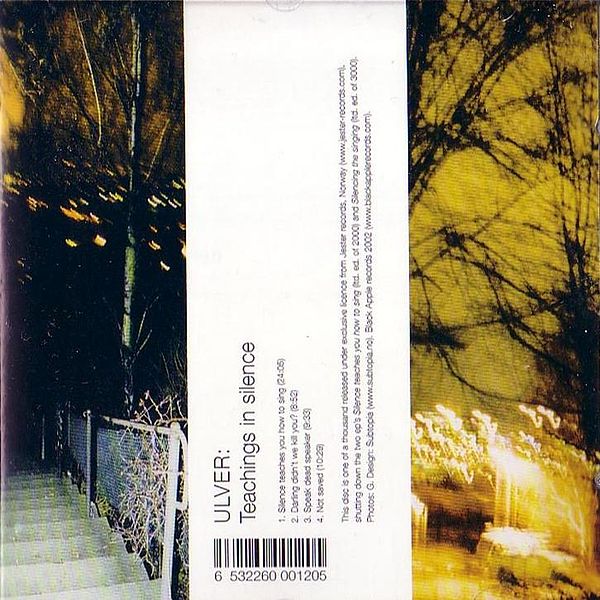
SOUNDTRACK: ULVER-Teachings In Silence (2002).

This EP is a collection of Ulver’s two previous limited edition EPs: Silence Teaches You How to Sing and Silencing the Singing.  It was originally released as a limited edition of 1000 copies, but has since been given wide release.  The two EPs that it replaced were officially retired (after print runs of 2000 and 3000 respectively).

“Silence Teaches You How to Sing” seems like perhaps Ulver has pulled a fast one.  The song starts with static…waves of static.  And you think, what, 24 minutes of THIS?  But after about four minutes, some quiet guitars layer through the static.  By 5 minutes a melody emerges, rather Twin Peaks theme-like.  Static resumes and then another wave of music bursts through and then, around 11 minutes, distant voices can be heard.  As the track nears the end you can hear a distant choir.  And by the end you’re listening so intently that you hear all kinds of things.

That was the only track on the first EP.  The second EP had three shorter tracks.  They are in a similar style to Silence, although there is more music.  “Darling Didn’t We Kill You” has a somber guitar melody and distant choral voices or a buzzing drone.

“Speak Dead Speaker” is more static (it’s easy to see why these two EPs were bundled together).  There’s more Twin Peaks style washes over the static.  I keep picturing the Pacific Northwest.  The last two minutes are a surprise cello version of the themes from the first 7 minutes.  It’s lovely and sorrowful.

The final track is a beautiful melody that repeats itself more and more quietly (with a wonderful loud funeral bell keeping time).  It repeats its cycle three times before ending.

Ulver continues to confound listeners.  Neither one of these EPs is really essential, but they are both interesting and really create a mood.

[READ: November 3, 2011] “Nilda”

This is the final uncollected story (according to Wikipedia anyhow) by Junot Díaz that I was able to access online.  There are two more stories “Invierno” (Glimmer Train 1998) and “Flaca” (Story, Autumn 1999) that I can’t seem to access online.  The rest of the listed short stories appear in Drown

This story is about longing and making the wrong choices.  Having read a bunch of Junot Díaz stories lately, this feels very much like a story he would write (I probably should have read Drown before I read these stories, but when I get to it, I’ll be able to confirm my suspicions).

In this story, Yunior, who is evidently the constant narrator in his earlier works (and in Oscar Wao) knows Nilda from school.  She was a friend of his–a kind of teasable friend–until puberty hit and her chest was to die for.  Unfortunately for Yunior, they were already friends, and she was off with other boys.

Indeed, Nilda was trouble more or less from the start–“brown trash,” he calls her.  Her mother was an alcoholic and Nilda was defiant.  She even spent time in a group home.  But she was nice and easy to talk to.  Dammit, why did she have to start dating Yunior’s brother Rafa? (more…)

Read Full Post »

SOUNDTRACK: BOOKWORM-Jeffrey Eugenidies: The Marriage Plot (December 1, 2011) (2011).

Since “Just Kids” mentions  Eugenides’ book, and since Eugenides happened to appear on Bookworm at around the same time as I read this article, it seemed like a good pairing.

Obviously, from the title of the episode you can tell that this is all about Eugenides’ new book, The Marriage Plot.  Michael Silverblatt raves about this book like no other book I have heard (granted I haven’t listened to all that many episodes of Bookworm, but still).  In fact while listening to this episode, I put The Marriage Plot on hold at the library.  I always planned to read it but figured I’d just get around to it some day.  Now I feel more of a sense of urgency.

They talk at length about the state of marriage in the 21st century.  Not as in its decline but in how it differs so much from classic literature in which women had to get married by 21 or risk spinsterhood.  Eugenides set out to write a book about people getting married without having the trappings of classical literature.

It sounds wonderful.

The reason I mention this interview at all is because in the article below, Hughes talks about contemporaries of DFW using DFW as the basis for a character in their books.  So, in Franzen’s Freedom, there is character who is very much like DFW (I haven’t read Freedom yet so I can’t say). 

And in The Marriage Plot, there is a character who resembles DFW.  When I read the excerpt of this story in The New Yorker, I had to admit he did seem an awful lot like DFW–a tobacco chewing, bandanna wearing philosopher.  Eugenides had been mum about it for a while, but now, under the gentle nudging of Michael Silverblatt, he comes clean. 

He admits that there are some characteristics of DFW in the character.  However, he says that he didn’t know DFW all that well and the character has been kicking around since he went to college (long before he knew DFW).  Tobacco chewing was rampant at Brown in the 80s apparently.  But it’s a nice revelation and it ties in very well with the article.

You can listen to the show at KCRW.

[READ: December 7, 2011] “Just Kids

I have always grouped together certain authors in my head.  When there were a bunch of Jonathans publishing, I kind of lumped them together.  I think of Mark Leyner and Bret Easton Ellis in the same breath.  It’s fairly common, I suppose.  But I never really thought of David Foster Wallace in terms of a group of authors.  He seems so solitary that it’s funny to even think of him as having friends.   But according to Hughes, many of today’s established authors prove to have been a part of a kind of nebulous writer’s circle.  A kind of 1990’s update of Dorothy Parker’s vicious circle.  But more insecure.

The article bookends with Jeffrey Eugenides.  In 1983 he and Rick Moody drove to San Francisco with the intent of being writers.  Five years later with no written works, Eugenides moved to Brooklyn, alone.  In that same summer, Jonathan Franzen was in Queens, also feeling alone (even though he was married–unhappily) and desperate for friends and peers.  And then Franzen got a fan letter from David Foster Wallace (that’s after he had written Broom of the System, but before Girl with Curious Hair) praising The Twenty-Seventh City

Franzen and DFW became friends.  To this friendship was added William T. Vollman, and David Means, also Mary Karr (whom DFW dated) and Mark Costello (who co-wrote Signifying Rappers with DFW).  Later they would connect with Eugenides, Rick Moody and Donald Antrim.  (more…)

Read Full Post »

SOUNDTRACK: THE COLIN McENROE SHOW-The Life & Legacy Of David Foster Wallace (December 5, 2011) (2011).

This NPR show features an interesting discussion about David Foster Wallace:  his fan base, his cronies and his archive.   The guests were Donald Brown (New Haven Review), Evan Hughes, Ryan Walsh (who created the David Foster Wallace Audio Project) and Maria Bustillos.  Evan Hughes recently wrote a piece in New York that I’ll look at tomorrow and Maria Bustillos wrote the main piece for today’s post.  The other two guys I admit I don’t know.

This show looks at some interesting aspects of DFW’s life in the wake of his suicide and the release of The Pale King.  Although really the impetus seems to be Hughes’ article (which was published in Oct).  McEnroe asks him about the state of literature today and how both Jonathan Franzen and Jeffrey Eugenides have created characters that “resemble” DFW in some way.

They talk about the cult of DFW and play some audio clips.  Brown is an older reader and so does not embrace DFW as much as others.  He is of the same age as DFW and so loves the people DFW loved more than DFW himself.  I get the feeling that he is a curmudgeon.

But they can all agree that fans of DFW feel that he was their buddy.  Super-intelligent but very human, almost speaking like they would (if they were that smart).  They conclude that the Kenyon commencement speech is something of the pinnacle of his project of earnest warmth in humanity.

At the half way point, Maria Bustillos comes in to talk about going to the archive (which you can read about below).  She explains her own interest in self-help books and how DFW was a person who needed help.

The end of the episode has them talking about DFW’s voice.  They wonder why DFW has an “audio project” but other writers do not.  They talk about DFW’s voice and his presence during interviews and how he is very warm, even when he’s being cold (it’s an odd clip they choose). I’ve mentioned the Audio Project before.  It’s wonderful.

For anyone interested in reading books that are in a similar vein to Infinite Jest, Bustillos recommends Under the Volcano (Malcolm Lowry) and wholeheartedly recommends The Last Western (Thomas Klise).

A fascinating thing about this show was finding out that McEnroe was the author of a pretty funny piece in McSweeney’s many many years ago called “I Am Michiko Kakutani.”  He offers an anecdote about originally mentioning DFW in the story but that the McSweeney’s guys asked him to change it to someone else.

But I have to say that the show seems a bit too much about Colin McEnroe (the McSweeney’s anecdote was just one of many involving McEnroe).  He talks a lot about himself and about how he’s “afraid” that the Awl will make fun of him or that Franzen (who was with McEnroe in a green room backstage at some show) will put him in his next book (because he was discussing Neti Pots).  But I’m just not sure that Colin McEnroe rates enough to warrant the concern. 

It’s an enjoyable show, although unlike other interviews by people like Charlie Rose or Michael Silverblatt, McEnroe’s questions and comments aren’t very well informed.  If you know a lot about Wallace, this show is a bit frustrating because it takes a tone that Wallace is basically a “postmodern ironist” or that he sees everything as “a big dark joke.” And even when the guests are showing that that is not the case, he seems to try to keep reverting back to this trope.

Oh well, it led to some interesting articles at least.  Like the one below.

[READ: December 7, 2011] “Inside David Foster Wallace’s Private Self-Help Library”

For no reason in particular, I’m devoting this weekend to articles that are specifically or tangentially about David Foster Wallace (it’s been awhile, and I have yet to finish my Consider the Lobster project, so, why not). 

I actually read this because of the above radio show.  I know Maria Bustillos because we’re both in a newsgroup.  “Newsgroup” is so 90s, I wonder what they’re called these days).  Anyhow, Maria has always proven to be smart, funny and very articulate.  And the only reason I didn’t read this article when it came out was because I wasn’t sure I wanted to dive into this topic. 

After listening to the above radio show, however, I felt that this would be a very interesting article. And so it was.  It’s available at The Awl.

As it opens, Bustillos lets us know that she visited the DFW Archives Ransom Center at the University of Texas at Austin and pored over all of the materials they have there (undergrad papers, drafts of fiction and non-fiction, syllabi, tests and quizzes, and juvenilia among other things). 

Wallace was a major note-taker.  And he loved to take notes in a book as he was reading.  Just look at some of these books

But what surprised Maria (and me) is that among Wallace’s collection of wonderful fiction was a collection fo self-help books which were equally annotated and marked up. 

Much of the set up of the article concerns why DFW had self-help books at all.  The answer is, of course, because he was a depressed person (obviously) and because he had been in rehab for a pretty long time.  None of this background information is new, but Maria offers insights into DFW and his life that I had never heard before (Maria and DFW had corresponded, although I don’t know if they were “friends” or not).  (more…)

Read Full Post »

SOUNDTRACK: TRENCHMOUTH-Inside the Future (1993).

This album came before the other Trenchmouth CD I reviewed.  And it’s safe to say that all of the ideas were still in place for this CD as well. 

What I love about Trenchmouth is that all 4 members seem to be playing different songs and yet they all work so well together.  True, it sounds chaotic and at times unpleasant (such is the nature of punk) and yet when you listen a few times you hear how it all works.

“Telescopic” opens with a crazy punk bass line, the guitars are just screams of noise and the drums are rhythmic yet chaotic (that’s Fred Armisen on drums and he is a wild man).  Then lay over the top the disaffected vocals (which are in a different ke)y and you get one hell of  a punk song.  The feedback squalls at the end let you know that they have no intention of being on the radio.

“Power to the Amplifier” condenses all of that noise into 2 minutes of fury. 

“The Dawning of a New Sound System” starts with some crazy guitar chords (showing you just how weird the guitars are) but this song has a pretty catchy chorus (with backing vocal shouts of “Hail Hail”).  “Yes, This is the Place” offers slightly less abrasive guitars and a very smooth middle section.

“Capsule” actually opens with a sound similar to Prodigy’s “Smack My Bitch Up” and it has a different vocalist (although I don’t know who).    The percussion on “Confectionery” is amazing, while “In the Event of a Struggle” is another 2 minute cycle of styles.  “The Future Vs. Centrifugal Force” sounds the most like that mid 80s SST style that I like so much–kind of a jam feel, but short and punky.

“Sea of Serenity” is listed as “Swing Version”, although I don’t know if there’s another version.  This one has intense guitars (don’t they all) and frantic drumming.   It also has a wonderful third part with a great off-kilter guitar riff.   The final proper song is “Hit Men Will Suffocate the City” and it is more of the same noisy wonderment.  It ends with a great bass line.

The final track is “Now I Have Tasted Life” and it is absolute filler.  A weird addition, it’s 7 minutes of slow melodica noodling and occasional reggae sounding guitars with random percussion  There’s also some feedback squalls.  It sounds like one of their real songs stretched out and slowed down.  It would be okay if it weren’t so long.  But it’s hard to blame anyone for experimentation when the rest of their experimentation is so good.

It’s obvious why Trenchmouth weren’t popular (although you can hear proto-Primus all over this record–I wonder if Les and Ler knew Trenchmouth at all?), but it’s a shame their music is so hard to find.

[READ: November 30, 2011] “The Musical Brain”

I have been meaning to read César Aira for a little while now.  He’s on my list of new authors to check out.  So I was pretty delighted to see this story (translated by Chris Andrews) in the New Yorker.

There are so many wonderful and unexpected aspects to this story that I was constantly kept on my toes.  This also made it somewhat challenging to write about.

The story appears to be autobiographical (we learn late in the story that the narrator is named César), about an incident that happened when he was 4 or 5.   It is set in the Argentinian city of Coronel Pringles and it talks a lot about his family and the town that he lived in.

I loved the strange little details he threw in about his family.  Like his mother’s “invincible suspicion of any food she hadn’t prepared herself” or the provenance and outrageousness of his father’s wallet.

 As the story opens, César remembers a night when the family went out to dinner.  And on that occasion, he recalls the high school headmistress Sarita Subercaseaux holding forth in the corner of the restaurant while people brought her boxes of books.  He concludes (in the present, but had no idea at the time) that they are donations for the new library that is to be built (and of which Subercaseaux will be the head librarian).

He remembers Subercaseaux very fondly both from the library and from school, and when he asks his mother about her, we get the first of many erasures of the past.  His mother informs him that Subercaseaux died long before he was born.  Which of course he knows is impossible.  But his mother’s memory is better than his! (more…)

Read Full Post »

SOUNDTRACKART OF TIME ENSEMBLE WITH STEVEN PAGE-A Singer Must Die (2009).

According to their website, “Art of Time Ensemble is one of Canada’s most innovative and artistically accomplished music ensembles. Their mandate is to give classical music the contemporary relevance and context it needs to maintain a broader audience to survive.”

So what you get is a modern orchestra playing contemporary music.  It’s not a unique idea, but in this case, it works very effectively.  And what you also get is Steven Page, former singer of the Barenaked Ladies as the vocalist.  Page has an awesome voice.  I’ve often said I could listen to him sing anything.  And here’s a good example of him singing anything.

The great thing is that the song choices are unusual and wonderful–not immediate pop hits or classic standards–it’s a cool menagerie of songs with great lyrics and equally great compositions.  This is no heavy metal with strings, this is majestic songs with orchestral scoring.  The orchestra includes: piano, sax/clarinet, cello, violin, guitar and bass.

And the song choices are fascinating.  And with Page’s amazing theatrical voice, the songs sound quite different, mostly because the original singers don’t have powerful voices.  They all have interesting and distinctive voices, but not operatic ones.  So this brings a new aspect to these songs (I knew about half of them before hand).

THE MOUNTAIN GOATS-Lion’s Teeth.
This is a very dramatic reading of this dramatic song.  It pushes the boundaries of the original song.

ELVIS COSTELLO-I Want You.
I had never heard this Costello song.  With Costello you never know what the original will sound like–punk pop, orchestral, honky tonk?  It’s a fascinating song, though and Page hits some really striking and I would say uncomfortable notes.

RUFUS WAINWRIGHT-Foolish Love
I don’t know Rufus’ work very well, although I immediately recognized this as one of his songs.  Page plays with Wainwright’s wonderful theatrics and makes this song his own.

BARENAKED LADIES-Running Out of Ink
Covering one of his own songs, this is fascinating change.  The original is a fast, almost punky song, and it seems very upbeat.  This string version brings out the angst that the lyrics really talk about (Page is definitely a drama queen).

LEONARD COHEN-A Singer Must Die
This is one of the great self-pitying songs and the lyrics are tremendous.  Page takes Cohen’s usual gruff delivery and fills it with theater. It’s a great version.

JANE SIBERRY-The Taxi Ride
Coming from her early album The Speckless Sky, this is a wonderfully angsty song with the premise that is summarized: “it’s a long, long, lonely ride to find the perfect lover for your lover.”  Page hits one of the highest notes I’ve heard from him here.  Very dramatic.

THE DIVINE COMEDY-Tonight We Fly
This is one of my favorite Divine Comedy songs.  Of course it is already string filled, so this version isn’t very different.  But its wonderful to hear it in another context.

THE WEAKERTHANS-Virtute the Cat Explains Her Departure
I love this song.  This is a guitar filled pop punk song, so the strings add a new edge to it.

THE MAGNETIC FIELDS-For We Are the King of the Boudoir
I know the Magnetic Fields but not this song.  It’s quite clever and funny (as the Fields tend to be) and Page makes some very dramatic moments.

RADIOHEAD-Paranoid Android
I recently reviewed a covers album of OK Computer, wondering how someone could cover the record.  The same applies to this song.  A string orchestra is a good choice for it, as there is so much swirling and crescendo.  And while nothing could compare to the original (and they don’t try to duplicate it), this is an interetsing choice.  As is Page’s voice.  He has a much better voice than Thom Yorke, but that actually hinders the song somewhat when he gets a little too operatic in parts.  Nevertheless, it is an interetsing and enjoyable cover.

The whole record is full of over the top drama.   It’s perfectly suited for Page and it’s a side of him that has peeked out on various releases but which he really gets to show off here.  As an album, the compositions all work very well–they are, after all, trying to make classical pieces out of them–not just covering them.  And the choices of songs are really inspired.  Dramatic and interesting and when the music slows down, the lyrics lend to a wonderfully over the top performance.

If you like Page or orchestral rock, this is worth tracking down.

[READ: November 28, 2011] “Leaving Maverly”

For some reason I was under the impression that Alice Munro was no longer writing.  I’m glad that’s not true, and really, what else would she do with herself–she has so many more stories to tell.

I think of Munro’s stories as being straightforward, but this one was slightly convoluted and actually had two things going on at once.  It opens by discussing the old town of Maverly.  Like many towns it once had a movie theatre.  The protectionist and owner was a grumpy man who didn’t deal well with the public, and that’s why he hired a young girl to take the tickets and be the face of the theatre.  When she got in the family way, he was annoyed, but immediately set out to hire someone else.  Which he did.  The new girl, Leah, came from a very religious family.  She was permitted to work there under the stipulation that she never see or hear a movie or even know anything about them.  And that she get a ride home.  The owner balked at this second idea–he surely wasn’t going to drive her home.  So instead, he asked the local policeman Ray, to walk her home.  Which he agreed to do.

The next section of the story looks at Ray.  And although the story is ostensibly about Leah, we get a lot more history of Ray.   He was a night policeman only because his wife, Isabel, needed help at home during the day.  We learn about the scandalous way he met his wife and how they managed through the years until she became ill.

Ray talks with Leah on their walks home, something he found terribly awkward because of how cloistered she was.  Then he would get home and talk with Isabel about Leah. This young girl who meant nothing to him was suddenly a significant part of his life.

And then one day the theater owner came to report that Leah was missing.  They went to see her father at the mill, but she wasn’t there.  And there was really no other place where Leah went, so they were at a loss.  It was winter and they feared the worst. (more…)

Read Full Post »

SOUNDTRACK: MATES OF STATE-“Palomino” (2011).

I don’t know Mates of State, although I have heard about them a lot.  This is their new song and it is immediately infectious.  It starts out with a falsettoed “Whoo oo oo ooo oo oo” that is immediate and catchy as heck. 

I just read about them on the NPR page and it makes me want to like them even more:

Kori Gardner and Jason Hammel speak a shared language in Mates of State, the effervescent pop band they share as a married couple with children. Alternately sung and chanted, often in unison, their words represent the sound of infectious joy — the irony-free expression of a love that’s as true as it is hard-won.

Sometimes a good pop song can really make you day.  Even if you’re more into noise rock or heavy metal a pop song that’s neither cloying nor stupid just warms your heart. And this one sure does that. 

Looks like it’s time to check out their past releases.

[READ: November 10, 2011] Artemis Fowl: The Atlantis Complex

For some reason, it took me a long time to start reading this book.  I just recently learned that there will be only one more book in the series.  For some reason even if I like a series, I’m happy to see it come to a conclusion even if, as in this case, I don’t feel that the series has run its course yet.  But the strangest thing about this book is that the cover is completely different from the rest of the series.  I find this bizarre for a couple of reasons.  If you have established a cover style for a series of books, why suddenly change it in the 7th book?  And even weirder, if there is only one more book in the series, why change it now?  When it came out, I didn’t even realize it was an Artemis Fowl book.  Very strange.

The only reason I can imagine is because in the book Artemis himself is a very different person (but really, that’s pushing it, designwise).  For in this book, Artemis has contracted the deadly Atlantis Complex.  Essentially, since he has been feeling guilty for his past transgressions and because he has ingested a lot of magic, his system is trying to cope.  And it manifests in the Atlantis Complex. 

The Atlantis Complex begins with a sense of paranoia and crazy compulsions (in Artemis’ case, he trusts no one, not even his family, and he suddenly gets obsessive about numbers–5 is good, 4 is death).  And for Artemis, who is usually a steady, logical thinker, not only is superstition very noticeable (all of his sentences have words in multiples of 5), it is quite dangerous. (more…)

Read Full Post »

« Newer Posts - Older Posts »