Feeds:
Posts
Comments

Archive for the ‘Culture Shock’ Category

SOUNDTRACK: THE DEAD MILKMEN-Metaphysical Graffiti (1990).

You know that it would be untrue, you know that I would be a liar if I were to say to you I didn’t set your house on fire.

You don’t have to be a philosopher to appreciate the joke of this album title (actually that may hurt the joke a little). But the “runes” that accompany the disc are quite amusing.

I haven’t listened to this disc in ages, and it turns out that I remembered about half of these songs really well.  And that’s because half of the songs are really good.  And the other half are, well, okay.

It opens with a children’s chorus which morphs into one of their heaviest rocking (although fairly uninspired) songs, “Beige Sunshine.”  The disc comes into focus with track two: “Do the Brown Nose” a funny song that outlines exactly how to do the titular dance (although at nearly 5 minutes, it’s a bit long).

The single (!) “Methodist Coloring Book”: features Joe Jack Talcum singing (clearly his success with “Punk Rock Girl” had an impact on that decision).  But on this track, he sings with a dark and distorted voice (which pales to Rodney’s dark voice) and is less interesting than his whiny normal singing voice. It’s a good song (and amusing) although as a single it’s less than successful.

I’ve always enjoyed the premise of “I Tripped Over the Ottoman” although I’m not sure it’s a very good song.  While “If You Love Somebody Set them on Fire” is funny and catchy (and astonishingly irritating with the screechier higher register notes in the chorus).

“In Praise of Sha Na Na” makes the valid point that they played at Woodstock and aren’t dead.

Joe Jack’s other songs are the very slow ballad “Dollar Signs in Her Eyes” and the rollicking (and more distorted singing) of “I Hate You, I Love You.”  But the ending tracks “Now Everybody’s Me” and “Little Man in My Head” (which is musically quite a good reggae track) just don’t have a lot of oomph.

However, the final track, “Anderson Walkmen, Buttholes and Howl!” (which parodies a short-lived but much talked about prog rock band) is delightfully twisted.

The problem with the disc overall is the four or five “improv pieces”  They all feature the same bassline, and by the end of the disc you start to cringe when you hear it (especially since the last one is 6 minutes long).  Each one is a mildly funny rant (along the lines of “Stuart” from Beelzebubba, but less focused and less interesting).  Some of them are certainly funny (Earl’s maggots and the “chills me to this day” refrain is pretty good), but they feel like comedy skits that you only want to hear once.

Erlenmeyer Flask!

[READ: April 3, 2010] By Night in Chile

In continuing with my Bolaño obsession, I moved onto yet another of his short books (144 pages).  Interestingly, By Night in Chile is written in a complete different style than the other two titles I’ve recently read (Bolaño is nothing if not diverse).

This is a stream of consciousness reminiscence told by Father Sebastián Urrutia Lacroix.  The entire book is one paragraph (actually that’s not true, the final line of the book is its own paragraph).

As the book opens, Father Urrutia is dying.  But worse than that, he has been disparaged by a wizened youth.  And his entire memory/rant is a response to the accusations of this (unseen by us) wizened youth.

And Father Urrutia uses this opportunity to describe the highlights of his life.  When he was very young he decided to join the priesthood against his family’s objections. There’s a running joke about people calling him “father,” I especially enjoyed the scene where his mother calls him father. (more…)

Read Full Post »

SOUNDTRACK: RUSH-Permanent Waves (1979).

When my friend Doug and I were hanging out back in the 80s, we both were getting into Rush at the same time.  And because this album was in black and white this was the last Rush LP we bought.  Imagine our surprise when it turned out to contain “The Spirit of Radio” one of the best hard rock anthems ever.

The cover art also featured a newspaper that read Dewey Defeats Truman.  But the band got in trouble for it from the Chicago Tribune!  I’ve never actually seen an actual cover with that headline (or the proposed fix: Dewei Defeats Truman).  Huh, thanks internet, here’s a picture of it.

The disc  also contains some (more) of my favorite Rush tracks.  “Freewill,” a fantastic “smart” song features some insane guitar and bass work in the middle sections.  And side one ends with “Jacob’s Ladder,” a 7 minute mini epic with precious few words that really evokes the simple concept of the sun’s rays bursting through clouds.  It’s surprisingly moving.

Side two features two more short tracks: Entre Nous suffers from side two syndrome: it would have been a hit if it was on side one.  While “Different Strings” is probably the last mellow song the band would write until the acoustic tracks on Snakes and Arrows.

For me, the best song is “Natural Science.”  A three-part mini 9 minute mini epic that features very cool lyrics, acoustic and electric guitar, a mid-song (short) drum solo and an incredibly intense heavy metal section.  And I have been really really psyched that they play this live again.

This disc marks an interesting transition from the prog rock heyday to the poppier commercial side that would soon arrive.  It’s a great mix of truly classic classic rock, real virtuoso performances and a couple of nice pretentious epics.  You’ll but it for Spirit of Radio, but you’ll get hooked by Natural Science.  “A quantum leap forward, in time and space….”

[READ: Week of March 29, 2010]  2666 [pg 565-633]

Before I start with the final week of the Crimes, I wanted to acknowledge everyone else who has been doing a great job in the endurance-o-rama that is the winter/spring 2666 online readathon.  I have been terribly remiss in mentioning (and even reading) as many of these posts as I would have liked (oh where does the time go).  But there’s some folks who have been doing a great job bringing up issues and suffering through The Part About the Crimes with me.

Obviously our friends at Bolanobolano are hosting this event and keeping wonderful track of details that I’m too exhausted to do myself.

And of course, the cohosts in Crimes, Infinite Zombies, are keeping tabs on all manner of thoughtful aspects of this book.

Steve, who I often read on IZ, also posts at his own site: A Solipsist’s 2666.

The Daily Snowman has been offering interesting thoughts, as well as a Paragraph of the Week (often from 2666).

Naptime Writing always offers thoughtful comments as well as a quote of the week.

Bleakonomy offers brief summaries and ideas, as well as non-2666 related thoughtful ideas.

Alone with Each Other offers that rarest of birds: someone who really likes The Part About the Crimes.

I haven’t been reading these blogs as much as I would have liked (and maybe someday I’ll post a comment to one of them long after we’ve all finished reading), but what I’ve read, I’ve appreciated.  So thanks for keeping me company out here.

And on to the last (and best) section of the Part About the Crimes.

I don’t know if the slow plodding death after death was like climbing a hill, but these last 68 pages were like speeding downhill with the top down.  So much was packed into it.  I was totally rejuvenated, thrilled to meet new (!) characters and totally unsurprised when the Part ended and absolutely nothing was resolved. (more…)

Read Full Post »

SOUNDTRACK: Big 4 Thrash Tour (2010).

During my recent trip down metal memory lane, I learned that the Big 4 Thrash bands may be touring together.  The Big 4 would be: Metallica, Anthrax, Megadeth and Slayer.

When I was a young metal dude, these were definitely my big 4.  I own the first 5 or so albums by all of these bands.  Megadeth was the first to fall out of favor (around 1990), then Anthrax (around 1993), then Slayer (around 1994) (although they came back nicely in the last few years) and the Metallica (around 1997 although really they’ve drifted the furthest from the thrash world, and probably I should’ve stopped sooner).

I haven’t really listened to any of these guys’ newer releases (although I did get Slayer’s 2001 release, God Hates Us All–and I wanted to add this wonderful quote from Araya, who sings of ever so much death and destruction: “when you see someone and if you’re a human being you respect them and treat them as human beings”), so I can’t say that I’m the target audience for this tour.  However, I am delighted that these 4 bands, whose music I loved while growing up, are still together and still touring.

I wonder what the audience make up for this show is?  Is it old fogeys like me (who are still younger than the band members, at least) who would have wet themselves for this tour back in 1989, or is it a new generation of thrash kids who would mosh the crap out of me?

Either way, I won’t be going to this concert (in Poland or in Greece for that matter) but nor will I be going should it come to a theater near me.  But I’ll be delighted to hear how it goes.

[READ: March 29, 2010] “Bystanders”

I was prepared not to like this story (actually an excerpt from a novel).  It is set on a mountainside on the border of China and Tibet.  And it was about mountain climbing, a subject about which I care very little.  And as it started  feared it was going to be another story about battling with the elements on top of a mountain, blah blah.

But rather, the story went in a different direction entirely.  While the young protagonist is watching the sun set on the mountains she hears gun shots.  Ad i the distance, she sees a man fall.  The guides come over to offer her a hand but she refuses.  They force her down behind the rocks as they call for her father.  Then she flashes back to another time when her father selflessly came to someone’s rescue.

There were many cool ideas in this story.  I loved the idea that she was sitting in two countries at the same time.  I loved even more the later idea that the glacier has moved the border between the to countries and that soldiers had to remeasure and replace the flag.  But really, it was the final line, “that by making his care, his very life and limb, equally available to all, he deprived [his family] of an exclusivity they had a right to expect” that was incredibly moving.

I don’t know that I’ll track down the novel Every Lost Country, but I did enjoy this excerpt quite a lot.

Read Full Post »

SOUNDTRACK: KISS-Sonic Boom (2009).

Kiss has been kicking around in one incarnation or another for the last few years: original line up with make up, another line up with no make up and now this new line up: original makeup with two new people in the Peter and Ace positions (I wonder what happened to Bruce Kulick?).

There’s something disingenuous about having a fake Ace and a fake Peter, because in the past they always changed makeup for new members. So, this gives the impression that the original members are here (even though you can see that they are different men under the makeup).

But, Gene says it’s about the band, not the people.  So, whatever.  The first song, “Modern Day Delilah” is as good as any song they’ve done in two decades.  It’s heavy and catchy and the band sounds great.  But I feel like each song produces diminishing returns.  “Russian Roulette” loses me because the lyrics are seemingly for two different songs: one in the verses, one in the chorus (not that one should ever look too deeply at Kiss lyrics).

“Never Enough” sounds like a pretty typical 90’s Kiss song (except the melody is totally Ozzy’s “Flying High Again.”  “Nobody’s Perfect” is one of those poppy Gene songs that’s kind of throwaway but works well as a light-metal song.

The most egregious errors on this disc are the two anthems.  If ever there was a band who thrives on anthems, it’s Kiss.  But their best anthems are about partying and rocking.  These anthems are about standing united together (and we’ll ask the former members of Kiss about that).  “Stand” is about being there when you’re down. “All for the Glory” is a similar theme (we’re all for one), but it fares better musically.  It is weird though that fake Peter sings it in  voice that sounds a little bit like real Peter.  It’s also weird that “When the Lightning Strikes” features fake Ace that sounds a wee bit like real Ace.

On some better notes, I rather like the silly pun of “Danger You, Danger Me, Dangerous.”  And, “I’m an Animal” sounds a like Creatures of the Night era Kiss, which is a good thing.  The final song is an anthem that they got right.  It’s about partying and features a silly “Say Yeah!” chorus.  And that’s what Kiss does best.

The bonus disc is this new lineup re-recording classic Kiss songs. It’s a weird thing and  number of  bands seem to be doing it lately. I’m not entirely sure why.  Most of the songs sound exactly the same, but where they deviate from the original I don’t think they work as well (yes, I’m  traditionalist).  Although I like the less disco-ey version of “I Was Made for Lovin’ You.”  But if you’re not going to radically change anything, then why bother?

And to hear the by now 60-something year-old Gene Simmons singing about a 16-year-old is just majorly creepy (before it was statutory, now it’s statutory and gross) if he keeps going, he’ll be living the lyrics of “Goin’ Blind,” “I’m 93, you’re 16.”

So, this is a good effort from the band.  It has received pretty rave reviews, which I don’t think it quite deserves.  But it’s better than a lot of their middle period discs.

[READ: March 20, 2010] School of Fear

I ordered this book for our library’s Spanish collection.  When it arrived it looked intriguing, so I found an English copy and set out to read it.  I enjoy this sort of children’s book: adventure, schooling, fears, books that don’t insult kids’ intelligence.

And this book doesn’t.  I’m not even sure exactly what the age range is supposed to be because some of the jokes are quite sophisticated.  However, as I will get to shortly, the older the reader is, the less likely that she will fall for the “surprise” of the book.

But let’s start at the beginning.  The premise of the book is that if you have a terrifying, crippling fear, The School of Fear will cure you of it.  But the school is incredibly secretive, so secretive, in fact, that no one knows about it (except for the precious few who can help you get help there). (more…)

Read Full Post »

SOUNDTRACK: BLUE ÖYSTER CULT-compilations and live releases (1978-2010).

For a band that had basically two hits (“Don’t Fear the Reaper” and “Burnin’ for You”) and maybe a half a dozen other songs that people might have heard of, BOC has an astonishing number of “greatest hits” collections.

Starting in 1987 we got Career of Evil: The Metal Years (1987), Don’t Fear the Reaper (1989), On Flame with Rock n’ Roll (1990), Cult Classic (which is actually the band re-recording their old tracks (!)) (1994), and the two cd collection Workshop of the Telescopes (1995).  There’s even Singles Collection, (2005) which is a collection of their European singles & Bsides.

This doesn’t include any of the “budget price” collections: E.T.I. Revisited, Tattoo Vampire, Super Hits, Then and Now, The Essential, Are You Ready To Rock?, Shooting Shark, Best of, and the 2010 release: Playlist: The Very Best of).

The lesson is that you evidently won’t lose money making a BOC collection.

I don’t know that any of these collections are any better than the others.

The 2 CD one is for completists, but for the most part you’re going to get the same basic tracks on all of them.

And, although none of them have “Monsters” for the average person looking for some BOC, any disc is a good one.

Regardless of the number of hits they had, BOC was tremendous live.  And, as a result, there have also been a ton of live records released.  Initially the band (like Rush) released a live album after every three studio albums. On Your Feet or On Your Knees (1975) Some Enchanted Evening (1978) and Extraterrestrial Live (1982) were the “real releases.”

Then, in 1994 we got Live 1976 as both CD and DVD (which spares us nothing, including Eric Bloom’s lengthy harangue about the unfairness of…the speed limit).  It’s the most raw and unpolished on live sets.  2002 saw the release of A Long Day’s Night, a recording of a 2002 concert (also on DVD) which had Eric Bloom, Buck Dharma an Allan Lanier reunited.

They also have a number of might-be real live releases (fans debate the legitimacy of many of these).  Picking a concert disc is tough if only because it depends on the era you like.  ETLive is regarded as the best “real” live disc, although the reissued double disc set of Some Enchanted Evening is hard to pass up.  Likewise, the 2002 recording is a good overview of their career, and includes some of their more recent work.

If you consider live albums best of’s (which many people do) I think it’s far to say that BOC has more best of’s than original discs.  Fascinating.  Many BOC fans believe that if they buy all the best of discs, it will convince Columbia to finally reissue the rest of the original discs (and there are a number of worthy contenders!) in deluxe packages.  I don’t know if it will work, but I applaud the effort.

[READ: October 2009-February 2010] State By State

This is a big book. And, since it’s a collection essays, it’s not really the kind of big book that you read straight through.  It’s a perfect dip in book.  And that’s why it took me so long to get through.

I would love to spend a huge amount of time devoting a post to each essay in the book.  But, well, there’s 51 (including D.C.) and quite a few of them I read so long ago I couldn’t say anything meaningful about.  But I will summarize or at least give a sentence about each essay, because they’re all so different.

I’ll also say that I read the Introduction and Preface last (which may have been a mistake, but whatever).  The Preface reveals that what I took to be a flaw in the book was actually intentional.  But let me back up and set up the book better.

The catalyst for the book is the WPA American Guide Series and sort of Steinbeck’s Travels with Charley.  The WPA Guides were written in the 1930s as part of the Works Progress Administration.  48 guide books were written, one for each state.  Some famous writers wrote the books, but they were ultimately edited (and many say watered down) by a committee.  I haven’t read any of them, but am quite interested in them (and am looking to get the New Jersey one).  Each guide was multiple hundreds of pages (the New Jersey one is over 800).

State By State is written in the spirit of that series, except the whole book is 500 pages (which is about 10 pages per state, give or take).  And, once again, famous writers were asked to contribute (no committee edited this book, though).  I’ve included the entire list of authors at the end of the post, for quick access.

So I started the book with New Jersey, of course.  I didn’t realize who Anthony Bourdain was until I looked him up in the contributor’s list (I’m sure he is thrilled to hear that).  And his contribution was simultaneously exciting and disappointing,.  Exciting because he and I had quite similar upbringings: he grew up in North Jersey (although in the wealitheir county next to mine) and had similar (although, again, more wealthy) experiences. The disappointing thing for me was that Bourdain fled the state  for New York City (and, as I now know, untold wealth and fame (except by me))  I felt that his fleeing the state, while something many people aspire to, is not really representative of the residents of the state as a whole.

And that dissatisfaction is what I thought of as the flaw of the book (until I read the Preface).  In the Preface, Matt Weiland explains that they asked all different authors to write about states.  They asked some natives, they asked some moved-ins, they asked some temporary residents and they asked a couple of people to go to a state for the first time.  In reality, this decision makes for a very diverse and highly entertaining reading.  In my idealized world, I feel like it’s disingenuous to have people who just stop in to give their impression of an area.  But hey, that’s not the kind of book they wanted to compile, and I did enjoy what they gave us, so idealism be damned.

For most of the book, whenever I read an essay by someone who wasn’t a native or a resident of a state, I assumed that there weren’t any famous writers from that state.  I’ve no idea if that played into anything or not.  From what I gather, they had a list of authors, and a list of states (I was delighted to read that three people wanted to write about New Jersey-if the other two writers ever decided to put 1,000 words  to paper, I’d love to read them (hey editors, how about State by State Bonus Features online, including any extra essays that people may have wanted to write).

From New Jersey, I proceeded alphabetically.  And, I have to say that I’m a little glad I did.  I say this because the first few states in the book come across as rather negative and kind of unpleasant.  Alabama (written by George Packer) comes across as downtrodden, like a place you’d really have to love to live there.  Even Alaska, which ended up being a very cool story, felt like a veil of oppression resided over the state (or at  least the part of the state that Paul Greenberg wrote bout.)  But what I liked about this essay and the book in general was that the authors often focused on unexpected or little known aspects of each state.  So the Alaska essay focused on Native fisherman and the salmon industry.  Obviously it doesn’t do justice to the rest of that enormous state,  but that’s not what the book is about.

The book is meant to be a personal account of the author’s experiences in the state. (more…)

Read Full Post »

SOUNDTRACK: BLUE ÖYSTER CULT–Blue Öyster Cult (1972).

Craig Ferguson mentions that the only concert he saw as a teen in America was Blue Öyster Cult.  My guess is that it would have been around the Agents of Fortune or Spectres tour (ie, around “(Don’t Fear) The Reaper”) so that must have been a killer show.

In honor of his book, I’m going to look at the lesser known early work of BOC.  Their first disc is a fascinating amalgamation of hard rock, blues, boogie and psychedelia.  All of that is coupled with the utterly perplexing lyrics that they came up with. In addition to the huh? factor of titles like “She’s a Beautiful as a Foot” and “Before the Kiss, a Redcap” we also get fascinating title like “Transamaniacon MC” (later on John Shirley would write a book called Transmaniacon as a tribute to this song).

The album isn’t heavy by today’s standards, but at the time, this was some pretty heavy stuff.  The rocking chorus of “Transmaniacon,” the blistering speed of “Stairway to the Stars,” and yes, the undeniably heavy riff of “Cities on Flame with Rock and Roll” let you know that this is no simple rock album.

And yet, they work so well with the fundamentals: Steppenwolf is clearly an inspiration.  This is classic rock that doesn’t quite fit the classic rock mode (which, frankly, makes it far more interesting).  There’s a lot to like here, and there’s more to come.

[READ: February 26, 2010] American on Purpose

I keep saying I don’t read memoirs but then I keep reading them. Yes, I’m a liar.

Well, in this case, I felt it was justified because a) Craig Ferguson is hilarious and I assumed his book would be too and b) he has already written a novel that I really liked (as well as 3 screenplays which I have not seen). So I figured it would be a well-written, funny book.  And, since it turned out I had two days off because of the “snow” I finished the book in a couple of days.

Right, so Craig Ferguson is the host of The Late Late Show, a show that Sarah and I fell in love with last year and then kind of forgot about it. And then we caught it again recently and have been enjoying some TiVo’d bits every now and then. Ferguson has a wonderfully warped sense of humor and his show veers into the bizarre more often than not.   But he is always enjoyable, and his celebrity interviews are worth watching for how funny and un-promotional they are.
But what about this book? This book basically details his life growing up in Scotland, moving to the States and becoming a “huge star.”

But the crux of the book is about his descent into alcoholism, how it destroyed his first marriage and several other long term relationships, as well as potentially his career. (more…)

Read Full Post »

SOUNDTRACK: NOTHING SMELLS QUITE LIKE ELIZABETH compilation (1992).

This was Dromedary Records’ first big release: a statement of purpose if you will.  This is a compilation of unsigned Jersey indie bands.  I listened to this all the time as it was being compiled and mastered.  It’s been a while since I listened to the disc start to front.
It’s funny to hear some of these tracks now 18 years later, to see what stands up.

Melting Hopefuls’s “Gondola” has always been a favorite of mine, a weird intertwining vocals/guitars mix.  I’ve no idea what it’s about, but it sounds great.  Oral Groove’s “She’s Still Here” is okay.  The opening riff is pretty great, but the rest of the song isn’t all that memorable.

Planet Dread’s “What We See” is all over the place but manages to be a reasonably cohesive metal song. The time changes are still unexpected and are quite interesting.  This was a band who liked to throw everything into a song, so when the trippy middle section comes in, it sounds almost like a different band until that same crazy riff brings it back to metal territory.  The triangle at the end is a nice touch too.

When this disc came out, Eternal Vision was this huge buzz band, Jersey’s (specifically my home town of Hawthorne’s) up and coming Dream Theater.  And you can hear the talent in this song.  I have to say I much prefer the instrumental section to the parts with vocals.   Bassist Frank LaPlaca (who yes I played little league with) is now in the prog rock band 4front. His bass work has always been amazing and no doubt still is.

Footstone’s “Forbidden Fruit” is one of the poppier/groovier numbers here.  It’s always made me smile, as it’s about office furniture: “That’s not your chair.”  The unexpected funk freak out in the middle is just a bonus.  And cuppa joe’s “Meanings” is one of their lighter songs with some of my favorite lyrics on the disc.  When the song starts I think it’s going to be a bit too twee, and yet it always redeems itself wonderfully.

Ya-Ne-Zniyoo’s “The Man in My Dream” is as peculiar as the band’s name.  Jangly guitars, tribal drums, and cool vocal twists (nice background vocals in particular).  And, like a lot of these songs, there’s a wild middle section, this one with heavy groove guitars.  Ya-Ne-Zniyoo have a disc available on Amazon (at least I assume it’s the same Ya-Ni-Zniyoo).

Godspeed have a really raw, heavy sound on “Child Bride.”  When I was younger I always laughed at the “So soft, it makes me hard” line (that’s mixed quite loudly), but now it seems a little too silly.  However, it’s a good set up for the weird and almost jokey mosh section that ends the track.  I also enjoy any song with a coda that has nothing to do with the rest of the song.

Rosary was my friend Garry’s band. They were a really interesting band out of Hasbrouck Heights.  “Asylum”  holds up quite well.  The guitars sound great and the vocals at the end sound fantastic.  There’s something about the overall mix that’s a little muddy, which I think hides how good this song is.  The disc ends with Grooveyard’s “Child Bright” (huh, two songs with almost the same title).  It’s probably the most metal song of the bunch, even though it has a very jam-band guitar opening.  But with the heavy guitars and strong vocals, (and the “time to die” lyrics), this is easily the heaviest song on the disc.

So, 18 years later, this is still a fun compilation.  I’m not even sure how many of thee bands are still around.  You can hear a few songs on Dromedary Radio.  He might even have a few CD compilations left over, if you ask nicely.

[READ: February 18, 2010] “The Insufferable Gaucho”

This is the longest Bolaño short story of this batch.  This is a slow paced story following a man in his steady decline (or is it?) from urban lawyer to small town rabbit hunter.

As the story opens, we meet Héctor Pereda an irreproachable lawyer and caring father who lives in the wonderful city of Buenos Aires.  His son Bebe and daughter Cuca later accused him of sheltering them from life’s harsh realities.  But when Pereda’s wife died (the kids were 5 and 7) he wanted to respect her memory, so he never remarried (and he didn’t want to burden his children with a stepmother).

Cuca eventually married and Bebe became a very successful writer. Both kids eventually moved away.  And Pereda seemed to age prematurely.  Then the Argentinian economy collapsed.  He couldn’t afford to pay his cook or maid, so he decided he would move to his country house where he could be more frugal.

When he gets out to the country, he find the place to be desoltae.  His house is in terrible disrepair.  He tries to fix it himself, but he finds that he needs to call on the help of some lazy gauchos (who do, in fact, play guitar all day). He buys a horse, meets with people and slowly, slowly starts building a small farm.

By the end of the story he is unrecognizable: unshaven, dirty and dressed like one of the gauchos.  But the real question is, is he happy?

There’s some (to me) unbelievable parts of this story: rabbits attacking people on horseback?  But it occurs to me that Pereda may be going slowly crazy.  Surely his son (and writer friends) think so.

It’s a long story where not very much happens, but I still enjoyed it.  Despite the apparent lunacy, it was a very engaging portrait.

For ease of searching I include: Bolano

Read Full Post »

SOUNDTRACK: THE MOMMYHEADS-Flying Suit (1994).

The Mommyheads continue the Dromedary catalog’s streak of consistently poppy indie rock.  Throughout the disc, the The vocals are gentle and falsettoed, setting kind of a trend on the label thus far.
What sets this disc apart from a lot of comparable acts of jangly, light-on-the-bass 90s rock is the subtle complexity of the songs.  Even though most of the songs are fairly simple pop confections, there’s usually an unexpected moment that pops up, making things a little more than what they appear.

The opening chords of “Sandman” are, well, weird, angled and minor, but they somehow lead into a very poppy catchy verse about a sandman.

“Saints Preserve Us” opens with a crazy, no wave guitar lick that, somehow, is matched by a vocal line.  And yet, they can’t resist a smooth an catchy bridge, even if it is only two chords long.  Meanwhile, “Spiders” sounds like a long lost Moxy Fruvous track, kinda funny but kinda serious at the same time.

The only thing odd about “Bottom Out” is how normal it is…a fairly simple, undeniably catchy little pop song that would have fit in very nicely on the Juno soundtrack

“Annabell Ann” plays with the listener’s head by sounding for all the world like an orchestral pop song with a weird arrangement until the chorus pops in with poppy chords and harmonies.  And what of “Worm”?  An opening set of bizarre chords that sounds like it’s coming from next door, followed by a delightfully obscure jazzy bassline.  The song wanders around into interesting corners for a few minutes before ending just as suddenly.

The wonderfully titled “Henry Miller is Dead” shows the heavy side of the band, with noisy guitars and raucous lyrics until the very gentle bridge grounds the song back into familiar Mommyheads sound.  The disc ends with “Valentine’s Day” a gentle sorta jokey sounding song about, well, Valentine’s Day.  It sounds like an even indier version of something off of The Replacemnets’ Hootenanny disc.

The disc is less than half an hour long, making it close to an EP.  But it’s a wonderful half an hour.  You can hear the tracks on Dromedary Radio.

[READ: February 17, 2010] “Gómez Palacio”

This short story comes from Last Evenings and Other Stories, and was translated by Chris Andrews.

Bolaño is from Chile and Mexico City, and he seems to have a rather disparaging view of small Mexican cities.  Gómez Palacio is a small Mexican city where the narrator is assigned to teach a short term writing workshop.  The narrator is a poet himself.  His class is attended by only 5 people, none of who are very good.

The bulk of the story concerns his relationship with the director of the Arts Council where the class was held.  She has bulging eyes and is quite short.  Yet every day she picks him up from his seedy motel and drives him to school.  While driving one day she asks him to take the wheel but he doesn’t drive.  Regardless, he drives down the road until a car pulls over in front of them.  The director says that it’s her husband.  She then regales him with a story about her unhappy marriage. (more…)

Read Full Post »

SOUNDTRACK: ELFIN SADDLE-Ringing for the Begin Again [CST059] (2009).

This is a fascinating disc from our friends at Constellation Records. It defies ready classification and offers elements of folk music, eastern instrumentation, klezmer and Asian influences.

The most obvious Asian influences come from Emi Honda who sings in Japanese.  In a most misunderstanding, on “The Procession,” which sounds Middle Eastern, I actually thought she was singing in Israeli or something until I realized it was Japanese.

Jordan McKenzie, the other half of the band, sings in English and has a variety of vocal styles. He also plays accordion banjo and xylophone, which complements Emi’s own accordion and singing saw (!).  There is also a feeling of random percussion (or as the Constellation website puts it: junk percussion).

The opening track, “The Bringer” begins quietly, building in a gentle staccato with both members singing until it reaches its full height of intensity.  “Running Sheep” sung in Japanese, actually feels like a running song, while “Hammer Song” is almost, almost, a straightforward folk song (in which Jordan sounds Scottish) except for perhaps the tuba accompaniment.  Yet for all of these disparate elements, the disc holds together amazingly well.  These are not nine individual track  glued together, they all work together to create a very solid composition.

It should also come as no surprise that Jordan and Emi are visual artists.  The cover depicts a sculpture of theirs (and the liner notes are beautifully illustrated).  Lyrics are included and the Japanese is translated for us.

The disc doesn’t feature the dramatic highs and lows of some other Constellation releases, but as a solid, slightly avant garde folk release, it’s quite terrific.

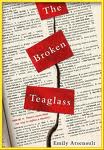
[READ: February 14, 2010] The Broken Teaglass

[UPDATE: Sarah just reviwed the book here.  We don’t often read the same books, so this was fun.]

Sarah’s friend Denise said I would really like this book.  Upon hearing that this book was right up my alley I had to investigate immediately (I always wonder what people think I would like).  And she was totally correct.

So what makes this book perfect for me?  Well, it is set in a dictionary.  Actually, it is set in the editorial department of the offices of the Samuelson Dictionary, one of the premiere dictionaries in the world.  The protagonist is Billy, a recent college graduate (in philosophy) whose first job comes at Samuelson.  The offices are located in the small town of Claxton, Mass.  Billy moves away from home (although it is still driving distance) to a small apartment in this very small town.

I have no idea if the descriptions of working in a dictionary office are in any way accurate, but it certainly is enticing.  Essentially, everyone works in silence all day.  They are assigned several magazines to read to see if there are any new words that are coming into common usage which might wind up in future editions of the dictionary.  Eventually they are assigned words to define as well (for future supplements to the dictionary).

They are also responsible for correspondence with dictionary users.  People write (or call) with questions about word usage, misusage and even suggestions for additions to the dictionary.  How fascinating is that? (Oh and these correspondences were absolutely hilarious!). (more…)

Read Full Post »

SOUNDTRACK: LES CLAYPOOL-Of Fungi and Foe (2009).

Claypool was asked to score a video game called The Spore Wars and, at around the same time, to score a movie called Pig Hunt.  According to the liner notes of the disc, he used the templates that he made for the scores and fleshed them out to make this album.

This was the first Claypool solo album I’d bought in several years (since 2002’s Purple Onion).  I’d heard “Mushroom Men” on the radio and really liked it, so I decided to get the disc.  And I have to say overall I’m a little disappointed.

Now, I’ve been a Primus fan for years (I even saw them right after Suck on This) so I know what I’m getting with Les.  And yet, maybe I don’t anymore.  The disc is very percussion heavy, with lots of rather long songs.  And although I love long songs, I love long songs that aren’t the same thing for 6 or so minutes.  I also rather miss Claypool’s voice.  He doesn’t sing a lot of these songs in his typical falsetto.  There’s a lot of very deep voiced, rather processed sounding voices here (it works great on the muh muh muh muhshroom men, but not so great elsewhere).  Because when you combine that with the bass and percussion, it’ really hard to hear what he’s on about (and Claypool lyrics are half the fun).

Plus, we know that with Primus’ own brand of weirdness, a little goes a long way.  So, hearing the same bizarro riff for 4 minutes can be trying.

Despite the criticisms, the disc is good in small doses.  The first 4 tracks are all really solid.  But that 5th track, “What would George Martin Do?” just sucks all the life out of the disc.  The same goofy riff for 6 minutes with completely unintelligible lyrics.  Ouch.   But “You Can’t Tell Errol Anything” picks up the pace somewhat with a wonderful Tom Waits-ian soundtrack.  The addition of Eugene Hutz on insane wailing vocals brings a wonderful new level of dementia to the disc.

Throughout the disc there some amazing bass riffs (of course) and some really cool effects thrown onto the bass (and other instruments).  But the overall feel of the disc is just too samey.  I think the music would probably work really well as soundtrack music, but it lacks a little something by itself.

I’m not suggesting that Claypool needs to be more poppy, because that’s hardly it (although he does have an amazing gift for clever hooks), but it’s possible that he needs an editor.  Was that the role Ler played in Primus?  Who will ever know?

[READ: February 5, 2010] Diario de Oaxaca

Wa-HA-Ca (that’s how you pronounce Oaxaca (the first question I had)).

I ordered this book for our Spanish collection without really knowing what it was about.  When it arrived I had a hard time deciding where to catalog it…is it a graphic novel?  a biography?  It’s bilingual so does it even go in the Spanish collection, which has much less circulation than our English collection?  As I flipped though the book, it looked really cool, so I decided to just read it and figure it out for myself.

Peter Kuper is, among other things, the drawer of Mad Magazine’s Spy vs Spy since about 1997.  Sometime in 2006, Kuper decided to go on sabbatical from the politics of George W. Bush.  He and his family packed up and moved to Oaxaca, Mexico for two years.  While he was there, the city experienced a semi-annual teacher’s strike.  However, this particular strike turned bloody when the President of Oaxaca turned his soldiers against the strikers. (more…)

Read Full Post »

« Newer Posts - Older Posts »