Feeds:
Posts
Comments

Archive for the ‘Books about writers’ Category

bothfleshSOUNDTRACK: SIGUR RÓS-Von brigði [Recycle Bin] (1998).

recycleAfter releasing their first album, Sigur Rós was approached by Icelandic musicians to remix the album. And thus came Recycle Bin.  I realized too late that I really just don’t like remix albums all that much–they’re mostly just faster drums plopped on top of existing songs.  And such is the case here.  Despite the interesting musical pedigrees of the remixers, there’s nothing anywhere near as interesting as on Von itself.  There are ten tracks, but only 5 songs.

”Syndir Guðs” gets two remixes:

Biogen keeps the bass but adds some more drumlike sounds.

Múm removes the bass, adds some wild drums and trippy textures and reduces the 7 minutes to 5.  It is quite pretty but very far from the original.

“Leit að lífi” gets three remixes

Plasmic takes a spacey 3 minute wordless noodle and turns it into a heavy fast dance song with speedy drums, big bass notes and with spacey sounds.

Thor brings in some fast skittery drums and keeps the spacey sounds (which sound sped up).  And of course bigger bass noises.

Sigur Rós recycle their own song into a dance song by adding funky bass and drums.

“Myrkur” gets two remixes.  the original is a fast-paced groovy track.

Ilo begins it as a spacey non-musical sounding piece.  After two minutes they add a beat of very mechanical-sounding drums.  It’s probably the most interesting remix here.

Dirty-Bix adds big, slow drums.  It keeps the same melody and vocals as the original but totally changes the rhythm and texture of the song, (removing the guitar completely).

The remaining three songs get one remix each.

The original “18 Sekúndur Fyrir Sólarupprás” is 18 seconds of silence.  Curver turns it into “180 Sekúndur Fyrir Sólarupprás” and makes a muffled drum beat and some other samples from the album, I think.  It constantly sounds like it is glitching apart until the end where it practically disintegrates–an interesting remix of silence.

“Hún Jörð” 7 min Hassbræður increases the drums and adds a more buzzsaw guitar sound and makes the vocals stand out a bit more.

“Von” has delicate strings and Jónsi voice.  The remix by Gusgus adds low end bass and drums making it a thumping rather than soaring track.

I prefer the original, but I much prefer their next album to the first one.

[READ: end of October to early November 2013]  original articles that comprise Both Flesh and Not

As I mentioned last week, I decided to compare the articles in Both Flesh and Not with the original publications to see what the differences were.  I had done this before with A Supposedly Fun Thing… and that was interesting and enlightening (about the editing process).

This time around the book has a lot more information than the original articles did.  Although as I come to understand it, the original DFW submitted article is likely what is being printed in the book with all of the editing done by the magazine (presumably with DFW’s approval).  So basically, if you had read the original articles and figured you didn’t need the book, this is what you’re missing.

Quite a lot of the changes are word choice changes (this seems to belie the idea that DFW approved the changes as they are often one word changes).  Most of the changes are dropped footnotes (at least in one article) or whole sections chopped out (in others).

For the most part the changes were that the book version added things that were left out or more likely removed from the article.  If the addition in the book is more than a sentence, I only include the first few words as I assume most readers have the book and can find it for themselves.  The way to read the construct below is that most of the time the first quote is from the original article.  The second quote is how it appears in Both Flesh and Not.  At the end of each bullet, I have put in parentheses the page in BFAN where you’ll find it.  I don’t include the page number of the article.  And when I specifically mention a footnote (FN 1, for example), I am referring to the book as many times the articles drop footnotes and they are not always in sync.

Note: I tried most of the time to put quotes around the text, but man is that labor intensive, so if I forgot, it’s not meant to be anything significant. (more…)

Read Full Post »

bomarsSOUNDTRACK: SIGUR RÓS-“Ný batterí” (2000).

nyThe single opens with “Rafmagnið búið” a kind of brass introductory piece.  There’s lots of horns building slowly, growing louder but not really playing a melody.  By the end of five minutes, it segues into “Ný batterí” which opens with horns as well.  Then the bass comes in, a slow, deep rumble of simple melody.  After 4 and a  half minutes, the drums are a powerful counterpoint to the sweet melody.

“Bíum bíum bambaló” is a slow piece (aren’t they all) that is mostly percussion.  Apparently it is an Icelandic lullaby.  The final track, “Dánarfregnir og jarðarfarir” was a theme used for death announcements on Icelandic radio.  I love the way it builds from a simple melody into a full rock band version and then back again.  It’s very dramatic.

Both tracks were used in the film Angels of the Universe (and appear on the soundtrack).

That certainly makes this single less interesting than the first one (although I’m not sure that the soundtrack was readily available at the time).

[READ: December 1, 2013] Breakfast on Mars

This is a collection of 38 essays (and an introduction by Margaret Cho).  It also includes an introduction geared toward teachers–an appeal that essays do not need to be dull or, worse yet, scary.  The editors encourage teachers to share these essays with students so they get a feel for what it’s like to write compelling personal nonfiction.  The introduction proper gives a brief history of the essay and then talks about the kind of fun and funny (and serious) essays that are included here.

This was a largely fun and largely interesting collection of essays.  When I grabbed it from the library I didn’t realize it was essays (I was intrigued by the title and then looked at the author list and immediately brought it home).  I know it says essays on the cover, but I chose to ignore that apparently.  When Sarah saw the authors (she knows more of them than I do) she had to read it first.  This proved to be a great counterpoint to the very large novel that I was reading at the same time.

The essays each take on different topics.  And what I liked was that before each essay, they include the question that inspired the essay.  I have included the questions here. (more…)

Read Full Post »

witmisSOUNDTRACK: NEIL HALSTED-“Wittgenstein’s Arm” (2012).

neil-halstead-palindrome-hunches-450Halsted was a founder of the band Slowdive, who I knew somewhat.  I don’t know anything of his solo work, although his name rang a little familiar.

This is a very pretty, slow acoustic ballad.  Halsted’s voice is whispery and with proper folk inflections. The chorus has a very catchy melody.  And yet the lyrics are really dark and sad.

And while there is a mention of an arm in the song, there’s no mention of Wittgenstein.

You can check out the video here:

[READ: November 3, 2013] Wittgenstein’s Mistress p. 181-end

This peculiar book draws to a close in much the same way that it started. There are a few interesting revelations or, if not revelations, then perhaps ponderables as to the nature of just what our narrator (who is apparently named Helen) is doing.

As this last section opens, she is revisiting some more of the things that have been on her mind for the book—the waterlogged atlas that lies flat on the shelf and that blasted arthritic should/ankle  .

I have been wondering about her constant references to her period.  In addition to simply being something that happens to her which she is recording, I have to wonder if it is a nod to her fertility and the fact that since she is the last person alive she will never bear children.  On a slightly related note, I also have to wonder if her focus on rape means she was once raped.  It’s not necessarily the case of course, but there is a lot of it in the book, like this next mention: (more…)

Read Full Post »

dec2000SOUNDTRACK: FLY ASHTRAY-“Also Muffins” (2013).

flyRecently I was thinking to myself that I don’t hear much music that is just weird anymore.  It could be that I am exposed to it a lot less than I used to be (when I was music director at my college station I received all kinds of crazy stuff) or maybe people just don’t do unconventional music as much.  This latter option seems very unlikely give the preponderance of cheap home recording equipment.  But bands that are not exactly novelty acts, but who are just totally out there (and amazingly used to get album releases).

And then my friend Paula forwarded me this absolutely weird song from Fly Ashtray.  Not only was I delighted to hear a weird song, I loved how good it was.

“Also Muffins” starts with big sloppy guitars and a piercing guitar riff which is simple but slightly off.  This goes for about 20 seconds before a staccato decrescendo brings the riff to a halt.  This fun chaos is repeated three times. It’s a crazy wonderful punk intro.

Then at a minute an a half the song turns almost folkie, with strummed acoustic guitars.  The band starts singing together (in no-part harmony) about how good their delicatessen is (they also sell muffins).  They all seem somewhat flat in their delivery, as a deliberate let down from the frenetic earlier section.  Then for part 3, an electric guitar comes back in with a kind of great alt 90s solo and a series of fast chords.  I love this section a lot.

The final section comes in and opens with another simple riff that is at once catchy even if the last note is flat.  It is fast and vaguely sinister (with a kind of siren sound in the background) and with some skittery guitars and an occasional bass element thrown in.  This last part lasts for over a minute and then the whole song fades out.

The video is low budget and fun and gives a kind of explanation to the music, although I have found that i enjoy it without the video as well.

And visit the band’s website.

[READ: November 1, 2013] “All is Vanity”

This is not an actual article by Bissell, it is one of those “annotation” items in Harper’s in which an advertisement or press release is critiqued.  in this one they analyze an Xlibris ad.

Bissell was an editor at Henry Holt (and may still be) when he wrote this.  And he is snarky from the start (as the Annotation always is), emphasizing the “Publishing Services Provider” and noting with numbers why Xlibris is a foolish vanity project.

“70 percent of the books the company has sold have been bought by their own authors.”

And how in general

“90 percent of the half-million [books] written each year remain unpublished.” (more…)

Read Full Post »

witmis4SOUNDTRACK: PANIC-Requiem for Martin Heidegger (1978).

13+LP+Hoes++VoorkantPanic was a Dutch punk band.  Their album 13 came out in 1978 and “Requiem for Martin Heidegger” was the final track.  I love the album cover (and no I had never heard of this band either).

The lyrics are wonderfully simple (and no you won’t learn a thing about the man) with the completely singable chorus of “Hi-Degger, Hi-Degger, Hi-Degger, Hi-Degger, Hi!”

There are some other lyrics (including ein, zwei, drei, vier) and “Is he in heaven, is he in hell, where has he gone?  no one can tell.”

There’s some introductory chatter which I think is in German, but may be in Dutch.  But that’s all irrelevant, because this is three minutes of classic 70s punk.  And the video is a hoot too.

[READ: October 30, 2013] Wittgenstein’s Mistress p. 120-180

Although I read the first half of this book rather quickly, I took some time off before reading this section.  The good news is that this book does not require constant attention.  The bad news is that because there are so many details in the book (whether “relevant” or not) it’s easy to forget if she has talked about the different pieces before.  And that is kind of the point from her a well, since she constantly questions whether she has talked about something or not.

I’m breaking from my normal summary for a minute because I wanted to bring up something that struck me as I was reading this.  Several times throughout the book I found myself searching the web for ideas and facts that she mentions.  And it struck me that, while yes, in her world, the internet wouldn’t be working anyhow—there’s no electricity even—but she would not even have the concept of being able answer her questions with a few clicks.  This book wasn’t written that long ago, but when it was, the internet as we know it didn’t exist.  So our narrator does not know that she could have answered all of her questions in just seconds.  If this book was written now, it might even be seen as a “point” that the world no longer has such easy access to information.  But that is not an issue in this book.  Rather, our narrator simply knows that unless she is willing to dig through boxes or really wrack her brain to be able to remember where she found the information (and we know that’s not going to be successful), she simply won’t “know” what she knows.  And it’s interesting to imagine what it was like to read this book back in the 1980s without being able to quickly confirm  that indeed Wittgenstein said this or Heidegger said that or even that any of the artists she mentions really did what she says.   And I find that really fascinating.

Vaguely connected to this idea is her wondering about some details of the Savona soccer jerseys and then saying “One is scarcely about to return to Savona to check on this, however.” (122). (more…)

Read Full Post »

witmis3SOUNDTRACK: TOULOUSE LAUTREC-“Yesman” (2013).

heroesToulouse Lautrec are an alternative rock band from Romania.  Once again, I would not have ever heard of them had I not looked fora song about Lautrec (since he is mentioned in this section of the reading).

Toulouse Lautrec have two albums out, Heroes and their new one Extraordinar. They sing in both Romanian and English and this song (which is the first thing that came up on my search) is entirely in English.

It starts out with some very cool guitar riffs (very math rock–I actually considered it might be an instrumental).  Even the bass is doing something interesting behind the guitars.  Then about 50 seconds in the vocals begin.  And the singer has an almost American twang to him.

The chorus is a simple one, with ooh hoo hoo hoos.  But the real fun is at the end of each verse–the I say no I Say no and I say yes I say yes.

I listened to this song a few times and really liked it a lot.  It’s simple but solid alt-rock.  Then I found their website and watched a few more of their videos.  I really like the sound that they get–kind of buzzy guitars but otherwise very clean.

Check out the video for Yesman

and their site (which is in Romanian, but Google Translate will help you navigate)

[READ: October 20, 2013] Wittgenstein’s Mistress p. 61-120

This book is proving to be far less daunting and far more loose and fun than I anticipated.  As you can see by my “read” date, I finished this almost two weeks ahead of time.  In part it’s easy because unless I am gravely mistaken, there’s nothing really to “remember” about the story.  There are details and I think they are ponderable, but there’s nothing that seems to really impact the story. It’s more a series of ideas.

It’s really quite an audacious piece of writing.

Wittgenstein gets his first mention on page 61

“Once Bertrand Russell took his pupil Ludwig Wittgenstein to watch Alfred North Whitehead row, at Cambridge.  Wittgenstein became very angry with Bertrand Russell for having wasted his day” [61].

There are some meaty existential issues brought up like

“Surely one cannot type a sentence saying that one is not thinking about something without thinking about he very thing that one says one in not thinking about” [63]. (more…)

Read Full Post »

witmis2SOUNDTRACK: CÓDIGA DE GUERRA-“Wittgenstein Song” (2013).

codigoCódiga de Guerra is from Hidalgo in Mexico.  They have one album out (called Peyote).  I am having a devil of a time finding anything out about them.  You can stream the album on YouTube and you can even buy it from iTunes, but I can’t get any kind of band home page.

It should be apparent that I’d never heard of them before I saw they had a song called “Wittgenstein” and so here they are.

They sing entirely in Spanish, so I don’t really know what this song is about, but i really like it.  Indeed I like the whole album.  They have an indie rock feel–buzzy guitars and good melodies.  Some of the early songs on the album are even kind of mellow which made me think of R.E.M. for some reason.

“Wittgenstein” is the heaviest song on the album.  It opens with some echoed guitars (not unlike Kiss’ “Black Diamond”) but when the other guitars kick in, it is much louder (not heavy heavy, but louder).  The chorus gets kind of heavy again, but the song fades out entirely at around two minutes.  Then a buzzy bass comes back in and the echoed guitar plays the intro and the song starts again.  I heard the word logico in there so it may indeed be all about Wittgenstein.

Check out the song

or the whole album

[READ: October 16, 2013] Wittgenstein’s Mistress p. 1-60

Typically for a group read like this (especially the longer, harder books) I like to be a kind of touchstone–noting significant things that happen and trying to wrap my head around the book by summarizing it, without really speculating wildly about what will happen.  Well, Wittgenstein’s Mistress seems to studiously resist that sort of approach.  I am not typically a “solve it” kind of reader.  I don’t usually try to figure things out ahead of time.  If the book is well written, I just like to let it flow over me so I can think about it afterwards.

But this book more or less demands you to try to figure out what is going on right from the get go.

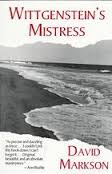
The cover image above shows the opening sentence:

“In the beginning sometimes I left messages in the streets.  Somebody is living in the Louvre, certain of the messages would say. Or in the National Gallery.”

followed soon by

“Nobody came , of course.  Eventually I stopped leaving the messages.”

Weird, right?  And then comes:

“I have no idea how long ago it was when I was doing that. If I was forced to guess, I believe I would guess ten years.”

Whoa.  And then the kicker:

“And of course, I was quite out of my mind for a certain period too, back then.” (more…)

Read Full Post »

dec2004SOUNDTRACK: AWAY-Cities (2013).

awayAway is Michel Langevin, the drummer for metal band Voivod.  But on his first solo album he eschews all conventional music.  Rather, he has created an exercise in found sound and released it on the small label Utech Records.

The album is described as

Strong field recordings capture more than just the sound of an area, they capture a mood and spirit of the place and people. On Cities, local color and nature recordings clash with riots and discord, capturing the full human experience across the world. Literal and metaphorical “found music” appears: the booming stereo of a passing car or distant church bells, as does the rhythmic engine hum of a bus or the chirping of birds. This tour is a fast paced one, rapidly weaving through the geographic locations building a diverse, yet consistently engaging experience. The audio journey captured here perfectly reinforces the fact that, regardless of one’s location, the presence of music is never far, nor should it be.

What we get is a collection that sounds like a tour through the streets of the respective cities (nothing more specific than Europe is given, sadly).  We hear street noise and buskers playing (interestingly just about every type of music I have heard in Boston subways as well).

I only wish more information was given about just what Away was up to.  Where he was and, more importantly, how he recorded these sounds. The recording quality is amazing—the panpipes and harmonicas sound crisp and clean with no other ambient noise.  Did he ask the performers if he could record?  How did he get them so pristine especially since I assume they are in the streets?  And for the Europe ones, was there any given order to the way they were edited?  Is it the progression of their Voivod tour, or is it just random?  The mixing and sequencing is quite good, especially in the shorter pieces which really take you on a journey.  Not knowing what’s happening is maddening and part of the fun as you try to picture (especially if you use headphones) exactly what you are hearing.

“Montreal 2010” opens with the sound of travel until we zoom in on panpipes (for a few seconds).  This switches to a lurching shanty (sung, I suspect in French—it’s a little hard to hear).  Then from the shadows comes the sound of someone playing Leonard Cohen’s “Hallelujah” on the harmonica.

“Europe 2012” opens with someone playing what I suspect is a hammered dulcimer (exactly the kind of thing that buskers play in subway stations), it shifts to a jazz trio (sax, bass, drums) wailing away with traffic noises in the background.  After some busses and an accordion solo, there are delicate chimes.  Finally a bagpipe melody leads us away from the delicate chimes until we hear announcements in what sound like Russian and then French.  The track ends with fans chanting “Voivod Voivod.”

Montreal 2012 returns Away to near his home city.  This time the scene is much nosier—it could be joyous, it could be angry—there are whistles and horns, and by the end it seems like a joyous parade.  The noise diminishes as an operatic voice pierces through briefly until the drums return.  More street noises, including police sirens, French chanting and a train passing by as we return to yet more street drumming.  If this track had more context for the title it would probably be more enjoyable. And yet as the parade (for surely that is what it is ) marches past you feel like you’re there.

“Mexico City 2012” opens with a truck honking and street noise until we hear what sounds like an indigenous band playing, then some more flute music and church bells pealing. Then there are announcements in Spanish (by both a man and woman presumably in the church) and church organ music.  Pan pipes and drums bring us back into the street and what sounds like a market scene which ends with some Mexican music playing.

“Europe 2011” opens with some beautiful guitar or perhaps an Indian stringed instrument playing and some traditional Indian singing.  There’s some more music playing and cheering and then some peace as birds take us out of this short track.

“Montreal 2011” opens with banjo music (!).  And then the more typically French sounding violin moves us along.  More pan pipes and traffic noise progress us through the city.  Then two very different examples of accordion music meld until the noise of the train wipes them out.   The track fades out with a band playing a  jaunty accordion inspired track.

“Chicago 2012” ends the disc with a symphony orchestra tuning up (I presume) for a few minutes.  It’s a shocking cacophony.  Until someone shushes the noises and the birds return, playing us out of this aural tour.

You can stream, download or buy the CD  here.  Buying the CD gets you some of Away’s cool art (although I wish there was more).

[READ: October 8, 2013] “War Wounds”

Since I’ve been enjoying Tom Bissell’s book reviews, I thought I’d see what else he had written in Harper’s.  He seems to have a storied career with the magazine as a traveling journalist.  And this article dates back to 2004.

It is a personal article about himself and his father.  What I found fascinating about this is that his father was a Vietnam veteran, and I don’t know too much in the way of writing that concerns being the child of a Vietnam veteran.  There are a lot of books and films about the Vietnam experience for the soldiers, but not so much about the families that they returned to (as far as I know).  So it was interesting to read Bissell’s account of growing up with his father–who was a hard man and who wasn’t afraid to fight with his children (especially when drunk).

The man that Tom grew up with had a temper and didn’t much approve of Tom’s chosen profession.  But unlike many people of his generation, Tom didn’t feel that he had a particularly estranged relationship with his father.  What on earth possessed him to invite his father on a trip to Vietnam–to visit the sites where he lost friends and was himself wounded, is the stuff of journalism. (more…)

Read Full Post »

harper septSOUNDTRACK: LINDA THOMPSON-“Love’s for Babies and Fools” (2013).

lindaAfter two pop songs, here’s a major bummer from Linda Thompson.  Thompson is a fascinating figure.  She was married to Richard Thompson and made many albums with him.  They split very acrimoniously and them Linda suffered from psychogenic dysphonia, which rendered her incapable of singing.  She stopped singing for 11 years.  Now with botox injections into her throat she can sing again, but cannot perform live. She released an album n 2002 (Richard played guitar on a track) and another album in 2007.  Now’s she’s back and Richard plays on this song as well.

In the grand tradition of folk music, Linda’s lyrics are achingly straightforward and powerful:

My father is a traveler, he has a cuckold’s luck,  my mother is a queen but her hands are tied with blood. I’ve a brother in the graveyard, my sister has the blues.  I care only for myself.  Love’s for babies and fools.

The guitar work is beautiful, the song itself is beautiful and depressing at the same time.

Linda’s voice has always been unique—almost otherworldly and yet ordinary at the same time.  It’s strange and mesmerizing.  Welcome back Linda.

[READ: October 1, 2013] “A Different Kind of Father”

This is an excerpt from a new book by Franzen. The book itself is fascinating.  It is a translation of a “Nestroy and Posterity” a somewhat obscure essay from 1912 by the Austrian satirist Karl Kraus.  Franzen’s book is called The Kraus Project and in addition to the translation, Franzen includes a ton of footnotes that are all personal, like this one.  The book is 300 some pages and it sounds like the majority of it is footnotes.  [For those who like to keep track of Franzen’s connections to David Foster Wallace, of course this collection with footnotes does make one think of DFW.  Interestingly, Franzen talks about a book he was writing in 1981 (long before he met DFW which had a main character whose name was Wallace Wallace Wallace].

This footnote (no context is given) is all about the concept of thriving as a man by surpassing your father.  Be that literal or figurative (or literary).  In the case of Kraus, Franzen says, he is denying false paternity.  It was believed that Kraus was the literary son of Heinrich Heine, but Kraus tries to annihilate Heine by dismissing his successes and impugning his character.  However, Johann Nestroy was also a precursor to Kraus but Nestroy was a somewhat neglected and undervalued one, and so Kraus seeks to place Nestroy as his surrogate father. (more…)

Read Full Post »

2013-10SOUNDTRACK: VOIVOD-The Best of Voivod (1992).

bestvoivodMost Best of records promise you a selection of popular songs from a band.  Voivod never really had any popular songs, so this is an interesting choice to start with.  This may also be the only Best of compilation of a band where people who like some of the songs almost assuredly will not like other songs.

As my posts about the band have indicated, Voivod changed drastically over their first six records (which is the  period this collection covers).  And so in twelve tracks and 50 some minutes you get the very diverse history of this very unusual band.  I’m not going to talk about each track (already done that), but I will list the songs

  • Voivod [War and Pain] classic screaming metal.

  • Ripping Headaches [Rrröööaaarrr] brutal, but I must say sounds a ton better than the original CD.  I wonder if this was remastered for the compilation).

  • Korgull the Exterminator [Rrröööaaarrr] hard to believe they used two songs from this album.

  • Tornado [Killing Technology] heavy but quite catchy.

  • Ravenous Medicine [Killing Technology] signs of complexity enter the heaviness.

  • Cockroaches [EP] a strange inclusion, almost a rarity.

  • Tribal Convictions [Dimension Hätross] very complex with some heaviness.

  • Psychic Vacuum  [Dimension Hätross] I’m surprised they didn’t pick other songs though from this album.

  • Astronomy Domine [Nothingface] their hit.

  • The Unknown Knows [Nothingface] very hard to choose just two songs from this masterpiece.

  • Panorama [Angel Rat] Their newest single and quite a departure from everything that has come before.

  • The Prow [Angel Rat] their prettiest number ever.  If you buy this CD for this song you’ll hate the early stuff.

Although Voivod fans (like Dave Grohl)

are diehard, anyone who would buy only a Best of record from the band is sure to be disappointed. There are so many phases of the band and they are so radically different from “Voivod” to “The Prow” that it’s almost not even the same band.  I’m very curious as to what sales for this album were like.  (Even the cover isn’t that inspired)

[READ: September 2013] The Walrus: Tenth Anniversary Issue

It’s hard for me to believe that The Walrus has been around for ten years (even they seem a bit surprised).  I still remember hearing about the magazine on Book TV from some Canadian channel that I just happened upon.

When I heard about it The Walrus seemed interesting–kind of like Harper’s and elements of the New Yorker but all about Canada.  I’ve been a Canuckophile for decades now, so it seemed like an interesting prospect.  And over the ten years of the magazine, while I haven’t written about every issue, I have read every article.  I have written about all of the short stories that they’ve published.

This issue eschews some of my favorite elements (the short articles in the front and the arts section in the back), but they make up for it with an oversized issue (twice as long as usual and the articles are all packed with content) and some fascinating articles.

And while there are none of the short articles from the front, there are “Time Capsules,” one page articles about things that have happened in the last ten years: The iPhone, Sports Concussions, Armed Drones, The Residential School Apology, Justin Bieber, Foodies, Hand Sanitizer and Cyberbullying.  It’s interesting to read about these phenomena from a slightly different perspective.  We know that Canada and the U.S. share many similarities but there are, at heart some core differences.  And it’s these differences that make you rethink a subject.  (more…)

Read Full Post »

« Newer Posts - Older Posts »