Feeds:
Posts
Comments

Archive for the ‘Big Books’ Category

SOUNDTRACK: FRANK ZAPPA AND THE MOTHERS OF INVENTION-Over-nite Sensation (1973).

When I saw Marvy’s Mothers, it was hard not to pass up the connection to Zappa and his band.  But oh, what album to pick?  (He released like 40). I chose the one released in the same year as Gravity’s Rainbow.

It also happens to be full of all kinds of sex (imagine that).

It opens with “Camarillo Brillo” the kind of simple, catchy song that Zappa seems to whip out very easily.  I assumed that the title was some kind of sexual slang (not a bad assumption), but Wikipedia suggests it has something to do with an insane asylum (Camarillo) and the crazy hair they often had, which makes sense given the crazy lyrics.  It starts kind of trippy with inscrutable lyrics.  And then the bridge, “she was breeding a dwarf” is pretty insane.  It also features a very funny sequence that was oft-quoted in MST3K–“Is that a real poncho or a Sears poncho.”

“I Am the Slime” is a funky (a great Zappa riff) diatribe against TV (because it makes you buy crap you don’t need and makes you listen to the government).  “Dirty Love” is a perverse song with lots of guitar solos.  There’s some kind of bestiality in this song (which also ties in with parts of this section).

“Fifty-Fifty” features the vocals of Ricky Lancelotti (in a screaming style that would later be used a lot by Terry Bozzio).  It’s about an ugly guy who is crazy enough to sing to us.  The songs seem to be more about solos though, as there’s a keyboard solo an electric violin solo (from Jean-Luc Ponty) and some crazy guitar solos.

I don’t know what “Zomby Woof” is about, but it has some wicked guitar soloing and horns playing Zappa’s staccato riffs up and down the scale.

“Dinah-Moe Humm” is a song perfectly suited to this book–it’s a song in which a woman bets the narrator that he can’t make her have an orgasm.  The melody is twinkly and silly.  It’s shockingly explicit. But it’s even funnier to know that the backing vocals are supplied by The Ikettes (Ike and Tina were recording in the next room).  They got paid almost nothing and when Ike heard the song he called it “shit” and asked that their name be removed from the credits.

It also plays around with hippy slang.  “Kiss my aura Dora/It’s real angora/Would you all like some more-a/right here on the floor-a/and how about you fauna/You wanna?”

He also starts talking about Zircon encrusted tweezers, which come back in “Montana.”  “Montana” is about moving to Montana to raise dental floss (really).  It features some wonderful fast pizzicato notes that are more or less Zappa’s signature.  The middle section is  hugely difficult and very impressive for the backing vocalists (Tina apparently was really impressed that one of her girls could do it).

Zappa packs a lot of music into 35 minutes, and this album seems to be a turning point in his desire to cram sex and craziness into his commercial music.  Just about every song on this disc was played a lot live and this album has become something of a classic.

[READ: Week of March 19] Gravity’s Rainbow [3.1-3.5]

This week’s read has been the most challenging for me so far.  I enjoyed Section 2 very much.  The Slothrop scenes were funny and wild and even advanced the plot.  I never expected that Section 3 would introduce a ton of new characters, more or less ignore the old charterers and stay with these new characters so that by not paying close attention to them in the beginning I was just confused by the end.

I do admit that while skimming again for this post, I was able to focus on the new characters more and found it far less confusing.  It’s just that on a first read, suddenly there’s this whole new sequence of people and their histories to deal with!  Wow.

It was especially surprising because Section 3 begins with Slothrop (so it’s not like in 2666 where a new section means a new cast).  But he meets new characters and then we flash all the way back through each person’s life.  And yes, it was quite interesting once I actually paid attention, and the connections were pretty awesome.  But it was still pretty surprising on the first read through.

Section 3 is called In the Zone.  And the Zone is mentioned quite a lot, although I never figured out where it is meant to be exactly. (more…)

Read Full Post »

SOUNDTRACKPEARL JAM-Austin City Limits (2009).

Pearl Jam records (and sells) most of their shows and they occasionally videotape them as well.  But they don’t do TV all that much (excepting the recent Late Late Show episodes).  There seemed to be something special, or at least different, about Pearl Jam on Austin City Limits.  Think of it almost like Unplugged Updated.

It opens slow with Eddie on an acoustic guitar and strings behind him.  In fact, the whole set seems less heavy than many of their sets.  But that’s not to say that the band doesn’t rock out, because they do.

The first six songs of the set come from Backspacer.   And then they bust out “Army Reserve” (which makes sense given who is in the audience, see below).  Then there’s a wonderfully raucous version of “Do the Evolution” (one of my favorite PJ songs).

After that riotous track, they bring the strings out for one more song.  It’s a rather funny little joke because it’s just the strings and Eddie on acoustic guitar playing “Lukin,” the 80-second song that is so fast you can barely hear the words.

For an extra treat, touring mate Ben Harper comes out to play slide guitar on “Red Mosquito” (which is always a treat).  And the set ends with an amazing version of “Porch” with a super long guitar solo in which Mike McCready really shows off his chops.  There’s even a moment where Mike and Stone are riffing off each other, classic rock style.
The set ends the Eddie talking about playing for the wounded veterans in the audience and how it was quite moving for him given all they have done for us.  Over the closing credits you see the band mingling with the veterans (including a guy who has lost a leg).  It’s all surprisingly touching for a rock show.

[READ: November 20, 2011] “Perchance to Dream”

A while back I read all of the Jonathan Franzen articles that were published in The New Yorker.  I thought I had read everything he’d published until I realized I had forgotten to read this piece (possibly his most famous) that was published in Harper’s.  It fits in well with this weekend’s theme because it was mentioned in Evan Hughes’ article that I talked about yesterday and because David Foster Wallace is mentioned in it.

As with most of Franzen’s non-fiction, it’s not easy to write about critically unless I want to argue with him, which I don’t necessarily want to do.  So instead, I’ll try to summarize.  Of course, this is a long and somewhat difficult article, so let’s see what we can do with it.

The first surreal thing is when you see the byline: “Jonathan Franzen is the author of two novels, The Twenty-Seventh City and Strong Motion, and is writing a third.”  It’s hard to imagine he got a huge article in Harper’s before he wrote The Corrections.

The second surreal thing comes in the text: It opens with “The country was preparing for war ecstatically, whipped on by William Safire (for whom Saddam Hussein was ‘this generation’s Hitler’) and George Bush, whose approval stood at 89 percent.”  And it is only a few paragraphs later when he mentions Patriot missiles that it clicked that this was written in 1996 and not 2001 and that he was talking about the 1991 Iraq invasion.  He mentions this as a prelude, saying that he was trying to sequester himself in order to start writing again.

Then he talks about Paula Fox’s novel Desperate Characters as a benchmark in terms of insight and personal conflict, even if it is so crazily outdated (that someone would throw an inkwell!).   He talks about this book quite a bit. I’m, not sure I found it compelling enough to want to read, but it’s always interesting to hear a fan write about a book I’ve never heard of.  He will return to this book throughout the essay. (more…)

Read Full Post »

SOUNDTRACK: BOOKWORM-Jeffrey Eugenidies: The Marriage Plot (December 1, 2011) (2011).

Since “Just Kids” mentions  Eugenides’ book, and since Eugenides happened to appear on Bookworm at around the same time as I read this article, it seemed like a good pairing.

Obviously, from the title of the episode you can tell that this is all about Eugenides’ new book, The Marriage Plot.  Michael Silverblatt raves about this book like no other book I have heard (granted I haven’t listened to all that many episodes of Bookworm, but still).  In fact while listening to this episode, I put The Marriage Plot on hold at the library.  I always planned to read it but figured I’d just get around to it some day.  Now I feel more of a sense of urgency.

They talk at length about the state of marriage in the 21st century.  Not as in its decline but in how it differs so much from classic literature in which women had to get married by 21 or risk spinsterhood.  Eugenides set out to write a book about people getting married without having the trappings of classical literature.

It sounds wonderful.

The reason I mention this interview at all is because in the article below, Hughes talks about contemporaries of DFW using DFW as the basis for a character in their books.  So, in Franzen’s Freedom, there is character who is very much like DFW (I haven’t read Freedom yet so I can’t say). 

And in The Marriage Plot, there is a character who resembles DFW.  When I read the excerpt of this story in The New Yorker, I had to admit he did seem an awful lot like DFW–a tobacco chewing, bandanna wearing philosopher.  Eugenides had been mum about it for a while, but now, under the gentle nudging of Michael Silverblatt, he comes clean. 

He admits that there are some characteristics of DFW in the character.  However, he says that he didn’t know DFW all that well and the character has been kicking around since he went to college (long before he knew DFW).  Tobacco chewing was rampant at Brown in the 80s apparently.  But it’s a nice revelation and it ties in very well with the article.

You can listen to the show at KCRW.

[READ: December 7, 2011] “Just Kids

I have always grouped together certain authors in my head.  When there were a bunch of Jonathans publishing, I kind of lumped them together.  I think of Mark Leyner and Bret Easton Ellis in the same breath.  It’s fairly common, I suppose.  But I never really thought of David Foster Wallace in terms of a group of authors.  He seems so solitary that it’s funny to even think of him as having friends.   But according to Hughes, many of today’s established authors prove to have been a part of a kind of nebulous writer’s circle.  A kind of 1990’s update of Dorothy Parker’s vicious circle.  But more insecure.

The article bookends with Jeffrey Eugenides.  In 1983 he and Rick Moody drove to San Francisco with the intent of being writers.  Five years later with no written works, Eugenides moved to Brooklyn, alone.  In that same summer, Jonathan Franzen was in Queens, also feeling alone (even though he was married–unhappily) and desperate for friends and peers.  And then Franzen got a fan letter from David Foster Wallace (that’s after he had written Broom of the System, but before Girl with Curious Hair) praising The Twenty-Seventh City

Franzen and DFW became friends.  To this friendship was added William T. Vollman, and David Means, also Mary Karr (whom DFW dated) and Mark Costello (who co-wrote Signifying Rappers with DFW).  Later they would connect with Eugenides, Rick Moody and Donald Antrim.  (more…)

Read Full Post »

SOUNDTRACK: NADA SURF-Plays Covers on World Cafe (May 13, 2010).

I didn’t even know that Nada Surf had released a covers album (sometimes things slip through the cracks), but when NPR previewed their new song, I learned that they played some covers for World Cafe (not downloadable, sadly) to promote the album. 

So I’m going to be investigating that covers album shortly.  In the meantime, we get this very enjoyable four-song set (three covers and one of their own tracks). 

The band chats with David Dye briefly (about 5 minutes) before busting into the songs (a wonderful explanation of Bill Fox and a mention of reading about him in The Believer).  Their own track is “Whose Authority” one of their many wonderful songs.

The three covers are “Love Goes On” (by the Go-Betweens), “Enjoy the Silence” (by Depeche Mode) and “Electrocution” (by Bill Fox).  I didn’t recognize the first song until the Ba-ba-ba chorus kicked in, although I admit I’m not terribly familiar with it.  Similarly, the final song by Bill Fox is very obscure (as is Fox himself).  Both of these two songs are played with jangly guitars and are poppy and quite enjoyable.

The Depeche Mode song is the one that I already really knew well.  And boy do they make it their own.  They turn it from a somber dirge (catchy but somber) into a more upbeat almost poppy folk song.  It will probably be a polarizing cover (if anyone cares enough about Nada Surf to listen) and while I don’t think it’s as good as the original, it works so well in the context of a Nada Surf show, that it’ hard to argue with it.

Nada Surf is one of the great unsung bands and it’s hard to believe they aren’t more successful.

[READ: October 21, 2011] Mission Street Food

With Lucky Peach, McSweeney’s entered into the world of food publishing.  I was surprised by how much I enjoyed Lucky Peach.  But when I received Mission Street Food, I was no longer in the frame of mind to get excited to read this book, which, as the subtitle says, promises recipes and ideas.  And when I first flipped through it, I got to the recipes pages and said, well, when will I ever read this?

Then one night recently I couldn’t sleep and Mission Street Food was there, so I read the Preface.  And Anthony Myint has a great writing style, a great flair for telling a story and a wonderful story to tell.  Needless  to say, I read almost the whole first section before falling asleep.  And I was excited to tackle the rest of the book.

I hate to sound like I think that McSweeney’s has changed the way food book publishing is done, because that would be unfair.  I don’t read food publishing as a rule.  I can’t even enjoy looking in my wife’s cooking magazines.  Seeing names of foods and recipes for preparing them just doesn’t do anything for me.  But maybe the narrative of those books is more interesting than I give them credit.  Maybe I should sit down with another foodie book and see what it’s all about. (more…)

Read Full Post »

SOUNDTRACK: PUBLIC ENEMY-Fear of a Black Planet (1990).

NPR recently broadcast a PE show from the All Tomorrow’s Parties Festival.  I didn’t know that PE was still touring, so that was a surprise to me.  The show was largely a celebration of Fear of a Black Planet, which meant that I had to go back and listen to the original.

Man, is this a solid album.  The lyrics pack a punch even twenty years later and what is perhaps more amazing is that the sound collages that Terminator X created, which were something of an oppressive sonic assault are now fairly mainstream-sounding (forward thinking or what?).

What I like about this (and most PE) albums, is that  they have little skits between songs, but unlike most rap skits they’re not one-not jokes that you listen to once and then skip every future time.  A wonderful skit (for lack of a better word) is “Incident at 66.6 FM” in which we hear an amazing amount of racist epithets thrown at PE apparently on the radio.  Or the rather disturbing “Meet the G That Killed Me.”  “Anti-Nigger Machine” is a great collage of samples like “Think” and James Brown and a dozen more songs.

“Can’t Do Nuttin for Ya, Man!” is a (sort of) comic song from Flav that is catchy as anything. While “Reggie Jax” is a confusingly titled song that has nothing to do with baseball, but everything to do with funk.

Of course, this disc has some of PE’s best songs as well.  From the awesome “911 is a Joke” to one of the best rap songs ever, “Welcome to the Terrordome” (my favorite story of this song is when I was wearing a  Welcome to the Terrordome shirt and my philosophy professor asked me quite pointedly, “What in the hell is a terrordome.”  That was a fun conversation).  “Terrordome” is still amazing–powerful, musically intense and for all of its lyrical acuity, it still has funny moments….boing.

And of course, “Burn Hollywood Burn” is an amazing critique of the movie industry (and it’s catchy too).  I got Black Caesar back at the crib, right Lar?

I’ve always been a little confused by “Pollywannacracker.”  Not lyrically, but vocally, as Chuck’s (is it really Chuck?) voice is treated in a surprisingly tinny way.  I liked the song more on this listen than any other, I guess in the past it just kind of snuck by me.

The album is a little front loaded with greatness.   “Power to the People” is another powerful song, but it’s not quite as memorable as the other tracks.  “Fear of a Black Planet” has some really cool sounds on it (where did they get that “black man, black woman, black baby” sample?).   “Revolutionary Generation” is a great track in which Chuck and Flav stand up for black women: “R-E-S-P-E-C-T, my sister’s not my enemy.”  Not your average rap subject.

And the last couple of proper songs, “B Side Wins Again” and “War at 33 1/3” are fast paced and furious, but they don’t really have much in the way of a hook.  Nevertheless, lyrically they are really great, and I love to hear Chuck D flow that quickly.

The biggest surprise for me is the censored version of “Fight the Power” (the song that got me into PE in the first place, thanks Spike).  It’s really surprising to me that PE allowed their music to be bleeped–unless it was just for a deliberate radio play (which I can accept).  Although they also list a title as “Leave This Off You Fu*Kin Charts” (did I buy a Columbia House version or something?)

This is an amazing album, one that still sounds fresh and sadly, is still relevant.

[READ: October 15, 2011] Between Parentheses

I never expected to get so addicted to Roberto Bolaño.  And despite his death, there is no shortage of works coming out in English (that is one of the advantages to reading a translated author–even death doesn’t cease the available materials).  Indeed, this year alone, New Directions is publishing Between Parentheses, and Tres and FSG is publishing The Third Reich (a collection of non fiction, a collection of poetry and a novel respectively).

When I really get into an author, I fall for his or her works, not necessarily him or her as a person (heck, some author are downright jerks).  But there are some authors that I want to know about, personally.  Bolaño is a pretty polarizing figure–he seems obnoxious, his works don’t shy away from very specific opinions, and sometimes it’s unclear what kind of views Bolaño himself has in his works (or if he’s even telling the truth about his so-called truths).  One thing in particular is the constant use of the word “faggot.”  It is used often in 2666 (and I know that is a translator’s choice, but still) and used derogatorily.  Now, clearly the context is everything for something like that.  But it seems to speak badly of Bolaño.  And yet, when reading these essays he is not homophobic in the least.  He is obviously well aware of institutionalized homophobia in Latin America, and he is obviously not supportive of it.

But that’s just one interesting thing about this book.  So let me back up. (more…)

Read Full Post »

SOUNDTRACK: COLIN STETSON-New History Warfare, Vol. 2: Judges [CST075] (2011).

When you learn that Stetson played saxophone for Tom Waits, it makes perfect sense.  The middle of the second song, “Judges” sounds like the instrumental break for any of Waits’ newer songs.  Of course, once Stetson starts really wailing you realize that Stetson doesn’t need Waits’ lyrics to tell a story. With just one big-assed bass saxophone, Steston can say quite a lot.  He plays with circular breathing, meaning that he doesn’t have to stop to take a breath, he breathes in through his nose and out through his mouth at the same time (this is of course impossible).  The bass saxophone weighs some 20 pounds and is massive and Stetson makes it sound like everything from an oil tanker to a field of runaway horses.  Oh, and he also has pretty melodies and songs that sound longing.

This disc is part two of a trilogy, but this is the first of his records that I bought (thanks to a release via the folks at Constellation–I wonder if they will redistribute Pt 1).  There is a story that runs through these discs, although honestly, I’m not entirely sure what it is.  But that doesn’t matter to me, what matters is Steston’s amazing skills.

There are evidently a couple of overdubs on this disc, but for the most part it is just him and his saxophone (and 24 microphones).  The microphones were placed all over the room, on the instrument itself (to pick up the clacking of the keys) and even on his throat (when he makes those “voices muffled by a pillow” sound, that’s the throat mike picking up voice–singing while he is playing (which is impossible)).

The album features a couple of spoken word sections by Laurie Anderson, whose clipped, non-inflected voice gives this otherworldy music an even more otherworldy feel.  And there’s two songs sung by Shara Worden.  Other than that, it’s just the man himself.

Prepare to be amazed by this man’s talent.  But also prepare to be a little frightened by what you hear.  This is not timid music by any stretch.  There’s some scary stuff on this record, especially if you listen in the dark.  More especially if you listen loud (which you absolutely must do to hear all the nuances).  On first listen, this may sound like a noisy jazz record, but the more you get into it, the more amazing it becomes.

[READ: October 11, 2011] Moby Dick-in Pictures

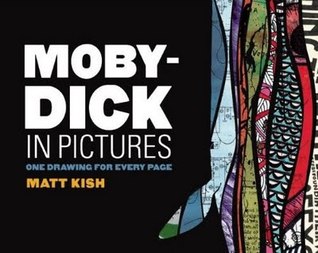
Matt Kish has accomplished an amazing thing.  He has drawn a picture a day (more or less) to accompany every page of the 552 page paperback version of Moby-Dick.  He takes a small passage from each page and renders an image for it.  One thing this book is not is an illustrated version of Moby-Dick.  It doesn’t purport to be.  You won’t get the whole story from this book.  It’s not a cheat sheet for high school students.  If you haven’t readMoby-Dick, this will give you a taste for the story–almost like a preview for a movie.  And hopefully it will compel people to read the original.  If you have read Moby-Dick, this is a wonderful companion.  Not only will the pictures give you fascinating insights into the story (and into Kish, of course), but seeing sentences excised from the book to stand alone makes you aware of the book in ways you just aren’t when you’re reading it as a novel.

Kish admits he is not an artist, which while not false modesty, is certainly selling himself short.  He has an awesome style of illustration.  I am especially excited by his vast pictures with small details (lots of pages where there are small circles with lines in them or, for instance, the details on Queequeg’s face) and when he uses bold lines to create vast, weighty iconic pictures.  Here’s one example of his awesome use of multiple straight lines.  I mean, it’s gorgeous.

But I also love the whole conceit that an artistic shortcoming for him has turned out to be an absolute boon.  Kish says he cannot render the human form and so he made the conscious decision to make the seamen more like avatars than people.  It’s daring and a little odd, but it works wonders.  I admit that I was a little less than excited by the very first page of the book–I was disconcerted by Ishmael and his utter lack of features. (I actually like the way he is rendered later in the book better–call it an artistic growth).  But by the time her gets to Queequeg, or the  gorgeous Tashtego  it’s obvious that his decision was genius.  Just take a look at the marvel that is is Ahab (left).  First off, the colors are amazing.  As are the details of the whale in the corners.  But look at him–he’s a metal machine–shiny and tough–part ship, part whale.  Look at the awesome shading and detailing of the blue “coat” that he’s wearing.  He’s even got the badge of Moby-Dick on his belt!  And then there’s the pegleg–the most beautifully drawn pegleg ever.  It’s really stunning.

Now you’re also noticing that there’s all kinds of diagrams behind Ahab.  Kish used to work at a bookstore and he hated seeing old pages of books thrown away (he has since become a librarian, which makes sense–although as I librarian I learned that librarians are actually quite cavalier about throwing away old books once they are beyond use).  So he brought these pages home.  And, given the density of the layers of meaning in Moby-Dick, he decided to draw his pictures on these old pages.  So on virtually every page you can see something in the background.  Most of the time they are these circuital diagrams, which are wonderful. But there are several drawings where the found pages are pages of text from books.  And I have to say if these were serendipitous findings then he has amazing fortune.  Some of the pages tie in so perfectly it is wonderful.

Like the page that is headed “Cetology” and is from what, a textbook on whales?  Or several other pages that I wish I had taken notes on, because they were really wonderfully chosen.  He even has a drawing on a title page of Moby-Dick. I have to ask, did he really find that or did he buy it for the project? (more…)

Read Full Post »

SOUNDTRACK: COLIN STETSON: “Horn of Plenty” (interview, NPR’s All Things Considered) (2011).

I’ll be mentioning some recordings by Stetson shortly, but as an introduction to this man and his bass saxophone, this ten minute piece from NPR is absolutely essential.  I had listened to his recent album and NPR has two concerts from him that are downloadable.  I enjoyed the music, but after listening to this interview it gave me so much more appreciation for what the man is doing.

For a lot of classical and jazz, knowing what the author “meant” can help.  Knowing that The Moldau is a river makes Bedřich Smetana’s piece all the more interesting and moving.  Similarly, knowing that “Judges” is about horses… well, holy crap yes it is.

More importantly, knowing how he does what he does–circular breathing: taking air in through your nose while breathing out through your mouth (try it…it’s not possible) allows Stetson to essentially never have to stop playing.  (Tenacious D has a very funny version of this called “Inward Singing,” although it lacks the gravitas of Stetson.)

Also, the bass saxophone weighs twenty pounds nad is almost as tall as him.  The picture is preposterous.  Who even thinks of making music with such a thing.  And yet he does.  Unsettling music, sure, but music nonetheless.   Listen to this interview and be amazed.

[READ: 2010-2011 and beyond] Natasha Wimmer

Many readers don’t read anything that was written in a different language.  And those of us who do probably give little thought to the translator.  Until recently I didn’t give much thought about them either.  Often I assumed that if I didn’t like a book, it was the author not the translator.  And that could be true, but it may also not be so easy a judgment.

Natasha Wimmer has translated many of Roberto Bolaño’s English publications (she has not translated them all–see below–and, she has also translated other writers).  But she has famously translated The Savage Detectives which rocketed her to prominence, and then she managed his unwieldy 2666.  She has also recently translated Between Parentheses, the book I am currently reading.

Between Parentheses is a collection of newspaper columns, essays and pseudo-fictions.  It is a far cry from the convoluted masterwork that is 2666 and yet Wimmer has made this collection of essays utterly readable (I’ll review the book proper when I finish it).  Again, obviously the work is Bolaño’s and he deserves the credit.  But as I’m reading these newspaper articles, I am aware that they were written in Spanish.  And yet the word choices that Wimmer uses, from idioms to real seventy-five-cent words make the essays flow, give them real impact and really convey the kind of writer that Bolaño was.  Let’s take just one example picked not at random but because it uses a real seventy-five-cent word and it mentions David Foster Wallace (can I go a week without mentioning him?).  In “All Subjects with Fresán”, Bolaño states that he and Rodrigo Fresán spend much of their time talking about various subjects;  he lists 30.  Number 22 is “David Lynch and the prolixity of David Foster Wallace.”  I have no idea what word Bolaño used in Spanish (he has an amazing vocabulary, so I’m sure it was a Spanish 75 cent word) but how many translations would have used the word prolixity?  [Okay I had to look it up, he uses “palabrerío” which Collins translated as “verbiage, hot air.”  How much more outstanding is “prolixity”!–Oh, and as if Bolaño wasn’t prone to palabrerío himself]. (more…)

Read Full Post »

SOUNDTRACK: MC PAUL BARMAN-It’s Very Stimulating (EP) (2001).

So is this guy a joke? Well, he’s very funny.  Very funny, in fact.  But to my ear, not in a novelty sort of way.  He’s got the kind of rhymes that make you laugh but still work upon multiple hearings.  And, yes, Paul Barman is a squeaky, Jewish boy from Ridgewood, New Jersey (again!) and he really can’t rap on the beat and he really doesn’t have much in the way of rhythm, but got awesome skills in the lyrics department and he has production from Prince Paul (that’s the kind of credentials that anyone would like).

The theme of this EP is Paul’s utter failure to get with women (even in his fantasies).  He’s crass and vulgar and yet he’s also quite smart and rather witty (“I think about all the pube I got while reading the Rubaiyat“) .  The music is more or less inconsequential.  As Prince Paul noted, the craziness comes from the lyrics, so you don’t want to overkill the song.  But there’s some great samples and some solid beat work as well.  Nevertheless, we’re here for the words.  So, sample a few of these rhymes:

“The Joy of Your World”

It was time to copulate but we didn’t want to populate
So my bold groin reached for my gold coin proooophylactic
I unwrapped it, you can’t know how I felt
It wasn’t a gold coin condom, it was chocolate Chanukah gelt
The white part crumbled on her tummy and the rest began to melt
Foiled again…..

“School Anthem” or “Senioritis” (this song was renamed for the reissue of the disc it seems)

Homework is tell major lies or plagiarise encyclopedias, so boring
Fresh-faced teachers want to tickle ’em
but a test-based curriculum excludes exploring

I’ll let a mystery gas out of my blistery ass
Just to disrupt the misery of history class

“Salvation Barmy”

She said, “Go get a haircut”
So I showed her my bare butt
Pulled down my Carhartts put my moon in her star-charts

“I’m Frickin’ Awesome” ( I love this especially for the Lila Acheson bit)

It’s nice to be hypnotized by a man you don’t despise yet
He had a type of flow and I can’t quite label it
All I know it made me want to take off my cableknit
Sweater, Oh he better be hetero
I hope they don’t catch us in the Lila Acheson
Wallace Wing when Paulus brings the mattress in–rudely
He backlashed my booty
like I was Susan Faludi over the Grace Rainey Rogers Room rostrum

“MTV Get Off The Air, Pt 2”  (the first two lines are fantastic, but the whole thing is genius).

Smirkin’ jocks with hackysacks
in Birkenstocks and khaki slacks
I’m the hypest lyricist
while they’re like, “What type of beer is this?”

Just wait until the full length for the utter genius that is “Cock Mobster” (how can be s o smart and so stupid at the same time?)

[READ: October 10, 2011] E Pluribus Venom

Like most people, I learned the name Shepard Fairey because of his iconic prints for Barack Obama.   In addition to supporting Obama, I really liked the design of the prints–simple, bold, an easy iconic style (which has since been lifted, morphed and used everywhere).  I know that many of Fairey’s prints actually come from other people’s original photos.  He has a print of Muhammed Ali in this book, and he clearly didn’t take the original photo (I don’t know where it came from).  But since all art is theft, I’m okay with Fairey taking someone else’s work and making something new from it.  I’ve always felt that attribution should be enough if you modify the original enough to call it different (which I feel this print does).  [The fact that he didn’t acknowledge the source does bug me, of course].  But that’s neither here nor there because this book predates all of that.

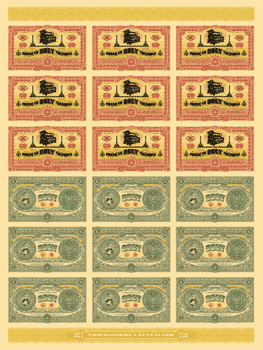
This book documents events that occurred in 2007.  The E Pluribus Venom show was based largely around two images that Fairey designed to reflect the two sides of capitalism.  The image to the right really doesn’t do any justice to the work itself, but you can kind of see that he created two-sided faux dollar bills.  The front showed all the good things that capitalism can do.  The back showed all of the evils that capitalism causes.  The images resemble dollars, but the text is straightforward in its message.  As with a lot of what Fairey does, it’s blunt and obvious but pretty cool.

As far as I’m concerned, though, this is the least interesting image in the book.  Although I love that they made dollar bill sized prints of these faux dollars and left them scattered around in cities to promote the show.  They way they were folded made them look at a glance like actual currency.  Very cool. (more…)

Read Full Post »

SOUNDTRACKLOS CAMPESINOS!-“By Your Hand” (2011).

I’ve enjoyed Los Campesinos!’s records in the past and I’m pretty excited about the prospect of a new release.  This song doesn’t deviate too far from their previous releases although to my ear it sounds a bit more musical (more instruments, more vocals) and less abrasive.  The basic elements are still there:great lyrics delivered in a more or less spoken way, followed on its heels by big shouty sections (and the whole band seems to be shouting along on this one).

This song also feels a little warmer, although the lyrics “by your hand is the only end I’ve foreseen” is either really dark or really naughty depending on how well it correlates to the verses.  Regardless, the chorus is catchy and fun to sing and the lyrics are wonderfully twisted.  Los Campesinos! have done it again.

And here’s the video.

[READ: September 16, 2011] “Jean-Baptiste Labat and the Buccaneer Barbecue in Seventeenth-Century Martinique”

I was interested in this article because it talked about the boucan and the buccaneer, and both of these things were mentioned in Book 9 of The 39 Clues.  It was a weird sort of coincidence that the boucan which I had never heard of before should appear in two things that I read about week apart (and then this weekend the Pa Renaissance Faire was pyrate themed!).   I was also interested because of the way this article was presented in the email to us: “if you have ever wondered on what foods a seventeenth-century missionary from the island of Martinique dined, check out this article from Gastronomica. (Hint: They include manatee, lizard, and parakeet)” made it a must-read.

While the article does, indeed make mention of these foodstuffs, it is by no means the extent of the article.  Rather, Toczyski looks at what Labat, a French priest and a missionary, wrote in his extensive chronicle about his stay in the Caribbean.  In particular, she focuses on the amazing breadth and depth of his gastronomical accounts (which includes details about all the meals they ate en route (the ship was amazingly well stocked–they even had a garden on board, which was under guard day and night (!); and then on the island he also talks in loving detail (with recipes) of all of the native dishes that he would eventually consume (including turtles, frogs and the palm worm (see picture at right (the picture and an awesome description of eating the palm worm is here at Boots in the Oven, at the bottom of the page).

(more…)

Read Full Post »

SOUNDTRACK: COSMO JARVIS-“My Day” (2011).

I learned about Cosmo Jarvis through NPR.  The DJs called it a love it AND hate it song.  But I find that I mostly love it.  The video is a blast to watch, but even without the video, the song is quite catchy and fun.  It’s a half punk song and half folkie/trad song.

So who the hell is Cosmo Jarvis?  Well, he was born in NJ, but is really from England.  He’s a filmmaker and musician and he’s had a hit with the song “Gay Pirates” that Stephen Fry raved about on his Twitter feed!  “Gay Pirates” is a fun shanty, but “My Day” is a full-on punk blast.

The song laments the state of things today and talks about how things were back in “my day” (which is of course funny since he’s 21).  The verses are a kind of folkie/storytelling style (but with electric guitars) and the end of each verse has a guitar riff that sounds traditional to me.  But when the chorus jumps in, it’s heavy, rocking, screaming punk.

Okay so the song is nearly 8 minutes long, which is probably overkill.  There’s a fairly lengthy instrumental bridge about 5 minutes in which features guitar and tin whistle solos.  And then the final 2 minutes are just fast metal screams of “My Day” with some wild soloing.  Yes, it’s too much (I’ll bet the single mix is awesome), but it’s still an enjoyable song.  Even without the video.

But you should watch the video, if only because it’s what the guys from Jackass would do if they were in a band and lived in the English countryside.

[READ: July 15, 2011] The Corrections

My company recently asked us if we had read any books over the summer.  I was able to pony up this review for our company newsletter.  I’ll be fleshing it out, but it’s pretty apt.

I’d put off reading this for a number of years, and I wish I had read it sooner.  It’s a very detailed look at one family: Elderly parents, thirty-something kids, and a few grandkids.  The depth of character development is amazing (and includes even depth of characters that the main characters interact with).  It’s a long book but it is very rewarding—comic scenes, moving scenes and one or two shocking moments.  It’s also the first time I’ve read a book where I thought, “even though I like this character, I think it would be better for everyone if he died.”  It’s an unnerving thing to think, but Franzen really makes you think about how family members impact one another.

It took me forever to start reading this book, obviously.  I wasn’t really interested in Franzen when all of the Oprah commotion came out, so I blew off this book entirely.  I’ve recently grown more interested in him.  But rather than reading his novels, I had decided to read all of Franzen’s New Yorker pieces.  (And even though I wanted to read Freedom when it came out, I felt that I should read this one first).  I wasn’t hesitant about reading it, I think I just wanted time to devote to it.  Much like I needed time to devote to writing up this post.  It’s been well over two months since I finished the book.

The Corrections is a wonderful, engaging story about three generations of the Lambert family (and many of the people they interact with).  The matriarch and patriarch of the family, Enid and Alfred, live in the midwestern town of St. Jude.  They have three children: Gary, a banker in Philadelphia who is (more or less unhappily) married with three children; Chip, a former school teacher and current playwright who sponges off of his younger sister while he tries to live the high life in New York City; Denise, a very successful chef who also lives in Philadelphia.  She has no children.  Gary’s children play a small but significant part in the story, keeping the three generations aspect working very well.

I found the first chapter a little slow and somewhat off-putting.  I read an excerpt from the novel in the New Yorker, which was a piece about Chip.  So I was surprised that the book opened with an older couple.  The chapter deals with Alfred and Enid.  Alfred’s dementia is hitting their household quite hard but Enid just feels that Alfred isn’t trying very hard.  Because Enid has very little in her life, she wants nothing more than to have her whole family together “one last time” for Christmas.  Enid and Alfred are long-married and this chapter picks up in the middle of a typical day.  So it takes a few pages to get up to speed.  Of course, once I did, I felt that the whole family was completely real and believable. (more…)

Read Full Post »

« Newer Posts - Older Posts »