Feeds:
Posts
Comments

Archive for the ‘Big Books’ Category

SOUNDTRACK: THE FLAMING LIPS & STARDEATH AND WHITE DWARFS featuring HENRY ROLLINS and PEACHES doing The Dark Side of the Moon (2010).

You’ve got to have balls to cover the most popular album of all time.  Everyone knows Dark Side of the Moon, according to Billboard charts everyone probably owns a copy of Dark Side of the Moon.  So, you’re taking on a pretty big task here.  But the Flaming Lips aren’t called The Fearless Freaks for nothing.

What delights me about this album is that it is utterly unfaithful to the original.  There’s nothing worse than a cover song that just apes the original version.  With that in mind, the Lips have put their bizarro stamp on the classic album, oftentimes rendering the songs almost unrecognizable–but more on that in a moment.

The two guest stars on the disc are Henry Rollins and Peaches.  Rollins recites all the spoken word bits from the original.  He actually makes a lot of those weird ramblings clear for me for the firs time.  The originals were spoken by a (presumably) high Englishman.  Rollins’ delivery is much more abrasive (but then so is the music).  It works pretty well, especially since Rollins’ laugh is maniacal, although if he sounded a bit more drunken I think it would work even better.  Peaches sings a few of the female vocal bits.  I’ve never been much of a fan of hers but, man, she does an awesome job in covering “The Great Gig in the Sky,” the track from the disc that features a wondrous diva singing and screaming her heart out.  Peaches really lets loose and showcases the power of her voice.

The Lips play on 7 songs and StarDeath play on 6.  They work together on 2 tracks.

StarDeath is fronted by Wayne Coyne’s nephew, Dennis.  I’d only heard one track from them before, and I liked it.  Dennis’ voice is a higher register, like Wayne, but he’s also a bit more subtle. Musically they are less noisy as well, and it’s a good counterpoint to the static of the Lips’ tracks.

So the opener, “Breathe” (Lips) is distinct right away, because the main focus of this version is a loud throbbing bassline. “On the Run” (Stardeath) is completely indistinguishable from the original.  You would never suspect it was a cover.  It’s a bass-propelled, very cool song, but there’s almost no similarity.

“Money” (Lips) stays fairly faithful to the original, except that the vocals are totally auto-tuned.  It makes the song sound really alien, as if coming, yes, from the other side of the moon.

“Time” (Stardeath) on the other hand, is a very delicate, acoustic track, (sounding somewhat like Mercury Rev, actually).  It is something of a counter to the rocking version on the original.

“Us and Them” (Lips) is probably the closest sounding to the original.  It has simple washes of sound and Wayne’s delicate voice.  But, once again, the louder sections of this song are left out.  “Any Colour You Like” (Stardeath) is a much closer instrumental to the original than “On the Run” was.  And “Brain Damage” (Stardeath) is really quite spot on (and may be even creepier than the original).

The ender, “Eclipse” is like a distorted indie rock version of the original.  It works pretty well.

There’s surprisingly little in the way of sound effects (which are all over the original).  I’d have thought they’d populate the disc with all kinds of fun things, but no, they actually play it pretty straight.

My one real complaint about the disc (and actually about Embryonic as well).  The Lips have always pushed the envelope of music.  But lately, they seem to be redlining  a lot of their sounds, making them distort and crackle.  Now, I love distortion when it’s used well, but this “too loud” distortion actually hurts my ears, even if the volume is low.  I find the sound to be unpleasant, and not in a good way.  And I think it’s a shame because the Lips write such great music, that I hate to have it obscured by clouds of noise.

So, yeah, this will never replace the original for anyone.  But it’s a fun experiment and actually sounds a bit like a rough demo for the final release.  In fact, in many ways it sounds like it’s coming from outer space and may be conceptually more accurate for the title.

I saw The Lips and Star Death on Jimmy Fallon.  They played “Breathe” and all eight (or more) guys were on stage.  It was a big wonderful mess.  And they sounded really good together.

[READ: May 11, 2010] ; or The Whale

In 2007, a book was published called Moby Dick in Half the Time.  And, as the title implies, it took Herman Melville’s Moby Dick; or The Whale and truncated it.  The editors basically kept in all of the “plot” and excised most of the “wandering” parts of the story.

So, in 2009, Damion Searls decided to print all of the excised material as a book itself.  This exercise was published in The Review of Contemporary Fiction, Summer 2009 | Vol. XXIX.  So, this “book” is Moby Dick without the “plot” or as the introduction puts it, “all Moby, no Dick.”

This book includes “every chapter, sentence, word, and punctuation mark that Anonymous removed to produce [Moby Dick in Half the Time]” (10).

And so what we get is a very surreal story indeed.  It comes across as a fascinating look into the mind of the (in this version) not named until Chapter 11 or so narrator (since we’ve obviously lost “Call me Ishmael”).  It also comes across in many sections as bizarre poetry.

; or the Whale’s opening line is:

“methodically.” (31). (more…)

Read Full Post »

When I started reading 2666, I didn’t know anything about Bolaño.  I didn’t even know any of his other books (except I had heard The Savage Detectives was excellent).  But I didn’t know anything about him, personally.

You shouldn’t need to know an author’s biography to appreciate a novel.  And that’s the case with Bolaño, certainly.  However, knowing his biography adds a new dimension to his work that explains why he writes what he writes.

So, the brief outline: (more…)

Read Full Post »

I’ve waited to post this, my wrap up of ideas abut 2666, until I saw what others had to say about it.  Which is kind of a cop out but also kind of understandable.  This book is a giant mess of information, and I’m not entirely sure how to process it all.  So I’ve been looking for help.  And I’ve gotten some, but it’s all kinds of contradictory.  Most people seemed to hate the book.  A few people enjoyed it somewhat, and one or two people really felt moved by it.

I think I fall squarely in that middle camp.  As anyone who has been reading here knows, I became obsessed with Bolaño’s books, and read all of his short fiction (saving Savage Detectives for a read in a few weeks).  And yet I’m not exactly sure WHY I felt compelled to read these stories.  (I’m very glad I did…there will be more on Bolaño himself in a day or two).

I’ve decided to look back over what I wrote to get a sense of what I thought of the book (I knew these posts would come in handy). (more…)

Read Full Post »

SOUNDTRACK: FUGAZI-Steady Diet of Nothing (1991).

Jangly noisy guitars open the track (and then a lengthy silence after a minute or so).  And this loud/soft dynamic is pretty dramatic on this disc.

There’s a slot of really cool sounds (within the framework of loud noisy alterna-punk).  “Reclamation” opens with some harsh guitar harmonics over a kind of spoken verse, but it bursts into a great chorus.  “Nice New Outfit” is quite catchy (even if lyrically it’s very dark).  But by the middle of the disc, it feels like some of the songs aren’t quite as interesting.

Of course, the instrumental “Steady Diet” is noisy and wonderful.  And “Runaway Return” has a catchy noisiness to it.  But the band comes back to a high point with “Polish” and the thoughtful “Justice Letter” (written about favored  Supreme Court Justice William Brennan who retired in 1990).

This record is a cool departure from the first disc.  To me it’s not quite as immeiate as Repeater, and yet it still has some really powerful songs.  I find that no matter how many times I listen to it there’s a few tracks that never grab me, but overall, this is another great release from Fugazi.

[READ: Week of April 26, 2010]  2666 [pg 831-893]

Wow.

The book is over and I am blown away.  I don’t know if it was the set up, or my utterly lowered expectations or the complete lack of connections previous to this, but I had assumed that this story would end (well, actually exactly as it did, with him going to Mexico) but the 30 pages before the end blew me away.  I can’t get over how nicely he tied so much together and in such an unexpected way.  I could not tear myself away from the end.  Wow.

I’m still not sure how I feel about the whole book.  I’ll do a final thoughts post after I digest, but the ending of the book was immensely satisfying. (more…)

Read Full Post »

SOUNDTRACK: PHISH-Joy (2009).

This is basically Phish’s reunion disc (after a 5 year hiatus).  It opens with one of their poppiest songs, “Backwards Down the Number Line” a song that picks up where their least disc left off: with a feeling of driving down a country lane with nowhere to go, windows opens, just happy to be alive.  The second track, “Stealing Time from the Faulty Plan” is a delightful rocker with a supremely catchy chorus “got a blank space where my mind should be….”
The third track, “Joy” starts as a simple piano ballad, but quickly morphs into one of the prettiest songs I’ve heard in ages, an outrageously happy upbeat tender song: “We want you to be happy, cause this is your song, too.”

“Sugar Shack” is a delightfully funky song, recognizable at once as one of Mike’s songs.  It’s a simple, pleasant enough track, but somehow Mike’s voice sounds weaker than usual.

“Ocelot” is a silly track (and one of my favorites) while “Kill Devil Falls” is a bluesy number that will easily be a lengthy jam live.  It’s my least favorite track on the disc, but it is followed by a more upbeat future-jam called “Light” which features delightful multi part harmonies.

The highlights of the disc are the final two songs: the 13 minute “Time Turns Elastic” and the five-minute “Twenty Years Later.”  “Elastic” is a wonderful non-jam, a thoughtfully constructed epic with many parts (although not an elaborate prog rock track or anything).  It’s catchy and moving with sweeping grandeur and easy to sing parts.  And it melds wonderfully into the delicate multipart gorgeous final track.

This is a really strong, mature disc from Phish. There’s not a lot of silliness or nonsense, just some great uplifting gentle rock songs.  It’s quite wonderful.

[READ: Week of April 19, 2010]  2666 [pg 766-830]

This penultimate section of 2666 (the end is nigh!) settles down into an almost pasotral recollection of Archimboldi (the man formerly known as Reiter) as a writer (yes the pronunciation of his name is not lost on me, although I assume it doesn’t have the same connotation in German).  And while it is not all happiness, there is more joy in these 60 some pages than in most of the rest of the book combined.

But before we get there, we have one final moment with a war criminal.

(more…)

Read Full Post »

SOUNDTRACK: ALANIS MORISETTE-Jagged Little Pill (1995).

In this book, DFW considers himself to be absolutely useless when it comes to music.  He doesn’t know anything at all.  He says he listens to Bloomington country radio stations until he can’t take it anymore and then he switches over to the alt rock station.  He’d never even heard of Nirvana until after Cobain’s suicide.

And so, the soundtrack for the book is R.E.M., Bush (two songs) and Alanis.  In fact, there’s a surprisingly long section devoted to Alanis in the book, including DFW’s admittance that he would love to have a date with her for tea.  He admits that she is pretty much manufactured angst and yet there’s something about her that he finds irresistible.

At this stage (2010), the whole Alanis thing seems almost adorable in it’s “controversy” or “hype” or whatever.  It’s still hard for me to be objective about the quality of Jagged Little Pill (I mean, Flea plays bass on it so it must be good, right?).  I really enjoyed it at the time, perhaps because of its rawness or its honesty (which was pretty novel at the time, especially from a woman), all packed in a clean production of course.  There’s also something weirdly appealing to me about her (really not very good) voice.  She seems just off enough for all of this to be really sincere.

And of course, the nastiness of “You Oughta Know” was pretty astonishing for pop radio at the time.  True, there’s songs on here that make me cringe now (there’s a lot about her that makes me cringe) and yet there’s still some really enjoyable stuff here.  Even the perennially mocked “Ironic” for all of its flaws has a stellar chorus.

Now that the “women in rock” phase of alternative music has passed, there’s very little music like this being made anymore.  So it’s kind of fun to reminisce about this stage of my musical life, warts and all.

Oh, and by the way, I also grew up watching Alanis on “You Can’t Do That on Television,” so it was pretty exciting to see a child star that I knew make it big.

I never liked Bush though.

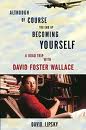
[READ:April 21, 2010] Although of Course You End Up Becoming Yourself

As I mentioned, I was super excited to get this book and I treated it like the artifact it is: trying to read it in one sitting (impossible) or at least in as compressed a time as possible to preserve the stream of consciousness attitude of the book.

For, as the subtitle doesn’t quite state, this is five-day conversation between David Lipsky and David Foster Wallace.  The tape recorder was running for most of these five days and what we get is a literal transcript of the conversation (with much of Lipsky’s parts excised).  It is an all-access pass to the mind of the man who wrote Infinite Jest as the hype of the book was really taking off and as his brief promotional tour for the book was winding down.

Lipsky was (is) a reporter for Rolling Stone. DFW’s Infinite Jest was the huge media hit (#15 on the bestseller list) and the hype was outrageous.  DFW had begun a (sold out) reading tour which actually began the day before the book came out, so he rightfully notes that no one could have actually read the book by then, they were just there because of the hype.  And Lipsky himself is part of this hype.

Lipsky was sent to do a profile of the wunderkind, literature’s next great hope (RS hadn’t (hasn’t?) covered a young author like this in a decade at least).  The idea was that Lipsky would tag along with DFW, go to the last readings on the tour, an NPR interview, and spend most of their time together: planes, rental cars, hotel rooms, etc generally just hanging out with tape recorder running. (more…)

Read Full Post »

SOUNDTRACK: VAMPIRE WEEKEND-Contra (2010).

I absolutely loved Vampire Weekend’s debut album (and still do).  It was my favorite record of last summer and always makes me think of summer fun and hijinx.  Critics trotted out the “world/ethno/Paul Simon” vibe when discussing the album.  But I really didn’t hear it.  I mean, yes  I suppose it was there but the album felt more like a punky ska album of fun.

On this, their follow up, it’s as if they took all those critics to heart and decided to make the album that everyone was describing. This disc emphasizes all of the ethnic music sounds,  and downplays the guitars and more rock elements.  I was a little disappointed by this on the first listen or two.  However, subsequent listens showed me that the songwriting was still there and it was just as strong.

There’s still lots of rocking elements, it’s just that they are hidden under the other divergent influences.  But for the most part, the album is still bouncey and full of fun summer tunes.  There are three songs that slow down the pace, “Taxi Cab” and “Diplomat’s Son” (at 6 minutes, it’s a little long).  And the final song “I Think Ur a Contra” is a bit too divorced of beats (it works as an end to the disc, but I’d never listen to it on purpose).

The rest of the disc however, is very enjoyable, and I find that the 7 other songs work just as well as anything off the debut. “Horchata” is a delightfully fun world music treat (I hear Paul Simon, yes, although come on, Graceland came out 24 years ago!).  “White Sky” has delightfully catchy falsetto screams.  “Holiday” is practically classic ska and “Cousins” has a delightfully tricky guitar riff.

This feels like a band who has matured and experimented and yet not lost track of who they are.  I’m really looking forward to their next release.

[READ: Week of April 12, 2010]  2666 [pg 702-765]

Last week I concluded that

It almost seems as though Bolaño is saying that even Nazi Germany is better than Santa Teresa.

Oh how wrong I was.  Despite the fact that I found the bulk of this section enjoyable and fascinating (twisted and dark certainly, but fascinating nonetheless), the ending killed me.  The opening’s entire writers among writers, within writers, with communist party members and secret diaries was completely captivating.  And then it is all shattered by the reality of WWII. (more…)

Read Full Post »

SOUNDTRACK: THE DEAD MILKMEN-Beelzebubba (1988).
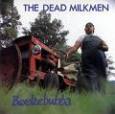
Why the hell do you think they call it a burrow owl anyway?

Beelzebubba is pretty close to the pinnacle of The Dead Milkmen’s career.  Of the 17 songs, there’s only one or two that fall flat.  But there are so many that rise to greatness.  The wholly un-PC James Brown-mocking song “RC’s Mom” which is pretty much all about beating your wife is in hugely questionable taste, but the funk is quite funky.

The brilliant “Stuart” is the culmination of all of the white trash mocking/spoken word nonsense songs.  And then there’s the outstanding single “Punk Rock Girl.”  It is simultaneously catchy as all hell and yet whiny and kind of off-key.  It’s really magnificent and was suitably lauded.

The strange thing to me is that the actual released “single” was for “Smokin’ Banana Peels” (an EP with that title was released with an absurd number of dance remixes).

“Sri Lanka Sex Hotel” is an angry rant that references The Killer Inside Me and talks about having sex with everything.  It’s pretty bizarre, but is musically fantastic.

True, the back half of the disc suffers somewhat (“Howard Beware” and “Ringo Buys a Rifle” are just okay), but the disc ends with the sublimely vulgar “Life is Shit” a gospel-tinged song that matches Monty Python’s “Always Look on the Bright Side of Life” for faux uplift.

Future DM discs would feature some good songs, but the band pretty much peaked with this one.  I’m so bored I’m drinking bleach.

[READ: Week of April 5, 2010]  2666 [pg 637-701]

What a difference a week makes.  The style and writing of Part 5 is markedly different from Part 4.  It is far more laid back and focuses primarily on one individual, Hans Reiter (who we know from Part One is Archimboldi).

The Part opens with information about his parents: his father had one leg (he lost the other in WW1) and his mother was blind in one eye.

Hans’ father, after losing his leg, was in the hospital, expounding on the greatness of smoking.  (He even gives a smoke to a man wrapped head to toe in bandages–and smoke pours out from all the cracks).  When he left the hospital, he walked home–for three weeks.  And when he arrived back home he sought the one-eyed girl in the village and asked for her hand in marriage.

Hans Reiter was born in 1920. He proved to be unreasonably tall: (At 3 he was taller than all the 5 year olds etc).  And he was most interested in the seabed.  There is much information from his childhood of his love of the sea (when his mother bathed him, he would slip under the water until rescued).  At six he stole a book, Animals and Plants of the European Coastal Region, which he more or less memorized and was the only book he read.  And then he began diving, investigating the shoreline.

His father evidently hates everyone and thinks all nations are full of swine (except the Prussians).

Hans also enjoyed walking and he would often walk to the surrounding towns: The Village of Red Men (where they sold peat), The Village of Blue Women , The Town of the Fat (animals and butcher shops); or in the other direction, he went to Egg Village or Pig Village.  Or even further along was the Town of Chattering Girls (who went to parties and dances).

He almost drowned twice.  The first time he was initially mistaken for seaweed as he was floating in the water.  (After he had discovered laminaria digitata).  He also began to draw seaweed in his book.  (The seaweed connection is pretty thorough as he was described as looking like seaweed when he was born).  The tourist who saved him was named Vogel.  He believed in the general goodness of humanity, but he felt that he was a bad person for initially mistaking Hans for seaweed.  Vogel also talked endlessly about the virtues of masturbation (citing Kant as an example). (more…)

Read Full Post »

SOUNDTRACK: Philadelphia Radio Stations (circa 1990 and 2010)

There’s a Dead Milkmen song called “The Big Sleazy” in which the chorus is

“I hate MMR I hate YSP/You know that classic rock/Does not interest me.”

I’ve always been amused by the song, especially when I travel to Philly and hear these stations.  That song is from 1990, so 20 years later I’m not sure what the band would think of their new playlists.

But one thing I never really noticed before is the middle verse which is about one of my favorite Philly stations WXPN.  The verse is:

I hate what they’ve done to XPN
Those folk Nazis ruined my favorite station
I hate what they’ve done to XPN
If you hear it now it’s just a pale imitation.

Now, I have no idea what XPN was like before, but, yea, I can see that he folk Nazis are in charge.  Of course, I rather like that.  However, XPN also plays a bunch of artists who are broader than the folk label, so I wonder if they have changed even more since 1990.
History is fascinating, innit?

[READ: April 3, 2010] Trinity

Collins Gibson is a patron at our library.  He has been working on this book for a few years now.  The first time I looked at a bit of it, it was a novel.  I hadn’t seen him for a while and now he has brought the book back as a screenplay.

I didn’t read enough of the original novel to know whether this works better as a novel or a screenplay, but given the very visual nature of the story, it seems like screenplay fits the story better. And so, since Collins is a good guy, I’m going to do my part to get the word out about the story. (more…)

Read Full Post »

SOUNDTRACK: RUSH-Permanent Waves (1979).

When my friend Doug and I were hanging out back in the 80s, we both were getting into Rush at the same time.  And because this album was in black and white this was the last Rush LP we bought.  Imagine our surprise when it turned out to contain “The Spirit of Radio” one of the best hard rock anthems ever.

The cover art also featured a newspaper that read Dewey Defeats Truman.  But the band got in trouble for it from the Chicago Tribune!  I’ve never actually seen an actual cover with that headline (or the proposed fix: Dewei Defeats Truman).  Huh, thanks internet, here’s a picture of it.

The disc  also contains some (more) of my favorite Rush tracks.  “Freewill,” a fantastic “smart” song features some insane guitar and bass work in the middle sections.  And side one ends with “Jacob’s Ladder,” a 7 minute mini epic with precious few words that really evokes the simple concept of the sun’s rays bursting through clouds.  It’s surprisingly moving.

Side two features two more short tracks: Entre Nous suffers from side two syndrome: it would have been a hit if it was on side one.  While “Different Strings” is probably the last mellow song the band would write until the acoustic tracks on Snakes and Arrows.

For me, the best song is “Natural Science.”  A three-part mini 9 minute mini epic that features very cool lyrics, acoustic and electric guitar, a mid-song (short) drum solo and an incredibly intense heavy metal section.  And I have been really really psyched that they play this live again.

This disc marks an interesting transition from the prog rock heyday to the poppier commercial side that would soon arrive.  It’s a great mix of truly classic classic rock, real virtuoso performances and a couple of nice pretentious epics.  You’ll but it for Spirit of Radio, but you’ll get hooked by Natural Science.  “A quantum leap forward, in time and space….”

[READ: Week of March 29, 2010]  2666 [pg 565-633]

Before I start with the final week of the Crimes, I wanted to acknowledge everyone else who has been doing a great job in the endurance-o-rama that is the winter/spring 2666 online readathon.  I have been terribly remiss in mentioning (and even reading) as many of these posts as I would have liked (oh where does the time go).  But there’s some folks who have been doing a great job bringing up issues and suffering through The Part About the Crimes with me.

Obviously our friends at Bolanobolano are hosting this event and keeping wonderful track of details that I’m too exhausted to do myself.

And of course, the cohosts in Crimes, Infinite Zombies, are keeping tabs on all manner of thoughtful aspects of this book.

Steve, who I often read on IZ, also posts at his own site: A Solipsist’s 2666.

The Daily Snowman has been offering interesting thoughts, as well as a Paragraph of the Week (often from 2666).

Naptime Writing always offers thoughtful comments as well as a quote of the week.

Bleakonomy offers brief summaries and ideas, as well as non-2666 related thoughtful ideas.

Alone with Each Other offers that rarest of birds: someone who really likes The Part About the Crimes.

I haven’t been reading these blogs as much as I would have liked (and maybe someday I’ll post a comment to one of them long after we’ve all finished reading), but what I’ve read, I’ve appreciated.  So thanks for keeping me company out here.

And on to the last (and best) section of the Part About the Crimes.

I don’t know if the slow plodding death after death was like climbing a hill, but these last 68 pages were like speeding downhill with the top down.  So much was packed into it.  I was totally rejuvenated, thrilled to meet new (!) characters and totally unsurprised when the Part ended and absolutely nothing was resolved. (more…)

Read Full Post »

« Newer Posts - Older Posts »