 SOUNDTRACK: THE POGUES-If I Should Fall From Grace with God (1988).
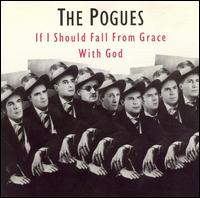 So the cover of this album has James Joyce on it (and a hilarious pastiche of the rest of the band). I guess we know what we’re in for, then. This is the Pogues third album and the one that tamed the wildness of their first shambling discs into a (somewhat) presentable collection of songs. And, jaysus, it’s fantastic.
The Pogues seamlessly blended punk and traditional Irish music (and on this disc they expanded into latin & middle eastern motifs too). The first track opens with a fast paced Irish whistle playing what is pretty darn close to a jig. And then Shane MacGowan (whose teeth are not to be believed–or if you are lucky, not to be seen) sings his slurred, fantastic lyrics. MacGowan always presented such a contradictory figure for this band of well dressed resctable players. And it’s often confusing wondering how he became the front man of this band. But he adds that certain something to make the band unforgettable.
“Fairytale of New York” is one of the most gorgeous, sad Christmas anthems ever. It’s a duet with the much missed Kirsty MacColl and it’s moving and charming, even with the lyrics: “you scumbag, you maggot, you cheap lousy faggot, happy Christmas me arse, I pray God it’s our last.”
Then you get a crazy instrumental, “Metropolis” fast paced, manic energy and a great riff (and of course, let’s not forget the quoted musical passage too).
What’s surprising is when you get a tender ballad like, “Thousands Are Sailing.” Lyrically it is stunning, and you wonder why is Shane singing it with that slurry voice of his. And then you realize it works perfectly as a drunken lament. And then you get to the chorus, and you stop caring and just enjoy the song.
They even throw in a couple of traditional songs, like “South Australia” and “Medley” (which incorporates “Rocky Road to Dublin.”) But after “Fairytale,” I think my favorite track is “Fiesta” which is a Spanish/Mexican sounding song with loud horns and absurd faux Spanish lyrics. Ole!
And, just so we know, it’s not all drinking and rollicking, Shane also wrote “Birmingham Six.” “There were six men in Birmingham / In Guildford there’s four / That were picked up and tortured / And framed by the law / And the filth got promotion / But they’re still doing time / For being Irish in the wrong place /And at the wrong time / In Ireland they’ll put you away in the Maze
In England they’ll keep you for seven long days”
The Pogues would release two more albums before Shane MacGowan took off. And they’re all pretty darn good, but I’ve always been partial to this one.
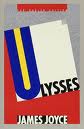
[READ: Week of July 12, 2010] Ulysses: Episodes 1-3
This is my third time reading Ulysses. The first time I was a freshman or sophomore in college and I signed up for a James Joyce class because, get this, the Canadian band Triumph had released a CD called Thunder 7 which was supposedly based on the 100-letter words in Joyce’s Finnegans Wake (which I had bought and found impenetrable). Our teacher was intense and tried to scare everyone off (which worked for some, but not me). The class was hard (first assignment : read The Odyssey over the weekend for a quiz on Monday). I enjoyed Dubliners and Portrait of an Artist as a Young Man, but I thought Ulysses was pretty daunting.
I read it again when I re-took the class with the same teacher (not for credit this time, but because I wanted to, imagine that). And that time I learned to really appreciate what Ulysses had going on for it. I was also inspired by it to try to write challenging fiction, paying careful attention to every single word, and even possibly using different writing styles in the same book. (The world appreciates that that never panned out).
But so the careful attention thing: Joyce spent seven years working on Ulysses. Every single word was charged with meaning. He even made up his own words. And it’s very apparent that he was the inspiration for countless modern authors (for better or worse).
I’m excited to pick the book up again. In part, because it was ranked number 1 on the MLA list of books, but also because for twenty-some years I’ve felt the book was fantastic. And I wanted to see if I would enjoy it without guided instruction.
I was curious about which edition to read. Since my class, when there was only really one edition available, many many editions have been published. There’s a great discussion about this at Infinite Zombies, and I considered getting the third one Judd mentions. But when I consulted with my old professor, he said the Gabler edition is still the best, so I went with that one. And that edition is littered with all the notes I took from class and from the supplemental resources.
I decided not to read the supplemental resources this time (although I can;t help but look at my notes), to see what I can get from the story AS A STORY.
I remember a bunch from the class, but one thing that I distinctly remember is that to get everything out of Ulysses, you need to understand Catholicism (the mass in particular), The Odyssey, European history–especially Irish history, and popular Irish culture circa 1920. It also helps to know Latin. And these are all things that Joyce would have known and his audience probably would have known. Every year we move away from its publication, means we know less about what he was writing about. But that’s all the little details and jokes and blasphemies. I wanted to see (with some background, which certainly gives me an advantage) if I could enjoy the story without all the help.
So… (more…)

 SOUNDTRACK: BILLY BRAGG-Talking to the Taxman About Poetry (1986).
 I’ve liked Billy for ages now. I’ve seen him live a few times, and I’ve always loved that his accent is so prominent when he sings. Over the years he has become somewhat less overtly political, but he is still a man of issues and causes.
 SOUNDTRACK: MASTODON-Leviathan (2004).
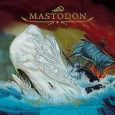 This is the CD that started it all. Well, for me and Moby Dick- related music, anyhow. My friend Andrew asked if I would be reviewing it along with Moby Dick. And, yes I am.
 SOUNDTRACK: THE DECEMBERISTS-“The Mariner’s Revenge Song” (2005).
 This was the hardest week for music tied to Moby-Dick. (I’m saving Mastodon for the grand finale). I don’t really have anything that relates directly to the book. I have a number of nautical-themed songs, but very little in the way of albums. And, it’s true that this song doesn’t have anything to do with Moby-Dick directly.
 The Decemberists are one of your more nautical bands (and I’ve reviewed all of the albums here somewhere). Their first album, Castaways and Cutouts featured an album cover with a ship with ghosts drifting from it.
 SOUNDTRACK: GREEN DAY-21st Century Breakdown (2009).
 Like most people who like Green Day, I’ve been a fan since Dookie. They were incredibly poppy (although they wrote great punk riffs) and they sang about weird, kind of subversive things. And they got huge really fast. Of course since then they have become one of the most commercially successful bands in America (including having their song picked for the ending scene of the Seinfeld montage–jeez).
 SOUNDTRACK: RHEOSTATICS-Whale Music (1992).
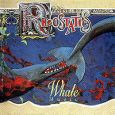 The Rheostatics are from Etobicoke Canada. Their second album was called
  “Self Serve Gas Station” is a great opening. It begins with swirling guitars and a beautiful solo (Rheostatics guitar lines sound so elemental as to seem like they’ve always been around). But just as the vocals begin, the song becomes a sort of country track: a folkie song about adolescnece. But it returns to a good rocking (and falsetto fueled) rock track.
 “King of the Past” is another great track, with a wondrous string sound near the end. It’s a gorgeous song with (again) different sections conveying shanties and jigs (and you can dance to it). Like Moby from last week, Rheostatics, also bust out a fast metal track, but this one works well: “RDA (Rock Death America)” has a major hook and name checks everyone from The Beatles to The Replacements.
 SOUNDTRACK: STEREOLAB-Transient Random Noise Bursts with Announcements (1993).
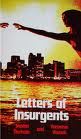
 Stereolab are a bizarre band. They make bubbly electronic music, with all sorts of bleeps and whirls and buzzes. They even describe their music as space age pop. Their album cover art is overexposed or simply silk screened. (This is a hi-fi needle getting dropped on an LP). The back cover looks like it’s a hi-fi test record.
 SOUNDTRACK: DANGER MOUSE AND SPARKLEHORSE present: Dark Night of the Soul (2010).
 Seems like most things that Danger Mouse touches involve lawsuits. I’m not entirely sure why this disc had such a hard time seeing the light of day. But it is due for a proper release in July. Although by now, surely everyone has obtained a copy of the music, so why would anyone give EMI any money for the disc (since they hid it away in the first place).
 SOUNDTRACK: MOBY GRAPE-Moby Grape (1967).
 Moby Grape is one of those bands that I’ve always heard of but had never heard. I know, their debut is 43 years old and yet I’d never heard it. Well, thanks to the internet (lala.com, RIP as of today), I was able to listen to what I assumed was their Greatest Hits. If only I had done a modicum of research. The disc I chose was Legendary Grape, which it turns out is not a greatest hits at all, but is actually some weird pesudo-Moby Grape record released in 1989 under a different band name due to legal protractions, but then reissued as Moby Grape. It was rather uninspired and nothing at all what I thought it would sound like. Nothing dreadful, just nothing worth thinking that this band “legendary.”
 So, with a little research, I learned that their first album is what I should have been checking out. Moby Grape is the eponymous release and it sounds much more like what I assumed this psychedelic era-band would sound like. This disc is pretty much in keeping with what a band that produced an album cover like this would sound like.
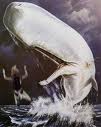 SOUNDTRACK: LED ZEPPELIN-The Song Remains the Same (1978).
 I don’t normally try to have my soundtracks correspond to the book. But since Andrew
 I Just Read About That...