Feeds:
Posts
Comments

Archive for the ‘William Gaddis’ Category

SOUNDTRACK: SISKIYOU-“Bad Days” (2012).

Siskiyou has had some medical problems and have canceled their recent tour.  They are also going on a brief haitus.  This is a shame as after their second album, they really had momentum and they sounded better than ever.

As a kind of peace offering to fans who would not be able to see the band, they recorded a cover of The Flaming Lip’s “Bad Days.”  The cover souds remarkably like the original, with one big difference: rather than squalls of feedback, Siskiyou uses only piano.  And it works very well, getting down  to the basics of the song and sounding a bit like Wayne Coyne singing.

It’s a nice tribute and  a nice “until later”

[READ: August 27, 2012] Agapē Agape

I have a long history with this book.

I was working at Baker and Taylor, a book supplier, when this book was released.  Some of the higher ups were able to get free books from the publishers they dealt with.  The guy who dealt Viking was not the friendliest guy, but since B&T paid absoluet crap wages, I was going try to get any books I could for free.   So, I asked for this book.  It was embarrassing enough to walk in and say this title with confidence, since I knew how it was pronounced (yes I took Greek in college), but knew he didn’t.  After some groveling, his reaction led me to think I wouldn’t be getting it.

But lo and behold a few weeks later it was sitting on my desk.

And now, ten years later, I’ve finally read it.

In JR, Jack Gibbs is writing a book with the name Agapē Agape, it is a jumbled history of the mechanization of the arts, starting with the player piano.  JR was finished in 1975–who knows for how long he had been working on it until then.  According to the Afterword of this book by Joseph Tabbi, Gaddis was pretty all-consumed by the idea of the player piano.  (It’s really quite an obsession).

This book is the culmination of all of Gaddis’ work on the player piano and how it removed all of the artistry from music (this theme of art and mechanization is in JR as well).   But rather than write this as an essay, which he didn’t think would be very effective, Gaddis decided to make this a novel.   I admit to not really knowing if he finished it–Gaddis died in 1998.  While it doesn’t feel unfinihsed, I’m just not sure if he was “done” with it. (more…)

Read Full Post »

I had hoped to read a lot of commentary and observations about JR this week as a nice finalization to the summer reading.  But a couple of things happened.  First, we went on vacation, so JR was the furthest thing from my mind.  Second, I had a really hard time finding commentary.

I somehow missed the whole Goodreads discussion—which I read just the other day and enjoyed.  And I also had a really hard time with the LARB tumblr account.  I don’t know if this speaks to tech non-savvy, but man, that’s a hard thing to search.  It took several tries before I noticed the teeny search window at the bottom, and when I finally got it to search what I wanted I found the results less than spectacular.  So I was able to piece together most of Lee’s comments, which I rather liked, but I wish I had been able to read them as we went along (Googling #OccupGaddis only brought that initial tumblr page, which was very frustrating). (more…)

Read Full Post »

I had intended to post my final recap of William Gaddis’ JR today.  But my family had been on vacation and I was feeling lazy.  Then September 3 proved to be Labor Day, a perfect day to write thoughts about JR.  The irony was not lost on me.  But then I figured I’d fudge a bit, leave my Monday post until Tuesday and back date it (a good technique for checks too!).

Well, it turned out that my position was terminated at my job.  Which means I got laid off.  Right after Labor Day, and right when I was about to post some thoughts on JR.

That’s a pretty big helping of irony right there.

So here it is two days later, Sept 5 and I’m backdating this post (because I’m anal retentive and like to have a post per day).  I’m happy that I had written a bunch of posts for this week already as I don’t have much gumption for writing about books right now (even though I read several good ones over the vacation).

So enjoy my ironic life and I’ll say a few words about JR next Monday, if I still think it’s funny.

Perhaps I’ll apply for a new job as Mister Ten-forty.

Read Full Post »

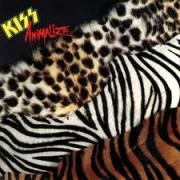
SOUNDTRACK: KISS-Animalize (1984).

This year, 1984, was the first time that I saw Kiss live.  Sadly I remember more about the opening band (Loudness) asking if New York was having a good time (and the fans screaming that we were in New Jersey). But I still have my booklet from the show and I do remember a few things from the show (again, sadly they were not in makeup).  So this album holds a special place for me, even though in retrospect it’s not as good as Lick It Up.

“I’ve Had Enough (Into the Fire)” starts the album off with a bang—blistering solos from new guitarist Mark St. John.  But, as with Lick It Up, the album for me is overshadowed by the (massive) single.  “Heaven’s On Fire.”  It’s such a lame little sing-along (and yes I do remember that song from 1984 show—Paul really milked it).  But man it’s such a bad song.  Musically, “Burn Bitch Burn” is interesting, but what were they thinking with those lyrics “I want to put my log in your fire place…burn bitch burn?”  That’s a far cry from “I am the doctor of love.”  “Get All You Can Take” is, to my knowledge, the first time Kiss has said the word fuck in a song (“What fucking difference does it make?” Is sung by the deeper response voices in the chorus.  It’s a catchy song with an interesting riff.  “Lonely is the Hunter” has a kind of 70s southern rock feel.  It also seems to be calling back to some earlier songs in the style of singing—which only reminds you how much better the earlier song was.   The band is relying a lot on call and response vocals on this album.  And they’re okay but seem like a something of a crutch..

“Under the Gun” continues as another sort of generic fast rocker from this era.  “Thrills in the Night” is one of my favorite songs on the disc–it sounds so much like Kiss of the 70s.  And with Paul’s vocals and the guitars, this could have come off of his solo album.  “While the City Sleeps”  is a fairly uninspired Gene song.   None of these songs are bad, really, they’re just not as exciting as they might be.  “Murder in High Heels” has more of that 70s rock swagger that Gene likes to pull off.  It’s just not always clear that the 70s swagger rock works well with the heaviness of other songs on the record, like the band wasn’t sure which direction to go in.  So even though this disc is the one that brought me back to Kiss, it has some good songs, but it doesn’t really hold up all that well.

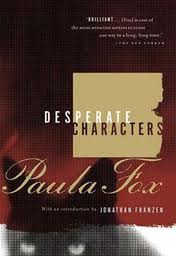
[READ: August 1, 2012] Desperate Characters

David Foster Wallace, Jonathan Franzen and Tom Bissell have all championed this book.  Bissell was instrumental in getting it republished once it went out of print.  Franzen wrote the introduction to the newly published version.  David Foster Wallace blurbed the book: “A towering landmark of postwar Realism….A sustained work of prose so lucid and fine it seems less written than carved.”  It was also on his syllabus.  Zadie Smith has also written favorably about Fox’s fiction.

So why did it take me so long to read this book?  (I read the original version, which is what the library had.  I’m curious about Franzen’s introduction and will get to it eventually).

S. knows Paula Fox as a children’s author, which surprised me even more when I read the grittiness of this book.

It is submerged in downtrodden New York City of the late 60s, where people throw garbage out their windows, where racial tensions run high and where everything feels dirty.  This powerful description late in the book sums up the attitude about the City:

They drove through miles of Queens, where factories, warehouses, and gas stations squeezed up against two-story, two-family houses so mean and shabby that, by contrast, the ranks of uniform and tidy tombstones rising from cemetery islets that thrust up among the dwellings seemed to offer a more humane future. Sidewalks, brutal slabs of cracked cement, ran for a block or two, then inexplicably petered out, and along the center of the tarmac streets, short lengths of old trolley tracks occasionally gleamed among the potholes. Here and there, the skeletons of a vast new apartment complex sat on the rent ground; tree roots and rocks and earth rolled up around its foundation. Cries of boredom and rage were scrawled across the walls of factories, and among these threats and imprecations, invitations and anatomy lessons, the face of an Alabama presidential candidate stared with sooty dead eyes from his campaign posters, claiming this territory as his own. His country, warned the poster – vote for him – pathology calling tenderly to pathology. [For those ignorant of history like me, that candidate was George Wallace.  This was his third time running, this time as part of the American Independent Party].

But that’s just the descriptions.  What is this story about?  Simply, it is about Otto and Sophie Bentwood, a successful childless couple living in Brooklyn.  Otto is a lawyer, and, Sophie is a successful translator (I liked that Sophie was employed and not “just” a housewife).  But Sophie hasn’t felt up to translating lately and Otto’s successful practice hits a bump when long time partner Charley decides to leave to work on more important causes.

Otto is rather cut off emotionally–Charley has been his friend and partner for decades yet he can barely muster a proper goodbye when he steps out the door.  And while Otto and Sophie are mostly happy, he has more or less pushed her into the arms of another man.  She looks back on this brief affair with fondness.  However, the fact that the affair is never suspected and the fact that it ended the way it did are just more indignities that Sophie has to suffer.

But what sets off the action in the story is an act of kindness.  Sophie sees a cat that is hanging around the alley behind their brownstone.  Amid the people throwing garbage out the window and hanging up sheets to act as curtains, Sophie decides to do a nice deed for this cat.  She brings it some milk. It hungrily laps up the milk and when Sophie goes to pet it, it bites her really hard on the hand.  And literally the rest of the story follows the swelling of her hand. (more…)

Read Full Post »
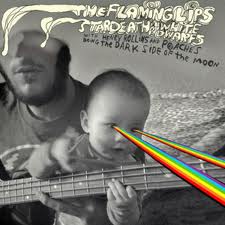
SOUNDTRACKTHE FLAMING LIPS AND STARDEATH AND THE WHITE DWARF WITH HENRY ROLLINS AND PEACHES-“Money” (2011).

I’ve already mentioned this full length album, but how can you not talk about JR without mentioning this song.  (I probably could have dine a post a week about all of the covers of it).

This is one of the most famous songs certainly by Pink Floyd on one of the most popular album s of all time.  So how do you cover it?  You can’t lose the bass line, it’s way too important to the song.

But aside from that the song is pretty different–the vocals are machine tuned almost out of recognizability.  And that’s when you realize that although this is a pretty faithful cover, it’s also a goofy cover.  Not silly, not really disrespectful but not entirely right either (notes are out of tune and flubbed).  It’s very mechanized, as if they are talking about the auto-tuned nature of making hit songs.

  Henry Rollins takes the roll of the random punters ranting at the end of the song, and that’s pretty fun.

The whole thing is kind of  a trifle.  It works better in context of the album because you can understand what the group is doing.  On its own it’s a bit of  shock.

[READ: Week of July 9, 2012] JR Week 4

This week continues where last week left off–in the middle of trying to get Dan to convince Ann to drop the lawsuit against the school (for firing Bast). Whiteback tries to speak for Vern, but Vern will have none of it–Whiteback, despite being president of the school and the bank, is proving to be more and more of a pushover as the story goes along.

Vern gives his take on the school:

The function of this school is custodial.  It’s here to keep these kids off the streets until the girls are big enough to get pregnant and the boys are old enough to go out and hold up a gas station, it’s strictly custodial and the rest is plumbing.  If these teachers of yours strike just sit still and keep the doors open, by the time these kids have been lying around the house for a week their parents will march the teachers back in at gunpoint (226).

Dan interrupts the proceedings to talk to Whiteback about his mortgage (Vern magnanimously tells Dan to go ahead and conduct personal business during work hours).  Dan’s mortgage is not working out so well because the studs in his house are too far apart–causing it to be less insurable and causing him to pay a lot more. When Whiteback commends Major Hyde’s house for being spectacularly built Dan says that he was surprised to see that Hyde was moving.  Hyde doesn’t know what he’s talking about.  Dan tells him that there was a moving van in his driveway taking all of his things out.  There’s some chaos (and a stolen car) when JR comes in and tells them that Buzzie (who was sent down for possession) has taken off down the hall. (more…)

Read Full Post »

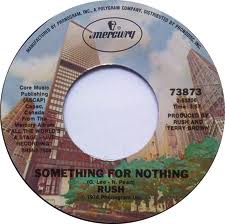
SOUNDTRACK: RUSH-“Something for Nothing” (1976).

This song comes from Rush’s 2112 album.  Since I’ve started reading JR, the refrain keeps popping into my head.  People talk of the influence of Ayn Rand on the band at this time and this song fits the bill.  When you think about the themes of most rock songs (carefree sex and partying) the lyrics to this song are totally conservative: “You don’t get something for nothing, you can’t have freedom for free.”  Rush has always been a hard working band, so this attitude makes sense.

And the song also resounds with the capitalists in this story–make your money (and other people’s money) work for you.  “Countless ways you pass the day.”

The song starts quietly but man it rocks hard with some really heavy guitars.  And the solo is intimidatingly noisy.

Oh and as for Rand, “What you own is your own kingdom.”

Of course, there is a little less capitalism as the song ends: “in your head is the answer, let it guide you along, let your heart be the anchor and the beat of your song.”  So, the message is not one of greed, but that to make your dreams come true you have to work for it.  Not bad advice, really.  Unless you were born into money of course.  In which case, never mind.

[READ: Week of July 2, 2012] JR Week 3

My JR posts are proving to be a day late (but not a… nope I won’t say it). It’s not the reading that’s hard it’s finding time to write these up.  So, apologies for those waiting with bated breath.

The week’s section opens with sex, specifically, Polaroids of sex.  Mr Angel, Stella’s husband, gets a call from Coen at the hospital (he got into an accident because of his broken glasses (ha–it was not reckless driving).  Then he starts talking with Terry about sprucing up the place–nice paneling, some plants–she thinks that’s a great idea (and actually buy a plant with her own money later).  They are interrupted by Mr Angel’s worker Leo who presents him with a stack of photos of the same Terry engaging in various graphic sexual positions (the boys in shipping had them).  With multiple men.  And although none of the men work in the office, the pictures are taken in this very office.  Mr Angel suggests that the photos could be doctored, to which Leo replies, “You’d have to have a picture of her eating a cucumber to paste onto this one, that’s some doctor” (151).   Childish but very funny.

Mr Angel goes off to Dayton to deal with some business and we see that quickest passage of time yet in the book.  Most of the book so far has been set in a day or two, but as we stay with the secretaries, several days pass in Mr Angel’ absence.  Terry and Myrna move their things into the same area so they can talk and listen to the radio while they work.  So there’s the gossip and the radio chatter vying for attention (the radio comes in Spanish as well as English) and the scene stays with them over a few days and through weekend.  Although this book doesn’t shy at all from potty humor, I enjoyed this little exchange before he leaves: Mr Angel say that she’s left the letter “s” off the word scrap on one of the documents.  She’s so embarrassed!

Terry also says she has something to tell Mr Angel about Leo…but that never gets said aloud, even when he returns and reminds her. (more…)

Read Full Post »

SOUNDTRACK: BUILT TO SPILL-“Carry the Zero” (1999).

For a time, before the bands each took off, I lumped Built to Spill, Death Cab for Cutie and Modest Mouse into a pile of bands I really liked but wasn’t always sure who was who.  They each have melodic sections, noisy sections and high pitched singers.  (It also turns out that both Modest Mouse and Death Cab for Cutie cite Built to Spill as a big influence).  The big difference between the three is that Built to Spill’s Doug Martsch is a guitar god—he does amazing solos which is why his songs are so long (their Live album features a 20 minute version of Neil Young’s “Cortez the Killer.”

I have no real idea what this song is about, but I love it.  It’s catchy and fun with a great melody.  And, in this case it kind of ties in to JR, because JR is all about making money but his basic math is shaky.  In the same way, carrying the zero won’t do anything in basic math.  Although “you have become a fraction of the sum” is a nice refrain.

This was the song and album that introduced me to Built to Spill and I love it.  Great 90s alt rock.

[READ: Week of June 25, 2012] JR Week 2

And since there are no paragraph breaks, week two picks up mid-flow.  However, this proved to be a good breaking point because almost the entire read for this week is about Mrs Joubert and her class on their field trip to the New York Stock Exchange.  And Edward Bast is steamrollered into doing (and paying for) everything.   Gaddis’ style completely allows for the miscommunication and ease with which Bast is overtaken by Joubert and Gibbs.  While it certainly calls into question Bast’s ability to stand up for himself, it also shows how easily one can be pushed into doing things (although in real life I suspect you’d just say “wait a minute, I can’t,” at some point).  It’s still very funny and the action moves along so quickly that it works perfectly with the flow.

The scene begins with Mrs Joubert herding the kids onto a car and then talking to Mr Bast.  He apologizes for what happened yesterday,  Of course, he is talking about his disastrous TV meltdown but she thinks he means the loss of the bag of money and its turning up 3 pennies short.  Through a series of unsubtle hints from Mrs Joubert, Mr Bast winds up joining their trip to the city.  He had business to conduct in Manhattan so he was going in anyway, but now he’s roped in with the kids.  There’s a lot of sexual tension on this trip–the boys are watching women bend over and Mr Bast keeps pressing his body again “her unyielding thigh.”

Then we get our first really big scene with JR.  In this scene he and a friend (unnamed as far as I can tell) are going through all of their free mail publications and doing trades.  Everything the boys try to trade is a load of crap (a word count on “crap” would be very high indeed). So the kids start looking through their brochures: K’ung-p’a, piano lessons, rare coins, scientific method builds powerful muscles,government surplus (a Tank that turns out to be an airplane gas tank (ha)), How to Make Big Profits Overseas, selling shoes, etc.  There’s some very funny back and forth as smart-assed kids will do (he really has young kids’ dialogue down very well), like :What are you gonna do where it says “married” or what are you gonna do when it says shoe size and you put yours? (more…)

Read Full Post »

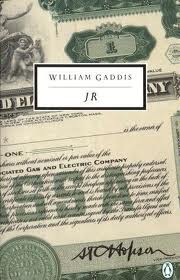
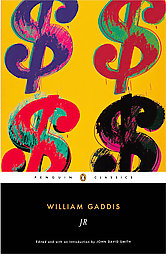
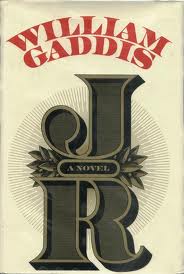
The edition I’m using.

SOUNDTRACK: RICHARD WAGNER-“Ride of the Valkyries” (1856).

Possibly the most famous piece of music from any opera (known for a billion reasons other than the opera itself).  This song was introduced to be by Bugs Bunny.  And then cemented in my consciousness in Apocalypse Now.

It’s really impossible for me to listen to it without seeing helicopters dropping napalm.

I’ve never seen it performed before.  Most of us think of it as an instrumental, but there are vocals, and they add a lot to the performance.  I also didn’t realize that the whole first minutes is a prelude to the third Act–with a darkened stage.  I just watched this version by the Danish Royal Opera in which the setting is updated.  The Stage is amazing and it’s a pretty powerful image, that won’t leave me head too soon.  And of course, the women sound phenomenal.

Smells like victory to me.

[READ: Week of June 19, 2012] JR Week 1

And so begins the saga of JR.  A little of my background:

I read JR about a decade ago.  I recall the structure and some of what happens, but not enough to actually remember anything ahead of time, plotwise.

Usually for these weekly group reads, I post fairly detailed recaps of the book.  And usually I do that because there’s so much going on in a large book, that it’s one way for me to keep track.  JR is going to be a little different.  If you’ve gotten this far in the book, you’ll notice that there’s not a lot of plot going on.  There’s a few scenes with lots of dialogue and maybe something comes of it, maybe not.  So, I’m certainly not going to try to recap everything that happens in the dialogue, nor am I even going to try to figure out who said what or even who is in every conversation–I’m not even sure that’s possible.  But I am going to talk about each scene a bit and see if I can pick out anything that seems important.

The book strikes me as being like an unedited film.  Or like a Picasso–Gaddis wants to show you everything, and let you pick out the important bits.  And so the book feels like a boom mike has been inserted into a room or scene.  We’re not really sure who everyone is, or even who is talking at a given moment.  But we hear everything that’s said. And then the boom mike pulls out and the camera pans somewhere else and the boom mike goes down and we hear some more.  It’s not always clear even that a scene has shifted–although usually a dense paragraph of prose indicates a shift in scene.

As far as characters, it’s not clear if anyone mentioned early on is going to stay with us through the book.  It’s clear that JR will be here (although his first real scene is right after my spoiler line for this week).  There’s also the Bast family who will no doubt play some ind of important role.  Then there’s a lot of teachers as well. (more…)

Read Full Post »

SOUNDTRACK: FEIST-“Femme Fatale” (2011).

The funny thing about The Velvet Underground is that it seems like it would be very hard to fail at covering them.  Their songs are pretty open to interpretation.  But, it’s even more true if you wanted to do it pretty straight.  I mean, while Lou Reeds voice is unique, Nico’s isn’t really.  It’s slow and languorous, sexy and distant.  I would never have thought to describe Feist that way and yet she fits into the Nico mold very nicely.

This cover comes from the Velvet Underground Revisited show from 2011, with a band comprised of members of Radiohead, Air and Supergrass.  Feist did vocals for this one.  It’s not an earth-shattering cover.  In fact it’s pretty spot on.  Maybe everyone who hears this will start a band too.

You can hear it here.

[PLANNED: Summer 2012] #OccupyGaddis

I had my books all planned out for the summer.  A series of smaller books to get through before trying to tackle any really big books that are on my shelf (and there are plenty).

And then came #OccupyGaddis.

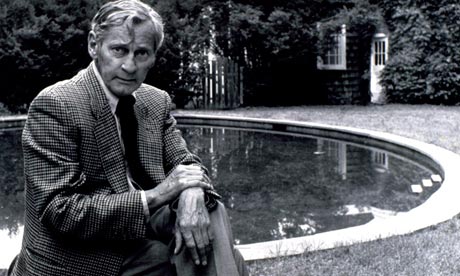
William Gaddis is an author, like Thomas Pynchon, who writes large, unwieldy novels which are something of a bedrock for contemporary American fiction–like The Velvet Underground–not many people have read him, but those who have all went on to write wonderful books.  And he forms a kind of continuum of (among many many others) Joyce>Gaddis>Pynchon>Wallace which means that I ought to be reading him.

I read JR about a decade ago.  I remember a few things about it–basic plot details and the fact that you never know exactly who is speaking.  I wasn’t keeping this blog then, so I didn’t exactly take notes on it or anything.  It’s kind of a blur.

So Lee Konstantinou is running #Occupy Gaddis this summer.  It is meant  to be an Infinite Summer type-deal.  Unlike Infinite Summer which was weekly, he’s planning on posting every two weeks.  I’ll try to do my weekly post (work permitting), by picking a midpoint as a Spoiler Line.  Since my recollection is that JR is like one large block of text with no breaks anywhere, my spoiler line will be pretty arbitrary.   But here’s his:

June 29: pp. 150

July 15: pp. 300

July 31: pp. 460

August 15: pp. 610

August 26: done!

(more…)

Read Full Post »

SOUNDTRACK: AZTEC CAMERA-“Jump” (1984).

This is a wonderfully twisted covered of Van Halen’s “Jump.”  VH’s version of “Jump” is bouncy, lively, fun, it makes you want to yes, Jump!  It was many years after the release of VH’s “Jump” that I heard the Aztec Camera version (even though it was released the same year).  The first time I heard it I assumed it was a joke.

I didn’t know much about Aztec Camera (and actually still don’t–looking at their Wikipedia page I don’t recognize the names of any of their singles).   But I have grown to love this cover of “Jump.”  In fact I prefer it to the original.

The opening chord structure makes me think it’s going to be the Rolling Stone’s “Waiting on a Friend” but instead of Jagger’s ooh oohs we get Roddy Frame’s deep voice practically whispering the lyrics that David Lee Roth made famous.  And it stays with this delightfully mellow acoustic style and pacing throughout.  The guitar work in the bridge is actually much more interesting than the bridge in the Van Halen version (ouch).

The chorus seems kind of odd with his very mellowly saying “jump” (although David Lee Roth doesn’t scream “jump” either, it’s the backing vocals that do the exciting part).  I feel like the original VH version hasn’t held up that well, but the Aztec Camera version shows that it’s quite a good song.

Check it out here.

[READ: Week of November 8] Consider David Foster Wallace [first three essays]

I lied.

I said that I wouldn’t feel up to writing posts about all of the articles in this book on a regular basis.  As it turns out, I don’t have a lot to say about these essays, but I had a few thoughts about each one.  Since there’s a group reading going on, I thought it might be fun to post these thoughts now while people were still speaking about the articles instead of waiting until the end.

Before I say anything about this articles, I want to preface that I’m not going to repeat things that were said in the group read (for a couple of reasons).  Everything here is going to be things that I felt about the article and maybe, if something another reader says really sticks with me, I’ll mention it as an influence on me.

Having said that, in one of the comments, author Clare Hayes-Brady says that her article is a part of a longer thesis.  I found this to be a very useful thing to know, and I assume that she is not the only one who had to compress her article because of size and time constraints.  With that in mind, I’m going to accept that if it seems like the author could/should say more about a certain thing within the article that there is probably a larger version of the piece.

And finally, because I don’t have a lot to say about the pieces, I’m only going to mention things that I found puzzling/confusing.  But be assured that if I don’t mention the vast majority of the article it’s because I found it interesting/compelling/believable.  I don’t feel comfortable paraphrasing the articles’ argument.  Besides, what would be the point of that?

(more…)

Read Full Post »

« Newer Posts - Older Posts »