Feeds:
Posts
Comments

Archive for the ‘Authors’ Category

SOUNDTRACK: NADA SURF–North 6th Street (1999).

In 1999, Nada Surf released this collection of songs.

It was named after the street in Brooklyn where we first got together. It has our first singles, some 8-track demos we made in our practice space, some alternate versions, french versions, a couple of unreleased songs and a cover.

Collections like this can be hit or miss, especially when a band had progressed from their original sound.  But there’s nothing embarrassing about this collection at all.  In fact, there’s a lot of really charming stuff on here.

The first two songs, “The Plan” and “Deeper Well” are labelled as 7″ Version.  I don’t really know what that means.  Both songs appear on High/Low.  “The Plan” is a little shorter than the record and “Deeper Well” is a little longer.  They sound similar, although there’s a different drummer, Aaron Conte.  But they both sound really good and are a nice reminder that Nada Surf can really rock out.

The next three songs are demos of songs from High/Low: “Ice Box,” “Psychic Caramel,” and “Popular.”  These also have their first drummer.  These aren’t boombox recordings.  They sound well produced, although they do feel a little more grungy than the album.  “Popular” sounds the most different.  There’s female vocals in the beginning.  The tone of this version seems a bit angrier, but otherwise similar.

The next two songs are French versions of songs from High/Low.  Matthew Caws and Daniel Lorca met at a French school in New York, so their French is quite good.  It’s weird, but cool to hear familiar songs sung in a different language by the same vocalist.  These songs, like the whole High/Low album were produced by Rik Ocasek, so I’m assuming they were done a the same time.

“Traffic” and “Me and You” are (I believe) previously unreleased.  “Traffic” is a quiet instrumental propelled by Daniel’s bass and some gentle pretty guitar picking.  The ambient noise of an ambulance is a nice touch.  “Me & You” is a full-on folk song–acoustic guitars and possibly a suitcase for drums.  Each of these songs is 1:47 long–snippets into bits of songs.

“Silent Fighting” and “Spooky” are alternate versions of songs that appeared on the band’s reissue of their album The Proximity Effect.  They weren’t on the original album (which was lost in record label hell for quite a long time), but they are the final songs on the version that’s largely available.  “Silent Fighting” is a demo version, but again, it sounds professionally done.  And “Spooky” is listed as an Alternate Version.

The next two songs are also unreleased elsewhere.  “The Manoeuvres” is a quiet acoustic ballad.  “Sick of You” is an Iggy Pop song!  Like the original, this song is slow and moody with a distinctly Iggy tone in the vocal delivery.  And like the original, it rocks out in th emiddle with a full on punk assault.  It runs over five minutes long

Up next are two more demos from The Proximity Effect.  “Robot” is a lot quieter.  You can hear the lyrics more clearly and the heaviness is toned down.  “Amateur” sounds pretty similar–full with a great bass sound.  Although it’s missing the wonderful “ooh ooh ooh” part.

“River Phoenix” is a rocking song with a spoken vocal line and fascinating lyrics like:

River Phoenix
Ian Curtis
And river Phoenix
And me and you

And it’s quite catchy.

“Mother’s Day” is another demo from The Proximity Effect.  This is a fantastic anti-rape song with brutal, angry lyrics.  This version sounds a little different–a little less distorted, a little less loud, but still angry.

“Dispossession” is an alternate version from The Proximity Effect.  The album’s guitars sound a bit rawer, the guitars a little crisper and the whole things feels a bit more wild.  This version is a bit cleaner, except for the wild guitar solo.

[READ: November 7, 2020] The Midnight Library

S. brought this home and really enjoyed it.  She thought I’d enjoy it too.  Of course she was right.  I’d probably enjoy most of the books she reads, but I already have my own dozen dozen authors that I like to read already.

The book opens with the fascinatingly dramatic opening sentence:

Nineteen years before she decided to die, Nora Seed sat in the warmth of a small library at Hazeldene School in the town of Bedford.

Nora is playing chess with Mrs Elm the librarian when Mrs Elm gets a call that Nora’s father has just died.

The book jumps nineteen years ahead to “twenty-seven hours before she decided to die.”  The next few chapters list the miseries of her life: her cat is hit by a car, she gets fired from her lousy job (her boss has the funniest, meanest line I’ve read: “I can’t pay you to put off customers with your face looking like a wet weekend.”) (more…)

Read Full Post »

SOUNDTRACK: CONTROL TOP-Control Top (2019).

Control Top is an intense punk/new wave band from Philly.  They are a must-see live.  Ali Carter is a dynamic front person.  Al Creedon’s guitar is a blast to see live and Alex Lichtenauer’s drums are even better when you can feel them.

This is their debut album.  A couple of songs run over 3 minutes, but most are in the two and a half minute range (the album is ten songs in 29 minutes).  While the music is mostly hardcore-ish, they have a very cool early new wave sound–robotic and precise.  There’s angular rhythms and interesting juxtapositions all underneath carter’s (mostly) screamed vocals.

“Type A” sets the mold with screamed vocals, interesting lead riffs and heavy chords.  Creedon makes all kinds of interesting walls of noise which never detract from the melody of the song itself.  “Office Rage” has thundering drums and a cool change of guitar sounds midway through the song.  not to mention when Carter sings “service with a smile,” the band pauses and she shouts “eat shit.”  How they manage to squeeze a guitar solo into this 3 minute song is beyond me.

“Chain Reaction” has jagged guitar chords and a robotic vocal delivery.  I love the way Carter’s bass holds down the melody while the guitar is just playing a wall of noise.  “Unapologetic” runs to almost four minutes with two distinct parts, the main verses that have distorted harmonic guitar notes and Carter’s staccato delivery and the piercing high notes of the “who’s” the bull in the China shop now?” part.

“Straight Jacket” is less abrasive than the other songs with a more new wave feel and Carter’s vocals more melodic.  “Covert Contracts” plays a lot with empty space–there’s moments with just bass and moments with just drums but the loud guitars are never far away, ready to fill in with squalls just when the song seem like they might be getting too quiet.

“Betrayed” returns to the angry style of the earlier songs–harsh guitars and appropriately angry vocals.  “Ego Deaf” has a few pummeling drum rolls in just over two minutes with a bass and drum-only portion before the ringing solo comes in.  “Traffic” is only 90 seconds long and it soars with harsh notes and angry vocals. Amazingly, it even has time for a slower middle section and a pause before the speed resumes.

“Prism” is a terrific new wave song.  The verses start with just bass and drums and vocals.  The chorus is crazy catchy, yes catchy.  Although the noisy guitar squalls after the chorus keep it from being too poppy.  The disc ends with “Black Hole” which shows off more of those drum fills and that rumbling bass.

This album is a cathartic blast and when the 30 minutes are over, you’ll want to start it again.

[READ: November 10, 2020] Mind of My Mind

I recently read (and loved) an excerpt from one of Octavia Butler’s stories.  So when this book came across my desk (perhaps all of her books are getting reissued in trade paperback?) I immediately decided it was time to start reading her books.

Obviously one wants to read a series in order.  But this was the book I so I hoped I could start here.  I had seen there was a prequel to this book, but that it was written after this one.  Just to make things more confusing, none of the books in the Patternist series were written in chronological story order.  Here is the story timeline (and when they were written).

1 Wild Seed (1980)
2 Mind of My Mind (1977)
3 Clay’s Ark (1984)
4 Survivor (1978)
5 Patternmaster (1976)

So this is the second book written and the second book chronologically.

At any rate, I didn’t need the other books to appreciate or understand this one.

The premise is fairly simple, but the execution is outstanding. (more…)

Read Full Post »

SOUNDTRACK: AND THE KIDS-When This Life Is Over (2019).

I’ve seen And the Kids twice and they put on a fantastic live show.  I highly recommend seeing them when live shows start again. 

The core of the band is Hannah Mohan on guitar and vocals and Rebecca Lasaponaro on (fantastic) drums.  For this record they were a four piece (although no names are included on the disc).

“No Way Sit Back” starts the record with a slow swinging song that features the wonderful wordless hook of Mohan singing “oooh oh oh no.” Midway through, the song shifts gears to a kind of glockenspiel melody over the lyrics “the world is never made for us.”  Even though lyrically this album is dark, musically it is really lovely.

“Butterfingers” lopes along at an unusual pace before a really catchy guitar melody kicks in midway through.  There’s some more catchy melodies as the two vocals line intertwine with each other.  Then comes “Champagne Ladies” a remarkably catchy song right from the get go.  The quietly rumbling guitar and the great vocal melody is nicely mimicked by the bass.  It’s a really fantastic song and should have been a big hit, even with the uplifting chorus: “life is a bastard, it wants to kill you don’t let go.”  But if the lyrics are too dark, there’s another fun wordless “ah ah ah” melody near the end.    

“2003” opens with a penny whistle introduction (when I saw them live, Mohan played the whistle and then just tossed it aside before she started singing).  There’s some excellent unusual and complex drumming at the top of this song. 

“The Final Free” has grooving guitars and a cool part in the middle where the guitar follows the vocal line in a quiet but catchy melody.  “When This Life Is Over” has a kind of hawaiian feel to it with guitars and choral vocals.   “Special For Nothing” is a quieter song that builds into a gorgeous soaring chorus. When the song shifts to the middle part and the music all falls back except for the vocals, it’s really quite lovely.  I love when the backing vocals do counterpoint over the refrain

“Get To That Place” is a short song, less than two minutes and sounds like a bedroom recording (lots of hiss) but as the song gets bigger there’s some cool vocal tricks (so much soaring highs) and glockenspiel.  It’s followed by another short song.  The mellow “Somethings (Are) Good” is just over two minutes with more overlapping vocals and a dynamite melody. 

“White Comforters” sounds bigger and more full sized.  It’s much slower with a bouncy guitar melody and a lot of spare playing. It starts a little too quietly but it builds very nicely.  “Religion” brings back the rocking guitars with a loud opening and a simple but catchy guitar melody, the joyous vocals with two layers of oh ho ho s really makes this song soar to glorious heights.

The disc ends with “Basically We Are Dead” a longer song that opens with a quieter guitar melody and vocal.  Atmospheric keys fill in the backing moments along with a bouncy synth melody and some joyful bah bah bahdahs.  But before the song ends, some familiar chugging guitar chords enter the song and they sing the chorus to “Champagne Ladies” one last time before it’s all over.

And the Kids play wonderful indie pop with plenty of unexpected twists.  And they are terrific live, too.

[READ: November 5, 2020] The Divided Earth

This is the final book in the The Nameless City trilogy.

The book opens with the leaders of the city agreeing that their sacred fire, Napatha, must be destroyed, lest it be used by one of the splintering factions.  But one copy of the recipe spared–given to the monks to hide for as long as was necessary.

Then we flash forward.

Kaidu is sitting with Rat and the others, resting up for what’s to come.

We see Mura, the woman who was abandoned by the monks as a little girl, receiving that copy of the book from the monks (they are hesitant).  She has every intention of learning the formula and creating the Napatha again. She imagines giving the formula to all of the other Dao generals for maximum production against the Yisun.  But Ezri, who has forcibly put himself in charge of the Dao people, wants to keep it under wraps.  Being a treacherous person, he anticipates treachery from everyone else as well.

The Yisun army is marching on the city.  Ezri hopes to have the Napataha ready to use against them.  He has just enough to show how powerful it is.  And it has the desired effect.

When Rat and Kaidu see what happened, Kaidu announces that he is going to steal the book from Mura’s clutches.  How?  Well, that’s where most of this book’;s adventure comes in.  It’s clever and stealthy and very exciting with switches and crosses and trouble everywhere.  They even get help from their minstrek friends (it’s always nice to see minor characters come back). 

At the same time, Kaidu’s parents (Kata and Andren) are (unbeknownst to Kadi and Rat) planning to negotiate with the Yisun army to save the city  Kata explains that she is in charge of the Dao tribe Liuvedao and she is no friend to the Dao regime currently ruling.

The soldier in charge of the Yisun army scoffs at this idea.  Until Kata’s secret weapon (which she didn’t know she had) steps forward and explains why the Yisun leader might want to hear them out. Kata proposes an dambush on the city, using an equal amount of Kata’s forces and the Yisum army. 

None of the attacking plans go smoothly.  Rat and Kaidu face very difficult odds (and many soldiers) and the ambush team literally walks into a dead end and needs to be rerouted through a sewer tunnel (ew).

There is a terrific showdown between Rat and Mura, two women whose lives began in a similar way but who took very different paths. And there are many many pages of battle scenes.  Hicks does a great job of keeping the action exciting and clear, with lots of one one one combat as well as an army of warriors.

The story has an epilogue set three years later, which is fun. It’s neat to see Kadi and Rat grows up some, although I could have used a dozen more pages of epilogue to see what things are like now.  And to see them catch up (there’s no Facetime back then). 

But even so, this was a great series, full of excitement and very emotional moments,.

Read Full Post »

SOUNDTRACK: BORIS-tears e.p. (2019).

Boris tends toward being a very heavy band.  Their two recently albums D.E.A.R. and NO are some intense heavy metal.  They also do a lot of noise and heavy drone.  But they are not afraid of melody.  And they are not at all afraid to make pretty, dancey music.

There are five songs.  The first song “どうしてもあなたをゆるせない (doushitemoanataoyurusenai)” is on the disc twice.  The first version of this song is a remix by Narasaki under his name “Sadesper.”  It opens with a grooving bass line and some pretty guitars.  The drums are metronomic and there’s a sprinkling of keys.  I’m not sure who sings, but there’s a lot of falsetto. I love how just before the chorus there’s some orchestra hits.  It’s pretty much a full on dance song and it suits them perfectly.  You’d never guess it was Boris, but it makes sense once you realize it.  It even ends with a nifty guitar solo that sadly fades out.

“u fu fu” opens with a fast simple guitar chugging riff.  After a good ol’ “Whoo!” from Atsuo, the song pulses forward on the insistent grunted  “ooh ah” that works as a foundation to the song.  There’s a lots of great backing vocals in each ear. With about a minute to go, the bass takes over with a fast, heavy rumble before the harmonizing vocals kick in.

Up next is a fantastic cover of a Coaltar of the Deepers song “To the Beach.”  I didn’t know Coaltar of the Deepers before this release, but I have listened to them a bunch since and they are a terrific Japanese band unknown in the States.  I’m not sure how much this differs from the original , but this version is fantastic–slow and moody with lots of build and release.  The song starts with a pretty guitar melody and then a series of crashing chords and cymbals while Wata’s guitar soars.  The verses are slow with a whispered vocal.  But the choruses resume the crashing chords to punctuate things perfectly.  In the middle of the song as the vocals overlap and blend, it sounds magnificent.

“Peaches” comes next, it’s a 2 minute song sung by Wata.  A pulsing bass line propels the song forward as Wata chants the the word “peaches” over and over with an occasional “la la la” fleshes things out.  A repeating piano is added for a bit and then a shift to a kind o funky bass line that leads to the end of the songs.  It’s only two minutes long and kind of goofy but I wish it was longer.

The disc ends with an instrumental version of “どうしてもあなたをゆるせない.”  The song is so catchy and wonderful that hearing it a second time in the EP is a great thing.  It’s one of the few instrumentals that I think might sound better than the original because you can really hear what the musicians are doing–and its some great stuff.

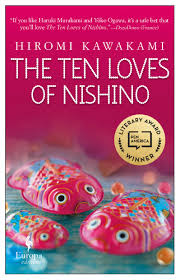
[READ: October 29, 2020] The Ten Loves of Nishino

I have a stack of books waist high next to my desk which I intend to read.  And yet, I continue to find new (to me) books that I jump in and read first.  This book was recommended by the most recent Tiny Desk Contest winner Linda Diaz.  Why on earth would I read a book recommended by a person I’d never heard of before?  She said it was her favorite book ever (which seems weird since it only came out in English last year, but whatever).  It was also pretty short.  So I decided to check it out.

I have enjoyed many of the Japanese writers that I’ve read, so I was intrigued to read a contemporary female author (this book was translated by Allison Markin Powell).

So this book is written in ten chapters–each one written by a lover of Nishino, an enigmatic figure whom we only learn about from the women writing about him.

There is something strangely seductive about Nishino that these women find hard to resist.  He is aloof and puzzling, but that seems to make women want him even more.  But he is perpetually with women (more than these ten, it would appear). (more…)

Read Full Post »

SOUNDTRACK: THE ROOTS feat. JILL SCOTT-“You Got Me” (1999).

I’ve wanted to listen to more from The Roots ever since I was exposed to them on Late Night with Jimmy Fallon.  But as typically happens, I’m listening to other things instead.  So this seemed like a good opportunity to check them out (based on Samantha Irby’s rave below).

One of the best things about this recording (and The Roots in general) is Questlove’s drumming.  In addition to his being a terrific drummer, his drums sound amazing in this live setting.

Erykah Badu sings on the album but Jill Scott (Jilly from Philly) who wrote the part, sings here.

It starts out quietly with just a twinkling keyboard and Scott’s rough but pretty voice.  Then comes the main rapping verses from Black Thought.  I love the way Scott sings backing vocals on the verses and Black Thought adds backing vocals to the chorus.

Midway through the song, it shifts gears and gets a little more funky.  Around five minutes, the band does some serious jamming.  Jill Scott does some vocal bits, the turntablist goes a little wild with the scratching and Questlove is on fire.

Then things slow down for Scott to show off her amazing voice in a quiet solo-ish section.  This song shows off how great both The Roots and Jill Scott are.  Time to dig deeper.

[READ: November 1, 2020] Wow, no thank you.

This book kept popping up on various recommended lists.  The bunny on the cover was pretty adorable, so I thought I’d check it out. I’d never heard of Samantha Irby before this, but the title and the blurbs made this sound really funny.

And some of it is really funny. Irby is self-deprecating and seems to be full of self-loathing, but she puts a humorous spin on it all.  She also has Crohn’s disease and terribly irritable bowels–there’s lots of talk about poo in this book.

Irby had a pretty miserable upbringing.  Many of the essays detail this upbringing.  She also has low self-esteem and many of the essays detail that.  She also doesn’t take care of herself at all and she writes about that.  She also doesn’t really want much to do with children or dogs.  And yet somehow she is married to a woman with children.

From what some of these essays say, it sounds like she is married to this woman yet somehow lives an entirely separate life from the rest of the house.  It’s all rather puzzling, although I suppose if you are already a fan, you may know many of the details already. (more…)

Read Full Post »

SOUNDTRACK: BORIS-“warpath” (2015).

Back in 2015, Boris released three albums on the same day all under the “new noise literacy” banner: “urban dance” “warpath” and “asia” [according to their label numbers, this is the order they go in].

All three records are experiments in abrasive noise.  Despite the adorable child on the covers, these records will scare children.

This album has four songs, all of which are variations on drone.

“Midgard Schlange” is 11 minutes of heavy distorted chords played slowly, as they ring out and rumble.  Its a a sort of seven-note melody but stretched out impossibly long.  At around 5 and a half minutes the electronics start to fade in from far away.  The first time I listened to the song I thought an airplane was flying overhead as these sounds came in.  These sounds eventually resolve into chords that acts as a kind of counterpoint to the guitar drones. It’s relatively fast tempoed for a drone song, but it still long and stretched out.

“Behind the Owl” continues the drone, but in a different way. There aren’t pummeling guitar chords that ring out.  Rather, they are just quietly building distortion waves, pulsing in and out.  It’s rather understated, a low menace that seems to cycle slowly between two notes.

The wonderfully named “Dreamy Eyed Panjandrum”starts with a kind of staticky electronic pulsing with occasional glitchy percussion sounds.  It sounds like somebody doing light construction for about 8 minutes.

The guitars come back on “Voo-vah,” and ominous ten and a half minutes of dark rumbling.  This time, the guitars are low and ringing, with waves of pulsing bass and stretched out chords. Around 8 minutes some higher-pitched notes come in, almost sounding like ghosts in the night.  Closing credits to a nightmare.

The album is credited to: takeshi: guitar, bass / wata: guitar & echo / atsuo: electronics.

[READ: November 5, 2020] “Sitting with the Dead”

I really enjoyed the way this story revealed its details.

It begins with an old, sickly man asking to go out to his barn. It was winter and he wore only his pajamas and a winter coat.  A week later, the doctor assured his wife Emily that that’s not what killed him–it didn’t even hasten the inevitable.

At half past seven on the day he died, the Geraghty sisters knocked on her door.  They were two middle-aged women who sat with the dying.  They were known in the area although Emily didn’t know them personally.  They had heard that her husband was dying and they came to sit with him, but they were too late.

Emily laughed to herself at how much he would not have wanted these two there to sit wit him.  He was not religious and he would have said that their sitting with him had an ulterior motive. (more…)

Read Full Post »

SOUNDTRACK: BORIS-“urban dance” (2015).

Back in 2015, Boris released three albums on the same day all under the “new noise literacy” banner: “urban dance” “warpath” and “asia” [according to their label numbers, this is the order they go in].

All three records are experiments in abrasive noise.  Despite the adorable child on the covers, these records will scare children.

This album has five songs, two of which actually take a break from the relentless noise that’s present on “asia.”

“Un, deux, trois” (French for “One, Two, Three”) starts out with a series of distortion bursts, a beat of distortion coupled with a wall of noise that follows up.  It’s harsh and unwelcoming.  But at just over 4 minutes it’s one of the shorter noise compositions on these three discs.  Around three minutes it sounds like distorted electronic balloons being manipulated and then the air let out.  The noise drops of for the last seven seconds before the next song starts.

“Surrender” is pretty much the only thing resembling a proper song on these discs.  It’s got bass, drums, guitar and vocals.  It’s also got a melody.  The overall feeling is one of shoegaze and the melodies, both guitar and vocal are really pretty.  Although this being an album of noise, it couldn’t help but add a hugely noisy field of distortion to the middle of the song almost as an instrumental break.  There’s a second distortion interruption in the song that lasts long enough to make it seem like maybe there’s no more music.  But the song returns, keeping that melody until the end.

“Choreographer” is nearly nine minutes long.  It starts with a rumble and electronic feedbacking.  There’s some soaring sounds buried in the rumble–some lead guitar notes (feedbacking) that add a little structure to the noise; at times it sounds like a guitar trying to fight its way out of a pile of noise.

“Endless” is a little different than the other songs.  It has a bit more of a drone feel than a noise and distortion feel.  It’s still a wall of sound, but rather than a low rumble of noise, it’s more like high notes feeding of of each other.  After three minutes it feels like a distant dreamy melody is soaring in from afar.  A couple minutes later some drums come in, a militant beat putting some tempo to the rest of the sounds.  With about four minutes left, a series of four drum hits with a cymbal add a nice regular pattern to the song–making the drums an almost catchy element because of its consistency.  The end of the song has a bit more notable percussion until it drops out and the song fades on its own.

“Game of Death” is even longer at over 11 minutes.  It starts with sharp feedback and low pulsing space sounds full of distortion and noise.  But after a minute it turns into a full on raging distortion fest.  It feels like maybe two or more different sources of distortion rumbling in and playing atop the other ones.  About midway through, a higher-pitched distortion comes in and swirls around.  But for the most part it’s a relentless barrage of noise, with some interesting new (but still noisy) sounds in the last minute.

The album is credited to: takeshi: guitar, bass & vocals / wata: guitar & echo / atsuo: drums & electronics.

[READ: November 1, 2020] “Hungry Self”

I’ve noted that I rather enjoyed Rebecca Curtis’ more recent stories, so I was disappointed by how much I didn’t really like this one.

As I think about it there was nothing bad about it, it just felt a little flat and mean-spirited without much more.

The narrator is working at a Vietnamese restaurant.  She is a waitress.  She likes the boss’s son; he thinks she is disgusting.  One of the chefs likes her.  He has no teeth and sells cocaine in the basement.  She snorts with him but nothing else.

She noticed that a customer who sat down was her former therapist. The woman gave “the smile you give a waitress if you’re the kind of person who is nice to a waitress.”

Her ex-psychiatrist was overweight and this issue had caused them all trouble.  Initially, the waitress’ whole family was seeing the psychiatrist together and the waitress’ father commented about her weight.  He asked the waitress how much she thought the psychiatrist weighed and the waitress replied 260.  The psychiatrist insisted that they be seen individually from then on.

The next time, when the waitress was alone, the psychiatrist told the waitress about Harry’s Diet Pretzels which she now ate all the time.

The psychiatrist was very nice, but the waitress didn’t want that.

I wante a shirtty tip so I could have a reason for hating the fat ugly lesbian, a reason other than that she had once seen me cry.

The psychiatrist and her lover ordered lo mein (noodles in oil–food that the fat woman definitely did not need) and egg drop soup (the soup most likely to have a roach at the bottom).

When the psychiatrist left, the tip was good, “so as to say ‘We like you’ but not too good so as to say, ‘We feel bad for you obviously.'”

I wanted more to happen here.  Oddly enough I couldn’t tell where the story was set.  I initially thought Vietnam, but that doesn’t make sense.

Read Full Post »

SOUNDTRACK: BORIS-“asia” (2015).

Back in 2015, Boris released three albums on the same day all under the “new noise literacy” banner: “urban dance” “warpath” and “asia” [according to their label numbers, this is the order they go in, but I’m posting them out of sequence].

All three records are experiments in abrasive noise.  Despite the adorable child on the covers, these records will scare children.

This album has three songs.

“Terracotta Warrior” Runs for 20:38.  It opens with quiet, slow rumbling–almost inaudible for the first 30 seconds or so.  Then the pulsing sounds start bubbling up under a hissing, mechanical sound.  Around seven minutes the rumble stays pretty steady, but the higher noises–hissing, clanging, horror movie sounds, start to grow more intense.  At 8 minutes, some discernible guitar chords ring out (heavily distorted, but clearly guitars).  It turns into a lengthy drone with squeaky feedback noises throughout.  At 17 and a half minutes the feedback gets louder and louder until it abruptly cuts off and after moment of silence distance guitars start ringing out again.  There’s even the first sign of drums (a gentle hi-hat).

“Ant Hill” is half as long, but similar is tone.  It is primarily pulsing electronics and high pitched squealing electronic manipulation.  There’s also some digital glitching sounds. After 8 minutes the song fades to a pause only to resume a few seconds later with some more digital glitching and manipulation.  With 30 seconds to go, a drum beat comes in and the distortion takes on a more melodic sound including what sounds like someone sawing in the distance.

“Talkative Lord vs Silent Master” is also ten minutes long and it is the most unpleasant of the three songs.  It is full on static and noise with what sounds like a monstrous voice growling in the distance.  By the end of the song it sounds like being in the middle of a howling winter storm.  And as it closes up there is some serious digital glitching.  Not for the sensitive of hearing.

The album is credited to: takeshi: guitar & bass / wata: guitar & echo / atsuo: drums & electronics.

[READ: January 19, 2017] “The Very Rigid Search”

Jonathan Safran Foer has become something of a more serious writer over the last few years, so I’m alway happy to read one of his earlier funnier works (himm, that sounds familiar).

This story is written from the point of view of a Ukrainian tour guide named Alexander Perchov.  He is writing this tale in English, although his English is slightly off (as the title hints at).  He speaks very good English, but his word choices often eschew idioms for literal translation (and much hilarity ensues).

Alex’s family own a Ukrainian branch of an international travel agency and it is his job to pick up and translator for an American traveller.

Alex refers to the traveler as the “hero” of the story.  And the hero’s name is Jonathan Safran Foer.

Jonathan Safran Foer is not having shit between his brains  He is an ingenious Jew.

JSF was travelling from New York to Lutsk. (more…)

Read Full Post »

SOUNDTRACK: MARCO BENEVENTO-Between the Needles and Nightfall (2010).

This is the third album by Marco Benevento and his trio: Reed Mathis on bass and Andrew Barr on drums.

It’s hard to put this release into any genre because of how fluid Benevento is.  He has some poppy songs, some jazzy bits and some experimentation.

Most of the songs are pretty long (over 6 minutes) and none of the songs have words (well, one has a aspoken section).

“Greenpoint” flows around a very simple bass line as Marco plays a poppy piano throughout the song.  There’s also some synthy blasts that move the song beyond a simple piano motif.  Around the four minute mark, the song shifts gears, growing a little faster and little more intense as the drums crash through.

“Between the Needles” is a slower song with a pretty bass line and slow piano chords.  After a minute and a half it takes off a bit with bigger piano chords and a more dramatic tone.  But then it all slows down to just piano before building up again, this time with even more evocative lead bass.  “Two of You” is quieter, with a waverly keyboard line that lays under the lead piano  The main piano line acts like a lead vocal line and is really pretty and quite catchy as well.  It builds into a nice bouncy song by the end.

“Numbers” is a slow song with a lead bouncing bass and simple keyboard intro chords.  The song builds in layers until it is a loud, almost-crashing sound with some jazzy piano soloing on top.  “It came from You” is a super catchy piano melody with some complicated electronic drumming. It turns into a bouncy and fun romp by the end.

“Ila Frost” is one of the catchiest things on the album–a lively piano melody both in the repeated background and the main lead line.  It’s followed by the even catchier “RISD.”  In addition to the fun pulsing bass, the main echoing keyboard melody is simple but instantly catchy.

“You Know I’m No Good” is the shortest song on the disc.  It’s a slinky torch song that is actually written by Amy Winehouse. Knowing that, you can hear it in the delivery.  There’s a sort of crashing drum section in the middle.  This song also has the only vocals–worldless “da da daing” toward the end.

“Music Is still secret” is a lovely, slow jazzy ballad. While “Wolf Trap” is the opposite.  There’s some loud clangy drums and a big fuzzed up bass that matches perfectly with the really noisy piano melody.  Once the song starts going, there is some ferocious soloing from Marco as the rest of the band jams behind him.

The disc ends with “Snow Lake” an electronic kind of processed sounding track that mixes some interesting synths and some low ringing bass.  It ends with a wild cacophony of sounds–electric and otherwise–and then abruptly ends.

There’s not a lot of earworms on this disc.  But everything sounds great.  The musicianship is top notch and the songs are all pretty fun.

[READ: September 14, 2010] “Lucky Girls”

In this story, the narrator is an American woman living in India.

As the story opens she says she always imagined what it would be like meeting Arun’s mother for the first time.  She pictured a fancy restaurant with herself looking stunning.

But in reality, Mrs Chawla showed up at the apartment one day, unannounced.  The narrator had been living there for five years and had yet to meet the mother of the man who owned the place.

The narrator was in her painting clothes when Mrs Chawla showed up.  The narrator considered changing, but decided against it.  Mrs Chalwa was shorter than expected; she looked at the narrator as if she too were not what was expected. (more…)

Read Full Post »

SOUNDTRACK: TEGAN AND SARA-“Proud” (1999).

Each chapter in this book is headed by a quote from a different song. I chose this Tegan and Sara song because it sounds so remarkably different from their current stuff (things do change in 20 years, how about that).

This song sounds a lot like it was made by Ani Difranco (early in her career).  It opens with a shuffling acoustic guitar.  A chunky melody with scratching between chords.  Then an interesting and off-kilter drum beat kicks in.

The singer (I never know which one is singing) has a kind of snarling power to her voice

Freedom’s rough
So we take our stand and fight for tomorrow
Finally we got something something we can
Bring down the house with

The second verse gets much bigger with a fat bass

The middle section has a super catchy repeating of “no no no” in a kind of scatting style and then soaring vocals.

The song quietens down again for the verses until the bass comes back for the raucous ending.

The quote that the book uses is

Freedom and blood
I make my mark and fight for tomorrow

Sounds like Elizabeth Warren to me.

[READ: November 4, 2020] Elizabeth Warren

This is one of four books in the Queens of Resistance series.  The series celebrates a different woman fighting oppression and making waves in the United States government.  [The other books are about Alexandria Ocasio-Cortez, Nancy Pelosi and Maxine Waters].

The books are written by Brenda Jones who was communications director for Rep. John Lewis, and Krishan Trotman, an editor at Hachette who specializes in multicultural voices and social justice.

This series is aimed at younger readers, young women mostly, and is meant to be an inspirational account of women who are fighting for justice throughout their lives and especially during the present administration.

This book acts as a biography as well as an up to the minute account (as of May 2020) of what this powerful women is doing.

I wanted Elizabeth Warren to be President.  She was my first choice (with Kamala Harris being a very close second).  So this book was like candy to me.  I knew a lot about Warren, but I really didn’t know much about her backstory.  This book fills all that in. (more…)

Read Full Post »

« Newer Posts - Older Posts »