Feeds:
Posts
Comments

Archive for the ‘Authors’ Category

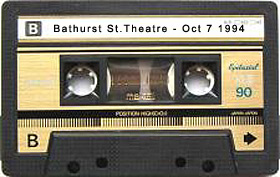
SOUNDTRACK: RHEOSTATICSBathurst Street Theatre Toronto ON October 7 1994 (1994).
I have been listening to a bunch of the Rheostatics live downloads as of late.

This is one of the first concerts they have available on the Rheostatics Live website (there’s a 1991 show as well).  But what’s especially nice about this one is that it was broadcast (and taped) on the radio, so the sound quality is quite good.

The show is from just before the release of Introducing Happiness, so the band is trying out some of those tracks.

I’ve never seen the band live (and of course, now I never will) but these recordings show how much fun they had live.  They were never afraid to experiment or to make jokes in their chatty sections (original drummer Dave Clark was also a lunatic–it often seemed like he wasn’t taking things seriously at all, and yet he never missed a beat).

The shows from 1996 & 1997 also showcase a lot of these songs too, but having the crisp recording of the radio (and the reasonably short set) makes this a good place to start if you want to hear some Rheostatics live.  Some of those other early shows are recorded in the audience, so the fidelity isn’t always 100%.

All of the shows are available at the Rhesoatics Live site (thanks all contributors).  This show is available here.

[READ: July 27, 2010] “The War Between Sylvania and Freedonia”

Your enjoyment of this story depend a lot on whether or not you have watched (and enjoyed) the Marx Brothers’ Duck Soup.  The reason is that this is a retelling of Duck Soup–sort of from the perspective of the mayor of Sylvania and sort of from an impartial observer who is on the side of Sylvania, or more specifically, anti-Firefly.

What Coover does is simply present the audacity and insanity of Groucho’s character, Rufus T. Firefly, as if it were a historical account.  Any reasonable person could see what a terrible mayor he would make.  And this accounts for the amusement in the story. (more…)

Read Full Post »

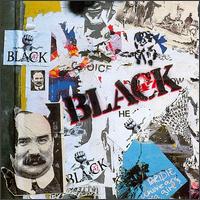
SOUNDTRACK: BLACK 47-ep (1992).

The name Black 47 comes from the Irish famine (and it’s mentioned in Episode 12 of Ulysses.  I saw Black 47 on tour in Boston just before this EP came out.  They played a fantastic live set and had a ton of energy.  I was really excited to ge the EP.  And I liked it very much.

Then I got a new roommate who was from Ireland, staying in the US for school.  And man did he hate Black 47.  He hated the “fiddle dee diddle dee” and the “Bridie!” and oh so much about the band.   And now when I listen to it I hear all of his complaints and I like the disc a bit less.

It’s true, the single “Funky Ceili” is pretty over the top with the Irishyness, and having a chorus of fiddle dee diddle dee didley dee is kind of obnoxious.  But the song still stands pretty strong.

I am much more taken with “James Connolly” a rousing rocker with historical awareness.  I can do without the over-earnest bit about “Lily” but the rest is pretty great.

Overall the disc has a bit too much in the wailing saxophone department.  I don’t dislike the saxophone in general, but there’s a bit too much of it on here.  Larry Kirwan’s voice tends to veer into some weird whiny territory (once or twice I thought he sounded like Robert Smith), but his main singing voice is just fine, especially when he’s rocking out.

The band is still playing today and in fact released an album this year, although I haven’t listened to them much since the 90s.

[READ: Week of August 2, 2010] Ulysses: Episodes 10-12

Much like last week’s reading I really didn’t enjoy this week’s very much on the first read through.  On my second skim through the chapters, I got a lot more out of it.  It feels like there’s a lot of “noise” in the chapters–he’s including little bits of everything–but if you can cut through the chatter, you can find the meat.

Episode 10, which was from many different perspectives, was a nice break in the stream of consciousness.  But Episode 11 was a dry slog about music and Episode 12, while often kind of funny was (I assume deliberately) long-winded with many man lists and all kinds of esoterica about Ireland. (more…)

Read Full Post »

SOUNDTRACKRUSH-“La Villa Strangiato” (from Rush: Beyond the Lighted Stage) (2010).

In the bonus features of the DVD for Rush: Beyond the Lighted Stage, we see (in addition to some awesome live footage of Rush in 1974 with original drummer John Rutsey) a fantastic live clip of Rush playing “La Villa Strangiato,” one of the best instrumentals around.

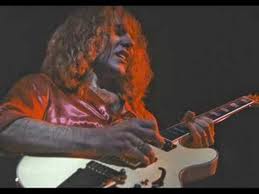
The camera angle focuses mainly on Alex Lifeson.  And man does he rock!

It’s common knowledge, even among Rush haters, that Geddy Lee and Neil Peart are (or at least were) always at the top of the list of “Best” bassist and drummer respectively.  And yup, they are pretty amazing.  But this has always left Alex in the shadows.

Admittedly, there are thousands of great, amazing, ear melting guitarists.  And, typically, the bassist and drummer are kind of dull, so it makes sense that Alex’s playing is in the shadows of the other two.  But I fear that he is often labelled as just not very good.

This video should totally prove that suggestion incorrect.  He plays quickly and with amazing accuracy, in a multitude of styles.

And speaking of the movie, I always wondered if their families minded that Alex and Geddy changed their names for the band (it’s never addressed in the film). It seems like a weird thing to have done circa 1974 in Canada, although Kiss did the same thing at the time in New York (removing the Jewishness of their names).  I just love the name Živojinović, and it’s a shame it’s not better known.  (Huh, although Wikipedia tells me that Lifeson is a sort of literal translation of Živojinović.  Who knew?)

[READ: July 29, 2010] “Grokking Rush”

Since Rush has been everywhere lately, I figured I’d mention this recent article in The Believer.  There’s nothing terribly new in the article.  In fact, it seems like something of an introduction to the uninitiated, giving a basic history of the band and their lyrical themes.

The only thing I didn’t know, which is teased out in the subtitle, was that so many academic papers have been written about the band. Dissertation titles include “Permanent Changes: Rush, Musicians’ Rock, and the Progressive Post-Counter-Culture” and “Grand Designs: A Musical, Social and Ethnographic Study of Rush.”  They have also been written about in The Journal of American and Comparative Cultures and Popular Music and Society.  And, they are the only band ever to be cited in the Journal of Ayn Rand Studies. (more…)

Read Full Post »

SOUNDTRACK: WOODY GUTHRIE-This Land is Your Land: The Asch Recordings Vol 1 (1997).

Protesters don’t get more powerful or more emblematic than Woody Guthrie (if nothing else, he should be forever thanked for “This Land is Your Land”).   Some of his other great political songs are “Lindbergh” (“Now Lindy tried to join the army, but they wouldn’t let ‘im in,/’Fraid he’d sell to Hitler a few more million men”).  There’ also the silly on the surface “Do Re Mi” which holds a deeper meaning: “They think they’re goin’ to a sugar bowl, but here’s what they find/Now, the police at the port of entry say,”You’re number fourteen thousand for today.”/ Oh, if you ain’t got the do re mi, folks, you ain’t got the do re mi,/Why, you better go back to beautiful Texas, Oklahoma, Kansas, Georgia, Tennessee.”

He also introduced a wider world to his “Talkin’ Blues” which were influential on Bob Dylan among others.

The thing that I didn’t know about him was that he wrote so many “silly” songs.  “Car Song” features some car engine noises (as done by a three-year old) as a verse.  “Why Oh Why” which is a nonsensical call and response song: “Why don’t you answer my questions?/Why, oh why, oh why?/’Cause I don’t know the answers.
Goodbye goodbye goodbye.” And “Talking Hard Work” is a pretty hilarious look at how hard it is to do nothing.

The only thing I don’t particularly care for on this disc is, well, Woody’s voice.  I’ve listened to this disc many times, and I have grown to appreciate it, but it was quite a shock to hear his reedy, unpolished voice and how tinny the recording it.  Don’t get me wrong, it’s great that this music is available to hear, but don’t expect 21st (or even mid-20th) century production or anything.

Here’s a verse that most people don’t know from “This Land is Your Land”

There was a big high wall/there that tried to stop me/The sign was painted; said “Private Property”/But on the back side it didn’t say nothing/This land was made for you and me

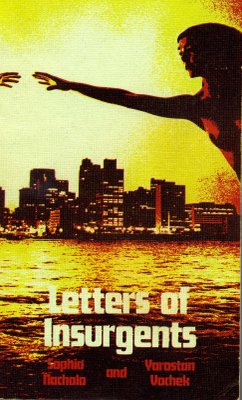
[READ: Week of July 23, 2010] Letters of Insurgents [Seventh Letters]

Last week, Sophia wrote to Yarostan without having read his letter (which was just as well, as Mirna was pretty far off the deep end).  But Yarostan has received Sophia’s letter and is ready to write back to her.

And he is thrilled that he and Sophia are really in synch with their attitudes and events for once (things have changed a lot for him since he last wrote).

I regret much of what I said in that letter. I now have an opposite admission to make to you.  I was very moved when you said you were waiting for me to walk into your “council office.”  If such an expedition should ever be undertaken, I’ll be the first to volunteer and of course I’ll bring Yara and Mirna along as well as Jasna and Zdenek. I love you, too, Sophia; we all do; you’ve seduced us with your honesty and especially with your modest, almost shy courage (497).

In fact, things are worlds apart in Yarostan’s household.  Mirna was thrilled to get the latest letter and to learn that Sophia was on strike.  But more importantly, Mirna reveals that she herself is on strike, too!  And they will be partying!  Jasna excitedly comments that they are in the same world, separated only by geography.

Zdenek comes over and reads the letter too, but he has a hard time thinking that the unions where Sophia is are the same as unions where they are.  And Mirna jumps all over him, asking if old age is making him conservative.  But Zdenek makes what I think is an excellent point about the postal workers.  Everyone uses the mail, even rebels.  So, sure they should have rights too, but encouraging them to strike doesn’t only harm capitalists. (more…)

Read Full Post »

SOUNDTRACK: SERENA-MANEESH-Serena-Maneesh (2005).

The thing that surprises me most about this band is that they are Norwegian (although I’m not sure why that surprises me).  They have a convoluted past, and I’m still not sure what the name means, but I really like the CD.

So, as I was led to believe, this debut album is parts My Bloody Valentine, but it is much more than that. The opening, “Drain Cosmetics” is another quintessential shoegazery song with male and female vocals over waves of gentle distortion.

The third track “Un-duex” is another fairly gentle track (clocking in at under 2 minutes) with waves of layered distortion competing with each other.  “Candlelighted” is like the opposite of “Un Duex,” a 6-and-a-half minute noise-fest, conflicted guitars and over 3 minutes of instrumental introduction before the gentle wash of vocals come in.

“Beehiver II” continues the noise (and features the loudest vocals so far).  These darker songs certainly owe a debt to Sonic Youth (not that MBV doesn’t but MBV was more wash and less abrasive).  “Her Name is Suicide” slows things down considerably, almost spoiling the flow, but the song is weird enough to be interesting.

“Chorale Lick” returns to SY type noise with squealing guitars.  The final track is a 12-minute song that begins slowly with gentle washes (and vibes?).  By the seven minute mark all the instruments have been dragged out and it’s a noisy attack.  At about 9 minutes the song screeches to a feedback-fuelled halt, but it is quickly followed by a delicate piano coda.

I didn’t enjoy the album when I was listening to it quietly (I was trying to listen at work).  But when I was able to really turn it up it sounded less like a pile of noise and more like intricate uses of noise.  I’m curious to see now what else they have done in the last five years.

[READ: July 27, 2010] “Multiples of Cohen”

This is a fascinating story that begins surprisingly and ends even more surprisingly (and yet very satisfyingly).

It opens with this statement of purpose: “The important fact about Cohen: he did die.”

The story is written from the point of view of Cohen’s cardiologist. Cohen is a hairy-backed, middle-aged man who judges everyone on their fuckability (the first thing he says to his doctor’s wife: “nice rack”; while his nanny has “an okay ass”).  He also has a heart that will not quit.  He passes all of his tests with flying colors and has the stamina of a bull.

So why did he have a heart attack while making a joke about sleeping with someone’s sister?  How had the cardiologist failed him? (more…)

Read Full Post »

SOUNDTRACK: SERENA MANEESH-“Sapphire Eyes” (2005).

I used to keep a list of songs and albums that I would try to find.  On this list was a single or a B-Side by Serena Maneesh.  I’ve lost the list, but someone just donated their debut album to our library.  So I’m excited to check it out.  In the meantime, I found the video for this track so I’ll start there.

For years people waited for the follow up to My Bloody Valentine’s Loveless.  And if David Shields ever does release a disc under that name again, it will be more scrutinized than Chinese Democracy (and possibly less inspired).

So, why not let someone else take up the reigns of shoegazing music some fifteen years later.

This track displays many traits that made MBV so great.  It opens with a slightly distorted female vocalist.  She starts singing before a throbbing bass and noisy, distorted (seemingly backwards) guitars bring in a wall of noise.  But that wall only lasts for a short time before it breaks away and the song builds again, slowly, with more and more parts (the video shows a violin although I can’t hear it).

And then about half way through the song it does what MBV always made me do, pick up my head and go, yes, this is great.  A mildly distorted amazingly catchy bridge peeks out through the noise and grabs on to you.  Then more noise and a little backwards vocals and its over.

Other reviews of the album suggest that this isn’t the only kind of music they play, that they are also heavier and darker; I’m looking forward to the rest of the disc.   First impressions (five years late) are very good here.  Check it out here.

[READ: June 25, 2010] A Reader’s Guide

Despite my fondness for Infinite Jest, I had not read any of the supplementary books about it.  I’d heard of them, of course, but I didn’t feel compelled to get any of them.  Then I saw that this one was very cheap.  And I decided to get Elegant Complexity while I was at it (a few cents to the Fantods).  Complexity is a big honking book, and I don’t have time for it right now, but this reader’s guide is very short and a very quick read.

I had an idea of what to expect from the book, but I didn’t really know who the intended audience was.  So, I was very surprised to see the way it was set up.  The first chapter is a biographical account of DFW including his place in the new writers anti-ironic camp.  It was a good summary but nothing new, and I worried about what I had just bought. (more…)

Read Full Post »

On July 25, I reached 90,000 hits.
It took me seven months to get from 60,000 (Dec 25, 2009) to 90,000.
It took me nine months to get my first 30,000 hits.

There are some obvious contributing factors to this improvement (not the least of which is links from referrers that make absolutely no sense whatsoever (and which are pretty clearly spam, but hey, numbers are numbers, right?)  But the most obvious is the huge outcry at the failure of Scholastic to continue publishing the Ulysses Moore series.

If you Google “Ulysses Moore” I am the first post (after the official Scholastic site, Amazon, and fantasticfiction).  I have received so many comments from people who are frustrated that the can’t finish the series. It is amazing that so many voices are ignored.  As you can see, this series has garnered me 4020 views.

At 60,000 views I posted some theories as to why I thought these posts were so successful.  Since very little has changed (mostly just a little shuffle of the top ten), I won’t bother repeating that.  But, there is one post (see the bottom, hee hee) which has absolutely skyrocketed in just a few short months.

1. 4020 views posted April 25, 2009 [was #1 at 60,000: 1663 views]
Pierdomenico Baccalario–Ulysses Moore series Books 1-4
SOUNDTRACK: PEARL JAM-Vitalogy (more…)

Read Full Post »

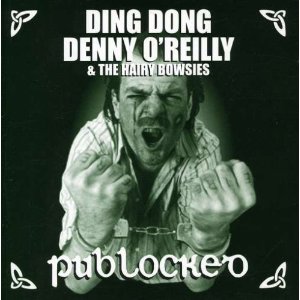
SOUNDTRACK: DING DONG DENNY O’REILLY & THE HAIRY BOWSIES-publocked (1996).

My friend Lar introduced me to this ol’fella (he may have even sent me this CD, as I can’t imagine where I’d have found it on my own).

Ding Dong Denny is the alter ego of Paul Woodfull (who created the Joshua Trio a U2 tribute/pisspull).  And, as I know precious little else about the man, I’ll let the more enlightened pass along the details.

Publocked is a lowbrow amalgam of all kinds of Oirish nonsense.  It’s vulgar and crass and often quite funny.  (Some of the bits stand up to repeated listening–the songs more than the chatty bits, although the chatty bits are especially funny).

Take “The Ballad of Jayus Christ” which sounds like a pretty standard simple ballad until you realize what he’s singing:  “Jaysus O Jaysus As cool as bleeding ice…It’s funny you never rode, coz its you I do my shouting for each time I shoot me load.”

But it’s not all blasphemy.  The “single” “Flow River Flow” is a very sensitive track about the benefits and majesty of the sacred waters (with tin whistles and everything): “When I was just a young man, I sit on the river bank  I loved your gentle water so much I’d have a wank”  With the glorious swelling chorus: “Flow river flow, fuck off to the sea, go where you are wanted, to the deserts of Gobi”

True, now, that’s all kind of crass.  But Ding Dong takes a political stance, too. Take “Spit at the Brits.”  “We Spit at the Brits an we showered’em in a lovely shade of green…we spit at the brits, and then they blew us all to smithereens.”

And what Irishman could ignore the Famine.   “The Potatoes Aren’t Looking the Best” is a view of the famine through the eyes of a farmer.  Shite.

Not everything is a winner, “I Get A Round” is a “cover” of “I Get Around.”   The lyrics are changed to reflect being in a pub (get it?).  And “My Heart Gets So Full (You’d Swear I Had Tits)” is pretty funny, especially since it’s played as an oh so serious ballad, but there’s not much in the world that’s funny for 7 minutes.

So, yes, it’s not quite Joyce, but then Joyce does talk about masturbating by the water, so it’s all equal, right?

[READ: Week of July 26, 2010] Ulysses: Episodes 7-9

Before I begin, I want to make sure that everyone has checked out Ulysses Seen.  It’s an illustrated rendition of the book.  The details are exquisite and you’ll no doubt pick up things that weren’t as apparent in the proper text.  The only bad thing I can say about it is that it’s not finished yet.  So far Robert Perry has only completed Episode One, and it sure looks like that took a long time (it’s really stunning); but between the details ion the drawing and the extensive reader’s guide that comes with it, one can perch there for quite a while.

I admit that this week’s slog through Ulysses was rather unpleasant for me.  The three episodes included here were massive doses of stream of consciousness.  I actually found them exhausting to read.  Not to mention, in terms of plot advancement, they’re rather paltry. (more…)

Read Full Post »

Our family visited Washington DC and went to a few museums.  We talked about subscribing to Smithsonian magazine (and getting a membership to the museums), but we put it off.  Then I received an offer in the mail to subscribe to the magazine and get a membership all for $12.  So we did.  And I’m thrilled with the magazine.

I recall subscribing to this magazine many years ago (turns out it was about fifteen years ago) as I distinctly remember reading, savoring and the keeping the September 1995 issue which featured a cover about James Gurney’s Dinotopia.  The cover is still blazed in my memory (even if I can’t find a better picture than this online).

As with many things, I find that as an adult (and a dad) I enjoy this sort of magazine a lot more than I did as a recent college grad.  It was also fascinating to learn in the new 40th anniversary issue that the magazine started not long after I was born.  It’s like we grew up together (but I ignored it for years). (more…)

Read Full Post »

SOUNDTRACK: AVI BUFFALO-“What’s In It For” (2010).

I received an email from Amazon telling me that their top 50 CDs of the year (so far) were online.  The second disc was by Avi Buffalo.  I’d never heard of Avi Buffalo, but they were on Sub Pop, so that’s a good sign.

I was going to listen to a sample, but saw that they had a video for “What’s In It For” on the Avi Buffalo page.

Avi himself looks about 12, which is disconcerting.  But his voice is really angelic (he sounds like one of those high voiced singer like from The Shins or Band of Horses or, indeed like Grant Lee Phillips) In fact, this song could be a B0H outtake.   And as such, that’s a good thing.

I’m not sure just how original the band is, and I’m also not sure if they are tagging onto this high-voiced folkie bandwagon (he doesn’t have a beard at least, so that’s a relief; of course, he may not be old enough to grow one).

A sampling of the rest of the songs shows more diversity than the “single?” indicates.  And, indeed, this looks like a great, quirky summer release.

[READ: July 20, 2010] “The Last Stand of Free Town”

Even though I read all the articles in The Believer, I don’t often talk about them, mostly because they are non-fiction, and I don’t tend to talk about non-fiction articles for whatever reason.

But anyhow, I’m mentioning this because it ties pretty directly to the Insurgent Summer story Letters of Insurgents that I and others are reading.

This article is about the pacifist commune that has existed in Christianshavn (part of Copenhagen, Denmark) since 1971:

That year, a group of squatters overtook an abandoned army base east of Prinsessegade, barricaded the roads, outlawed cars and guns, and created a self-ruling micro-nation in the heart of Copenhagen. They called the eighty-five-acre district Christiania Free Town, drew up a constitution, printed their own currency, banished property ownership, legalized marijuana, and essentially seceded from Denmark. The traditionally liberal Danish government allowed the settlement at first, dubbing Christiania a “social experiment.” Then it spent the next three decades trying to reclaim the area. Thirty-nine years and a dozen eviction notices later, the nine hundred residents of Free Town represent one of the longest-lasting social experiments in modern history.

Note that Christiania was founded in 1971 and Letters is from 1976, so something must have been in the air. (more…)

Read Full Post »

« Newer Posts - Older Posts »