Feeds:
Posts
Comments

Archive for the ‘Authors’ Category

oddduck1SOUNDTRACK: SAM LEE-Tiny Desk Concert #470 (September 11, 2015).

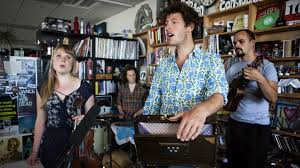
samlee Sam Lee has a fascinating voice, it reminds me of Nick Drake, but more… powerful.  He has Drake’s timbre and somewhat unusual delivery–sort of a stage-ready musical delivery.  But aside from his voice, what makes Lee so interesting is that for these three songs, possibly for all of his songs, he “has dedicated himself to preserving centuries-old folk songs of the U.K. and Ireland, particularly from “outsider” communities like the Roma (Gypsies) and the Scottish and Irish Travelers.   He and his bandmates–ukulele player and vocalist Jon Whitten, violinist and vocalist Flora Curzon, and percussionist and vocalist Josh Green–put these ancient songs in thoroughly 21st-century arrangements that feel creative, fresh and surprising, but also deeply human.”

“Over Yonders Hill” opens with that ukulele and Lee’s voice–I was quite surprised when I first heard it all together, but it works quite well.  And then the fiddle kicks in, playing some lovely swirling solos.  Then Lee adds a tiny harmonium, and that wheezy tone adds perfectly to the feeling that you might be out by a campfire   The song keeps building with backing vocals from the drummer.  As the song nears its end the violinist adds her haunting backing voice to the proceedings.

He explains that he goes around the country recording old singers—the keepers of these old traditional songs.  So the second song, “Lovely Molly” he learned from an old Scots traveler—a song of an old plow boy going to war.  They do this one a cappella and their harmonies are beautiful.

He learned the final song, “Goodbye My Darling” from a horse dealer in Kent–an old gypsy man.  It is about men being sent off to penal servitude in the United States and Australia and the injustice done to those incarcerated.  It is also played on that tiny harmonium which looks like a laptop.  As the harmonium fades away the violin plays a sweet pizzicato melody.  After about three minutes the song kicks into high gear, sounding very much like a traditional song—fast violin and quick rhythm.   And yet as the music grows more alive, the lyrics get darker.  As the song ends he does a kind of whistling hum, which I simply don’t understand, but which adds a delightfully strange texture to the music.

I don’t know that I would seek out Lee’s music, but it’s nice knowing he’s out there.

[READ: March 26, 2016] Odd Duck

I love the First Second Childrens’ books.  They are a little bit odd, but ever so fun.   And Sara Varon is a great illustrator so putting her art on anything makes it enjoyable.

I’ve read a number of Castellucci’s other books, and the two seem like good pair for this story about not quite fitting in.

Theodora is a duck.  She likes things to be regular and consistent.  She goes for a swim at the same time every day, with a tea cup on her head–making sure not to spill a drop.  She always has exact change at the store and looks at the stars every night.

But she is also a little different from the other ducks.  She buys mango salsa (which no one else does), she buys fabric squares and reads books that haven’t been checked out in years. (more…)

Read Full Post »

1993-1994 SOUNDTRACK: LEON BRIDGES-Tiny Desk Concert #469 (September 8, 2015).

leonLeon Bridges has a great old soul voice.  Indeed, I had no idea he was so young until he started speaking after the third song and all manner of young person chat came out of his mouth: “Thanks to my main man, you all looking beautiful man.”  His voice is pure and clean and hearkens back to 1960s soul singers like Sam Cooke.

The way he sings “baby baby baby” in “Coming Home” is classic soul.  And his enunciation of “mouth” is just gorgeous.  This song features the backing vocals of his sister Jesse.

“Smooth Sailin'” features a sax solo and Bridges on guitar.  Since there are 2 guitarists already Bridges’ guitar doesn’t  add much, but for me it’s all about his voice anyhow.

“Twistin’ & Groovin'” is about how his grandparents met.  He says the first time he saw her at a party the thing he noticed first about her was her long legs.

“River” is just him on acoustic guitar with Jesse singing backing vocals.

It’s a solid set and Bridges’ star has continued to rise since this show.

[READ: September 18, 2016]  The Complete Peanuts: 1993-1994

I didn’t like the previous book all that much, but this one picked things up a bit.

The year starts with Snoopy taking a test in school and acing the true false part–the only one to do so!

1993 has Schulz’ first celebration of MLK day.  Patty mentions the “I have a dream speech” but I love that she just mentions it without making it a big deal, it quickly changes to an unfair lunch swap between a carrot stick and french fry.  Speaking of old words, Lucy begins insulting Linus with: blockhead airhead, noodleneck but then finds that these older words work better: puzzlewit, dimbulb.

In pop culture notes, April 1993 sees Snoopy as Joe Grunge and in May 1993 Sally asks why is Barney purple? (more…)

Read Full Post »

varmintsSOUNDTRACK: HANGEDUP & TONY CONRAD-Transit of Venus [091] (2016).

conradHangedUp & Tony Conrad have the third of three discs released as part of Constellation’s Musique Fragile 02 set. From the Constellation site: Transit Of Venus documents this fertile collaboration and includes some enormous slabs of drone rock alongside more decomposed pieces and gorgeously gritty string duos.  [[The performers] recently plunged back into the archives and started shaping an album from the various 2-track and live-mixed [improvisations and] multi-track source material.

“Flying Fast n Furious” has clattering percussion and squeaky violins.  There’s some fast drumming and violin playing in the middle with a great wobbly low bass around.   About 4 minutes in the sounds are almost otherworldly/underwatery.  “Transit Of Venus” has the return of that low wobbly bass—big round fat bass notes that just seem to linger as the drums clatter away.  The sawing violin is a little less interesting than I’d like, however.  “Principles” features a buzzy violin that scratches over the interesting drum pattern.  After a minute or so some strange sounds percolate under the drone.  The sounds are mechanical, organic, (balloons?) digital—unclear.  It’s 8 minutes long and there’s a few moments when the big bass notes come in that are very cool.  In the last minute or so a new violin solo comes out of the din but it doesn’t alter the tone of the song all that much

“Bright Arc Of Light” is 4 minutes of slow bowed and plucked violins.  It’s quite minimal.  “Gentil The Unlucky Astronomer ” is 11 minutes long and it starts with multi layered violins.  It sounds a bit like The Velvet Underground’s “Heroin” and after 2 minute the slow drums come in.  Once the drums enter, the song stays mostly the same—sawing violins and a steady drums with some other occasional percussion.  It’s very droney.  Around 6 minutes things change slightly and the song becomes more insistent.  It continues like this for most of the rest of the song and then ends with some solo violins.  The final track is “Panorama From Maxwell Montes” which opens with some dissonant scratchy violins.  The drums come in and start playing an intersection complex rhythm making this a good album closer.

fragileMusique Fragile Volume 02 is the second in our series of limited-edition, artwork-intensive box sets featuring three full-length albums by three different artists, available on heavyweight vinyl and as a digital bundle. The vinyl set will be limited to 500 hand-numbered copies, lovingly designed and hand-assembled.

[READ: November 1, 2016] Varmints

I really enjoyed the drawing style in this book.  The main characters were cute and cartoony and yet the backgrounds were reasonably realistic looking.  It really conveyed the setting (the old west, I guess) effectively.

However, I had a huge problem with the story.  The book felt like it was part 2, but to the best of my knowledge it isn’t.  There just seemed to be huge gaps in the story that were never filled in.  Not to mention, this is supposed to be a children’s story, but we find out (very late in the story) that the childrens’ mother was killed in cold blood–more or less on a whim.  It’s a shocking piece of violence which I suppose little kids can handle but, woah, what the hell, dude?

The story begins with Opie and Ned in a saloon.  They are young kids, Opie is Ned’s older sister–a joke is made about Opie being a weird name for a girl, but sadly, nothing more comes of that.  Opie is holding her own in a game of cards but Ned is bored and keeps interrupting the game as annoying little brother will do.

Ned says he wants a hat, and since no one will give him one, he climbs a mountain of a man (he’s so tall we can’t see his face and he is wearing a full-sized bear as a cloak of some sort) and takes the hat off of him.  Chaos ensues, the hat flies off (and gets two holes in it) and the kids wind up stealing the giant man’s horse and taking off. (more…)

Read Full Post »

 quirkSOUNDTRACK: PACHA: Affaires Étrangères [CST090] (2012).

pachaPacha has the second of three discs released as part of Constellation’s Musique Fragile 02 set.  Pacha is the solo work of percussionist Pierre-Guy Blanchard and this disc is made of rhythm-heavy instrumentals, propelled by Middle-Eastern synth lines and sprinkled with guitar, bass and oud along with the odd looped field recording. It’s like electronic music with an Arabic pop fixation.  And the instrumentation is really interesting:

“L’Aeroport De Charlo” is mostly thumping drums and a buzzy synth.  There are some synth solos with distinctively Middle Eastern tones.  I like the way the basic rhythm alters throughout the nearly 5 minute track.  About half way through it turns to nearly all percussion a great rumbling drumming with one middle eastern instrument playing over the top (it sounds like a buzzy clarinet).   “Macedonian Mind” has some great, complex drumming behind a simple synth riff.  The music feels slightly menacing as the synths are quite buzzy, but the drums are just a lot of fun.   The middle of the song uses that Middle Eastern sound with a melody line (I can’t tell if its voice or instrument or what) that works perfectly with the main Rockies riff.

“Modern Malaise” opens with a vocal choir, singing while there’s a simultaneous, seemingly unrelated bass line.  And then a very cool funky section with more great drums and a kind of sneaky sounding riff.  As the song progresses some spacey synths enter the song amid a clatter of echoing drums before it all resolves to that initial cool riff.  In “La Gare De Podgorica” slow synths play over some complex drumming with a bunch of what sounds like hand drums.  “Tunel” has some great hand drumming and low droning synths.   And then comes the most middle eastern sounding riff of the disc.  This track is my favorite–catchy and funky with some great hand drumming.  The keys sound very later 60s.

“Ankara” is a fast song with complex hand drumming and an almost drone with vocals samplings, and a lot of the instrument listed below (Omar Dewachi plays saz and oud) and a warbly synth line.   It is one of the longest songs on the disc and has the most going on it.  “Starcevo” opens with some deep hand drums and what sounds like violins or maybe sampled voices or both.  It’s kind of a disconcerting track with the drums the only thing keeping things steady.  “Le Soviet” is played on a bunch of synths with a kind of carnivalesque feel to the sound.  There’s a Middle Eastern riff and some interesting solos that sound almost classical.

From the Constellation site:

Blanchard received a BA in music in 2003, majoring in percussion performance, and then escaped the ‘new music’ trajectory by traveling extensively and immersing himself in Middle Eastern and Balkan traditions, studying under various masters and playing with a wide range of regional groups. During his periods back in Canada he performed as guest percussionist for Black Ox Orkestar … has also performed regularly with Sam Shalabi’s jazz/psych/arabic orchestra Land Of Kush.  … Constellation re-sequenced and remastered the Affaires Étrangères CD-R for vinyl and is proud to be giving this album a more substantial life. It marks Blanchard’ first attempt at a definitive musical statement of his own and we think it succeeds wildly.

.

fragileMusique Fragile Volume 02 is the second in our series of limited-edition, artwork-intensive box sets featuring three full-length albums by three different artists, available on heavyweight vinyl and as a digital bundle. The vinyl set will be limited to 500 hand-numbered copies, lovingly designed and hand-assembled:

[READ: October 31, 2016] Quirk’s Quest 1

This story threw out so much disconnect for me that I never really determined if I liked it.

The artwork is adorable–the characters look like Fraggle Rock creatures–soft and furry with big round ping pong ball eyes.  Even the bad guys (much taller with four eyes) don’t look all that fierce.

And yet.

In the first 30 pages, these monsters kill and eat some of the cute Fraggle Rock creatures. What?!

This book looks ostensibly like a children’s book.  It is really cute.  But the diary entries of the Captain are written in a cursive that even I had a hard time reading (particularly because the captain’s named is Quenterindy Quirk and he is sailing on the H.M.S. Gwaniimander (hard enough to read that, imagine trying to figure it out in cursive!).

So just what’s it about? (more…)

Read Full Post »

decomposSOUNDTRACK: COLIN STETSON & SARAH NEUFELD-Never Were the Way She Was [CST113] (2015).

colinThis is kind of a show offy disc because both Stetson and Neufeld proudly state:  “All songs performed live (no overdubs/loops).”  And so we get Neufeld ’s cycling violin and Stetson’s cycling saxophone playing seemingly endless series of trills and melodies.

Despite Neufeld’s excellence on the instrument, the violin does play a kind of support role to Stetson’s sax (mostly because the sax is louder and more obtrusive).  But while the disc does sound like a Stetson disc, the violin adds some really interesting textures.  The disc opens with “The sun roars into view” and the violin playing a fast two note melody as the sax seems to rise up from the initial static slowly overtaking the song.  About 2 minutes in, the violin plays some loud trills that remind you it’s there, but when the sax quiets a few seconds later, the repetitive violin picks up the melody.  About half way through the 7 minute song the violin soars.   Around five minutes the sax drops away to a single bass note repeated while the violin takes some fanciful runs.  A voice, (not sure whose, but I assume Sarah’s) then soars above the music.

“Won’t be a thing to become” begins with a slow bass melody (with audible sax clicks).  The violin plays a similar melody—slightly different to accentuate the notes.  It’s a shorter piece (only 3 and a half minutes) and these shorter pieces tend to explore quieter moments in an interesting way.  “In the vespers” starts with some fast violin notes once the sax kicks in, it adds a new sense of urgency to the melody.  It’s all very pretty.  The middle turns into rapid fire violin alternating with some noisy sax.  As the song winds down, the fast sax notes continue but a bit more quietly and they are accented by long slow bows of the violin.

“And still they move” is a slow piece.  It’s primarily violin with the occasional sax note adding low end.  It’s barely 3 minutes long.  “With the dark hug of time” stays slow but with some incredibly deep rumbling bass notes underneath the squeaky violin.  It’s a cool and menacing sound.  There is a quiet section near the end which resolves as a low rumble and Stetson’s unusual vocalizations through his sax.

“The rest of us” is a kind of bouncing,thumping song with some high tense violin strings running along it.   I love the part where Stetson “sings” the four note discerning riff and the violin plays along with it—it’s the highlight of the disc for me.  The 8 minute “Never were the way she was” opens with a low rumble and feedbacky sounds.  The melody comes in slowly with some incredibly low notes from the sax.  After about 6 minutes the sax drops out leaving just the bowed violin.  The last two minutes are a pretty, somewhat mournful violin section with the sax providing low bass notes.

Flight is only a minute and a half and it opens with a gentle static/rain and slow notes.

Given these two great musicians, I expected a bit more from this.  Either Neufeld really keeping up with Stetson (rather than accompanying him, which i what it feels like) or perhaps Stetson playing differently to accommodate someone else.  I suspect I have just been spoiled by their other works to expect something mind blowing.

[READ: February 15, 2016] Princess Decomposia and Count Spatula

I have really enjoyed Andi Watson’s work in the past.  I haven’t read much from him lately, but when I was really into graphic novels twenty years ago, he was an artist I would always gravitate towards.

This is his first book for First Second (he used to do a lot of his books for Oni Pres).  It’s a romance (like many of his stories) but with a twist.

The story is set in the underworld.  Princess Decomposia is the overworked daughter of King Wulfrun.  The kind is old and infirm and never gets out of bed.  Indeed, he won’t even eat, declaring that any food is too much for his poor stomach.  Of course, he reads Wellness Weekly to get new ideas for broths to eat–but he never likes them.

Since he never gets out of his bed that leaves the Princes to do all of his diplomatic work.

She meets with the lycanthrope delegation and almost has a disaster on her hands because her father has fired the chef.  But when they see uncooked meat the werewolves are quite pleased. (more…)

Read Full Post »

margoSOUNDTRACK: COLIN STETSON-New History Warfare Vol. 3: To See More Light [CST092] (2013).

stetson3 After the raucous wildness of Stetson’s Vol. 2, I wasn’t expecting the first song to be so gentle.  Justin Vernon sings (with many layers of processing) the rather pretty opening track.  When I first heard it I didn’t like it—I wanted Stetson to do Stetson and it seemed like the track was all voice (nad very different from Stetson).  But Stetson is there, and he plays his normal unceasing melodies behind the voices.  The track seems especially light since it is followed by the aggressive “Hunted” which prominently features Stetson’s “voice” (he has a microphone on his throat or something to pick up his grunts), making an almost growling noise as he plays.   It’s worth repeating that Stetson does circular breathing, is able to play nonstop and can somehow to play different things at the same time (no overdubs) as well as vocalize in interesting ways.  You can also hear him taking breaths while he platys—the breaths are part of the percussive nature of his playing. It’s pretty amazing.  About four minutes in, the tone changes a bit, becoming a little sharper which seems to make the growl even more pronounced.

“High Above A Grey Green Sea” is a quieter song with more vocalizing, but this one feels mournful and lonely as opposed to intense and scary.  “In Mirrors” opens with a deep breath as he plays a slow quiet 90 second song full of unexpected high notes.

“Brute” is appropriately named as it sounds like he is forcing the song out of his sax.  He places mics on his sax so you can hear the clacking of the keys.  And that is readily apparent on this song which is full of clacking and clicking and grunting all the way.  After about a minute, a discordant melody comes in and establishes a tone that plays or a few bars until Justin Vernon returns, but this time with growled words.  It’s a pretty intense and rather scary track—and nothing like Bon Iver at all.

“Among The Sef (Righteous II)” is a brighter song—higher notes played in a very fast style.  There are some vocalized melodies as well.  But the main song is a rolling series of high notes.  “Who The Waves Are Roaring For (Hunted II)” opens with an interesting vocalized melody—he is really using that technique a lot on this record.  It also featured Justin Vernon.  “To See More Light” opens with slow echoed notes as he begins to build a melody out of a four note string.  He starts adding more and more notes.  The melody grows faster and faster until about five minutes when it starts to really slow down—dramatically so.  Around 7 minutes in, the song slows to a crawl, almost drunkenly it seems.  And the song feels like it has ended.  But Stetson has more on his mind.  The notes are held longer and shift more slowly.   Then the song starts to build up again with a different 4-note pattern that adds some squeaky feedback notes and then a catchy melody.  All 15 minute of this song done nonstop, pretty impressive.

“What Are They Doing In Heaven Today?” begins with voices from Vernon (in a softer voice than we’ve come to expect) as he sings a verse before the sax comes in.  “Bed” features some loud key clacking a great rhythmic pattern and some quiet notes from both the sax and his voice.

The final song is “Part Of Me Apart From You.” It really emphasize his “singing” the melody in his throat while playing the repeating lines on the sax.   The song seems to emphasize the lower notes in this song even as he “sings” higher notes.

[READ:October 20, 2016] The Creepy Case Files of Margo Maloo

The title of this book implies that it is a series, and I rather hope it is.  I loved the premise of this book.  Most of the characters were interesting and the mystery behind Margo herself was really cool.

I didn’t love Weing’s drawing style, though.  It really never resonated with me at all, and at times I found it off-putting.  Which is a shame since the story is so fun.

Charles is moving to Echo City and he hates it.  His mom tries to convince him that big cities are fun.  Plus, his dad is fixing up a big old hotel and they get to live there for free (suspension of disbelief there).  There are already some people living there, too.

Charles’ dad is hip and cool (he is seen with Dead Kennedys and Black Flag logo tattoos).  All of the things that Charles finds creepy about the place, his dad calls “character.”   Like the giant chandelier that was in a closet.  Whatever his dad says, Charles’s comment is simply, “This place is definitely haunted.” (more…)

Read Full Post »

peanuts-10991SOUNDTRACK: CHRIS STAPLETON-Tiny Desk Concert #484 (November 5, 2015).

chrisChris Stapleton is a big dude with a big beard and long hair.  He could be a heavy metal guy, but put a cowboy hat on him and you know exactly what his music is going to sound like–slow with an almost mumbling drawl (although his lyrics are quite clear).

The blurb says that his songs are timeless and in a way they are–I wouldn’t know if these songs were old country songs or new country songs, but that’s probably because I don’t much like country songs anyway.

“More of You” is a slow song in which he is joined by his wife Morgane on harmony vocals.  The song is fine.  But I was surprised by how funny he was when it was over and he asked, “When did DC turn into Louisiana?  It’s hot!”

“When The Stars Come Out” was cowritten with Dan Wilson but it doesn’t quite have Wilson’s super catchiness.

He is playing a beat up guitar that he says is 12 years old.  He doesn’t know where it came from, but he says he thinks someone has even used it as a canoe paddle and it has mud in it.  He says he has lots of guitars and his wife says Lots and Lots.

“Whiskey and You” is a song about, big surprise, drinking.  Lyrically it’s kind of funny, despite its intentional sadness.

[READ: September 14, 2016] The Complete Peanuts 1991-1992

I was trying to figure out when the last original Peanuts strip I’d ever read was written.  I stopped reading newspapers in college.  But I’m sure I came across Peanuts once in a while.  My dad also used to get the papers, and I might have browsed through the comics.  But I have to assume it was sometime around 1992 or 1993 that I stopped looking altogether.

I wonder if Sparky started golfing again as there are a lot of golfing comics this year, including one on April 21 1991 where Snoopy is trying to hit it over a tidal wave.  This is one of those rare Sunday comic that he started doing with what was basically a full-page comic as opposed to several panels.

I also felt that 1991 was not a particularly great year for Peanuts.  We all know that Snoopy loves to be in different characters–and has recently been a surgeon.  Well, in January 1991, Snoopy pretends to be a road flagman.  Not very aspirational.

I loved the Peggy Jean story line from last year.  She finally gets a mentions again in March, but she has moved away. Which means he’s back to pining for the red-haired girl.  I know that the red-haired girl is classic Peanuts, but I really liked Peggy Jean.

But there are some great strips and themes.

I did enjoy that Sally after being steady rebuffed by her sweet Babboo calls herself his Sweet Babbooette.  Later, Sally comes up with a new philosophy.  “I’ve decided to put everything off until the last-minute and to learn everything in life the hard way.”  When Charlie says, “Good luck,” Sally says, “That’s what my teacher said.”

Sally asks Linus what happens if she doesn’t go to school and he tells her the sheriff comes and throws you in a dungeon with no food or water for ten years.  She hates that idea, but then thinks, “if we go to school for 12 years….”

Harriet’s famous recipe for seven minute frosting makes a return in April 1991 with all the birds talking about it.  Man, I should find out what this is.

And there’s a lot of scenes with Snoopy wrangling with Linus’ blankets which I always like.

Joe Garagiola gets some more abuse in May when he makes it into the hall of fame and Lucy says, “It means there’s still hope for us all.”

One thing I have never mentioned is the amount of times Schulz draws or mentions zambonis (and even calls them zucchinis).  I assume someone has collected this information, but he must have really loved the zamboni because boy does it ever make a lot of appearances.  Often times once a week for several weeks.

For something new Sally and Charlie are asked to teach a Bible class to kids, which is kind of fun.  The boy wish they’d gotten a “cute chick” instead of an “old lady” like sally.  And one of the boys keeps talking about the Great Gatsby, “Gatsby stood by the sea of Galilee and picked out the green light at the end of day’s dock.”  The series ends with the kid waving goodbye to her and Snoopy saying “So long, old sport.”

Way back in a previous book Billie Jean King says that whenever Sparky put her name in a strip it meant she should call him.  So in August Snoopy says “I’ve always wanted to call Billie Jean King.”

I enjoy this attitude from Patty: “Hey Marcie its a beautiful summer day  C’mon out and we’ll waste it away doing nothing. Then we can look back upon it and regret it for the rest of our lives.”

When I was a kid I believe I had the same seasonal beliefs as Patty does in Sept 1991: “the four seasons are baseball, football basketball and hockey.”

The football gag in 1991 shows Lucy waving a book about holding the football.  But when she pulls the ball away she tells him that she wrote the book.

Later in the year, Lucy speculates that the Great Pumpkin might be a she  “Never occurred to you, did it?”

As the year ends, Marcie and Patty give Charlie an ultimatum to decide who he likes best.  Of course he hesitates and they walk away.

In January 1992, Spike says that if he had an earache his dad would blow cigar smoke in his ear.  I’d never heard of this, but it is indeed an old wives tale.

Schulz loved having his Peanuts‘ kids read really big books.  And sometimes they were used a lot as punchlines.  But I enjoyed Patty saying A  Tale of Two Cites was written by “Charlie Dickens.  Chuck  Chaz?”  And then when she gives here report she begins “St. Paul and Minneapolis are…” and then we see her sitting next to Marcie who says “One of the great tries of all time, sir.”

Sally continues to be one of my favorite snarky characters.  “Sometimes I worry about you big brother.  Often?  No not often, just sometimes.  Like maybe seldom.  That’s it, seldom!”

Charlie is still being very loving and missing Snoopy.  He tries to get out of school a lot so he can sit with the dog and even worries when it rains.  When he goes away he calls over to where Snoopy is staying and talks on the phone (he says “Woof”) and Snoopy says “Woof? what does that mean?”

Another full-page Sunday strip came on April 19, 1990.  This may be the weirdest, most context-free strip of them all.  Snoopy is looking at a map and the whole page is covered with a gorge and the caption says “Every year thousand of tourists visit Victoria Falls in Zambia.”  Huh?

There are still more Tiny Tots Concerts, Patty still hates to be called a Tiny Tot.  Although she gets excited in May of 1992 because she thinks the new song is called “Hey dude” when it is actually “Etude.”

Pop culture references: in August 1991 someone described being suspended from the bungee cord of life Fried Green Tomatoes is mentioned in April 1992.  Spike does Velcro jumping in July 1992.  After playing some football, Marcie says she could be another Joe Iowa (Montana).

And Sally changed her philosophy from “who cares?” to “what do I care?”

In Summer 1992, Charlie goes to camp and helps out a kid named Cormac, although we don’t see him much after that.

In 1992, Charlie believes that Lucy in sincere about holding the ball.  When he misses, Sally says “You’re not in love with Lucy, are you big brother?”  When he says No, she says, “I should Hope not,  I’ve discovered that love makes us do strange things.  So does stupidity.”

In 1992, Marcie decides to help spread the word about the Great Pumpkin but she calls it the Great Grape.  When she realizes her mistake she says, “I guess it would be hard to carve a scary face in a  grape, wouldn’t it?”

Over the years there have been hundred of jokes about Schroeder’s musical staff and Snoopy either sleeping on it or breaking it or so many other possibilities.  They’ve all been mildly amusing.  I liked in December 1992, when Snoopy takes the notes and uses them as the sound of his bell when he is Santa Claus ringing bells on the street.  Because yes, for the last two years Snoopy has dressed up like Santa Claus on a street corner ringing bells.   I like the one later when Charlie brings snoopy his dinner and a girl says “Hey look, Ma, Santa Claus is eating out of dog dish.”

There’s two Sundays in a row with Sally writing a letter to Samantha Claus.  In the first one, Charlie asks if she goes Ho Ho Ho or just smiles daintily, but the following week we find out that Sally talked about her in school and was roundly mocked.

Spikes Christmases have been pretty sad, but I did get a kick out of this one. “Last year I exchanged a gift with a rock, I think he liked what I bought him…he still wearing it.”  And there’ s funny sequence where Spike puts lights on his tree then walks all the way to Needles to plug it in at the chamber of commerce.  There’s even a news story the next say, “Someone sneaked into the chamber of commerce building last night and plugged in an extension cord.  The cord led out of town somewhere into the dessert.  Everyone is puzzled as to who or why someone would do such a thing.”

Although perhaps the best Christmas joke ever comes in 1992 when Sally is writing her thank you note: “Dear Grandma, Thank you for the money you sent me for Christmas.  I am going to save it for my college education.”  Then she says “It’s hard to write with a straight face.”  And Charlie says, “I never said a word.”

1992 ends with a New Years Eve party at Snoopy’s and he says “What do you mean we’re all out of hors d’oeuvres.

So overall, it’s not a bad two years, there’s just not a ton of noteworthy jokes.

The introduction is by Tom Tomorrow.  He says his influences were Mad magazine, Garry Trudeau and Matt Groening but his earliest inspiration was Charles Schulz.

He says that in the 1960s he hit the perfect sweet spot with Peanuts:  old enough to understand the humor, young enough to truly appreciate the whimsy. When he was a child, he loved the Christmas Special, and he was excited that his parents bought their first color TV in time for its annual airing.  He had also been given a Snoopy astronaut in the year he became the unofficial mascot of Apollo 10.

He describes Peanuts as “a strip that spun heartbreak into wry humor.  A cartoon about childhood anxiety that veered frequently into the realm of magical realism.”

He loves things like that the doghouse was bigger on the inside than the outside (although that aspect has been downplayed in recent years).

When he was a young cartoonist, he wrote to Charles Schulz.  And Schulz invited him over for lunch. Schulz was very generous with his time. “We ate at the cafe adjacent to the skating rink he’d built. The table was always reserved for him and on which you will still find a reserved sign to this day.”

Tomorrow says he wrote the only obituary comic he’d ever done for Schulz and he quotes Schulz: “If I were a better artist, I’d be a painter. And if I were a  better writer, I’d write books.  But I’m not so I draw cartoons.”

Tomorrow addresses his change from the strict four panel strips of his whole career, which I noted with concern and excitement.  Evidently, Schulz always wanted to experiment with the panels, but he was unsure if the Syndicate would allow it.  Tomorrow jokes that at this point in his career, he probably could have demanded a solid gold table and a full complement of chorus girls to entertain him while he worked.

He concludes his introduction by saying that Schulz gave him an original strip–which is the middle strip on page 71 in this book (dated June 14), and what a nice one it is:

“It’s nice to be able to do something for someone once in a while that’s appreciated.”

Read Full Post »

bibSOUNDTRACK: THE BEATLES-Live at the Hollywood Bowl (2016).

beatlesThis disc was released this year.  It is technically the soundtrack to the film Eight Days a Week: The Touring Years.  But regardless of the film, these are newly mastered recordings from two Beatles concerts at the Hollywood Bowl in 1964 and 1965 (which were released in 1977).  This disc has 7 songs from 1965 and 6 from 1964 (not including the four bonus songs).

The concerts were legendary for the shrill screams that the audience made during these shows–so loud that the recordings were practically inaudible and, apparently, even the band members had a hard time hearing each other.  Sounds like a nightmare, frankly.

Well, George Martin’s son has used some technology to make these recordings listenable.  They have reduced the shrill screams to a kind of low-level, high-pitched sound and, even better, they have fleshed out the band so they don’t sound like they are playing in a tin can.

Here’s some fascinating things about that Hollywood Bowl Concerts. Tickets cost $5.50 in 1964 and $3 in 1965.  WHAT?  In 1965, the band played for 33 minutes.  That’s it–not sure how long they played in 1964.

The band had no monitors on stage–those things that musician are always pointing at and asking the mixer to turn up.  So on many shows they couldn’t even hear themselves.  The fact that their harmonies are so good is really impressive.  The notes suggest that the open roof of this show meant that the shrill crowd noise was somewhat dissipated allowing them to hear each other a little better for these shows.

Evidently the track listing for this disc consists of the best original recordings from the two shows.  I’m not sure why they’re not played in sequential order, but whatever.  Perhaps the energy of the opening “Twist and Shout” (all 90 seconds of it) is a pretty great way to start.  While the band is spot on in their playing (sometimes it’s easy to forget that they are laying instruments as well as singing, since the voices are the big thing) you can hear Paul’s voice straining on “Can’t Buy Me Love” (which is cool).  Or John saying he thinks the next song “Things She Said Today” is on the new album over here.  This song–quieter and less dancey sounds pretty great and you can kind of hear the audience paying attention to it, so that when the band gets to the loud part the crowd really erupts.

I’m surprised at how many covers the band plays.  I realize these songs are picked from two set lists, but there are dozens of serious hits that they could have played instead of say “Roll Over Beethoven” or, and this is the most surprising thing to me, ending their 1964 set with “Long Tall Sally” rather than one of their huge hits.

It’s funny how crazy the crowd goes for Ringo when he sings lead on “Boys.”

I enjoy hearing them talk about their films–one we made in black and white, the other in color.  “Hard Days Night” sounds great but even more impressive is “Help!”.  John intros the song by saying, “we’d like to do another film song from a different film–coz we’ve made two.”  “Help!” is really impressive the way the band launches right into their harmonies on that first note–it sounds incredible all the way through the song.  Even when John strains hard at the end.

There’s not a lot of stage banter, but I did enjoy this one from 1964: “This next song is an oldie, some of you older people might remember it.  It’s from last year.  It’s called “She Loves you.”  I like hearing the rocking guitar line more prominently and the fact that they don’t go “ooooh” during the first time it’s supposed to appear, but when they do the next time, the crowd goes nuts.

As the disc ends, Paul asks, “We all hope you enjoyed the show.  Have you enjoyed the show?”  Apparently they have.

I’m not sure why the final four songs are listed as “bonus tracks.”  The inclusion of “I Want to Hold Your Hand” can’t be a bonus!  But the four songs (two from 1964 and two from 1965) also sound great.  The harmonies on “Baby’s in Black” are fantastic.

John Lennon said the fans didn’t come to listen, they came to love.  Regardless, the band played wonderfully and gave a great performance.  It’s nice to be able to hear it.

[READ: March 10, 2016] Baby’s in Black

This story is about The Beatles before they became THE BEATLES.

I didn’t know all that much about the early Beatles.  I knew that they were in Germany (although I don’t really know why, and I still don’t). But I didn’t know about all of the trials and excitements that happened to them there.

What I loved about this story is that while it is about The Beatles, it’s actually about Stuart Sutcliffe and his girlfriend Astrid Kirchherr and their impact on the nascent Beatles.

The story begins with Astrid’s ex boyfriend Klaus Voormann running to Astrid to tell her about this band that he just heard down at the Reeperbahn.  He said they all dressed the same and they really rocked (or whatever they would have called it back then).

The Reeperbahn was sketchy place at the best of times, so it was unlikely that anyone other than sailors and thugs would have seen this band iinitially.  But Klaus was so insistent that Astrid agreed to go.  And she was mesmerized by them.  She was especially taken with bassist Stuart Sutcliffe (although none of the fans knows their names at this point).  The band consisted of John, Paul, George, Pete Best on guitar and Stuart on bass. (more…)

Read Full Post »

klezmerSOUNDTRACK: COLIN STETSON [CST073] “The Righteous Wrath of an Honorable Man” (2010).

stet7This is a 7″ release from Constellation, a kind of single from New History Warfare 2.  It has two tracks, “The righteous wrath of an honorable man” is such a good song that it deserved to be singled out like this.  It’s also amazing how short it is.

Side 2 is called “Judges (Damian Taylor Concretification Mix).”  This is a fascinating track because Taylor has “grabbed samples from throughout the album to create a musique concrète roundup of the entire record!”

It’s a strange listen as he picks certain things and repeats them–sometimes very quickly (like a skip) other times in slow modulations.  And then it just jumps somewhere else–again, like a skip.  There’s some menace and some sirens like sound juxtaposed with thudding bass moments.  And the middle samples all the clicking and banging from the keys on his sax.

I did like how he throws in a few notable riffs into the song but more as a repeated refrain than as part of the overall song.

This track is more interesting than enjoyable.  It’s unlikely to convince anyone of the genius of Stetson, but it’s an interesting listen.

[READ: June 10, 2016] Klezmer

I have read a bunch of books by Sfar because of First Second publishes a lot of his books (although apparently only a small fraction of the hundreds that he has written).  The frustrating thing about this book is that thee are apparently five volumes of this original series but it appears that there is no intention of publishing the rest (it has been ten years since this one came out, after all).

This story is meant to be very loosely based on something, although I’m not exactly clear what.  As with so many other stories, it was translated by Alexis Siegel. (more…)

Read Full Post »

sardine6SOUNDTRACK0 Tonne Seize [CST bonus] (2016).

tonne0 Tonne Seize is a bonus compilation of three tracks each from Off World, Automatiste and Jason Sharp.  The collection is 41 minutes of music (not too shabby) and came with a pre-order of the three records (and is available on Soundcloud as well).

The first three songs are by Off World and the first two of those are remixes.  The original “Wonder Farm” is dominated by popping drum sounds.  There are some other sounds that go through the track but the base is mostly a kind of slow Asian melody.  The “Wonder Farm (Summer Crop)” mix removes those snaps and percussion entirely.  It focuses just on the music, which I have to say is far more enjoyable without the bangs.  “Primitive Streak” is a slow droning piece, while this compilation’s “Primitive Streak (Silver Mix)” doesn’t sound all that different.  It also removes the drums, and highlights the squeaky synth sounds and the overall drone tone.  It seems to emphasize and de-emphasize different instruments but otherwise sounds pretty similar. The final track  “Lost Meadow” is a pretty, delicate piano based piece with some twinkling of spacey synth notes.  It’s easily the prettiest piece.

The three Automatiste tracks do not quite follow the same naming convention as the actual disc, although the first track is called “Simultanéité 5.” It has slow beats and is basically two-note washes building on top of each other.  “Fragments continus” is a noisy piece with layered thudding drums (like heartbeats especially around the 1 minute mark) and drone noises that wash in and out.   About half way through what sounds like a melody appears amid the din, but it feels like it formed organically around the synths and drums which is pretty cool.   “Le Silence 3” opens with some jackhammer sounding drums and then almost easy listening synths.  The juxtaposition is interesting and by the end the song feels nicely dancey.

The final three songs are from Jason Sharp.  These three are quite different from his album because they really feature the saxophone to a larger degree.  “Plummeting Veins” opens with a heartbeat and some rumbling sax (that sounds like the opening of the Speed Racer TV show).   This track is under 2 minutes, the shortest he’s done by far, and the way the heartbeat speeds up as the sax plays some low rumbling notes is pretty cool. “Hear a Fading Cry” is a much longer number.  The heartbeat is quieter but the sax is much louder.  It sounds a lot like Colin Stetson in the low rumbling and noisy barking that the bass sax can produce.  It ends with some rather high-pitched squeaky sounds that I assume come from the sax, but which I can’t imagine coming from such a bass instrument.  It’s 7 minutes long although it takes almost 2 minutes to really get going.  And it swerves between loud and rumbling and then sort of menacing by the end,  “Ride On Into the Sweetening Dark” is perhaps the most conventional of Sharp’s songs.  It is a series of sax solo lines over a gentle tinkling backing drone.  Some of the solos lead to noisy wailing, but for the most part the line are pretty and jazzy.

It’s interesting how different these bonus tracks tend to be from the actual releases.  I enjoyed listening to these variants to see what else these artists are capable of.

[READ: April 9, 2016] Sardine in Outer Space 6

Sardine is a children’s book published by First Second.  It was originally published in France (and in French) and was translated by Sasha Watson.  There are six Sardine books out.

The inner flap says “No Grownups Allowed (Unless they’re pirates or space adventurers).”  This is the final Sardine book.  And while I didn’t enjoy the first book much, by now I’m sorry to see the series end.

This book also has the fewest stories in it (only 9). (more…)

Read Full Post »

« Newer Posts - Older Posts »