Feeds:
Posts
Comments

Archive for the ‘David Foster Wallace’ Category

flesh

SOUNDTRACK: SIGUR RÓS-Von (1997).

von

This is Sigur Rós’ debut album. It is a far cry from the gorgeousness that their later albums would bring.  In fact it is primarily an excuse for washes of songs, trippy sound effects, otherworldly vocals and the occasional song.  You can hear elements of that later Sigur Rós, but for the most part this is some pretty simple space rock.

 “Sigur Rós” opens the album with spacey sounds and a distant hi hat.  It’s a series of swirling notes and waves of chords for 9 minutes.  Some vocals (okay screams) come in around 6 minutes making it a bit more scary than trippy.  It morphs into “Dögun”which is closer to the famed Sigur Rós sound–swirls of notes and ethereal voices.  At 3 minutes some really distant crazy voices start singing as most of the music drops away. “Hún Jörð …”   brings some beats (backwards) until the song proper starts.  There are two vocals singing high swooning sounds over a simple bass (two note) melody and drums.  It’s a very simple song but especially after 12 minutes of space music that preceded it, it really coalesces as a song.  And when the band crashes in and the drums start pounding (a great build up) the album really hits its stride.  It’s a pretty great precursor to their later great songs and the studio trickery at the end of the song (making it go backwards) is pretty fun too.

“Leit að lífi” is a 3 minute song of spacey noodling. maybe backwards guitar and theremin.  “Myrkur” reintroduces some bass guitar (this actually sounds like a riff from an 80s alt rock band). It may be their most conventional song.  “18 sekúndur fyrir sólarupprás” is 18 seconds of silence.  “Hafssól” is a trippy swirly song with waves of music and distant voices for over 12 minutes.  “Veröld ný og óð” is mostly percussion, which then morphs into people talking and laughing.

Title tack “Von” also begins with percussion, but in a more song oriented way.  The vocals also come in nicely in the mix letting you know that a proper song is coming–although it stays very spacey and fragile.  “Mistur” is only 2 minutes of percussion.  “Syndir Guðs (Opinberun frelsarans)”  has a simple bassline with trippy squeaky guitars and whispered vocals.  For 7 minutes.  It’s simple and repetitive but very enjoyable.  The final track “Rukrym”  is six minutes of silence and then “Myrkur” played backwards.

Never reaching the heights of their later albums, this does give a glimpse into what they might get up to.  However, it mostly feels like early trippy Pink Floyd.

[READ: November 27, 2013] Both Flesh and Not

Sarah got me this book for Christmas last year.  I had intended to read it but I realized that I had read all of the essays individually before, so it became a lower priority.  The only thing in the book that is “new” is the list of DFW’s definitions of words that he saved on his computer.  Before each essay there is an alphabetical list of words he found interesting with their definitions (and some annotations).  They help you appreciate the kinds of things he was interested in and the complexity of words.  It’s pretty cool.  I particularly liked: “muntin–strip of wood or metal that separates & holds various panes in a window, like a window w/four individual panes arranged in a big rectangle etc (that’s putting it well Dave).

But when I recently read Wittgenstein’s Mistress, I decided to reread his essay, so i looked in the book.  And it all spiraled from there–so much that I’m going to compare the book versions to the original articles next week.

And but so, this is a very enjoyable collection of essays. The essays are arranged chronologically from 1988-2007 (except for the first article which gives the book its title and is a great opener, but which I argue is the one that should be read after a different essay).  There’s a couple of essays on tennis, some book reviews, some essays about writing, and some thoughts on the (then) current political climate.  Nothing is too too academic (well, a couple are), and while many of the stories do come from DFW’s younger writing days when he was a little pedantic, his later ones are a lot of fun (and his love for tennis is palpable). (more…)

Read Full Post »

contficSOUNDTRACKTHAO NGUYEN-Tiny Desk Concert #5 (September 4, 2008).

thaoI had never heard of Thao Ngyuen (who admits that her last name is a phonetic disaster–it’s pronounced When) before this concert and man is she a lot of fun.

  She plays a great acoustic guitar—very percussive on the strings (and even some percussive noises from her mouth before the first song starts).  Her voice is a strange mix of a few singers, reminding me a bit of Björk (but with a kind of Southern sounding accent) and maybe Beth Orton, if Beth was a bit more excited.   Thao plays her guitar very loosely—a kind of sloppiness that is really fun—but not in a “she can’t really play” way.  It’s an I’m having a lot of fun style.

NPR dude Mike Katzif heard her band Get Down Stay Down opening for another band.  And he loved her off-kilter melodies (which are ample).  “Bag of Hammers” is played on the high strings and it has an almost Caribbean feel—boppy and fun and totally made for dancing. Her guitar playing is very fast strumming, especially on “Beat (Health, Life and Fire),” I love watching the chords she is playing up and down the neck of the guitar.

I really enjoyed the conceit of “Big Kid Table” and the Hawaiian vibe she gets from her guitar.  “Feet Asleep” brings out a bit more of a country vibe from her singing (she is from Virginia).  I love the diversity of her music and I’m looking forward to checking out both her band and her solo work. In addition to being a great singer and songwriter, she is also quite funny—the story about her grandma and her calves is very funny indeed.

This continues the greatness of the Tiny Desk concerts.

[READ: November 14, 2013]  “The Empty Plenum”

The reason I got involved with Wittgenstein’s Halloween was because David Foster Wallace had said Wittgenstein’s Mistress was one of the best books of the 1990s.

The whole list is on Salon, but here’s the quote about WM:

“Wittgenstein’s Mistress” by David Markson (1988)
“W’s M” is a dramatic rendering of what it would be like to live in the sort of universe described by logical atomism. A monologue, formally very odd, mostly one-sentence ¶s. Tied with “Omensetter’s Luck” for the all-time best U.S. book about human loneliness. These wouldnt constitute ringing endorsements if they didnt happen all to be simultaneously true — i.e., that a novel this abstract and erudite and avant-garde that could also be so moving makes “Wittgenstein’s Mistress” pretty much the high point of experimental fiction in this country.

I had also read his review of the book before [I copy everything I said then below].  I admit I didn’t get that much out of it before because it was mostly about Wittgenstein and a book I hadn’t read.  Well, now that I’ve read the Markson book, it seemed like a good time to revisit the review.

Two things strike me immediately–this was written after Wallace had written Broom of the System and some other fiction and yet he speaks of himself as a “would-be writer,” not a writer.  And two, this review really belongs in a philosophy journal rather than a literary journal–DFW was making the jump from philosophy to literature, but his knowledge of philosophy is very strong, so he is focusing on that aspect of the story. (more…)

Read Full Post »

witmisSOUNDTRACK: NEIL HALSTED-“Wittgenstein’s Arm” (2012).

neil-halstead-palindrome-hunches-450Halsted was a founder of the band Slowdive, who I knew somewhat.  I don’t know anything of his solo work, although his name rang a little familiar.

This is a very pretty, slow acoustic ballad.  Halsted’s voice is whispery and with proper folk inflections. The chorus has a very catchy melody.  And yet the lyrics are really dark and sad.

And while there is a mention of an arm in the song, there’s no mention of Wittgenstein.

You can check out the video here:

[READ: November 3, 2013] Wittgenstein’s Mistress p. 181-end

This peculiar book draws to a close in much the same way that it started. There are a few interesting revelations or, if not revelations, then perhaps ponderables as to the nature of just what our narrator (who is apparently named Helen) is doing.

As this last section opens, she is revisiting some more of the things that have been on her mind for the book—the waterlogged atlas that lies flat on the shelf and that blasted arthritic should/ankle  .

I have been wondering about her constant references to her period.  In addition to simply being something that happens to her which she is recording, I have to wonder if it is a nod to her fertility and the fact that since she is the last person alive she will never bear children.  On a slightly related note, I also have to wonder if her focus on rape means she was once raped.  It’s not necessarily the case of course, but there is a lot of it in the book, like this next mention: (more…)

Read Full Post »

lou_reed-620x412 SOUNDTRACK: LOU REED-Metal Machine Music (1975).

mmmfrom Wikipedia:

Metal Machine Music is generally considered to be either a joke, a grudging fulfillment of a contractual obligation, or an early example of noise music. The album features no songs or even recognizably structured compositions, eschewing melody and rhythm for an hour of over-modulated feedback and guitar effects, intricately mixed at varying speeds by Reed himself. In the album’s liner notes he claimed to have invented heavy metal and asserted that Metal Machine Music was the ultimate conclusion of that genre.

I don’t know how many people have actually listened to this album all the way through.  There are four 16-minute tracks.  Each one is, on the surface, exactly the same: feedback and more feedback.  In truth, the album is a bit more complicated than that.

There is a guitar in the left speaker and a guitar in the right speaker and each one is feedbacking in very different ways.  Indeed, if you listen to only one speaker at a time, you get a very different experience (I haven’t done that with the whole album, although that’s only because I really only found out about that recently, I did for a few minutes and it was pretty fascinating).

And fascinating is what this release is.  It was unlistenable in 1975, there is no question.  Just as something like Slayer would have been unlistenable in 1975.  But twenty years later, when Sonic Youth was riding high, Metal Machine Music seemed a lot less outrageous (indeed, their 1998 release Silver Sessions was essentially the same structure of feedback).

And now MMM seems very forward thinking.  Whether or not it was a joke or some kind of payback to the label or whatever (liner notes suggest he just really enjoyed enveloping himself in feedback), it’s a remarkable record.  If you can actually sit through it, there are some really interesting moments in it.  There are times when the squall and noise turns eerily beautiful, when the ringing notes take on chime-like status.

And unlike the aforementioned SY album in which they just turned up their amps and left, it sounds like Reed was actually hanging around and manipulating the sound.  You can hear times when new notes/strumming comes in and changes the mood.  And of course, Reed had to edit it for the album.

One of the more interesting moments comes right at the end of the disc.  On the vinyl release, he made a locked groove so the final rotation would keep repeating over and over until you had to get up and manually lift the needle (as if the album wasn’t difficult enough).  On the CD, they repeat that section for about a minute.  And that little repeated section is noteworthy for the rough distorted guitar and chiming feedback that all sounds very cool.

All of this is not to say that this album is enjoyable.  It’s really not.  It’s brutal and harsh and best handled in small doses (even Reed admits that in the notes).  But it is noteworthy and fascinating.  And it may have inspired as many feedback based bands as the Velvet Underground inspired droning bands.

[READ: November 2, 2013] “I loved Lou Reed more than you”

I was sad at the passing of Lou Reed, although I’ve never been a huge fan.  But of all of the eulogies, I knew that Neal Pollack would write the best one.

Neal Pollock is a wonderfully pompous “character” (who is the main character in most of the writing of his that I have read).  This article—while much briefer than most of Pollack’s short pieces—is an honest eulogy of Reed, but is also a hilariously over the top profession of fandom.

When Pollock heard the news of Reed’s death, he was polishing the acetate of his producer’s cut of Metal Machine Music.  He wept, mostly for himself but also “on behalf of all cultured people everywhere.” (more…)

Read Full Post »

harper septSOUNDTRACK: LINDA THOMPSON-“Love’s for Babies and Fools” (2013).

lindaAfter two pop songs, here’s a major bummer from Linda Thompson.  Thompson is a fascinating figure.  She was married to Richard Thompson and made many albums with him.  They split very acrimoniously and them Linda suffered from psychogenic dysphonia, which rendered her incapable of singing.  She stopped singing for 11 years.  Now with botox injections into her throat she can sing again, but cannot perform live. She released an album n 2002 (Richard played guitar on a track) and another album in 2007.  Now’s she’s back and Richard plays on this song as well.

In the grand tradition of folk music, Linda’s lyrics are achingly straightforward and powerful:

My father is a traveler, he has a cuckold’s luck,  my mother is a queen but her hands are tied with blood. I’ve a brother in the graveyard, my sister has the blues.  I care only for myself.  Love’s for babies and fools.

The guitar work is beautiful, the song itself is beautiful and depressing at the same time.

Linda’s voice has always been unique—almost otherworldly and yet ordinary at the same time.  It’s strange and mesmerizing.  Welcome back Linda.

[READ: October 1, 2013] “A Different Kind of Father”

This is an excerpt from a new book by Franzen. The book itself is fascinating.  It is a translation of a “Nestroy and Posterity” a somewhat obscure essay from 1912 by the Austrian satirist Karl Kraus.  Franzen’s book is called The Kraus Project and in addition to the translation, Franzen includes a ton of footnotes that are all personal, like this one.  The book is 300 some pages and it sounds like the majority of it is footnotes.  [For those who like to keep track of Franzen’s connections to David Foster Wallace, of course this collection with footnotes does make one think of DFW.  Interestingly, Franzen talks about a book he was writing in 1981 (long before he met DFW which had a main character whose name was Wallace Wallace Wallace].

This footnote (no context is given) is all about the concept of thriving as a man by surpassing your father.  Be that literal or figurative (or literary).  In the case of Kraus, Franzen says, he is denying false paternity.  It was believed that Kraus was the literary son of Heinrich Heine, but Kraus tries to annihilate Heine by dismissing his successes and impugning his character.  However, Johann Nestroy was also a precursor to Kraus but Nestroy was a somewhat neglected and undervalued one, and so Kraus seeks to place Nestroy as his surrogate father. (more…)

Read Full Post »

aug2013SOUNDTRACK: JIM GUTHRIE-Tiny Desk Concert #294 (August 10, 2013).

jimgI was unfamiliar with Guthrie before this set and I almost didn’t play it because of his mustache–he just looks so country to me.  But then I read that he and his band drove 9 hours from Ontario just to do the show (which is 11 minutes long, so that’s pretty crazy).  But the set is really good.

The three songs come from Guthrie’s new album Takes Time (his first solo album in ten years).  And I was hooked…not right from the start, but 15 seconds into “The Difference a Day makes” when the guitar plays the chorus riff.  There is something so… Canadian about the melody line.  It reminds me of Neil Young, Sloan, Rheostatics, even Kathleen Edwards, all of these great Canadian songwriters who play with slightly different melodies.  The fact that he sings “doubt” and “out” with an Ontario accent solidifies it.  It’s one of my favorite mellow songs of the year.  “Before & After” sounds a bit like  Barenaked Ladies mellow song, like something  written by Kevin Hearn.  I tend to not like the Hearn songs, but I thin kit’s that I don’t like Hearn’s voice, because I like this song quite a lot.

Guthrie has a delicate but strong voice–I can’t imagine him screaming, but he conveys a lot.  Especially in the final song, the more mellow (and minor key) “Like a Lake.”  I’ve heard Tiny Desk shows that go on for five or six songs.  I wish that Bob and Robin had let them play for ten more minutes. Now I’m off to find his records.  Check it out.

[READ: September 10, 2013] 3 book reviews

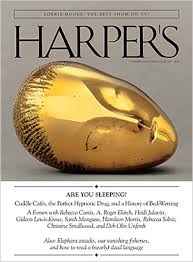
Tom Bissell reviewed three new books in the August 2013 issue of Harper’s.  I like Bissell in general and since I’ll probably wind up writing about these when they get collected anyway, why not jump the gun here.  Especially when there’s three good-sounding books like these.

sagamoreThe first is Peter Orner’s Last Car Over the Sagamore Bridge.  I know Orner from McSweeney’s mostly, where I’ve read a few of his things  But one of the stories that Bissell mentions from this short story collection sounds familiar and yet it doesn’t seem to be something I’ve read.  Hmmm.  Well anyhow, he says that Orner’s previous book (with a title that Bissell assumes he had to fight to keep–The Second Coming of Mavala Shikongo) was a great piece of fiction about Africa, and that his previous collection Esther Stories was also very solid.

This book is a little stranger—bundled into 4 sections, it includes more than fifty “stories” and is all of 200 pages.  (Sounds like just the kind of thing I can get into).  Bissell suggests that the stories have a layer of remove, like someone telling a story about someone telling a story.  Or, if they were about a bank robbery, the story would actually be about someone describing having once met the guy who sold the robbers their ski masks.  But the real selling point for me was this pithy description of the collection: imagine Brief Interviews with Hideous Men written by Alice Munro.   That sounds hard to pass up. (more…)

Read Full Post »

questionableshapeSOUNDTRACK: PHISH-Live Bait Vol 09 (2013).
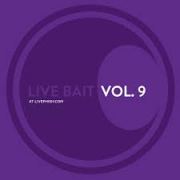
live bait 9I just recently realized that Live Bait 9 has been released.  So I grabbed it just in time.  Vol 9 is full of long jams.  The shortest track here is 10 and a half minutes and there are three over 30 minutes (true, some of them are actually multiple songs melding into one track, but they still retain that long jam feel).

What I especially liked about this set was that it included a few songs that I feel like aren’t represented all that well in the Live Bait catalog.  Like “Foam” from 1994—a solid rocking jam (at 10:47).  And “A Song I Heard the Ocean Sing” (from 2004—I like how they splice the cuts together, so in this case they jump a decade but it doesn’t sound it).  I feel like this song is not played as much, so it’s nice to hear.  And then there’s a lively “The Moma Dance” from 2000.

There are a number of quirky moments in many of the songs.  Like “Split Open and Melt” which comes in at 31 minutes.  Around 11 minutes, they morph into “Kung,” and what’s weird about this version (aside from the fact that the song itself is bizarre) is that instead of it just being them making noise and shouting, there’s actually music behind it—mostly drums—I’ve not heard it done like that before.  During the jam, at around 15 minutes, Mike plays Collective Soul’s “Shine” riff on the bass, but the rest of the guys don’t join in.

“Mike’s Song” (from 1999) begins a 40 minute jam.  The song seems slower than usual, which I find odd.  But it works well for the very mellow jam that constitute the big instrumental section—they even use the echoey guitar the runs for a few minutes keeping the beat and setting a pace.  At 17 minutes the song morphs into a rousing version of “Twist”.  Then at 31 minutes they morph into “Weekapaug Groove” (with Gordon’s great bass opening.  At 36 minutes Trey starts playing the Macarena, although not exactly right, which is pretty funny in and of itself.

“David Bowie” (from 1995) is a 25 minute jam that gets pretty dark in the middle.  Then comes the most interesting juxtaposition of songs jam.  From “AC/DC Bag” one of their earliest songs to “Ghost” one of their then newest ones.  “Tube” a, to my mind, underplayed song is next.  It has a funky jam and is appreciated.

This free set ends with “Undermind,” one of my favorite new songs (this one recorded n 2012). It opens with a staccato riff which gives it a kind of reggae feel.  But it soon returns to its normal sound and proves to be a great ender to this “set.”

I can’t say enough good things about the Live Bait series.  I’m not one to buy many concert sets, but having free samples is really cool.

[READ: July 28, 2013] A Questionable Shape

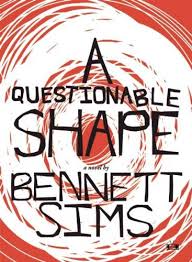
Karen read this book and not only raved about it, she personally recommended it to me. So imagine my surprise to find out that it’s a zombie novel!  But it is a zombie novel like no other.  If Colson Whitehead (in Zone One) made a zombie novel that was literary, Sims has gone one step further, making a zombie novel that is philosophical.

The story is set in Baton Rouge and takes place some time after a zombie epidemic has broken out. In the time since the zombies started appearing (worldwide, it is suggested), the police and emergency teams have managed to contain the worst of it (already that’s something new).  Panic has subsided somewhat and the government has even released a pamphlet on how to deal with everything that’s been going on (called Fight the Bite–I never checked to see if there was a version online, it would make a great “online extra” (having now read Karen’s review, I’m glad to see she agrees)).

The book focuses on two primary characters: the narrator (Michael Vermaelen–referred to mostly as Vermaelen whose name is not given until very long into the story) and Matt Mazoch.  There is a third important character–the narrator’s live-in girlfriend, Rachel, who plays as something of a foil.

The simple plot takes place over a week.  Mazoch is searching for his father.  Mr Mazoch died just before the epidemic and Matt believes that he is among the walking dead.  And so Matt has asked Michael to go with him to try to find him.  There’s a couple things to note right off the bat (the pun was not intended, although Matt carries a bat with him as his line of defense and who knows what else).  Matt and Mr. Mazoch had a weird relationship, one which fell apart considerably over the last few years. Mr Mazoch let himself go completely and seems opposed to everything that Matt believed in–physical fitness and intellectual pursuits (or, as Michael points out, perhaps Matt pursued them to be the exact opposite of his father). The second is that while Michael is happy to go along with Matt, he has no idea and is even afraid to ask what Matt plans to do should he find his father.  And this issue comes to a head later with Rachel.

Matt has given them exactly one week to find his father, with the explicit instructions that after a week thy give up pursuit so that it doesn’t drag on indefinitely.

Okay so far so good–they are going zombie hunting.  But the thing is, the zombies have become a part of the landscape, but they have been tamed.  It is illegal to kill them (what an interesting twist).  Despite their zombie-ness (it’s actually considered an insult to call them zombies), and their desire for human flesh, rather than eradicating them, they are being rounded up and put in camps.  Naturally there are still a number of stragglers (zombies get everywhere), but there is a hotline to call if you see one and within minutes the police come and quarantine them.

So, what’s one to do on a day long adventure hunting zombies–or more specifically, one zombie–if you aren’t actually hunting them?  Well, mostly, you talk.  Michael is a philosophy student (he intended to read all of the important philosophical works although the outbreak has taken him off his goal somewhat), Matt is a literature student (Rachel is an art history major), so the discussions get very philosophical.  In addition to quoting Heidegger, Kant, Nietzsche and many other big names, they also talk video games and seek for metaphors for the zombie invasion.  The video game discussion was quite fascinating–Matt imagines the grid of zombie takeovers to be like a video game–going into blank nothingness. But Michael imagines it more like a filmy haze.

Indeed, since this is all told from Michael’s first person point of view, we learn a lot about what is in his head.  And it turns out that Michael is obsessed with the zombies (which is understandable, really).  But his obsession is different.  When the outbreak first happened he, like everyone else, refused to go outside.  But soon, when the government gave the all clear, Rachel not only went outside, she volunteered at the facilities. But Michael refused–seeing potential contamination everywhere. Indeed, even though he goes out with Matt every day, he still imagines and worries what would happen if and when someone he knows is infected. When they go to a diner, Michael won’t even eat the food, imagining some kind of contamination.

He even tries demilitarization exercises with Rachel (which she is understandably freaked out by).  But as the story moves on Michael’ footnotes (did I say there were footnotes? There are–almost one per page) spend more and more time wondering what the zombies are experiencing–he seems to be trying to pick the best one.  And he goes over and over these ideas in great detail.

After a few days (each chapter is a day) Rachel needs to know what Matt is intending to do if (when) he finds Mr Mazoch, especially since Matt suddenly believes he has some “evidence.”  Michael doesn’t want to know, which enrages Rachel.  She assumes the worst (that he wants to kill his father).  She assumes he would kill him out of malice towards zombies, but Michael suggests it would be to put him out of his misery).

Rachel has a personal stake in this issue.  Her father died before the epidemic, but she was convinced that he would be turned (before they proved that the longer-dead weren’t rising, it was only the recently dead).  So she waited at his graveyard, with the intent of digging him up if need be.  She proves to be a real bleeding heart on the issue.  To make her case, she gives the recent example of a scientist training a  zombie to speak.  She discusses the emotions of the woman whose father was the zombie.  She says this shows that these creatures still have humanity in them and to kill them all would be genocide.

By the end of the book, Matt has taken a polar opposite position–hurricane season is coming and these things are a security risk for all the living.   They should all just be killed.  For the safety of everyone.   Michael–always the intellectual–has a somewhat more nuanced position–he feels that perhaps they should be spared because we have so much to learn from them. And each case is made rather convincingly.

There are some wonderful passages–the discussion about leaves and greenery and the amazing description of Michael’s first encounter with a zombie (not at all frightening, just chilling) show what a great writer Sims is.

The strange thing about this book (aside from the whole “it’s about zombies, but not” premise) is that for such a short book (just over 200 pages), it’s a pretty slow read.  Between the footnotes and the philosophy, the book doesn’t exactly flow quickly.  It’s not light reading by any stretch.  And at times it’s a little…dull?  too in its own head?  Something?  But those moments seem few and far between, because ultimately the language is so interesting and fulfilling.

The end is one of those endings that’s not a real ending–it’s more of a “what would you, the reader, do?” kind of ending.  That’s always unsatisfying.  And yet at the same time, I have not stopped thinking about what I would do in his case.  And so it almost becomes the perfect ending.

Bennett Sims was a student of David Foster Wallace and although this book does have footnotes, the author he resembles most is Nicholson Baker–where not much happens in the body of the work and all of the “action” (which is really thought) is in the notes.

Karen put Bennett Sims along  with Seth Fried and Manuel Gonzales on her “magnificently weird” list, a list that I am intrigued enough by to hunt down these other two authors (and Sims’ story “House-Sitting” which i don’t seem to be able to find online.  So thanks Karen, i wouldn’t have found this one on my own.

Read Full Post »

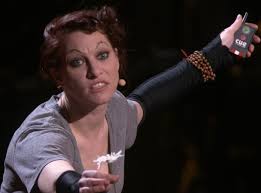
makegoodartSOUNDTRACK: AMANDA PALMER: The Art of Asking (TED Talk, February 2013).

palmerAmanda Palmer is Neil Gaiman’s wife.  She was the singer in The Dresden Dolls and has a solo career.  I actually don’t know that much about her music.

But I linked to this TED speech after reading Gaiman’s book.

In this talk, Palmer talks about asking for things and how it’s hard to ask, to beg., but how it makes for a real connection, especially between musicians and fans.

And she talks about crowdfunding–she’s going to give away all of her music but she’s asking for help from fans along the way.

It’s a pretty inspirational talk–how asking for things helps you connect with people.  It also made me feel a lot better about Palmer, who I’d heard negative things about.

Check it out here.

[READ: June 5, 2013] Make Good Art

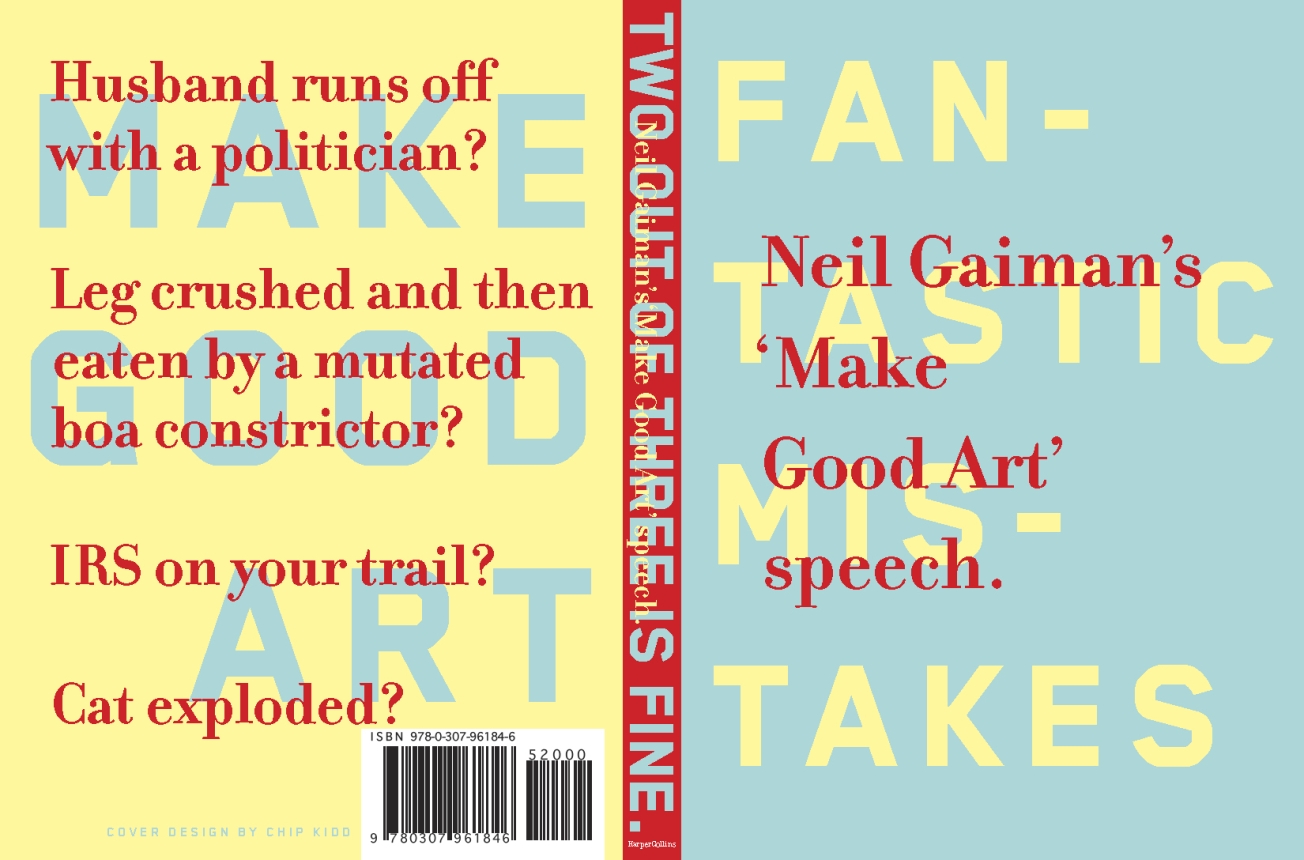
As with David Foster Wallace’s This is Water, this book is a short speech padded out to 80 some pages. The difference is that while This is Water is a rather boring-looking book, this title was designed by Chip Kidd, fabulous designer extraordinaire.  So every page looks interesting.  It’s not so much illustration as design—with shapes and text twirling and twisting upside down and what have you.

As with most inspirational works, this book is indeed inspirational.  But it is especially so if you are an artist or an aspiring artist.  Because this speech was given to the graduating class of Philadelphia’s University of the Arts in May 2012.  You can watch the whole speech here as well.  http://vimeo.com/42372767

Gaiman explains how he never went to college and never even really had a career, he just had a list of  things that he wanted to do: write an adult novel, a children’s novel, a comic, a movie record an audiobook, write an episode of Doctor Who.  And how he set about achieving these things is pretty great.

So some advice from Gaiman:

1. It’s better not to know the rules so that you’re not afraid to go beyond them.  If you don’t know something is impossible, it’s easier to do. (more…)

Read Full Post »

sed

SOUNDTRACK: TRABANT-“Maria” (2005).

trabantI learned about Trabant from the magazine pictured to the left.  It came with McSweeney’s issue #15 and is completely in Icelandic.  Trabant are apparently a pretty huge band in Iceland, and they have a  lot of songs on YouTube.  And many of their songs are very different sounding so I’m not entirely sure what kind of band they actually are.

This song begins with strange clicks and sound effects and then a big throbbing bass.  There’s kind of a funky keyboard background and then a slightly off kilter riff.

Then the big guitars kick in and the vocals (which are “if you want a love song”) don’t start until about two minutes in.  There’s a break in the middle where the band starts changing Ma Mo Ma Mo Maria and then the singer starts free associating over some wild guitar riffing and more sound effects.  It’s a really weird song and I have no idea if this is representative of the band (they did make a video for it so it can’t just be a throwaway, right?).

I’m really intrigued by these guys, and I’m going to have to look for more.

[READ: May 18, 2013] McSweeeny’s bits.

4Over the course of my reading the McSweeney’s issues, there were bits and pieces that I missed for one reason or another.  I tried to be complete, but sometimes it wasn’t easy.  So, with the publication of The Art of McSweeney’s I have now been able to read two things that I missed earlier.  And the third is something I didn’t exactly read, although I tried.

Just as issue 1 had a short story by Dave Eggers on its spine! issue #4 (the box of books) had a brief piece by Ben Greenman ringing the contents list of said box.  I never noticed it before (indeed I may not have ever read the back of the box before, shame on me).  But anyhow, in very tiny print is “More Notes on Revising Last Night’s Dream” by Ben Greenman.   And in this brief piece (which is several bullet pointed items–although arranged as a line rather than bullets) there are several ideas about last night’s dream which include “Egg on breakfast plate need not bloom into flowers” and “Cut out part in which Leslie Nielsen meets Trotsky–silly.”  And, of course, “More Invisibility.”  This is the kind of short silly thing that the first issues published which have more or less been relegated to the McSweeney’s website now.  And while I feel the website is a better place for it (and I need to go read the website more), these silly things are certainly missed.

20

The second missed item is also found thanks to The Art of McSweeney’s.  I mentioned in my review of Issue #20 that the story on the cover was completely covered by art.  And I wondered why and I wondered if you could find the whole text anywhere.  Well, in The Art of McSweeney’s they print the original cover!

I was delighted by this because it did two things–it explained how the cover was made (the 3D art was not “added on,” rather the white section under the art was “Compressed” which is how it came out 3D.  Very cool.  There’s also a brief breakdown of costs of the issue.  But the bulk of the cover story is about how the author (Eggers, I assume) broke up a fight in New York City.  A man and his family are walking down the street when a lady bumped into their little girl.  The man freaks out because she didn’t apologize and he gets right up in the lady’s face (really, dude?).  Eggers is on the phone arranging to meet someone when he says he has to get involved.  So he tells the guy to chill out.  Things quiet down a bit, but then the woman starts screaming “You got knocked up!”  And that’s when Eggers takes a look at her and realizes that she is homeless and crazy and not ever going to apologize.  But the screaming gets the mother involved in the fight which starts up again.  Things finally settle down with the family acknowledging that the lady doesn’t understand anything.  And they all depart.  It’s probably the most exciting editor’s note of them all, and yet it was covered up.

15My guess is, from what I know about Eggers, that story may have seemed too self-serving to include   Or maybe it was just fun to cover up words with a picture.

The final item comes from Issue #15.  It is a small magazine called Séð og Heyrt (Seen and Heard).  It is a real weekly magazine, although I’m not sure if our version is complete (I assume it’s not since it’s only 16 pages, but who knows how much tabloid you can fill each week in Iceland).  It is a pretty typical scandal magazine  For some insight into this magazine, check out this post on I love Icelandic Music.

I can’t even begin to guess what half of the articles are about as the pictures are mostly crazy.  There seems to be something about an Idol show, there’s a female body builder, something about some wholesome looking people who may be called Icelandic Pearls.  And then the centerfold is called Rokkorgia, which should be easily translated. It features half naked pictures of the guys from Trabant.  The next page has Love Guru in strange positions with his lady friend and a big headline Bingo I Beinni.  The back page has an ad for Krit Paradis Eyjahafsins which appears to be a nice resort.  What a fun, odd addition to the Icelandic Issue of McSweeney’s.

Then as I was glancing through I caught something that said That 70s Show.  And sure enough, it was a preview of a new episode tonight (is it dubbed into Icelandic??).  So even though I played around with translating bits and pieces of the magazine, this was the only one I did fully.  So in Icelandic (excluding some accents)

I kvold hefjast syningar a nyrri syrpu um unglingana i Wisconsin.  Jackie þarf ad velja a milli Hyde of Kelso.  Red er að ba ser eftir hjartaafall og Eric er með samviskubit yfir þvi að vera að fara i burtu i haskola.  þokkadísin Estella Warren leikur gestahlutverk i þaettinum

Which Google tells me means:

Tonight begins exhibiting a new series about a teenager in Wisconsin. Jackie has to choose between Hyde of Kelso. Red is ba after a heart function and Eric is guilty not be going away to college. charm diesel Estella Warren plays a role in the show.

Cool huh?  What a strange thing to find in a magazine that was not meant for me.  But I’m glad I read it because now I know all about Trabant!

For ease of searching, I include, well, I’m only including the magazine, because there’s way too much otherwise: Sed og Heyrt.

Read Full Post »

vonlastintSOUNDTRACKSURFER BLOOD-“Demon Dance” (Live at SXSW, March 27, 2013).

surfer blood

I’ve liked Surfer Blood since I first heard them.  They write catchy, mostly short, poppy songs.  And usually after a few listens, the hooks really grab you.  The strange thing about the band is that the hooks aren’t always readily apparent, which makes their songs sound kind of samey sometimes.

Of course, samey isn’t a bad thing, necessarily.  Surfer Blood is quite distinctive and I tend to enjoy everything they do.  This new song sounds like their other stuff, which is fine.  But the most distinctive thing about the band of probably their singer who sounds like a less-affected Morrissey.

Having also listened to the song from the album I can say that the singer is far harder to understand live, so maybe live is not the best way to hear a new song from them, but for an old favorite, Surfer Blood has a great energy live.

Watch the show here and hear the studio version here.

[READ: March 27, 2013] The Last Interview and Other Conversations

Melville House has published a number of these “Last Interview” books, and as a completist I feel compelled to read them.  I have read criticisms of the series primarily because what the books are are collections of interviews including the last interview that the writer gave.  They don’t have anything new or proprietary.  The last interview just happens to be the last one he gave.   So it seems a little disingenuous, but is not technically wrong.

There’s so far five books in the series, and I figured I’d read at least three (Vonnegut, David Foster Wallace and Roberto Bolaño–the other two turned out to be Jorge Luis Borges–who I would be interested in reading about and Jacques Derrida (!) who I have always loved–I guess this series was tailor made for me).

At any rate, these interviews are from various times and locations in Vonnegut’s career.  There are six in total.  I don’t know if the titles they give here were the titles in the original publications but here’s what’s inside:

  • “Kurt Vonnegut: The Art of Fiction” from The Paris Review, Spring 1977 (by David Hayman, David Michaelis, George Plimpton, Richard Rhodes)
  • “There Must be More to Love Than Death” from The Nation, August 1980 (by Robert K. Musil)
  • “The Joe & Kurt Show” from Playboy, May 1982 (by Joseph Heller and Carole Mallory)
  • “The Melancholia of Everything Completed” from Stop Smiling, August 2006 (by J.C. Gabel)
  • “God Bless You, Mr. Vonnegut” from U.S. Airways Magazine (!!!), June 2007 (by J. Rentilly)
  • “The Last Interview” from In These Times May 9, 2007 (by Heather Augustyn) (more…)

Read Full Post »
« Newer Posts - Older Posts »